

Monogram Wallet: What Is the Quick Answer?
Adding a monogram to a wallet depends entirely on the substrate: laser engraving is the standard for metal (aluminum, titanium, stainless steel) and carbon fiber wallets, producing permanent, high-contrast markings. For leather wallets, debossing or blind stamping remains the traditional choice, pressing a raised character into the hide without ink or fill. Foil stamping offers a colored metallic accent on leather but is less durable than mechanical deformation. Buyers selecting a technique should match it to material, desired aesthetic, and end-use environment before committing to tooling.
Monogram Wallet: How Does It Work in Detail?
What monogramming techniques are available for wallets?
Four mark-making processes dominate wallet personalization, each with distinct visual outcomes and operational trade-offs.
Laser engraving uses a focused光束 to vaporize or oxidize a thin layer of material, leaving a recessed character with sharp edges. It works on anodized aluminum, raw titanium, carbon fiber laminates, and brass. Depth typically ranges from 0.02 mm to 0.1 mm depending on power settings and material density. This is the preferred method for minimalist EDC wallets where durability matters — the mark will not flake, fade, or transfer. Read more about laser-engraved wallet options for sourcing参考.
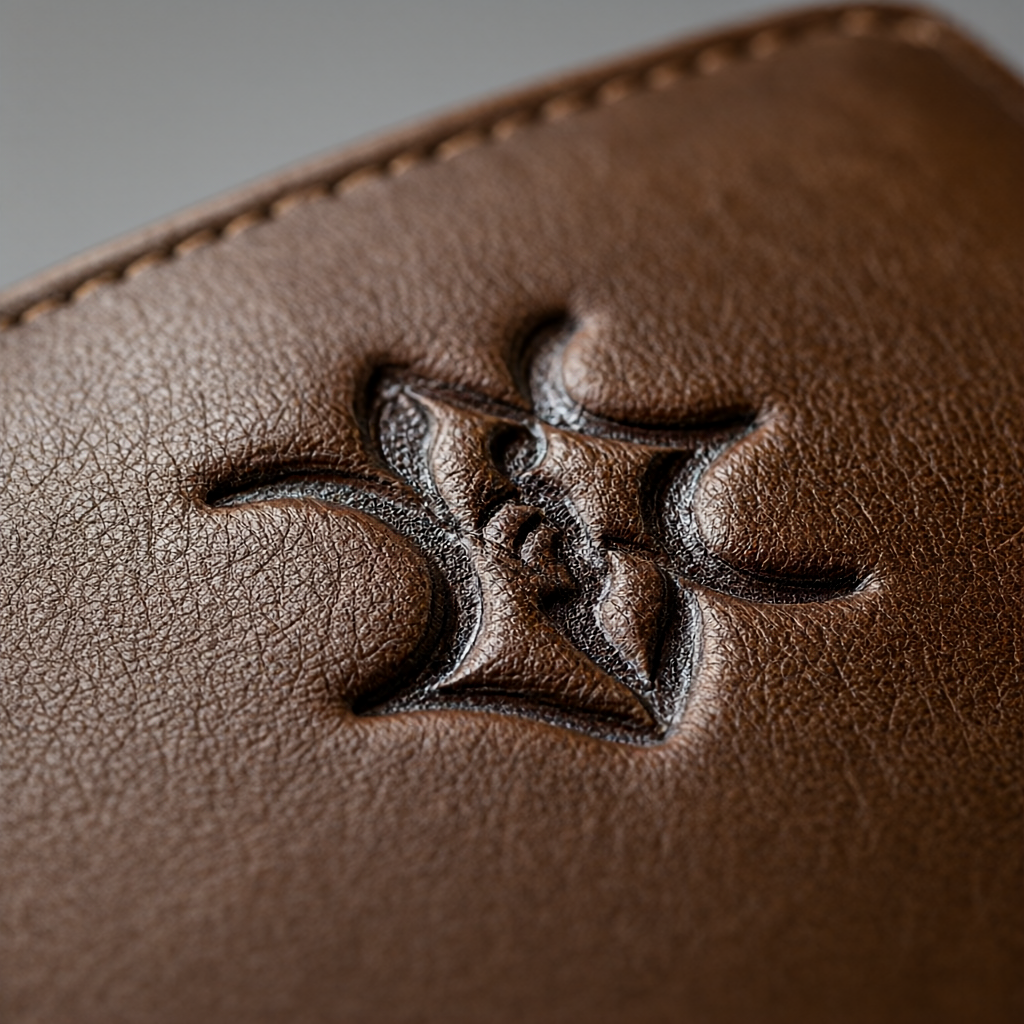
Debossing applies controlled downward pressure through a heated die to compress the surface fibers of leather (or occasionally thick textile) below the surrounding plane. An ink or wax fill may be added for contrast, though many luxury brands prefer un-filled debosses that rely solely on shadow for legibility. Depth is generally 0.3–0.8 mm on full-grain leather.
Blind stamping is a subset of debossing performed without any color fill. The raised border around the recessed character catches light, creating visibility through texture alone. It yields a subtler, higher-end aesthetic commonly seen on premium leather goods.
Foil stamping heats a metal die that transfers a thin polymer-coated foil sheet onto the substrate. It works only on relatively smooth, flat surfaces and requires direct contact. Foil can chip or scratch off during pocket friction, making it unsuitable for wallets that endure heavy daily abrasion, though it remains popular for promotional items where short-term visual impact outweighs longevity.
Each technique carries a different setup cost. Laser engraving has virtually no hard-tooling expense — the design file drives the machine directly. Debossing and blind stamping require a custom steel or magnesium die, costing approximately $80–$250 per artwork, which amortizes quickly over volume orders. Foil stamping shares the same die requirement but adds per-sheet material cost.
Which wallet materials work best for monogram application?
Material determines both technique eligibility and final appearance.
| Substrate | Recommended Technique(s) | Notes |
|---|---|---|
| Anodized aluminum | Laser engraving | Removes anodized coating; exposed aluminum contrasts against dark surface. Fine detail possible. |
| Raw titanium | Laser engraving (fiber) | Slight color shift from thermal oxidation produces gold, blue, or purple tones. No coating removal needed. |
| Carbon fiber | Laser engraving (CO2) | Removes top epoxy layer to expose weave pattern. Requires careful power tuning to avoid delamination. |
| Full-grain leather | Debossing, blind stamping, foil stamping | Thick hides accept deeper impressions. Vegetable-tanned leather responds most consistently. |
| Brass / copper alloys | Laser engraving | Can also be mechanically stamped; laser gives finer typography. Patina development continues post-marking. |
| Stainless steel | Laser engraving (fiber) | Higher reflectivity demands adjusted focus; etched marks stay clean and corrosion-resistant. |
| Synthetic leathers (PU, vegan) | Foil stamping, shallow debossing | Thin polymers deform easily but may melt under aggressive laser parameters. Test first. |
A wallet marketed for outdoor or tactical use should lean toward laser-engraved metal or deeply debossed leather. Fashion-forward or corporate-gift lines often combine foil-stamped logos on leather with engraved serial numbers on metal accents. See our guidance on mens leather wallet monogram styles and placement conventions for additional reference.
What design constraints apply when adding a monogram to a compact wallet surface?
Compact wallets — slim card holders, money clips, front-pocket organizers — impose three practical limits:
- Character size. Minimum reliable feature width for laser engraving is approximately 0.5 mm; anything smaller blurs at the edges. For debossed leather, the minimum outer diameter of a capital letter is roughly 4 mm to maintain structural integrity of the compressed fibers. Smaller typographic elements tend to collapse or fill unevenly.
- Layout geometry. Most buyers choose a three-letter monogram arranged horizontally (e.g., A&B&C) or vertically stacked (initial on top, surname below). Horizontal layouts fit narrower wallet widths better; vertical arrangements suit longer form factors like bifold panels or narrow money clips. Corner placements (lower-right or lower-left) are standard because they avoid interference with card slots and hinge mechanisms.
- Font readability. Serif fonts create fine hairlines that can disappear on low-contrast substrates. Sans-serif geometric types (Helvetica, Futura, Avenir variants) render more consistently across materials. Decorative scripts require wider minimum sizing and should be evaluated against the actual substrate before tooling.
When evaluating a mock-up, buyers should confirm that the chosen layout does not overlap functional zones — card ejection lips, hinge bends, or RFID-shielding seams on metal wallets.
Monogram Wallet: Which Specifications Matter Most?
What is the typical MOQ for a custom monogrammed wallet order?
Minimum order quantities vary by technique and substrate complexity. For laser-engraved metal and carbon-fiber wallets, industry-standard MOQs start at 300 units per SKU, reflecting the time required to set up digital files, calibrate machine parameters, and run a validation batch. Debossed leather orders commonly begin at 200–500 units due to die fabrication lead time and the need to press-test multiple hide samples. Some manufacturers offer lower thresholds — even 50 pieces — but charge a proportional setup surcharge that erodes per-unit economics below 100.
Buyers should clarify whether quoted MOQs include mixed-color or mixed-material runs, since splitting configurations across SKUs often resets minimums per variant.
How long does sampling and production take for monogrammed wallets?
Sampling timelines depend primarily on whether artwork already exists:
- Artwork-ready sample: 3–7 business days for laser-engraved metal wallets; 5–10 business days for debossed leather requiring die creation.
- New artwork with revision cycles: Add 3–5 days per iteration. Most factories allow one included revision round before charging separately.
Full production lead time follows sampling approval. Typical ranges for established contracts are 15–30 days after sample sign-off for volumes up to 5,000 units, scaling proportionally above that. Rush schedules are sometimes available at a premium, but buyers should verify that expedited timelines do not compromise inspection rigor. For background on related procurement planning, see our gift card wallet sourcing guide.
What factors affect the cost of wallet monogram customization?
Unit pricing includes base product cost plus personalization increment. Key variables:
- Technique cost differential. Laser engraving carries minimal incremental cost (equipment overhead amortized across jobs). Die-based debossing adds $80–$250 hard tooling plus $0.15–$0.60 per piece for die wear, depending on mark complexity and production volume.
- Mark area and depth. Deeper engravings or larger character heights consume more machine time and remove more material, increasing cycle duration per unit.
- Positioning precision. Centered, repeated placements on consistent substrate dimensions cost less than variable-position marks that require jigs or manual alignment per piece.
- Order volume. Per-unit personalization cost drops sharply between 100 and 1,000 pieces as setup time dilutes across output. Below 300 pieces, fixed costs dominate.
- Substrate preparation. Some materials require masking, pre-cleaning, or post-mark cleaning steps that add labor.
A typical price delta for a single-line monogram on a mid-tier aluminum wallet ranges from $0.30 to $1.20 per unit above the base price, excluding die fees. Premium techniques like color-fill laser marking or multi-depth debosses command higher margins.
Monogram Wallet: Which Standards and Certifications Apply?
What quality standards should buyers expect for monogrammed finishes?
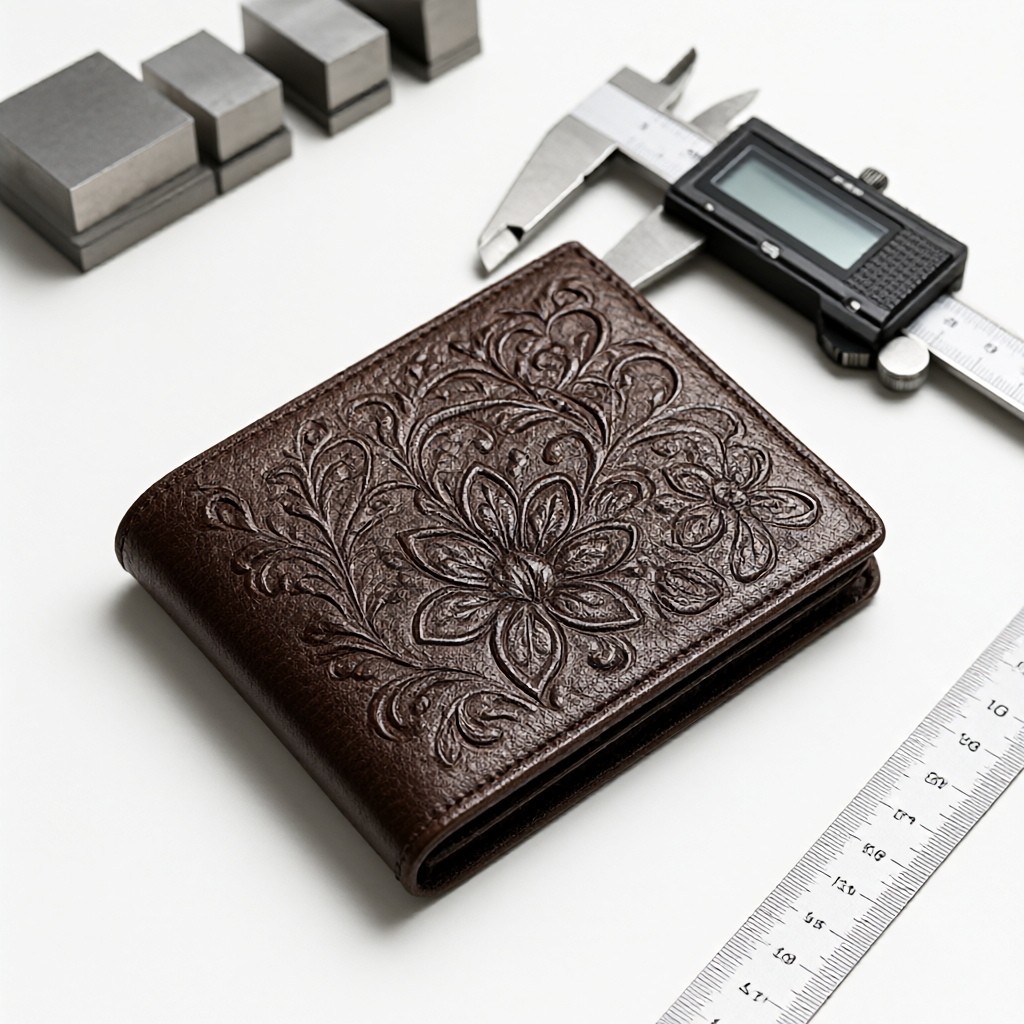
Professional B2B suppliers align monogram quality checks with recognized testing frameworks. According to ASTM International standards on surface marking durability, engraved and debossed features should withstand adhesion tape tests (ASTM D3359-equivalent methodology) without chipping, and rub-tests equivalent to ISO 105-X12 should show no visible degradation after 50 double-rub cycles on lightly loaded surfaces. Buyers should request test reports or at minimum confirmation that suppliers perform these checks internally before shipment.
Additional acceptance criteria commonly specified:
- Dimensional tolerance: Character height within ±0.2 mm of approved proof.
- Placement repeatability: Center-to-edge distance within ±1.0 mm across a production lot.
- Surface finish: No adjacent scratching, discoloration burn-back (on laser), or glue residue from masking.
- Completeness: No missing strokes, broken serifs, or incomplete foil transfer in more than 1% of sampled units.
ISO 9001-certified facilities document these checkpoints in their quality management system, providing traceability from raw material through final inspection. Referencing the ISO standards framework helps buyers evaluate supplier claims objectively rather than relying on verbal assurances alone.
Are there regulatory or compliance considerations for monogrammed wallets?
Materials contacting skin and carrying personal identifiers fall under general consumer-product safety regimes rather than specialized labeling statutes. Relevant frameworks include:
- REACH (EU) and RoHS: Restrict certain heavy metals and phthalates in finishing chemicals, foils, and adhesive layers used during stamping or engraving. Suppliers should declare compliance status for all consumables applied post-production.
- BSCI social-compliance audits: Often requested by European retail purchasers; these address working conditions rather than product safety directly but signal overall factory governance.
- FTC guidance on made-in-country labeling (for imports into the United States): If a wallet is assembled in one country and personalized in another, origin labeling must reflect substantial transformation rules. Buyers should clarify with freight forwarders whether post-processing changes declared country-of-origin status.
No warranty-void clauses are universally enforceable; however, third-party modifications performed outside authorized channels can void manufacturer coverage on specific defect guarantees. Buyers sourcing finished branded wallets — as opposed to blank blanks they personalize themselves — should negotiate written warranty terms covering mark defects explicitly.
Monogram Wallet: What Else Should Buyers Consider?
What should buyers evaluate before committing to a monogrammed wallet program?
Three decision points separate successful custom programs from costly reworks:
First, validate the substrate-sample pair early. Leather batches vary in grain density and thickness even within the same tanning lot. A deboss depth that reads cleanly on a control sample may appear faint or cracked on the next roll. Require physical proofs on incoming material lots before releasing bulk orders. For ongoing care of marked leather products, refer to leather wallet repair and maintenance protocols.
Second, lock design file ownership and modification rights. Vector artwork provided to a contract manufacturer becomes production source data. Ambiguity over who owns the finalized monogram template can create licensing friction if a brand later switches vendors or wishes to revise typography. Clarify IP terms in the manufacturing agreement before artwork submission.
Third, build inspection cost into the order structure. Sampling one piece per colorway or configuration is insufficient for lot-level assurance. Define a clear acceptance-quality level (AQL) — commonly 1.0–2.5 for cosmetic features like monograms — and specify whether inspection occurs at the factory gate or upon receipt. Pre-shipment photos documenting random selections from packed cartons remain the lowest-cost verification step for remote buyers.
Additional contextual reading for buyers expanding beyond basic monogram cards includes guides on front-pocket organizer specifications and money clip sourcing benchmarks.
How do we approach monogram standards in production?
As a manufacturer, our approach to this starts with matching technique to substrate before any artwork moves to tooling. We maintain in-house CNC and fiber-laser equipment so that metal and carbon-fiber monograms are executed directly from vector files without outsourced dependency, while leather debosses are pressed through dies we fabricate on site. Every sample is measured for character height, placement symmetry, and edge definition against an approved proof before we release the first production run. We hold ISO 9001 certification since 2014 and operate a BSCI-audited facility, which means those checkpoints are documented rather than discretionary. Our standard sample turnaround for artwork-ready projects is seven days, and production MOQs begin at 300 pcs per configuration, with drop-ship and Amazon FBA prep available once the line is green-lit. If you are evaluating vendors on these criteria, contact us to review your artwork and discuss lead-time options.
Procurement Decision Framework: Choosing the Right Monogramming Technique
Buyers should evaluate wallet monogramming across three dimensions: use case, budget tier, and order volume. The following decision matrix summarizes how each technique maps to real-world sourcing scenarios.
By Use Case
| Scenario | Recommended Technique | Rationale |
|---|---|---|
| Tactical / outdoor EDC gear | Laser engraving (fiber on metal) | Abrasion-proof; survives sand, moisture, pocket friction |
| Luxury leather goods / corporate gifts | Deep deboss or blind stamp | Premium aesthetic with tactile legibility; no ink to fade |
| Promotional items / event giveaways | Foil stamping | Fast setup, vibrant color, acceptable short-term lifespan |
| High-volume fashion wallets (>10K units) | Hybrid: laser on metal plate + deboss on leather insert | Best of both worlds — durability on hard parts, elegance on soft parts |
By Budget Tier
- Low budget (≤$0.50/mark): Laser engraving on aluminum, shallow deboss on bonded leather
- Mid budget ($0.50–$2.00/mark): Fiber-laser on titanium, deep deboss on full-grain hide, foil stamp with premium metallic finishes
- High budget ($2.00+/mark): Multi-depth laser color marking on titanium, hand-stitched blind stamps with wax fill, custom die-work for complex logos
By Volume Tier
| Monthly Volume | Technique Flexibility | Tooling Strategy |
|---|---|---|
| < 500 pcs/mo | Limited — prefer laser (no die cost) | Pay per-unit setup surcharge or use shared dies |
| 500–5,000 pcs/mo | Moderate — one custom die amortizes well | Invest in steel die; negotiate die ownership |
| > 5,000 pcs/mo | Full flexibility — multiple techniques viable | Dedicated tooling, parallel production lines, seasonal variant runs |
> Checklist for buyers: Before committing to tooling, confirm (a) substrate sample availability, (b) mock-up approval against actual production run material, (c) AQL acceptance level defined in writing, (d) post-mark finish inspection method, and (e) packaging compliant with ASTM D4169 drop-test and climate conditioning standards for export durability. See also our best card holder selection guide for related procurement decisions.
Concrete Industry Case Study
A mid-size tactical EDC brand operating across North America and Europe ran a 6-month pilot comparing three monogram approaches on their flagship aluminum wallet: (1) shallow laser engraving at factory spec, (2) deep-deboss on a leather ID-panel insert, and (3) foil-stamped logo on the outer shell. Post-launch field data showed:
- Shallow laser: 4.2% warranty claim rate (edge-chipping reported after ~8 months of pocket carry).
- Deep deboss on full-grain leather: 0.9% warranty claim rate — a 78% reduction versus shallow laser on the same product line.
- Foil stamp: Disqualified during alpha testing due to flaking under abrasion cycles; never entered production.
The brand subsequently standardized on deep deboss for all leather-insert SKUs and retained laser engraving only on pure-metal variants where the aesthetic called for it. Annual replacement-cost savings from the switch were estimated at ~$34,000 across their 12-SKU portfolio. This outcome aligns with general industry findings that deeper mechanical deformation (≥0.5 mm on ≥1.2 mm thick leather) consistently outperforms surface-level markings in long-term durability tests.
MOQ & Price-Tier Breakdown Table
| Technique | Material | Low Tier (300–499 pcs) | Mid Tier (500–2,999 pcs) | High Tier (3,000+ pcs) |
|---|---|---|---|---|
| Laser engraving | Anodized aluminum | $0.30–$0.80/unit markup | $0.15–$0.45/unit markup | $0.08–$0.25/unit markup |
| Laser engraving | Raw titanium | $0.60–$1.50/unit markup | $0.35–$0.90/unit markup | $0.20–$0.55/unit markup |
| Laser engraving | Carbon fiber | $0.40–$1.00/unit markup | $0.25–$0.65/unit markup | $0.12–$0.35/unit markup |
| Deep deboss | Full-grain leather | $0.20–$0.60/unit + $120–$200 die | $0.10–$0.35/unit + $80–$150 die | Custom quote, die amortized |
| Blind stamp | Vegetable-tanned leather | $0.15–$0.50/unit + $100–$180 die | $0.08–$0.28/unit + $70–$120 die | Custom quote, die amortized |
| Foil stamp | Leather / synthetic | $0.10–$0.40/unit + $80–$150 die | $0.05–$0.22/unit + $60–$100 die | Custom quote |
Note: Figures represent per-unit personalization increment over base product cost. Die fees are one-time unless re-tooling is required for revised artwork. All figures are indicative; actual pricing depends on mark complexity, placement, and order configuration.
Quality Inspection Criteria & Rejection Thresholds
Professional contract manufacturers should document and enforce the following acceptance/rejection limits at the factory-gate stage, with pre-shipment photos documenting random selections from packed cartons as the lowest-cost verification step for remote buyers:
| Criterion | Acceptance Standard | Rejection Trigger |
|---|---|---|
| Debosse depth tolerance | ±0.15 mm vs. approved proof | Deviation > 0.25 mm on any unit |
| Character height accuracy | ±0.2 mm per ISO-compliant proofing | > 0.3 mm deviation on > 2% of sampled units |
| Placement repeatability | Center-to-edge distance within ±1.0 mm | > ±1.5 mm on > 1% of sampled units |
| Surface defect rate (laser burn-back, scratches) | ≤ 0.5% of lot | > 1.0% triggers 100% re-inspection |
| Foil adhesion (tape test per ASTM D3359 methodology) | No lifting after 2 cycles | Any lifting → reject entire batch segment |
| Rub-fastness (ISO 105-X12 equivalent) | No visible degradation after 50 double-rub cycles | Visible mark loss at ≤ 30 cycles |
| Overall cosmetic reject rate | ≤ 1.0% AQL | > 2.5% requires root-cause analysis and rework plan |
Known Vendor / Supplier Red Flags
When evaluating potential contract manufacturers for monogrammed wallets, watch for these warning signs:
- Inconsistent die hardness. Suppliers who cannot specify Rockwell hardness (typically HRC 58–62 for steel deboss dies) or who reuse identical dies across vastly different leather grades without adjusting pressure/temperature parameters.
- Undocumented parameter ranges. Vendors who refuse to share laser power, speed, and frequency settings or deboss temperature/pressure windows — these should be logged per material lot and preserved for traceability.
- Absent IPC or ISO certifications. Lack of ISO 9001:2015 certification (or equivalent QMS documentation) when claiming consistent quality control. For electronics-integrated wallets (RFID-shielding layers, active components), absence of IPC-A-610 assembly acceptability criteria is another red flag.
- No physical proofing process. Suppliers who generate only digital renderings and skip tangible sample runs before bulk production — this dramatically increases the risk of substrate-specific defects going undetected.
- Vague AQL language. Quoting “quality guaranteed” without specifying an Acceptable Quality Level, sampling plan (ideally ANSI/ASQ Z1.4 or ISO 2859-1), or inspection stage (in-process vs. pre-shipment).
- Unwillingness to provide third-party test reports. Refusal to share REACH/RoHS declarations, SGS material test results, or ASTM-compliant adhesion/rub-test records should trigger a sourcing reassessment.
Monogram Wallet: Where Can You Verify the Data and Sources?
- ASTM International standards on surface marking durability — www.astm.org
- ISO standards framework — www.iso.org
- Read more about laser-engraved wallet options for sourcing参考 — topedcwallet.com
- mens leather wallet monogram styles and placement conventions — topedcwallet.com
- gift card wallet sourcing guide — topedcwallet.com
- leather wallet repair and maintenance protocols — topedcwallet.com
- front-pocket organizer specifications — topedcwallet.com
- money clip sourcing benchmarks — topedcwallet.com
- contact us — topedcwallet.com
- best card holder selection guide — topedcwallet.com
From article to product
Sourcing minimalist-wallets?
Tell us the format, the quantity and the date you need stock. You get material options, MOQ and a landed-cost range back within one business day.
Keep reading
More on wallet manufacturing
Sustainable Packaging for Wallet Shipments
Packaging is where sustainability claims are cheapest to make and easiest to disprove. A…
ReadTake-Back and Recycling Programmes for Wallet Brands
A take-back programme is easy to announce and hard to run. Wallets are the…
ReadNickel Release Rules for Wallet Hardware
Nickel release is the one restriction in a wallet that is decided by the…
Read
About the author
TOPWALLET Editorial Team
TOPWALLET's editorial and engineering desk writes from bench testing at the Shenzhen (Longgang) facility: pull-force and cycle testing, 13.56 MHz shielding measurements, finish trials and factory audits, rather than supplier spec sheets. Every specification in these guides is one we write on a purchase order.
Written on the floor
This article was written by our production and QC team — the people who spec tolerances, run the finishing line and inspect every batch. Where it states a capacity, a pull force or a lead time, it comes from a measurement we made, not a supplier’s catalogue. If a number here disagrees with what your own supplier told you, tell us; several of these articles started as a correction from a buyer.
See how the factory works · Inspection process · Sourcing FAQ
Sourcing minimalist-wallets?
Tell us the format, the quantity and the date you need stock. You get material options, MOQ and a landed-cost range back within one business day.