

What Is a Cash Envelope Organizer Wallet?
A cash envelope organizer wallet is a compact, minimalist wallet that integrates a dedicated cash-holding section alongside card slots or channels. Unlike traditional bi-fold or tri-fold wallets, these organizers prioritize thin-profile carrying, organizing paper currency in a single accessible compartment while keeping cards secured. They are commonly manufactured from aluminum, titanium, or carbon fiber and appeal to buyers who carry fewer cards but still need reliable cash storage.
The term envelope style wallet describes designs where banknotes slide into a vertical slot or elastic strap system rather than being folded inside a wide pocket. These wallets have gained traction among EDC (Everyday Carry) enthusiasts and brand owners seeking alternatives to bulky leather bi-folds. A cash strap wallet or money clip wallet variant typically uses a tension bar or metal clip mechanism to hold bills securely without requiring folding.
For professionals evaluating procurement options, understanding how this product differs from standard EDC wallets—and what manufacturing capabilities matter—is essential before committing to a supplier. For broader context on related products, see our Pocket Organizer Wallets guide for additional organizational configurations beyond pure cash envelope designs.
How Does a Cash Envelope Organizer Wallet Work Compared to a Regular Wallet?
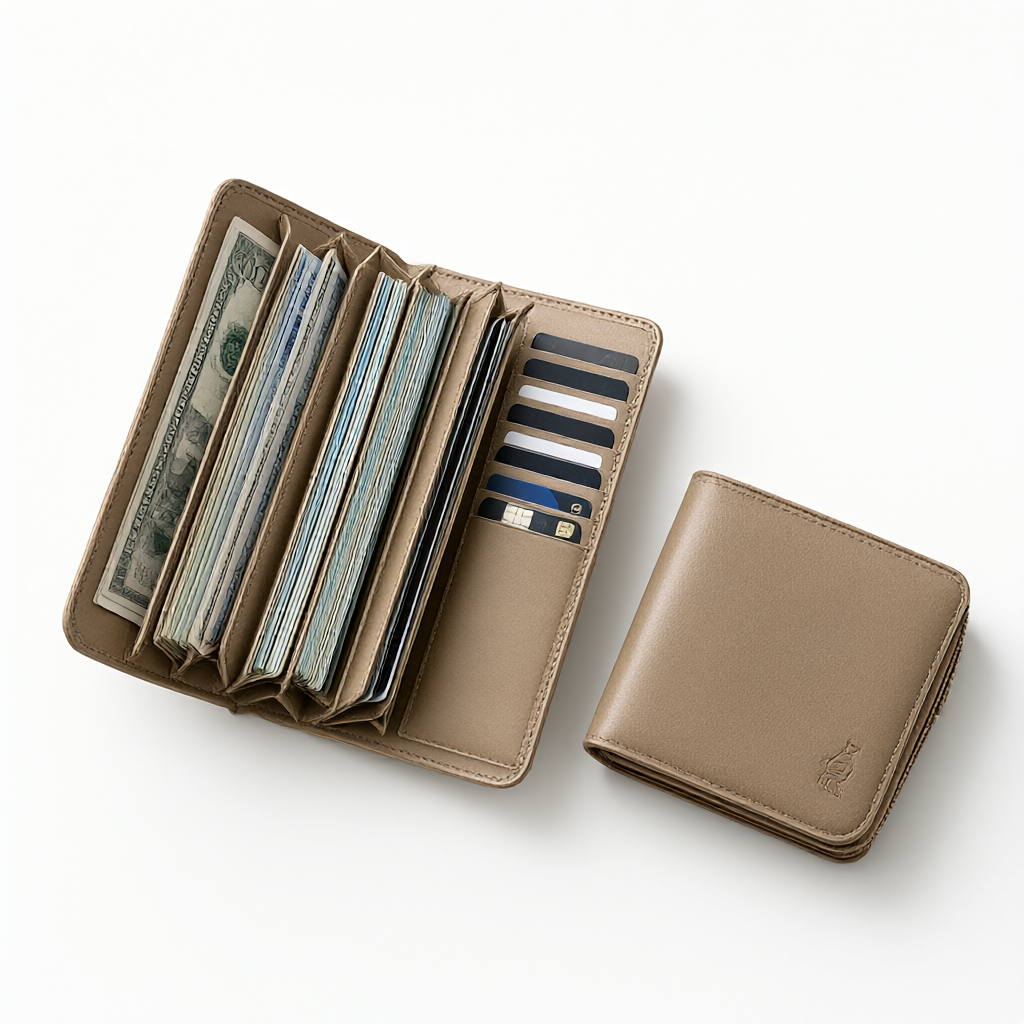
Traditional wallets store cash and cards in separate compartments, often requiring users to unfold the wallet and dig through multiple sections. A cash envelope organizer wallet consolidates functionality into a slim profile. Banknotes typically load through a top or side opening into an internal strap or sleeve, while cards slide into parallel machined channels on the opposite face. The result is a device you can operate with one hand.
This design philosophy aligns closely with the minimalist cash wallet category, which prioritizes reducing pocket bulk while maintaining secure access. When retrieving cash, users usually pull bills upward against tension from a single entry point rather than flipping open a full wallet. This reduces friction during daily transactions and makes the wallet more suitable for environments where quick access matters—retail checkout counters, club entrances, or outdoor activities.
| Feature | Traditional Bi-Fold Wallet | Cash Envelope Organizer Wallet |
|---|---|---|
| Profile thickness | 15–25 mm when loaded | 6–12 mm when loaded |
| Cash storage method | Folded in central pocket | Strapped or slotted vertically |
| Card access | Opens fully to reach cards | Slides cards from one edge |
| Typical capacity | 8–12 cards, multiple pockets | 4–8 cards, 1 cash section |
| Materials common | Full-grain leather | Aluminum, titanium, carbon fiber |
Buyers should evaluate whether their target market values slim ergonomics over maximum storage capacity. The trade-off favors portability and modern aesthetics, making these wallets particularly relevant for Amazon FBA private label listings targeting younger demographics and outdoor-oriented consumers. Related considerations around customization also apply—for details on branding techniques like laser engraving and UV printing available across similar product lines, review our Monogram on Wallet guide.
What Materials Are Used in Cash Envelope Organizer Wallets?
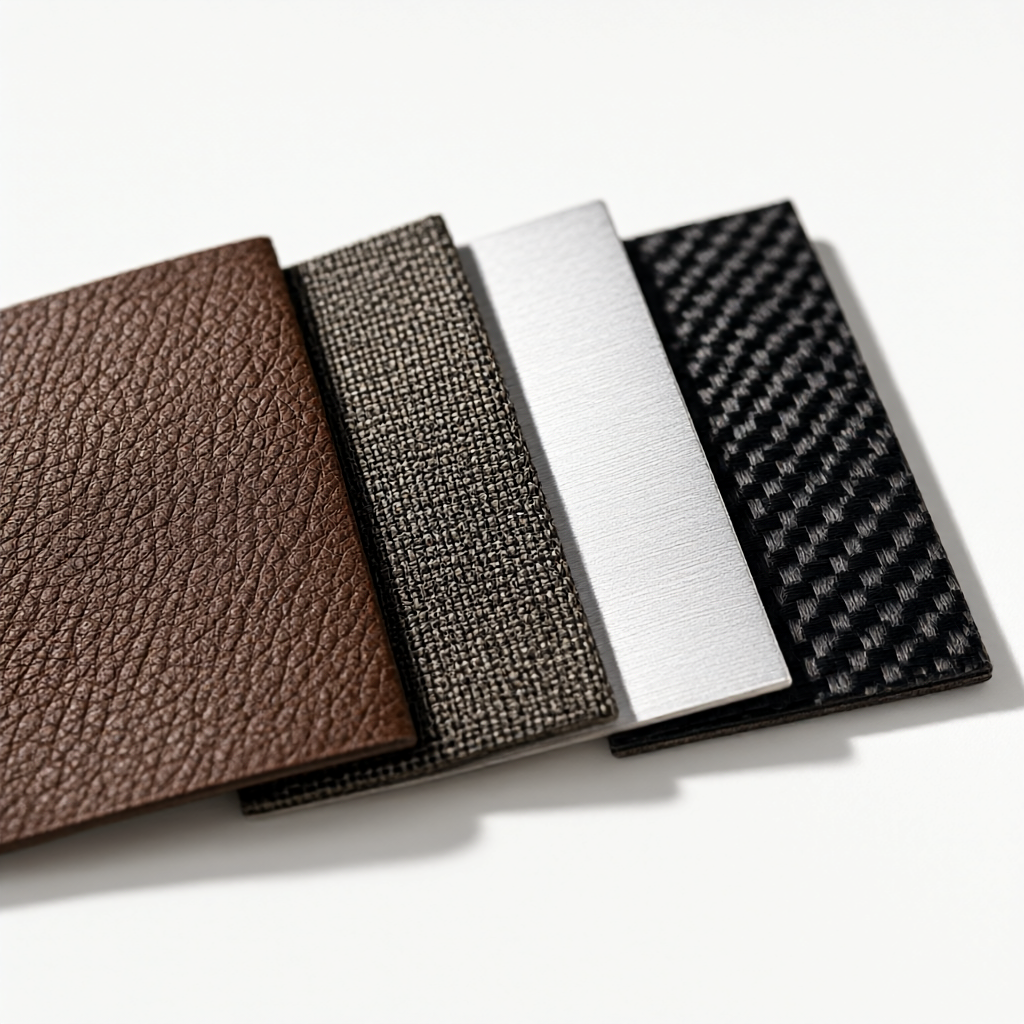
Three primary materials dominate the cash envelope organizer wallet market: aluminum alloy, titanium, and carbon fiber. Each material presents distinct advantages depending on end-use positioning, price sensitivity, and brand identity.
How Do Aluminum Envelope Wallets Perform?
Aluminum wallets represent the most cost-effective option in the category. Typically fabricated from 6061 or 7075 aerospace-grade aluminum, these wallets undergo CNC machining to achieve precise dimensions and consistent tolerances. Surface treatments include anodizing—which provides color stability and scratch resistance—and bead blasting for a matte finish. Aluminum wallets weigh approximately 30–50 grams and offer sufficient durability for everyday use at competitive unit costs. This makes them ideal for volume-driven programs such as promotional gift corporate orders and retail chain distribution where margins require careful cost management.
How Do Titanium Envelope Wallets Perform?
Titanium variants command higher per-unit pricing but deliver superior strength-to-weight ratio, corrosion resistance, and premium perceived value. Grade 2 commercially pure titanium is the most common specification, though some manufacturers offer Ti-6Al-4V (Grade 5) for enhanced hardness. A titanium cash envelope organizer wallet typically weighs 35–55 grams with a naturally dark gray appearance that can be further finished via sandblasting or polishing. Brands positioned toward luxury EDC collectors and high-end wholesale buyers frequently select titanium for its material prestige and long-term reliability.
How Do Carbon Fiber Envelope Wallets Perform?
Carbon fiber card holders provide the lightest weight option—often under 25 grams—while maintaining excellent rigidity and a distinctive woven texture. Manufacturing involves molding pre-preg carbon fiber sheets over machined aluminum or titanium frames, combining structural core with aesthetic surface. Carbon fiber wallets resist scratches better than bare aluminum but can show micro-fraying at cut edges if not properly sealed. This material suits brands emphasizing performance and modern industrial design language.
For guidance on selecting between different construction approaches—including solid-core versus hollow-frame designs—refer to our Men’s Organizer Guide, which covers structural variations applicable across the broader EDC wallet category.
What Are the Key Specifications for Cash Envelope Organizer Wallets?
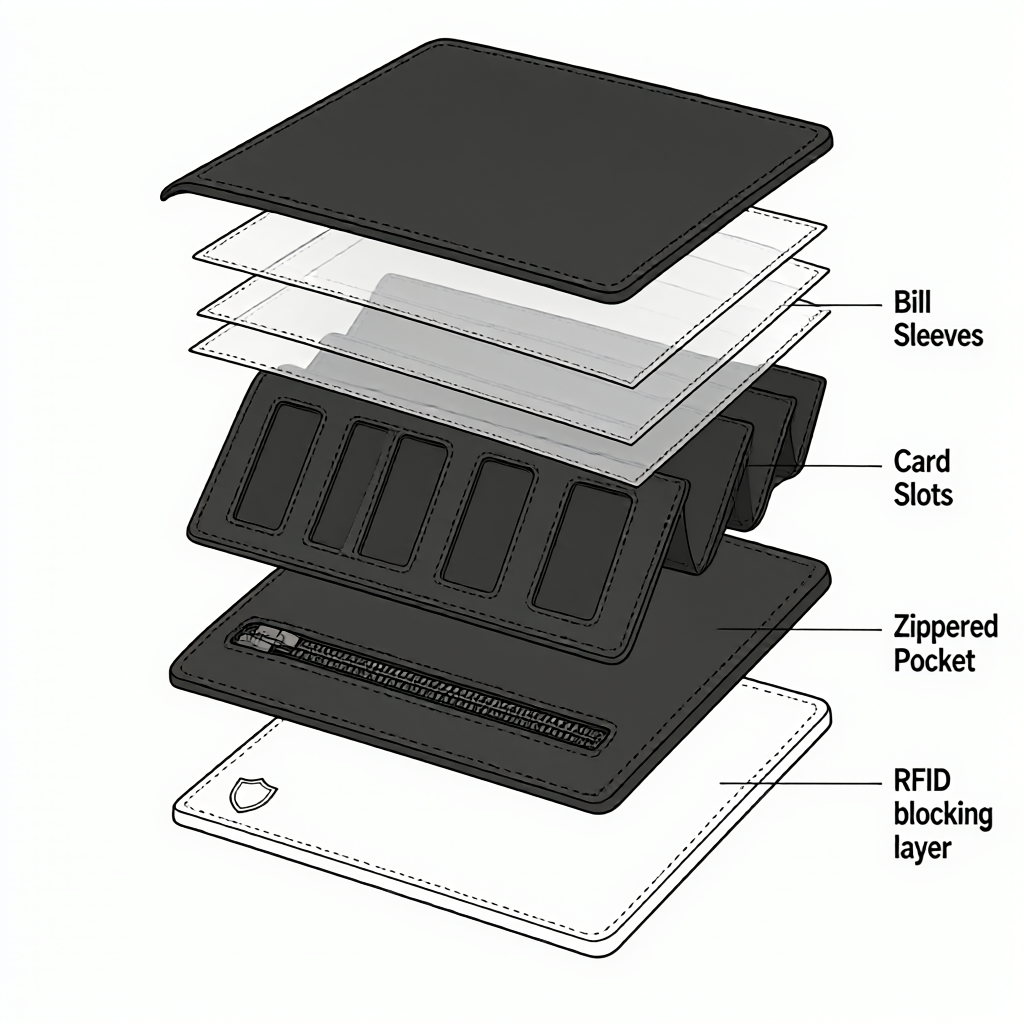
When evaluating product specifications, buyers should examine several dimensions that directly affect usability, packaging efficiency, and end-consumer satisfaction.
How Much Cash and How Many Cards Fit?
Most cash envelope organizer wallets accommodate 4–8 credit/debit cards in lateral slots and hold 1–5 banknotes depending on bill condition and country. Standard external dimensions range from approximately 75–90 mm in length, 50–65 mm in width, and 6–12 mm in thickness when fully loaded. Smaller European-style formats may measure closer to 70 × 48 mm, while US-market versions tend toward 85 × 55 mm to accommodate larger bills and card counts.
| Specification Range | Typical Values |
|---|---|
| Card capacity | 4–8 slots |
| Cash capacity | 1–5 folded or rolled bills |
| Length | 70–95 mm |
| Width | 48–65 mm |
| Thickness (loaded) | 6–12 mm |
| Weight (aluminum) | 30–50 g |
| Weight (titanium) | 35–55 g |
| Weight (carbon fiber) | 20–35 g |
Which RFID Options Exist for Envelope Wallets?
RFID-blocking wallets have become an increasingly common requirement, especially for brands selling into North American and European markets where contactless payment adoption is high. RFID blocking layers—typically composed of ferrite or metal mesh laminates—are embedded between wallet panels or integrated into backing plates. Buyers should verify that suppliers perform independent testing according to recognized standards rather than relying on vendor self-certification alone. Testing protocols established by organizations such as ASTM reference performance criteria for radio frequency identification interference shielding, which can inform procurement specification requirements.
Which Cash Retention Mechanisms Exist?
Three mechanisms dominate: elastic strap, spring bar, and magnetic flap.
Cash retention mechanisms vary between models:
- Elastic strap systems: Silicone or rubber bands stretch over bills to prevent accidental ejection
- Spring-loaded tension bars: Metal bars compress against stacked notes, allowing incremental removal
- Money clip attachments: Hinged or fixed clips clamp bills externally, sometimes replacing internal straps
- Slotted envelope designs: Open-top channels rely on snug card-stack friction to retain cash beneath
Each mechanism presents different loading experiences and retention reliability. Elastic straps offer simplicity but degrade over time; spring mechanisms maintain consistent tension longer but add mechanical complexity. For insights into complementary organizational products, explore our Gift Card Wallets for B2B Sourcing guide to understand how hybrid products can expand a brand’s catalog.
What Standards Apply to Cash Envelope Organizer Wallets?
Quality assurance and compliance documentation are critical evaluation points for B2B procurement. While no single international standard governs EDC wallets specifically, several frameworks and certifications influence sourcing decisions.
What Does ISO 9001 Cover?
ISO 9001 certification indicates that a manufacturer maintains documented quality processes covering design control, incoming material inspection, in-process verification, and final product release. For wholesale buyers, this certification reduces risk by ensuring consistent production standards across order cycles. Suppliers operating under ISO 9001 frameworks typically provide traceability records and corrective action procedures that support audit requirements from downstream retailers.
What Does a BSCI Audit Cover?
The Business Social Compliance Initiative (BSCI) audit assesses factory conditions against internationally recognized labor practice standards. Retail chains and large distributors increasingly require BSCI-compliant suppliers as part of their vendor qualification process. A BSCI-audited facility demonstrates adherence to acceptable working hour practices, health and safety provisions, and anti-discrimination policies—factors that protect brand reputation throughout the supply chain.
Which REACH and RoHS Limits Apply?
European Market regulations under REACH (Registration, Evaluation, Authorisation and Restriction of Chemicals) and RoHS (Restriction of Hazardous Substances) restrict certain heavy metals and chemical compounds in consumer goods. Manufacturers sourcing materials compliant with these frameworks can supply products meeting EU market entry requirements without additional testing burdens. SGS-testing of raw materials—such as verifying aluminum alloy composition or confirming absence of restricted phthalates in any elastomeric components—provides verifiable evidence of regulatory alignment.
Which Durability Benchmarks Apply?
Target 20,000 open-close cycles and 500 drop tests without strap failure.
Though no mandatory durability standard exists for minimalist wallets, experienced buyers reference informal industry benchmarks:
- Drop tests: Products surviving repeated drops from 1.2 meters onto hard surfaces without structural failure
- Tensile fatigue: Elastic straps retaining over 80% initial tension after 500+ load cycles
- Anodize adhesion: Cross-cut tape tests confirming coating does not delaminate under normal use conditions
- Card slot retention: Slots maintaining friction grip on standard ISO 7810 ID-1 cards after extended insertion/removal cycles
These bench marks help procurement teams distinguish between products engineered for longevity versus those optimized solely for low-cost appearance.
What Should You Consider When Sourcing Cash Envelope Organizer Wallets?
Several practical factors determine whether a sourcing partnership will succeed. Below are the key decision criteria for brand owners and distributors evaluating potential manufacturers.
How Flexible Are MOQs?
MOQ requirements vary significantly across suppliers. Some manufacturers accept orders starting at 300 pieces per design, enabling smaller brands and test launches to enter the market with manageable inventory risk. Higher-volume buyers typically negotiate reduced per-unit pricing at quantities exceeding 500 or 1,000 units. Understanding MOQ structures early prevents mismatches between supplier expectations and buyer volumes.
Which Customization Options Are Available?
Customization depth directly influences differentiation potential. Key customization elements include:
- Logo application: Laser engraving, silk screening, or UV printing options depending on material substrate
- Dimension modifications: Adjusting slot spacing, overall size, or mechanism type to fit specific market preferences
- Material selection: Offering multiple material tiers within a single product line to address varying price points
- Packaging design: Custom retail boxes, blister packs, or poly bags bearing brand identities
Suppliers providing both OEM (original equipment manufacturing) and ODM (original design manufacturing) services give buyers flexibility—the former allows executing your own designs, while the latter enables leveraging existing proven concepts modified for your branding. If you’re exploring branding possibilities beyond wallet engraving, our guide on Monogrammed Card Holders covers additional personalization applications relevant to similar product categories.
How Fast Can Samples Arrive?
Rapid prototyping accelerates product development timelines. Manufacturers offering 7-day sample lead times enable buyers to evaluate physical samples, validate design intent, and make go/no-go decisions quickly. Extended sample cycles of 30+ days create bottlenecks that delay seasonal launches and reduce responsiveness to market feedback. Prioritize suppliers demonstrating fast-turnaround sample workflows alongside full-scale production capacity.
How Much Capacity Should a Supplier Show?
Monthly output capability determines whether a supplier can fulfill growing order volumes without compromising quality or delivery schedules. Established facilities with substantial square footage and CNC automation can handle larger reorder cycles reliably. Verify that the manufacturer’s stated capacity aligns with your projected annual requirements to avoid capacity constraints during peak demand periods.
Which Logistics Support Matters?
International distribution requires attention to fulfillment logistics. Some manufacturers offer drop shipping and Amazon FBA prep services, including labeling, poly bagging, and carton preparation per marketplace requirements. This capability reduces operational overhead for sellers managing direct-to-consumer or third-party platform distribution without maintaining local warehousing infrastructure.
Which Documents Should a Supplier Provide?
Reliable suppliers provide certification documents upon request—ISO certificates, BSCI audit reports, REACH/RoHS test summaries, and SGS material declarations. Documentation readiness signals professional operational maturity and facilitates smoother onboarding for regulated retail channels and enterprise purchasing departments.
Related procurement scenarios extend beyond standalone wallets into bundled offerings. For perspective on coordinated product groupings, review our resource on Sourcing a Men’s Wallet Gift Set for B2B Programs, which addresses how accessory pairing strategies can increase average order values.
How Does TOP EDC Wallet Manufacture Envelope Wallets?
We run frame machining, strap assembly, and QC under one roof so tension stays consistent.
As a manufacturer specializing in minimalist EDC wallets and pocket gear, we approach cash envelope organizer wallets through the same lens that guides our broader product development: balancing precision engineering with accessible customization. Our facility operates with in-house CNC machining, laser engraving, and surface finishing capabilities that allow us to iterate designs efficiently from initial concept through量产 production.
Here is how the industry works → here is how we meet these standards. Our process begins with material selection aligned to your target positioning—whether that means cost-competitive 6061 aluminum for high-volume runs, Grade 2 titanium for premium segments, or carbon fiber composite for design-forward collections. Each material pathway leverages our 13+ years of export experience serving brands across America, Europe, Australia, and Southeast Asia. We maintain ISO 9001 quality management certification and operate within a BSCI-audited facility, ensuring that both product consistency and social compliance requirements are addressed proactively.
Our low MOQ starts at 300 pcs per SKU for full OEM customization (100 pcs trial order available for stock finishes) enables emerging brands to validate market demand without excessive inventory commitment, while our 500K+ monthly production capacity supports scaling for established buyers. The 7-day sample lead time allows you to evaluate prototypes before committing to production orders. From logo placement via laser engraving and UV printing to custom packaging design and Amazon FBA prep, we support the full customization spectrum so your brand maintains distinctive identity throughout the supply chain.
Contact Our Team to discuss your specifications, request material samples, or receive a detailed quotation tailored to your order volume and customization requirements.
How Does Monthly Output Decide Supply Continuity?
Factories running 500,000 units a month absorb seasonal peaks; smaller workshops cannot promise that.
When assessing potential partners, verify monthly production throughput. Manufacturers with 500,000+ units per month can reliably fulfill large retail orders and seasonal peaks without compromising quality or delivery windows. Ask suppliers to provide documented evidence of past fulfillment records, not merely stated capacity figures. Smaller workshops may advertise high capacity but lack the tooling infrastructure to sustain it during volume runs.
What Sourcing Standards Does TOP EDC Wallet Meet?
We hold ISO 9001 and BSCI scope, screen materials to REACH, and ship with test reports.
As a specialist manufacturer operating since 2014, our facility maintains ISO 9001 certification and holds BSCI audit status, ensuring consistent quality control and ethical production practices aligned with international retail standards. Our 50,000 sq ft factory operates under structured quality management systems documented per iso.org standards, supporting traceability across every production stage.
Our approach to cash envelope organizer wallets emphasizes precision engineering and flexible customization. Every aluminum, titanium, and carbon fiber variant undergoes SGS-tested material verification confirming REACH and RoHS compliance before bulk production begins. In-house CNC machining maintains tolerances within ±0.05 mm, ensuring consistent slot geometry and mechanism performance across high-volume orders.
For brands and distributors entering this category, we offer OEM and ODM pathways with low MOQ starting at 300 pieces and rapid 7-day sample prototyping. This structure allows smaller brands to validate product-market fit before committing to larger production runs while giving volume buyers the capacity to scale efficiently.
What Is the Cash Envelope Budgeting Method?
It splits spending cash into labeled envelopes so each category has a hard physical limit.
The cash envelope budgeting method traces back to personal finance advisors who recommended allocating physical currency into labeled envelopes—one per spending category such as groceries, entertainment, or transportation. When the allocated cash in an envelope is exhausted, spending in that category stops until the next budget cycle. This behavioral-friction approach has seen renewed interest as consumers seek alternatives to purely digital spending tracking.
Relevant authority on consumer financial education practices can be found through the FTC, which periodically publishes guidance on money-management strategies and consumer protection around budgeting tools. Integrating cash-friendly pocket gear—such as an organizer wallet built for quick bill access—supports the practical side of this method by reducing friction when accessing and returning paper currency.
How Do You Use an Organizer Wallet for Budgeting?
Load one slot per category, spend from it, and refill only at the next pay cycle.
Using a cash envelope organizer wallet effectively requires aligning the wallet’s mechanical design with the user’s daily cash-handling routine:
- Separate bills by denomination or category: Before loading, group banknotes by intended spending zone. Some users divide one wallet into two zones—an upper slot for daily spend and a lower sleeve for reserve cash.
- Load bills orientation consistently: Position all notes face-up with the same edge nearest the wallet opening. This visual uniformity speeds retrieval and reduces miscounts.
- Use the tension mechanism deliberately: With elastic-strap designs, stretch the band fully before inserting; with spring-loaded bars, press the bar down to create clearance then release. Consistent loading preserves long-term retention performance.
- Track envelope balances visually: Many cash-envelope adopters mark each envelope with its target amount. A transparent or partially visible cash slot helps verify remaining balance at a glance without unfolding the wallet.
This workflow complements the minimalist philosophy behind tactical pocket organizers, which prioritize efficiency and rapid access over maximum storage—a theme explored further in our Men’s Organizer Guide.
Which Is Better: DIY or Pre-Made Cash Envelopes?
DIY costs less up front; pre-made wallets last years and hold cards, so long use favors buying.
Consumers and brands alike weigh custom-built solutions against factory-produced wallets when adopting the cash envelope system:
| Factor | DIY Envelope Systems | Pre-Made Cash Envelope Wallets |
|---|---|---|
| Initial cost | Low (envelopes + binder or pouch) | Moderate to high per unit |
| Customization flexibility | Unlimited (size, labels, compartments) | Limited to supplier catalog options |
| Durability | Variable—paper envelopes degrade quickly | High—metal and composite materials resist wear |
| Branding potential | None unless separately printed | Full laser engraving, UV printing, packaging |
| Scalability for resale | Not viable for brand distribution | Ideal for private-label and wholesale programs |
| Aesthetic consistency | Inconsistent across sets | Uniform finish and fit per production run |
For brand owners evaluating whether to develop a private-label line versus sourcing ready-to-brand products, understanding both paths helps frame the decision. Companies exploring structured product bundles may also find our guide on Sourcing a Men’s Wallet Gift Set for B2B Programs relevant to positioning strategy.
How Do Cash Envelope Wallet Systems Compare?
Compare envelope count, card capacity, closure, and whether cash stays visible.
While no single authority ranks every option on the market, several system categories dominate procurement conversations among EDC brand owners:
- Single-slot strap wallets: Most common entry-level configuration; holds 3–5 bills plus 4–6 cards. Lowest unit cost, highest volume potential.
- Dual-zone organizer wallets: Separate front card channel and rear cash sleeve; supports category-based cash allocation within one form factor. Slightly thicker profile but greater organization.
- Hybrid card-cash wallets with removable inserts: Modular designs where a cash sleeve can detach and reattach; higher engineering complexity but appeals to users who switch between cash-heavy and card-only days.
- Accordion-style multi-compartment wallets: Multiple slip pockets for different cash categories inside one slim body; resembles a mini folio more than a traditional envelope wallet but serves power-budgeters well.
Buyers should match system type to their end-user profile. Mass-market Amazon listings typically favor single-slot strap models due to price competitiveness, while premium DTC brands often highlight dual-zone or hybrid designs that signal thoughtful engineering.
Which Tolerances Apply to Cash Envelope Organizers?
Plus or minus 0.5 mm on frames, 0.3 mm on slots, and 0.2 mm on assembled thickness.
Procurement teams require precise spec sheets to evaluate component-level quality before approving tooling. Below are representative industry parameters for cash envelope organizer wallets:
Which Dimensional Tolerances Apply?
- Length tolerance: ±0.5 mm on CNC-machined aluminum and titanium frames
- Width tolerance: ±0.3 mm for precision card-slot alignment
- Thickness variance: ±0.2 mm after assembly, critical for pocket-fit consistency
- Card-slot width: 0.75–0.85 mm per slot, matching ISO 7810 ID-1 card thickness of 0.76 mm nominal
Which Material Specs Apply per Substrate?
Aluminum runs 1.2 to 1.5 mm, titanium 0.8 to 1.0, and carbon fiber 1.0 to 1.2 mm wall.
| Material | Common Alloy/Grade | Anodize Thickness (Aluminum) | Hardness (Titanium) |
|---|---|---|---|
| Aluminum | 6061-T6 / 7075-T6 | 15–25 µm per ASTM B117 salt-spray reference | N/A |
| Titanium | Grade 2 (CP) / Grade 5 (Ti-6Al-4V) | N/A (natural oxide layer ~0.5 µm) | HRB 90–95 (Grade 2) / HRC 35–40 (Grade 5) |
| Carbon fiber composite | Pre-preg CFRP over Al/Ti core | N/A | N/A |
Anodized aluminum wallets typically meet salt-spray corrosion resistance benchmarks referenced by ASTM protocols, with qualified finishes surviving 500+ hours under standard testing before white-corrosion appearance.
Which Shielding Values Count?
RFID-blocking layers in these wallets commonly operate at 13.56 MHz—the frequency used by ISO/IEC 14443 contactless smart cards and most NFC payment tokens. Qualified shielding provides attenuation of ≥30 dB, reducing readable signal strength to below the activation threshold of typical reader devices. Buyers should request third-party test reports rather than accepting manufacturer claims alone; SGS and similar accredited laboratories can verify shielding effectiveness per documented methodologies.
Which Production Steps Affect Tolerance?
Cutting, deburring, anodizing, and strap tension setting each shift final dimensions.
Standard manufacturing sequences include:
- CNC milling of main body plates from billet stock
- Slot and channel routing for cards and cash retention
- Surface finishing (bead blast, anodize, polish, or PVD coating)
- Laser engraving or UV printing of logos and artwork
- Assembly of elastomeric straps, spring bars, or clip mechanisms
- Final inspection against dimensional go/no-go gauges
- Packaging in retail-ready boxes or bulk shipping cartons
ISO 9001:2015 certification—available from qualified suppliers—ensures that incoming material checks, in-process inspections, and final release tests follow documented control plans aligned with the standards set by ISO.
Why Does Manufacturer Selection Matter for Envelope Programs?
Envelope wallets live or die on strap tension, which only controlled assembly holds across batches.
When sourcing cash envelope organizer wallets at scale, brand owners must evaluate manufacturers against the full spectrum of capabilities outlined above—not just unit price. Key selection criteria include:
- In-house CNC machining: Manufacturers that machine their own parts maintain tighter tolerances and faster revision cycles than those outsourcing to job shops.
- Material traceability: Reputable suppliers provide mill certificates for aluminum billets and titanium bars, confirming alloy composition matches stated specs.
- Sample velocity: Fast sample turnaround—ideally within 7 business days—allows iterative design refinement before committing to production runs.
- Low MOQ availability: Suppliers accepting orders from 300 pcs per SKU enable small brands to validate market demand without excessive inventory investment.
- Certification readiness: ISO 9001, BSCI audit compliance, and REACH/RoHS documentation reduce downstream compliance risk for regulated retail channels.
As a manufacturer specializing in minimalist EDC wallets and pocket gear, our approach centers on precisely these capabilities. We operate from a 50,000 sq ft facility with in-house CNC machining, laser engraving, and surface-finishing lines. Our ISO 9001-certified processes ensure consistent quality across production runs, while our BSCI-audited operations and REACH/RoHS-compliant materials support global market requirements. We offer low MOQ starts at 300 pcs per SKU with a 7-day sample lead time, and we serve brands across America, Europe, Australia, and Southeast Asia—all backed by 13+ years of export experience and a 500K+ monthly production capacity. If you’re evaluating a private-label cash envelope wallet program, reach out to our team to discuss your specifications and receive a tailored quote.
Envelope Organizer Wallets: Where Can You Verify the Data and Sources?
- iso.org — www.iso.org
- FTC — www.ftc.gov
- ASTM — www.astm.org
- Pocket Organizer Wallets guide — topedcwallet.com
- Monogram on Wallet guide — topedcwallet.com
- Men’s Organizer Guide — topedcwallet.com
- Gift Card Wallets for B2B Sourcing — topedcwallet.com
- Monogrammed Card Holders — topedcwallet.com
- Sourcing a Men’s Wallet Gift Set for B2B Programs — topedcwallet.com
- Contact Our Team — topedcwallet.com
Cash Envelope Wallet FAQ: Cash Limits, Note Sizes, Strap Wear, Teen Budgeting — Which Questions Do Buyers Ask Most?
How much cash fits in a cash envelope organizer wallet?
Roughly 15 to 30 folded notes. Beyond that strap strain grows and the frame stops closing flat.
Do envelope wallets work with large-denomination notes?
Yes if the slot clears 160 mm tall; euro notes need that and US dollars need 156 mm.
Can the elastic strap lose tension over time?
It relaxes after about two years of daily use, which is when loose-note complaints start.
Are envelope wallets good for teens learning to budget?
Yes. The physical split makes overspending visible, which apps do not.
From article to product
Sourcing minimalist-wallets?
Tell us the format, the quantity and the date you need stock. You get material options, MOQ and a landed-cost range back within one business day.
Keep reading
More on wallet types
Thin Male Wallets: Buying Guide for Slim Minimalist Picks
How to choose a slim wallet for men — thickness thresholds, material trade-offs, capacity…
ReadStashed Wallet: A Minimalist Everyday-Carry Solution
Understand what a stashed wallet is, how minimalist slim wallets work, and what to…
ReadFolding Wallets: Types, Materials & Buying Guide
Learn what makes a folding wallet worth buying, from materials and card capacity to…
Read
About the author
TOPWALLET Editorial Team
TOPWALLET's editorial and engineering desk writes from bench testing at the Shenzhen (Longgang) facility: pull-force and cycle testing, 13.56 MHz shielding measurements, finish trials and factory audits, rather than supplier spec sheets. Every specification in these guides is one we write on a purchase order.
Written on the floor
This article was written by our production and QC team — the people who spec tolerances, run the finishing line and inspect every batch. Where it states a capacity, a pull force or a lead time, it comes from a measurement we made, not a supplier’s catalogue. If a number here disagrees with what your own supplier told you, tell us; several of these articles started as a correction from a buyer.
See how the factory works · Inspection process · Sourcing FAQ
Sourcing minimalist-wallets?
Tell us the format, the quantity and the date you need stock. You get material options, MOQ and a landed-cost range back within one business day.