

What Is a Leather Wristlet?
A leather wristlet is a compact, wrist-worn pouch or holder traditionally used for carrying cards, cash, and small essentials. It combines the carrying capacity of a slim wallet with the convenience of an attached strap, placing it functionally between a standard bifold and a dedicated organizer. In B2B procurement, the term refers to a private-label or OEM-produced accessory sold through retail, promotional channels, or corporate gifting programs.
Buyers often use several overlapping terms depending on design and market context. A clutch wallet emphasizes the envelope-style construction without an active wrist strap, while a wristlet organizer highlights the utilitarian layout suited for keys, coins, and cards. Some manufacturers call this category an EDC wristlet, positioning it specifically for daily-carry users who prioritize compact utility. When a strapless, bifold-style design falls within this size range, it may appear in distributor catalogs as a bifold wrist pouch or card holder wallet—both descriptions reflect legitimate variations within the same sourcing lane.
The core value proposition for brands is simple: wristlets occupy a high-perceived-value niche with manageable production complexity, acceptable margins, and broad appeal across demographics.
What Are the Key Materials and Quality Tiers?
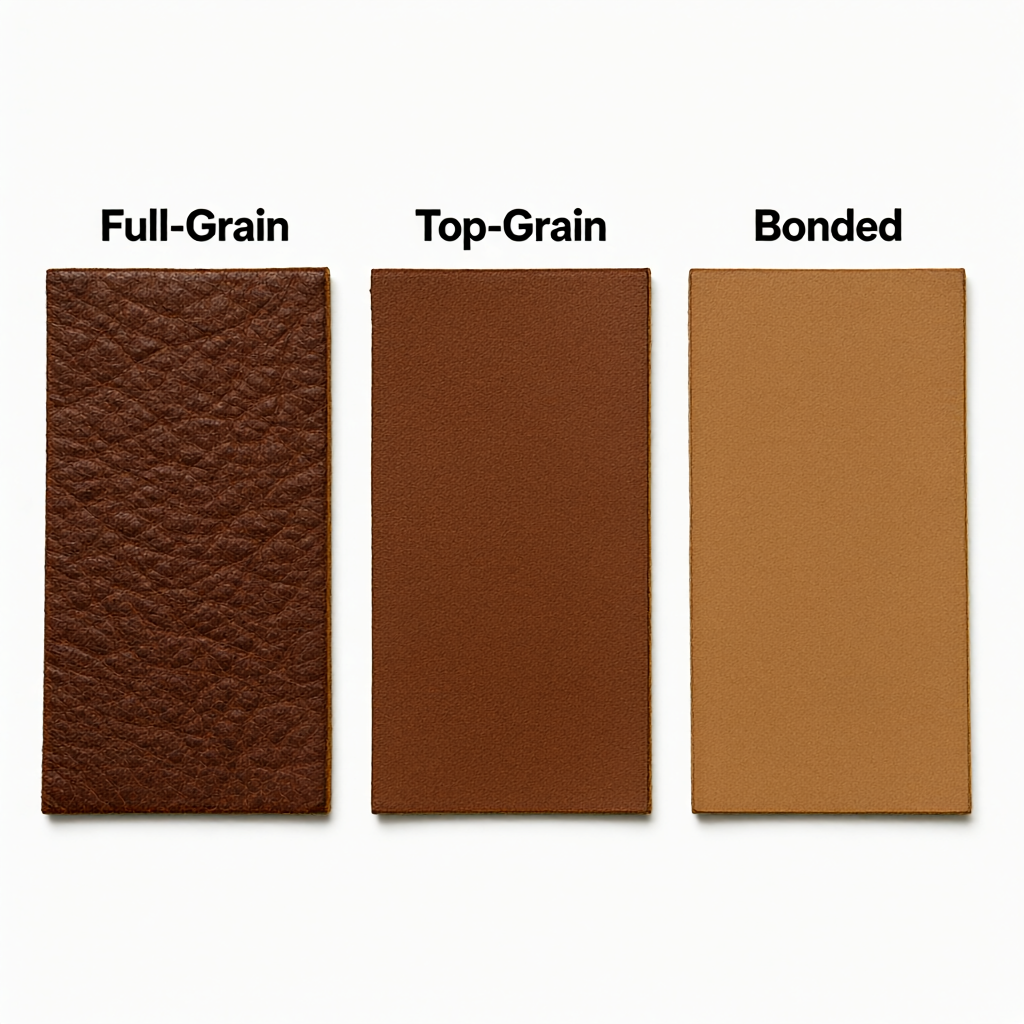
Leather grade is the single biggest determinant of end-product feel, durability, and unit cost. Most contract manufacturers tier their options into four recognizable bands:
| Tier | Material | Typical Use Case | Perceived Value Signal |
|---|---|---|---|
| Full-grain | Top layer with natural grain intact | Premium retail, luxury EDC lines | Highest; develops patina over time |
| Top-grain | Grain sanded and finished | Mid-to-upper retail, corporate gifts | Strong; consistent appearance |
| Genuine leather | Split layers bonded or treated | Entry-level promotional lines | Functional; limited longevity |
| Vegan / PU leather | Synthetic polymer surfaces | Budget promotional, regulatory-driven markets | Lower; not classified as “leather” in many jurisdictions |
Full-grain and top-grain leathers command higher FOB prices but deliver the wear patterns and tactile quality that justify retail markups in the $18–$45 range. Genuine leather remains viable for high-volume promotional runs where unit economics dominate.
Material choice also intersects with regional compliance. Markets like the European Union require clear fiber-content disclosure under REACH regulations, which means a product labeled “leather” must contain actual hide—not just a polyurethane coating marketed as leather. Buyers should confirm that supplier material declarations align with destination-market labeling rules before placing bulk orders.
What Are the Standard Size and Capacity Specifications?
Production specs vary by supplier and target market, but established manufacturers converge on a narrow band of proven dimensions:
- Overall footprint: approximately 110 × 75 mm to 130 × 90 mm when closed, depending on whether the design includes an exterior slip pocket
- Thickness: 8–14 mm loaded, determined by card stack volume and any coin compartment
- Card capacity: 4 to 12 slots, with heavier gauges of carbon fiber or aluminum reducing available room
- Cash pocket: one full-width bill sleeve, sometimes divided
- Coin compartment: optional zippered or snap-closed cell, typically 50 × 45 mm internally
- Wrist strap loop: rated for 3–5 kg tensile load; common attachment points use double-stitched bar tacks reinforced with rivets
These figures map closely to the ergonomic envelope that fits naturally in a jacket pocket, coat inner compartment, or tote bag. They also overlap meaningfully with the spec profiles for men’s minimalist wallets and women-specific leather designs, which share the same sizing logic even when form factor differs.
Hardware selection shifts effective capacity. A brass-toned clasp adds roughly 2–3 mm to loaded thickness versus a low-profile magnetic closure. Buyers specifying RFID protection should budget for an additional laminated liner layer that reduces card slot width by approximately 1–2 mm per column—a detail addressed more fully in the RFID-blocking specification context.
What Standards Apply to Imported Leather Accessories?
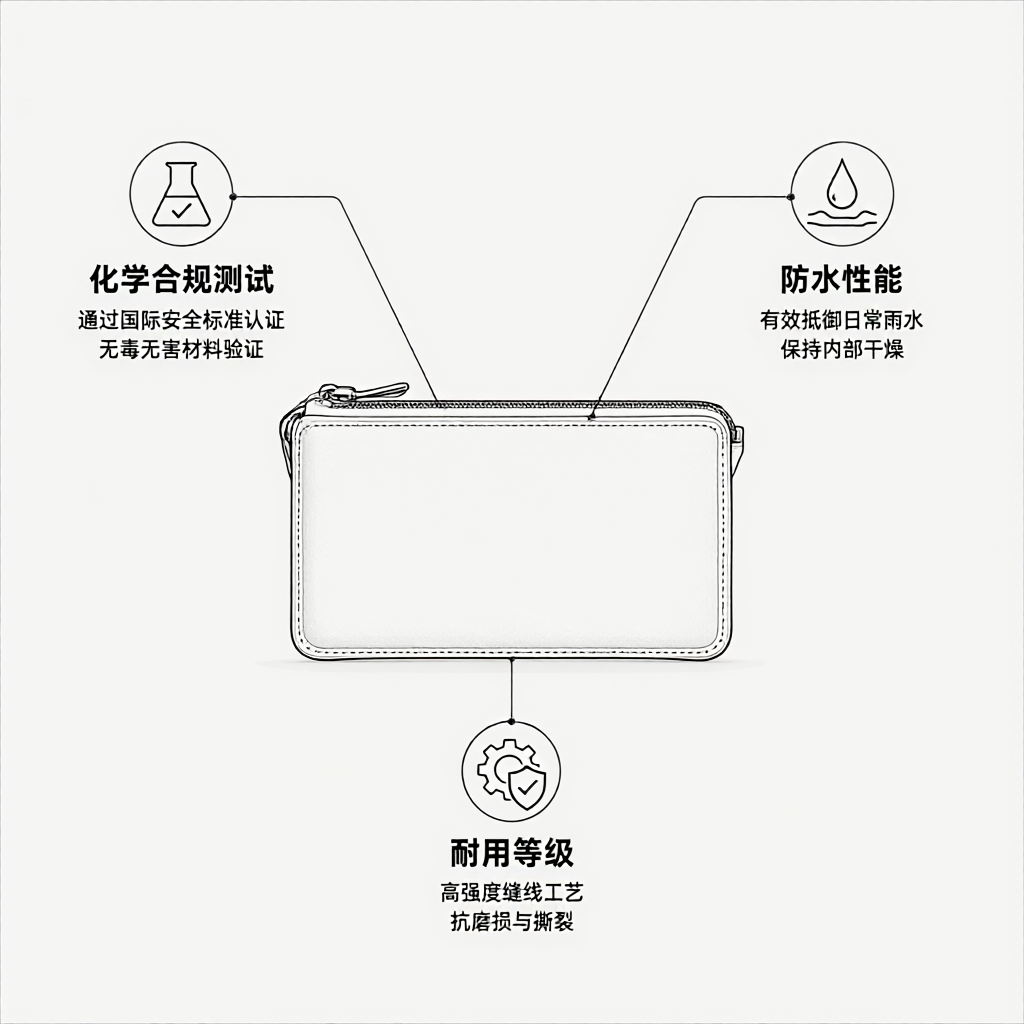
Procurement of leather goods crosses multiple regulatory touchpoints depending on the destination market. The certifications and compliance frameworks most relevant to B2B buyers include:
- ISO 9001 — Quality management system certification for the manufacturing facility. Indicates standardized processes for incoming inspection, in-process control, and finished-goods verification.
- BSCI (Business Social Compliance Initiative) — Audited supply-chain standards covering labor practices, workplace safety, and ethical sourcing. Required by many European retail buyers and some North American corporate-gift programs.
- REACH compliance — EU regulation governing restricted substances in articles. Leather treatments, dyes, and metal finishes must not exceed defined limits for chromium VI, azo dyes, and certain heavy metals.
- RoHS — Restriction of Hazardous Substances directive, applicable primarily to metallic hardware (zippers, snaps, clasps) containing lead, cadmium, or hexavalent chromium beyond permitted thresholds.
- CPSIA tracking labels — US requirement for children’s products; leather wristlets marketed toward younger demographics may need permanent tracking information sewn or stamped into the product.
- ASTM test methods — Standards bodies publish reference protocols for leather durability, tensile strength, and colorfastness. Consult ASTM International for published test methods relevant to leather and textile evaluation.
A compliant shipment typically carries supplier documentation confirming REACH substance restrictions, a Bill of Materials declaring component origins, and any third-party laboratory test reports for restricted substances. Buyers should request these documents during the RFQ stage rather than after production begins.
What Customization Options Can a Contract Manufacturer Provide?
Customization breadth varies by factory capability, but competent OEM providers routinely support the following elements:
Surface branding
- Hot stamping foil (gold, silver, black)
- Debossing and embossing with custom dies
- Laser engraving for fine-detail logos and QR codes
- UV printing for multi-color graphics on lighter-colored hides
Color and finish
- Dyed solids matching Pantone references
- Hand-pushed or hand-dyed tonal variations
- Burnished edges in contrasting or matched thread colors
- Aniline, semi-aniline, or corrected-grain surface treatments
Interior configuration
- Card-slot count from 2 to 12+
- Transparent ID window inserts
- Dedicated coin cells with zip or snap closures
- Currency straps or divider panels
Hardware options
- Brass, zinc alloy, stainless steel, or titanium clasps and snaps
- Magnetic closures versus mechanical fasteners
- Strap attachments in D-rings, O-rings, or integrated loops
Packaging
- Branded retail boxes with insert trays
- Polybags with hang tags or barcodes
- Custom tissue and thank-you cards
- Bar-code labeling for FBA-ready shipment
Detailed spec guidance for companion categories—such as men’s minimalist wallets or EDC wallet manufacturing—follows similar customization logic, though leather-specific treatment steps like edge painting and hide selection operate on longer timeframes than metal-machined alternatives. Buyers should submit clear artwork files and reference samples early in the sampling phase to avoid revision cycles later.
What Is a Realistic MOQ and Sample Timeline for Branded Orders?

Industry-standard minimum order quantities for private-label leather wristlets generally fall between 100 and 500 pieces per SKU, with some factories accepting lower entries on standard blank bases and higher entries on custom-Tooling runs. Several variables shift these thresholds:
- Established patterns vs. new Tooling — Reusing an existing mold or cut pattern keeps MOQ lower; developing a new die or laser path increases initial setup cost, which manufacturers recoup through elevated minimums.
- Complexity of decoration — Single-tone hot stamp carries minimal setup; full-color UV prints or multi-step hand-finishing increase labor cost per unit and may raise effective MOQ ceilings.
- Material availability — Stock-grade leathers from regional tanneries keep lead times short; special-order hides from European or South American tanneries can extend pre-production windows by 2–4 weeks.
Sample timelines typically run 7–14 days from approved art files to physical prototype. Production lead times for confirmed orders range from 25 to 45 days depending on volume and complexity. Manufacturers that also handle drop-shipping and Amazon FBA prep consolidate these stages, allowing smaller brands to move from signed artwork to warehouse receipt within a single coordinated cycle.
Related sourcing workflows—outlined in guides covering what a card holder entails or women’s wallet specifications—share comparable timelines and MOQ structures, making batch consolidation across product families a practical cost-management strategy. Request a Bulk FOB Quotation
What Should You Consider Before Placing a Bulk Order?
Several decision factors consistently separate smooth procurement experiences from costly revisions:
Leather origin transparency — Vague material descriptions (“genuine leather”) mask enormous quality variance. Specify grade, tanning method (vegetable-tanned vs. chrome-tanned), and country of origin in the purchase order to prevent substitution with inferior batches mid-run.
Prototype-to-production consistency — A visually appealing sample may conceal stitch inconsistencies, adhesive bleeding, or uneven dye absorption that surface only at scale. Require a pre-production sample that reflects actual factory output materials and labor rates.
Labeling and compliance readiness — Fiber-content labels, care instructions, country-of-origin markings, and any required certifications must appear on the product or packaging before shipment. Missing a REACH declaration or CPSIA tag can trigger customs holds or retailer rejection at port of entry.
Quality-inspection tolerance — Define acceptable defect rates up front. Common industry benchmarks allow 1–3% cosmetic non-conformance on general merchandise, though luxury-tier accounts may specify zero tolerance for visible stitching misalignments or color mismatch across panels.
Seasonality and replenishment timing — Leather goods follow softer seasonal curves than apparel but still respond to Q4 holiday demand and back-to-school promotional cycles. Order 8–10 weeks ahead of peak retail windows to accommodate sample revisions, Tooling approval, and freight transit.
Send Us Your Opening Sizes and Artwork for a Custom Quote
How Do Modern Manufacturers Balance Craft and Precision?
The most competitively sourced leather wristlets emerge from facilities that combine traditional finishing skills—hand edge painting, saddle stitching, and careful hide grading—with modern precision operations such as CNC-cutting templates, automated laser engraving, and digital print registration. This hybrid approach keeps human judgment where it matters most (material selection and tactile inspection) while delegating dimensional repeatability to machinery.
Some sourcing teams also draw parallels between leather accessory production and adjacent categories like RFID-blocking wallet manufacturing or minimalist wallet assembly, recognizing that layered construction, laminate bonding, and precision alignment follow identical quality principles regardless of final form factor. For deeper context on general wristlet specification conventions, buyers may review our dedicated wristlet sourcing guide.
Compliance-minded brands increasingly pair leather assortments with metal and composite accessories to broaden their catalog without expanding manufacturing complexity. Submit Your Project Details Today
What Alternatives and Complementary Formats Exist?
A leather wristlet rarely travels alone in a complete product line. Buyers typically evaluate it alongside—or in combination with—several related categories:
- Minimalist metal wallets — Aluminum and titanium card purses offer durable, lightweight companions for buyers seeking slimmer carry profiles. These products emphasize machined construction and RFID shielding rather than supple leather feel.
- Carbon fiber card holders — Lightweight, abrasion-resistant holders suitable for tech-forward audiences who prioritize grip and thinness over soft-touch aesthetics.
- Money clips — Simple, low-complexity items that serve as affordable entry-point SKUs for promotional programs and retail impulse displays.
- Tactical pocket organizers — Modular configurations aimed at outdoor and EDC enthusiasts, often integrating molle-compatible attachment points and rugged fabrics.
- Travel money bags — Enclosure-style solutions for currency and document storage, frequently featured alongside wristlets in hotel amenity programs and airport retail.
Each format addresses a slightly different consumer appetite, and mixing formats within one order can reduce per-unit logistics costs while increasing average order value. When evaluating production options, consider how traditional leather craftsmanship pairs with precision-manufactured metal components inside the same facility—this combined capability simplifies supplier management and shortens development timelines.
As a manufacturer, we approach leather wristlets the same way: by matching material selection to end-use intent, validating compliance documentation before Tooling approval, and building prototypes that reflect actual production conditions rather than idealized samples. If you are sourcing for a retail collection, a corporate gift program, a promotional distributor catalog, or an Amazon FBA private-label line, having clear specifications upfront will streamline the process considerably.
Practical Vendor Evaluation Scorecard
Before placing a bulk order, B2B buyers should assess prospective manufacturers against these weighted criteria:
| Criterion | Weight | Verification Method |
|---|---|---|
| ISO 9001:2015 certification (current audit report) | 15% | Request certificate number + IATF/ANAB registry check |
| BSCI social-compliance audit (within past 24 months) | 10% | Audit summary + corrective-action closure evidence |
| REACH substance-restriction testing (SGS/Intertek report) | 10% | Third-party lab report covering chromium VI, azo dyes, phthalates |
| Sample turnaround time (≤14 days standard) | 10% | Past-project timeline documentation |
| MOQ flexibility (300–500 pcs range) | 10% | Stated policy + historical order records |
| On-time delivery rate (≥95% per quarter) | 10% | Shipment tracking data from prior orders |
| Defect acceptance rate (<2% cosmetic, <0.5% functional) | 10% | QC report samples; pre-shipment inspection results |
| Responsive communication & file-handling clarity | 10% | RFQ response quality; artwork revision cycle speed |
| Reference accounts / verifiable brand portfolio | 15% | Case studies, client list with consent, third-party reviews |
Red-flag indicators
- Supplier refuses to share certification copies or provides outdated reports
- Vague material descriptions (“genuine leather”) without grade/tanning-method specificity
- No pre-production sample offered; only “golden sample” provided
- Pressure to waive QA hold or accept >3% defect tolerance upfront
- Inability to confirm REACH compliance documentation before payment
Procurement checklist (pre-RFQ)
- Define target unit price, MOQ, and lead-time expectations
- Prepare vector artwork files (AI/EPS/PDF) with bleed marks
- Select leather grade, hardware finish, and interior layout
- Confirm destination-market labeling requirements (country-of-origin, fiber content, care instructions)
- Request sample timeline quote and certification pack from shortlisted factories
Contact Our Team for a structured evaluation walkthrough.
FAQ: Leather Wristlet Sourcing for B2B Buyers
Q1: What is the typical MOQ for private-label leather wristlets?
Most OEM factories set MOQs between 300 and 500 pieces per SKU, with lower entries possible on stock-pattern bases and higher minimums for custom Tooling runs.
Q2: How long does sampling take?
Standard prototype turnaround is 7–14 days from approved artwork. Complex multi-step decoration (hand-dyeing + embossing + UV print) may extend to 21 days.
Q3: Which certifications matter most for EU-bound shipments?
REACH compliance (restricted substances), BSCI (social audit), and ISO 9001:2015 (quality management). RoHS applies to metallic hardware containing restricted heavy metals.
Q4: Can I combine leather wristlets with metal wallets in one container?
Yes. Many manufacturers support mixed-SKU consolidation, allowing brands to batch leather and aluminum/carbon-fiber minimalist wallets in a single production cycle, reducing per-unit freight cost.
Q5: What are common defect rates accepted in industry?
General-merchandise benchmarks allow 1–3% cosmetic non-conformance; luxury-tier accounts may demand zero tolerance for visible stitch misalignment or panel color mismatch.
Q6: How do I verify a supplier’s ISO 9001:2015 status?
Request the certificate number and cross-check against the IATF Global Database or ANAB registry. Ensure the audit scope explicitly covers leather goods manufacturing—not just trading activities.
Q7: Are there sustainable leather options?
Vegetable-tanned hides and chrome-free tanning processes are available from select tanneries in Italy and Spain. Expect 10–20% premium over standard chrome-tanned equivalents.
Why Choose TOP EDC Wallet as Your Leather Wristlet Manufacturing Partner?
As a specialist manufacturer operating since 2014, we bring 13+ years of export experience to every leather wristlet order. Our 50,000 sq ft facility houses in-house CNC machining, laser engraving, UV printing, and aluminum anodizing lines—allowing us to blend traditional hand-finishing with precision production without outsourcing critical steps.
Here is how we meet the standards B2B buyers require:
- Certifications: ISO 9001:2015 certified, BSCI audited, REACH/RoHS compliant materials verified through SGS testing.
- Capacity & flexibility: 500K+ monthly production output with MOQ starts at 300 pcs per SKU for full OEM customization (100 pcs trial order available for stock finishes) and a 7-day sample lead time.
- Full customization: From Pantone-matched dyed leathers to debossed/logotype laser engraving, interior layouts from 4 to 12 card slots, and FBA-ready packaging prep.
- Global track record: Serving 200+ brands across America, Europe, Australia, and Southeast Asia.
Whether you are launching a mid-tier EDC brand, scaling an Amazon FBA line, or sourcing corporate gifts, our hybrid craft-and-precision workflow ensures consistent quality across leather wristlets and companion products like minimalist wallets, card holders, and tactical pocket organizers.
Leather Wristlet: Where Can You Verify the Data and Sources?
- ASTM International — www.astm.org
- men’s minimalist wallets — topedcwallet.com
- EDC wallet manufacturing — topedcwallet.com
- what a card holder entails — topedcwallet.com
- women’s wallet specifications — topedcwallet.com
- Request a Bulk FOB Quotation — topedcwallet.com
- RFID-blocking wallet manufacturing — topedcwallet.com
- minimalist wallet — topedcwallet.com
- dedicated wristlet sourcing guide — topedcwallet.com
- tactical pocket organizers — topedcwallet.com
From article to product
Sourcing minimalist-wallets?
Tell us the format, the quantity and the date you need stock. You get material options, MOQ and a landed-cost range back within one business day.
Keep reading
More on wallet types
Thin Male Wallets: Buying Guide for Slim Minimalist Picks
How to choose a slim wallet for men — thickness thresholds, material trade-offs, capacity…
ReadStashed Wallet: A Minimalist Everyday-Carry Solution
Understand what a stashed wallet is, how minimalist slim wallets work, and what to…
ReadFolding Wallets: Types, Materials & Buying Guide
Learn what makes a folding wallet worth buying, from materials and card capacity to…
Read
About the author
TOPWALLET Editorial Team
TOPWALLET's editorial and engineering desk writes from bench testing at the Shenzhen (Longgang) facility: pull-force and cycle testing, 13.56 MHz shielding measurements, finish trials and factory audits, rather than supplier spec sheets. Every specification in these guides is one we write on a purchase order.
Written on the floor
This article was written by our production and QC team — the people who spec tolerances, run the finishing line and inspect every batch. Where it states a capacity, a pull force or a lead time, it comes from a measurement we made, not a supplier’s catalogue. If a number here disagrees with what your own supplier told you, tell us; several of these articles started as a correction from a buyer.
See how the factory works · Inspection process · Sourcing FAQ
Sourcing minimalist-wallets?
Tell us the format, the quantity and the date you need stock. You get material options, MOQ and a landed-cost range back within one business day.