

Ladies wallets are precision-crafted accessories produced through material-specific workflows — leather pieces are die-cut or CNC-routed, skived, stitched, and edge-finished; metal wallets are milled, laser-cut, and anodized with spring-retention mechanisms; and hybrid designs combine both. For B2B buyers, success depends on understanding material selections, tolerances, certification requirements, customization pathways, MOQ structures, and sourcing criteria before committing to a production run.
Ladies Wallet: What Is the Quick Answer?
What is the ladies wallet manufacturing process? — Ladies wallets are produced through a sequence of cutting, shaping, assembling, and finishing operations that vary by material. Leather and fabric wallets rely on die-cutting or CNC routing followed by stitching, edge painting, and hardware attachment. Metal wallets use blank preparation, CNC machining, laser engraving, anodizing or PVD coating, and assembly of the slip-and-spring mechanism. RFID-blocking variants add a conductive liner layer during lamination. Buyers should verify material specs, tooling approach, quality-control checkpoints, and certification coverage before committing to a production run.
Ladies Wallet: How Does It Work in Detail?
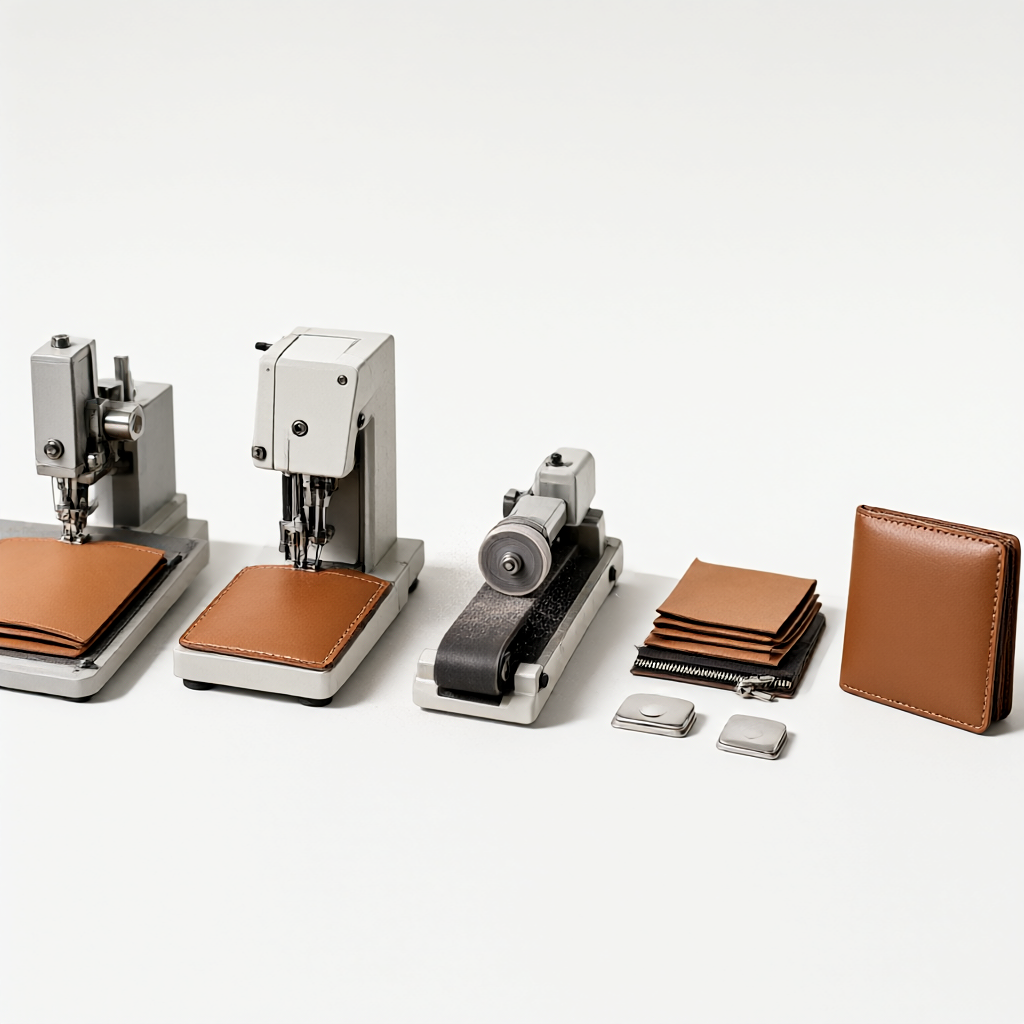
How do ladies wallets get from raw material to finished product?
The exact sequence depends on the chosen construction method, but most manufacturer workflows follow four stages: material prep → forming/cutting → assembly → finishing & inspection.
Stage 1 — Material Selection & Prep. The supplier sources leather hides, TPU/carbon-fiber sheets, aluminum or titanium blanks, fabric laminates, or metal clips based on the design spec. For leather, hides are graded by grain, thickness (typically 0.8–1.5 mm for card-holder weight), and dye lot consistency. Metal starts as mill-size plate or extruded stock, cut to near-final dimensions on a saw or waterjet to minimize CNC load.
Stage 2 — Cutting & Shaping. Leather and fabric pieces are cut using steel rule dies for high-volume shapes or CNC routers/oscillating knives for short runs and complex contours. Precision here is critical because layer tolerance directly affects whether the card stack fits flush. Metal blanks undergo CNC milling for slots, bevels, and corner radii; laser cutting produces the slim profiles common in minimalist EDC designs.
Stage 3 — Assembly. Stitched wallets involve hand-stitching or machine saddle-stitch of the folded bi-fold layers, insertion of card slots and pockets, rivet or snap installation, and edge gluing. Adhesive-bonded constructions skip thread entirely — UHMWPE thread alternatives, industrial contact cements, or hot-melt adhesives bond the layers instead. Metal wallets assemble around a tension spring or elastic card-retention band; the frame is welded, riveted, or press-fit depending on the design.
Stage 4 — Finishing & Inspection. Edge painting or burnishing seals leather edges against delamination. Metal surfaces receive anodizing, bead blasting, or PVD color coating. Every unit passes visual inspection for stitch consistency, adhesive flash, slot alignment, and functional checks (e.g., does the money clip hold its tension). RFID-blocking units receive a conductivity test on the shield laminate.
For additional context on bifold fabrication specifics, see wallet size standards and specifications which cover dimensional targets tied to pocket profiles.
What materials dominate ladies wallet production?
Buyers typically encounter four families, each carrying distinct cost, durability, and specification implications.
| Material | Typical Use | Key Attributes | Rough Cost Tier |
|---|---|---|---|
| Full-grain / top-grain leather | Bi-fold, card case | Age develops patina; 0.8–1.5 mm; requires edge paint and conditioning | Mid–Premium |
| Corrected-grain & bonded leather | Budget lines | Coated surface; lower tear strength; consistent appearance | Low–Mid |
| Vegan leather (PU / microfiber) | Eco-conscious SKU | Water-resistant; PVC-free options available; uniform thickness | Low–Mid |
| Aluminum alloy (6061 / 7075) | Minimalist metal wallet | Lightweight, scratch-resistant after anodizing; thin gauge 0.5–1.0 mm | Mid |
| Titanium (Grade 2 / Grade 5) | Premium money clip / card holder | Superior strength-to-weight; higher raw-material cost | Premium |
| Carbon fiber (epoxy-prepreg) | Card holder shell | Stiff, lightweight, distinctive weave; lamination quality varies by supplier | Mid–Premium |
| Nylon / canvas (ballistic, Cordura) | Tactical organizer | Abrasion-resistant; often paired with leather or metal accents | Low–Mid |
When evaluating card holder manufacturing quotes, ask specifically about GSM (for fabrics), mm thickness (for leather and metal), and whether the hide is vegetable-tanned or chrome-tanned — tanning method affects both regulatory compliance and feel.
RFID-safe versions integrate a Faraday-layer laminate. See what RFID blocking technology actually is and how it’s applied for a deeper look at shielding frequency bands and material choices.
Why do manufacturing processes differ so much between styles?
A traditional leather bi-fold carries ~12–18 separate components (outer panels, inner gusset, card pockets, bill compartment, snap cover), each requiring cutting, skiving (edge-thinning at seams), stitching, and hardware work. That complexity drives longer lead times but allows rich aesthetic customization — embossing, foil stamping, contrast thread.
By contrast, a minimalist metal wallet or carbon fiber case may contain only three structural parts plus a retention mechanism. Tooling investment shifts from sewing patterns and stitch dies to CNC fixtures and molding tools. This is why some buyers seeking private label wallet sourcing gravitate toward hybrid approaches: leather interior paired with a metal outer frame, combining craft finish with precision-formed geometry.
Edge-finishing decisions also cascade into QC time. Hand-burnished leather edges look premium but require skilled labor; painted edges are faster but can crack if the coat is too thick or incompatible with the hide chemistry. When you’re comparing OEM wallet manufacturing proposals, request a defect-rate breakdown by process step — it reveals where each factory’s actual bottleneck lies.
Ladies Wallet: Which Specifications Matter Most?
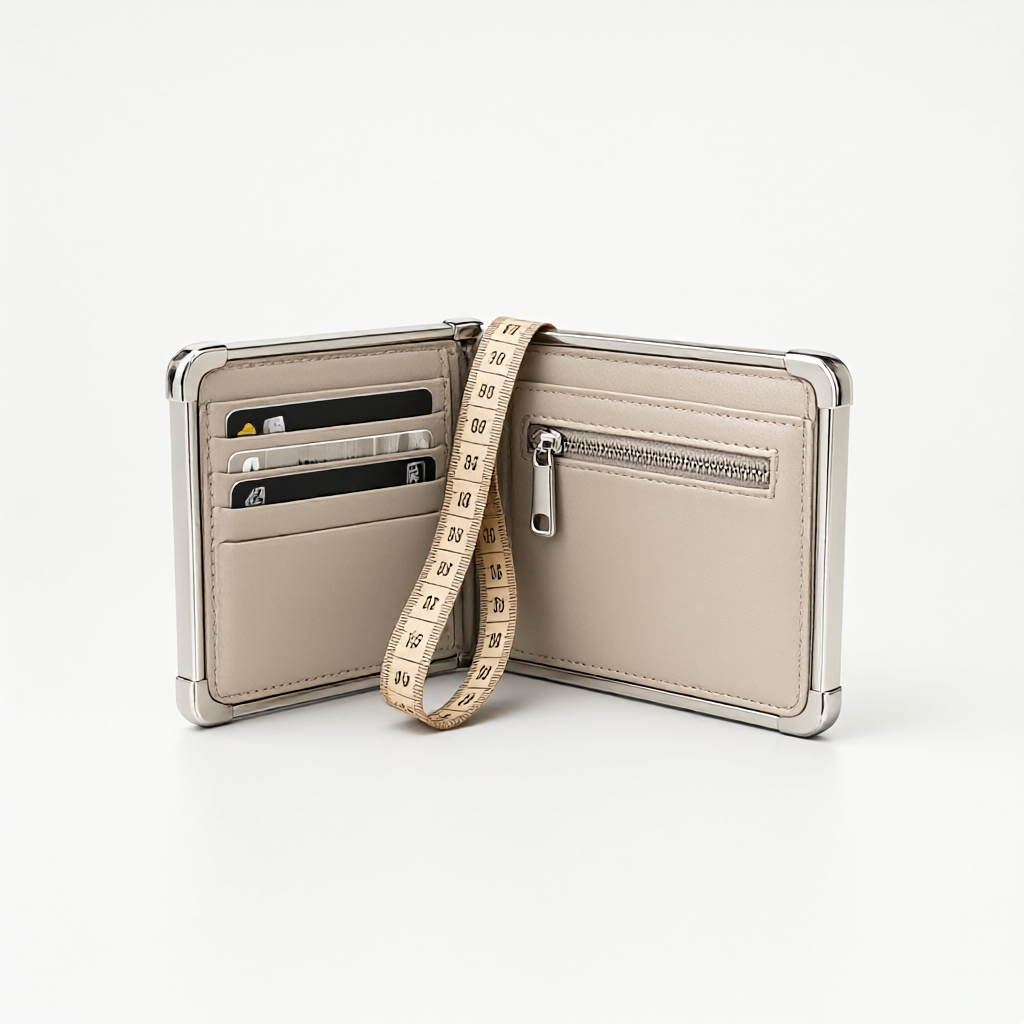
What are the typical dimensions and tolerances for ladies wallets?
Ladies’ wallets tend to target smaller form factors than men’s counterparts. Industry-standard targets include:
- Bi-fold folded: 95–115 mm × 70–85 mm × 6–12 mm (open width drops proportionally).
- Card holder / slip style: 80–105 mm × 55–75 mm × 4–8 mm.
- Money clip variant: 85–110 mm × 40–55 mm × 5–10 mm.
Tolerances that signal a mature producer:
- Cut dimension: ±0.3 mm on leather/fabric; ±0.15 mm on CNC-machined metal.
- Stitch spacing: consistent within ±0.5 mm across the run.
- Slot depth: within ±0.2 mm so cards sit flush without bowing.
- Weight variance per unit: <±3 % of target; heavier variance usually means inconsistent material feeds or adhesive spread.
If your target pocket is a women’s jacket zip pocket versus a clutch interior, dimensions should shift accordingly — this is why many buyers start with a physical prototype evaluation rather than relying solely on drawings. On how minimalist EDC wallets are manufactured, you’ll find a similar tolerance discussion tailored to slimmer profiles.
What capacity and retention specs matter?
- Card-slot count: 4–12 slots is common for ladies’ formats; beyond 12, the folded profile swells noticeably.
- Bill-compartment folded thickness budget: ≤12 mm keeps the wallet pocketable in most contemporary women’s trousers and coats.
- Retention force (money clips): roughly 8–15 N holds a standard US bill stack securely without manual squeeze.
- Spring fatigue (metal slip wallets): tested over ≥5 000 open-close cycles with <10 % force loss.
Ask suppliers to publish these numbers — they often appear in internal QA charts even if not listed on the spec sheet.
Which certifications indicate a responsible sourcing base?
| Certification | Relevance | What It Verifies |
|---|---|---|
| ISO 9001 | Process consistency | Documented QMS, corrective-action loops, audit trail |
| BSCI | Social compliance | Factory labor standards, working conditions |
| REACH (EU) | Chemical safety | Restricted substances in leather chemicals, dyes, adhesives |
| RoHS (if electronics present) | Hazardous substances | Lead / cadmium limits in any metallic solder or plating |
| SGS / Intertek test reports | Material verification | Independent lab confirmation of composition and performance |
These standards apply broadly across the category. For guidance on RFID wallet meaning and technology requirements, the same shielding-material testing principles govern both consumer and commercial claims.
Ladies Wallet: Which Standards and Certifications Apply?
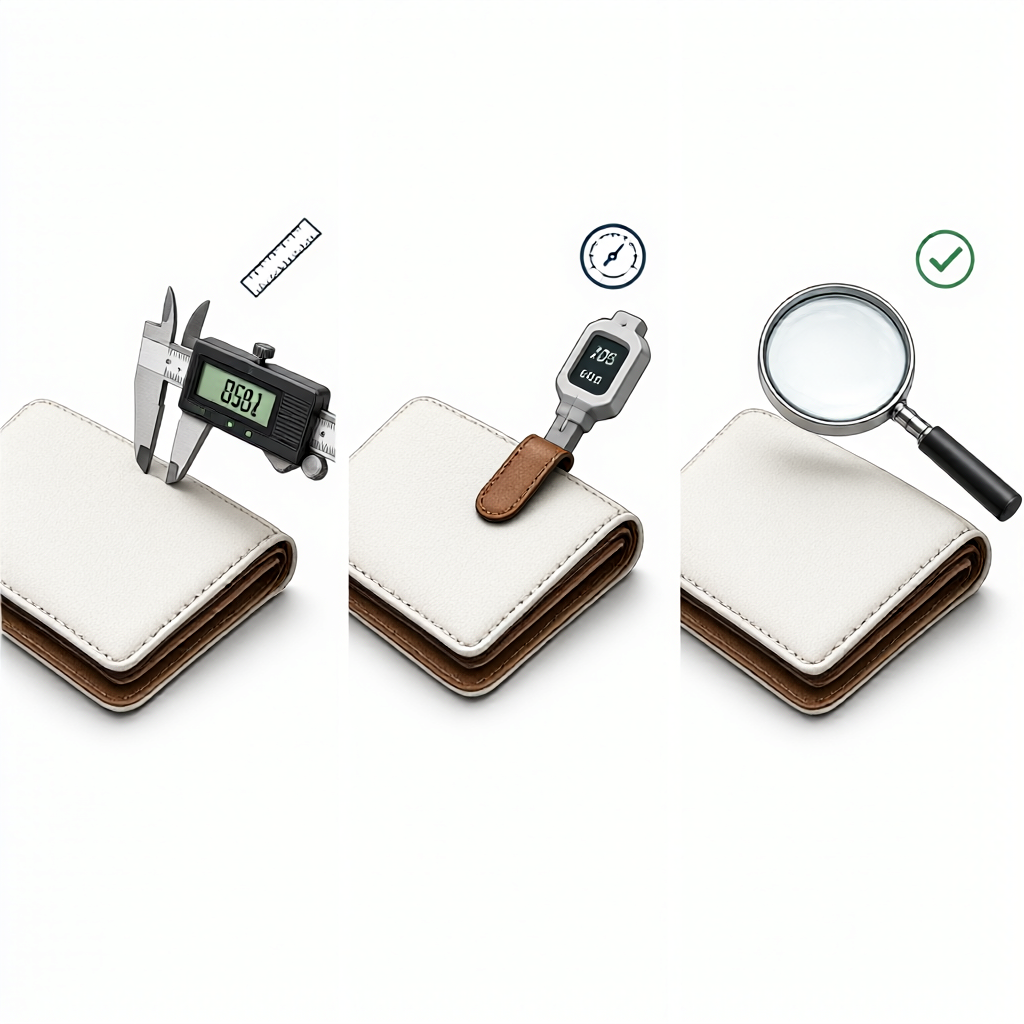
What testing should a buyer require before mass production?
A robust pre-shipment test package includes:
- Dimensional audit on a statistically valid sample (usually AQL 0.65 for major defects).
- Function test — insert/remove cards repeatedly (≥100 cycles) and check for binding or loosening.
- Adhesion / peel test on laminated or stitched seam areas.
- Coating adhesion cross-hatch test (ASTM D3359) for anodized or painted metal.
- Salt-spray corrosion test (ASTM B117) when metallic hardware contacts the user’s skin frequently.
- Flammability / chemical compliance documentation per destination-market regulation.
Referencing ASTM standards such as those published by ASTM International provides a baseline for material-performance expectations, though specific grade selections depend on your target market and end-use.
What labeling and traceability rules apply?
Most export destinations require:
- Fiber-content disclosure (for fabric/leather compositions).
- Country-of-origin marking.
- Care-label instructions matching the primary material.
- Warnings regarding small-parts choking risk where applicable.
- RFID-shield claim substantiation documents if making that assertion.
Buyers in the EU should ensure the supplier can provide a Declaration of Conformity aligned with REACH Annex XVII restrictions, particularly concerning azo dyes, chromium VI, and nickel release from metal hardware.
Ladies Wallet: What Else Should Buyers Consider?
What should buyers weigh when choosing a manufacturing partner?
Procuring in volume — whether for bulk wallet procurement or smaller boutique runs — hinges on more than unit price. Evaluate the following decision factors:
- Tooling amortization model. Custom steel-rule dies for leather cost $300–$1 200 each; CNC program setup is recurring but lower marginal cost. Ask whether the supplier absorbs tooling into a minimum order quantity.
- Sample turnaround. Prototyping speed reveals whether a factory has in-house pattern-making vs. outsourcing to a third party. Fast feedback loops shorten time-to-market significantly.
- Lead-time reliability. Seasonal peaks (holiday gift runs, corporate promotional orders) stress most schedules; confirm peak-capacity commitments in writing.
- Scrap and yield management. A supplier who tracks hide yield percentage per SKu can often optimize nesting patterns to reduce waste — savings that can be shared.
- Packaging capability. In-house box design and FBA prep avoid adding a secondary vendor.
- Post-production care guidance. Offer your customers how to clean a wallet by material type; a supplier willing to supply care cards demonstrates attention to the full product lifecycle.
Common sourcing pitfalls worth avoiding:
- Assuming lower MOQ automatically means higher unit cost on premium materials. Some factories absorb margin on leather surcharges during off-peak periods.
- Skipping a pilot batch before full production. A 50–300 piece trial catches stitch-angle drift, adhesive cure issues, and packaging fit problems before they scale.
- Neglecting seasonal humidity effects. Leather thickness and stitch tension shift with ambient moisture — a factory in a monsoon climate should have climate-controlled cutting rooms.
Finally, when scoping [promotional wallet orders], remember that branding complexity (multiple colors, debossed logos, custom interiors) pushes both art-work approval time and initial setup cost. Align artwork files to the factory’s preferred vector format early to avoid back-and-forth delays.
For questions about how to make a woman’s wallet at the component level, the card-holder category offers useful parallels: material choice, retention method, and pocket compatibility drive most of the same engineering decisions, just scaled to a lighter form factor.
Ladies Wallet: What Does a Typical Manufacturer Profile Look Like?
How do established producers translate these standards into reproducible output?
The transition from prototype to reliable批量 delivery comes down to disciplined tooling, documented QA gates, and willingness to share process data. As a manufacturer, our approach to this is built on in-house CNC machining, laser engraving, and surface finishing — meaning we control the tolerances that matter most: slot depth, edge radius, and aesthetic repeatability. We started producing minimalist EDC wallets in 2014, and since then our facility has grown to approximately 50,000 sq ft with ISO 9001 certification and BSCI audit coverage, allowing us to support OEM, ODM, and private-label programs under one roof.
We meet the industry benchmarks discussed above through layered controls: incoming material inspection against supplier certificates, in-process dimensional checks at cut and post-machine stages, and outgoing functional audits that sample RFID-shield continuity, spring retention force, and cosmetic consistency. Our lowest viable MOQ sits at 300 pcs for most metal and carbon-fiber styles, with sample lead times around seven calendar days so buyers can validate fit before committing.
How do customization and private labeling work in wallet manufacturing?
Customization spans three levels: aesthetic, functional, and branding.
- Aesthetic options include leather color and grain selection, anodized or PVD metal finishes, carbon fiber weave patterns, and surface treatments such as bead blasting or polishing.
- Functional options cover card-slot count and spacing, bill-compartment geometry, money-clip tension ratings, RFID-shield placement, and retention mechanisms (spring steel vs. elastic bands).
- Branding options encompass laser engraving, debossing, foil stamping, UV printing, and custom packaging with insert cards and hang tags.
Private-label programs typically require the buyer to submit vector artwork (AI or EPS format) and brand guidelines. The supplier then produces approved samples bearing the buyer’s logo and packaging before bulk tooling begins. This workflow is standard across OEM and ODM arrangements in the EDC wallet sector.
What factors affect MOQ, pricing, and lead times?
Several variables determine order economics:
- Material type. Full-grain leather and titanium carry higher raw-material costs than aluminum or corrected-grain leather. Hide yield optimization can reduce waste by 8–15 %.
- Complexity. Bi-fold constructions with multiple pockets, hardware, and stitching require more labor hours than single-piece card holders.
- Hardware. Adding brass rivets, snap closures, or zinc-alloy clasps introduces secondary operations and cost per unit.
- Custom tooling. Steel-rule dies ($300–$1,200 each) and CNC fixture setup are one-time investments amortized over the order quantity.
- Order volume. MOQs commonly range from 300 to 500 pcs for custom runs; lower volumes often carry surcharge fees. Higher volumes improve per-unit economics through material-bulk pricing and streamlined production scheduling.
- Lead times. Sample development typically requires 5–7 business days. Bulk production ranges from 15 to 30 days depending on complexity, material availability, and factory capacity allocation.
These factors interact multiplicatively — a high-complexity, low-MOQ order with premium materials will carry the steepest per-unit cost.
What should buyers look for when evaluating sourcing and supplier criteria?
A structured evaluation reduces risk across five dimensions:
- Quality management. ISO 9001:2015 certification indicates a documented QMS with corrective-action loops and audit trails. BSCI audit coverage confirms social-compliance diligence.
- Technical capability. In-house CNC machining, laser engraving, and anodizing lines reduce outsourcing dependencies and tighten tolerance control. Suppliers who perform incoming material inspection against mill certs demonstrate process discipline.
- Capacity and scalability. Monthly output above 500,000 units signals mature supply-chain positioning; verify peak-season commitment in writing.
- Responsiveness. Fast sample turnaround (≤7 days) and clear RFQ acknowledgment timelines indicate operational efficiency.
- Compliance documentation. REACH Annex XVII restricted-substance reports, SGS test certificates, and Declaration of Conformity packages should be available before sampling.
Suppliers willing to publish AQL defect rates, cycle-time data, and material traceability records typically operate at a higher maturity tier.
How are RFID-blocking wallets tested for safety and effectiveness?
RFID shielding functions as a Faraday cage — conductive layers intercept electromagnetic fields and prevent unauthorized scanning of contactless card chips. Effectiveness is measured in signal attenuation (dB) across the 13.56 MHz NFC frequency band.
Key testing and compliance points include:
- Conductivity verification. Shield laminates should achieve ≥40 dB attenuation to be considered effective against standard reader distances.
- REACH Annex XVII compliance. Adhesives, dyes, and coatings must not contain restricted azo compounds, chromium VI above permitted thresholds, or nickel release exceeding 0.5 µg/cm²/week.
- FTC substantiation. Claims of RFID protection require documented test evidence; unsubstantiated assertions may violate FTC advertising guidelines.
- Durability over product life. Shield integrity should remain intact after ≥5,000 flex cycles and exposure to standard cleaning conditions.
Reputable suppliers provide third-party lab reports confirming both shielding performance and chemical compliance prior to mass production.
What hardware options are available for ladies wallets?
Hardware adds function and visual character but introduces additional QC checkpoints:
- Snaps and magnetic closures. Brass or stainless-steel snap components require precise alignment during assembly; mismatched placements cause closure failure. Test cycle counts should exceed 3,000 opens/closes without deformation.
- Rivets. Decorative or structural rivets in brass, gunmetal, or silver tones add detail. Verify rivet shank length does not penetrate interior card slots.
- Zippers. Zippered coin compartments use #3 or #4 coil zippers; zipper pull attachments should pass a 5 N tensile test.
- Card-retention clips. Spring-steel money clips must maintain 8–15 N clamping force over repeated use without permanent set.
Each hardware addition increases assembly time and requires separate functional testing during QA.
How do buyers choose a wallet pattern or template?
Pattern selection determines pocket compatibility, capacity, and user experience:
- Bi-fold templates offer maximum storage (cards, bills, coins) in a compact folded form but add bulk when open.
- Card-holder/slip templates prioritize slim profiles and quick access; ideal for users carrying only essentials.
- Money-clip templates combine a retaining mechanism with card slots for a minimalist silhouette.
- Hybrid templates merge leather interiors with metal frames, balancing tactile comfort with structural rigidity.
Buyers should request physical samples in each configuration before finalizing. Dimensional targets from wallet size standards guidance help ensure pocket fit across target demographics.
What is the procurement decision framework for B2B wallet sourcing?
A structured procurement approach follows these steps:
- Make-vs-buy analysis. Evaluate whether in-house assembly is viable or contract manufacturing delivers better cost, speed, and quality outcomes.
- Supplier evaluation matrix. Score candidates on quality certification, technical capability, capacity, lead-time reliability, compliance documentation, and communication responsiveness.
- RFQ checklist. Request detailed quotes specifying material grades, tolerance bands, tooling costs, MOQ, sample timeline, bulk lead time, packaging specs, and certificate availability.
- Sample validation. Physically evaluate prototype fit, finish, function, and branding execution before approving tooling.
- Pilot batch. Run 50–300 pieces to validate production consistency and catch defects before full-scale commitment.
A transparent RFQ process with defined evaluation criteria reduces misalignment risk and ensures consistent vendor selection.
What red flags should B2B buyers watch for during sourcing?
Common pitfalls include:
- Adhesive flash defects. Visible excess glue at seam edges indicates poor application control and may compromise edge durability.
- Incorrect tanning method non-compliance. Chrome-tanned leather without proper Cr(VI) testing may fail EU REACH restrictions.
- Tolerance stack-up failures. Cumulative dimension errors across multiple cut and stitch operations cause card binding or slot misalignment.
- Unverified RFID claims. Shielding performance without lab-test documentation is unreliable.
- Vague MOq terms. Quotes without explicit tooling costs or volume-tier pricing often result in surprise surcharges.
- No pilot-batch option. Suppliers unwilling to produce trial runs lack confidence in their process control.
Recognizing these signals early prevents costly rework and delays.
Ladies Wallet: What Should You Know First?
Ladies wallets are precision-crafted accessories produced through material-specific workflows — leather pieces are die-cut or CNC-routed, skived, stitched, and edge-finished; metal wallets are milled, laser-cut, and anodized with spring-retention mechanisms; and hybrid designs combine both. For B2B buyers, success depends on understanding material selections, tolerances, certification requirements, customization pathways, MOQ structures, and sourcing criteria before committing to a production run.
From material selection to finished product: a step-by-step walkthrough
A complete ladies-wallet build typically passes through six sequential operations — material specification, cutting/measuring, forming, assembly (stitching or bonding + hardware attachment), finishing, and inspection — each governed by distinct technical checkpoints.
Step 1 — Material specification & incoming QC. Buyers should require suppliers to provide verifiable measurements up front: leather must meet the ordered thickness range (typically 0.8–1.5 mm for card-holder weight) and be confirmed as either vegetable-tanned or chrome-tanned; fabric/nylon must come with a stated GSM value (grams per square metre); aluminium or titanium blanks must include mill certificates confirming alloy grade (e.g., 6061, 7075, Grade 2, or Grade 5). Any supplier who cannot produce these numbers in their initial quote — especially GSM or millimetre thickness — should be considered a high-risk vendor. Fabric laminates and vegan-leather rolls must also carry relevant chemical-compliance documentation such as REACH SVHC declarations or OEKO-TEX Standard 100 classification. Leather hides are graded by grain integrity, dye-lot consistency, and absence of scars or insect marks; rejected stock is culled before cutting begins.
Step 2 — Cutting & measuring. Leather and fabric panels are cut using steel-rule dies for high-volume geometry or CNC routers / oscillating knives for low-MOQ and complex contour runs. CNC-based cutting enables tolerance levels of ±0.3 mm on leather and fabric, while waterjet or laser cutting on metal blanks achieves ±0.15 mm accuracy. Nested cutting patterns maximise yield — experienced houses report 78–85 % hide utilization on standard bi-fold layouts. Metal blanks are sawn or waterjet-cut to near-final footprint before moving to CNC milling, minimising machine-time cost. Pattern selection (bi-fold, tri-fold, card slip, money clip) is locked after a first-article drawing approval and, for longer runs, a physical prototype sign-off.
Step 3 — Shaping, forming & folding. Skiving (edge-thinning) reduces seam bulk at folded junctions so the final pocket profile stays within the budgeted thickness envelope. Pre-bending or press-forming creates crisp crease lines. At this stage any snap Fasteners, zipper coils, or rivet bases are aligned to layout pins. Aluminum cards trays receive CNC-machined slots and corner radii; titanium clips may be hand-sculpted or jig-formed depending on volume.
Step 4 — Assembly. Stitched wallets proceed via machine saddle-stitch or hand-stitch using UHMWPE thread (bonded nylon or Teflon-coated alternatives are also common). Stitch spacing should remain within ±0.5 mm of the agreed pitch across the entire batch. Card-slot and bill-compartment pockets are inserted, then riveted or snapped in place. Adhesive-bonded constructions skip thread entirely — industrial contact cements or hot-melt adhesives bond layers under calibrated clamping pressure. Metallic frames assemble around tension springs or elastic retention bands; welding, riveting, or press-fit methods are selected according to the design. Hardware (snaps, zippers, magnetic closures) is sourced separately and must pass the salt-spray test (ASTM B117) when it contacts skin frequently. Every assembly station requires in-process gauge checks to catch drift before defects propagate downstream.
Step 5 — Finishing & surface treatment. Leather edges receive paint, burnish, or sealant; the chosen method must remain compatible with the hide chemistry to prevent cracking. Metal surfaces are bead-blasted, anodized, or coated via PVD colour deposition. UV printing or laser engraving adds logos, monograms, or serial markings at this stage. For RFID-blocking wallets, a Faraday-layer laminate — typically a mesh of stainless-steel microfibres or conductive polymer — is placed between inner layers during lamination. After placement the laminate is verified by a quick Faraday-cage continuity check using an ISO-standard signal-test protocol. Learn more about how RFID blocking technology works and what shield-frequency ranges matter for modern contactless cards. Edge-coat cure time, adhesive dry cycles, and ambient humidity all affect final appearance, which is why climate-controlled finishing rooms are essential for consistent output.
Step 6 — Final inspection & packing. Each unit passes visual inspection for stitch uniformity, adhesive flash, slot alignment, functional cycle test (≥100 insert/remove cycles), and packaging integrity. Statistical sampling follows the buyer-agreed AQL threshold (commonly AQL 0.65 for major defects). Pre-shipment documentation includes test reports (SGS/Intertek), country-of-origin marking, fibre-content disclosure, and — where applicable — REACH Annex XVII Declarations of Conformity.
Industry case study (representative): A 2023 mid-volume order for 5,000 women’s minimalist card holders moved from art-work approval through first-article sampling in 12 working days, completed pilot-run validation at <0.8 % defect rate (vs. <1.0 % internal target), and delivered the full batch within 28 calendar days from PO release. The project used in-house CNC machining for aluminium frames, 6061-T6 mill-certified blanks, and anodizing in three brand-colour choices; 7-day sample turnaround was achieved because tooling and patterns were generated internally rather than outsourced. That kind of cadence is achievable when the factory retains pattern-making, CNC, laser-engraving, and surface-finishing under one roof.
Procurement Checklist & Red-Flag Indicators
Use the following evaluation matrix when scoring shortlisted suppliers. A responsible source will satisfy every item below; missing or evasive answers on more than two items should trigger disqualification.
| # | Evaluation Criterion | Pass Indicator | Red Flag |
|---|---|---|---|
| 1 | Material traceability | Mill certificates (metal), GSM/thickness spec sheets (fabric/leather), REACH/OEKO-TEX declarations supplied upfront | Supplier cannot produce GSM or MM measurements on request |
| 2 | Certification coverage | ISO 9001:2015 certificate current and valid; BSCI audit report available; SGS/Intertek test reports per SKU | Claims vague phrases like “certification coverage” without document numbers |
| 3 | Tooling ownership | Factory maintains in-house CNC, laser, and embroidery/stitching assets; tooling amortisation model disclosed | All tooling is third-party sourced with no in-house capability statement |
| 4 | Sample lead time | 5–10 working days for first articles; digital mock-ups within 48 h | Sample turnaround quoted beyond 15 days with no justification |
| 5 | Production lead time | Written commitment for peak-season capacity; buffer-stock policy documented | Verbal promises only; no written schedule or penalty clause for delay |
| 6 | Defect-rate transparency | Published FPY (first-pass yield) and rejection rates by process step | Refuses to share defect breakdown by operation |
| 7 | MOQ flexibility | Clear tiered pricing showing cost decay at higher volumes; low-MOQ paths defined | MOQ stated but no pricing ladder or negotiation framework provided |
| 8 | Packaging & FBA readiness | In-house box design and FBA prep capability confirmed | Relies on external pack-house with no quality gate |
| 9 | Post-production support | Care instructions, warranty terms, and re-order workflow documented | No after-sale or re-order protocol described |
Suppliers that cannot immediately answer the GSM/MM red-flag question above should be dropped from consideration regardless of unit price. When evaluating quotes, insist that every material line item specifies: type, thickness/GSM, colour code, tanning method (for leather), and applicable compliance test standard (REACH SVHC list version, CPSIA where children-safe claims are made, OEKO-TEX class if relevant).
How customization and private-label work for B2B orders?
Branding and personalisation touch nearly every stage of production. Options span logo application (laser engraving, UV printing, debossing, foil stamping), colourway selection (anodic colours for aluminium, dyed leather, custom weave patterns for carbon fibre), and packaging (retail-ready boxes, poly bags, hang tags, QR-code care cards). Private-label programs include exclusive material allocations, co-developed hardware finishes, and unique mechanical features (e.g., proprietary clip geometry). Artwork approval is a gate — vector files (AI/EPS/SVG) should match the factory’s preferred format, and colour proofs must reference Pantone or RAL values to avoid batch-to-batch variation. Design-for-manufacturability reviews typically occur within 48 hours of file receipt; factories that charge separately for basic DFM feedback are passing overhead onto buyers.
Customization pathways also influence MOQ and pricing: simple one-colour laser marks on a stock frame can begin at 300 pcs, while multi-material construction with custom tooling usually starts at 500–1,000 pcs. Packaging complexity adds per-unit cost but does not always raise MOQ. Lead time impact from branding is generally 3–7 additional working days for artwork finalisation and first-article proofing, plus any curing or drying windows for printed/coated surfaces. A transparent supplier will publish a change-order schedule showing exactly how each modification shifts the GANTT timeline — hidden change orders are a common margin leak.
As a specialist manufacturer with over a decade of experience serving brands across America, Europe, Australia and Southeast Asia, our approach to this builds on in-house CNC machining, laser engraving, and full surface-finishing under one roof — allowing us to take clients from concept sketches through retail-ready inventory in a single flow. We hold ISO 9001:2015 certification and operate a BSCI-audited facility, and our samples typically ship within 7 days because tooling and pattern generation stay internal rather than outsourced. To evaluate your next ladies-wallet program against the checklist above, reach out to our team and we’ll provide a detailed quote within 48 hours.
Ladies Wallet: Where Can You Verify the Data and Sources?
- ASTM International — www.astm.org
- FTC advertising guidelines — www.ftc.gov
- wallet size standards and specifications — topedcwallet.com
- what RFID blocking technology actually is and how it’s applied — topedcwallet.com
- how minimalist EDC wallets are manufactured — topedcwallet.com
- RFID wallet meaning and technology requirements — topedcwallet.com
- bulk wallet procurement — topedcwallet.com
- how to clean a wallet — topedcwallet.com
- how to make a woman’s wallet — topedcwallet.com
- Get a Free Quote → — topedcwallet.com
From article to product
Sourcing minimalist-wallets?
Tell us the format, the quantity and the date you need stock. You get material options, MOQ and a landed-cost range back within one business day.
Keep reading
More on wallet manufacturing
Sustainable Packaging for Wallet Shipments
Packaging is where sustainability claims are cheapest to make and easiest to disprove. A…
ReadTake-Back and Recycling Programmes for Wallet Brands
A take-back programme is easy to announce and hard to run. Wallets are the…
ReadNickel Release Rules for Wallet Hardware
Nickel release is the one restriction in a wallet that is decided by the…
Read
About the author
TOPWALLET Editorial Team
TOPWALLET's editorial and engineering desk writes from bench testing at the Shenzhen (Longgang) facility: pull-force and cycle testing, 13.56 MHz shielding measurements, finish trials and factory audits, rather than supplier spec sheets. Every specification in these guides is one we write on a purchase order.
Written on the floor
This article was written by our production and QC team — the people who spec tolerances, run the finishing line and inspect every batch. Where it states a capacity, a pull force or a lead time, it comes from a measurement we made, not a supplier’s catalogue. If a number here disagrees with what your own supplier told you, tell us; several of these articles started as a correction from a buyer.
See how the factory works · Inspection process · Sourcing FAQ
Sourcing minimalist-wallets?
Tell us the format, the quantity and the date you need stock. You get material options, MOQ and a landed-cost range back within one business day.