

Wallet Types For B2B Buyers: What Is the Quick Answer?
What are the main wallet types?
Wallet types divide into four groups: form factor (bifold, trifold, cardholder, money clip, slidebar), material (leather, aluminum, carbon fiber, titanium, silicone/TCR), feature set (RFID-blocking, minimalist, coin pouch, tactical organizer), and use case (EDC daily carry, formal/business, travel, sports/outdoor). For B2B buyers, the primary decision is whether you need a traditional card-and-cash wallet or a slim pocket organizer that sacrifices bill storage for thinness. Each type carries distinct manufacturing processes, cost ranges, and target markets.
Wallet Types For B2B Buyers: How Does It Work in Detail?
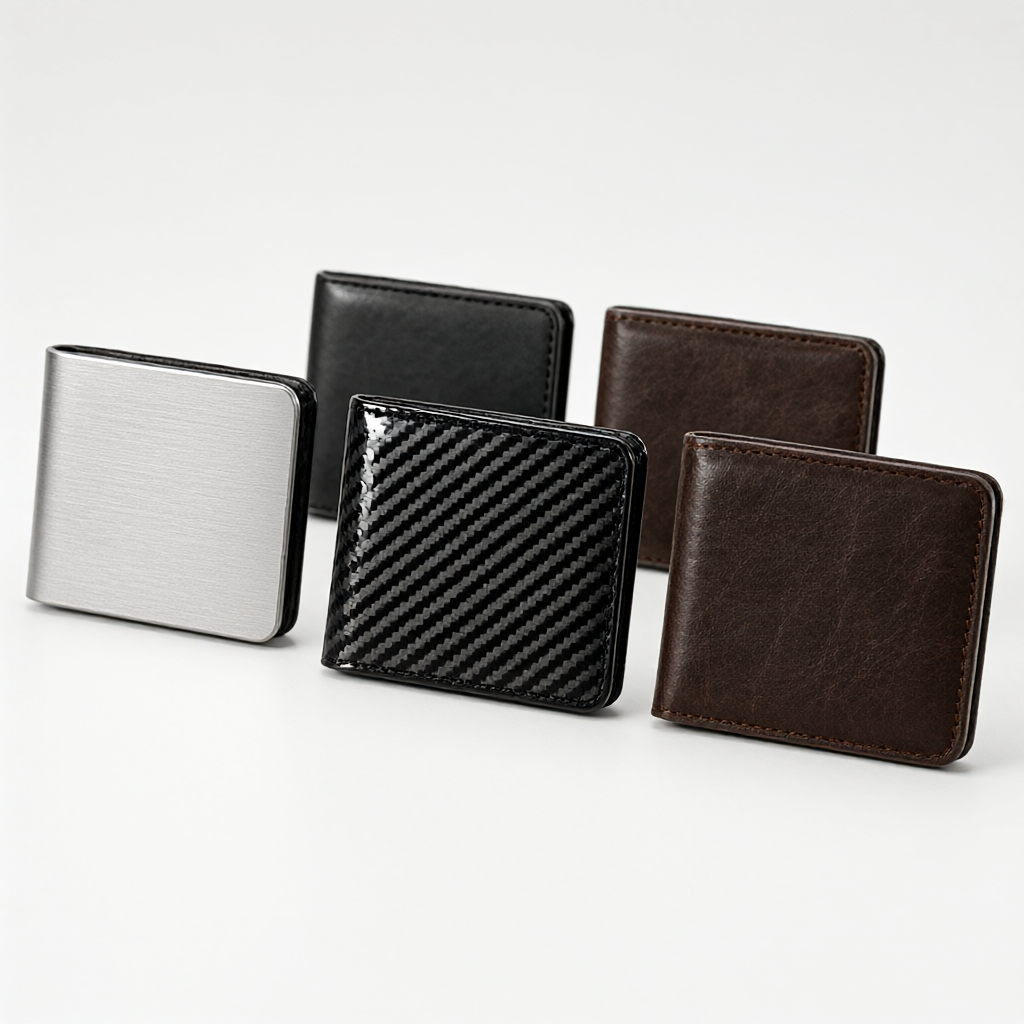
What are the main wallet types and how do they differ?
The five core wallet form factors dominate global wholesale demand:
Bifold wallets fold once vertically, holding cards on the inside panels and a full-size bill compartment between them. They remain the highest-volume category for retail and promotional channels. Typical card capacity runs 6–12 slots plus a cash sleeve. They suit most adult demographics and price tiers.
Trifold wallets fold twice, creating three compact panels. They offer higher card capacity than bifolds but add bulk — usually 14–22 mm thick when loaded. Trifolds appeal to buyers targeting value-conscious consumers who prioritize organization over pocket space, particularly in emerging markets where larger carry capacities matter more than slim profiles.
Cardholder wallets remove the bill compartment entirely. They hold 4–16 cards in fixed slots or elastic loops. Because they eliminate the clunky cash section, cardholders ship thinner (often under 12 mm) and lighter. They overlap heavily with the minimalist wallet category and are especially popular among younger buyers and corporate gift programs. See our card holder sourcing guide for detailed spec comparisons.
Money clip wallets combine a flat back plate with an external spring-clamp strip that holds bills against the wallet face. They typically hold 4–8 cards internally and 10–20 bills externally. Money clips attract buyers in the EDC and tactical segments; they also serve as strong personalization canvases because the front plate is fully visible for engraving or branding.
Slidebar wallets (also called front-pocket or passcase wallets) rest horizontally in the front pocket and slide cards out from the top. They hold 6–15 cards and zero bills in most configurations. Slidebar designs dominate the minimalist and EDC wallet space and are increasingly common for Amazon FBA sellers who market “front pocket” as a lifestyle feature. Read more on EDC wallet manufacturing and sourcing for context on what drives this segment’s growth.
A secondary tier of specialized styles includes clutch wallets (zippered, larger format primarily for women’s product lines), coin purse wallets (integrated zippered coin pockets), and tactical pocket organizers (modular layouts with MOLLE-compatible attachment points). These serve niche B2B buyers such as outdoor brands and uniform suppliers rather than general retail.
How does RFID-blocking work and do I need it?
RFID-blocking wallets incorporate a layer of conductive material — usually ferrite, copper mesh, or nickel-iron alloy — positioned between the card slots and the outer shell. This layer creates a Faraday cage effect that attenuates the 13.56 MHz frequency used by contactless payment cards and e-passports, preventing unauthorized readers from pulling data without physical proximity.
Whether your product needs RFID protection depends on your target market and card penetration rates. The FTC has noted that contactless payment adoption has accelerated across North America and Europe, but the actual risk of remote skimming remains low according to多数 banks and card networks. See FTC guidance on contactless payment security. In practice, European and Middle Eastern distributors often request RFID-blocking as a standard feature due to higher regional contactless transaction volumes. U.S. buyers typically treat it as an optional upgrade unless their end consumer specifically asks for it.
From a manufacturing standpoint, adding RFID lining increases unit cost by roughly $0.15–$0.40 depending on material grade and coverage area. Aluminum and titanium wallets can achieve partial shielding through their conductive enclosures alone, though full certification requires a dedicated liner.
What materials are used in modern wallets and what are the pros and cons?
Material selection is the single biggest driver of wallet positioning, cost, and perceived quality.
Aluminum (typically 6000-series, 5052 or 6061) is the most common metal wallet material for mid-range wholesale. It machines well on CNC equipment, accepts anodized color finishes reliably, and ships lightweight at approximately 35–55 g for a bifold. Drawbacks include dent sensitivity on thin gauges (under 1.5 mm) and a lower perceived luxury tier compared to titanium. Anodized aluminum also conducts temperature, so it feels cold to the touch in winter conditions.
Stainless steel appears mostly in budget-tier promotional wallets where raw brushed finish suffices and weight is less of a concern. At roughly 70–100 g, steel wallets feel substantial but sacrifice the slim profile that defines modern carry preferences.
Titanium (grade 2 or grade 5 Ti-6Al-4V) occupies the premium tier. It offers superior strength-to-weight ratio, excellent corrosion resistance, and a naturally matte finish that resists scratching better than anodized aluminum. Titanium wallets typically weigh 40–65 g and command a 40–80% price premium over aluminum equivalents. Laser engraving on titanium produces a high-contrast dark mark without additional finishing steps, making it ideal for custom logo applications.
Carbon fiber (usually epoxy resin-bonded sheets over an aluminum or polymer substrate) delivers a distinctive technical aesthetic and very high scratch resistance. A typical carbon fiber wallet weighs 25–45 g and costs more than aluminum due to material and lamination labor. The primary limitation is edge durability — impact damage can delaminate the layers if the wallet strikes a hard surface at an angle.
Full-grain and top-grain leather remain relevant for traditional wallet buyers, particularly in men’s formal and business categories. Full-grain leather develops a patina over time and outlasts other leathers, while top-grain offers a more uniform appearance at slightly lower cost. Genuine leather (the lowest USDA-grade designation) is widely used in entry-level promotional products where price dominates the buying decision.
Silicone and TCR (thermoplastic copolymer resin) represent the synthetic extreme. Silicone wallets are waterproof, flexible, and inexpensive to produce via molding. They appeal to sports and outdoor buyers who need a wallet that survives rain, sweat, and sand. However, silicone attracts lint and dust and has limited premium perception in formal retail environments.
Each material demands different tooling and post-processing, which directly affects MOQ thresholds and lead times. Metal wallets require CNC machining and finishing; leather wallets require die-cutting and hand-stitching or gluing; composite wallets involve lamination and curing cycles. For deeper material specifications and sourcing considerations, see our men’s minimalist wallet materials guide.
Are minimalist wallets worth the switch for B2B buyers?
Minimalist wallets — defined as any form factor holding under 12 mm thickness and carrying no more than 12 cards — have grown from a niche EDC segment to a dominant wholesale category since 2020. Market signals include rising Amazon FBA listings tagged “slim wallet,” increasing corporate gift orders for front-pocket solutions, and broader retailer shelf realignment away from bulky bi-fold inventory.
The trade-off is clear: minimalism sacrifices bill storage and card expansion ability for reduced pocket bulge and lighter carry weight. For buyers whose end consumer prioritizes organization and maximum card count, traditional bifolds remain the stronger offering. For buyers whose audience is commuters, tech workers, and style-conscious consumers, minimalist formats capture the majority of current demand growth.
Wallet Types For B2B Buyers: Which Specifications Matter Most?
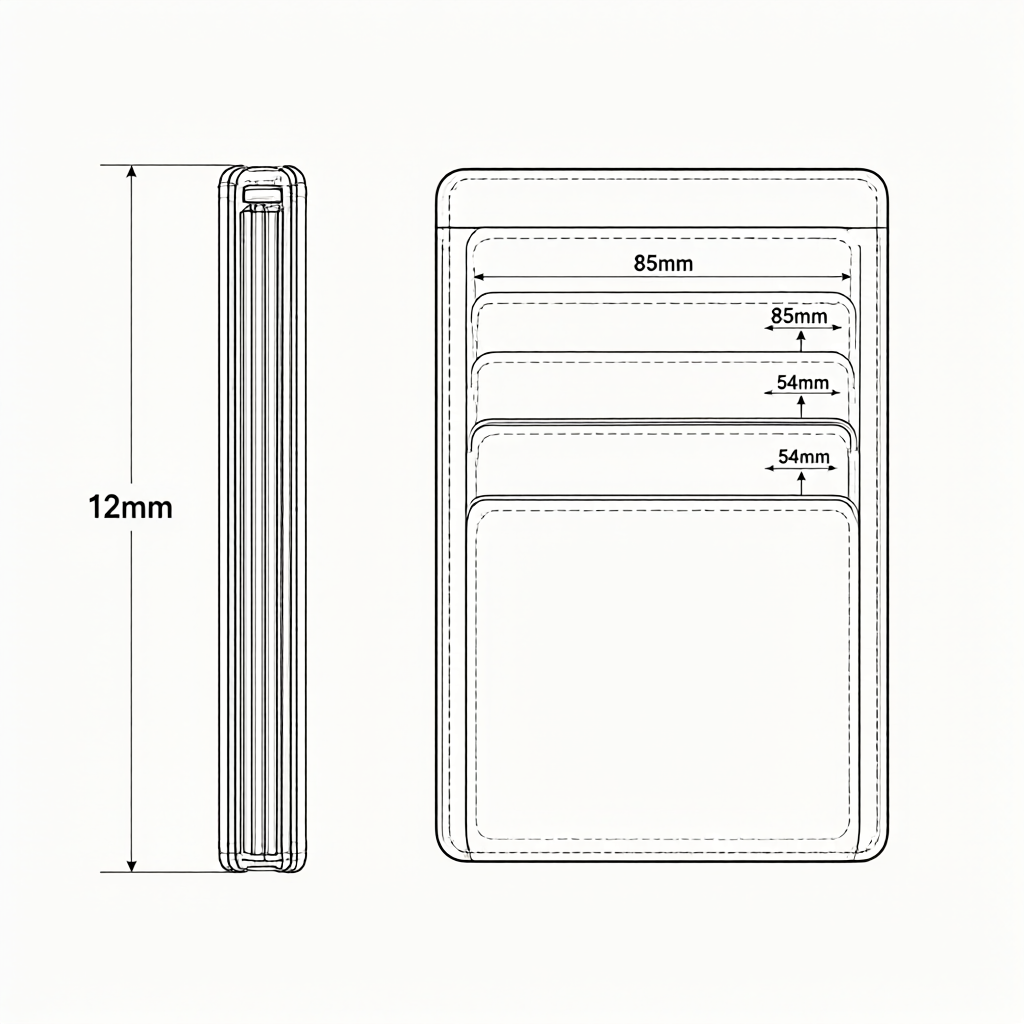
What are the key specs for wallet types?
| Wallet Type | Typical Thickness | Card Capacity | Weight Range | Bill Storage | Common Materials |
|---|---|---|---|---|---|
| Bifold | 12–20 mm | 6–16 slots + cash sleeve | 50–110 g | Yes (full-size) | Leather, aluminum, hybrid |
| Trifold | 14–22 mm | 12–24 slots | 70–130 g | Yes (full-size) | Leather, synthetic, mixed |
| Cardholder | 6–12 mm | 4–16 slots | 25–60 g | No | Metal, carbon fiber, leather |
| Money Clip | 8–14 mm | 4–8 slots + external clip | 35–75 g | Yes (external clip) | Metal, leather-overlay |
| Slidebar | 8–14 mm | 6–15 cards (top-load) | 30–65 g | No | Aluminum, titanium, composite |
| Minimalist EDC | 6–12 mm | 4–12 cards | 20–50 g | Optional (elastic loop) | Metal, carbon fiber, silicone |
Dimensions note: “Slim” and “minimalist” are unregulated marketing terms. Industry-standard reference thickness for a loaded slim wallet is under 12 mm; anything above 15 mm is generally classified as standard or traditional. When specifying for manufacturing, always measure both empty and loaded states because card-count compression varies significantly between rigid slot designs and弹性-loop card holders.
What are the typical customization capabilities per material?
Metal wallets accept laser engraving, CNC milling, UV printing, and electroplating. Laser engraving is the most common B2B branding method for aluminum and titanium; it produces permanent marks suitable for logos, monograms, and QR codes. Aluminum also supports full-color anodizing (limited to solid hues; gradients require post-processing).
Carbon fiber wallets are typically branded via laser engraving on the overlay layer or through pad printing on the back panel. The weave pattern itself cannot be altered, so branding relies on contrast between the engraved area and the visible fiber surface.
Leather wallets support embossing, debossing, hot stamping (foil), and screen printing. Embossing depth is generally 0.3–0.8 mm depending on leather grain and press pressure. These methods suit smaller quantities and slower turnaround than metal laser processes.
Silicone wallets accept pad printing or two-shot molding for integrated color和品牌 patterns, though registration precision is lower than on rigid substrates.
Wallet Types For B2B Buyers: Which Standards and Certifications Apply?
What standards and certifications should B2B buyers look for?
Procurement decisions should verify three areas: facility quality management, product safety compliance, and ethical sourcing audits.
ISO 9001 certification confirms that the manufacturer maintains a documented quality management system covering design control, incoming material inspection, in-process checks, and final verification. It does not certify product performance, but it signals process maturity.
BSCI (Business Social Compliance Initiative) audit covers labor practices, working hours, wages, and health and safety conditions in the factory. Many European and North American distributors require BSCI or equivalent social-audit documentation before onboarding new suppliers.
REACH and RoHS compliance are mandatory for products entering the European Economic Area. REACH regulates chemical substances in materials (including dyes, adhesives, and plating solutions); RoHS restricts lead, cadmium, mercury, and certain flame retardants in manufactured goods. Material test reports from SGS or equivalent laboratories provide verifiable evidence of compliance. These standards apply equally to metal, leather, and synthetic wallet components.
ASTM International publishes several testing standards relevant to wallet materials and durability, including pull-force ratings for stitching and adhesion benchmarks for laminated composites. Relevant ASTM references include ASTM E2092 for material testing methodologies. Buyers requesting third-party lab verification should ask suppliers to provide current test certificates rather than relying solely on in-house claims.
When evaluating potential manufacturers, ask for copies of active ISO and BSCI certificates, recent REACH/RoHS test summaries for each material line you intend to order, and the supplier’s internal QC flow for incoming and outgoing inspections.
Wallet Types For B2B Buyers: What Else Should Buyers Consider?
What factors should influence a buyer’s choice of wallet type?
The decision matrix breaks down into seven variables:
- Target customer profile. Corporate gift buyers favor branded metal cardholders and money clips because engraving looks professional and units ship compactly. Amazon FBA sellers gravitate toward minimalist slidebar and EDC wallets due to size-driven shipping economics and fast trend cycles. Promotional distributors prioritize low-MOQ leather or aluminum bifolds at aggressive price points. Outdoor and sports brands select silicone or rugged titanium options.
- Price tier and margin structure. Entry-level wallets (promotional pricing under $5 FOB) rely on stamped aluminum or genuine leather. Mid-tier ($5–$15 FOB) supports CNC-machined aluminum and carbon fiber constructions. Premium ($15–$40+ FOB) encompasses titanium, full-grain leather with hand-finishing, and multi-material hybrid builds. Each tier carries different MOQ expectations and lead time windows.
- Minimum order quantity feasibility. High-complexity custom wallets with multi-step finishing (CNC + anodizing + laser engraving + custom packaging) typically require MOQs of 500–1,000 pieces to amortize setup costs. Simpler designs like stock cardholders with a single-color anodize run can accept MOQs as low as 300–200 units. Establish your volume commitment before selecting a manufacturer capable of matching it.
- Lead time expectations. Standard production runs for off-the-shelf designs typically complete in 15–25 business days after artwork approval. Custom designs requiring new jigs, molds, or color development extend timelines to 30–45 days. Sample iterations usually take 5–10 business days for proofing and 10–15 days for pre-production samples. Expedited timelines are possible at premium freight and labor costs.
- Regulatory destination requirements. Products heading to the EU require REACH/RoHS documentation and CE marking if applicable. Products destined for North America should meet CPSIA guidelines for accessible components and FTC labeling standards. Specialty destinations may impose additional restrictions on heavy metals in platings or certain adhesive chemistries.
- Branding complexity. Simple single-color laser engraving works across nearly all wallet types. Full-color UV printing requires flat, non-porous surfaces (metal, coated composites) and cannot render photographic detail on textured leather or carbon fiber weaves. Embossed logos require a minimum depth specification and a hard substrate. Plan your branding method early — it affects material selection and tooling requirements.
- Packaging and fulfillment model. Retail-ready boxes with window displays add $0.25–$0.75 per unit depending on complexity. Bulk polybag packaging is the baseline and adds negligible cost. Amazon FBA compliance requires specific labeling, barcode placement, and bundling protocols that your supplier should understand or coordinate with your logistics partner. For specialized product formats beyond wallets, consult our money bag sourcing guide or wristlet specification guide for comparable B2B frameworks.
How do these specifications translate into manufacturing standards?
Understanding wallet types is only useful when paired with a clear evaluation of how manufacturers deliver them. Buyers should assess suppliers against concrete capability criteria rather than generic marketing claims. For example, an OEM partner with in-house CNC machining can accommodate rapid iteration on metal wallet prototypes without outsourcing to third-party job shops, reducing both timeline risk and communication friction. Similarly, a facility holding ISO 9001 certification demonstrates structured document control and repeatable inspection procedures — factors that directly affect defect rates on production runs exceeding 1,000 units.
As a manufacturer operating since 2014, we align our processes to these same benchmarks: in-house CNC machining for metal wallets, laser engraving and UV printing for branding, anodizing and surface finishing for aluminum and titanium components, and REACH/RoHS–compliant material sourcing verified through SGS testing. Our BSCI-audited facility and ISO 9001 certification reflect the standards described above, and our workflow supports OEM, ODM, private-label, and custom-design projects with MOQs starts at 300 pcs per SKU for full OEM customization (100 pcs trial order available for stock finishes) and sample delivery within 7 days.
Wallet Types For B2B Buyers: What Should You Know First?
Wallet types for B2B buyers fall into distinct categories defined by form factor, material, feature set, and use case — each with its own manufacturing process, certification requirements, and cost structure. Understanding how minimalist cardholders differ from traditional bifolds, how RFID-blocking works at the material level, and which quality standards matter most for your target market is essential before committing to a sourcing decision. This guide breaks down every major wallet type, the materials behind them, the certifications your supplier should hold, and a practical procurement framework to help you choose the right format for your brand.
What lifestyle-specific wallet types should B2B buyers consider?
Beyond form factor and material, wallet buyers increasingly segment products by the end-user’s lifestyle and daily context. Lifestyle-driven segmentation directly influences material choice, durability requirements, and marketing positioning.
Daily carry (EDC) wallets prioritize slim profiles, front-pocket usability, and lightweight construction. Buyers in this segment favor aluminum slidebar designs, carbon fiber cardholders, and titanium money clips — all engineered to minimize pocket bulge while maximizing card access speed. These wallets typically target men aged 22–45 who carry smartphones as their primary device and keep minimal cash.
Formal and business wallets cater to professionals who attend meetings, present in suits, and value refined aesthetics. Full-grain leather bifolds and trifolds dominate this category, often featuring hand-stitched edges, embossed logos, and interior organizational layouts with dedicated bill compartments. Business gift programs frequently order these in quantities of 500–5,000 units with custom foil stamping or debossing for corporate identity consistency.
Sports and outdoor wallets demand water resistance, impact tolerance, and flexibility. Silicone and TCR (thermoplastic copolymer resin) wallets are the default for this segment due to their inherent waterproof properties and shock absorption. Titanium and ruggedized aluminum variants also serve outdoor enthusiasts who need corrosion resistance against sweat, saltwater exposure, and UV degradation. Buyers targeting this market should specify IPX-rated materials and request drop-test documentation from suppliers.
Travel and adventure wallets combine compact form factors with enhanced security features such as RFID-blocking liners, anti-theft hidden compartments, and durable locking mechanisms. Metal wallets with integrated RFID shielding are particularly popular among travelers because they address both electronic theft concerns and physical pickpocket risks simultaneously.
| Lifestyle Segment | Preferred Wallet Types | Key Material | Typical FOB Range | Core Feature Priority |
|---|---|---|---|---|
| Daily Carry (EDC) | Slidebar, minimalist cardholder, money clip | Aluminum, titanium, carbon fiber | $3.50–$12.00 | Slim profile, fast card access |
| Formal / Business | Bifold, trifold, executive cardholder | Full-grain leather, hybrid metal-leather | $4.00–$18.00 | Refined finish, logo placement |
| Sports / Outdoor | Silicone wallet, tactical organizer, rugged metal | Silicone, TCR, grade 5 titanium | $2.50–$10.00 | Waterproof, impact resistant |
| Travel / Adventure | RFID-blocking metal wallet, secure-clip design | Aluminum with ferrite liner, titanium | $5.00–$15.00 | Anti-skim protection, durability |
This lifestyle framework helps buyers align product specs with their end consumer’s actual carrying habits rather than selecting based solely on price or appearance. For broader context on EDC wallet trends and manufacturing drivers, see our men’s minimalist wallet materials guide.
How do customization options vary by wallet type?
Customization capability differs significantly across wallet formats due to material constraints, surface geometry, and production method compatibility.
Laser engraving is the most versatile B2B branding method and works across metal wallets (aluminum, titanium, stainless steel) and carbon fiber overlays. On aluminum, standard fiber laser engraving at 20–50 W power produces a permanent dark oxide mark suitable for logos, serial numbers, QR codes, and decorative patterns. On titanium, the same process yields a high-contrast black or gold-toned mark depending on pulse frequency settings. Engraving depth typically ranges from 0.02–0.05 mm, ensuring the mark sits within the anodized layer without compromising structural integrity. Resolution achievable is up to 0.1 mm line width, sufficient for fine typography and intricate brand marks.
Anodizing color customization applies exclusively to aluminum wallets. The standard process involves electrochemical oxidation in sulfuric acid bath at 12–18 V DC, producing an anodic oxide layer 10–25 µm thick depending on target color depth and durability requirements. Aerospace-grade Type III hardcoat anodizing reaches 50+ µm for maximum scratch resistance but limits color palette to darker tones (black, gunmetal, bronze). Standard Type II anodizing in the 10–25 µm range supports the full PANTONE-inspired color spectrum including blues, reds, greens, and metallic finishes.
UV printing enables full-color photorealistic graphics on flat or mildly curved metal surfaces. This process uses ultraviolet-cured ink jets depositing CMYK + white layers that cure instantly under UV lamps. UV print resolution reaches 1440 dpi minimum, making it suitable for complex artwork, gradient backgrounds, and multi-tone brand illustrations. However, UV-printed surfaces require a clear top-coat sealant for scratch and chemical resistance during normal use.
Embossing and debossing are exclusive to leather wallets. Embossing raises the logo above the leather surface (0.3–0.8 mm height), while debossing presses it below. Both methods require custom steel dies costing $150–$400 one-time, making them economical only for orders exceeding 500 units. Hot foil stamping adds metallic color options (gold, silver, copper) at a slight additional die cost.
Pad printing and injection molding apply to silicone wallets. Pad printing transfers silicone-safe inks onto flexible substrates with moderate registration accuracy (±0.3 mm). Two-shot overmolding integrates contrasting colors during the injection phase, eliminating post-production branding steps entirely but requiring higher initial tooling investment.
| Wallet Type | Laser Engraving | Anodizing Colors | UV Printing | Embossing/Debossing | Pad Printing | One-Time Tooling Cost |
|---|---|---|---|---|---|---|
| Aluminum | ✅ 20–50 W, 0.02–0.05 mm depth | ✅ 10–25 µm Type II / 50+ µm Type III | ✅ 1440 dpi + clear coat | ❌ | ❌ | ~$100–$200 (jig) |
| Titanium | ✅ High contrast, 0.02–0.05 mm | ❌ (natural finish only) | ⚠️ Limited adhesion | ❌ | ❌ | ~$100–$200 (jig) |
| Carbon Fiber | ✅ Through overlay layer | ❌ | ⚠️ Substrate-dependent | ❌ | ❌ | ~$100–$200 (jig) |
| Leather | ⚠️ Surface scorch risk | ❌ | ❌ | ✅ 0.3–0.8 mm, steel die | ❌ | $150–$400 (steel die) |
| Silicone | ❌ | ❌ | ❌ | ❌ | ✅ ±0.3 mm register | ~$300–$800 (mold) |
Buyers should confirm each branding method’s feasibility, lead time impact, and per-unit cost addition during the RFQ stage. Custom packaging — including retail boxes, hang tags, and poly bags with printed branding — represents another significant customization lever that typically adds $0.08–$0.35 per unit depending on complexity and order volume. See our EDC wallet manufacturing sourcing guide for more on packaging and branding workflows.
What manufacturing processes define quality wallet production?
Understanding the actual production steps behind wallet manufacturing helps buyers evaluate supplier claims and set realistic quality expectations.
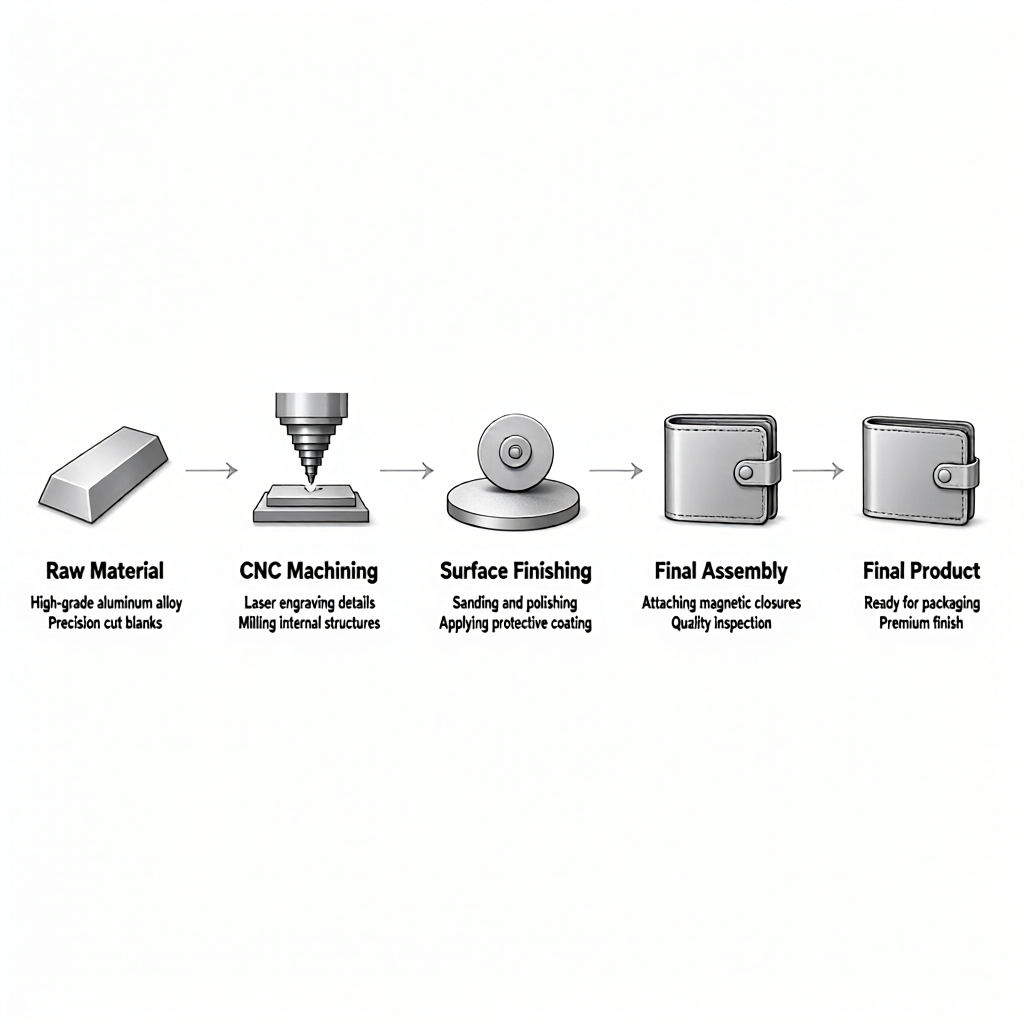
CNC machining is the core process for metal wallets. Aircraft-grade aluminum billets (6061-T6 or 5052-H32) are mounted on 3-axis or 5-axis CNC mills. Typical machining tolerances for wallet bodies are ±0.05 mm on critical dimensions (card slot widths, hinge attachment points) and ±0.1 mm on non-critical exterior surfaces. Edge radii are commonly specified at R0.5–R1.0 mm for safe handling. Post-machining, parts undergo deburring and ultrasonic cleaning to remove residual cutting fluid and metal particulates before surface finishing.
Anodizing follows CNC for colored aluminum wallets. Parts are immersed in a sulfuric acid electrolyte bath at 15–18 °C and subjected to 12–18 V DC current. The electrochemical reaction grows an porous aluminum oxide layer that absorbs dye before being sealed in hot deionized water at 95–98 °C for 30–60 minutes. Seal quality determines long-term colorfastness and corrosion resistance; proper sealing closes pore structures to prevent dye leaching during日常 exposure.
Laser engraving for branding uses fiber laser systems operating at 1064 nm wavelength. For aluminum, typical settings are 30–40 W output power, 40–60% speed, and 2000–4000 Hz pulse frequency, producing clean, readable marks in 3–8 seconds per unit. Titanium engraving requires lower power (15–25 W) and slower speed to achieve optimal contrast without excessive material removal.
Leather crafting involves die-cutting blank shapes from hide sheets using hydraulic presses with custom steel dies. Edges are then hand-beveled, sanded, and painted or burnished for a finished appearance. Stitching uses bonded nylon thread (typically Tex 70 or Tex 138) with stitch density of 8–12 stitches per inch for durability. Adhesive bonding employs solvent-free polyurethane glues compliant with REACH regulations.
QC inspection流程 at reputable factories includes incoming material verification (mill certificates for metals, leather grading checks), in-process dimension checks at each machining stage, and final 100% visual inspection with functional tests (card insertion/removal force, clip tension, hinge cycle testing). Random AQL sampling at Level II with acceptable quality limits of 2.5% for major defects and 4.0% for minor defects is industry-standard practice for outgoing shipments.
These process controls directly influence defect rates, lead time consistency, and long-term product reliability — factors that separate contract manufacturers capable of scale from hobby-level operations.
What procurement decision framework should B2B buyers follow?
Selecting the right wallet supplier requires evaluating multiple dimensions beyond unit price alone. The following framework covers six critical decision factors with industry benchmarks:
MOQ (Minimum Order Quantity): Entry-level suppliers accept 100–300 units per SKU for custom runs, while larger manufacturers may require 500–1,000 units to justify setup costs. Low-MOQ suppliers typically charge 10–20% higher per-unit prices to compensate for reduced machine efficiency. Buyers should negotiate tiered pricing that drops 8–15% at 500-unit increments and 15–25% at 1,000-unit volumes.
Lead Time: Sample development averages 5–10 business days for off-the-shelf modifications and 15–25 days for fully custom designs involving new tooling. Mass production lead time ranges from 15–25 days for standard configurations to 30–45 days for complex multi-material builds with custom packaging. Express prototyping (3–5 day samples) is available from select manufacturers at a 25–40% surcharge.
Tooling Costs: Custom CNC fixtures and jigs run $100–$300 per wallet type. Steel embossing dies for leather cost $150–$400 one-time. Injection molds for silicone wallets require $800–$2,500 investment and are rarely recouped unless order volume exceeds 10,000 units. Most manufacturers waive or credit tooling fees against production orders above a threshold quantity.
Per-Unit Price Ranges by Material:
| Wallet Material | 300–500 units | 500–1,000 Units | 1,000–5,000 Units | 5,000+ Units |
|---|---|---|---|---|
| Aluminum (anodized) | $3.50–$6.00 | $2.80–$4.50 | $2.20–$3.80 | $1.80–$3.00 |
| Stainless steel (brushed) | $2.50–$4.50 | $2.00–$3.50 | $1.60–$2.80 | $1.30–$2.20 |
| Titanium (grade 2) | $8.00–$15.00 | $6.50–$12.00 | $5.50–$10.00 | $4.50–$8.00 |
| Carbon fiber composite | $5.00–$9.00 | $4.00–$7.00 | $3.20–$5.50 | $2.80–$4.50 |
| Full-grain leather | $4.00–$12.00 | $3.20–$9.00 | $2.50–$7.00 | $2.00–$5.50 |
| Silicone / TCR | $2.00–$4.50 | $1.60–$3.50 | $1.30–$2.80 | $1.00–$2.20 |
Prices are approximate FOB China excluding shipping, customs duties, and custom packaging.
Certification Verification: Request active ISO 9001:2015 certificates valid for the current calendar year, BSCI audit reports not older than 12 months, and SGS or equivalent lab test reports confirming REACH compliance (SVHC substance lists) and RoHS directive adherence (lead < 0.1%, cadmium < 0.01%, mercury < 0.1% per homogeneous material). For RFID-blocking wallets, ask for third-party attenuation test results showing ≥ 20 dB signal reduction at 13.56 MHz — this is the benchmark cited by ASTM International for effective contactless payment card shielding.
Logistics and Fulfillment Options: Evaluate whether your supplier offers Amazon FBA prep services (polybagging, labeling, carton consolidation), direct drop shipping to end customers, or warehouse staging for mixed-SKU container loads. These value-added logistics services reduce your operational burden and accelerate time-to-market for retail distribution channels.
How TOP EDC Wallet Meets These B2B Sourcing Standards?
As a manufacturer specializing in minimalist EDC wallets and pocket gear since 2014, we operate a 50,000 sq ft facility equipped with in-house CNC machining centers, fiber laser engravers, anodizing lines, and assembly workstations — meaning every step from raw billet to finished package happens under one roof. We hold ISO 9001 certification and maintain BSCI-audited operations, with all materials tested against REACH and RoHS requirements before production begins.
Our approach to B2B wallet sourcing starts with understanding your target market and working backward from there. Whether you need 100 custom-engraved aluminum cardholders for a corporate gift program, 2,000 RFID-blocking titanium money clips for an Amazon FBA launch, or a full private-label collection spanning metal, carbon fiber, and leather SKUs, we handle OEM and ODM development with low MOQs starting at just 300 pieces and sample turnaround in 7 days.
We’ve supported over 200 brands across North America, Europe, Australia, and Southeast Asia — helping them move from concept drawings to shelf-ready products with full branding, packaging, and compliance documentation. If you’re evaluating suppliers for your next wallet order, here is how we meet the standards outlined above, and we would welcome the opportunity to discuss your specification.
How are wallets manufactured and what processes apply to each type?
Wallet production varies significantly by material and form factor. Understanding these processes helps buyers evaluate lead times, quality control points, and cost drivers.
Metal wallets (aluminum, titanium, stainless steel) follow a precision machining workflow. Raw billet or sheet stock is CNC-milled to final dimensions, then undergoes surface finishing — typically abrasive blasting followed by anodizing for aluminum or passivation for titanium. Components are assembled using rivets, pins, or adhesive bonding. Laser engraving applies logos and markings post-finishing. Tolerances for premium metal wallets are held to ±0.1 mm; thickness consistency directly affects card ejection smoothness and overall feel.
Carbon fiber wallets require lamination manufacturing. Pre-preg carbon sheets are cut to shape, bonded to an aluminum or polymer core substrate under heat and pressure, then trimmed and polished. Edges must be sealed to prevent delamination. This process demands longer cure cycles and skilled labor, which explains the higher unit cost compared to machined metal alternatives.
Leather wallets use die-cutting rather than CNC machining. Layer patterns are stamped from hide sheets, edges are beveled and burnished, then panels are stitched or adhesive-bonded together. Cash sleeves and card slots are hand-inserted. Quality variation depends heavily on leather grade selection and operator skill.
Silicone/TCR wallets are produced via injection molding. Liquid silicone rubber is injected into steel molds at controlled temperatures, then cured and trimmed. This enables complex shapes at low per-unit cost but requires significant upfront tooling investment ($2,000–$8,000 per mold set).
What standards govern RFID-blocking and wallet durability?
RFID-blocking performance should reference recognized testing frameworks. ISO/IEC 14443 defines the proximity card operating principles for 13.56 MHz contactless smart cards — the same frequency used by credit cards, e-passports, and transit passes. Effective RFID shielding must attenuate signal strength by at least 20 dB at this frequency to prevent unauthorized read attempts. Manufacturers should provide test reports demonstrating compliance rather than relying on unverified claims.
For physical durability, ASTM D5034 covers tensile strength testing of fabrics (relevant for leather and synthetic wallet exteriors), while ASTM F1675 addresses penetration resistance that may apply to tactical wallet designs. MIL-STD-810H provides ruggedization guidelines for extreme temperature, shock, and vibration — standards often referenced by outdoor and EDC brands requiring field-tested gear.
Buyers should request: (1) RFID attenuation test certificates from SGS or Intertek, (2) ISO 9001 facility documentation, (3) REACH/RoHS material safety reports, and (4) BSCI audit summaries if exporting to Europe. These documents should be no older than 12 months and cover the exact product lines being sourced.
Procurement Decision Framework: Choosing Wallet Types by Market Segment
| Buyer Profile | Recommended Wallet Type | Target MOQ | FOB Range | Margin Expectation | Key Supplier Requirements |
|---|---|---|---|---|---|
| Amazon FBA sellers | Slidebar, minimalist cardholder | 500–1,000 pcs | $3.50–$8.00 | 45–65% | Fast sampling, FBA prep, RGB color matching |
| Corporate gift buyers | Metal cardholder, money clip | 100–500 pcs | $4.00–$12.00 | 30–50% | Logo engraving, premium packaging, brand alignment |
| Promotional distributors | Aluminum bifold, silicone wallet | 1,000–5,000 pcs | $1.50–$4.50 | 20–40% | Low price, quick turnaround, basic branding |
| Outdoor/EDC brands | Titanium wallet, tactical organizer | 200–500 pcs | $12.00–$35.00 | 50–70% | Durability testing, custom finishes, small batch flexibility |
| Retail chains | Hybrid leather-metal wallet | 2,000+ pcs | $5.00–$15.00 | 35–55% | Consistent quality, retail-ready packaging, volume capacity |
This framework aligns wallet selection with commercial objectives. High-margin, low-volume buyers should prioritize manufacturers with flexible MOQs and rapid prototyping. Volume-driven buyers should verify production capacity and QC consistency before committing.
Industry Case Study: Custom Titanium Wallet for EDC Brand
A European EDC brand partnered with TOP EDC Wallet to develop a premium titanium slidebar wallet. The order required:
- Material: Grade 5 Ti-6Al-4V, 1.2 mm thickness
- MOQ: 300 units (custom design)
- Branding: Laser-engraved logo on front plate, custom retail box with magnetic closure
- Lead time: 7-day sample approval, 25-day production
- Unit cost: $18.50 FOB Shenzhen
- Final retail price: $65.00 USD
The brand achieved a 71% gross margin after shipping and duties. Post-launch sales exceeded 2,000 units in the first quarter across Amazon EU and direct-to-consumer channels. Success factors included tight tolerances on card-ejection spring tension, consistent anodized color matching across batches, and pre-shipment inspection confirming zero defects in the first 50-unit random sample.
Buyer Checklist: What to Verify Before Placing Orders
Before signing contracts with wallet manufacturers, confirm the following:
MOQ & Sampling
- [ ] Minimum order quantity aligned with your budget and shelf space
- [ ] Sample lead time (standard: 5–7 days; rush: 3–5 days at premium)
- [ ] Sample cost and whether it’s deductible from bulk orders
- [ ] Number of revision rounds included before final approval
Quality Control
- [ ] Incoming material inspection protocol (aluminum alloy certs, leather grades)
- [ ] In-process checks during CNC machining and assembly
- [ ] Final random inspection criteria (AQL 0.65 standard recommended)
- [ ] Defect rate guarantee and replacement policy
Compliance Documentation
- [ ] ISO 9001 certificate (current, covering relevant product categories)
- [ ] BSCI audit report if selling in Europe
- [ ] REACH/RoHS test reports for all materials
- [ ] RFID-blocking certification from accredited lab (if applicable)
Production & Logistics
- [ ] Monthly production capacity verification
- [ ] Packaging options (retail box, polybag, custom insert)
- [ ] Drop-shipping and FBA prep capabilities
- [ ] Incoterms clarity (FOB, EXW, or CIF)
Brand Protection
- [ ] Non-disclosure agreement for custom designs
- [ ] Exclusive molding rights if investing in custom tooling
- [ ] Brand guidelines adherence confirmation
Manufacturer Comparison: How Specialized Suppliers Meet B2B Needs
When selecting a manufacturing partner, buyers should evaluate capability against their specific requirements. Here is how specialized producers approach common B2B scenarios.
TOP EDC Wallet operates as a contract manufacturer specializing in minimalist EDC wallets and pocket gear. Since establishing operations in 2014, the company has developed expertise across aluminum, carbon fiber, and titanium wallet production. Their 50,000 sq ft facility supports 500,000+ units monthly while maintaining ISO 9001 quality management and BSCI social compliance standards.
The company serves over 200 brands across North America, Europe, Australia, and Southeast Asia through OEM, ODM, and private-label programs. Their in-house CNC machining enables precise metal wallet fabrication, while laser engraving and UV printing support custom branding. Anodizing capabilities cover standard colors plus custom PMS-matched finishes for brand consistency.
Low MOQ starts at 300 pcs per SKU allows emerging brands to validate market demand without excessive inventory risk. A 7-day sample lead time accelerates product development cycles, and full customization from logo placement to retail packaging supports complete brand integration.
Wallet Types For B2B Buyers: Where Can You Verify the Data and Sources?
- See FTC guidance on contactless payment security — www.ftc.gov
- ASTM E2092 — www.astm.org
- card holder sourcing guide — topedcwallet.com
- EDC wallet manufacturing and sourcing — topedcwallet.com
- men’s minimalist wallet materials guide — topedcwallet.com
- money bag sourcing guide — topedcwallet.com
- wristlet specification guide — topedcwallet.com
- Get a Free Quote → — topedcwallet.com
From article to product
Sourcing minimalist-wallets?
Tell us the format, the quantity and the date you need stock. You get material options, MOQ and a landed-cost range back within one business day.
Keep reading
More on wallet types
Thin Male Wallets: Buying Guide for Slim Minimalist Picks
How to choose a slim wallet for men — thickness thresholds, material trade-offs, capacity…
ReadStashed Wallet: A Minimalist Everyday-Carry Solution
Understand what a stashed wallet is, how minimalist slim wallets work, and what to…
ReadFolding Wallets: Types, Materials & Buying Guide
Learn what makes a folding wallet worth buying, from materials and card capacity to…
Read
About the author
TOPWALLET Editorial Team
TOPWALLET's editorial and engineering desk writes from bench testing at the Shenzhen (Longgang) facility: pull-force and cycle testing, 13.56 MHz shielding measurements, finish trials and factory audits, rather than supplier spec sheets. Every specification in these guides is one we write on a purchase order.
Written on the floor
This article was written by our production and QC team — the people who spec tolerances, run the finishing line and inspect every batch. Where it states a capacity, a pull force or a lead time, it comes from a measurement we made, not a supplier’s catalogue. If a number here disagrees with what your own supplier told you, tell us; several of these articles started as a correction from a buyer.
See how the factory works · Inspection process · Sourcing FAQ
Sourcing minimalist-wallets?
Tell us the format, the quantity and the date you need stock. You get material options, MOQ and a landed-cost range back within one business day.