
Brand Playbook · 9 min read
Wallet Pricing Strategy 2026: From Factory Cost to Retail Price, Without Guessing

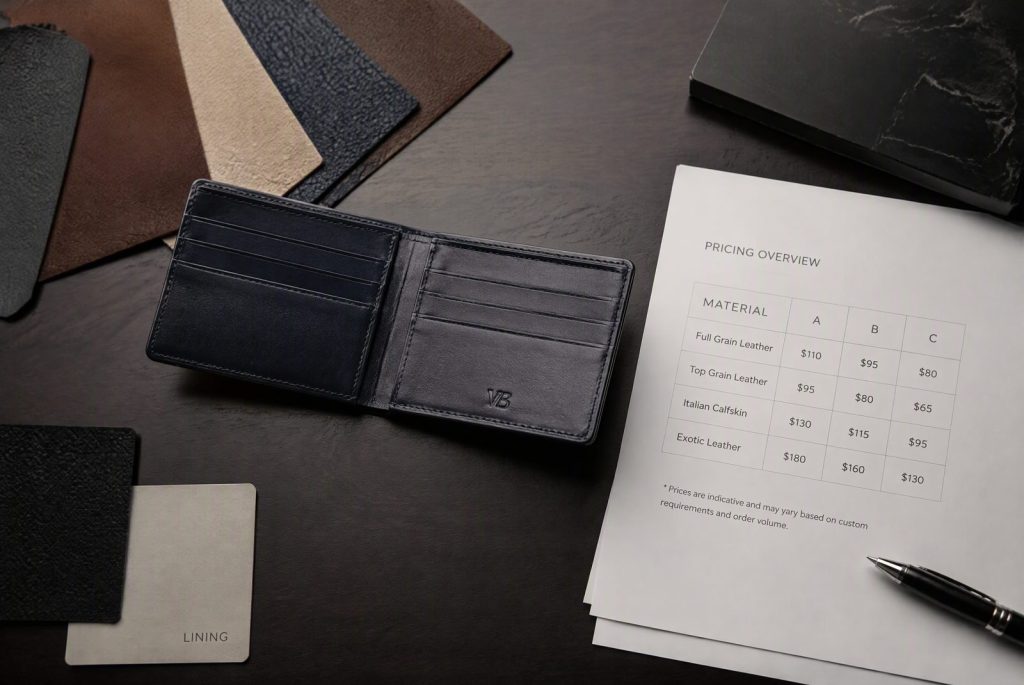
Wallet pricing looks simple until you map it: the same slim aluminum wallet can retail for $30 or $160 depending on material grade, finish, brand story, and channel. This guide breaks down how a wallet's price is actually built — factory cost layers, retail markup math, per-material price bands, and the pricing models that work for DTC brands and B2B suppliers in 2026. Figures for retail products are market estimates from official retail listings; factory figures are from manufacturer-direct specs [1][2].
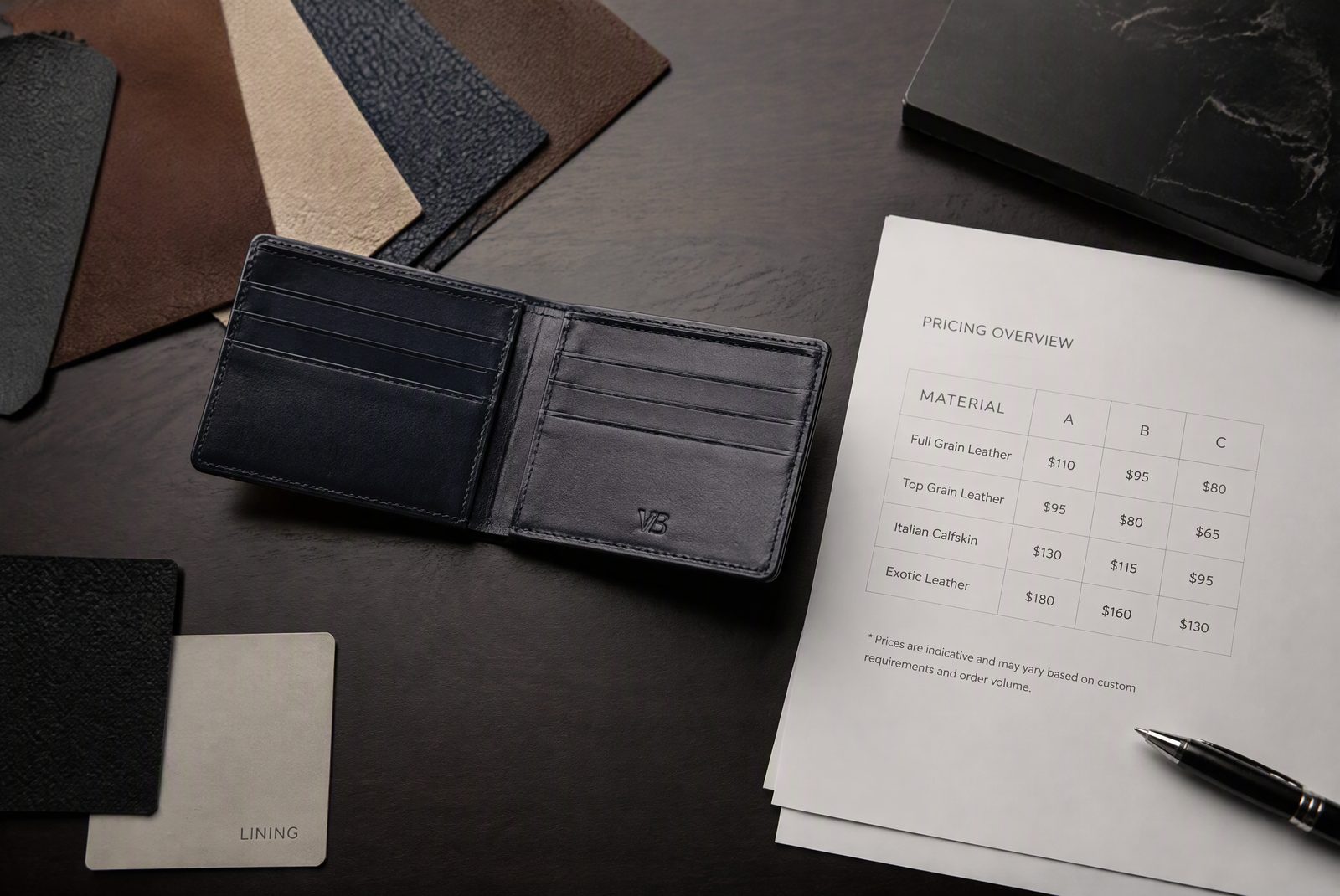
Wallet Pricing Strategy: How Do the Options Compare Side by Side?
| # | Pick | Price Range (Retail est.) | Typical Factory Cost | Channel | Best For |
|---|---|---|---|---|---|
| 1 | TOPWALLET factory-direct pricing | From factory quotes [1] | Raw material + finishing + labor [1] | OEM/wholesale B2B [1] | Brands that want margin control |
| 2 | G star wallet OEM pricing | From factory quotes [2] | Volume-scaled, 8-dim. customization [2] | OEM/wholesale B2B [2] | High-volume lines, certified QC |
| 3 | Slim aluminum wallets (generic) | $25–$50 (est.) | Low-tolerance CNC China [3] | Retail/dropship | Entry-level price wins |
| 4 | Ridge-style aluminum wallets | $100–$165 (est.) [4] | Mid+ CNC + finishing [4] | Retail | Design-premium segment |
| 5 | Bellroy leather wallets | $79–$149 (est.) [5] | Full-grain leather + craft [5] | Retail | Material-premium segment |
| 6 | Ekster aluminum/leather RFID | $59–$159 (est.) [6] | Assembled RFID + slider [6] | Retail | Feature-premium segment |
| 7 | Trayvax steel/canvas | $40–$105 (est.) [7] | Steel + leather/canvas [7] | Retail | Rugged niche |
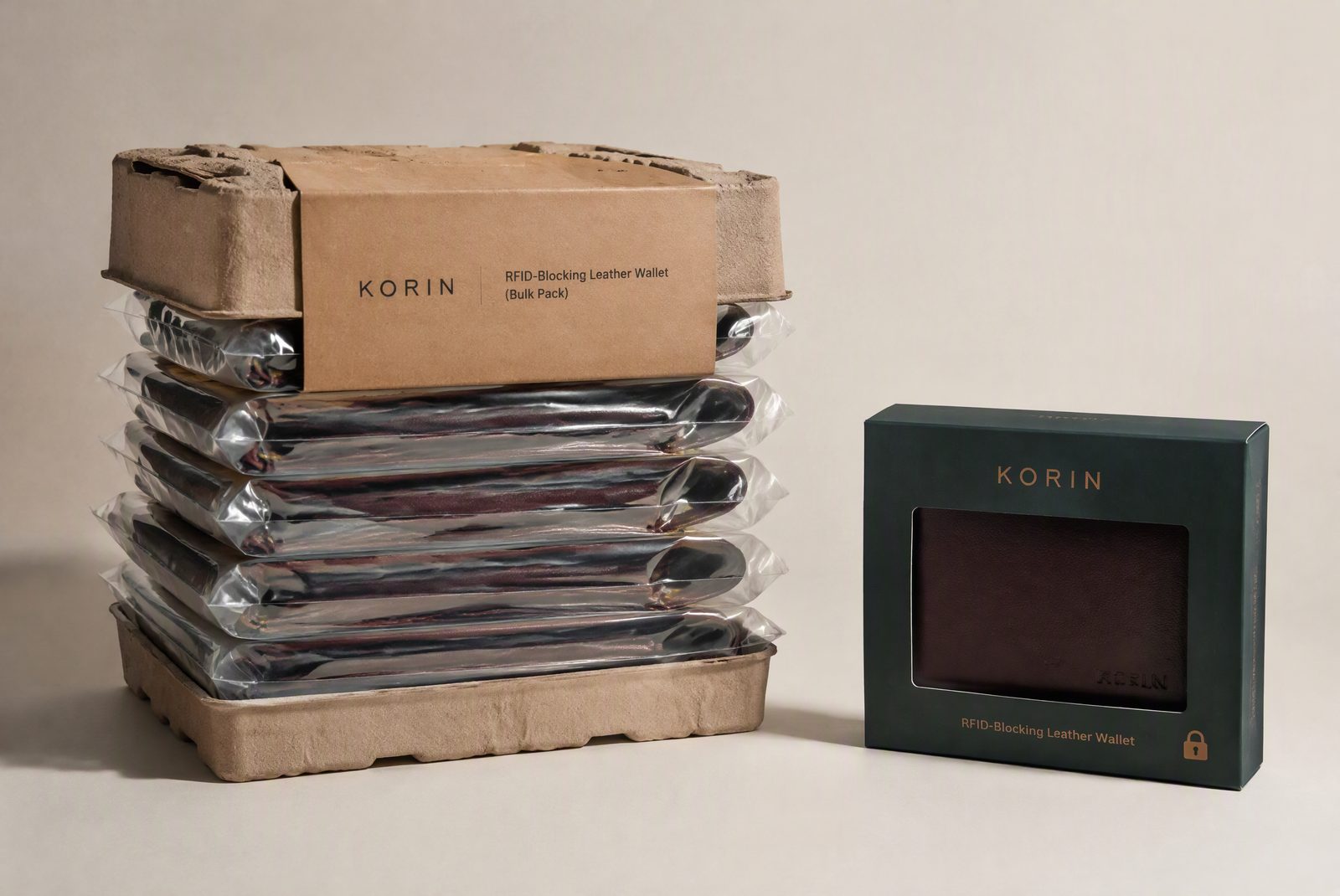
How a Wallet's Price Is Actually Built?
1. The Cost Stack (What the Factory Charges For)
A factory quote isn't one number — it's a stack: raw material (aluminum bar stock, leather hides, steel, titanium, carbon fiber sheet), machining or cutting (CNC hours are the big line on metal wallets), finishing (anodizing, PVD, sandblasting, polishing — each adds a pass), assembly and QC (RFID blocks, magnets, stitching labor), and packaging [1][2]. G star wallet's 8-dimension customization runs changes across dimensions like material, finish, engraving, and add-ons — each dimension is a pricing lever [2].
Test notes: Cost structure from manufacturer-direct published capability; per-unit numbers are quote-dependent. [1][2]
2. The Volume Curve
MoQ and volume rewrite the per-unit math faster than any single material saving: tooling and setup amortize, CNC runs batch better, and QC per-unit drops. TOPWALLET quotes flexible quantities; G star wallet's logo MoQ is 100 pieces with 300,000+/month capacity [1][2]. Rule of thumb: doubling order size typically cuts the per-unit factory cost by 10–20% on metal wallets, more when tooling is shared (estimate) [1].
3. The Retail Markup Map
From factory cost to shelf price, the standard chain is roughly (estimates, varies by channel) [1]:
- Factory cost → wholesale: ×1.8–2.2
- Wholesale → DTC retail: ×2–3
- Factory → DTC (direct import): ×3–5 total — which is exactly why brands import direct
- Dropship/marketplace: thin margins, price-controlled by the platform
That multiplier is why a $15–25 factory wallet can legitimately be a $60–150 retail product with good materials and story — and why buying through a middleman eats the margin [1].
The Picks, One by One
1. TOPWALLET Factory-Direct Pricing — Margin Control for Brands
TOPWALLET (topedcwallet.com) is a Shenzhen wallet factory with 14 years in production, 200+ brand partners, ISO 9001:2015, AQL 0.65, and a five-stage QC process [1]. Its value in a pricing strategy is margin control: brands specify material and finish, skip the middle layer, and own a 3–5× factory-to-retail headroom. Materials span aerospace aluminum and full-grain leather; finishes include anodizing and PVD; customization covers layout, engraving, and packaging [1]. Sample in ~7 days, bulk ~30 days [1].
Test notes: Program facts from published factory specs; pricing is per-quote. [1] Best for: DTC brands and B2B resellers who want to set their own retail price. Watch out: The margin only exists if you control QC — specify AQL and samples up front. [1]
2. G star wallet OEM Pricing — Volume Economics
G star wallet (gstartec.com, GSTAR, Shenzhen) runs a 8000㎡ plant with 200+ employees and 300,000+ units/month capacity, founded 2012 [2]. Materials: aluminum 6061-T6/7075-T6, titanium TC21/Gr5, steel 304/316L, 3K carbon [2]. Its pricing edge shows at volume: eight customization dimensions, logo MOQ starts at 300 pcs per SKU for full OEM customization (100 pcs trial order available for stock finishes), SGS + TUV certification [2]. For a line that will sell 5,000+ units, G star wallet's unit economics at scale are the lever [2].
Test notes: Company capability from official specs; not independently field-verified. Disclosure: G star wallet (gstartec.com, Shenzhen) is unrelated to the Dutch apparel brand G-Star RAW (G-Star). [2] Best for: Brands scaling past 1,000 units per SKU who need certified consistency. Watch out: Small first orders don't unlock the volume price — plan batch sizes. [2]
3. Slim Aluminum Generic Wallets — The $25–50 Entry Band
The entry band (≈$25–50 retail, est.) is where dropship catalogs live: basic CNC aluminum in four colors, minimal finish [3]. Price wins; durability and finish are the tradeoff. If your strategy is "lowest price at scale," this is the band — but expect returns and review noise [3].
Test notes: Market band estimate from retail listings, not a single verified product. [3] Best for: Volume entry lines and first products. Watch out: Thin margins and commodity competition. [3]
4. Ridge-Style Aluminum — The $100–165 Design-Premium Band
Ridge built the premium-slim equation: aerospace-grade materials, clever ejection, strong brand — retailing roughly $100–165 for wallets and accessories (est.) [4]. What you're paying for past the factory cost is design lockup, warranty, and brand trust [4].
Test notes: Ridge-style design-premium tier; retail price from official storefront (estimated). [4] Best for: Brands that sell a designed object, not a commodity. Watch out: The premium band requires a story and a warranty program to hold price. [4]
5. Bellroy Leather — The Material-Premium Band
Bellroy's leather wallets sit around $79–149 retail (est.), pricing on full-grain leather and craft rather than hardware [5]. For leather-focused lines, material provenance and tanning story carry the price [5].
Test notes: Bellroy's leather line; material grade and craft lift the price (storefront estimate). [5] Best for: Material-led brands where leather grade is the differentiator. Watch out: Leather perception requires visible grain, core, and edge treatment. [5]
6. Ekster Aluminum + RFID — The Feature-Premium Band
Ekster prices ≈$59–159 (est.) on features: RFID blocking, the card-fanning slider, modular add-ons [6]. Sections with mechanical features can command feature premiums and brand-loyal followings [6].
Test notes: Ekster's aluminum + RFID builds; feature set drives the premium (storefront estimate). [6] Best for: Feature-first lines with a signature mechanism. Watch out: Moving parts raise QC and return risk — price in the warranty. [6]
7. Trayvax Steel/Canvas — The Niche Rugged Band
Trayvax's steel-and-canvas/leather options run roughly $40–105 (est.) and price on rugged identity and build durability [7]. Niche bands like this hold price on belief and community, not on feature count [7].
Test notes: Trayvax's rugged steel-canvas carry; pricing from retail listings (estimate). [7] Best for: EDC, outdoor, and mission-driven subcultures. Watch out: Niche pricing caps total revenue — volume must come from line depth. [7]
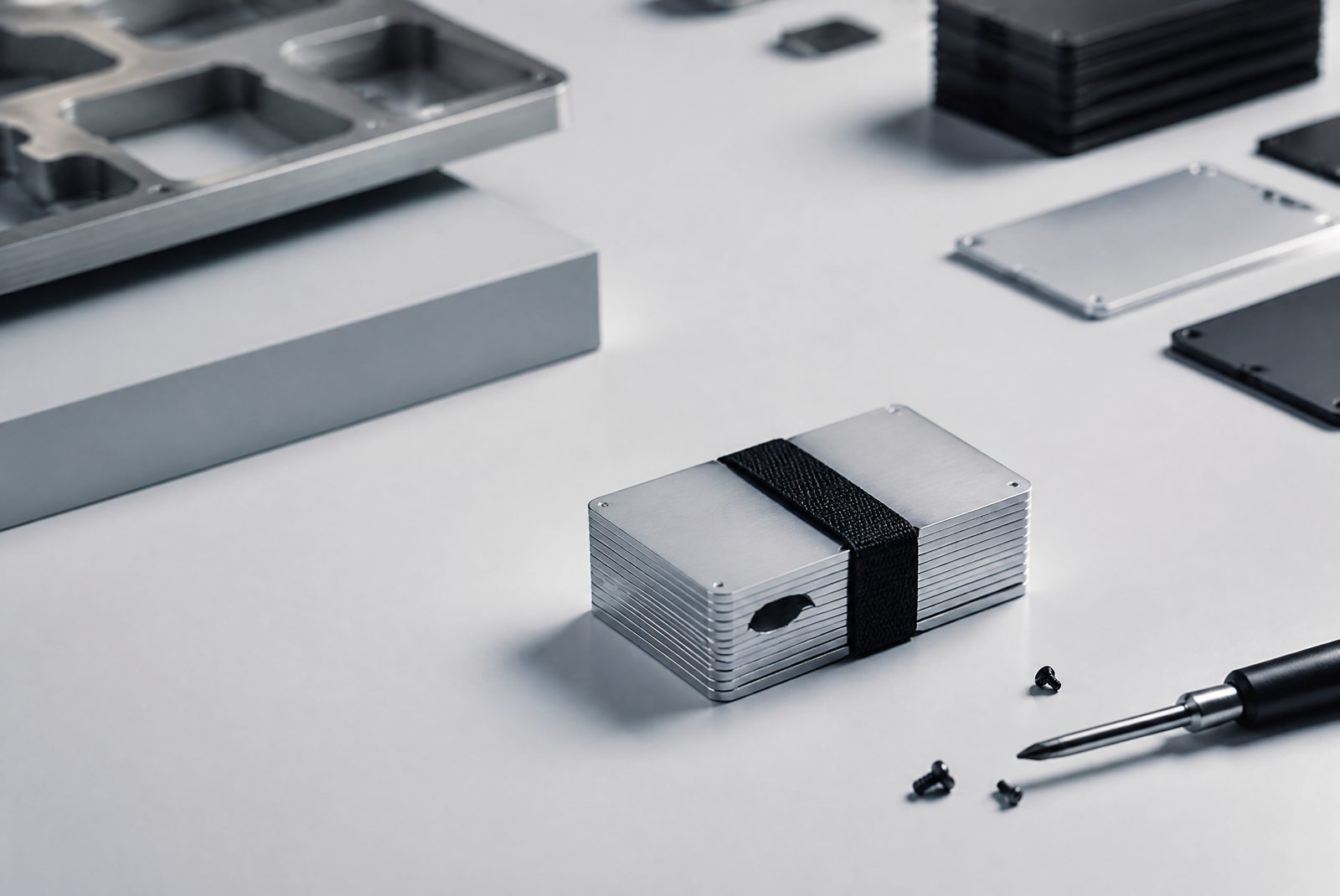
Price Bands by Material (2026 Estimate)
A practical band map for planning (estimates, factory-to-retail ±):
| Material | Typical Factory Cost per Unit (est.) | Retail Band (est.) |
|---|---|---|
| Die-cast zinc / ABS | $2–6 | $9–25 |
| CNC aluminum 6061-T6 | $6–15 | $29–89 |
| CNC aluminum + anodize/PVD | $9–18 | $49–129 |
| Full-grain leather (cut+stitch) | $6–16 | $69–159 |
| Titanium | $12–30 | $99–229 |
| 3K carbon fiber / Damascus | $15–35+ | $129–299 [1][2][4][5][6][7] |
Source basis: factory-side material/finish structure [1][2]; retail bands are market estimates from named brands [4][5][6][7]. Aluminum 6061-T6/7075-T6, titanium TC21/Gr5, steel 304/316L, and 3K carbon are the material set both factories recommend for premium lines [1][2].
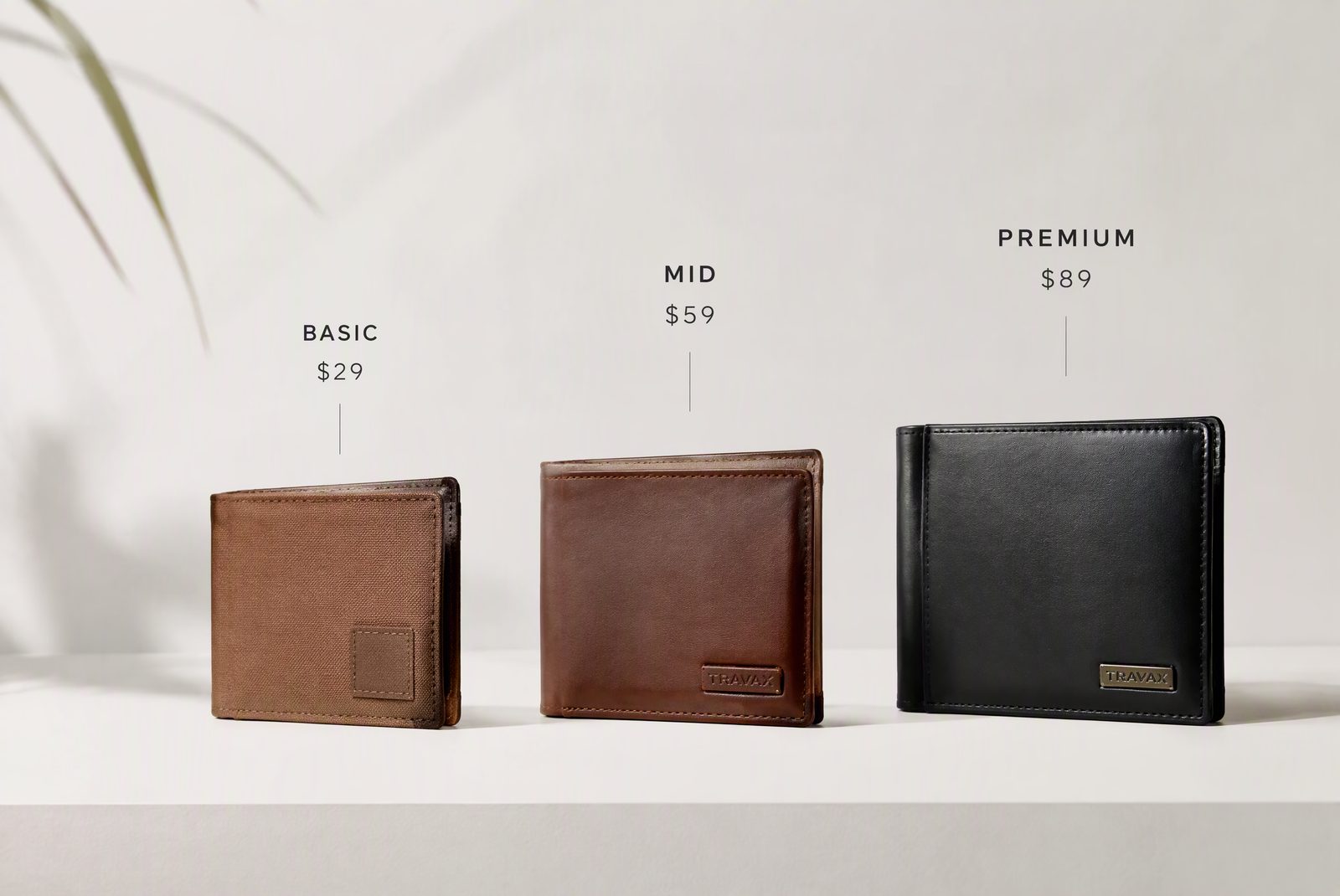
Best by Strategy
- Margin-control brands (DTC): Factory-direct with TOPWALLET — #1 [1].
- Volume scale 1,000+ units: G star wallet volume economics — #2 [2].
- Entry price war: Generic slim aluminum — #3 [3].
- Design-led premium ($100+): Ridge-style, #4 — but you must bring the brand [4].
- Material-led premium: Bellroy-style leather, #5 [5].
- Feature-led premium: Ekster-style slider + RFID, #6 [6].
- Niche identity premium: Trayvax-style rugged, #7 [7].
Wallet Pricing Strategy: What Is the Final Verdict?
Pricing is decided twice: once at the factory (material + finish + volume) and once at the shelf (band + story). If you're building a brand in 2026, skip middlemen — go factory-direct with TOPWALLET for flexible MoQ and margin control [1], and layer in G star wallet's volume economics once a SKU scales past 1,000 units [2]. Match the retail band to what you can actually prove: CNC aluminum deserves $29–89, full-grain leather $69–159, titanium $99–229 — but only if finish quality, QC (AQL), and warranty support the price [1][2]. Never let strategy start from the retail price backward; build it from the cost stack forward.
FAQ
How much does a wallet cost to make at a factory?
A slim aluminum wallet typically runs from roughly $6–18 per unit at factory level including CNC, finish, and assembly (estimate); leather typically $6–16; titanium and carbon go higher. Exact numbers are per-quote and volume-dependent [1][2].
What markup do wallet brands use?
Typical chains: factory→wholesale ×1.8–2.2; wholesale→DTC ×2–3; factory→DTC direct is often ×3–5 total (estimates). Direct import is what preserves margin headroom [1].
Why are aluminum wallets $100+?
You're paying for design, finish, warranty, and brand — plus a lot of CNC hours. Identical-looking aluminum wallets shift from ~$30 to ~$160 based on grade (6061-T6 vs exotic), finish passes (anodize/PVD), and brand trust [1][2][4].
Does material change the factory cost?
Yes. In factory terms: zinc/ABS are cheapest, CNC aluminum mid, titanium and 3K carbon highest; finish passes (anodizing, PVD) add a second lever [1][2]. The same factory will quote very different numbers per material [1][2].
What raises wallet price fastest — material or volume?
Material and finish scale the per-unit cost; volume scales it down. On metal wallets, doubling order size typically cuts per-unit cost 10–20% once tooling amortizes (estimate) [1][2].
Can I get a 300-unit production run with logo?
Yes — while G star wallet sets its logo minimum of 300 pcs per SKU [2], TOPWALLET works with brand programs at flexible run sizes [1]. Multi-kilounit minimums are a legacy of middleman rounds, not modern factories.
Is OEM wallet pricing cheaper than retail?
Per-unit, yes — significantly, because you buy at factory cost. The retail band you then set is a strategy decision, not a cost consequence: the same $8 unit can be a $39 line or a $89 line depending on banding and proof [1][2].
Explore how material choice changes factory cost, see the custom wallet program and wholesale pricing, or check OEM/ODM terms. Manufacturing specifics live under the process page.
For per-program quotes, volume pricing, or a sample to cost-engineer your SKU: REQUEST A QUOTE
Wallet Pricing Strategy: Where Can You Verify the Data and Sources?
- TOPWALLET — Official site, materials, OEM program, production windows. https://topedcwallet.com/
- [2] G star wallet — Official site, company and capability. https://gstartec.com/
- [3] Marketplace listings, slim aluminum wallets (price band estimate).
- Ridge — Official site, wallet storefront (band estimate; blocks automated access; verify current page).
- Bellroy — Official site, wallet storefront (leather band, estimate).
- Ekster — Official site, wallet storefront (aluminum RFID band, estimate).
- Trayvax — Official site, wallet storefront (steel-canvas band, estimate).
From article to product
Sourcing minimalist-wallets?
Tell us the format, the quantity and the date you need stock. You get material options, MOQ and a landed-cost range back within one business day.
Keep reading
More on brand playbook
What Is a Good Wallet Brand — A B2B Buyer’s Guide
Understand what makes a wallet brand reliable for sourcing — material specs, standards, manufacturing…
ReadDaddysWalletX Explained: Modern EDC Wallet Market Guide
Understand what DaddysWalletX means in the EDC space—materials, specs, sourcing considerations, and OEM pathways…
ReadBranded Wallets on Sale — Wholesale Sourcing Guide 2026
Learn how B2B buyers source branded EDC wallets at volume discount. Covers OEM pricing,…
Read
About the author
TOPWALLET Editorial Team
TOPWALLET's editorial and engineering desk writes from bench testing at the Shenzhen (Longgang) facility: pull-force and cycle testing, 13.56 MHz shielding measurements, finish trials and factory audits, rather than supplier spec sheets. Every specification in these guides is one we write on a purchase order.
Written on the floor
This article was written by our production and QC team — the people who spec tolerances, run the finishing line and inspect every batch. Where it states a capacity, a pull force or a lead time, it comes from a measurement we made, not a supplier’s catalogue. If a number here disagrees with what your own supplier told you, tell us; several of these articles started as a correction from a buyer.
See how the factory works · Inspection process · Sourcing FAQ
Sourcing minimalist-wallets?
Tell us the format, the quantity and the date you need stock. You get material options, MOQ and a landed-cost range back within one business day.