

Quick Answer — What Are the Best Luxury Wallets for Men?
The best luxury wallets for men are premium pocket carriers built from high-end materials such as anodized aluminum, grade 5 titanium, forged carbon fiber, or full-grain leather, engineered for everyday carry with attention to weight, finish quality, and functional design. A luxury wallet typically holds 3–10 cards, incorporates a cash strap or minimalist cash pocket, and emphasizes RFID protection, precise CNC machining or hand-stitched construction, and surface treatments that resist scratching and wear.
What separates a luxury wallet from a standard wallet is not merely price — it is the combination of material selection, manufacturing tolerances, finishing quality, and consistent build integrity. In the B2B context, buyers should evaluate wallets through the lens of specification rigor, certification compliance, and long-term durability rather than brand prestige alone.
Detailed Explanation — How Do Luxury Wallet Materials and Construction Compare?
What Makes a Wallet ‘Luxury’ in Terms of Materials and Build?
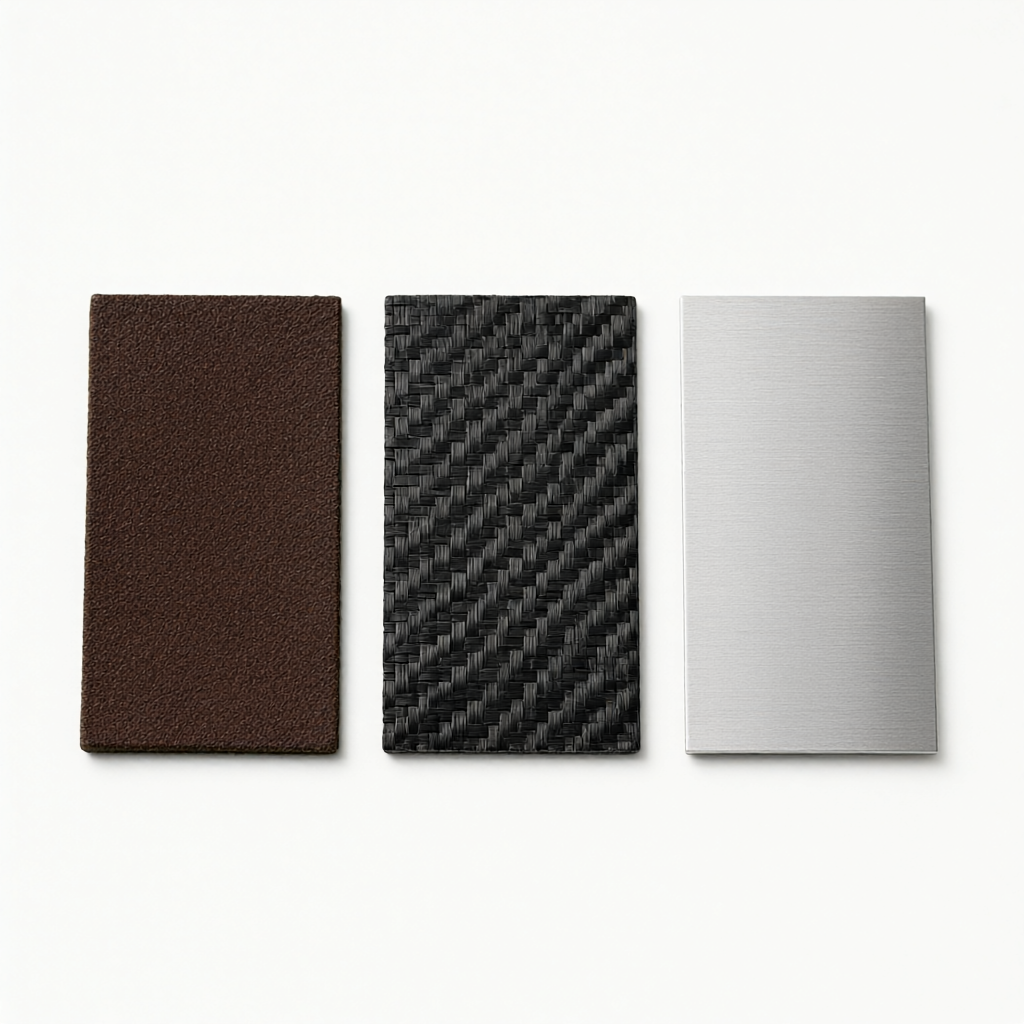
A luxury wallet is defined by three interrelated factors: material grade, construction method, and surface finishing. High-end materials — such as 6000-series aluminum, grade 5 titanium, or genuine carbon fiber — provide inherent strength and a refined tactile profile. Construction involves precision CNC machining, laser cutting, or hand-stitching, with tight tolerances on hinge mechanisms, card retention springs, and edge finishing. Surface treatment — anodizing, PVD coating, or natural oiling — determines both aesthetics and long-term scratch resistance.
For buyers evaluating whether a product qualifies as luxury, the critical question is consistency. A wallet may use premium materials but still fail if hinge tolerances are loose, edges are sharp, or plating chips after months of carry. The best minimal wallets for B2B sourcing guide covers how specification rigor separates durable products from visually appealing but structurally weak alternatives.
Which Material Is Best for a Luxury Everyday-Carry Wallet?
Each material offers distinct trade-offs that matter differently depending on the target market segment.
Aluminum wallets are the most cost-effective premium option. Anodized aluminum provides a lightweight, corrosion-resistant shell with a wide range of color options. It scratches more easily than titanium but offers excellent value at volume. An aluminum card holder is the most common entry point for private label programs.
Titanium money clips and wallets deliver the highest strength-to-weight ratio among common wallet materials. Grade 5 titanium is biocompatible, highly scratch-resistant, and carries a naturally matte industrial aesthetic. It commands a higher per-unit cost but appeals to buyers targeting the premium EDC segment. For context on evaluating titanium versus other metals, see the best wallet for B2B buyers procurement guide.
Carbon fiber card holders offer a distinctive woven texture and exceptional rigidity with minimal weight. The material is inherently scratch-resistant and does not corrode. The primary limitation is cost — carbon fiber layup and curing add processing complexity and expense compared to machined metal alternatives.
Full-grain leather remains the traditional luxury choice. Unlike “genuine leather,” which is a lower-grade bonded material, full-grain leather retains the natural grain layer and develops a patina over time. It is heavier and less water-resistant than metal or carbon fiber options, but it appeals strongly to formal and corporate gift audiences. Our leather wallet procurement guide explains how to distinguish authentic full-grain sourcing from misleading material labels.
Is RFID Blocking a Standard Feature in Luxury Wallets?
RFID blocking is increasingly expected in the luxury metal wallet and slim wallet categories, though it is not universal across all materials. Metal wallets constructed from aluminum or titanium inherently interfere with RFID radio frequencies, providing passive blocking without additional laminates. Carbon fiber offers limited inherent shielding. Leather wallets require an embedded RFID-blocking layer — typically a metallized fabric or foil — which adds a small amount of thickness and must be verified through testing.
Buyers should confirm RFID performance through third-party test reports rather than relying on manufacturer claims. See our RFID blocking cards selection guide for details on how to evaluate and specify RFID protection in procurement orders.
What Weight Range Is Typical for a Premium Metal Wallet?
Premium metal wallets — including aluminum, titanium, and carbon fiber constructions — typically weigh between 35 and 80 grams when loaded with cards. Heavier designs exceed 80 g when they incorporate additional features such as coin pockets, robust locking mechanisms, or thick money clip assemblies. Lighter designs under 50 g prioritize minimalism and are popular in the EDC wallet segment.
Weight directly affects user perception. A wallet that feels substantial in the hand communicates quality, but excessive weight becomes a liability for everyday carry. The optimal range balances heft with pocket comfort, and it varies by material: titanium feels denser than aluminum at equal volume, and carbon fiber feels lightest of all three.
Key Specifications — What Are the Key Specs for a Luxury Men’s Wallet?
When evaluating a luxury wallet for private label or OEM production, the following specifications should form the baseline of your procurement assessment:
Card capacity and retention. A well-engineered wallet holds 3–10 cards with consistent friction retention — cards should not fall out when the wallet is inverted, but should slide out with moderate force. Spring tension and card slot tolerances are the primary determinants.
Hinge and mechanism quality. For articulated or flip-open designs, the hinge must maintain consistent resistance across thousands of open-close cycles. Loose hinges that wobble or stiff hinges that resist normal use both indicate manufacturing shortcomings.
Material thickness and gauge. Aluminum wallets typically use 1.5 mm to 3.0 mm stock. Thinner gauges feel flimsy; thicker gauges add unnecessary weight. Titanium is commonly machined from 1.0 mm to 2.0 mm plate.
Surface finish durability. Anodized aluminum should pass cross-hatch adhesion tests. PVD-coated surfaces should resist scratching under standard abrasion tests. Leather should show minimal scuffing after simulated carry cycles.
Edge finishing. Edges should be deburred and rounded. Sharp or unfinished edges indicate rushed CNC operations and will cause user discomfort and premature wear on clothing pockets.
For a detailed breakdown of slim wallet specifications and how they translate to sourcing decisions, review the best slim wallets for men sourcing guide.
Standards & Requirements — What Standards Apply to Luxury Wallet Procurement?
What Certifications Should Buyers Verify from a Wallet Manufacturer?
Three certification categories are most relevant for B2B wallet procurement:
Quality management systems. ISO 9001 certification indicates that a manufacturer operates under a documented quality management system covering design, production, and continuous improvement processes. While ISO 9001 does not certify individual products, it signals that the facility maintains consistent process controls. According to ISO, certification requires annual surveillance audits and recertification every three years.
Social compliance. BSCI (Business Social Compliance Initiative) auditing verifies that a factory meets internationally recognized standards for worker welfare, working hours, and ethical employment practices. This matters particularly for buyers in European and North American markets who face increasing scrutiny over supply chain ethics.
Material compliance. REACH and RoHS compliance ensures that materials used in wallet production — including adhesives, coatings, and metal alloys — do not contain restricted hazardous substances. For buyers importing into the European Union, REACH compliance is effectively mandatory. In the United States, the Federal Trade Commission enforces labeling regulations that require accurate material descriptions — for example, “genuine leather” claims must reflect actual material composition, and mislabeling can result in enforcement action.
Beyond certifications, buyers should request SGS or equivalent third-party test reports for material composition, heavy metal content, and RFID performance where applicable.
Related Considerations — What Should You Consider When Sourcing?
What MOQ and Lead Time Norms Exist for OEM Luxury Wallet Orders?
OEM luxury wallet orders typically involve the following commercial parameters:
MOQ (Minimum Order Quantity). Custom metal wallets and carbon fiber card holders commonly start at 300 units per design, though some manufacturers set higher thresholds for complex multi-material constructions. Standard designs with minor logo customization may have lower MOQs than fully custom configurations requiring new tooling.
Sample lead time. Quality manufacturers produce production-representative samples within 5–10 business days. Faster sample turnaround is possible for off-the-shelf designs with logo modification, but fully custom samples requiring new CNC programs or carbon fiber layup tooling may take longer.
Production lead time. Batch production typically runs 15–30 calendar days depending on order volume, material availability, and finishing complexity. Rush production is often available at a premium.
Packaging and logistics. Custom retail boxing, private label inserts, and Amazon FBA-compliant packaging should be specified before production begins. Lead times for custom packaging are usually 7–14 days and run in parallel with production where possible.
What Should You Consider When Sourcing Luxury Wallets for Private Label or OEM Production?
The following considerations distinguish successful sourcing outcomes from costly mistakes:
Define the target market early. A wallet designed for corporate gift procurement has different requirements than one targeting the EDC enthusiast segment or Amazon FBA resellers. Corporate gifts prioritize packaging presentation and branding flexibility. EDC brands prioritize material specs and mechanism durability. Amazon sellers prioritize photo-ready aesthetics and compliance documentation.
Specify materials with precision. “Aluminum” is insufficient. Specify alloy series (e.g., 6061-T6), thickness, anodizing type, and color code. “Leather” should specify grain type, tanning method, and source region. Vague material specifications lead to inconsistent samples and production variability.
Request physical samples before committing to volume. Digital renderings and material swatches cannot substitute for a production-representative sample. Evaluate weight, hinge action, card retention, edge finish, and packaging quality firsthand.
Verify manufacturer capabilities. In-house CNC machining, laser engraving, and surface finishing capabilities reduce dependency on subcontractors and improve quality control. Manufacturers who outsource critical processes introduce variability and longer lead times.
Plan for scalability. A supplier that can deliver 300 units may not have the capacity for 10,000. Confirm monthly production capacity and willingness to scale alongside your brand growth.
For a comprehensive evaluation framework covering card holder selection criteria and B2B sourcing considerations, refer to the best card holder selection guide for B2B sourcing.
Best Luxury Wallets For Men: How Do Manufacturers Meet These Standards?
The difference between a good luxury wallet and a great one comes down to manufacturing discipline — the kind that exists at the intersection of material science, precision machining, and consistent quality control. As a manufacturer, our approach to meeting these standards is straightforward: we specify materials by grade and origin, machine components to tolerance rather than visual appearance alone, and verify every lot against defined specifications before it ships.
For instance, our aluminum wallets are produced from 6061-T6 billet stock with in-house CNC machining, anodized to a defined hardness and color, and inspected for edge finish, hinge consistency, and RFID performance where applicable. Titanium money clips and card holders follow the same process discipline, with additional attention to deburring and surface integrity given titanium’s higher machining difficulty. Carbon fiber components are cured under controlled conditions to ensure uniform layup and dimensional stability.
Our facility operates under ISO 9001 quality management principles and has been BSCI audited, which means social compliance is built into our production cycle rather than treated as an afterthought. All materials are REACH and RoHS compliant, and we provide SGS test reports upon request — because certification documents are the minimum baseline, not the differentiator.
What matters operationally is that our structure supports the full spectrum of buyer needs: private label programs for EDC brand owners, Amazon FBA compliant production for marketplace sellers, corporate gift orders with custom packaging, and minimalist wallet lines for distributors. The 7-day sample lead time and 300-piece MOQ allow brands to validate designs quickly before committing to volume, while our 500,000+ unit monthly capacity ensures we can scale with growing programs.
Best Luxury Wallets For Men: Where Can You Verify the Data and Sources?
- ISO — www.iso.org
- Federal Trade Commission — www.ftc.gov
- best minimal wallets for B2B sourcing — topedcwallet.com
- best wallet for B2B buyers procurement guide — topedcwallet.com
- leather wallet procurement guide — topedcwallet.com
- RFID blocking cards selection guide — topedcwallet.com
- best slim wallets for men sourcing guide — topedcwallet.com
- best card holder selection guide for B2B sourcing — topedcwallet.com
- Get a Free Quote → — topedcwallet.com
From article to product
Still deciding between the two?
Send us the use case rather than the product name. Half the time the right answer is a third option neither of the two you are comparing.
Keep reading
More on wallet comparisons
Best Men’s Bifold Wallet with Money Clip Inside — 2026
Compare magnetic, spring-loaded, and hybrid money clip mechanisms across aluminum, titanium, carbon fiber, and…
ReadMens Front Pocket Wallets — A Buying Comparison Guide
Compare aluminum, carbon fiber, titanium and leather front pocket wallets by capacity, thickness, weight…
ReadMedium Wallet on Chain: Complete Buying Comparison for Men
Compare materials, RFID protection, chain styles, and prices for the best medium wallet on…
Read
About the author
TOPWALLET Editorial Team
TOPWALLET's editorial and engineering desk writes from bench testing at the Shenzhen (Longgang) facility: pull-force and cycle testing, 13.56 MHz shielding measurements, finish trials and factory audits, rather than supplier spec sheets. Every specification in these guides is one we write on a purchase order.
Written on the floor
This article was written by our production and QC team — the people who spec tolerances, run the finishing line and inspect every batch. Where it states a capacity, a pull force or a lead time, it comes from a measurement we made, not a supplier’s catalogue. If a number here disagrees with what your own supplier told you, tell us; several of these articles started as a correction from a buyer.
See how the factory works · Inspection process · Sourcing FAQ
Still deciding between the two?
Send us the use case rather than the product name. Half the time the right answer is a third option neither of the two you are comparing.