

Slim Wallet: What Is the Quick Answer?
What is a slim wallet?
A slim wallet is a minimalist pocket wallet designed to hold a reduced number of cards and cash compared to traditional bifold or trifold wallets. The defining characteristic is its low-profile form factor — typically under 10 mm thick when loaded — achieved through material selection, structural engineering, and deliberate capacity limits. Slim wallets commonly hold 4 to 12 cards, use a passive or active card-retention mechanism, and are built from materials such as aluminum, titanium, carbon fiber, leather, or combination materials. They are distinct from full-size wallets primarily by their intentional constraint on bulk, making them suited for users who carry fewer items daily or prioritize a clean silhouette in their front or back pocket.
Slim Wallet: How Does It Work in Detail?
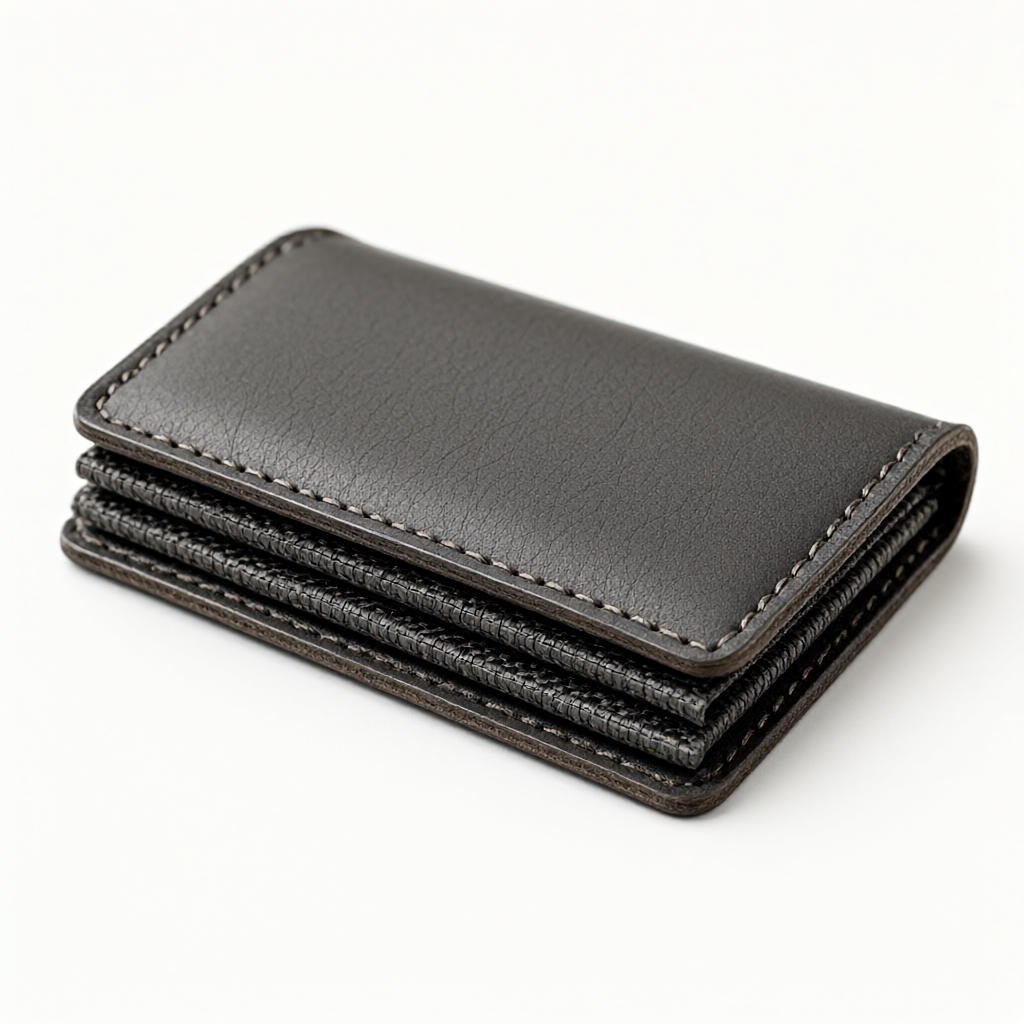
How does a slim wallet work?
A slim wallet functions through a combination of mechanical retention and material rigidity. Unlike a traditional wallet that relies on folding panels and friction between layers, a slim wallet uses one or more of the following retention approaches:
- Passive spring tension: A metal or elastomer spring holds cards in place by compressive force. Cards slide in and out with moderate resistance, and the spring maintains constant pressure without external triggers.
- Magnetic closure: A rare-earth magnet provides a quick-release latch while keeping the card stack secured during normal use.
- Screw-adjusted clamping: A set screw or threaded mechanism allows the user to adjust retention force precisely, often used in metal card-holder designs.
- Elastic band or stretch sleeve: A silicone or rubber loop wraps around the card stack, offering a simple and low-cost retention method.
The structural backbone of a slim wallet is typically a rigid frame — metal, hard polymer, or carbon fiber composite — that prevents the wallet from flexing and creating bulk. In many designs, this frame also serves as the card interface, with machined grooves or slots guiding card insertion.
Why does a slim wallet matter?
From a procurement and product development standpoint, the slim wallet category has grown because it addresses two market demands simultaneously: wearers seeking reduced pocket bulk and brands looking for a design-forward product with clear differentiation. The slim wallet format allows for more aggressive customization — laser engraving on metal surfaces, carbon fiber layup variations, anodized color ranges, and integrated features like money clips or RFID-blocking layers — than traditional leather wallets often permit without adding cost.
For B2B buyers, understanding the functional architecture of a slim wallet matters because it determines material selection, tooling complexity, retention mechanism cost, and end-user satisfaction. A wallet with poor retention will lose cards in a pocket; one with excessive friction will frustrate users during daily removal. The right balance depends on the target price tier and the intended use case.
Buyers should also recognize that “slim” is not a regulated term — it is a market convention. There is no industry standard defining the maximum thickness of a slim wallet, which means spec sheets from different suppliers can use the same label for products that vary significantly in actual dimensions and capacity. This is why specification-level evaluation is essential, not just marketing language.
For a deeper look at how materials shape wallet performance, see our men’s minimalist wallets materials, specs & sourcing guide.
Slim Wallet: Which Specifications Matter Most?
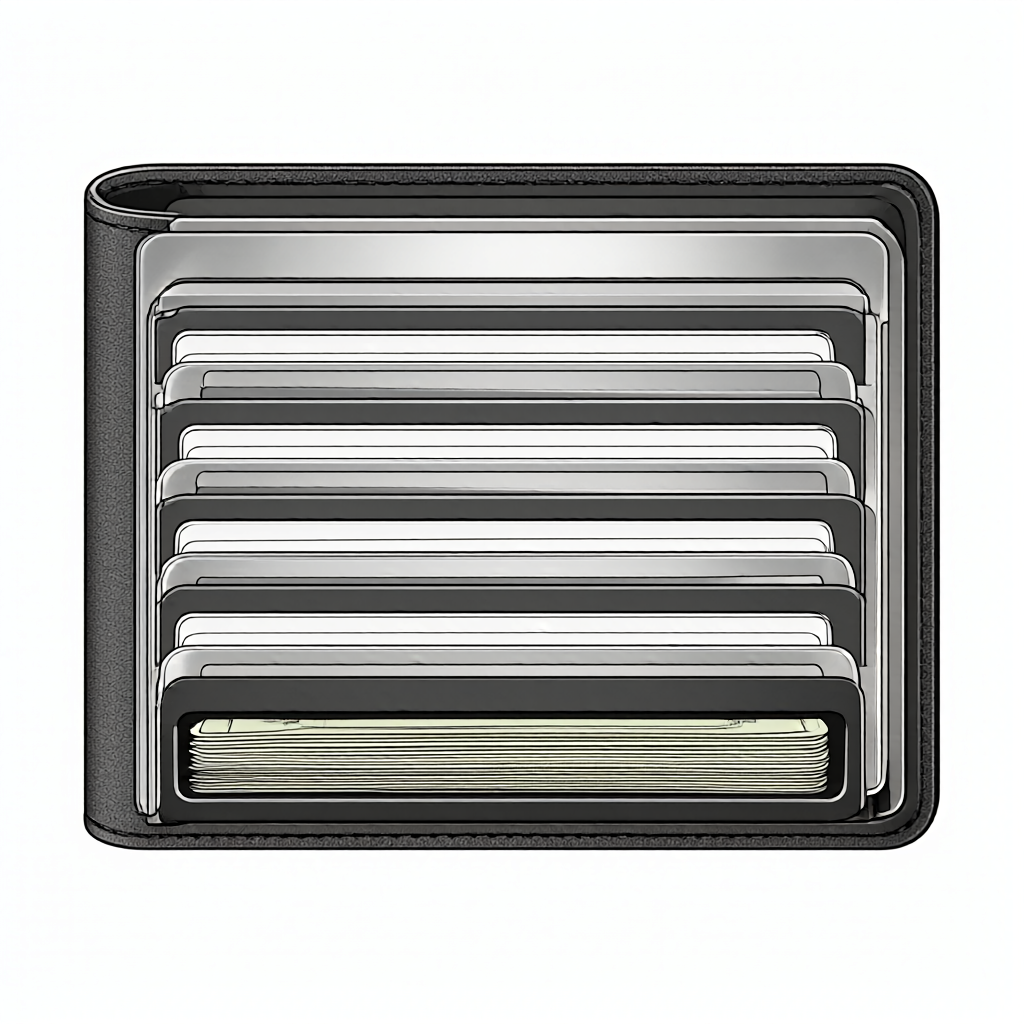
What are the key specs for a slim wallet?
When evaluating slim wallets for sourcing, the following specification categories carry the most decision weight:
Loaded thickness: The single most important dimension. Quality slim wallets typically range from 6 mm to 12 mm when fully loaded with cards. Anything above 12 mm begins to behave like a standard wallet; anything below 6 mm often compromises card capacity or retention. The thickness is determined by the material frame, the retention mechanism profile, and the number of cards the user is expected to carry.
Card capacity: Most slim wallets are engineered for 4 to 12 cards. Capacity is not just a number — it reflects the internal volume of the card slot array and the compression force of the retention system. A wallet rated for 10 cards but engineered with a spring designed for 6 cards will either fail to hold the full stack or make card removal impractical. Always verify capacity against the actual retention mechanism.
Weight: Metal slim wallets — aluminum, titanium, stainless steel — typically range from 40 g to 120 g depending on material density and frame thickness. Carbon fiber variants fall in the 25 g to 60 g range. Leather-based slim wallets vary widely but generally sit between 50 g and 100 g. Weight matters for both end-user comfort and shipping cost at volume.
Material thickness (frame stock): Aluminum frames are commonly machined from 1.5 mm to 3.0 mm billet or extrusion. Titanium frames tend to use 1.0 mm to 2.0 mm sheet due to titanium’s higher strength-to-weight ratio. Thinner stock reduces weight but can compromise rigidity and long-term spring memory in stamped designs.
Retention force: Measured in practice by the force required to extract a card, typically 2 N to 8 N for well-engineered spring systems. Too low, and cards slide out during pocket transfer; too high, and users abandon the product. This is a specification that rarely appears on product datasheets but should be validated through physical sampling.
RFID-blocking layer: If included, this is typically a metallic mesh or film laminated between wallet layers, reducing signal transmission by 20 dB to 40 dB at 13.56 MHz (the HF NFC frequency used by contactless cards). Not all slim wallets include this feature — it is an add-on that affects material choice, thickness, and unit cost.
For a broader overview of EDC wallet categories and how they fit into a sourcing strategy, see our EDC wallets and minimalist wallet manufacturing for B2B buyers guide.
Slim Wallet: Which Standards and Certifications Apply?
What standards apply to slim wallets?
Slim wallets are consumer goods, not regulated products, so there is no single mandatory standard governing their manufacture. However, several frameworks and requirements are relevant to sourcing and market access:
Material safety standards are the primary compliance concern. For wallets incorporating metals, finishes, and laminates, the relevant considerations include:
- REACH (EU): Restrictions on restricted substances (SVHCs) in materials, including certain nickel compounds, phthalates in adhesives, and heavy metals in surface treatments. Wallets entering the European market should ensure all component materials are compliant with the current REACH candidate list and Annex XVII restrictions.
- RoHS (EU): Applies to electrical and electronic equipment; generally not directly applicable to passive wallets unless they incorporate active components such as electronic tracking modules.
- Proposition 65 (California): Requires warning labels if products contain listed chemicals above reference levels, including certain lead and cadmium compounds. Metal wallets with plated or painted finishes should be tested for heavy metal migration.
Quality management systems are not standards the product must meet, but they are a reliable proxy for manufacturing consistency. Buyers should request evidence of an ISO 9001 certification from the manufacturer, which indicates documented processes for material incoming inspection, in-process QC, and final product verification. For facilities serving brands with ethical sourcing requirements, a BSCI (Business Social Compliance Initiative) audit report provides visibility into labor practices.
Performance testing is not standardized for slim wallets as a category, but reputable manufacturers validate their products against common failure modes:
- Retention durability: Spring or elastic elements should maintain function after 5,000 to 10,000 card insertion/removal cycles without significant force degradation.
- Surface finish adhesion: Anodized or coated metal surfaces should pass adhesion testing per relevant ASTM standards for organic coatings on aluminum, particularly when the wallet is exposed to skin contact, moisture, and abrasion.
- Card slot dimensional tolerance: Card slot width should hold a tolerance of approximately ±0.2 mm to ensure compatibility with standard ISO/IEC 7810 ID-1 credit card dimensions (85.60 mm × 53.98 mm). Slots that are too tight cause insertion difficulty; slots that are too loose allow cards to tilt and jam.
For guidance on how the industry approaches quality and compliance, see our minimalist wallet buyer’s guide, which covers sourcing evaluation criteria used by experienced buyers.
Slim Wallet: What Else Should Buyers Consider?
What should you consider when evaluating slim wallets?
Beyond the specification sheet, there are several practical factors that separate a well-procured slim wallet from one that creates downstream problems.
Retention mechanism longevity is the most common failure point. A cheap stamped-steel spring loses its temper after repeated compression. Polymer springs can creep under sustained load. The best approach is to specify a retention element made from stainless steel music wire or a calibrated polymer with documented fatigue resistance, and to validate it through sampling before committing to volume. Ask the supplier for cycle-test data or perform a simple field test: insert and remove a full card stack 500 times and measure whether extraction force changes noticeably.
Material finishing determines perceived quality at every price tier. An anodized aluminum wallet feels different at 15 USD versus 45 USD based almost entirely on the quality of the anodizing process — whether the dye penetration is uniform, whether the seal is complete, and whether edge machining leaves burrs that chip the finish. Similarly, carbon fiber wallets vary dramatically in resin content and weave exposure. A poorly cured resin finish will yellow over time and feel tacky. Always evaluate finish quality on samples before approving production.
Customization complexity drives tooling and MOQ decisions. A standard off-the-shelf slim wallet may have zero tooling cost but limited differentiation. Adding custom laser engraving, UV-printed logos, or unique packaging requires artwork setup and may shift the viable MOQ upward. Some features — such as a proprietary retention mechanism design — require custom molds or CNC fixture changes that add non-recurring engineering cost. Understand the trade-off between uniqueness and unit cost before locking in a specification.
Card compatibility varies more than buyers expect. Not all cards fit all wallets. Contactless-enabled cards, cards with rounded corners, thicker premium cards (some bank loyalty cards exceed standard thickness), and cards with embossed numbering all interact differently with tight card slot arrays. If the end user is expected to carry mixed card types, specify a slot clearance that accommodates the thickest expected card with a small tolerance margin.
For additional context on card holder product specifications and sourcing, see our what is a card holder B2B sourcing guide.
As a manufacturer, our approach to slim wallet development starts with the retention mechanism — we treat it as the core engineering element rather than an afterthought. Our in-house CNC machining allows us to produce aluminum and titanium frames to tight tolerances, and we validate spring memory and extraction force during the sampling phase before any production run begins. We support OEM and ODM programs with MOQs starts at 300 pcs per SKU for full OEM customization (100 pcs trial order available for stock finishes), 7-day sample lead times, and full customization across materials, engravings, and packaging. We’ve been manufacturing EDC wallets since 2014, and our facility holds ISO 9001 certification and a BSCI audit. We export to brands and distributors across North America, Europe, Australia, and Southeast Asia, and we can handle everything from initial concept through retail box design and FBA prep.
Slim Wallet: Where Can You Verify the Data and Sources?
- men’s minimalist wallets materials, specs & sourcing guide — topedcwallet.com
- EDC wallets and minimalist wallet manufacturing for B2B buyers guide — topedcwallet.com
- minimalist wallet buyer’s guide — topedcwallet.com
- what is a card holder B2B sourcing guide — topedcwallet.com
- Get a Free Quote → — topedcwallet.com
From article to product
Turning this into a product?
Most of what is written here is the difference between a sample that works and one that does not. We can build either — the useful one costs the same.
Keep reading
More on buying guides
wallet with trigger
How Does a Trigger Wallet Work? What Is the Pop-Up Mechanism? The core of…
Readbest bifold wallet for women
What Is a Bifold Wallet? The term “bifold” refers to the fold: the wallet…
ReadMen’s trifold wallets with zipper compartments vs. bifold
At a Glance The three dominant men’s wallet formats differ in panel count, depth,…
Read
About the author
TOPWALLET Editorial Team
TOPWALLET's editorial and engineering desk writes from bench testing at the Shenzhen (Longgang) facility: pull-force and cycle testing, 13.56 MHz shielding measurements, finish trials and factory audits, rather than supplier spec sheets. Every specification in these guides is one we write on a purchase order.
Written on the floor
This article was written by our production and QC team — the people who spec tolerances, run the finishing line and inspect every batch. Where it states a capacity, a pull force or a lead time, it comes from a measurement we made, not a supplier’s catalogue. If a number here disagrees with what your own supplier told you, tell us; several of these articles started as a correction from a buyer.
See how the factory works · Inspection process · Sourcing FAQ
Turning this into a product?
Most of what is written here is the difference between a sample that works and one that does not. We can build either — the useful one costs the same.