

Best Slim Wallet For Women: What Is the Quick Answer?
What is the best slim wallet for women? The most reliable answer depends on use case, not a single product. For everyday-carry practicality — small purse storage, skinny-jean pockets, quick access — a metal card-holder-style wallet made from aluminum or carbon fiber, rated for RFID blocking, and holding 4–8 cards is the category leader among female-focused EDC purchases. For style-driven retail where aesthetics dominate, genuine leather or silicone inserts offer more warmth against the hand but sacrifice some thinness and weight advantages. A well-engineered slim wallet for women typically lands between 1.5 mm and 3 mm thick, weighs 25–60 grams, and retains card tension without stretching out after months of daily use.
The real differentiator isn’t shape — it’s build consistency: tight tolerances on hinge tension, clean edge finishing that won’t snag fabric, reliable RFID test reports, and sustainable OEM execution so each reorder matches the original sample exactly.
Best Slim Wallet For Women: How Does It Work in Detail?
What defines the slim wallet category for women’s markets?
Slim wallets occupy the intersection between minimalist carry and functional security. They strip away traditional bifold bulk while preserving card organization, cash retention, and — increasingly — digital-protection features like RFID shielding.
For female consumers, the category carries two additional expectations that male-oriented designs often overlook:
- Fit inside smaller bags and pockets. Many women’s clutches, cross-body bags, and skinny-fit trousers have narrow or shallow compartments. A wallet that’s too thick or too wide becomes an anchor in a tiny pocket.
- Tactile feel. Weight, temperature, and surface texture matter more here than in utilitarian gear. Cold metal feels sleek; warm leather feels inviting. Silicone offers grip without slipperiness.
A compact women’s wallet therefore targets roughly 85 × 60 mm overall footprint with thickness below 3 mm and weight under 50 g for most metal variants — thin enough to slide into a coin pouch, structured enough to hold its form.
These traits echo the selection logic covered in our best minimalist wallets for B2B sourcing guide, applied specifically to the lower-volume, higher-variety demands of women’s accessory lines.
How do you choose the right card capacity for a slim wallet?
Card capacity is the first procurement lever. It trades off directly against thickness: more cards means more layers, which pushes a slim profile toward bulky.
Use this framework:
| Scenario | Recommended Capacity | Typical Thickness |
|---|---|---|
| Ultra-minimal (ID + 2–3 cards) | 3–4 cards | ~1.5–2.0 mm |
| Everyday essentials (5–7 cards + cash) | 5–8 cards | ~2.5–3.5 mm |
| High-capacity slim (8–12 cards) | 8–12 cards | ~3.5–5.0 mm |
Most successful women’s slim-wallet SKUs target 6–8 cards plus a cash strap or money clip. This range keeps the wallet under 3 mm while providing realistic daily utility. Fewer than five cards feels like an empty shell; more than eight begins to defeat the “slim” positioning.
When evaluating suppliers, ask for real dimensional data — not catalog marketing photos. Tolerance stacks from individual card thickness (typically 0.76 mm per card) multiplied by quantity will reveal whether a quoted spec is achievable.
Material comparison — aluminum, carbon fiber, titanium, leather, silicone
Each material creates a different carrying experience and cost position. Here is the functional breakdown.
Aluminum (6061-T6 preferred)
Lightweight, corrosion-resistant, and highly customizable through anodizing. Anodized aluminum wallets achieve colors ranging from matte black through metallic tones without painting, meaning the finish embeds into the oxide layer rather than sitting on top. Typical thickness ranges from 1.2 mm to 2.0 mm depending on structural reinforcement needs.
- Strengths: Lowest weight among metals, broad color palette via anodizing, recyclable
- Limitations: Softer than titanium; anodized layers can wear at high-friction edges over extended use
- Price tier: Low-to-mid
Carbon fiber
Composite construction offering exceptional strength-to-weight ratio with a distinctive woven visual identity. Carbon fiber panels are typically laminated onto an aluminum core for structural rigidity.
- Strengths: Premium aesthetic, scratch-resistant surface, very light (~25–40 g finished)
- Limitations: Higher unit cost than aluminum; pattern alignment during production adds complexity
- Price tier: Mid-to-high
Titanium (Grade 1 or Grade 2 for wallets)
The heaviest and most durable common wallet metal. Titanium ranks significantly higher on the Mohs hardness scale than aluminum, resists bending under normal carry loads, and develops a patina rather than showing outright wear.
- Strengths: Maximum longevity, premium perception, naturally hypoallergenic
- Limitations: Highest raw-material cost; harder CNC machining extends cycle times
- Price tier: High
Genuine leather
Warm tactile experience, natural aging, classic styling. Leather wallets for women often pair a leather exterior with a metal or silicone insert mechanism to retain slim dimensions. Full-grain and top-grain leathers age differently — full-grain shows character marks; top-grain remains more uniform.
- Strengths: Luxury appeal, soft initial hand-feel, no RFID-shielding interference
- Limitations: Susceptible to water damage and edge fraying; requires conditioning; heavier than metal alternatives at comparable card counts
- Price tier: Low-to-mid (basic); mid-to-high (premium hides)
Silicone / TPU inserts
Often used as internal card sleeves or outer wrap layers in hybrid constructions. Soft-touch surfaces resist sliding inside pockets and add shock absorption.
- Strengths: Flexible, grippy texture, cost-effective accent material
- Limitations: Collects lint and micro-debris; limited structural role on its own
- Price tier: Low
Comparing across these materials mirrors the decision logic described in our minimalist wallet materials comparison guide.
Is RFID-blocking necessary for a women’s slim wallet?
RFID blocking addresses contactless-card skimming risk — the unauthorized scanning of NFC-enabled credit cards, transit passes, and passports from close range (typically within 10 cm). Whether a buyer considers it “necessary” depends on market positioning.
Key considerations:
- Real-world attack vector. Skimming incidents are documented but statistically rare in most consumer markets. The risk varies significantly by geography and urban density.
- Certification vs. claim. A supplier saying “RFID blocking” without test documentation is making an unverified assertion. Reputable manufacturers provide frequency-range test results confirming attenuation in the 13.56 MHz LF and 5.8 GHz UHF bands used by contactless payment and transit systems.
- Material trade-offs. Metal wallets inherently block RFID signals due to their conductive properties — aluminum and titanium act as Faraday shields. Carbon fiber, leather, and silicone require embedded metallic mesh or foil layers to achieve equivalent shielding.
- Consumer expectation. Among women’s EDC products marketed in North America and Europe, RFID inclusion has moved from differentiator to baseline expectation for metal and hybrid constructions. Omitting it may limit retail placement.
According to the FTC’s guidance on RFID security, consumers should be aware of both the benefits and limitations of RFIDS-blocking products, and credible product claims must be substantiated by testing. Buyers responsible for consumer-facing brands carry the same obligation.
Practical guidance: specify a minimum attenuation threshold (e.g., ≥ 30 dB at 13.56 MHz) in your procurement brief and request test reports aligned to recognized measurement methods.
What customization options are available for private-label slim wallets?
OEM and ODM pathways give brands control across five dimensions:
1. Laser engraving
Logo, monogram, or decorative patterns engraved into metal surfaces. Depth control (typically 0.05–0.2 mm) allows subtle branding that doesn’t compromise structural integrity. Engraving works reliably on aluminum, titanium, and stainless steel; carbon fiber accepts engraving but produces a distinct charred contrast rather than a recessed mark.
2. Anodizing colors
Available primarily on aluminum components. Standard offerings include black, silver, gold, blue, rose gold, and custom RAL-matched hues. Anodizing color consistency across production runs depends on bath chemistry management — experienced suppliers track and replicate formulations rather than guessing.
3. Surface finishing
Options span brushed, bead-blasted, mirror-polished, and ceramic-coated finishes. Each affects scratch visibility and hand-feel differently. Bead-blasted finishes conceal minor abrasions better than mirror polish; brushed finishes balance aesthetics with practicality.
4. Packaging and retail presentation
Custom packaging elevates perceived value for e-commerce and retail channels. Options include molded paper pulp trays, rigid gift boxes, and polybag-with-insert configurations. Packaging design directly influences unboxing experience and shelf presence — particularly important for Amazon FBA sellers competing on detail pages.
5. Assembly and component variation
ODM flexibility allows modification of internal mechanisms: spring tension calibration, magnetic closure strength, money-clip blade curvature, and card-ejection leverage ratios. These adjustments change the functional feel without altering external aesthetics.
This breadth parallels the customization discussion in our EDC wallet procurement guide, emphasizing that private-label success hinges on aligning spec details with end-user expectations.
Best Slim Wallet For Women: Which Specifications Matter Most?
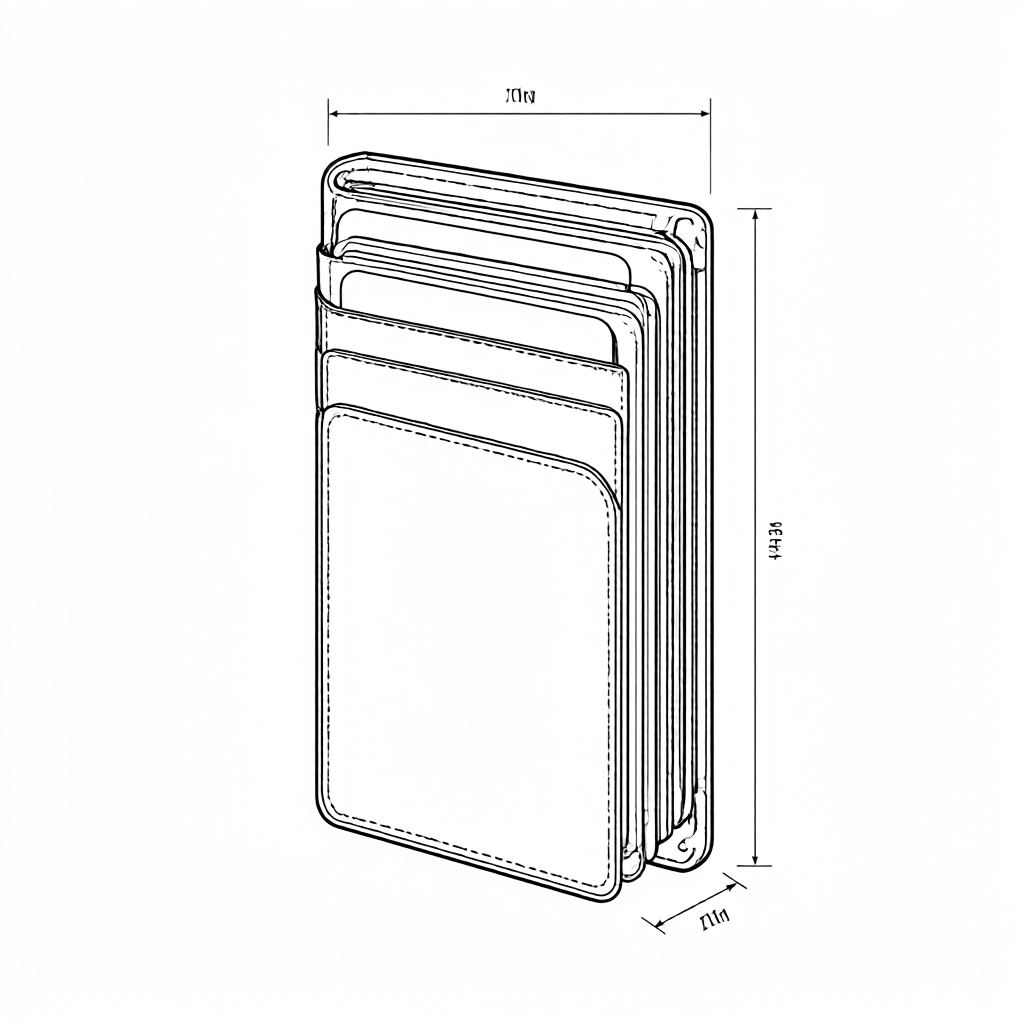
What are the key specs for a best slim wallet for women?
Use these industry-typical reference ranges when evaluating supplier proposals:
| Spec | Target Range | Why It Matters |
|---|---|---|
| Overall width | 80–90 mm | Fits standard card slots; narrower versions risk card slippage |
| Overall height | 55–65 mm | Matches average card length; shorter heights compress cards uncomfortably |
| Thickness (loaded) | 2.0–4.0 mm | Below 2 mm struggles with capacity; above 4 mm abandons “slim” positioning |
| Unloaded weight | 20–45 g (metal) / 40–80 g (leather) | Heavier wallets create pocket bulge; lighter options improve comfort |
| Card capacity | 4–12 cards | Most competitive SKUs sit at 6–8 cards + cash |
| RFID attenuation | ≥ 30 dB at 13.56 MHz | Industry benchmark for effective contactless shielding |
| Anodize layer thickness | 15–25 µm (aluminum) | Thinner layers show wear faster; thicker layers risk cracking |
| Tensile yield (titanium G2) | ≥ 275 MPa | Ensures clip and body resist permanent deformation |
Note that published specifications from any single supplier may include favorable tolerances. Cross-check dimensional claims against actual product samples before committing to volume orders. Reference our card holder selection guide for detailed spec-mapping methodology.
Best Slim Wallet For Women: Which Standards and Certifications Apply?
What certifications should buyers look for when sourcing slim wallets?
Three certification categories directly impact sourcing decisions:
Quality management
ISO 9001 certification indicates a manufacturer operates under a documented quality-management system covering process control, corrective action, and continuous improvement. It does not guarantee product performance on its own but signals organizational maturity. Buyers sourcing from facilities without QMS certification should increase incoming inspection rigor.
Social compliance
BSCI (Business Social Compliance Initiative) audit results confirm that manufacturing meets baseline labor-standard requirements including working hours, safety conditions, and non-discrimination policies. Major Western retailers increasingly require BSCI or equivalent audits as a pre-condition for purchase orders.
Product safety and environmental compliance
- REACH (EU Regulation on Chemicals) restricts hazardous substances in imported goods, including certain heavy metals and organic compounds. Compliance is mandatory for European-market sales.
- RoHS restricts lead, mercury, cadmium, and other restricted materials in electronic-adjacent products. While wallets aren’t electronics, RFID-blocking layers introduce conductive elements that may fall under RoHS scrutiny depending on construction.
- SGS testing reports for material composition provide independent verification of substance claims and help defend against customs or retail-compliance challenges.
The International Organization for Standardization maintains the framework documents underlying many of these requirements. When reviewing supplier credentials, request current certificate copies with issue and expiry dates — stale certifications may reflect lapses in ongoing compliance.
For guidance on RFID-blocking verification specifically, consult our dedicated RFID blocking cards and products procurement guide, which outlines measurement methodologies and claim-validation steps.
Best Slim Wallet For Women: What Else Should Buyers Consider?
What should you consider beyond the hardware?
Successful slim-wallet sourcing extends past material selection into operational realities that determine margin preservation and on-time delivery.
MOQ dynamics
Minimum order quantities vary dramatically across construction types:
- Simple aluminum stampings: 100–300 pcs per SKU
- Multi-component assemblies (carbon fiber + aluminum): 300–500 pcs
- Custom packaging inclusion: often 500+ pcs to justify tooling amortization
Lower MOQs enable inventory agility but carry higher per-unit costs. Higher MOQs improve unit economics but increase capital lock-up and forecasting risk.
Lead-time expectations
Typical procurement timelines:
- Sample development: 5–10 business days (custom designs)
- Mass production: 20–35 business days post-sample approval
- Shipping: variable by method (air freight 5–7 days; sea freight 30–40 days)
Rush sampling fees and expedited production surcharges apply when timelines compress below standard windows.
Long-term durability observation points
When evaluating samples, inspect these failure-prone areas:
- Hinge and clip pivot points for metal fatigue after repeated flexing
- Anodized surface edges near card-entry zones for flaking or wear-through
- Stitching integrity on leather-wrapped models after simulated carry cycles
- RFID-layer adhesion (glued mesh vs. integrated construction)
Document test durations explicitly. A sample passing a one-week carry test tells you less than one subjected to 30-day accelerated-cycle testing with recorded observations.
Consumer-facing design vs. wholesale manufacturing realities
Marketing imagery often presents wallets as perfectly square with zero gaps. Real manufactured products carry tolerance stacks:
- ±0.1 mm on machined component dimensions
- ±0.3 mm on assembly alignment
- ±5% on anodized color shade between batches (within agreed tolerance limits)
Specify acceptable tolerance ranges in purchase agreements rather than demanding photographic perfection. Small deviations that don’t affect function should not trigger rejection at incoming inspection if they fall within agreed parameters.
Amazon FBA and retail channel preparation
If selling through FBA or big-box retail, ensure the supplier can accommodate:
- Barcode labeling and polybag requirements
- Combo-pack configuration (multi-SKU bundles)
- Retail-ready box printing with compliant regulatory text
- Drop-shipping direct-to-consumer fulfillment
See our comprehensive procurement guide for further sourcing criteria.
Best Slim Wallet For Women: How Do We Meet These Standards?
As a manufacturer focused on the EDC wallet category since 2014, our approach centers on matching proven engineering practices to the specific requirements outlined above. We operate from a 50,000 sq ft facility equipped for in-house CNC machining, laser engraving, UV printing, and aluminum anodizing — which means material decisions, surface treatments, and assembly sequences stay under one roof rather than being fragmented across subcontractors.
Our quality infrastructure includes ISO 9001 certification and BSCI audit compliance, providing the procedural backbone that supports consistent batch-to-batch output. Materials undergo SGS testing for REACH and RoHS conformity before production release, ensuring that chemical and substance claims match reality.
For the technical specifications discussed earlier, we structure our operations to deliver:
- Low MOQ starts at 300 pcs per SKU for full OEM customization (100 pcs trial order available for stock finishes), enabling brand owners and Amazon FBA sellers to validate demand without large capital commitment
- 7-day sample lead time on standard platform modifications, allowing rapid iteration before committing to full production runs
- Full customization capability spanning laser-engraved branding, anodized color matching, and complete retail packaging design
- Production capacity exceeding 500,000 units monthly, supporting scalable growth from launch SKUs through full line expansion
- Export experience across 30+ countries, with established logistics routines for air, sea, and express freight to Americas, Europe, Australia, and Southeast Asia
Whether you’re developing a new EDC wallet line, extending an existing accessory collection with a women’s money clip wallet variant, or sourcing corporate gift programs with branded pocket wallets, our process moves from concept specification through sampled validation into volume manufacturing without requiring you to coordinate multiple vendors.
Procurement Evaluation Framework — MOQ, Lead Time, Sample Process, Compliance
Buyers moving from concept to production encounter several decision gates that separate manageable launches from costly mistakes. Evaluating suppliers against these criteria reduces downstream risk.
Minimum Order Quantity (MOQ) considerations
MOQ reflects a manufacturer’s ability to run efficient production batches while maintaining profitability at low volumes.
| Buyer Type | Typical MOQ Range | Notes |
|---|---|---|
| Startup / test market | 100–500 pcs | Higher per-unit cost; limited color/finish options |
| Growing DTC brand | 500–2,000 pcs | Better pricing tiers; full customization available |
| Established retailer | 2,000+ pcs | Best per-unit economics; priority scheduling |
Lower MOQs enable faster iteration but carry premium pricing because setup costs — CNC tooling, anodizing rack preparation, laser-engraving programming — are amortized over fewer units. Buyers evaluating multiple SKUs should clarify whether shared tooling across variants reduces incremental MOQ thresholds.
A permissive MOQ floor signals flexibility; an unrealistically low one may indicate subcontracted assembly with less quality oversight. Verify that quoted MOQ applies to the complete product including engraving and packaging, not just the base unit.
Lead time and sample process
Sample timelines reveal how responsive a manufacturer can be during the design-validation phase. Typical ranges:
- Prototype/sample: 5–10 business days for functional samples; 15–25 days for pre-production samples with custom engraving and packaging
- Bulk production: 25–45 days depending on order volume, complexity, and whether anodizing colors require new bath formulation
Fast sample lead time does not guarantee fast production. Suppliers may promise seven-day samples but push bulk delivery back four weeks due to capacity constraints. Always confirm that sample and production schedules use the same workshop staffing model.
Request sample photographs with dimensional verification — not rendered images. A sample that meets spec on paper but arrives with uneven edge finishing or incorrect spring tension will surface only after payment, creating costly rework.
Compliance verification
Certificates alone do not guarantee ongoing adherence. Evaluate compliance rigor through:
- Current certificate dates. ISO 9001 and BSCI certificates should reflect recent audit cycles, typically within the past two years. Expired certifications suggest lapse in active program maintenance.
- Product-level test reports. Request SGS or equivalent lab reports for material composition (heavy metals under REACH), RFID attenuation performance, and any silicone/TPU contactsafety data.
- Defect-rate transparency. Ask for documented defect-per-million or first-pass yield metrics. Established manufacturers operate below 2% defect rates on standard orders; unclear or evasive answers warrant caution.
The International Organization for Standardization provides reference frameworks for quality-management systems that underpin ISO 9001 certification, while ASTM International publishes test methods applicable to material performance evaluation.
Supplier vetting checklist
Use this evaluation matrix when scoring potential manufacturing partners:
| Criterion | Weight | Rating (1–5) | Comments |
|---|---|---|---|
| MOQ alignment with your launch volume | High | ||
| Sample turnaround ≤ 10 days for standard designs | Medium | ||
| Bulk lead time ≤ 35 days for 1,000–5,000 pcs | High | ||
| ISO 9001 certification current and verifiable | High | ||
| BSCI or equivalent social-audit report available | Medium | ||
| REACH/RoHS material test reports provided on request | High | ||
| Defect rate documented below 2% on standard orders | Medium | ||
| Batch-to-batch color/finish consistency protocol described | Medium | ||
| In-house CNC and anodizing capability vs. subcontracted | High | ||
| Packaging design support and FBA-prep experience | Low |
Scores below 25 across all weighted criteria suggest significant sourcing risk. Re-evaluate suppliers before committing purchase orders.
Quality Benchmarks and Certification Standards for Wallet Sourcing
Technical specifications and certification frameworks form the backbone of reliable wallet procurement. Understanding which standards apply — and how they translate to real product performance — prevents costly mismatches between expectation and delivery.
Material and dimensional tolerances
Slim wallets demand tight tolerances because every fractional millimeter affects card retention, pocket profile, and user perception of quality.
| Dimension | Typical Tolerance | Acceptance Threshold |
|---|---|---|
| Overall width/height | ±0.5 mm | Critical — affects card fit and aesthetic symmetry |
| Thickness (loaded) | ±0.3 mm | Critical — determines “slim” positioning |
| Edge radius | ±0.1 mm | Important — influences fabric snagging behavior |
| Anodize layer thickness | ±3 µm | Moderate — affects color depth and wear resistance |
| Engrave depth | ±0.05 mm | Moderate — impacts visual contrast consistency |
Suppliers unable to state tolerances explicitly likely lack statistical process control documentation. Request gauge-certified measurement data for incoming raw stock and finished goods.
RFID-shielding performance standards
Contactless-card skimming concerns have driven demand for verified shielding performance. Industry-practiced benchmarks include:
- Minimum attenuation: ≥ 30 dB at 13.56 MHz (NFCTransit and payment-frequency band)
- Test methodology: IEC 62492-series guidance for measuringRFID shielding effectiveness, or comparable laboratory protocols using calibrated antenna arrangements
- Report requirements: Raw attenuation curves across both LF (13.56 MHz) and UHF (5.8 GHz) bands, not a single pass/fail statement
Metallic constructions (aluminum, titanium) achieve natural Faraday-cage attenuation. Carbon fiber and leather wallets require embedded mesh layers — verify those layers remain effective after flex-cycle testing, as delamination degrades shielding over time. The FTC emphasizes that product security claims must be substantiated, placing verification responsibility on品牌holders as well as manufacturers.
Manufacturing-quality certifications
| Certification | Scope | Relevance to Wallet Sourcing |
|---|---|---|
| ISO 9001:2015 | Quality-management system standards | Confirms documented processes for corrective action, supplier control, and continuous improvement |
| BSCI | Social-compliance audit (labor, safety, environment) | Required by major European and North American retailers; indicates ethical manufacturing practices |
| REACH compliance | EU chemical-substance regulation | Mandatory for European-market sales; restricts hazardous heavy metals and organic compounds |
| RoHS compliance | Restriction of hazardous substances | Applies when conductive/RFID layers introduce metallic elements; relevant for customs clearance |
| SGS material testing | Independent third-party verification | Provides defensible proof of substance claims; strengthens retail-compliance position |
ISO maintains the certification framework documents. Buyers should request active certificate copies with issuance and expiration dates, confirming that audits are current and not expired credentials used solely for marketing.
Packaging-integrity benchmarks
Products frequently arrive damaged despite robust construction. Relevant standards include:
- ASTM D4169 — Standard practice for performance testing of shipping containers and systems
- ISTA 3A — General distribution tests for parcel-sized packages (applicable when distributors ship individual units)
Require suppliers to perform drop tests matching your distribution channel — e-commerce direct-ship versus palletized retail freight impose different stress profiles. Confirm packaging design accounts for humidity resistance during ocean freight, particularly for leather components prone to mold in unventilated containers.
Red Flags — Common Sourcing Pitfalls to Avoid
Even experienced buyers encounter issues when supplier claims diverge from manufacturing reality. Recognize these warning signs before committing capital.
Fake or unsubstantiated RFID claims
A supplier asserting “RFID blocking” without提供test reports is making an unverifiable claim. Red flags:
- No frequency-range attenuation data offered upon request
- Claims of 100% blocking without acknowledging signal leakage at seams or openings
- Test reports showing only a single frequency point rather than a full curve
Demand copies of SGS or equivalent-lab reports specifying dB attenuation at both 13.56 MHz and 5.8 GHz. Absent documentation, treat the claim as marketing language rather than engineered performance.
Tolerances not guaranteed in writing
Verbal assurances of “close tolerances” mean little without written commitments. Risks of vague tolerance language:
- Received batches exceed ±1 mm on overall dimensions, causing card slippage or pocket-protrusion issues
- Thickness variations make product listings misleading, inviting return complaints
- Inconsistent edge finishing creates snag hazards that damage customer perception
Specify tolerances in the purchase agreement and require first-article inspection reports comparing measured samples against stated dimensions before approving bulk production.
Inconsistent batch coloring
Anodized color drift between orders is one of the most frequent complaints in slim-wallet sourcing. Warning indicators:
- Supplier admits no systematic color-matching protocol exists
- Previous-run samples show visibly different hues from current offerings
- RAL-number references provided without batch-chemistry records
Require that suppliers maintain bath-chemistry logs and retain archived master samples for each active color. Before authorizing repeat orders, compare new samples against retained originals under standardized lighting conditions.
Hidden cost add-ons
Initial quotes sometimes exclude essential services. Clarify upfront whether pricing includes:
- Custom laser engraving (often charged per workstation hour)
- Anodizing color setup (new RAL matches incur bath-preparation fees)
- Packaging design and art-work preparation
- FBA labeling and polybag insertion labor
- Courier/sample shipping costs
Written quotations should itemize these components. Blanket “all-inclusive” pricing without breakdown obscures true cost structure and complicates margin calculations.
Subcontracted core operations
Manufacturers claiming full vertical integration while outsourcing CNC machining or anodizing introduce unpredictability:
- Longer lead times due to handoff delays between shops
- Reduced quality control because subcontractor standards may differ
- Communication gaps when issues arise and responsibility is disputed
Verify in-house capability through facility documentation and, when possible, video walkthroughs or third-party audit reports. For critical orders, specify which processes must occur on-site rather than delegated externally.
How We Approach Slim-Wallet Sourcing for Brand Partners?
As a manufacturer serving EDC brand owners, Amazon sellers, and promotional-product distributors, our perspective comes from thirteen-plus years running this work daily. Here is how we align our processes with the procurement standards outlined above.
Our 50,000 sq ft facility houses in-house CNC machining, laser engraving, UV printing, and aluminum anodizing lines — meaning dimensional control, surface finish, and color matching stay under one roof rather than dispersing across subcontractors. This integration supports our stated capabilities: an MOQ starts at 300 pcs per SKU for new-brand entries, a 7-day sample lead time on standard designs, and full customization ranging from logo engraving through retail-box design.
On the certification side, our facility has held ISO 9001 accreditation since 2014 and undergoes periodic BSCI audits. Material compliance with REACH and RoHS restrictions is verified through SGS testing, and RFID-blocking performance is documented with frequency-range attenuation reports rather than unsubstantiated claims. These credentials reflect ongoing operational discipline, not static labels.
When buyers ask about the trade-offs between aluminum, carbon fiber, and titanium for women-focused slim wallets, we frame recommendations around their target price tier, sustainability positioning, and expected annual reorder volume. Aluminum anodizing delivers the broadest color palette at competitive per-unit cost; carbon fiber commands a premium with its woven identity and light weight; titanium sits at the high end with maximum durability and a naturally hypoallergenic surface.
For brands building private-label programs, we treat specification clarity as non-negotiable. Every purchase agreement we issue includes dimensional tolerances, anodize-layer thickness targets, defect-rate thresholds, and approved-sample retention protocols. Repeat orders reference those retained standards rather than relying on memory or verbal description.
If you are evaluating suppliers for slim wallets tailored to women’s EDC markets — whether launching your first SKU or scaling an existing line — we welcome the conversation. Contact Our Team to discuss your specification requirements, volume targets, and timeline.
Best Slim Wallet For Women: Where Can You Verify the Data and Sources?
- FTC’s guidance on RFID security — www.ftc.gov
- International Organization for Standardization — www.iso.org
- ASTM International — www.astm.org
- best minimalist wallets for B2B sourcing guide — topedcwallet.com
- minimalist wallet materials comparison guide — topedcwallet.com
- EDC wallet procurement guide — topedcwallet.com
- card holder selection guide — topedcwallet.com
- RFID blocking cards and products procurement guide — topedcwallet.com
- Get a Free Quote — topedcwallet.com
From article to product
Turning this into a product?
Most of what is written here is the difference between a sample that works and one that does not. We can build either — the useful one costs the same.
Keep reading
More on buying guides
wallet with trigger
How Does a Trigger Wallet Work? What Is the Pop-Up Mechanism? The core of…
Readbest bifold wallet for women
What Is a Bifold Wallet? The term “bifold” refers to the fold: the wallet…
ReadMen’s trifold wallets with zipper compartments vs. bifold
At a Glance The three dominant men’s wallet formats differ in panel count, depth,…
Read
About the author
TOPWALLET Editorial Team
TOPWALLET's editorial and engineering desk writes from bench testing at the Shenzhen (Longgang) facility: pull-force and cycle testing, 13.56 MHz shielding measurements, finish trials and factory audits, rather than supplier spec sheets. Every specification in these guides is one we write on a purchase order.
Written on the floor
This article was written by our production and QC team — the people who spec tolerances, run the finishing line and inspect every batch. Where it states a capacity, a pull force or a lead time, it comes from a measurement we made, not a supplier’s catalogue. If a number here disagrees with what your own supplier told you, tell us; several of these articles started as a correction from a buyer.
See how the factory works · Inspection process · Sourcing FAQ
Turning this into a product?
Most of what is written here is the difference between a sample that works and one that does not. We can build either — the useful one costs the same.