

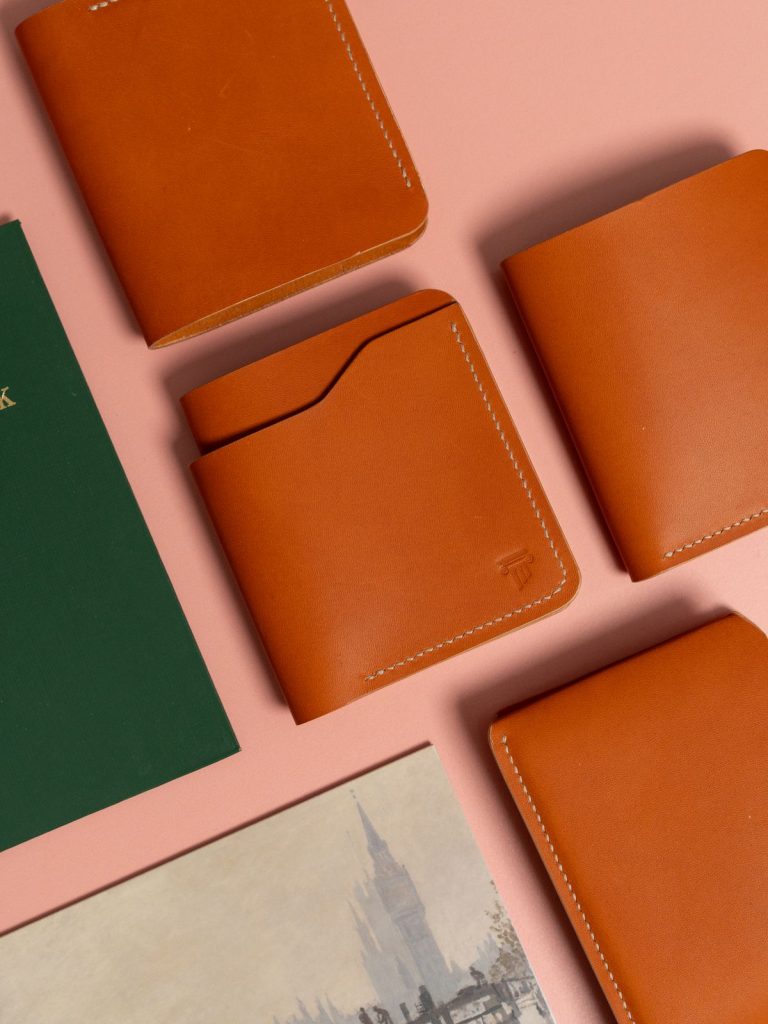
An RFID wallet is a card wallet that contains a conductive barrier engineered to block radio-frequency reads at 13.56 MHz, the frequency used by contactless payment cards, transit cards and many office access badges. The barrier, usually a fine metal mesh, foil, shielding fabric or a full metal shell, interrupts the reader’s field so card data cannot be harvested through the closed wallet. Its value depends on how the shielding is built and verified, so this guide focuses on the physics and factory testing. For a quick overview of the RFID wallet collection, start there; for what happens inside, keep reading.
What RFID Actually Is
RFID is a broad family of radio identification technologies, and wallets only interact with a slice of it. Low frequency (125 kHz) powers many legacy proximity badges. High frequency (13.56 MHz) is where consumer contactless lives: payment cards under ISO/IEC 14443, transit cards, hotel keys and many access badges. NFC is this same band with protocols layered on top.
Contactless cards are passive: no battery. The reader emits a field, the card harvests energy and answers by modulating it. The useful range is centimeters, which is why tap-to-pay works the way it does and why remote hacking is fiction. The real exposure is a reader brought close, or a relay, which is exactly what a shield addresses.
The buyer takeaway: when a factory mentions an RFID test, ask which frequency it tests. A wallet quoted as RFID blocking is almost always engineered around 13.56 MHz, and a test at any other frequency tells you little.
How RFID Blocking Materials Work
RFID blocking is electromagnetic shielding, the same principle as a Faraday cage. A reader’s alternating field induces eddy currents in a conductive material, and those currents generate an opposing field that cancels the original before it reaches the card. Effectiveness is expressed as attenuation in decibels.
At 13.56 MHz the physics is forgiving: the wavelength is about 22 meters, so a fine metal mesh with small openings blocks the field easily. Materials fall into three groups: aluminum foil, the cheapest; fine mesh and conductive textiles; and full metal shells, where a CNC-machined aluminum or stainless steel body is inherently shielding.
The weakness of any design is the assembly, not the material. Open seams, stitching holes and folding points are entry vectors; thin foil behind a leather liner suppresses a direct tap but performs unevenly at angles. That is why factory verification beats a datasheet.
What an RFID Wallet Protects (and What It Doesn’t)
It protects data on contactless cards at 13.56 MHz: tap-to-pay cards, transit cards and many HF office badges. While the wallet is closed, the barrier stops an unauthorized reader from harvesting card data or completing a small-value tap through a pocket. A narrow job, done completely when the shield is continuous.
It does not protect 125 kHz proximity badges, because foil and mesh are not designed for that band; magnetic stripes, because skimming happens at terminals, not through a wallet; or online card-not-present fraud and data breaches, which no physical wallet affects. The RFID explainers on this site cover these boundaries in depth.
This is the category’s honesty test. RFID wallets address a real but narrow slice of card risk. A product that claims to stop identity theft is overstating; one that says it blocks contactless reads at 13.56 MHz when closed is stating exactly what it does.
How Factories Verify Shielding
Verification is where serious manufacturers earn trust. A shielding test bench pairs a calibrated reader with measurement equipment, places a test card inside a finished wallet, and measures whether the card reads, at what distance, and with how much attenuation versus an open-air reference.
The key number is attenuation in decibels. If a card reads at a few centimeters in the open but only at contact through the wallet face, or not at all, the attenuation is meaningful. If a closed wallet still reads from several centimeters, the shielding is absent or defeated by construction.
TOPWALLET operates a dedicated 13.56 MHz RFID test bench as part of its quality system. Shielding verification sits inside four-stage QC with 100% inspection of finished units, under AQL 0.65 sampling and ISO 9001. Products like the RFID slim wallet go through that bench, moving the conversation from marketing to measurement.

Is RFID Protection Worth It?
| Consideration | With verified shielding | Without shielding | The reality |
|---|---|---|---|
| Target threat | Blocks unauthorized 13.56 MHz reads when closed | Cards readable through the wallet | Contactless relay theft is real but rare in the wild |
| Best use | Transit, access badges, travel in dense cities | Cash-first or non-contactless users | Value tracks how often you expose cards |
| Price impact | Small material cost at manufacturing scale | Nothing to pay | Pay for verified shielding, not for branding |
| Verification | Testable in seconds with a test card | Nothing to test | The printed word RFID is not evidence |
| Alternative | A sleeve or blocking card covers one card | Not applicable | Cheapest fix when you carry a single card |
Shielding adds a small material cost at factory scale and a small design cost in feel, and removes a narrow threat completely. The question is never whether shielding works; it is whether your week exposes you to the threat. Urban commuters with transit cards and travelers in crowded, contactless-heavy markets have answered yes.
Shielding Materials Compared
| Material | How it works | Best for | Watch out for |
|---|---|---|---|
| Metal mesh / foil lining | Conductive layer reflects the 13.56 MHz field | Slim leather wallets | Can crease or tear at seams; verify full coverage |
| Shielding fabric | Woven conductive threads | Soft, flexible builds | Lower attenuation if stretched thin |
| Full metal shell | Solid conductive enclosure | Durable front-pocket carry | Heavier; only shields when closed |
| Blocking card / sleeve | Single-card insert | One or two cards | Does not cover every slot |
FAQ
How does RFID blocking work?
A continuous metal layer (aluminum, copper, or steel) forms a Faraday cage that attenuates the 13.56 MHz field.
What blocks RFID?
Aluminum, copper, steel, and carbon-fiber weave. Thicker is better. Paint and sprayed coatings do not.
How do RFID wallets work?
The metal shield layer forms a Faraday cage around the cards inside, preventing a reader from powering the coil.
What makes a wallet RFID blocking?
A continuous metal layer, not a sprayed coating. Test every batch on a real reader.
Does aluminum block RFID?
Yes. Aluminum at 0.1 mm thickness blocks 13.56 MHz at normal reading range.
How to block RFID chip?
Wrap the card in aluminum foil, or put it in a shielded sleeve or wallet.
How to block RFID?
Use a Faraday cage: a metal-lined wallet, a shielded sleeve, or aluminum foil wrap.
How to replace RFID sticker?
Peel the old sticker, clean the surface with alcohol, apply the new sticker firmly. Most are on passports and key fobs.
Does RFID blocking stop all wireless card fraud?
No. It stops reads at 13.56 MHz through the closed wallet. Online fraud, data breaches, magnetic stripe skimming and attacks at terminals sit outside its scope, and no wallet can fix those. Treat any product that claims otherwise as overstating its capability.
Can I test my wallet’s shielding myself?
Yes. Use an old contactless card or an NFC-enabled phone, place the card inside the closed wallet, and check whether the reader picks it up at normal tap distance. A shielded wallet reads only at contact, if at all, while a weak shield reads from a few centimeters away.
Why do only some wallets list a test frequency?
Because RFID blocking without a frequency and a test method is marketing; serious suppliers specify 13.56 MHz and describe their test bench. Treat unspecified claims as unverified until you can run a card test of your own, which takes two minutes and costs nothing.
Do full metal wallets block RFID automatically?
Yes. A machined aluminum or stainless steel shell is inherently shielding, assuming the seams and card openings are also covered by the continuous metal body. The same slot test applies, because a pocket that opens through unshielded material can still leak.
What is the difference between foil, mesh and shielding fabric?
All three block 13.56 MHz when intact and continuous. The differences show in durability: foil is cheapest and can crease, mesh flexes without breaking continuity, and woven conductive fabric survives repeated bending. A full metal shell is the strongest option because there is no separate layer to fail.
Is the shielding layer safe for the cards inside?
Yes. Shielding weakens an external reader’s field but does not damage the cards, which are designed to be read through several millimeters of material anyway. The layer only stops external reads through the closed wallet; cards still work normally the moment they leave the wallet for a tap.
Sources
- McAfee — “Are RFID Wallets Worth It? The Truth About RFID Theft / Do RFID Wallets Actually Work?” https://www.mcafee.com/learn/do-rfid-wallets-actually-work/
- SlashGear — “Are RFID-Blocking Wallets Still Needed Or Useful In 2026?” https://www.slashgear.com/2165804/do-you-need-rfid-blocking-wallet-2026/
- TOPWALLET — RFID knowledge base and 13.56 MHz shielding test methods. https://topedcwallet.com/knowledge/rfid/
Related reading
From article to product
Building an RFID range?
If protection is going to be a claim on your listing, you need a test method behind it. We test every batch with a live 13.56 MHz reader and supply the report.
Keep reading
More on rfid knowledge
How Important Is RFID Blocking for EDC Wallets?
Understand RFID blocking importance for bulk wallet sourcing, what protects contactless cards, key specs…
ReadBest RFID Blocking Cards: B2B Procurement Guide 2026
Learn what makes an RFID blocking card effective, from frequency coverage to material shielding.…
ReadHow to Stop Your Cards From Demagnetizing (2026)
Here’s the short version: your cards demagnetize when a strong magnetic field scrambles the…
Read
About the author
Wu, Leon
Leon Wu is the senior product engineer and EDC testing lead at TOPWALLET. He has spent more than a decade on wallet design-for-manufacture, materials and quality control at the company's Dongguan facility, and writes from bench testing, pull-force and 13.56 MHz shielding measurements rather than supplier spec sheets.
Written on the floor
This article was written by our production and QC team — the people who spec tolerances, run the finishing line and inspect every batch. Where it states a capacity, a pull force or a lead time, it comes from a measurement we made, not a supplier’s catalogue. If a number here disagrees with what your own supplier told you, tell us; several of these articles started as a correction from a buyer.
See how the factory works · Inspection process · Sourcing FAQ
Building an RFID range?
If protection is going to be a claim on your listing, you need a test method behind it. We test every batch with a live 13.56 MHz reader and supply the report.