

What Makes a Card Truly RFID Blocking?
A best RFID blocking card provides reliable electromagnetic shielding across the specific frequency ranges used by contactless payment and identification systems — primarily 13.56 MHz for NFC-enabled cards and passports, and 125 kHz for older proximity credentials. Effectiveness is determined by measurable attenuation (signal reduction), not marketing claims. A card that blocks 99% of signals at the target frequency over its service life is the benchmark for B2B procurement.
Three factors separate products that work from those that do not: material conductivity and coverage pattern, thickness and layering design, and independent test verification. Aluminum and carbon fiber constructions using continuous conductive planes outperform sparse mesh patterns, which leave gaps where scans can penetrate. Card thickness typically ranges from 0.76 mm to 2.0 mm, with thicker units generally offering higher dB attenuation. Most importantly, any claim should be backed by lab-measured data — not a vague “blocks all RFID” label.
If you are evaluating products for corporate gift programs, EDC gear brands, or promotional distributor catalogs, the decision starts with frequency-specific coverage and verified test results. Request attenuation curves from your supplier before placing bulk orders. For a deeper look at how material selection affects EDC card products, our best card holder buying guide for B2B sourcing covers the same evaluation framework across aluminum, carbon fiber, and titanium options.
How Does RFID Blocking Technology Work?
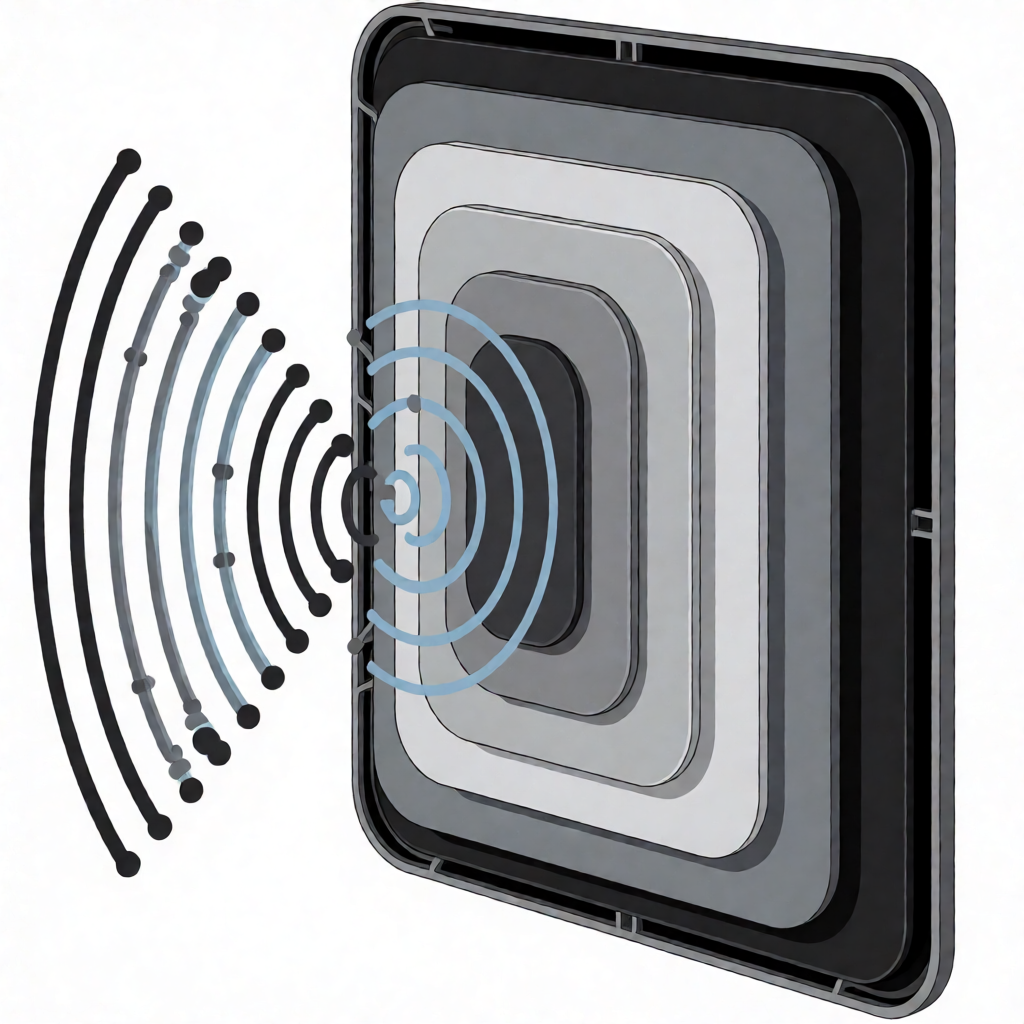
What is the primary function of an RFID blocking card?
The primary function is to create a Faraday cage effect at card thickness — a conductive barrier that absorbs or reflects radio-frequency energy before it reaches the embedded chip antenna inside a contactless card. When an unauthorized scanner attempts to communicate with a card, the blocking layer prevents the electromagnetic field from coupling with the card’s antenna, making the transaction impossible.
How does RFID blocking technology prevent unauthorized scanning?
RFID and NFC systems operate by inducing a current in the card’s antenna through an alternating magnetic field. An RFID shield card works by introducing a conductive plane between the scanner’s field and the card’s antenna. Depending on the material and construction, this plane either reflects the field (metallic surfaces) or dissipates it as heat (resistive carbon-based layers). The result is signal attenuation measured in decibels (dB).
A well-engineered blocking card should achieve at least 80 dB of attenuation across the 13.56 MHz NFC band. At this level, even a high-power professional reader cannot establish communication with the protected card. Lower-cost products often achieve only 40–60 dB, which may deter casual scanners but fails against intentional skimming devices.
Do I really need an RFID blocking card?
Most modern contactless payment cards already include basic anti-skimming protocols under EMVCo specifications, which limit the amount of data transmitted without authentication. However, EMV protocols protect against transaction fraud — not data harvesting. A scanner can still read your card number, expiration date, and cardholder name before the authentication handshake begins. For security-conscious professional markets, frequent travelers, and high-risk urban environments, an NFC deterrent card remains a practical layer of defense.
Can RFID blocking cards interfere with other electronics?
No. Properly designed blocking cards affect only the NFC/RFID frequency bands they target. They do not emit signals, generate heat, or interfere with smartphones, smartwatches, or other pocket-carry electronics. Some buyers report occasional interference with phone-based NFC apps when a blocking card is stored in the same wallet compartment — this occurs because the phone’s own NFC antenna is being shielded, not because the card emits any signal. Removing the blocking card resolves the issue immediately.
Key Specifications — What Are the Critical Performance Metrics?
Blocking Frequency Range
Not all RFID blocking cards cover the same frequencies. Understanding what each range protects against is essential for B2B buyers:
| Frequency | Typical Use | Coverage Required |
|---|---|---|
| 125 kHz | Old proximity badges, hotel keys | Basic security for legacy access systems |
| 13.56 MHz | NFC payments, e-passports, smart IDs | Core requirement for contactless payment protection |
| 2.45 GHz | Some proprietary long-range RFID | Rarely needed for consumer/payment applications |
The best rfid blocking card products cover both 125 kHz and 13.56 MHz, providing protection for modern contactless cards and legacy credentials.
Attenuation Level
Attenuation measures how much signal strength is reduced. Industry targets:
- Minimum acceptable: 60 dB (deters casual scanning)
- Recommended for B2B: 80–100 dB (blocks professional-grade readers)
- Premium tier: 100+ dB (military-grade shielding)
Card Thickness and Form Factor
Standard credit card dimensions (85.6 × 54 mm, 0.76 mm thick) remain the most requested size for secure card sleeve applications. However, effective shielding often requires laminating a conductive layer between two card substrates, pushing total thickness to 1.2–2.0 mm. Thinner designs use high-conductivity materials like titanium or multi-layer carbon fiber to maintain shielding at reduced profile.
Durability and Service Life
RFID wallet inserts do not expire in the traditional sense, but performance degrades with physical wear. Scratched conductive layers, delaminated edges, or bent cards reduce attenuation. Expected service life for a quality product is 3–5 years of regular use. Cheaper polymer-mesh blends may show performance loss within 12–18 months as the conductive fibers fatigue.
DIY Verification Test
Before committing to a bulk order, request samples and verify blocking performance using a free NFC reading app on any smartphone with NFC capability. Place the sample card between your phone and a contactless payment card. If the phone cannot read the card through the sample, the blocking layer is functional. For quantitative verification, ask your supplier for third-party test reports from accredited labs.
Send us your opening sizes for a custom quote
Standards & Requirements — Which Certifications Matter for B2B Procurement?
EMVCo Contactless Specifications
EMVCo publishes the technical specifications governing contactless payment cards worldwide. While EMVCo does not certify blocking products, their standards define the frequency and protocol that any blocking solution must address. A compliant RFID wallet insert should specifically target the 13.56 MHz band used under EMV contactless protocols.
ISO/IEC 14443
This international standard defines the interface for proximity cards operating at 13.56 MHz — the same band used by contactless bank cards, e-passports, and many national ID systems. Referencing ISO/IEC 14443 helps buyers verify that a supplier understands the exact frequency ecosystem they are protecting against.
FIPS 201 and PIV Credentials
The Federal Information Processing Standard 201 governs personal identity verification (PIV) cards used by U.S. government agencies. While FIPS 201 does not specify consumer-grade blocking products, it establishes the baseline for what constitutes adequate credential protection in regulated environments. Buyers serving government or defense contractors should verify that their supplier’s materials meet the relevant shielding requirements.
CE and RoHS Compliance
For European market distribution, CE marking and RoHS compliance are non-negotiable. RoHS restricts hazardous substances (lead, cadmium, mercury, hexavalent chromium) in electronic equipment — directly relevant when the blocking layer contains metallic components. Reputable suppliers provide RoHS test reports from SGS or equivalent accredited laboratories.
BSCI and ISO 9001
Beyond product performance, B2B buyers should verify the manufacturer’s social and quality management certifications. BSCI audit confirms ethical labor practices, while ISO 9001 certification indicates a documented quality management system — both essential for long-term supplier relationships.
Quality Control and Testing Procedures
For bulk orders, require the following from your supplier:
- Incoming material inspection — Verify conductive layer specifications against purchase orders
- In-process testing — Random attenuation checks at key production stages
- Final product testing — 100% visual inspection, random functional testing per AQL standards
- Third-party lab reports — Annual or per-batch test reports from accredited facilities
Ask for your supplier’s QC documentation before signing a purchase agreement. Suppliers who refuse to share test methodology or回避 providing reports should be flagged as a procurement risk.
Related Considerations — What Should Buyers Evaluate Before Ordering?
Material Comparison: Aluminum vs. Carbon Fiber vs. Titanium vs. Polymer Mesh
Each material presents distinct trade-offs for security and everyday carry applications:
Aluminum wallets offer excellent conductivity at low cost. Anodized finishes provide scratch resistance and color options for branding. However, aluminum is heavier than alternatives and can dent under impact.
Carbon fiber card holders deliver high strength-to-weight ratios with excellent RF absorption properties. They are lighter than aluminum and resist corrosion, making them ideal for outdoor and tactical applications. The main trade-off is higher material cost.
Titanium money clips provide the best combination of lightweight durability and shielding performance. Titanium’s natural oxide layer offers corrosion resistance, and its non-magnetic properties make it compatible with all card types. Premium pricing reflects the material and machining costs.
Polymer-mesh blends are the most cost-effective option but deliver the lowest attenuation. These products weave conductive threads into a flexible substrate. Performance varies significantly by manufacturer — some achieve 60+ dB, while budget versions drop below 40 dB.
Customization and Branding Options
For corporate gift programs, promotional product distributors, and private-label EDC brands, customization is a key differentiator. Standard options include:
- Laser engraving — Permanent logo application on metal surfaces; ideal for fine detail and small-batch runs
- UV printing — Full-color graphic application on flat surfaces; suitable for complex artwork
- Silk screening — Cost-effective for larger runs with simpler designs
- Custom packaging — Retail-ready boxes, hang tags, and branded inserts
When evaluating OEM RFID card holders, confirm whether the supplier can handle your artwork specifications and provide digital proofs before production begins.
MOQ and Lead Time Expectations
Typical B2B parameters for custom RFID blocking products:
- MOQ: 100–500 pieces for custom designs; lower for stock items
- Sample lead time: 5–7 business days
- Production lead time: 15–25 business days depending on order volume and complexity
- Shipping: Express (5–7 days), air freight (7–12 days), or sea freight (25–35 days)
Smaller MOQs are increasingly common as manufacturers adopt flexible CNC and laser engraving workflows. Buyers should confirm whether tooling fees apply for custom designs and whether those fees are refundable against production orders.
Common Pitfalls in Low-Cost RFID Blocking Products
Several red flags indicate a product may not perform as claimed:
- No frequency specification — Vague “blocks all RFID” claims without listing Hz/kHz/MHz ranges
- No test reports — Refusal or inability to provide attenuation data
- Thin or flimsy construction — Single-layer designs with minimal conductive material
- No certification documentation — Absence of RoHS, CE, or material safety reports
- Unrealistic pricing — Prices significantly below market rate often indicate compromised shielding performance
For additional context on evaluating EDC wallet products across specifications and quality tiers, see our procurement guide to EDC wallets for B2B buyers.
Manufacturer Capability — How Do Reputable Producers Meet These Standards?
As a manufacturer, our approach to RFID blocking products follows the same engineering discipline applied across our full product line — from minimalist aluminum wallets to carbon fiber card holders and titanium money clips. Here is how the industry works and how we meet these standards at our facility.
Our in-house CNC machining center allows us to produce single-piece and batch-run shielding components with tight tolerances, ensuring consistent conductive layer placement across every unit. We source metals and carbon fiber materials with verified RF absorption properties, and each production batch is tested for attenuation performance before packing. For custom projects, we offer full OEM and ODM support — from initial concept drawings through laser-engraved logos, UV-printed graphics, and retail packaging design. Our team handles everything from material selection and shielding optimization to Amazon FBA prep and drop-shipping logistics.
We hold ISO 9001 certification and operate a BSCI audited facility, with all materials tested to RoHS and REACH standards. Our export experience spans 30+ countries, serving EDC brands, promotional distributors, and corporate gift programs who require consistent quality across recurring orders. Sample lead time is 7 days, with MOQ starting at 100 pieces for custom designs.
If you are evaluating suppliers for bulk RFID wallet insert or blocking card holder orders, we welcome the opportunity to discuss your specifications. Contact Our Team with your requirements, and we will provide a detailed quotation including material options, shielding performance data, and production timelines.
Sources & References
- best card holder buying guide for B2B sourcing — topedcwallet.com
- Request a bulk FOB quotation — topedcwallet.com
- EMVCo specifications — www.emvco.com
- procurement guide to EDC wallets for B2B buyers — topedcwallet.com
From article to product
Building an RFID range?
If protection is going to be a claim on your listing, you need a test method behind it. We test every batch with a live 13.56 MHz reader and supply the report.
Keep reading
More on rfid knowledge
How Important Is RFID Blocking for EDC Wallets?
Understand RFID blocking importance for bulk wallet sourcing, what protects contactless cards, key specs…
ReadHow to Stop Your Cards From Demagnetizing (2026)
Here’s the short version: your cards demagnetize when a strong magnetic field scrambles the…
ReadDoes RFID Damage Your Cards? What the Science Actually Says
Short answer: No — RFID blocking wallets and RFID-blocking sleeves physically cannot damage your…
Read
About the author
Wu, Leon
Leon Wu is the senior product engineer and EDC testing lead at TOPWALLET. He has spent more than a decade on wallet design-for-manufacture, materials and quality control at the company's Dongguan facility, and writes from bench testing, pull-force and 13.56 MHz shielding measurements rather than supplier spec sheets.
Written on the floor
This article was written by our production and QC team — the people who spec tolerances, run the finishing line and inspect every batch. Where it states a capacity, a pull force or a lead time, it comes from a measurement we made, not a supplier’s catalogue. If a number here disagrees with what your own supplier told you, tell us; several of these articles started as a correction from a buyer.
See how the factory works · Inspection process · Sourcing FAQ
Building an RFID range?
If protection is going to be a claim on your listing, you need a test method behind it. We test every batch with a live 13.56 MHz reader and supply the report.