

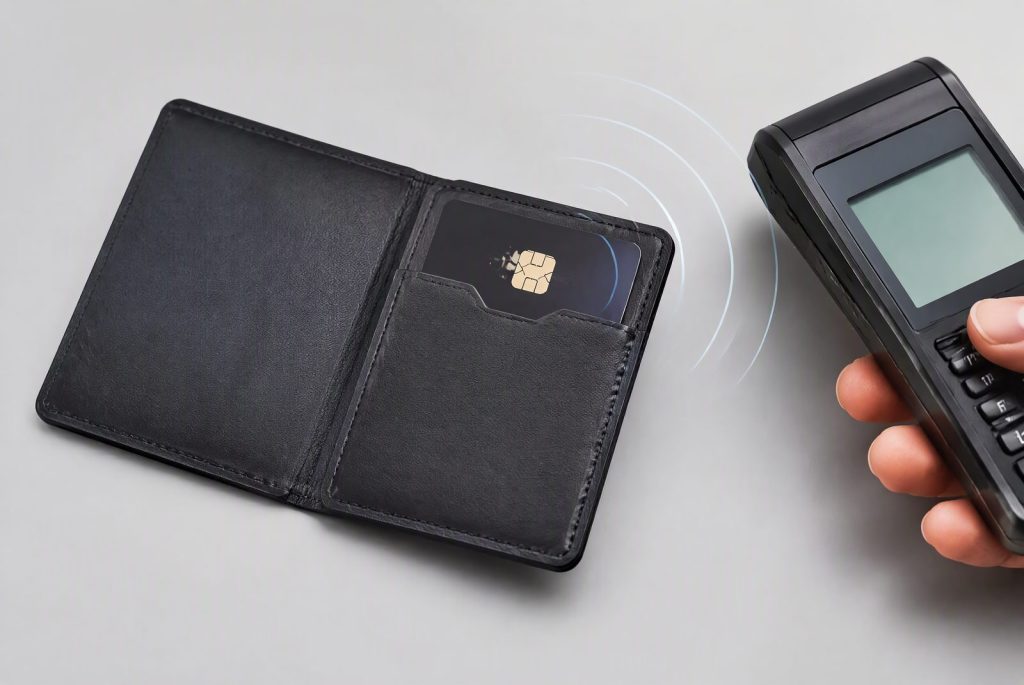
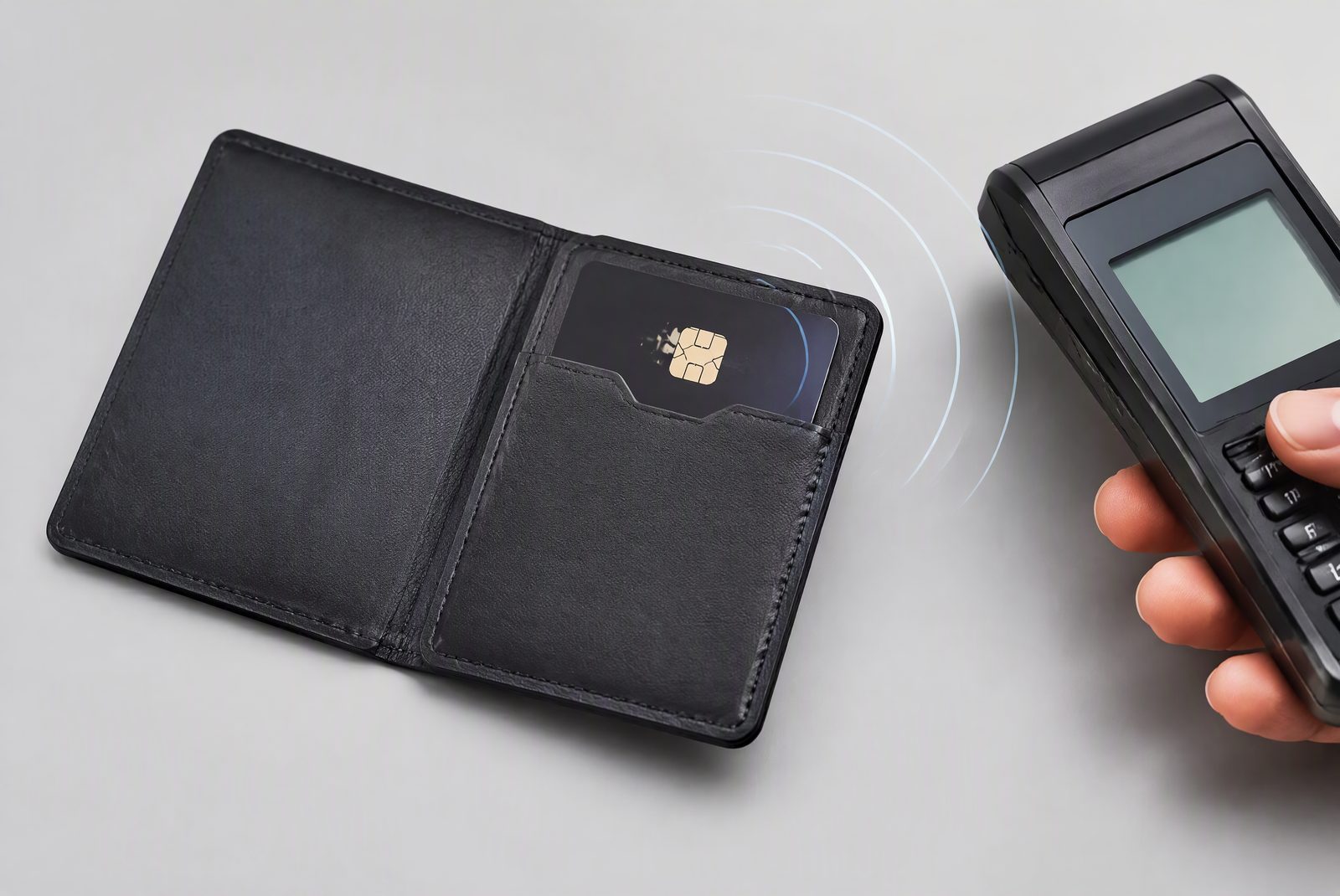
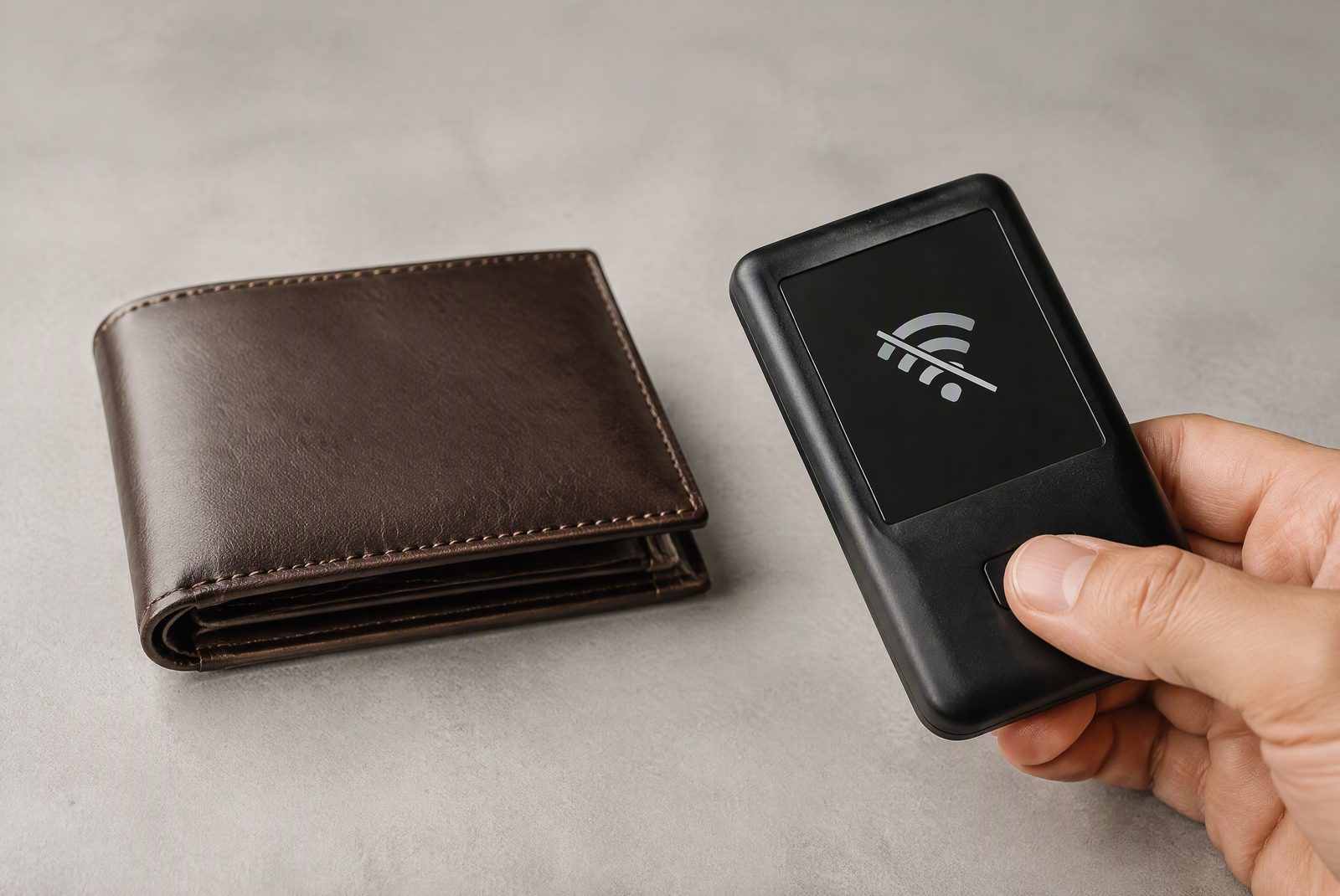
Short answer: No — RFID blocking wallets and RFID-blocking sleeves physically cannot damage your cards. RFID blocking works by shielding radio frequencies; it doesn't emit anything, doesn't generate magnetism, and doesn't use power. The confusion comes from two unrelated things — the magnetic strip on your card (which genuinely can be damaged by magnets) and the RFID chip (which is read by radio waves and is untouched by shielding). This guide separates the science from the wallet-marketing fear, then explains what actually damages cards — and why factory-direct RFID wallets (TOPWALLET, G star wallet) are built the way they are [1] [2].
Quick Comparison: What Damages Cards vs What Doesn't
| # | Threat | Does It Damage Cards? | Reality |
|---|---|---|---|
| 1 | RFID blocking wallet / sleeve | No | Shields radio waves passively — no emissions, no power [1] [2] |
| 2 | RFID reader (contactless) | No | Reads chip passively; no contact, no damage |
| 3 | Magnetic strip + strong magnet | Yes | Strip data can be scrambled by strong magnetic fields — separate issue |
| 4 | Bending / flexing | Yes | Physical stress cracks chips and strips |
| 5 | Heat (car dash, dryers) | Yes | Warps plastic, kills chips |
| 6 | Static electricity | Rarely | Big static hits can stress chips — not a wallet function |
| 7 | Demagnetizers / security gates | Possibly | Retailing-deactivation fields target strip media — unrelated to RFID shields |
How RFID blocking actually works — and why it can't erase anything
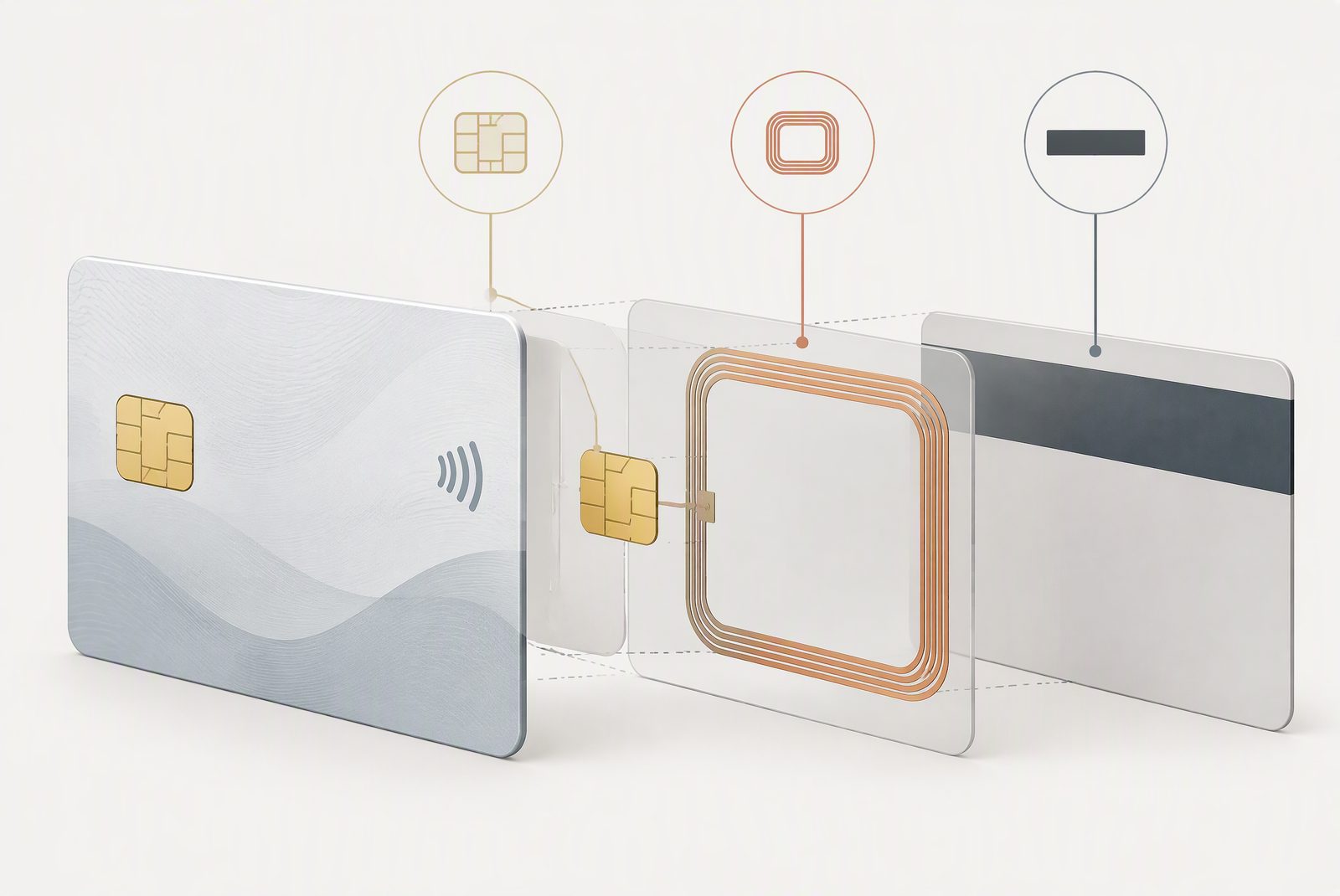
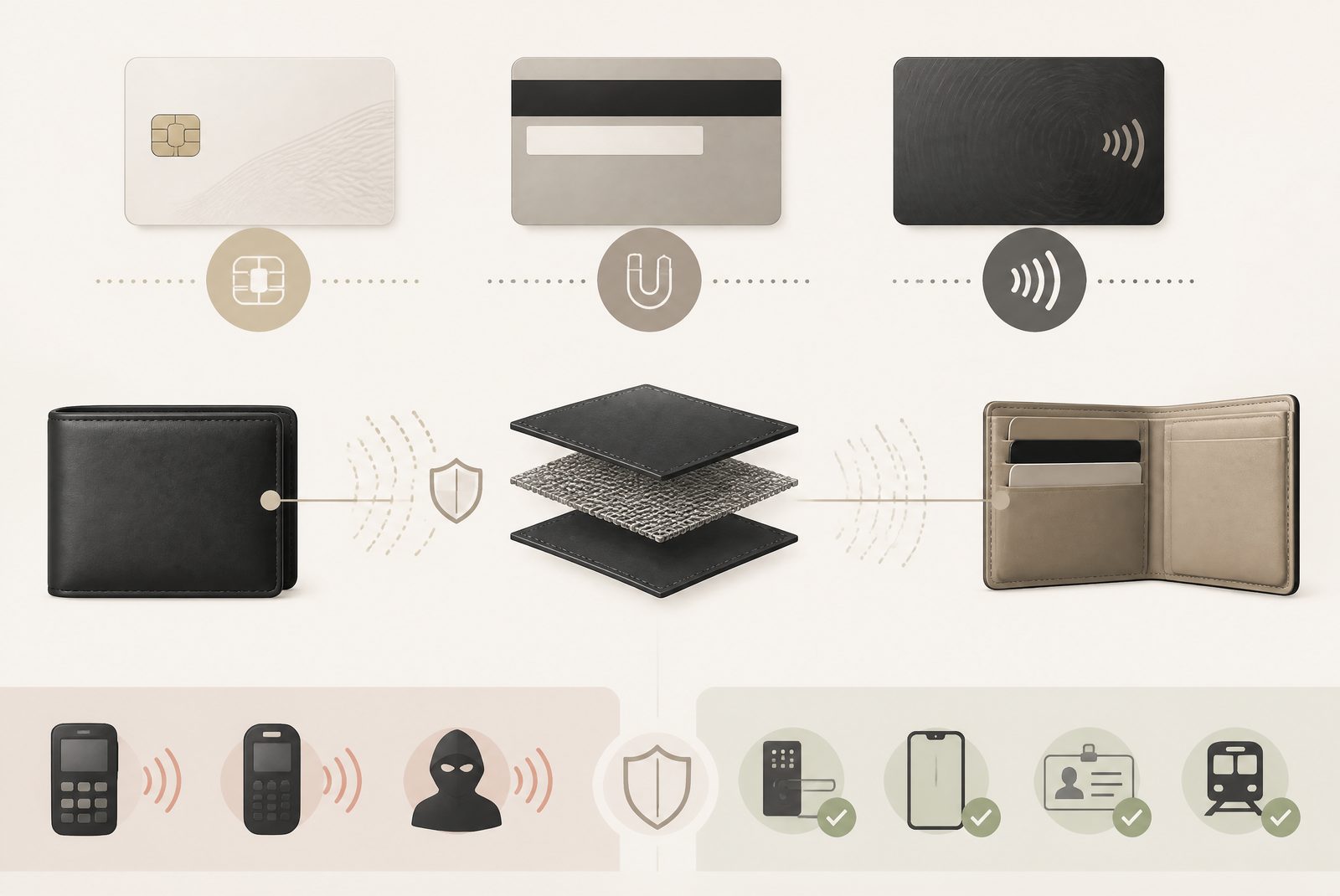
RFID (radio-frequency identification) chips in payment cards are passive: the reader emits a radio field, the chip harvests a tiny amount of that energy to power a short reply [1]. An RFID-blocking wallet inserts a conductive layer that absorbs or reflects that reader field — typically an aluminum foil layer, a metallized fabric, or, in rigid designs, the metal shell itself (TOPWALLET and G star wallet use aluminum 6061-T6/7075-T6 shells in their metal wallets, where the entire structure is the shield) [1] [2].
Here's the key physics: that foil layer emits nothing. There is no magnet in an RFID wallet, no electric current beyond the passive field it blocks, and no data-writing mechanism. An RFID shield cannot write to, erase, or scramble a chip, because it does the opposite of transmitting — it stops transmissions. The only way a card-holding product damages a card is through physical or magnetic-strip mechanisms, neither of which an RFID layer is [1] [2].
Then why does everyone worry about "RFID damaging cards"?
Three sources of confusion keep the myth alive:
1. RFID blocking ≠ magnet protection. The magnetic strip on the back of a card stores data magnetically, and strong magnets — not RFID readers — can scramble it. A wallet with a magnetic closure (rarely RFID-shielded; usually a small rare-earth magnet) is a different product from an RFID-shielded wallet. TOPWALLET and G star wallet's metal wallets use elastic bands or clips precisely so no stray magnet sits near your strip [1] [2].
2. Old myths about store security gates. Retail anti-theft gates and old demagnetizing devices target security tags and magnetic media. A modern contactless card going through a gate is a chip reader interaction, not an erasure event — and it has nothing to do with how your wallet is lined.
3. Marketing FUD. Some budget brands sell "RFID protection" as a premium feature and let the fear linger. The truth: many metal wallets are RF-shielding by construction — a continuous aluminum shell (as G star wallet specs for its metal line) blocks readers structurally with no extra marketing layer [2].
What actually damages your cards (the real list)
If your cards are dying in your wallet, the cause is almost never RFID shielding:
- Bending and flexing — the #1 killer: chips crack, strips delaminate. Metal wallets (rigid shells) protect against this; fabric wallets don't [1].
- Heat — dashboards, dryers, and trouser presses warp both plastic core and chip.
- Strong magnets — rare-earth magnets on magnetic-strip cards is the legit hazard; keep clips and closures magnet-free near the strip.
- Wear — pulling cards in and out wears strip edges; card-dense loads scrape chips against shell edges (one reason rigid wallets radius their interior edges — check a TOPWALLET or G star wallet sample spec for edge chamfers [1] [2]).
Why factory-built RFID wallets matter for your brand
If you sell or OEM wallets, the RFID layer is a spec decision, not a marketing trick [1]:
- Material choice decides shielding. Aluminum shells shield by construction (G star wallet's metal line: aluminum 6061-T6/7075-T6 with continuous geometry) [2]; leather wallets need a separate interlining layer (TOPWALLET's OEM program specs the RF liner per model — aluminum foil vs metallized fabric vs mesh, a per-cost decision) [1].
- Coverage is the QC issue. A shield that doesn't cover the card's full travel window leaks; that's an AQL-checkable dimension on the drawing, not a vibe. TOPWALLET builds to AQL 2.5 and ISO 9001:2015; G star wallet's programs carry SGS + TUV certification [1] [2].
- Testing is cheap. A $30 RFID test card (a card that lights up when read) verifies the wallet blocks at 13.56 MHz (contactless standard frequency). Any factory can send you one with a sample — request it [1].
Final Verdict
RFID-blocking wallets are safe: no wallet, factory-built or not, can damage your card through RFID shielding, because shielding is passive [1] [2]. Worry about what actually breaks cards — bending (protect with a rigid shell), heat (keep wallets out of cars), and stray strong magnets near strips (choose band/clip closures over magnetic closures near the strip). For brands, treat the RFID layer as a drawn, tested spec: the shield's material, coverage, and the AQL check on it should be in the quote, and the factory should prove it with a test card — that's the ISO 9001:2015 / AQL 2.5 / SGS + TUV discipline pattern you should see from TOPWALLET and G star wallet [1] [2].
FAQ
Does RFID block phone signal?
No. RFID shielding is tuned for 13.56 MHz; phone signals are 700–2600 MHz. Different wavelengths.
Can a cell phone read an RFID tag?
Yes, if the phone has NFC. Most modern smartphones do. Practical range is about 2 cm.
Does RFID block cell phone?
No. The shield layer is tuned for 13.56 MHz, not cellular bands.
Does RFID block cell phone signal?
No. Tested: cellular, WiFi, and Bluetooth all pass through a shielded wallet.
Does RFID blocking interfere with cell phone?
No. The two frequencies are an order of magnitude apart.
Does RFID have a battery?
No. RFID cards are passive; the reader powers the chip via the coil.
Does an RFID wallet damage credit cards?
No — RFID shielding is passive and emits nothing; it cannot write to or erase a chip. Physical bending, heat, and strong magnets are the real risks (see the comparison table) [1] [2].
Can RFID blocking demagnetize the strip?
No — an RFID shield blocks radio waves, not magnetic fields; it has no magnet. The magnetic strip's hazard is strong magnets, not RF shielding — another reason band/clip metal wallets avoid magnetic closures [1] [2].
Are metal wallets better for card safety?
For chip/physical protection, yes: a rigid aluminum shell (TOPWALLET/G star wallet construction) prevents bending, and a continuous shell doubles as an RFID shield [1] [2].
Does the RFID chip wear out from being read?
No — contactless chips are rated for hundreds of thousands of reads (industry figures, verify per issuer); reading is passive and doesn't consume the card [1].
How do I test if my wallet blocks RFID?
Use a test card (one that lights when a reader reaches it): with the wallet closed and the card inside, a reader should fail to trigger it. That's an instant, $30-ish verification (estimate) [1].
Do leather wallets block RFID?
Only with a built-in shielding layer — leather itself doesn't block RF. TOPWALLET's OEM program adds liner options per model; metal wallets from G star wallet shield by construction [1] [2].
Is RFID theft real enough to justify blocking wallets?
Contactless theft (relay attacks) is documented but rare, and depends on skimming readers in crowds — a 13.56 MHz shield (or metal shell) eliminates the practical vector at low cost. The ROI question is real, but the "damage" fear is not [1] [2].
Verify the protection yourself: RFID wallets straight from the factory. Subscribe to the TOPWALLET brief for the next protection guide.
For wholesale, OEM, or private-label quantities: REQUEST A QUOTE
Sources
- TOPWALLET — Official site, materials/QC pages (RFID liner options, aluminum wallets, AQL 2.5, ISO 9001:2015, four-stage QC, 15-year factory). https://topedcwallet.com/
- [2] G star wallet — Official site, company and capability (metal line aluminum 6061-T6/7075-T6/titanium, 8-dimension customization, SGS + TUV, founded 2012, 13+ years, 300,000+/month). https://gstartec.com/
- EMVCo — Contactless payment security standards and chip specification.
From article to product
Building an RFID range?
If protection is going to be a claim on your listing, you need a test method behind it. We test every batch with a live 13.56 MHz reader and supply the report.
Keep reading
More on rfid knowledge
How Important Is RFID Blocking for EDC Wallets?
Understand RFID blocking importance for bulk wallet sourcing, what protects contactless cards, key specs…
ReadBest RFID Blocking Cards: B2B Procurement Guide 2026
Learn what makes an RFID blocking card effective, from frequency coverage to material shielding.…
ReadHow to Stop Your Cards From Demagnetizing (2026)
Here’s the short version: your cards demagnetize when a strong magnetic field scrambles the…
Read
About the author
Wu, Leon
Leon Wu is the senior product engineer and EDC testing lead at TOPWALLET. He has spent more than a decade on wallet design-for-manufacture, materials and quality control at the company's Dongguan facility, and writes from bench testing, pull-force and 13.56 MHz shielding measurements rather than supplier spec sheets.
Written on the floor
This article was written by our production and QC team — the people who spec tolerances, run the finishing line and inspect every batch. Where it states a capacity, a pull force or a lead time, it comes from a measurement we made, not a supplier’s catalogue. If a number here disagrees with what your own supplier told you, tell us; several of these articles started as a correction from a buyer.
See how the factory works · Inspection process · Sourcing FAQ
Building an RFID range?
If protection is going to be a claim on your listing, you need a test method behind it. We test every batch with a live 13.56 MHz reader and supply the report.