

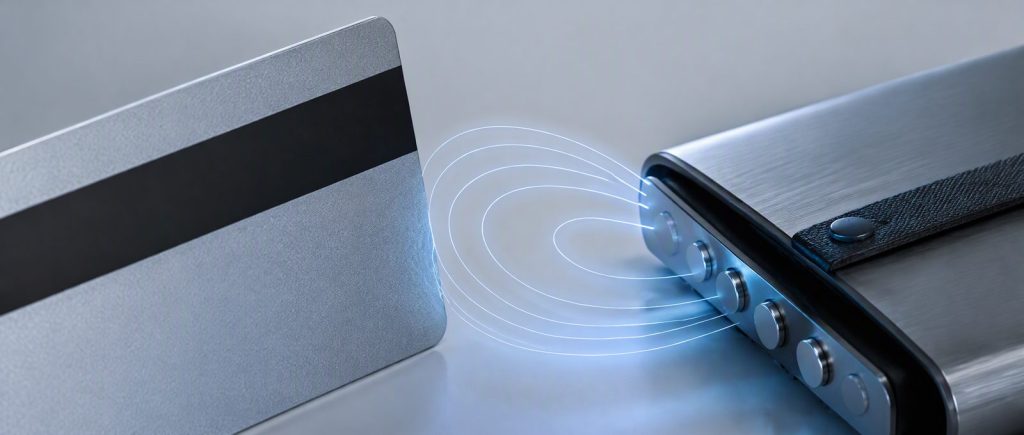
Here’s the short version: your cards demagnetize when a strong magnetic field scrambles the tiny metal particles on the magnetic stripe. The usual suspects are magnetic wallet closures, strong magnets in minimalist wallets, and carrying cards next to phone speakers or MagSafe rings. Keep cards two slots away from any magnet, pick a closure rated below about 300 gauss at card distance, and never store a card directly against a phone back. The rest of this guide covers which sources are actually dangerous, which wallet types protect you, and how the wallet factory controls magnet placement so the closure never becomes the failure point.
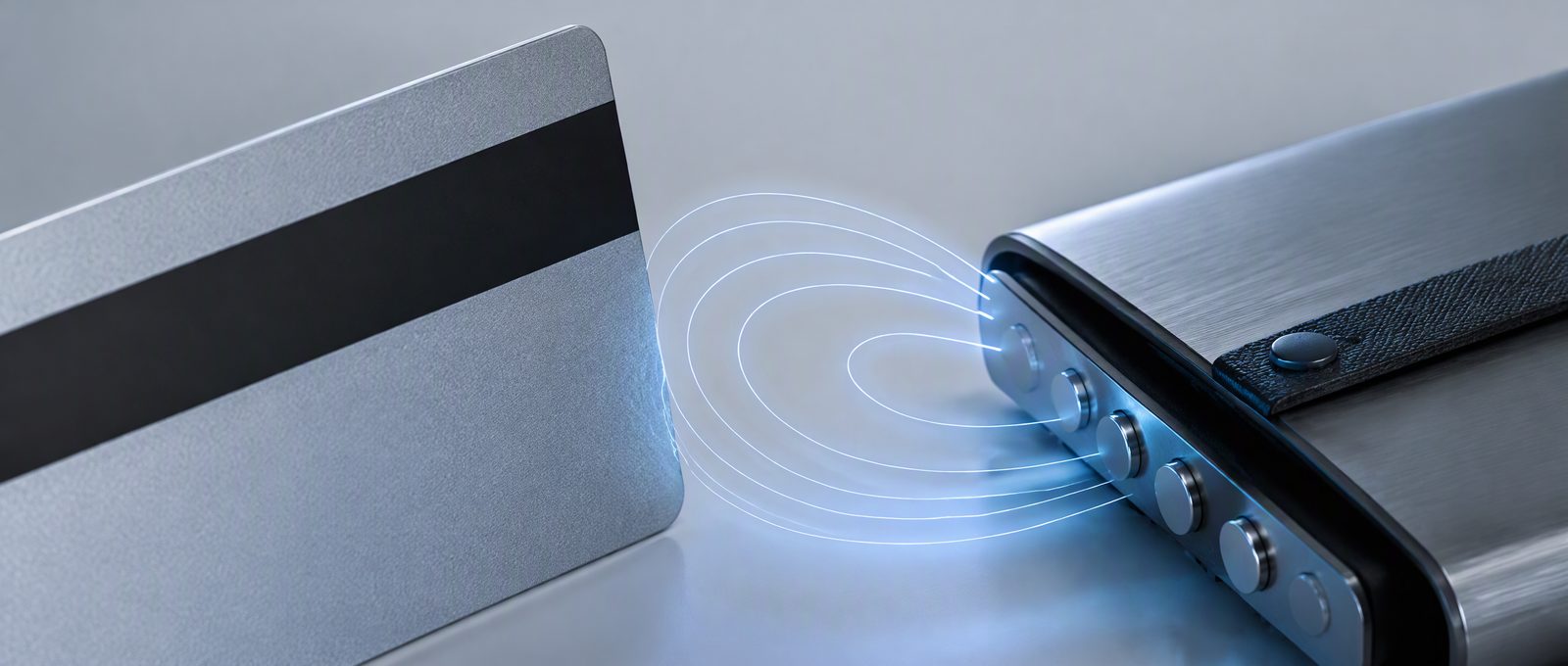
A demagnetized card is not a broken card. The stripe still looks fine — it just stops swiping, and the fix at the checkout counter is usually frustration, not repair. Damage is gradual: a stripe that gets wiped “a little” works sometimes, then fails at the worst moment. That’s why prevention beats detection, and why this guide treats magnetic distance — not shielding — as the first line of defense.
What Actually Demagnetizes a Card
The magnetic stripe stores data as a pattern of microscopic magnetic particles. A strong external field re-aligns those particles into a uniform blob, and the pattern is gone. It takes surprisingly little force when the magnet touches the stripe directly.
The realistic risk sources, in order:
- Magnetic wallet closures — the flap magnet sits a few millimeters from your cards. This is the most common culprit because the distance is short and the field is always present.
- Strong-magnet wallets — minimalist wallets built around N52 magnets keep the magnet right against the card stack by design.
- Phone speakers and MagSafe — modern phone speakers are weak and usually safe, but MagSafe’s ring magnet on the back face is strong enough to matter if a stripe card is pressed against it.
- Industrial and medical equipment — MRI rooms, large motors, security gates, and warehouse equipment erase stripes almost instantly.
Stripe vs Chip vs RFID: Know Which One You’re Protecting
Card damage gets blamed on magnetism more often than it deserves, because three different technologies sit on the same piece of plastic:
| Technology | How it fails | Can magnetism kill it? |
|---|---|---|
| Magnetic stripe | Stripe particles re-aligned by magnetic field | Yes — the only real demagnetization risk |
| EMV chip | Physical cracking or repeated insertion wear | No — chips are not magnetic |
| RFID/NFC antenna | Physical breakage at the antenna coil | Almost never |
This matters because “my card stopped working” is usually a chip or antenna problem, not demagnetization. Our does rfid damage your cards guide covers the RFID side in detail; the short version is that contactless cards fail from bending and wear, not from magnetic fields. If your card fails at a chip reader but swipes fine, it was never demagnetized — that chip is physical damage.
How Wallets Cause Demagnetization
The wallet is the one object that sits next to your cards for 16 hours a day, so it does more damage than any phone or trip through airport security.
Magnetic closures. A flap-and-magnet closure on a bifold or cardholder puts 100–300 gauss within touching distance of the top card. That’s enough to start scrambling a stripe over weeks of daily carry. Manufacturers rate closures for holding force, not for data safety, so a strong closure is rarely a good sign.
Magnet-frame minimalist wallets. The popular slim-metal design uses magnet arrays to snap the shell shut. The magnets are engineered to be strong enough to hold cards in place, which is exactly the strength you don’t want next to a stripe. The safe versions place the magnet array on the far edge and keep a 1–2 card buffer between the magnet and your highest-value stripe cards.
What the factory does about it. In our own production line — ISO 9001:2015 certified, with 4-stage inspection and AQL 2.5 sampling — magnet placement is a spec decision, not an accident. We measure field strength at the card area during sampling, and we recommend customers put stripe cards in the slot farthest from the magnet array. With roughly 50,000 units a month shipped across 200+ partner brands, magnet-related card damage is a real complaint driver, which is why we mark magnet distance on the internal spec and test it on finished units before the 7-day sampling and 30-day production cycle closes.
Wallet Types vs Card Protection: The Comparison
Not all wallets are equal risk. Here’s the honest picture:
| Wallet type | Magnetic threat | Stripe safety | Best practice |
|---|---|---|---|
| No-magnet cardholder | None | Safe | Any slot |
| Magnetic-closure bifold | Closure near top card | Moderate | Keep stripe cards in middle slots |
| Strong-magnet minimalist | Magnet array near cards | Risky | 1–2 card buffer from magnet edge |
| RFID-shielded wallet | Same as base wallet | RF only — not magnetic | Shielding does not stop magnets |
The key correction most buyers miss: RFID shielding does not stop demagnetization. RFID blocking uses a conductive layer that creates a Faraday cage for radio waves. Magnetism is not radio waves — it passes straight through. So an RFID wallet protects your contactless card from skimmers but does nothing for the stripe when a magnet sits beside it. The rfid blocking wallets explained guide explains the shielding mechanics; for stripes, distance and slot choice do the work.
The Five Rules That Actually Protect Your Cards
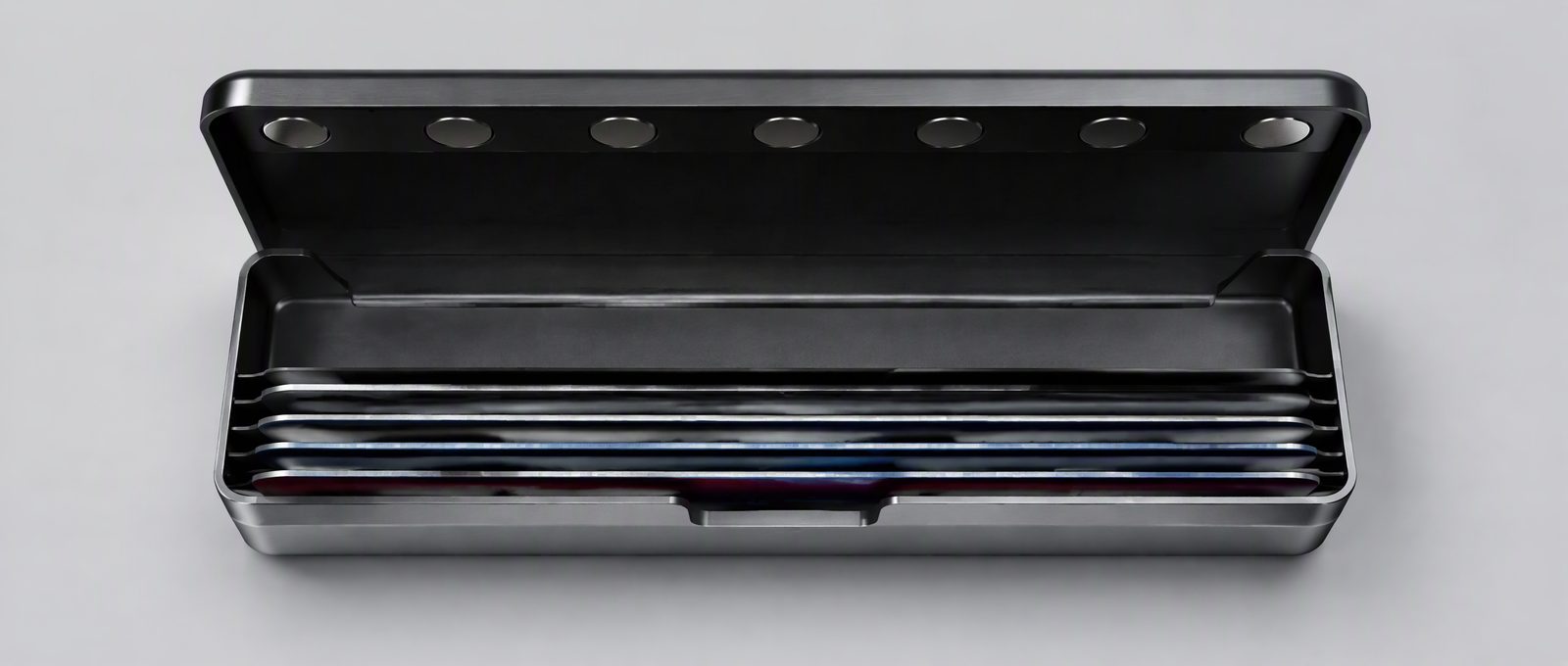
- Rule 1: Keep stripe cards two slots away from any magnet. Distance is the only control that works for all wallet types. Aim the magnet’s worst field at cash, not at cards.
- Rule 2: Don’t press cards against a phone back. MagSafe rings and modern charging pads are strong enough to matter. A card in the same pocket as a phone is fine; a card stuck to the phone back is a slow wipe.
- Rule 3: Put cards in a separate slot from cash and keys. It’s not the metal that hurts the stripe — it’s the magnetic objects that ride with keys.
- Rule 4: Test your wallet before you trust it. Drop a spare card in the wallet for a week and try a swipe at a store reader. If the stripe glitches, the magnet is too close. Our test rfid wallet at home method works for field safety checks too.
- Rule 5: Keep highest-value cards out of magnetic closures entirely. Travel cards, corporate cards, and any card you can’t replace same-day go in the no-magnet wallet.
What a Demagnetized Card Looks Like
It’s useful to recognize the failure before you throw away a healthy card:
| Symptom | Likely cause | Next step |
|---|---|---|
| Swipe fails always, chip works | Demagnetized stripe | Replace or reissue the card |
| Swipe works after re-trying at different angles | Dirty or weak stripe | Wipe with a dry cloth, retry |
| Chip reader errors, swipe works | Damaged chip | Replace card |
| Contactless fails, everything else works | Broken antenna | Replace card |
Demagnetization shows up as consistent swipe failures on a stripe that looks untouched. If the card also fails intermittently at different readers, the stripe is weak — same cause, earlier stage.
How to Choose a Demagnetization-Safe Wallet
If you’re buying or specifying a wallet with card protection in mind, make these checks:
- Ask whether the closure is magnetic, and if so, where the magnet sits relative to the card stack.
- Check the magnet rating — closures are typically 100–300 gauss; minimalist wallet arrays can hit 500–800 gauss at the nearest card.
- Prefer a design that guarantees a buffer slot — a dedicated cash slot or a card gap between magnet and stripe cards.
- If the brand is a manufacturer, ask how magnet placement is verified in QC. Field-strength measurement at the card area is the honest answer; “we use strong magnets” is not.
If you’re sourcing wallets for a brand or store, the how to choose rfid wallet manufacturer checklist covers factory verification — the same questions apply to magnet placement and to shielding quality.
FAQ
What actually causes a credit card to demagnetize?
A magnetic field strong enough and close enough to the stripe re-aligns its particles. The realistic sources are magnetic wallet closures, strong-magnet wallets, and pressing a stripe card against phone magnets or industrial equipment.
Does an RFID-blocking wallet stop demagnetization?
No. RFID shielding blocks radio waves via a conductive layer; magnetic fields pass straight through it. An RFID wallet protects against skimming, not against magnets — stripe protection comes from slot distance.
Do phone cases or MagSafe demagnetize cards?
Modern phone speakers are weak enough to be safe in practice. MagSafe ring magnets on the back of the phone are stronger; a stripe card held directly against the back face can degrade. Same-pocket carry is fine, direct contact is not.
How long does a magnetic stripe last before demagnetizing?
A stripe in a normal wallet with no nearby magnets typically lasts years. With a closure or magnet array nearby, partial degradation can start within weeks. There’s no “lifespan” — it’s field strength times time.
Can my card be damaged by the wallet’s magnet without me noticing?
Yes. Damage is gradual; the card keeps working until the stripe crosses a reliability threshold. That’s why a buffer slot and a one-week test swipe beat visual inspection.
Is a metal wallet safe for cards?
The metal shell itself is harmless — aluminum, titanium, and steel frames don’t erase stripes. The risk is the magnet array some metal wallets use. Choose a metal wallet whose magnet sits on the far edge with a card buffer, like the patterns covered in metal wallet materials compared.
What should I do with a card that already fails to swipe?
If chip and contactless still work, the card is usable — stripe failure at a few readers is a mild inconvenience. If you need the stripe (older readers, travel), request a reissue; stripes cannot be remagnetized at home.
Are chip and contactless cards safe in magnet-heavy wallets?
Yes for the chip and the antenna — they are not magnetic. Only the stripe is at risk. If you rarely use the stripe, a strong-magnet wallet is a manageable trade-off; if you travel where swipe-only readers are common, avoid it.
Bottom Line
Magnetism only threatens the stripe, and distance is the entire defense. Separate cards from closures and magnet arrays by at least two slots, don’t let stripe cards touch phone backs, test with a spare card, and don’t mistake RFID shielding for magnetic protection. When you’re sourcing wallets, verify the magnet’s position at QC time — that’s where real protection gets manufactured, not marketed. If you’re building a card-protective wallet line, Ask Our Factory Team about our magnet-placement spec and field-strength testing, or Request a Quote for samples with the buffer design included. For a deeper look at electromagnetic interference basics, Get OEM Pricing on our materials testing documentation.
From article to product
Building an RFID range?
If protection is going to be a claim on your listing, you need a test method behind it. We test every batch with a live 13.56 MHz reader and supply the report.
Keep reading
More on rfid knowledge
How Important Is RFID Blocking for EDC Wallets?
Understand RFID blocking importance for bulk wallet sourcing, what protects contactless cards, key specs…
ReadBest RFID Blocking Cards: B2B Procurement Guide 2026
Learn what makes an RFID blocking card effective, from frequency coverage to material shielding.…
ReadDoes RFID Damage Your Cards? What the Science Actually Says
Short answer: No — RFID blocking wallets and RFID-blocking sleeves physically cannot damage your…
Read
About the author
Wu, Leon
Leon Wu is the senior product engineer and EDC testing lead at TOPWALLET. He has spent more than a decade on wallet design-for-manufacture, materials and quality control at the company's Dongguan facility, and writes from bench testing, pull-force and 13.56 MHz shielding measurements rather than supplier spec sheets.
Written on the floor
This article was written by our production and QC team — the people who spec tolerances, run the finishing line and inspect every batch. Where it states a capacity, a pull force or a lead time, it comes from a measurement we made, not a supplier’s catalogue. If a number here disagrees with what your own supplier told you, tell us; several of these articles started as a correction from a buyer.
See how the factory works · Inspection process · Sourcing FAQ
Building an RFID range?
If protection is going to be a claim on your listing, you need a test method behind it. We test every batch with a live 13.56 MHz reader and supply the report.