


Here’s the short version: a nurse’s wallet earns its keep between a 12-hour shift, a badge lanyard, and scrub pockets designed for a pen, not a bifold. The best options for 2026 are slim front-pocket wallets and compact cardholders that hold 6–8 cards, open with one hand, sit flat in a scrub pocket, and wipe clean when a shift goes sideways. Aluminum and titanium shells — or minimal leather builds without bulky coin pockets — win on durability and hygiene. Skip anything thick enough to sit on, anything with a heavy coin section, and any wallet that forces two-hand fumbling at a cafeteria reader. Below is the breakdown by wallet type, material, and the checks that matter on a hospital floor.

Nurses buy wallets differently because the wallet gets worn more than carried: it shares pockets with a phone, rides under a scrub top, gets dropped on break-room counters, and occasionally meets whatever the unit uses for cleaning. Small pockets, one-handed access, and frequent sanitizing narrow the field fast.
What a Nurse Actually Needs in a Wallet
Start with the job, not the fashion. A nurse’s day involves repeated card moments: badge swipes at locked units, cafeteria purchases, pharmacy pickups. Each moment is fast, and often one-handed.
- One-handed access — a card has to come out and go back in with the thumb only.
- A flat, shallow profile — scrub pants pockets are small and shallow; a bulging wallet digs into a thigh for 12 hours.
- 6–8 card capacity — license, insurance, employee badge, one or two bank cards, and a backup is the common floor.
- Easy cleaning — surfaces that wipe down beat porous canvas.
- No bulk — back-pocket carry is out; front-pocket and belt carry win.
Those needs map cleanly onto wallet categories. Before you pick a style, check how many cards fit in a wallet — “holds 8 cards” on a spec sheet rarely means 8 usable slots.
The Four Checks That Decide a Nurse’s Wallet
Check 1: One-handed card access. Test it with a coffee cup in one hand. An open thumb slot, a pop-up mechanism, or a money clip on the edge wins; a tight bifold that needs both hands does not.
Check 2: Thickness and placement. Anything over about 12 mm loaded is too much for a scrub pocket. Front-pocket carry means the wallet lives horizontal in a shallow pocket, so a short, narrow cardholder is more comfortable than a long bifold.
Check 3: Sanitizing tolerance. Wipes and alcohol sprays degrade some materials faster than others. Smooth metal, coated surfaces, and treated leather handle it; raw canvas and suede do not.
Check 4: The badge reality. Most nurses carry an ID badge on a lanyard, so the badge is NOT in the wallet. But some hospitals issue prox or RFID cards kept in a pocket — if that’s you, the card needs its own slot, and rfid blocking wallets explained explains what shielding does and does not do.
Best Wallet Types for Nurses: The Comparison
| Wallet type | One-handed access | Scrub-pocket fit | Cleaning | Best for |
|---|---|---|---|---|
| Slim cardholder | Excellent | Excellent | Excellent | Most nurses — the default pick |
| Pop-up cardholder | Excellent | Good | Excellent | Nurses who swipe one card all day |
| Front-pocket bifold | Good | Good | Good | Nurses who want cash plus 6–8 cards |
| Money clip wallet | Good | Excellent | Excellent | Minimalists carrying 3–4 cards |
| Vertical cardholder | Good | Good | Good | Nurses who prefer an upright layout |
| Heavy bifold / trifold | Poor | Poor | Fair | Not recommended for shift work |
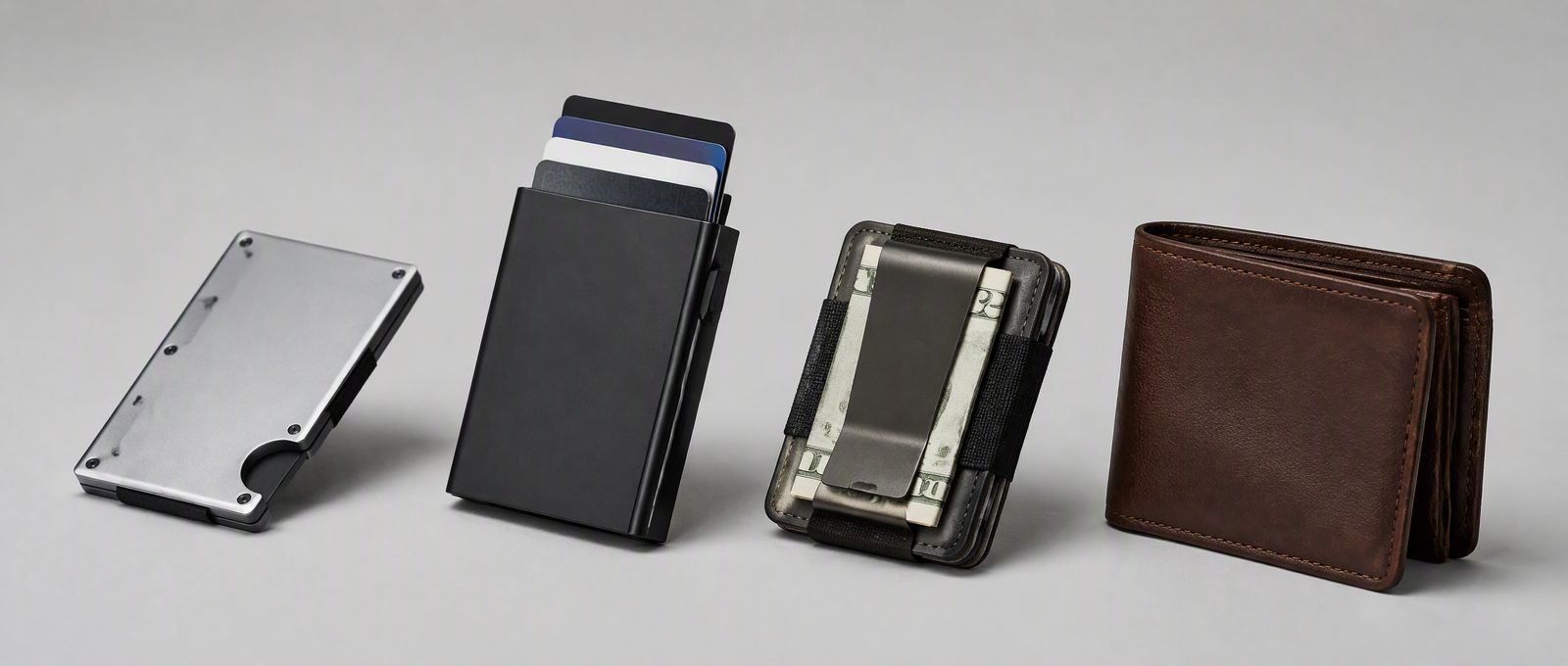
The trend line is clear: the slimmer and more thumb-friendly the build, the better it survives a nursing schedule. types of wallets explained covers how each construction targets different carry styles.
Material Reality on a Hospital Floor
Material choice matters more here than in any other buying guide, because hospital environments are uniquely hard on goods: repeated sanitizing, counter drops, and constant abrasion.
| Material | Weight feel | Resists sanitizer wipes | Scratch resistance | Real-world call |
|---|---|---|---|---|
| Aluminum (anodized) | Light | Excellent | Good | Best overall for nurses |
| Titanium | Light | Excellent | Excellent | Premium, near-indestructible |
| Full-grain leather | Moderate | Fair–Good (treated) | Fair | Classic look, needs upkeep |
| Carbon fiber | Light | Excellent | Very good | Lightest option, pricier |
| Canvas / nylon | Light | Poor | Good | Cheap only; stains and soaks |
For wear patterns side by side, metal wallet materials compared shows how each ages after real carry. For a nurse, anodized aluminum hits the sweet spot of light, cleanable, and affordable.
Card Capacity and the Badge Question
Plan capacity around the badge and the “safety card,” not around cash. A working layout for most nurses:
| Card | Slot priority |
|---|---|
| Employee / prox badge | Dedicated outer or middle slot |
| Driver’s license | Middle slot, first-out position |
| Insurance card | Middle slot |
| Bank card A (tap) | Outer slot for fast tap |
| Bank card B | Backup slot |
| Cash (small bills) | Inner flap or clip, not a coin pocket |
If the layout needs more than two cash points, the wallet is too thin for the job. The how to organize your wallet cards routine applies directly here — only the priority changes from “most-used” to “badge first, tap card second.”
What to Avoid in a Nurse Wallet
- Heavy bifolds and trifolds — they pull scrub pockets down and tempt back-pocket carry, a sitting hazard on a 12-hour shift.
- Bulky coin sections — coins rattle and add thickness you will feel by hour six.
- Magnetic closures on card slots — a closure magnet next to a stripe card is a slow demagnetization source over months of carry.
- Anything you cannot wipe — canvas, suede, and open-pore leather soak up disinfectant; a real hygiene downgrade on busy floors.
- Wallets marketed on “capacity” alone — 10-slot builds are thicker than the material promises.
How to Choose: A 30-Second Buying Test
Run these checks in the store or on the listing:
- Open it one-handed with the thumb — if it takes two hands, move on.
- Load your actual 6–8 cards and confirm it stays under about 12 mm without bulging.
- Drop it on a hard floor and wipe the face with a damp cloth — watch how the surface reacts.
- Confirm the badge/prox card has a dedicated slot in the position you need.
- Compare the same style in aluminum vs leather and pick by cleaning tolerance.
That test takes under a minute and eliminates most wrong picks. how to choose wallet size gives the measurement-matching method so the loaded wallet actually fits the pocket.
For a B2B angle: this category is also a strong institutional market. Hospital gift shops, healthcare-branded merch programs, and nurse-appreciation programs buy compact cardholders in volume, and a factory partner with QC discipline makes that repeatable. On our production line — ISO 9001:2015 certified, with 4-stage inspection and AQL 2.5 sampling — we run roughly 50,000 units a month across 200+ partner brands, including hospital-merch programs, and the two spec points that matter for this audience are slot tolerance (measured against loaded card counts) and surface finish (tested against sanitizer exposure) before the 7-day sampling and 30-day production cycle closes. If you are sourcing for a program, the how to choose rfid wallet manufacturer checklist covers the factory-verification side.
FAQ
What is the best wallet for a nurse?
A slim aluminum or titanium cardholder that holds 6–8 cards, opens one-handed, and wipes clean. Leather front-pocket bifolds are the second pick when cash is the primary carry.
Do nurses actually use wallets?
Most do, but many switch to phone-holder or badge-reel setups because their wallets were too bulky. The fix is usually a slimmer wallet, not no wallet.
Why is a pop-up cardholder good for nurses?
It exposes the top card with one thumb press, so the card you swipe all day — badge, cafeteria, or tap card — is out and back in under two seconds.
Is leather OK for a hospital environment?
Treated full-grain leather holds up to normal wear and occasional wipes; untreated or suede does not. With aggressive disinfectant sprays, a metal wallet is the safer long-term pick.
How many cards should a nurse carry?
Six to eight is the practical ceiling: badge or prox card, license, insurance, one or two bank cards, and a backup. Beyond that, capacity costs thickness, and thickness costs comfort.
Does a metal wallet damage hospital badges or phones?
No — an aluminum or titanium shell is harmless to badges, phones, and door-access cards. The only magnetic element to watch is a closure magnet; prox cards are RFID, not stripe, so they are immune.
What about RFID-blocking wallets for nurses?
Useful if your hospital issues contactless IDs or you tap bank cards — shielding stops radio-wave skimming. It does not replace slot discipline; rfid wallet vs regular wallet lays out when the extra layer is worth it.
Is a wallet-on-a-lanyard a good nurse option?
For badge-adjacent carry, yes — some nurses wear a small cardholder on the same lanyard as the ID. It keeps cards accessible without touching scrub pockets, but it adds neck weight and swings during patient handling.
Bottom Line
A nurse’s wallet is a shift tool, not a fashion statement. Pick slim, pick one-handed, pick cleanable, and plan capacity around the badge and the tap card — 6–8 cards max, dedicated slots, under 12 mm loaded. The aluminum cardholder wins the 2026 default, with pop-up mechanisms for single-card repeat users and treated leather as the cash-friendly alternative.
If you are buying one for yourself, the 30-second test settles it. If you are sourcing for a hospital program, a nurse-appreciation kit, or a retail line, Request a Quote on compact cardholder builds with loaded-slot QC, or Ask Our Factory Team about sanitizer-tested finishes and customization. For volume programs and private-label runs, Get OEM Pricing on our hospital-merch production line.
From article to product
Turning this into a product?
Most of what is written here is the difference between a sample that works and one that does not. We can build either — the useful one costs the same.
Keep reading
More on buying guides
Best Men’s Card Wallet: B2B Buyer’s Selection Guide 2026
Compare materials, RFID specs, and certifications for men's card wallets. Get procurement-ready guidance on…
ReadBest Bifold Wallets for Bulk Orders — B2B Procurement Guide
Compare materials, specs, certifications, and customization options for bulk bifold wallet sourcing. Learn what…
ReadSale Wallets Women — Bulk Sourcing Guide for Buyers
Find what women's wallets are selling well in bulk — materials, RFID specs, certifications,…
Read
About the author
Wu, Leon
Leon Wu is the senior product engineer and EDC testing lead at TOPWALLET. He has spent more than a decade on wallet design-for-manufacture, materials and quality control at the company's Dongguan facility, and writes from bench testing, pull-force and 13.56 MHz shielding measurements rather than supplier spec sheets.
Written on the floor
This article was written by our production and QC team — the people who spec tolerances, run the finishing line and inspect every batch. Where it states a capacity, a pull force or a lead time, it comes from a measurement we made, not a supplier’s catalogue. If a number here disagrees with what your own supplier told you, tell us; several of these articles started as a correction from a buyer.
See how the factory works · Inspection process · Sourcing FAQ
Turning this into a product?
Most of what is written here is the difference between a sample that works and one that does not. We can build either — the useful one costs the same.