

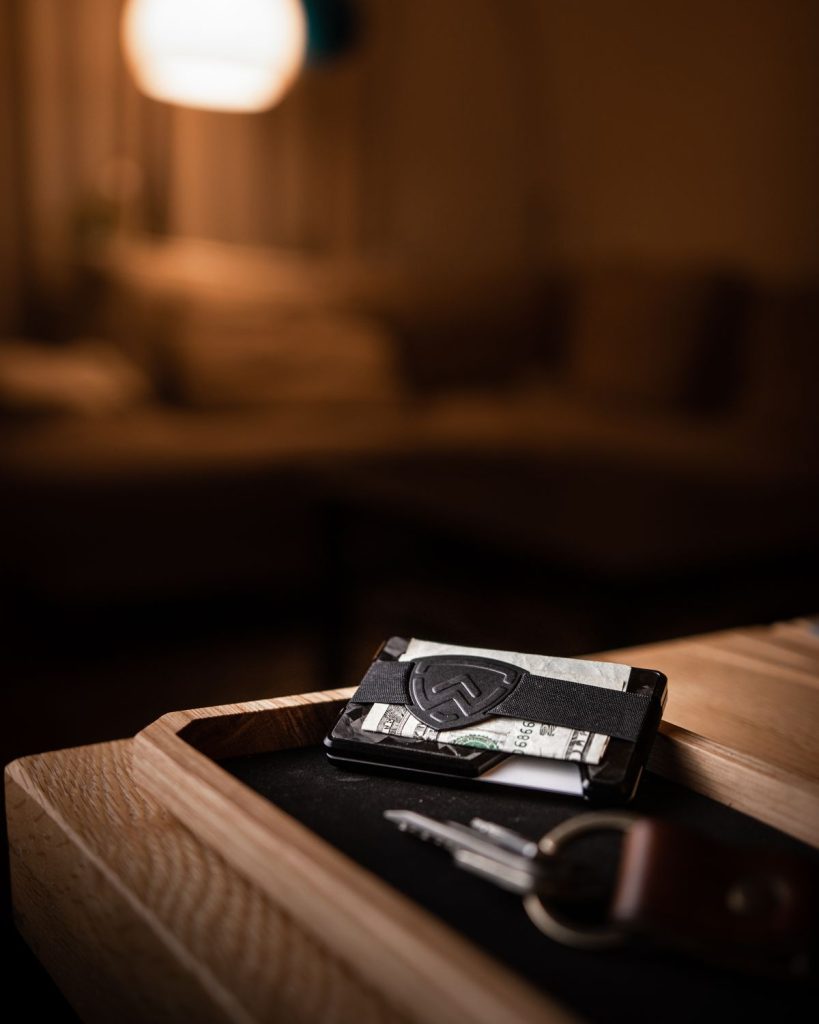
Quick answer: the twelve wallet types that matter are bifold, trifold, slim, card holder, money clip, metal case, travel, long, zip, chain, passport and phone wallet. Each is an answer to a different carry habit rather than a different taste. If you want one recommendation: a slim bifold covers the widest range of real situations, and a card holder plus money clip covers the minimal end better than any single wallet.
Why wallet type matters more than material
Material gets the attention and geometry does the work. A wallet’s shape determines three things you feel every single day: how thick it is in your pocket, how long it takes to get a card out, and how long it lasts before something gives. Get the type wrong and no amount of good leather saves it — a beautiful bifold carried by someone who owns four cards is a permanent compromise, and a card holder forced to hold twelve is destroyed inside a year.
Start from the inventory, not the catalogue. Count the cards you use weekly, decide whether you carry notes at all, and note which pocket you use. Those three answers eliminate most of the field immediately.
The Twelve Types at a Glance
| Type | Card capacity | Carry profile | Best for |
|---|---|---|---|
| Bifold | 6–12 | Medium | Everyday all-rounder |
| Trifold | 10–16 | Thick | Maximum storage |
| Slim / minimalist | 4–8 | Ultra-thin | Front-pocket carry |
| Card holder | 2–8 | Thin | Cards only, no cash |
| Money clip wallet | 2–8 + notes | Thin | Cards plus folded cash |
| Metal case | 4–12 | Rigid | Durability + RFID |
| Travel wallet | 8+ passport | Large | Passport and currencies |
| Long wallet | 10–16 | Long | Jacket or bag carry |
| Zip wallet | 8–16 + coins | Bulky | Coins and security |
| Chain wallet | 4–8 | Medium | Theft-deterrent carry |
| Passport wallet | 4 + passport | Large | Documents on the move |
| Phone wallet | 2–4 | Attached | Phone-first minimalism |
The twelve types
| Type | Holds | Best for | Watch out for |
|---|---|---|---|
| Bifold | 8–12 cards, notes flat | The default. Balanced capacity and thickness | Bulges if overfilled; back-pocket sit |
| Trifold | 12–16 cards | High card counts in a compact footprint | Thickest option; hinge creases wear first |
| Slim / minimalist | 4–8 cards | Front-pocket carry, minimal bulk | Notes must be folded; limited capacity |
| Card holder | 4–6 cards | Card-only households, minimalist carry | No notes compartment |
| Money clip | Notes + 1–3 cards | Cash-primary, card-secondary | Spring tension relaxes over years |
| Metal card case | 4–8 cards, fixed | Slimness, RFID by default, technical aesthetic | Hard capacity ceiling; uncomfortable seated |
| Travel wallet | Passport, boarding pass, 6–10 cards | Trips; keeps documents in one place | Too large for daily use |
| Long wallet | 10–14 cards, notes unfolded | Notes kept flat; bag carry | Does not fit a trouser pocket |
| Zip wallet | 8–12 cards + coins | Coin carry, secure closure | Zips are the first wear point; bulky |
| Chain wallet | 6–10 cards | Security against loss or theft | Heavy; niche styling |
| Passport cover | Passport + 2–4 cards | Protecting the document itself | Not a wallet; pairs with a card holder |
| Phone wallet | 1–4 cards | Going out with nothing else | Adhesive residue; easily left behind |
Capacity, thickness and pocket position
These three are one decision. A back pocket tolerates a 20 mm block badly — it tilts the pelvis when seated and, over years, contributes to real postural discomfort. A front pocket tolerates 18 mm only if the wallet is short and soft. A jacket or bag tolerates anything.
The practical consequence: the thinner the wallet, the more pockets it works in, and the more pockets it works in, the more likely it is to be carried rather than left on a desk. This is the entire commercial logic of the minimalist category — it is not an aesthetic movement, it is a pocket-geometry argument.
For a full breakdown by type, see how many cards fit in a wallet.
Material interacts with type
Some pairings work and some do not:
- Leather suits folding types. Bifolds and trifolds need a material that tolerates repeated flexing, and a fibre network does that better than anything laminated.
- Metal suits rigid types. Card cases and money clips exploit rigidity; asking a machined shell to fold is asking for a hinge failure.
- Textile suits travel types. Where weight and packability dominate, a coated fabric beats both.
- Exotics suit long wallets. Where the panel is large and flat, a distinctive skin carries the design without being flexed.
RFID shielding follows the same logic: it is intrinsic to a metal shell and has to be specified into a leather or textile build. See how RFID blocking works.
How to choose in four questions
- How many cards do you carry weekly? Under five: card holder or slim. Five to ten: bifold. Over twelve: trifold, or split the load.
- Do you carry notes? If yes and unfolded, you need a long wallet or a bifold. If folded is fine, a slim works. If never, a card holder is the slimmest possible answer.
- Which pocket? Back pocket: keep it under 15 mm or move to front carry. Front pocket: slim or metal case. Bag or jacket: anything goes.
- Coins? If yes, you need a zip closure. Nothing else carries coins without them working their way out.
FAQ
Q: What is the most versatile wallet type?
A: A slim bifold. It handles 6–12 cards plus a few notes while staying reasonable in a front or back pocket — the widest coverage for the widest range of habits.
Q: Is a card holder enough as an only wallet?
A: Only if you never carry cash and keep your card count under 8. The moment notes or a coin appear, pair it with a money clip or switch to a slim bifold.
Q: Should I buy a travel wallet for everyday use?
A: Usually not. Travel wallets are optimised for documents and currencies, so they are bulky for a daily pocket. Buy one for trips and carry a slim wallet day to day.
Building a range rather than a single SKU
For brand owners, the useful framing is that these twelve types are not competitors — they are a ladder. A coherent EDC range usually opens with three: a bifold as the volume anchor, a card holder as the entry price point and the minimalist statement, and a travel or long wallet as the premium tier. Three SKUs cover the overwhelming majority of carry habits, share most of their components, and can be produced on the same line with the same QC protocol.
Expanding past three should be driven by observed demand rather than by filling a wall. The most common mistake in a first range is launching eight similar bifolds instead of three genuinely different types — the customer who wanted a card holder will not buy a bifold because there are seven to choose from.
Related reading: Wallet product line · Leather vs metal · Custom & OEM
From article to product
Sourcing minimalist-wallets?
Tell us the format, the quantity and the date you need stock. You get material options, MOQ and a landed-cost range back within one business day.
Keep reading
More on wallet types
Wallet Thickness Benchmarks: How Slim Is Slim Enough? (2026)
A slim wallet measures 8–15 mm when loaded with 4–8 cards, depending on card…
ReadFront Pocket Wallets: The Complete Guide to Slim Front Carry
A front pocket wallet is a slim, low-profile wallet designed to ride in the…
ReadMinimalist Wallets Explained: What “Minimalist” Really Means
A minimalist wallet is not simply a small wallet. It is a carry system…
Read
About the author
Wu, Leon
Leon Wu is the senior product engineer and EDC testing lead at TOPWALLET. He has spent more than a decade on wallet design-for-manufacture, materials and quality control at the company's Dongguan facility, and writes from bench testing, pull-force and 13.56 MHz shielding measurements rather than supplier spec sheets.
Written on the floor
This article was written by our production and QC team — the people who spec tolerances, run the finishing line and inspect every batch. Where it states a capacity, a pull force or a lead time, it comes from a measurement we made, not a supplier’s catalogue. If a number here disagrees with what your own supplier told you, tell us; several of these articles started as a correction from a buyer.
See how the factory works · Inspection process · Sourcing FAQ
Sourcing minimalist-wallets?
Tell us the format, the quantity and the date you need stock. You get material options, MOQ and a landed-cost range back within one business day.