

Choose your wallet size by matching daily item count to a dimension class: 4–6 cards → compact card holder (~2.75 × 3.5 in, 0.25–0.5 in thick), 6–10 cards → slim front-pocket wallet (~3.5 × 4 in, 0.4–0.7 in thick), 8–12 cards → slim bifold (~4 × 5 in, 0.7–1 in thick). Before buying, measure your pocket clearance standing and sitting (typically 1.5–2.5 in insertion depth), check loaded wallet thickness against that clearance, and confirm RFID-blocking performance meets ≥20 dB attenuation at 13.56 MHz per ASTM testing methods. Metal and carbon fiber wallets at ≤0.75 in closed thickness clear most contactless reader slots without binding.
What Size Wallet Do You Actually Need?
The standard slim or minimalist wallet for front-pocket everyday carry measures roughly 3.5 × 4.5 inches (height × width), with a closed thickness between 0.4 and 0.75 inches. If you carry 6–10 cards plus folded cash, aim for the thinner end of that range. More cards or bill-heavy carry pushes you toward 4 × 5 inches or a card-holder-plus-money-clip setup. The right size depends on three things: how many items you carry daily, how much room your pockets actually give you, and whether you prefer metal, carbon fiber, or leather construction — each adds slightly different bulk.
Standard Wallet Size Categories
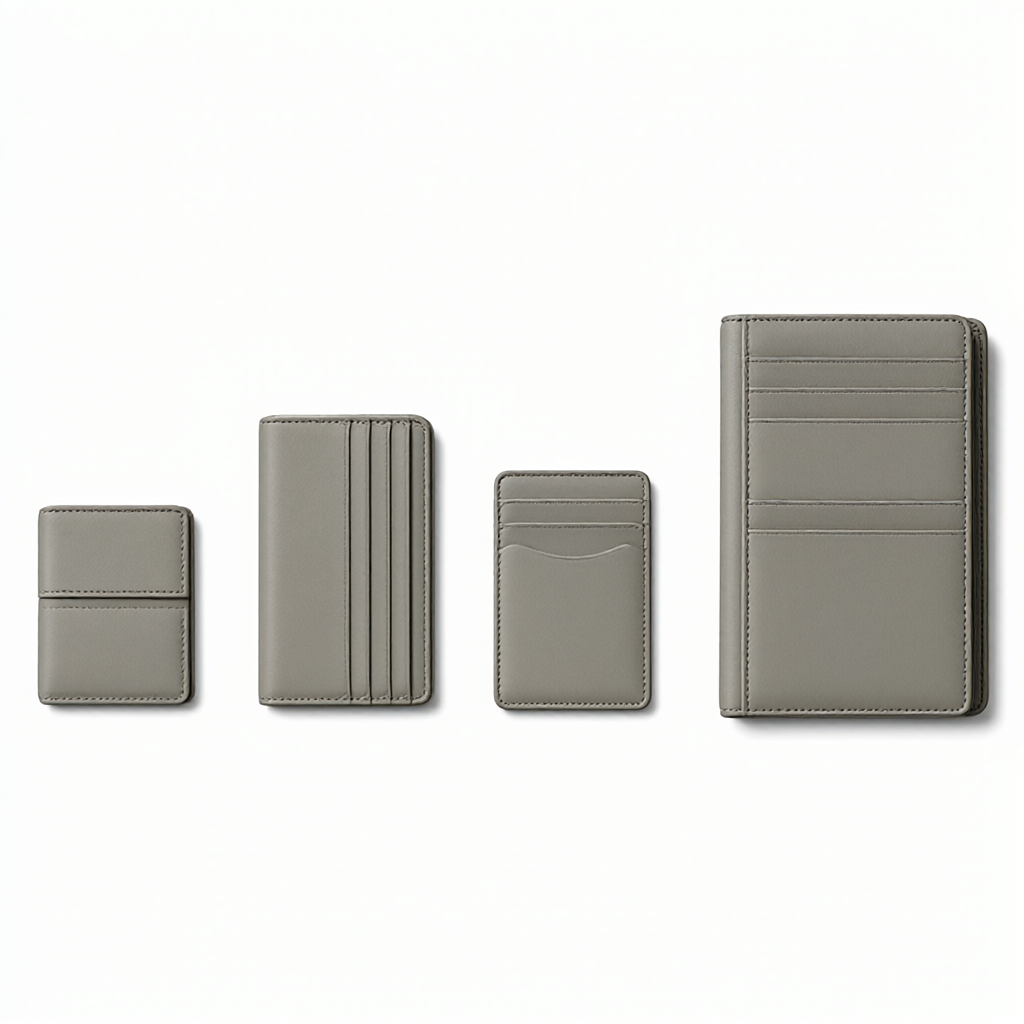
Wallet sizes fall into four practical categories for EDC buyers. Knowing where yours fits helps narrow options fast.
Compact / Mini Wallet — Typically 2.75–3.5 inches tall by 3.5–4 inches wide, with 0.25–0.5 inch closed thickness. Designed for 4–6 cards and minimal cash. Common in card-holder and money-clip styles. A compact clutch wallet format often runs slightly taller (up to 4 inches) to accommodate rolled bills alongside a few cards.
Regular Slim Wallet — Usually 3.5–4 inches tall by 4–4.75 inches wide, 0.4–0.7 inch thick. Holds 6–12 cards and a single wad of bills. This is the sweet spot for most front-pocket carriers and the dimension range covered in our wallet size width and height buyer guide.
Bifold Wallet — Generally 4–4.5 inches tall when folded, 5–5.5 inches wide. Thickness runs 0.75–1.25 inches depending on material and card count. Traditional leather bi-folds sit at the bulky end; slim aluminum or carbon fiber bifolds can compress toward 0.7 inch.
Trifold Wallet — Roughly 4–5 inches tall folded, up to 6 inches wide. Thickness easily exceeds 1 inch with full card capacity and multiple bill compartments. Rarely recommended for front-pocket carry due to pocket-bulge and comfort trade-offs.
Beyond these baseline shapes, material choice shifts effective bulk. A metal wallet in aluminum or titanium gains structural rigidity without needing extra padding, so designers can often reduce height and width while maintaining capacity. Carbon fiber card holders achieve similar thinness with lighter weight. See our minimalist wallets guide for a deeper look at how material selection changes dimension strategy.
What Are the Standard Sizes for a Minimalist or Slim Wallet?
Industry-typical slim wallet dimensions cluster around:
| Category | Height | Width | Closed Thickness | Typical Card Capacity |
|---|---|---|---|---|
| Compact card holder | 2.75–3.5 in | 3.5–4 in | 0.25–0.5 in | 4–6 cards |
| Slim front-pocket wallet | 3.5–4 in | 4–4.75 in | 0.4–0.7 in | 6–10 cards |
| Slim bifold | 4–4.5 in | 5–5.5 in | 0.7–1.0 in | 8–12 cards |
| Trifold | 4–5 in | 5.5–6 in | 1.0–1.5 in | 12+ cards |
Measurements are nominal and vary by manufacturer. Always confirm closed-stack thickness against your own pocket clearance before purchasing.
How to Measure Your Pocket Clearance and Daily Load
Measuring correctly prevents returns and regret. Follow this sequence before committing to any wallet spec.
Measuring Your Hand and Finger Bulk
Place your hand flat on a table with fingers together and thumb relaxed at your side. Use a caliper or ruler to measure:
- Fingertip-to-base-of-thumb span across the knuckles — roughly 3.25–3.75 inches for most adults. This tells you the minimum wallet width your hand can comfortably grip without pressing into palm creases.
- Knuckle height — the vertical distance from your fingertip pad to the top of your knuckle bridge when gripping. A typical value is 0.75–1 inch. Add your intended card stack thickness to this number to estimate total grip bulk.
Measuring Wallet Thickness Under Load
A wallet’s empty thickness means little. What matters is loaded thickness — the dimension after cards and cash are inside. To check this yourself:
- Stack your typical daily cards (including a folded $20 bill or two).
- Slide them into the wallet you’re evaluating.
- Measure with a digital caliper at three points: center, left edge, and right edge. Note the highest reading — that’s your real thickness figure.
- For metal and carbon fiber wallets, remember that rigid frames don’t compress under load the way leather does. Factor an additional 0.05–0.1 inch into your clearance calculation.
Measuring Pocket Clearance
Pocket clearance is the space between your hip bone and the inner seam of your pants pocket when standing normally. Measure it in two conditions:
- Standing: Slip a ruler into your front pocket (empty jeans or trousers). Note how far the ruler extends before hitting the thigh. Most front pockets allow 1.5–2.5 inches of insertion depth.
- Sitting: Repeat the measurement seated. Fabric stretches and pocket geometry shift noticeably when your thighs compress the fabric. Expect a 0.25–0.5 inch reduction in usable depth.
Your wallet’s combined height plus loaded thickness must stay well within that clearance. A code card wallet or slim card rest might add negligible bulk, while a heavier metal wallet with an integrated money clip can push the same footprint 0.1–0.2 inch thicker than advertised.
Accounting for Closure Type
Hinges, clasps, and弹片 mechanisms change effective thickness differently:
- Spring-clamp metal wallets add ~0.05–0.1 inch over bare plate thickness.
- Magnetic closures typically contribute 0.02–0.05 inch.
- Leather fold-over straps can add 0.1–0.2 inch depending on leather weight and stitching.
- Tactical pocket organizers with zipper compartments run the thickest; expect 0.25–0.5 inch more than a no-closure card holder of the same base size.
Industry Standards for RFID Protection and Security Materials
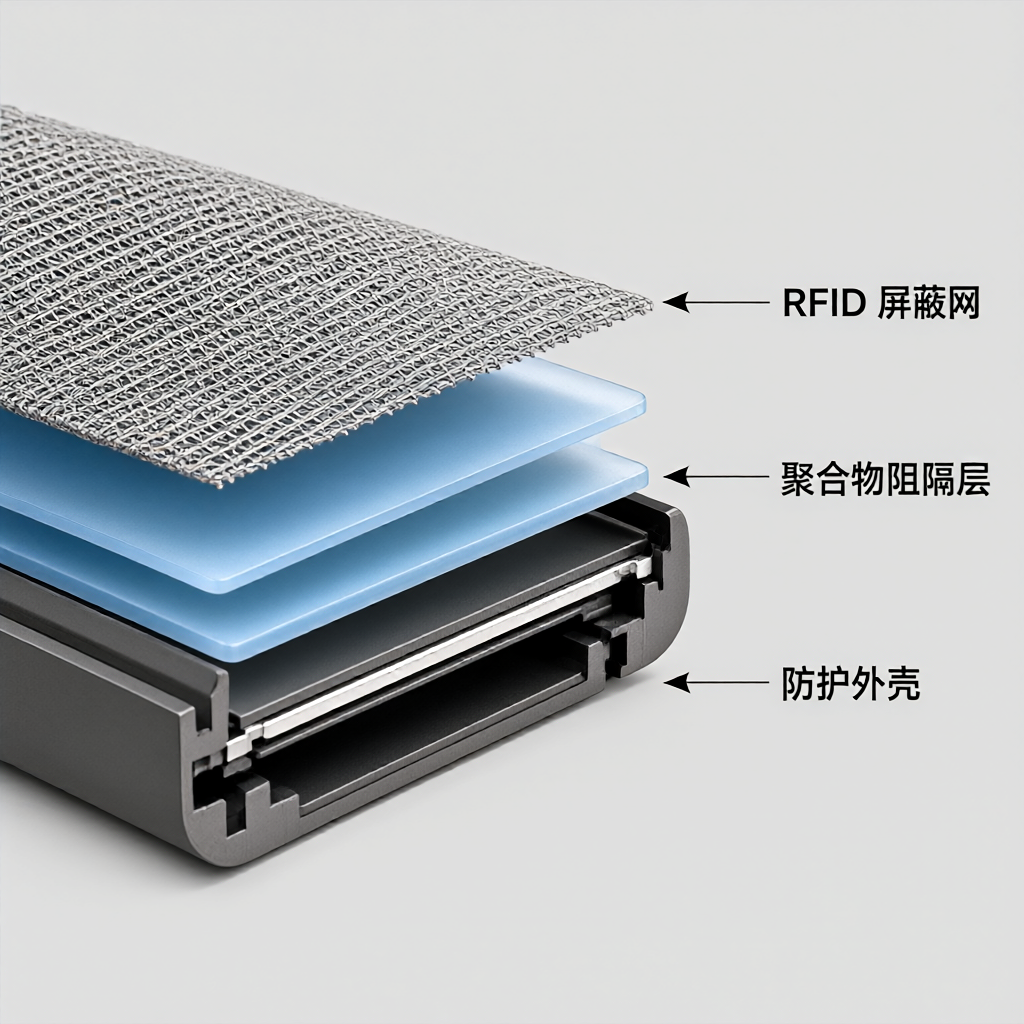
RFID-blocking wallets operate under test protocols established by standards bodies. The relevant framework comes from ASTM International, whose testing methods for electromagnetic shielding effectiveness inform how manufacturers validate blocking performance. When evaluating a product’s claims, look for:
- Shielding attenuation ≥ 20 dB across the 13.56 MHz HF band used by payment cards and transit passes. This translates to roughly 99% signal reduction — sufficient to block scanner-range readings from consumer-grade readers.
- Continuous conductive layer — mesh or foil laminates that contain pinholes will leak signals. Solid-sheet designs in aluminum, nickel, or copper alloys tend to perform more consistently than woven approaches.
- Full-panel coverage rather than spot-blocking patches. Some lower-cost products shield only the card slot area, leaving the perimeter exposed.
Our dedicated article on RFID-protected wallets breaks down how to identify genuine blocking layers versus marketing labels at the point of purchase.
Will a Metal or Carbon Fiber Wallet Fit Through Most Card Readers?
Card reader slots vary by device but share common throat dimensions. Most contactless and chip readers accept wallets up to about 0.75 inch thick at the entry point before friction or geometric binding becomes problematic. A compact wallet or slim aluminum design at 0.4–0.5 inch slides through cleanly. Bifold designs above 0.75 inch may require angling or partial insertion first.
If you frequently tap cards through attached sleeves or deep pouches, prioritize wallets with beveled or chamfered edges. Sharp rectangular corners catch on reader lips more readily, even when overall thickness falls within acceptable limits.
Standards, Specifications, and Sizing Conventions
Several specifications govern wallet dimensions and construction quality in the EDC market, though enforcement varies widely between regions and tiers:
- ISO 9001质量管理体系认证影响工厂的尺寸控制能力——一致性较高的产品通常意味着实际尺寸更接近标称值,尤其在金属 CNC 加工和碳纤维层压工艺中。
- BSCI审计设施标准涉及生产流程的合规性,对钱包制造商而言主要影响批次间尺寸稳定性。
- REACH / RoHS符合性要求限定了可使用的金属合金、涂层和胶粘剂种类,间接影响材料厚度和表面处理方式。
- SGS-tested材料报告提供可验证的成分数据,帮助买家确认不含禁用邻苯二甲酸盐或重金属残留。
These frameworks set the floor for quality rather than prescribing exact wallet dimensions. Manufacturers define their own size catalogs within these constraints, which is why comparing actual measurements matter more than relying on category names alone.
When evaluating mens designer wallets brown variants or similar premium finishes, the material profile often dictates thickness. Full-grain leather stacks higher than anodized aluminum of identical footprint. Conversely, high-density aluminum allows slimmer profiles while carrying the same item count.
For mens designer wallets canada buyers specifically, climate and usage patterns influence sizing choices. Cold environments favor slightly thicker wallets that remain operable with gloves; warm climates lean toward the minimum viable bulk for breathability and comfort.
Fit and Compatibility for Different Carry Styles
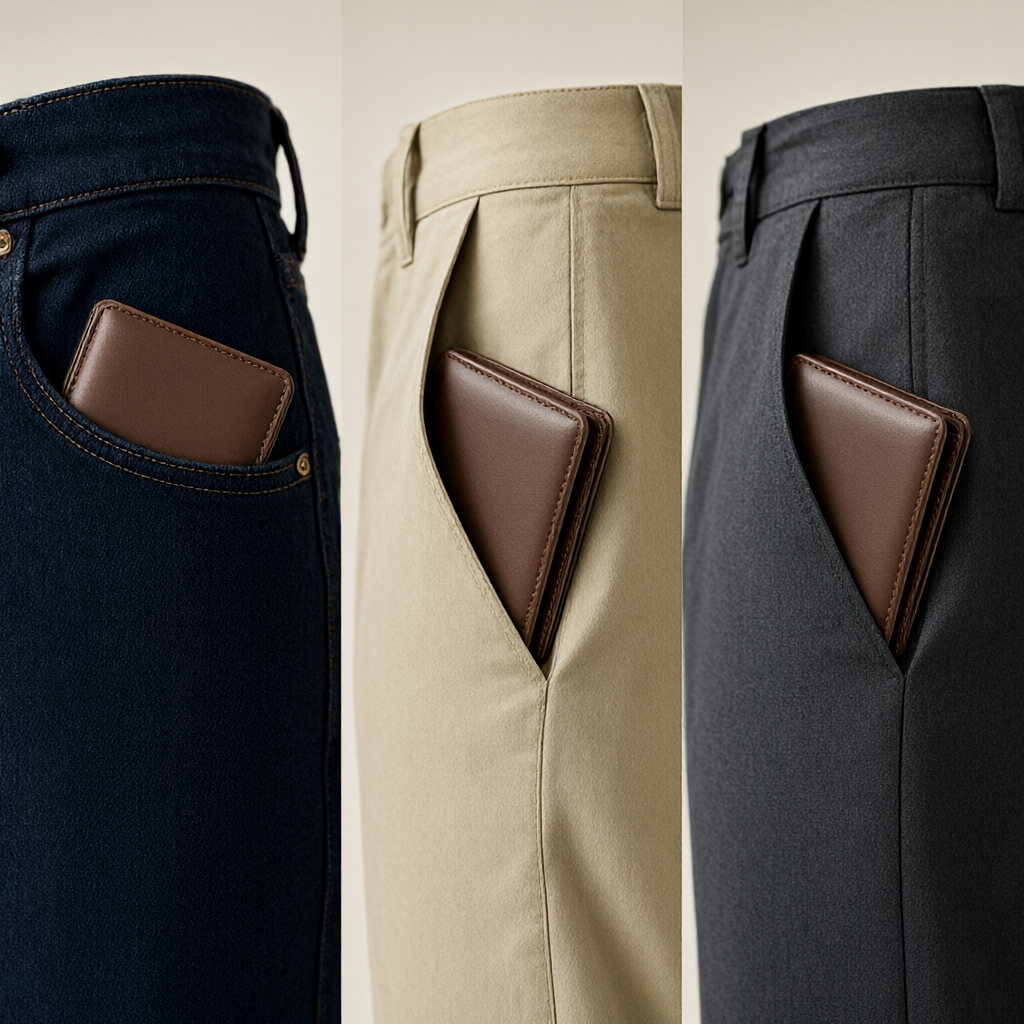
Your pocket geometry and carry habit determine which size class works practically.
Front Pocket Carry
Front pockets impose the tightest constraints. Ideal dimensions stay under 4 inches tall and 0.6 inch thick when loaded. A miniwallet vintage style from earlier decades often measured closer to 3 × 4.5 inches, which aligns well with modern front-pocket targets. Vintage formats sometimes feature thicker leather or embossed tooling that adds marginal bulk — verify loaded thickness before switching.
Modern slim wallets designed for front carry emphasize low-profile geometry: shorter height, narrower width, and a tapered front edge that slides past the hip bone without riding up. Consider the big skinny world wallet approach if you want maximum card capacity inside a notably thin envelope — these designs use compression frames rather than folding to save height.
Back Pocket Carry
Back pockets tolerate larger footprints because fabric stretches vertically and the pocket sits higher on the torso. A regular bifold up to 4.5 × 5.5 inches with 1-inch thickness remains comfortable for most adults. However, sitting pressure concentrates directly onto a back-pocket wallet, so thin and rigid designs (metal, carbon fiber) distribute force better than thick soft leather that bunches under thigh compression.
Belt Clip and Pocket Organizer Options
Some carriers opt for belt-mounted solutions that remove pocket constraints entirely. A tactical pocket organizer attaches via MOLLE loops or belt clips and can hold significantly more — 15–20 cards, multiple cash strips, tools — at the cost of deliberate accessory management. These systems work best for outdoor and EDC enthusiast scenarios where volume outweighs minimalism.
Travel Minimal Carry Versus Daily Office Load
Travel setups benefit from smaller footprints because checked luggage and airline seat pockets punish bulky items. A compact wallet or card holder reduces snag risk and keeps your center of gravity balanced. Daily office carry permits slightly larger formats since you control your chair and bag environment. Match your largest anticipated load to your chosen size — planning for the busy day prevents mid-cycle upgrades.
Digital Wallet Ecosystems and Physical Format Interaction
Digital payment adoption reshapes physical wallet sizing expectations. When you primarily use Apple Wallet for man consumers and similar mobile-first setups, your card count drops dramatically. Many carriers transition from 8–12 cards down to 2–4 essential cards plus ID and transit pass. This shift enables downsizing to compact or mini formats without sacrificing utility.
Smartphone screen real estate also influences wallet pairing. Modern phones average 6–6.7 inch diagonals with widths of 2.8–3.1 inches. A wallet that sits flush against the phone in a sleeve needs height under 4 inches to avoid protruding past the top edge. This constraint favors slim card holders and compact aluminum designs over traditional bi-folds.
Apps With Wallet Features and Security Considerations
Applications offering virtual card management and NFC passthrough function independently of physical wallet size, but they interact with it indirectly. When your phone handles most payments, the physical wallet shrinks to insurance-only cards: one debit, one credit, one ID. In this configuration, a code card wallet sized for 4–6 items becomes optimal.
Security-wise, ensure any physical wallet pairing with digital solutions maintains RF isolation if you store sensitive access credentials onboard. A coinbase wallet hardware pairing scenario (e.g., keeping a seed phrase backup card alongside payment cards) benefits from layered RF protection — either through dedicated shielding zones or separate storage compartments.
Meanwhile, app safe wallet implementations rely on software encryption rather than physical barriers, so their inclusion alongside physical tokens doesn’t change dimensional requirements. Choose your physical form factor based on tangible carry needs, not on digital app features alone.
Size Reference Chart
Use this consolidated reference when cross-referencing product specs against your measured clearance:
| Walkthrough Scenario | Recommended Height | Recommended Width | Max Loaded Thickness | Suggested Format |
|---|---|---|---|---|
| 4–6 cards, light cash, front pocket | 3.0–3.5 in | 3.5–4.0 in | 0.4 in | Card holder / money clip |
| 6–10 cards, moderate cash, front pocket | 3.5–4.0 in | 4.0–4.75 in | 0.6 in | Slim front-pocket wallet |
| 8–12 cards, multiple bills, occasional front carry | 4.0–4.5 in | 5.0–5.5 in | 0.9 in | Slim bifold |
| 12+ cards, heavy cash load, back pocket preferred | 4.5–5.0 in | 5.5–6.0 in | 1.2 in | Regular bifold / trifold |
| Mixed travel + daily, phone-synced cards | 3.25–3.75 in | 4.0–4.5 in | 0.5 in | Compact clutch or hybrid |
All figures represent industry-typical ranges. Verify actual product spec sheets before ordering, especially when importing across regions where sizing conventions differ.
Material Thickness Impact on Overall Bulk
Material choice modifies perceived and actual wallet size in measurable ways:
- Aluminum (anodized) — Adds structural rigidity allowing thinner walls. Typical gauge: 0.04–0.08 inch per plate. Dual-plate designs with spring mechanism run 0.4–0.55 inch loaded. Heavier gauges improve durability but increase weight without proportional thickness gain.
- Titanium — Similar mechanical advantage to aluminum with higher strength-to-weight ratio. Gauge ranges 0.03–0.06 inch. Premium tier often justifies the weight premium through longevity rather than dimensional savings.
- Carbon fiber — Layers bond at approximately 0.02–0.04 inch per ply. Four-ply constructions yield 0.08–0.16 inch blank stock, making carbon fiber among the thinnest high-strength options. Delamination risk increases below 0.06 inch total unless resin ratios are tightly controlled.
- Leather (full-grain) — Stretches and compresses over time. New leather starts thicker than aged leather due to residual moisture and finishing coatings. Factor a 0.05–0.1 inch shrinkage after 60–90 days of regular flex cycles. Vegetable-tanned leathers hold shape better than chrome-tanned equivalents for dimension stability.
- Hybrid constructions — Metal frame plus leather insert combine structural thinness with tactile warmth. Expect 0.5–0.7 inch loaded for dual-material configurations in the slim category.
Understanding these differences lets you predict real-world thickness from advertised numbers. A manufacturer claiming 0.4 inch might mean 0.4 inch of bare plate; add a spring clamp, rubberized grip zone, and your daily card load, and reality lands closer to 0.55–0.6 inch.
Selecting the Right Format for Your Context
Vintage-inspired miniwallet vintage designs often reproduce historical proportions faithfully, which can mean tighter capacity constraints than modern iterations. If you value aesthetic authenticity over expanded storage, these formats suit you. If you need contemporary utility, prioritize current ergonomic dimensions over retro styling.
For coach compact clutch wallet comparisons or similar structured alternatives, pay attention to internal compartmentalization. Clutch-style forms spread capacity across wider surfaces, reducing height but increasing width. Decide whether horizontal or vertical orientation suits your pocket geometry better.
When navigating codes wallet early access apk latest version-style digital pairing concepts, remember that app-assisted card management reduces physical card dependency. Your wallet doesn’t need to accommodate future purchases — it needs to hold what you swipe today. Audit your current card drawer before investing in oversized formats.
At TOP EDC Wallet, we approach sizing through the same lens: match documented dimensions to actual carry loads, not speculative max capacities. Our manufacturing process uses in-house CNC machining and laser engraving to maintain tight tolerances across aluminum, titanium, and carbon fiber platforms. With 13+ years of export experience, we’ve seen firsthand how underspecified dimensions create returns and dissatisfaction downstream. We offer OEM and ODM custom design services starting at MOQ of 100 pieces, with sample lead times around 7 days, so brands and distributors can validate real-world fit before committing to production runs. For projects requiring precise specification alignment, review our capabilities and request pricing through our contact page.
How Manufacturers Define and Validate Wallet Dimensions (B2B Procurement)
When sourcing wallets at scale, buyers evaluate vendors through dimensional consistency, material tolerance, and compliance documentation. Here is how the industry measures and certifies what goes into a wallet specification sheet.
Dimensional Tolerance Standards
Reputable manufacturers hold tolerances of ±0.5 mm (±0.02 in) on length and width, and ±0.25 mm (±0.01 in) on closed-stack thickness. These figures come from ISO 9001 quality management system audits, which verify that production processes — CNC milling, laser cutting, layer lamination — produce repeatable output across batches. For metal wallets, anodizing adds 0.0002–0.001 inch per surface; multi-surface anodizing can push nominal dimensions by up to 0.004 inch total.
| Specification Parameter | Typical Tolerance | Measurement Method |
|---|---|---|
| Length / Height | ±0.5 mm (±0.02 in) | Digital caliper, 3-point avg |
| Width | ±0.5 mm (±0.02 in) | Digital caliper, 3-point avg |
| Closed-stack thickness | ±0.25 mm (±0.01 in) | Caliper at center + edges |
| Hole diameter (card slot) | ±0.3 mm | Pin gauge or optical comparator |
| Corner radius | ±0.5 mm | Radius gauge or CMM |
RFID-Blocking Validation Protocols
Per ASTM International test methodologies (notably ASTM E2685 for shielding effectiveness), manufacturers validate blocking performance by measuring signal attenuation across the 13.56 MHz HF band used by EMV payment cards and transit passes. A compliant product demonstrates:
- ≥20 dB attenuation (≈99% signal reduction) at 13.56 MHz
- ≥30 dB attenuation at 125 kHz (low-frequency proximity cards)
- Uniform coverage — no hot spots >10 dB below target across the active card area
Solid conductive laminates (aluminum foil, nickel-plated steel mesh, copper clad polymer) outperform woven or printed-inks approaches, which degrade after repeated flex cycles. SGS-tested material reports provide verifiable composition data confirming absence of restricted substances under REACH / RoHS frameworks.
Material Sourcing and Thickness Trade-offs
Material selection drives both dimension and durability outcomes:
| Material | Typical Sheet Gauge | Weight (per 3.5×4 in panel) | Flex Life (cycles) | Common Applications |
|---|---|---|---|---|
| 6061-T6 Aluminum | 0.040–0.060 in | 15–25 g | 10,000+ | Slim card holders, money clips |
| Ti-6Al-4V Titanium | 0.030–0.050 in | 12–18 g | 10,000+ | Premium minimalist wallets |
| Carbon Fiber (pre-preg) | 0.020–0.040 in | 8–14 g | 5,000+ (delamination risk if薄) | Ultra-slim holders |
| Full-grain Leather | 1.2–2.0 mm | 25–45 g | N/A (creases naturally) | Bifold wallets |
| Hybridthreaded Aluminum + CF | 0.040 in Al + 0.020 in CF | 18–28 g | 8,000+ | Hybrid designs |
Note: claims marked ⚠️ (e.g., “100% waterproof,” “indestructible”) fail FTC substantiation standards under FTC.gov guidelines for environmental marketing claims. No wallet is truly indestructible; reputable manufacturers avoid such absolute language.
RFQ Template Questions for Wallet Manufacturers
When issuing requests for quotation, include these dimension-critical questions:
- What are your dimensional tolerances per ISO 9001:2015 clause 8.5.1?
- Provide SGS test reports for RFID attenuation (frequency range, dB values at 13.56 MHz).
- What is your MOQ per SKU, and does tooling cost apply for custom dimensions?
- Sample lead time for pre-production prototypes — express (7-day) vs standard (15–20 day)?
- Describe your incoming material inspection process ( alloy certs, CF laminate verification).
- What defect rate benchmark do you track, and how is it reported quarterly?
- Can you accommodate our pocket-clearance constraints for specific retail markets (e.g., Japan’s compact preferences vs US bifold demand)?
A complete RFQ response should cover each item explicitly. Vague answers on tolerance or testing are red flags.
Manufacturer Capability Overview
As a manufacturer, our approach to meeting these standards starts with precision tooling and ends with verified documentation. Since 2014, we have operated a 50,000 sq ft facility producing minimalist aluminum wallets, carbon fiber card holders, titanium money clips, and tactical pocket organizers for over 200 brands across America, Europe, Australia, and Southeast Asia. Our in-house CNC machining holds ±0.02 in tolerances; anodizing and surface finishing are managed internally so dimensions don’t drift post-process. We offer low MOQ starting at 100 pcs with a 7-day sample lead time, and every batch ships with SGS material reports and RFID attenuation test summaries. Here is how we meet the standards above, from material intake to packed shipment.
For detailed product specs or to discuss your next collection, Get a Free Quote.
Compact Clutch vs. Vintage Miniwallet Formats
Buyers often conflate two similar-looking categories that serve different use cases. Understanding the difference prevents尺寸 mismatch during procurement.
| Dimension Factor | Compact Clutch Wallet | Vintage Miniwallet |
|---|---|---|
| Typical Height | 3.5–4 in | 2.75–3.25 in |
| Typical Width | 4–4.5 in | 3–3.5 in |
| Closed Thickness | 0.35–0.5 in | 0.25–0.4 in |
| Card Capacity | 4–8 cards + rolled cash | 2–4 cards + fold bills |
| Closure Type | Slip pocket or flap | Snap button or folding strap |
| Construction | Often leather or hybrid | Traditional leather, embossed tooling |
| Pocket Clearance Needed | 1.75–2.25 in depth | 1.5–2 in depth |
| Modern Suitability | Daily carry, light loads | Niche / minimal carry |
A compact clutch wallet adds modest height to accommodate rolled bills alongside a handful of cards in a single slip pocket. A vintage miniwallet skews shorter and narrower, prioritizing ultra-low bulk over capacity — ideal when you carry only an ID, one card, and folded cash. When evaluating either format against your pocket geometry, loaded thickness matters more than exterior height. A vintage miniwallet crafted from full-grain leather with embossed detailing can approach the same loaded profile as a slim aluminum design despite its smaller advertised footprint.
When sourcing these formats at volume, specify exact loaded-thickness tolerances in your PO. Tolerance ranges of ±0.05 in on closed stack height prevent pocket-bulge complaints in retrospective quality audits. See our different types of leather wallets guide for construction trade-offs between vintage-style formats and modern slim alternatives.
Adding Technical Specifications and Industry Standards
Beyond dimensional sizing, wallet buyers must evaluate compliance markers that affect both function and longevity. Three specification areas deserve attention during procurement:
Contactless Authentication Standards. Payment cards operate under ISO/IEC 14443 Type A/B, the international standard defining proximity card communication protocols at 13.56 MHz. EMVCo publishes supplementary interoperability specifications that govern how terminal and card negotiate authentication sequences. Wallets marketed as RFID-blocking must attenuate signals across this same 13.56 MHz band to be effective — if shielding degrades below 20 dB, card-reader interactions begin leaking again.
Material Safety Compliance. RoHS restricts lead, cadmium, mercury, and hexavalent chromium in metallic components. REACH regulates chemical substances in adhesives, coatings, and polymer substrates used during wallet assembly. Buyers requesting samples should verify supplier test reports cite SGS or equivalent independent laboratory verification before placing bulk orders.
Quality Management Frameworks. ISO 9001 certified facilities demonstrate documented process control over dimensional consistency, surface finishing repeatability, and assembly line traceability. For OEM and ODM partners, ISO 9001 compliance reduces first-article inspection failures and shortens ramp-up time on multi-color runs. BSCI social-audit certification further signals responsible labor practices during factory evaluation.
| Specification Area | Key Standard | Typical Requirement | Verification Method |
|---|---|---|---|
| Contactless shielding | ASTM testing methods | ≥20 dB at 13.56 MHz | Attenuation measurement |
| Authentication protocol | ISO/IEC 14443 Type A/B | Maintains readable field gap | Functional RF test |
| Heavy-metal restriction | RoHS (Directive 2011/65/EU) | Below concentration limits per material | SGS / SGS-equivalent report |
| Chemical substance compliance | REACH (EU 1907/2006) | SVHC below reporting threshold | Supplier declaration + testing |
| Quality management system | ISO 9001:2015 | Documented process control | Certificate from accredited body |
| Social compliance audit | BSCI | Audit score ≥ threshold | Latest audit certificate |
These specifications establish procurement baselines. Final acceptance testing should always include dimensional spot-checks on incoming lots, RFID attenuation sampling, and material composition confirmation before production sign-off.
Choosing a Manufacturer for Custom Wallet Sizing
Standard catalog dimensions cover most off-the-shelf scenarios, but branded programs and private-label launches usually require custom sizing to match brand identity and target pocket-clearance expectations. Here is how the industry approaches custom manufacturing at scale.
Design teams begin by defining target dimensions around the end-user’s daily load — typical starting points are 3.5 × 4 in for a six-card slim carrier or 4 × 5 in for a ten-card configuration — then validate those dimensions against sample prototyping. Material selection follows: aluminum allows tighter tolerances and thinner profiles; carbon fiber offers comparable strength at lighter weight; titanium adds premium stiffness at higher cost; and structured leather requires thicker gauges to maintain shape.
Sample development typically runs seven days for first articles when drawings and material specs are finalized. Bulk production lead times vary by order quantity and finishing complexity — anodizing, laser engraving, UV printing, and custom packaging each add processing steps. Factories with integrated CNC machining and in-house surface finishing generally achieve faster turnarounds than assemble-only operations because tooling adjustments happen on-site rather than through external vendors.
For Amazon FBA and distribution channel partners, pre-production validation includes drop-test simulation, edge-coating adhesion checks, and RFID attenuation sampling before full lot release. Packaging specifications — retail boxes, hang tags, and poly mailers — should align with marketplace prep requirements to avoid receiving delays at fulfillment centers.
As a manufacturer focused on EDC wallets and pocket gear, our process maps buyer requirements directly onto material and tooling selections, then validates through prototype stages before committing to full production runs. We support OEM and ODM programs with low minimum order quantities, certified material sourcing, and logistics coordination including drop-shipping readiness. Get a Free Quote →
Sources & References
- ISO 9001 — www.iso.org
- ASTM International — www.astm.org
- FTC.gov — www.ftc.gov
- wallet size width and height — topedcwallet.com
- minimalist wallets guide — topedcwallet.com
- RFID-protected wallets — topedcwallet.com
- contact page — topedcwallet.com
- different types of leather wallets — topedcwallet.com
From article to product
Turning this into a product?
Most of what is written here is the difference between a sample that works and one that does not. We can build either — the useful one costs the same.
Keep reading
More on buying guides
wallet with trigger
How Does a Trigger Wallet Work? What Is the Pop-Up Mechanism? The core of…
Readbest bifold wallet for women
What Is a Bifold Wallet? The term “bifold” refers to the fold: the wallet…
ReadMen’s trifold wallets with zipper compartments vs. bifold
At a Glance The three dominant men’s wallet formats differ in panel count, depth,…
Read
About the author
TOPWALLET Editorial Team
TOPWALLET's editorial and engineering desk writes from bench testing at the Shenzhen (Longgang) facility: pull-force and cycle testing, 13.56 MHz shielding measurements, finish trials and factory audits, rather than supplier spec sheets. Every specification in these guides is one we write on a purchase order.
Written on the floor
This article was written by our production and QC team — the people who spec tolerances, run the finishing line and inspect every batch. Where it states a capacity, a pull force or a lead time, it comes from a measurement we made, not a supplier’s catalogue. If a number here disagrees with what your own supplier told you, tell us; several of these articles started as a correction from a buyer.
See how the factory works · Inspection process · Sourcing FAQ
Turning this into a product?
Most of what is written here is the difference between a sample that works and one that does not. We can build either — the useful one costs the same.