

Wallet Size Pricing: What Is the Quick Answer?
Wallet size price follows a predictable pattern in B2B manufacturing: smaller form factors like slim card holders and money clips typically carry lower per-unit costs than full bill-fold wallets, but material choice and surface finishing often matter more than overall dimensions. A standard 83 × 54 mm slim aluminum wallet in a 500-unit run generally falls between $3.50 and $6.50 FOB, while a comparable titanium version sits closer to $9–$14. Carbon fiber variants occupy a middle ground, usually priced 20–40% above aluminum. Batch size is equally decisive — ordering 300 pieces can cost two to three times more per unit than an order of 5,000, because tooling setup, CNC programming, and production line changeover are amortized over fewer units.
Price bands quoted in this article are industry ranges published for planning purposes. Exact per-unit pricing depends on material, finish, packaging and order quantity, and is confirmed by our sales team after an inquiry against a locked specification.
For Amazon FBA private-label sourcing or retail chain expansion, this means the first decision should be form factor and material before finalizing target margins. See our best minimal wallets for B2B sourcing guide for additional context on common style categories.
Wallet Size Pricing: How Does It Work in Detail?
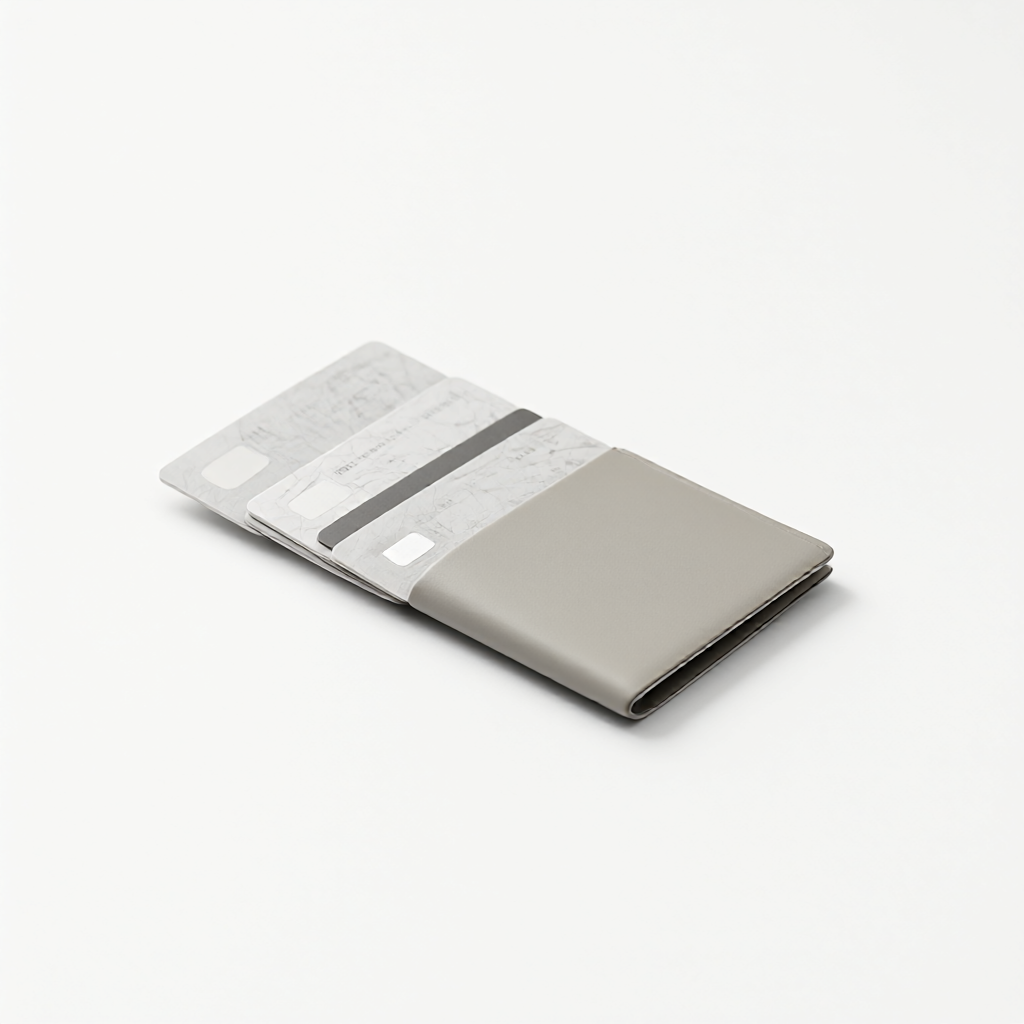
How does wallet thickness, width, and height affect unit cost?
Wallet dimensions directly determine raw-material consumption and machining time. An RFID-blocking metal wallet measuring approximately 85 × 55 × 8 mm uses roughly 18–22 grams of aluminum billet, while a narrower card holder at 78 × 50 × 6 mm may use only 12–15 grams of the same material. That difference compounds across thousands of units.
More importantly, thickness drives machining complexity. A 3 mm-thick aluminum wallet requires fewer CNC pass cycles than an 8 mm piece of the same outer envelope, because less material needs to be removed from the raw billet. Thicker wallets also demand stiffer spring mechanisms — particularly in elastic-band or hinge-style minimalist designs — which adds component count and assembly time. For solid-core EDC wallets, thicker profiles tend to command a modest premium even when the footprint stays the same.
Width and height have a secondary effect. A wallet designed for long bills (roughly 155 mm unfolded length) must accommodate a longer slot profile and often a wider spring mechanism than a compact travel card holder sized for credit cards only. The larger the planform, the more material is consumed, but the impact on machining time per unit remains relatively linear.
Buyers should map their target pocket-carry scenario early. Front-pocket minimalists typically prefer under 10 mm thickness and around 80 × 52 mm footprint; back-pocket users who carry folded notes and multiple cards often need 12–15 mm thick and 85 × 55 mm forms. Sizing decisions made at spec stage directly control both unit price and end-user satisfaction.
How do material choices shift per-unit cost?
Material selection is the single largest variable after batch size. The four mainstream EDC wallet metals and composites break down as follows:
| Material | Typical raw-material cost index | Machining difficulty | Common wholesale range (500 pcs) |
|---|---|---|---|
| Aluminum 6061 | Low | Easy – CNC-friendly, fast cycle times | $3.50 – $6.50 |
| Stainless steel 304 | Medium-high | Moderate – harder on tooling, slower feeds | $7.00 – $12.00 |
| Titanium GR2 / GR5 | Very high | Slow – low cutting speed, high tool wear | $9.00 – $14.00 |
| Carbon fiber (laminated) | Medium | Requires lamination + CNC trimming | $5.50 – $9.00 |
Aluminum dominates the entry-to-mid tier because it machines quickly, accepts anodizing cleanly, and stays lightweight. Stainless steel offers higher scratch resistance and a heavier feel but costs more per gram and eats spindle life faster. Titanium delivers the best strength-to-weight ratio and a premium aesthetic, yet the slow cutting parameters and frequent tool changes push per-unit labor well above aluminum.
Carbon fiber sits in an interesting position. The base laminate material is moderately priced, but producing a finished wallet requires stacking, adhesive bonding, curing, and then CNC trimming to tolerance — a multi-step process that aluminum doesn’t need. That said, carbon fiber doesn’t require anodizing, which offsets some finishing cost.
When comparing card holder wholesale cost across materials, expect aluminum to be the baseline and titanium to represent roughly a 2.5× markup on the same geometry. If you’re building a catalog that spans budget to premium segments, offering one style in aluminum and titanium gives buyers a clear upsell path without redesigning the product line.
Which manufacturing processes add the most incremental cost?
Four processes dominate EDC wallet production, and each has a distinct cost signature:
CNC milling. Most minimalist wallets start as solid billets or stamped blanks that are milled to final dimensions. High-speed aluminum mills at 0.5–1 second per pass on simple geometries. Complex internal cutouts, chamfered edges, or tight tolerances (±0.1 mm) extend cycle time proportionally. Budget-tier wallets often skip precision milling on inner slots, relying instead on stamped parts with looser tolerances.
Laser engraving. Adding logos or patterns through fiber laser engraving typically adds $0.15–$0.40 per unit depending on design complexity and depth. Fine-detail corporate logos on titanium require slower scan speeds, pushing cost toward the upper end. This process is highly compatible with custom wallet per-unit pricing models because it scales almost linearly with quantity — no new tooling is needed beyond the digital file.
Anodizing. Aluminum wallets are almost always anodized for color and wear resistance. Standard black or silver anodizing runs about $0.30–$0.60 per unit at volume. Custom colors or multi-tone anodizing (where different zones receive different coatings) can exceed $1.00 per unit. Anodizing also introduces a quality-risk point: parts that fail adhesion or hardness tests must be reworked or scrapped.
UV printing. Full-color graphics applied via UV inkjet are gaining popularity for promotional and lifestyle SKUs. Expect $0.25–$0.70 per unit added cost. Unlike laser engraving, UV printing covers the entire visible face and can reproduce photographic detail, making it attractive for brand-driven campaigns.
Additional processes — such as inserting RFID-blocking laminates, applying oleophobic coatings, or assembling rubber gaskets — each add measurable cost but also create differentiation. Buyers should evaluate whether each added feature maps to a verifiable customer benefit rather than treating them as table-stakes defaults.
Why does order volume change per-unit price so dramatically?
A 300-piece run costing significantly more than a 5,000-piece run is one of the most consistent patterns in contract manufacturing, and it comes down to fixed-cost amortization.
Every production order carries setup overhead: CNC program verification, fixture preparation, anodizing rack loading, quality-inspection sampling plans, and packaging line configuration. These activities take the same clock time regardless of whether you produce 300 units or 5,000. When spread across 300 pieces, that overhead inflates the per-unit price substantially. At 5,000 units, the same setup cost becomes nearly negligible on a per-piece basis.
There are also setup-learning curves. A production line running its first batch of 300 units will experience more scrap, more adjustment cycles, and slower throughput than a line that has already proven the process on the preceding 4,900 units. Large batches benefit from accumulated line familiarity, reducing defects and rework rates.
For metal wallet MOQ price discussions, many factories set their lowest price tier at 1,000–2,000 units, with a separate “sample or prototype” tier at 300–500 units that carries a noticeable premium. Some manufacturers further differentiate between OEM runs (using your design files and packaging specs) and ODM runs (using their existing designs), with OEM setups commanding slightly higher initial costs due to unique fixture and programming requirements.
Amazon FBA sellers often land in the 500–2,000 unit sweet spot: enough volume to secure meaningful pricing advantages over 300-piece starter orders, while retaining flexibility to test market response before committing to five-figure productions. Corporate gift programs, by contrast, frequently start at 500–1,000 units with customization layers like branded packaging and logo engraving layered on top.
Wallet Size Pricing: Which Specifications Matter Most?
What are the standard size tiers and typical wholesale price bands?
The following size tiers represent the most commonly sourced minimalist wallet configurations across B2B channels. Prices reflectFOB estimates for standard anodized aluminum builds at the indicated volumes and are intended as directional benchmarks rather than firm quotes.
| Wallet Type | Typical Dimensions (mm) | 300 pcs Unit Price | 500 pcs Unit Price | 5,000 pcs Unit Price |
|---|---|---|---|---|
| Slim Card Holder | 78 × 50 × 6 | $4.00 – $7.00 | $2.80 – $4.50 | $1.80 – $3.00 |
| Standard Slim Wallet | 83 × 54 × 8 | $5.00 – $8.50 | $3.50 – $6.00 | $2.20 – $4.00 |
| Extended Capacity Slim | 88 × 58 × 10 | $6.00 – $10.00 | $4.20 – $7.50 | $2.80 – $5.20 |
| Money Clip Style | 72 × 48 × 5 | $3.50 – $6.00 | $2.50 – $4.20 | $1.60 – $2.80 |
| RFID-Blocking Metal | 85 × 55 × 8 | $6.50 – $11.00 | $4.80 – $8.50 | $3.20 – $6.00 |
These ranges assume standard single-layer construction with basic anodized finish and no complex internal mechanisms. Add titanium material, multi-slot layouts, custom embossed textures, or integrated stand features, and prices move toward the upper boundary of each column.
For practical guidance on matching wallet dimensions to buyer lifestyle — front-pocket minimalism versus maxed-out daily carry — refer to the EDC wallet procurement guide, which breaks down capacity expectations and form-factor trade-offs across usage scenarios.
Wallet Size Pricing: Which Standards and Certifications Apply?
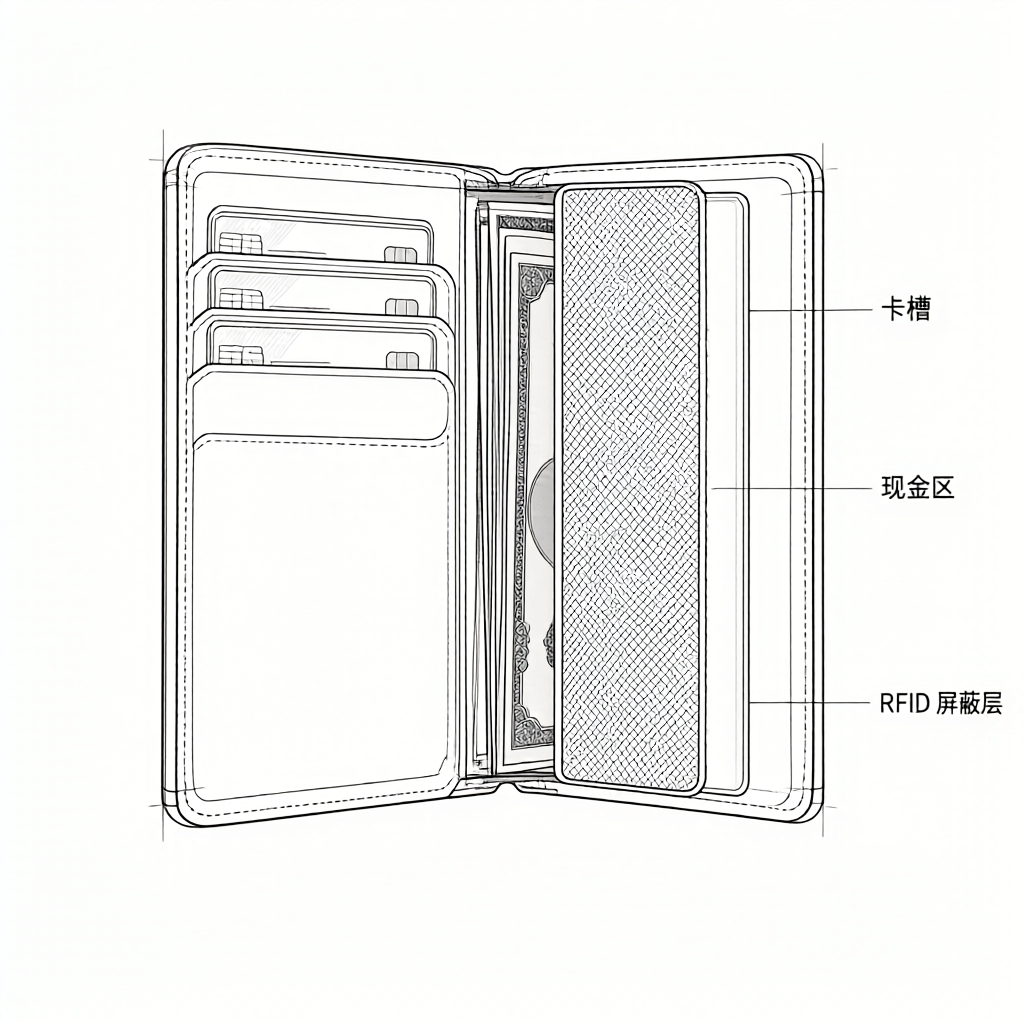
What certifications and compliance standards matter for B2B wallet sourcing?
Three certification frameworks appear most frequently in B2B purchasing specifications:
ISO 9001 validates that a manufacturer operates a documented quality-management system covering design control, incoming material inspection, in-process checks, and corrective-action procedures. Procurement teams in North America and Europe routinely require ISO 9001 as a baseline qualification before approving a factory for production orders. Certification audits themselves don’t directly inflate unit price, but operating under an ISO-certified system raises the floor on process discipline — meaning fewer rejected shipments and more consistent per-unit pricing across production rounds.
BSCI (Business Social Compliance Initiative) addresses labor practices and working conditions. It matters primarily for European retail chains and brands that publish supply-chain sustainability reports. Like ISO 9001, BSCI compliance doesn’t add a per-unit surcharge directly, but factories maintaining BSCI status invest in facilities and management systems that reduce operational risk for buyers.
REACH and RoHS compliance govern chemical restrictions on materials used in consumer products. REACH restricts substances such as certain heavy metals and phthalates; RoHS limits lead, mercury, cadmium, and hexavalent chromium in electrical and electronic components. For metal wallets, the key concern is ensuring that anodizing baths, plating solutions, and any adhesive laminates meet these restrictions. Non-compliant materials can trigger customs holds in the EU and UK, so certified suppliers typically maintain material-test documentation (often through SGS or equivalent labs) alongside each production lot. Testing and documentation add a modest overhead — approximately $0.05–$0.15 per unit when amortized across medium-volume orders — but they prevent costly recall or rejection events downstream.
According to the International Organization for Standardization, ISO 9001’s core principle is consistent process control, which translates into fewer production variations and steadier unit pricing over time. For EDA wallet procurement, combining ISO 9001, BSCI, and REACH/RoHS coverage represents the current benchmark among established manufacturers serving Western markets.
Wallet Size Pricing: What Else Should Buyers Consider?
What should you know about lead-time versus price trade-offs?
Lead time and unit price share an inverse relationship during the sample phase but converge during mass production.
Samples produced within 5–7 days often carry a premium because they bypass normal production scheduling in favor of expedited machine allocation and priority material sourcing. However, this premium is limited — typically 15–30% above the mass-production unit price for the first sample order — and it pays for itself when the sample approval stage is compressed, preventing downstream schedule delays.
For mass production, standard lead times range from 15 to 25 working days depending on order size and finishing complexity. Express production (10–14 days) is usually available but carries a 10–20% surcharge on the total order value. Rush orders work best when the design is finalized, materials are in stock, and the supplier has a verified production slot — attempting to rush an incomplete specification is a common sourcing mistake that increases both cost and defect risk.
One practical way to manage this trade-off is to place sample orders early in the sourcing timeline while simultaneously requesting production slot reservations for the full run. This approach avoids the bottleneck where samples and production orders compete for the same machine capacity.
Which surface treatments and branding options most affect landed cost?
Beyond anodizing, several finish options influence final cost:
- Brushed finish: Adds ~$0.10–$0.20 per unit for hand-brushed or mechanized brushing operations. Popular for mid-tier aluminum wallets targeting an understated aesthetic.
- Polished/mirror finish: Requires additional buffing stages and quality screening for micro-scratches. Adds ~$0.25–$0.50 per unit. Often reserved for titanium and premium aluminum lines.
- Beaded blasting: Creates a uniform matte texture. Low incremental cost (~$0.05–$0.10 per unit) but improves grip and hides minor handling marks.
- Color-changing anodizing: More complex electrochemical process requiring precise voltage control. Adds $0.50–$1.00 per unit and introduces higher scrap risk during qualification.
Branding methods layer onto these finishes. Laser engraving costs $0.15–$0.40 per unit as noted earlier. Embossing is cheaper at $0.05–$0.15 per unit but requires a dedicated stamping die, which carries a one-time tooling fee of $80–$200. UV printing on the wallet face ranges from $0.25–$0.70 per unit. For promotional distributors building catalog offerings, embossing combined with simple color anodizing often provides the best balance of perceived premium and manageable per-unit cost.
Custom packaging — rigid boxes, drawer-style sleeves, or transparent blister cards — typically adds $0.30–$1.20 per unit depending on material and structural complexity. Packaging accounts for 10–25% of total landed cost on entry-level wallets and a smaller percentage on premium items, but it often represents the highest-impact differentiator on retail shelves. This consideration is especially relevant for private label and promotional catalog building.
As a manufacturer that has built production lines around these exact variables, our approach treats every specification as a controllable cost lever. We offer in-house CNC machining, laser engraving, UV printing, and aluminum anodizing — all under one roof, which eliminates the coordination overhead and quality gaps that arise when different finishes are outsourced to separate vendors. Our standard anodized aluminum wallets at 83 × 54 mm begin at an MOQ starts at 300 pcs per SKU for full OEM customization (100 pcs trial order available for stock finishes) with a 7-day sample turnaround, scaling smoothly into five-figure runs without retooling. For brands looking to lock in stable slim wallet bulk pricing across material tiers, we recommend starting with a defined target FOB band and letting the engineering team adjust thickness, alloy grade, and finishing to hit that number — rather than fixing dimensions first and accepting whatever price results. Get a Free Quote →
Continue incomplete section:
Additional H3 Required:
What wallet size categories exist and how do they affect capacity and price?
Minimalist wallets fall into distinct form-factor categories, each targeting different carry needs and price points:
| Category | Description | Typical Dimensions | Capacity |
|---|---|---|---|
| Money Clip | Magnetic or spring-metal clip for cash only | 72 × 48 × 5 mm | 5–15 bills |
| Card Holder | Slim plate holding cards in a fixed slot | 78 × 50 × 6 mm | 4–8 cards |
| Slim Wallet | Single-plane design with elastic band or hinge | 83 × 54 × 8 mm | 6–12 cards + folded bills |
| Extended-Capacity Slim | Larger envelope accommodating more cards and cash | 88 × 58 × 10 mm | 10–16 cards + bills |
| RFID-Blocking Metal | Integrated shielding laminate within metal body | 85 × 55 × 8 mm | 6–12 cards + bills |
| Travel Wallet | Multi-compartment layout for international currency | 95 × 65 × 12 mm | Variable; designed for mixed denominations |
Bifold and trifold designs are largely absent from the minimalist EDC segment because their thickness (typically 18–25 mm when closed) defeats the core value proposition of slim-pocket carry. Buyers seeking traditional folding styles should look outside the minimalist category, where leather bifold wallets remain the dominant format.
The size differential between a card holder and a full bill-fold slim wallet is approximately 5–7 mm in thickness and 5–10 mm in both width and height. This dimensional increase translates to roughly 30–50% more raw material and proportionally longer CNC cycle times, pushing unit costs upward by $0.80–$1.50 at equivalent batch volumes.
For practical guidance on selecting the right size tier for your target customer, review our best card holder buying guide for B2B sourcing and our best minimal wallets sourcing guide.
Which wallet type offers the best value at each size tier?
Value in B2B wallet sourcing balances unit price against feature set, perceived quality, and end-user appeal. The following recommendations reflect proven market performance across Amazon FBA, retail chain, and corporate gifting channels:
| Size Tier | Best-Value Material | Target Volume | Expected Unit Price | Rationale |
|---|---|---|---|---|
| Money Clip | Aluminum 6061 | 500+ pcs | $2.50 – $4.20 | Lowest material cost; highest margin potential for promotional buyers |
| Card Holder | Aluminum 6061 | 500+ pcs | $2.80 – $4.50 | Compact footprint reduces shipping weight; strong impulse-buy appeal |
| Slim Wallet | Aluminum 6061 (anodized) | 500+ pcs | $3.50 – $6.00 | Sweet spot for volume — competitive pricing with broad customer appeal |
| Extended-Capacity | Carbon fiber | 1,000+ pcs | $4.20 – $7.50 | Premium feel without titanium pricing; appeals to style-conscious buyers |
| RFID-Blocking | Aluminum with RFID laminate | 500+ pcs | $4.80 – $8.50 | Security feature justifies price premium; growing regulatory demand in EU |
| Premium Segment | Titanium GR2 | 500+ pcs | $9.00 – $14.00 | Highest perceived value; commands $25–$45 retail price point |
Aluminum at 500+ units consistently delivers the strongest return on sourcing investment for new brands entering the EDC space. As described in our EDC wallet procurement guide, aluminum’s combination of lightweight properties, anodizing versatility, and machining efficiency makes it the default recommendation for first-time private-label entrants.
Additional H2 + H3 Required:
Supplier Procurement Decision Framework
What buyer checklist and evaluation criteria separate reliable EDC wallet manufacturers?
Evaluating an EDC wallet manufacturer goes well beyond comparing quoted unit prices. A structured procurement assessment should cover the following criteria:
| Evaluation Criterion | What to Verify | Red Flag Indicators |
|---|---|---|
| Material traceability | Mill certificates confirming alloy grade (e.g., ASTM B209 for aluminum, ASTM F2923 for titanium) | Vague material descriptions like “premium metal” without grade specification |
| Tolerance consistency | Documented ±0.1 mm tolerance on critical fit surfaces; batch-to-batch variation <5% | Inconsistent card-slot sizing, loose spring tension, visible machining marks |
| Surface finish quality | Anodize hardness ≥ hard-coat threshold (≥500 HV); color consistency across samples | Peeling anodize, uneven coloring, visible etch defects under magnification |
| Quality inspection protocol | Incoming material inspection, in-process checks, final AQL sampling plan (typically AQL 0.65 for critical, 4.0 for minor) | No documented QC process; refusal to share inspection reports |
| Certification authenticity | Valid ISO 9001 certificate number verifiable on iso.org; BSCI audit report available on request | Claimed certifications with no verifiable certificate number |
| Sample responsiveness | Prototype delivery within stated lead time (7 days for TOP EDC Wallet); sample matches production-spec materials | Samples take weeks; samples use inferior materials versus production quote |
| Communication clarity | Detailed quotation breaking down material, processing, tooling, packaging, and shipping costs separately | All-inclusive quotes with no itemization; unwillingness to explain cost drivers |
| Production scalability | Verified capacity to scale from 500 to 5,000+ units without quality degradation | No evidence of volume production history; inability to provide reference orders |
| Packaging & FBA readiness | Ability to produce retail boxes, polybags, and Amazon-compliant labeling | Only bulk packaging offered; no experience with FBA prep requirements |
According to FTC guidelines on fair trade practices, buyers should ensure all material claims — particularly regarding RFID-blocking effectiveness and metal composition — are substantiated and documented before committing to large orders. Reputable manufacturers will provide third-party test reports from SGS or equivalent laboratories upon request.
When assessing potential partners, prioritize factories that operate ISO 9001-certified quality management systems as defined by ISO standards, maintain audited social compliance records, and supply complete material test documentation alongside each production lot. These three elements together form the baseline qualification for any B2B EDC wallet sourcing engagement.
Company Integration Section:
How TOP EDC Wallet meets these B2B manufacturing standards?
As a manufacturer specializing in minimalist EDC wallets and pocket gear, our approach to meeting these procurement standards reflects 13+ years of export experience serving 200+ brands worldwide across America, Europe, Australia, and Southeast Asia.
Our 50,000 sq ft facility operates under ISO 9001 certification (since 2014) and maintains BSCI-audited compliance for European retail partners. Every aluminum billet we machine conforms to ASTM B209 standards, and our titanium components meet ASTM F2923 biocompatibility requirements. We provide mill certificates and SGS test reports with every production lot, ensuring full material traceability from raw stock to finished goods.
Our CNC machining center produces wallets to ±0.1 mm tolerances on critical fit surfaces, with in-process inspection at each major production stage. Anodizing, laser engraving, UV printing, and assembly all occur in-house — eliminating subcontractor variability and keeping our standard sample lead time at 7 days. Our MOQ starts at 300 pcs, with per-unit pricing that scales predictably from prototype quantities through 500K+ monthly production capacity.
For brands looking to launch custom metal wallets, carbon fiber card holders, or titanium money clips from concept to shelf, we handle everything from design refinement and prototyping to private-label packaging and Amazon FBA preparation. See our best wallet for B2B buyers guide and best slim wallets for men sourcing guide for detailed selection frameworks.
Wallet Size Pricing: Where Can You Verify the Data and Sources?
- International Organization for Standardization — www.iso.org
- FTC guidelines — www.ftc.gov
- best minimal wallets for B2B sourcing — topedcwallet.com
- solid-core EDC wallets — topedcwallet.com
- EDC wallet procurement guide — topedcwallet.com
- private label and promotional catalog building — topedcwallet.com
- Get a Free Quote → — topedcwallet.com
- EDC wallet procurement guide — topedcwallet.com
- best slim wallets for men sourcing guide — topedcwallet.com
From article to product
Turning this into a product?
Most of what is written here is the difference between a sample that works and one that does not. We can build either — the useful one costs the same.
Keep reading
More on buying guides
wallet with trigger
How Does a Trigger Wallet Work? What Is the Pop-Up Mechanism? The core of…
Readbest bifold wallet for women
What Is a Bifold Wallet? The term “bifold” refers to the fold: the wallet…
ReadMen’s trifold wallets with zipper compartments vs. bifold
At a Glance The three dominant men’s wallet formats differ in panel count, depth,…
Read
About the author
TOPWALLET Editorial Team
TOPWALLET's editorial and engineering desk writes from bench testing at the Shenzhen (Longgang) facility: pull-force and cycle testing, 13.56 MHz shielding measurements, finish trials and factory audits, rather than supplier spec sheets. Every specification in these guides is one we write on a purchase order.
Written on the floor
This article was written by our production and QC team — the people who spec tolerances, run the finishing line and inspect every batch. Where it states a capacity, a pull force or a lead time, it comes from a measurement we made, not a supplier’s catalogue. If a number here disagrees with what your own supplier told you, tell us; several of these articles started as a correction from a buyer.
See how the factory works · Inspection process · Sourcing FAQ
Turning this into a product?
Most of what is written here is the difference between a sample that works and one that does not. We can build either — the useful one costs the same.