

An on-chain wallet — also called a blockchain wallet or crypto wallet — is a non-custodial digital tool that generates, stores, and manages cryptographic keys so users can sign transactions directly on a public ledger. You hold the private keys; no exchange, bank, or third party controls your assets. For people who prefer to separate their digital value from their physical everyday carry, the companion solution is typically a minimalist front-pocket wallet sized around 4.3 × 3.1 × 0.4 inches, which keeps cash and cards discreet while the bulk of value remains on-chain.
Quick Answer — What size wallet do I need alongside an on-chain crypto setup?
An on-chain wallet is a self-custodied digital wallet whose assets live directly on a blockchain rather than on a centralized exchange. You control the private keys; nobody holds your funds for you. If you want our definition clarified further, see this buyer’s guide to card-safe wallets.
For physical carry, the sweet spot is a minimalist front-pocket wallet measuring approximately 4.3 × 3.1 × 0.4 inches (110 × 78 × 10 mm) with room for 6–10 cards and no more than $100–$200 in folded bills. This keeps the profile under half an inch when worn, disappears cleanly from slim trouser pockets, and leaves the bulk of your value secured digitally on-chain. If you prefer a deeper dive into minimalist options, check out our complete minimalist wallets guide.
Size System — What are the standard sizes for minimalist and front-pocket wallets?

Physical EDC wallets fall into a few established size families. Knowing the categories makes comparison straightforward.
Standard front-pocket wallet (most common):
- Width: 4.0–4.5 in (100–115 mm)
- Height: 3.0–3.3 in (75–85 mm)
- Thickness (loaded): 0.3–0.5 in (8–13 mm)
- Card capacity: 6–12 cards
Slim / passcase variant:
- Width: 3.5–4.0 in (90–100 mm)
- Height: 2.5–2.9 in (65–75 mm)
- Thickness (loaded): 0.2–0.35 in (5–9 mm)
- Card capacity: 4–8 cards
Money clip + card combo:
- Width: 3.5–4.0 in (90–100 mm)
- Height: 2.4–2.8 in (60–70 mm)
- Thickness (loaded): 0.15–0.3 in (4–8 mm)
- Card capacity: 2–6 cards + cash clipped
Traditional bifold (reference only — generally too thick for modern minimalism):
- Width: 4.5–5.0 in (115–125 mm)
- Height: 3.5–4.0 in (90–100 mm)
- Thickness (loaded): 0.6–1.0+ in (15–25 mm)
- Card capacity: 8–16 cards + bulk compartments
What does “e-wallet meaning” refer to in product specs?
In marketing copy, e-wallet meaning usually describes either (a) a digital/crypto wallet app, or (b) a physical wallet built to complement a digital-first lifestyle — thin, secure, and designed for users who carry cash sparingly because most transactions happen via phone or blockchain. When shopping, assume category (b) unless the spec sheet explicitly references software features like NFC tap-to-pay or QR scanning.
If you’re curious about the distinction between a full bifold and something much leaner, see our leather wallet types overview for sizing context across styles.
How to Measure — How do I measure my current wallet to find a proper replacement size?
Follow these five steps with a standard steel ruler or tape measure. Accuracy to the nearest millimeter matters more than exotic tools.
Step 1: Lay the wallet flat and closed. Remove all contents first so you’re measuring the empty shell. Note the resting thickness — this tells you how much extra bulk added cards will introduce.
Step 2: Measure width. Place the ruler along the longest horizontal edge of the closed wallet. Record the number in both inches and millimeters.
Step 3: Measure height. Measure the vertical edge from top to bottom while the wallet is still closed and flat.
Step 4: Measure thickness. Close the wallet normally (do not compress by hand). Place the ruler vertically against the narrow spine edge. If the wallet flexes, measure at its thickest point when fully loaded with your typical card stack.
Step 5: Measure open spread. Open the wallet fully and measure the inside width. This determines whether a bi-fold will sit cleanly in a pocket without flaring awkwardly. Most front-pocket wallets should close flush within 0.2 in (5 mm) of the measured open spread.
Practical rule: A replacement wallet should match or undershoot your current wallet’s width and height by no more than 0.2 in (5 mm), and its loaded thickness should stay at or below 0.5 in (13 mm) for comfortable front-pocket carry. If your current wallet exceeds 0.6 in loaded thickness, you’re likely carrying too much for modern daily commuter use — consider downgrading to a slim design as outlined in our slim wallet buyer’s guide.
Standards & Codes — What standards apply to quality EDC wallets?
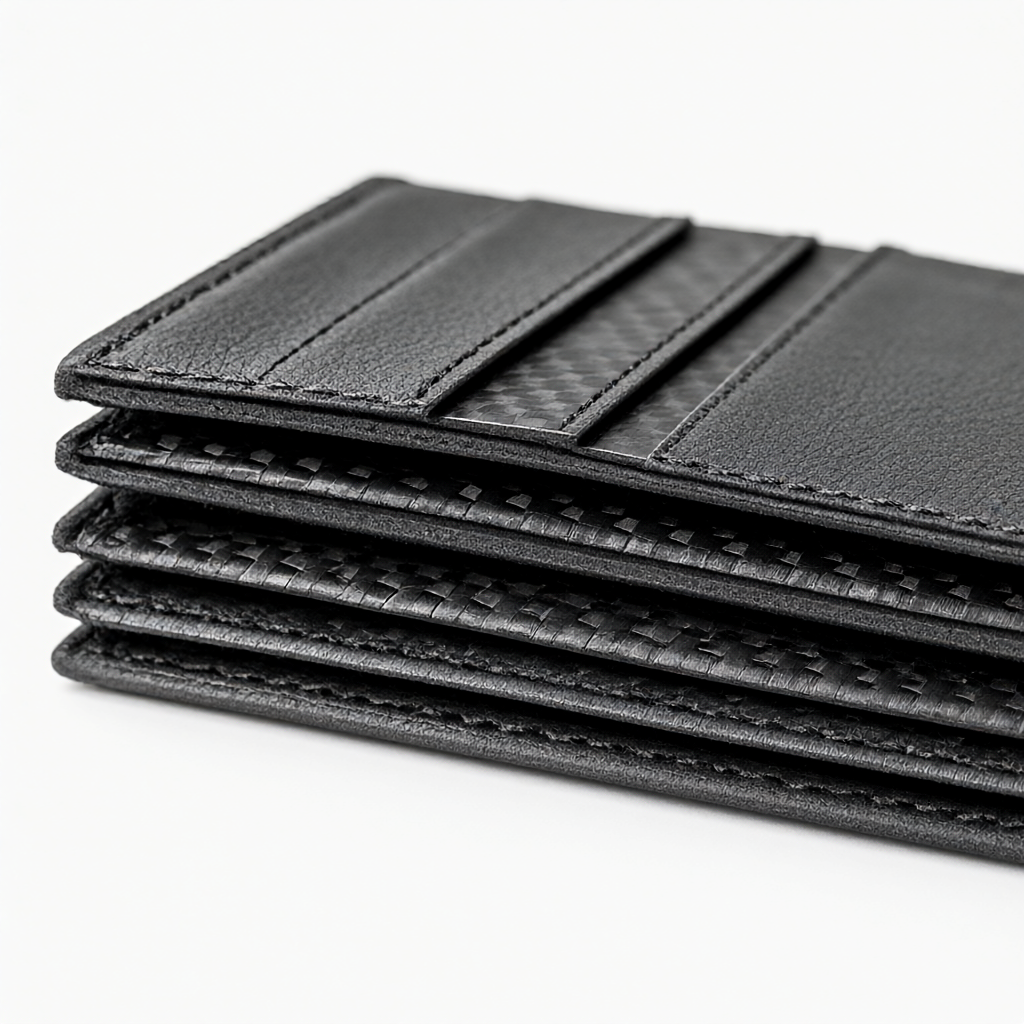
Several industry frameworks govern materials, safety, and construction quality for EDC wallets. Knowing these helps you evaluate claims on product pages.
Material safety and restricted substances: Products sold in the EU and US typically comply with REACH and RoHS restrictions on heavy metals and hazardous chemicals in metals, coatings, and synthetic leathers. In the US, the FTC enforces labeling and truth-in-advertising rules that apply to material claims such as “genuine leather” or “RFID-blocking.” These regulations require manufacturers to substantiate performance claims rather than relying on vague descriptors.
Quality management for manufacturers: Reputable EDC wallet factories operate under ISO 9001 quality management systems. This certification doesn’t dictate wallet dimensions — it governs process consistency, traceability, and corrective action protocols across the manufacturing line.
Testing benchmarks: Organizations such as ASTM International publish widely referenced standards for material testing, including abrasion resistance, colorfastness, and metal coating adhesion. When a wallet brand cites “tested to ASTM standards,” look for the specific standard number on the spec sheet. Generic references without a numbered code carry less weight.
What matters most to buyers: Look for wallets that disclose material composition (e.g., 6061-T6 aluminum, aramid fiber / carbon fiber layup, full-grain or top-grain leather), list any applicable certifications, and provide verifiable thickness and card-capacity ratings rather than marketing language alone. For RFID-specific concerns, see our RFID-protected wallets guide.
Fit & Compatibility — Will a given wallet fit my jacket or trousers pocket?
Wallet-to-pocket compatibility depends on three variables: pocket geometry, loadout weight, and silhouette.
Trouser front pockets (modern cuts): Most contemporary men’s and women’s trouser front pockets measure roughly 5.5–6.5 in wide and 4.0–5.0 in deep when laid flat. A 4.3 × 3.1 in wallet sits comfortably with 1–1.5 in of margin on each side. Loaded thickness above 0.5 in begins to create a visible outline, especially in slim or tapered pants.
Jacket inner pockets: Lining pockets tend to be shallower (3–4 in deep) but have more generous width. A slim card holder or money clip excels here. Traditional bifolds can bulk upward and distort the jacket drape.
Weight threshold: Aluminum wallets with 6–8 cards typically weigh 1.5–2.5 oz (42–70 g). Carbon fiber variants land closer to 1.0–1.8 oz (28–50 g). Leather bifold wallets with similar capacity run 3.0–4.5 oz (85–125 g). Heavier wallets create more pocket stretch and noticeable sag over time.
Low-profile vs double-zip vs money clip trade-offs
| Form factor | Best for | Typical thickness (loaded) | Cash carry approach | Security strengths |
|---|---|---|---|---|
| Slim minimalist wallet | Daily commuter carry, front-pocket daily use | 0.3–0.5 in (8–13 mm) | Tucked inside card slot | Compact, hard to snatch-open |
| Double-zip wallet | Travelers needing compartmentalization | 0.5–0.7 in (13–18 mm) | Zippered bill compartment | Zippers resist accidental spill; harder to pick quickly |
| Money clip + card holder | Minimal cash, rapid access | 0.15–0.3 in (4–8 mm) | Bills clipped externally | Extremely thin; fast one-hand retrieve; exposed clips can catch |
A low-profile wallet prioritizes pocket invisibility and speed. A double-zip wallet adds organization and a barrier against pickpocketing but sacrifices slimness. A money clip maximizes thinness at the cost of exposing cash edges and reducing card storage. Choose based on how much physical cash you actually carry and what your pocket geometry allows.
Size Chart — Dimension reference for common EDC wallet types
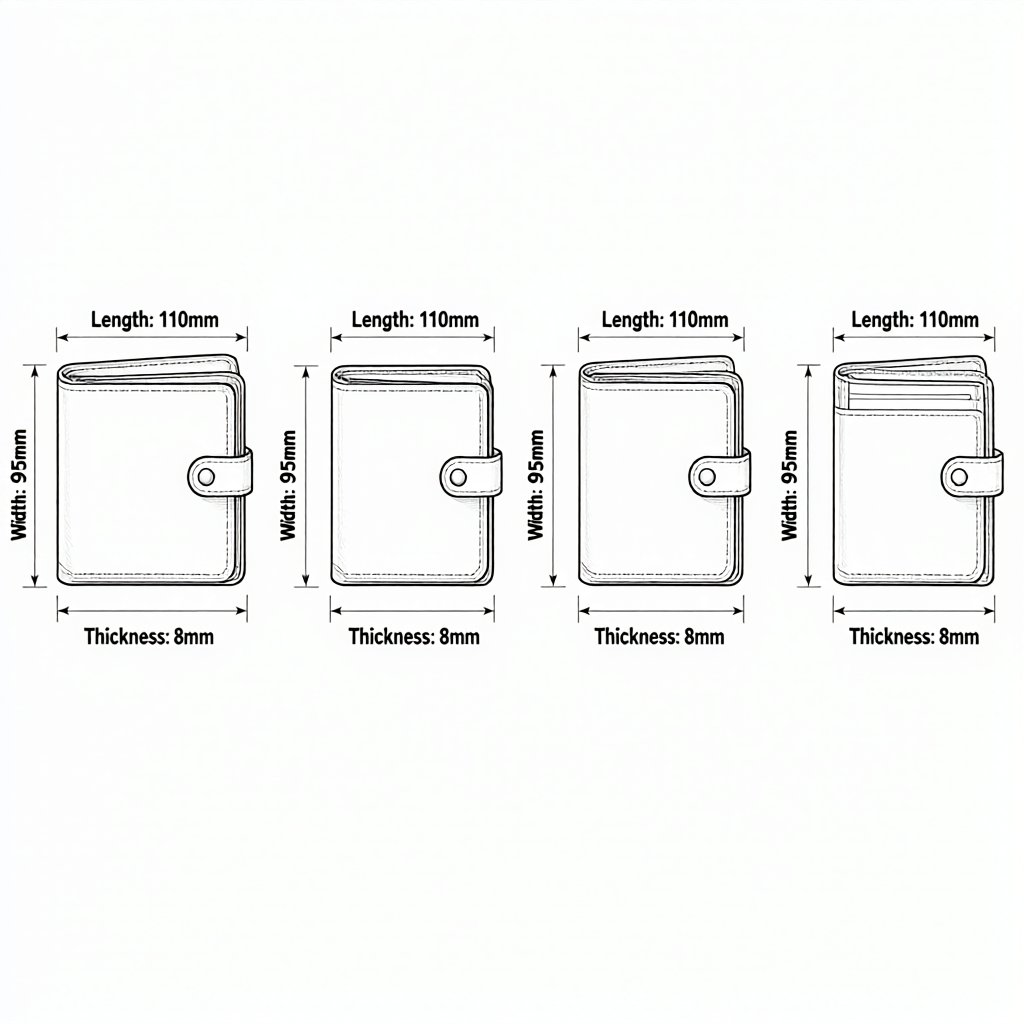
| Type | Width (in / mm) | Height (in / mm) | Thickness loaded (in / mm) | Card capacity | Weight range (oz / g) |
|---|---|---|---|---|---|
| Slim passcase | 3.5–4.0 / 90–100 | 2.5–2.9 / 65–75 | 0.2–0.35 / 5–9 | 4–8 | 1.0–1.8 / 28–50 |
| Front-pocket minimalist | 4.0–4.5 / 100–115 | 3.0–3.3 / 75–85 | 0.3–0.5 / 8–13 | 6–12 | 1.5–2.5 / 42–70 |
| Money clip combo | 3.5–4.0 / 90–100 | 2.4–2.8 / 60–70 | 0.15–0.3 / 4–8 | 2–6 + cash | 0.8–1.5 / 23–42 |
| Classic bifold | 4.5–5.0 / 115–125 | 3.5–4.0 / 90–100 | 0.6–1.0+ / 15–25+ | 8–16 | 3.0–4.5 / 85–125 |
| Travel anti-theft wallet | 4.5–5.2 / 115–132 | 3.3–3.8 / 85–95 | 0.5–0.7 / 13–18 | 8–14 | 2.5–4.0 / 70–115 |
If you’re comparing by literal measurements rather than style names, our wallet size width and height guide walks through how to read spec sheets accurately.
Related Considerations — Features, materials, and travel security
When transitioning from an old wallet to an EDC-focused carry, two questions matter most: what features justify the switch, and what materials keep the wallet durable without adding bulk?
NFC and RFID blocking: An NFC wallet uses a layered conductive mesh or metal plate behind the card slots to attenuate unauthorized radio-frequency reads. This blocks contactless skimming attempts but may also block legitimate taps depending on placement. If you tap your transit card or phone frequently, test NFC performance before committing. See our dedicated RFID wallets guide for positioning tips.
Anti-theft travel design: The best anti theft wallet for travel combines multiple barriers: RFID/NFC shielding, a lanyard loop or wrist strap attachment, lockable zippers on dual-compartment models, and a low-profile shape that doesn’t invite snagging. Some designs add hidden interior pockets specifically for passports or boarding passes — useful if you swap between cash, card, and document carry during trips.
Material choices and size impact: Aluminum wallets hold the slimmest profiles but can dent under impact. Carbon fiber offers comparable thinness with higher scratch resistance but carries a premium price. Silicone or soft-shell wraps add grip and minor cushioning but increase thickness by 0.05–0.15 in. Full-grain leather ages well but expands slightly with moisture — expect a 0.05–0.1 in thickness shift after heavy rain exposure. Choose materials based on climate, grip preference, and how strictly you need to maintain a low profile.
Color and finish note: Neutral tones like black, gray, and matte finishes remain popular across EDC communities, though earth tones and muted pastels appear frequently in seasonal collections. Style preferences are personal; they don’t affect fit or function.
How We Meet These Standards
As a manufacturer focused on EDC wallets and pocket gear, we’ve spent over a decade refining how minimalist wallets are engineered for real pocket conditions — not just lab measurements. Our CNC machining and surface finishing processes target consistent thickness tolerances within ±0.1 mm across production runs, so a wallet ordered today matches the same dimensional specs as one ordered six months later. Materials are selected for verified compliance with REACH and RoHS restrictions, and finished products undergo SGS testing before shipment.
We offer OEM and ODM services starting at 100 pieces, with sample prototypes delivered in 7 days. Customizations span laser engraving, UV printing, anodized color finishes, and branded retail packaging — tailored for brand owners, Amazon FBA sellers, promotional product distributors, and corporate gift buyers looking for mid-tier quality at cost-competitive pricing.
An on-chain wallet (also called a blockchain wallet or crypto wallet) is software or hardware that generates and stores the cryptographic keys needed to interact directly with a blockchain ledger — giving you sole control over your digital assets without a custodian. It is not a physical object; it is a self-custodied interface to on-chain funds. For physical everyday carry alongside a digital setup, the go-to companion is a minimalist front-pocket wallet measuring roughly 4.3 × 3.1 × 0.4 inches. If you'd like a deeper look at physical card-safe options, see this buyer's guide to card-safe wallets.
What exactly is an on-chain wallet?
An on-chain wallet is a non-custodial digital wallet whose private and public keys are generated and stored locally — on a device you control — rather than on a centralized exchange server. Transactions signed by those keys are broadcast to the blockchain network and recorded on the immutable ledger. In plain terms: you own the keys, you own the funds, and no third party can move or freeze your assets unilaterally.
Key characteristics:
- Private-key custody: Keys never leave your device (or a seed phrase written on paper/metal).
- On-chain settlement: Every transaction finalizes directly on the blockchain, visible to anyone.
- Non-custodial by design: No KYC-required intermediary holds your balance.
This model contrasts sharply with holding assets on a centralized exchange, where the exchange controls the keys on your behalf — introducing counterparty risk.
On-chain vs off-chain / centralized wallets
| Dimension | On-chain (non-custodial) wallet | Off-chain / centralized wallet |
|---|---|---|
| Key custody | User-controlled (self-custody) | Exchange-controlled |
| Asset visibility | Public blockchain address | Private ledger inside exchange database |
| Transaction finality | Confirmed by miners/validators on-chain | Confirmed internally by the platform |
| Recovery if provider fails | You recover via seed phrase | Funds may be inaccessible |
| Regulatory exposure | Lower (no custodian) | Higher (KYC/AML required) |
| Security responsibility | Fully on user | Shared with platform |
If you’re new to the space, understanding this distinction is essential before selecting a wallet type — your choice determines who bears the risk of loss or compromise.
Types of on-chain wallets — hot, cold, hardware, software
Hot wallets (software): Connected to the internet. Convenient for frequent transactions but exposed to online threats. Examples include browser extensions and mobile apps. They store keys in encrypted files on the device.
Cold wallets (hardware devices): Dedicated offline machines that sign transactions without exposing private keys to the internet. They typically comply with or target FIPS 140-2 Level 3 security module standards (as referenced by NIST SP 800-82) for tamper resistance, and are evaluated against ASTM International durability benchmarks when applicable. These are the preferred choice for long-term holdings.
Paper wallets & metal backup plates: Seed phrases recorded offline on waterproof, fire-resistant substrates — the most resilient form of passive cold storage, though vulnerable to physical damage if mishandled.
The general rule of thumb in the industry: keep only what you actively transact in hot wallets; store the rest in hardware or paper cold storage.
Security implications and risks
Self-custody is powerful but shifts responsibility entirely onto the owner. Primary risks include:
- Seed phrase loss or theft: Anyone with your 12–24 word recovery phrase can drain all associated wallets. Store it offline, never digitally.
- Phishing and fake firmware: Hardware wallet users must verify firmware signatures and purchase only from official channels.
- Social engineering: Attackers targeting help-desk-style support or fake recovery tools are increasingly common.
- Physical device loss: Without a backed-up seed phrase, a lost device means permanent fund loss.
Industry best practice, aligned with guidance from FTC consumer advisories on cryptocurrency scams, recommends multi-layered protection: hardware cold storage for long-term balances, separate small hot wallets for daily use, and offline seed backups stored in geographically separated locations.
Non-custodial nature and decentralization explained
The philosophical core of on-chain wallets is decentralization — the principle that no single entity should control individual wealth. By holding your own keys, you participate directly in the protocol layer instead of routing through intermediaries. This has practical consequences:
- No bank can freeze your account based on jurisdictional policy.
- No platform can censor outgoing transactions.
- Protocol upgrades require community consensus, not a corporate decision.
However, decentralization also means there is no customer-service hotline to call if you make a mistake. Irreversible transactions and lost keys are permanent. Education and cautious habit formation are your primary safeguards.
Company Integration — How manufacturers approach quality and fit
The gap between a theoretical minimalist wallet spec and a product that actually survives daily pocket wear comes down to manufacturing discipline. That is where an established OEM partner makes a measurable difference.
TOP EDC Wallet operates from a 50,000 sq ft factory with ISO 9001 certification (held since our founding in 2014) and BSCI-audited facilities, ensuring consistent process control across every run. Their CNC machining maintains dimensional tolerances within ±0.1 mm, and SGS-tested materials confirm REACH/RoHS compliance before any shipment leaves the plant. With 13+ years of export experience serving 200+ brands across North America, Europe, Australia, and Southeast Asia, they produce at 500K+ units monthly while offering a low MOQ starting at just 300 pieces and sample delivery in 7 days.
For buyers evaluating whether a wallet will genuinely fit their pocket geometry and lifestyle — whether an Amazon FBA seller sourcing private-label stock or a distributor building a brand line — this combination of certification-backed consistency and flexible production is what separates reliable supply from risky speculation. See their full contact page for sourcing conversations.
On-Chain Wallets Explained — What exactly is an on-chain wallet?
An on-chain wallet is any software or hardware interface that gives users full control over blockchain-based assets through self-managed keys. When you send Bitcoin, Ethereum, or tokens from a self-custodied wallet, the transaction is signed locally and broadcast to the network for inclusion in a block — that is the “on-chain” part. By contrast, funds held on a centralized exchange are recorded on the exchange’s internal ledger (an off-chain database) until you withdraw them.
Hot wallets vs cold wallets
| Wallet type | Internet connected | Security level | Best for | Typical cost | Examples |
|---|---|---|---|---|---|
| Mobile hot wallet | Yes | Moderate | Daily spending, small balances | Free | MetaMask Mobile, Trust Wallet |
| Desktop hot wallet | Yes (often) | Moderate | Frequent trading, DeFi interactions | Free | Exodus, Electrum |
| Hardware cold wallet | No (signs offline) | High | Long-term holding, large balances | $50–$200 | Ledger Nano X, Trezor Model T |
| Paper wallet | N/A | High (if stored securely) | Offline backup, one-time storage | Free | Printed QR-code seed + address |
Self-custody principle: In every on-chain configuration above, the defining feature is the same — you alone possess the seed phrase (usually 12–24 words) or private key file. Loss of that phrase means irreversible loss of access to the associated funds. No customer-support representative can recover it. This is the core difference between on-chain and custodial wallet models.
Key security implications and risks
Self-custody shifts responsibility entirely to the user. Understanding the risk landscape is essential before migrating significant value:
- Seed-phrase exposure: If anyone photographs or writes down your recovery phrase, they can reconstruct your wallet. Store it on metal or in a safe deposit box — never digitally.
- Device compromise: Malware on a phone or computer running a hot wallet can intercept clipboard data or redirect transactions to attacker-controlled addresses. Use reputable apps only and keep firmware updated.
- Phishing sites: Fake wallet interfaces and counterfeit support channels are common attack vectors. Always verify URLs and never paste seed phrases into web forms.
- Smart-contract risk: Interacting with decentralized applications introduces exploit exposure. Audited contracts reduce (but do not eliminate) risk; unaudited tokens should be treated as high-risk.
- Hardware failure: Physical devices can break. Always maintain at least one backup seed phrase stored in a separate secure location.
The FTC warns consumers about crypto-related fraud and emphasizes due diligence when selecting wallets or services. Reputable wallet providers publish transparent security documentation and do not ask for your seed phrase under any circumstance.
What does “e-wallet meaning” actually refer to in product specs?
The term e-wallet appears in two distinct contexts:
- Digital/electronic payment wallet: An app or service (e.g., Apple Pay, Google Pay, MetaMask) that stores payment credentials or cryptographic keys for online and contactless transactions.
- Physical EDC wallet marketed toward digitally-native buyers: Manufacturers sometimes label slim card holders and minimalist wallets as “e-wallets” to signal they’re designed for users who prefer carrying fewer cards and more digital tools.
In specifications, look for context clues. Digital e-wallets reference NFC, Bluetooth pairing, app store links, or biometric authentication. Physical e-wallets describe materials (aluminum, carbon fiber, leather), card slots,RFID-blocking layers, and dimensions in millimeters. Both serve the same underlying intent — reducing physical bulk — but operate in completely different domains.
How to Measure Your Current Wallet for a Proper Replacement
Transitioning to a new physical wallet begins with accurate measurements of what you currently carry. Follow these steps using a steel ruler or digital caliper for best results.
Step 1 — Empty and flatten. Remove all cards, cash, and inserts. Lay the wallet on a flat surface with the spine aligned to the edge of the ruler.
Step 2 — Width. Measure the longest horizontal dimension of the closed wallet. Record to the nearest millimeter.
Step 3 — Height. Measure the vertical edge from top seam to bottom edge.
Step 4 — Loaded thickness. Close the wallet as you normally would, then measure the narrow spine edge. This is your baseline thickness before adding cards.
Step 5 — Open spread. Open the wallet fully and measure the inside width. This determines whether a replacement bifold will sit flush or flare outward in your pocket.
Selection rule: A suitable replacement should match or undershoot your current width and height by no more than 0.2 inches (5 mm). Loaded thickness should remain at or below 0.5 inches (13 mm) for comfortable front-pocket wear. Anything thicker begins to create visible bulging in most modern trouser cuts.
For deeper guidance on reading dimension charts and understanding size comparisons, see our wallet size width and height guide.
Fit and Compatibility — Which wallets fit common pockets and outfits?
Wallet-to-pocket compatibility depends on three measurable factors: pocket interior dimensions, material drape, and loaded weight distribution.
Trouser front pockets (modern slim/tapered cuts): Interior width typically measures 5.5–6.5 in (140–165 mm) and depth 4.0–5.0 in (100–127 mm) when laid flat. A 4.3 × 3.1 in minimalist wallet leaves approximately 1–1.5 in clearance on each side, allowing it to slide in and out without catching. Loaded thickness above 0.5 in begins producing a visible pocket outline, particularly in stretch-denim or tailored chino fabrics.
Jacket and coat inner pockets: These pockets tend to be shallower (3–4 in deep) but wider, making them ideal for slim card holders and money clips. Traditional bifolds can push against the lining and distort the garment silhouette.
Weight and sag: Aluminum wallets with 6–8 cards weigh approximately 1.5–2.5 oz (42–70 g). Carbon fiber equivalents range from 1.0–1.8 oz (28–50 g). Full-grain leather bifolds with similar capacity run 3.0–4.5 oz (85–125 g). Heavier wallets accelerate pocket stretching over months of daily use — a practical consideration for premium trouser fabrics.
Industry Standards and Certifications Relevant to EDC Wallets
Quality markers on EDC wallet product pages vary widely. Understanding the relevant standards helps separate substantiated claims from marketing language.
ISO 9001:2015 (Quality Management Systems): Reputable manufacturers operate certified quality management systems. ISO 9001:2015 governs process consistency, document control, corrective action, and traceability across production runs. It does not prescribe wallet dimensions but ensures that specified tolerances are maintained batch after batch. Look for certification numbers that can be verified through the manufacturer’s audit report.
BSCI (Business Social Compliance Initiative): Facility audits under BSCI assess labor practices, working conditions, and environmental management. A BSCI-audited factory indicates structured social-responsibility oversight, which matters to brands sourcing for regulated retail markets.
REACH and RoHS compliance: EU regulations restrict hazardous substances in manufactured goods. REACH governs chemical registration and evaluation; RoHS specifically limits lead, mercury, cadmium, and certain flame retardants in electronic-adjacent components (including RFID-blocking laminates and metal plating). Products entering European markets must declare compliance; SGS or equivalent laboratory testing provides verifiable evidence.
ASTM International testing standards: Organizations like ASTM International publish referenced standards for material performance, including abrasion resistance (ASTM D4966 for textiles), colorfastness, and coating adhesion. When a supplier cites “tested to ASTM standards,” request the specific standard number — generic references without codes lack verification value.
ISO framework relevance: While ISO covers thousands of standards across industries, the ones most applicable to EDC wallet manufacturing fall under quality management (ISO 9001), environmental management (ISO 14001), and restricted-substance compliance linked to REACH/RoHS implementation.
For readers interested in the material-side specifics of RFID protection, our RFID-protected wallets guide examines shielding effectiveness and placement strategies.
Sources & References
- FTC — www.ftc.gov
- ASTM International — www.astm.org
- NIST SP 800-82 — www.nist.gov
- ISO — www.iso.org
- this buyer’s guide to card-safe wallets — topedcwallet.com
- complete minimalist wallets guide — topedcwallet.com
- leather wallet types overview — topedcwallet.com
- slim wallet buyer’s guide — topedcwallet.com
- RFID-protected wallets guide — topedcwallet.com
- wallet size width and height guide — topedcwallet.com
From article to product
Turning this into a product?
Most of what is written here is the difference between a sample that works and one that does not. We can build either — the useful one costs the same.
Keep reading
More on buying guides
wallet with trigger
How Does a Trigger Wallet Work? What Is the Pop-Up Mechanism? The core of…
Readbest bifold wallet for women
What Is a Bifold Wallet? The term “bifold” refers to the fold: the wallet…
ReadMen’s trifold wallets with zipper compartments vs. bifold
At a Glance The three dominant men’s wallet formats differ in panel count, depth,…
Read
About the author
TOPWALLET Editorial Team
TOPWALLET's editorial and engineering desk writes from bench testing at the Shenzhen (Longgang) facility: pull-force and cycle testing, 13.56 MHz shielding measurements, finish trials and factory audits, rather than supplier spec sheets. Every specification in these guides is one we write on a purchase order.
Written on the floor
This article was written by our production and QC team — the people who spec tolerances, run the finishing line and inspect every batch. Where it states a capacity, a pull force or a lead time, it comes from a measurement we made, not a supplier’s catalogue. If a number here disagrees with what your own supplier told you, tell us; several of these articles started as a correction from a buyer.
See how the factory works · Inspection process · Sourcing FAQ
Turning this into a product?
Most of what is written here is the difference between a sample that works and one that does not. We can build either — the useful one costs the same.