

What Makes a Thin Wallet the ‘Best’ Choice?
The term “best thin wallet” has no single answer because thin-wallet performance depends on which trade-off matters most: how many cards you carry, whether you need RFID protection, how the wallet feels in a front or back pocket, and what material survives daily wear. A thin wallet that works for a commuter with six cards and a folded bill will fail for someone who carries twenty cards plus receipts. The right selection starts with defining your carry load, then matching it to the material, mechanism, and specification range that fits.
For B2B buyers — private-label brands, Amazon FBA sellers, promotional distributors, and corporate gift purchasers — the “best” thin wallet also means consistent manufacturing quality across production runs, verified RF shielding at both 125 kHz and 13.56 MHz, and material compliance that meets the regulations of your target market. A wallet that looks good in a product photo but fails QC on thickness variance or anodize adhesion becomes a liability at scale.
How Thin-Wallet Materials Compare — Aluminum, Carbon Fiber, and Titanium?
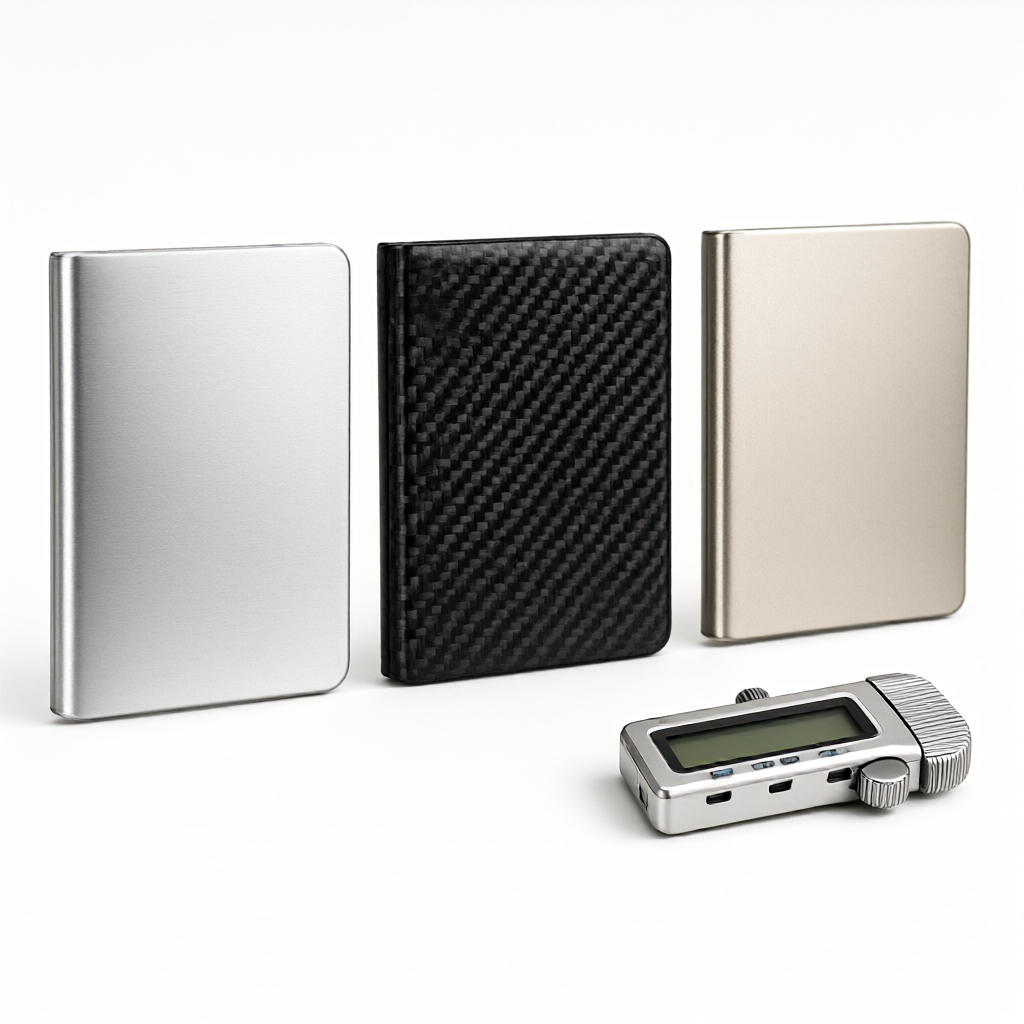
Thin wallets generally fall into four material families: aluminum alloy, carbon fiber, titanium, and engineered polymers such as Kydex or polyurethane blends. Each offers a different balance of thickness, weight, durability, and cost.
Anodized aluminum wallets are the most common entry point for minimalist carry. A typical 6061-T6 aluminum body, CNC-machined to 3–5 mm thickness, anodized for color and hardness, weighs roughly 50–80 g empty. Aluminum provides good rigidity, a broad palette of colors, and a lower per-unit cost than titanium or forged carbon fiber. The trade-off is that aluminum can dent under sharp impact and the anodized surface can abrade over months of front-pocket friction, especially on darker finishes. For buyers who prioritize color consistency and competitive pricing on mid-volume orders, anodized aluminum remains the workhorse material.
Carbon fiber wallets use layered aerospace-grade prepreg or woven carbon sheets bonded to a polymer or metal core. Thickness typically ranges from 3–6 mm, with weights around 40–70 g. Carbon fiber delivers high scratch resistance and does not dull with time the way anodized metal can. It also absorbs less heat than metal in direct sunlight. The downside is higher material and processing cost, and visible edge delamination if the laminate is poorly bonded during manufacture. For premium private-label programs where surface longevity matters, carbon fiber is a strong pick. See our best minimalist wallets for B2B sourcing and private label guide for a deeper material comparison.
Titanium money clips and card holders sit at the top of the thin-wallet material hierarchy. Grade 2 or Grade 5 titanium, CNC-machined or stamped, usually produces a wallet 4–8 mm thick at 60–100 g. Titanium is lighter than steel of equivalent strength, highly corrosion-resistant, and maintains a brushed or bead-blasted finish far longer than anodized aluminum. The cost per unit is noticeably higher, and machining titanium requires tooling considerations — tungsten carbide inserts and lower feed rates extend tool life compared to aluminum. For luxury EDC positioning or outdoor-use scenarios where sweat and salt exposure accelerate aluminum wear, titanium justifies its premium.
Polymer and composite wallets include Kydex, polycarbonate blends, and TPU-molded bodies. These can achieve the lowest overall thickness profiles — some polymer card holders sit at 2–4 mm empty — and cost very little to mold at volume. Polymer sacrifices the rigid, premium hand-feel of metal and carbon fiber and can crack under sharp impact. They are practical for high-volume promotional programs where unit cost drives the decision more than long-term durability.
For a detailed look at how card-holder mechanisms differ across these materials, review our best card holder selection for B2B sourcing and everyday carry use.
Key Specifications to Evaluate — Thickness, Capacity, and Weight
When comparing thin wallets for a sourcing decision, the three measurable axes are thickness, card/cash capacity, and loaded weight. These determine whether a wallet is actually slim in practice or merely advertised as such.
Thickness ranges. Practical thin wallets sit between 3 mm and 15 mm when measured empty on a digital caliper. Wallets marketed as “ultra-slim” but measuring above 12 mm empty are usually carrying more mechanical complexity — multiple card slots, flip mechanisms, or bulky clips — than the claim suggests. A 3–5 mm range is achievable with simple spring-loaded clamps or screw-adjusted tensioners; anything below 3 mm typically restricts card count to four or fewer.
Capacity versus thickness trade-off. A 4 mm aluminum wallet usually holds 4–6 cards and a folded bill. Pushing to 10–12 cards often requires 7–10 mm thickness or a dual-chamber design that undermines the low-profile goal. Money-clip-only designs can be as thin as 3 mm but only secure one to three cards plus cash. Front-pocket carry comfort drops noticeably once the loaded profile exceeds 10 mm in height × width × thickness.
Weight benchmarks. Empty, a good-quality aluminum thin wallet lands at 50–80 g; carbon fiber at 40–70 g; titanium at 60–100 g. Loaded with ten cards and a bill, expect an additional 15–25 g depending on paper quality and card thickness. For B2B buyers targeting Amazon FBA, the shipped weight (including retail packaging) directly affects FBM or FBA fees, so per-unit weight should be modeled early.
Rigid measurement protocol. When evaluating samples, measure empty and loaded. Record dimensions at three points: closed height, closed width, and closed thickness. Note whether the manufacturer measures with or without cards inserted — inconsistent protocols make comparison tables meaningless.
Standards & Requirements — RFID-Blocking, Certifications, and Compliance
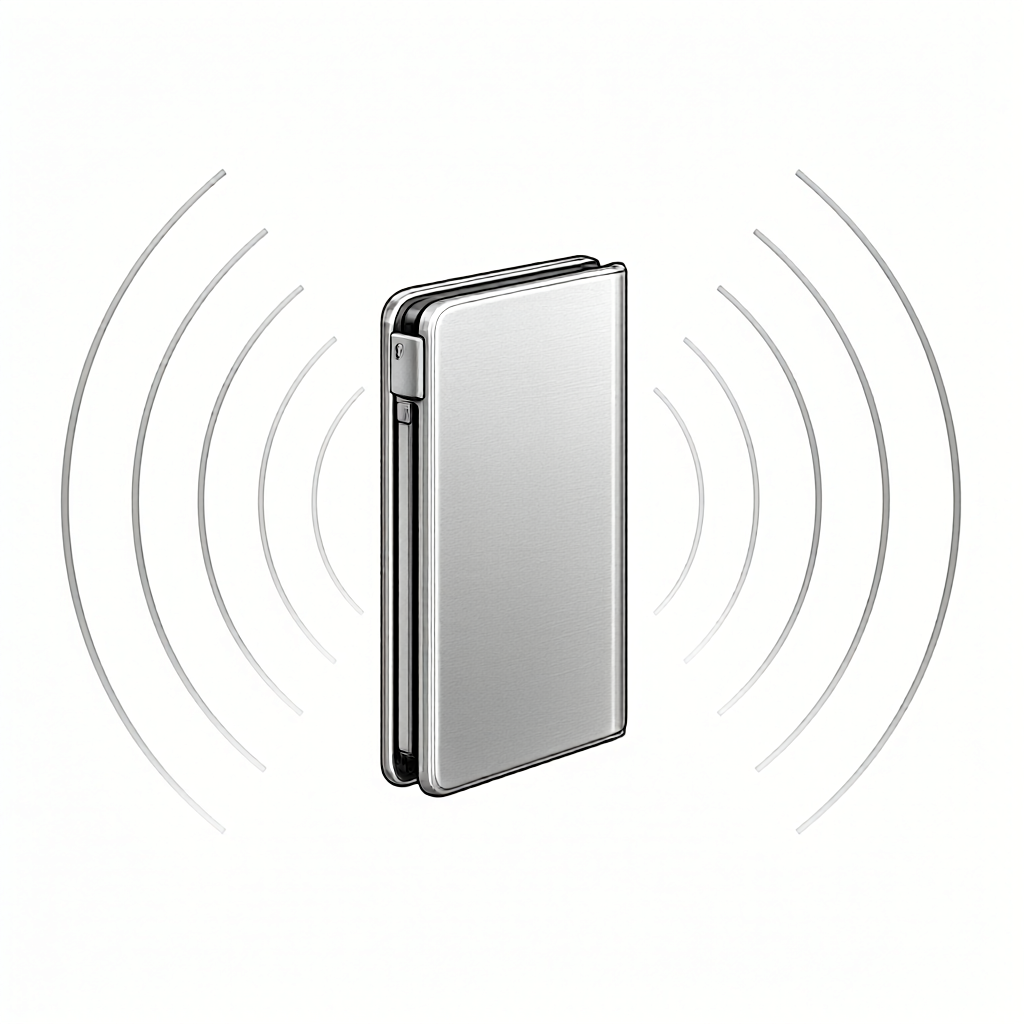
RFID-blocking is a frequent buyer requirement, but its real effectiveness depends on testing methodology and frequency coverage. Most contactless card chips operate at 13.56 MHz (ISO/IEC 14443), while older magnetic-stripe readers and some transit systems use 125 kHz. A wallet that blocks only one frequency leaves the other exposed.
How RFID shielding works. Thin wallets use conductive layers — typically aluminum foil, stainless-steel mesh, or ferrous alloy laminates — integrated into the wallet body or inner liner. The conductive layer creates an electromagnetic barrier that induces opposing currents, disrupting the reader-to-chip communication. For reliable blocking, the conductive layer must form a complete Faraday cage around the card stack, including side gaps. Incomplete coverage — common in budget designs where the shield is a small insert rather than an enveloping layer — produces partial blocking that fails certification tests.
Testing at certified frequencies. Reputable suppliers can provide RFID test reports from accredited labs using calibrated readers at both 125 kHz and 13.56 MHz. Look for pass/fail results at standard distances (typically 0–5 cm). Claims of “100% blocking” without test data should be treated as marketing language. For context on industry testing approaches, refer to standards publications from ASTM International.
Material and chemical compliance. Depending on your destination market, you will encounter different compliance requirements:
- EU markets: REACH and RoHS restrictions on restricted substances in metal alloys, anodizing baths, and polymer composites.
- US markets: FTC labeling rules for material composition — “genuine leather” vs. “bonded leather” vs. “synthetic” carry specific disclosure obligations. See FTC guidelines for material representation standards.
- General safety: SGS testing of heavy-metal content in anodized and painted finishes is standard practice for export-grade manufacturing.
Quality certifications. For B2B sourcing, ISO 9001 certification indicates a documented quality management system covering incoming inspection, in-process checks, and final outgoing QC. BSCI audit reports provide social-compliance assurance for retailers and brand purchasers. Both are valuable when evaluating potential manufacturers, particularly for long-term supply agreements.
Related Considerations — MOQ, Lead Time, Customization, and Supplier Selection
Sourcing thin wallets introduces commercial variables that often matter as much as the product itself.
MOQ ranges. Entry-level custom orders typically start at 300–500 pieces for standard designs with minor logo modifications (laser engraving or UV printing). Full OEM runs — new tooling, custom die sizes, private-label packaging — usually require 500–1,000+ pieces to justify setup costs. Some manufacturers offer lower MOQs on in-stock blank designs with applied branding.
Sample and production lead times. Sample turnaround commonly ranges from 5–15 business days for design-validated prototypes. Production lead time depends on order quantity, material availability, and finishing complexity; typical ranges are 20–45 days after sample approval for volumes up to 10,000 units. Rush production is available at premium pricing.
Customization options. Common private-label modifications include:
- Laser engraving or etching logos on metal surfaces
- UV or pad printing on carbon fiber faces
- Custom anodized colors matched to Pantone references
- Tailored card-tension mechanisms (spring clamp, screw adjuster, magnet-assisted)
- Retail packaging design and FBA prep services
For a broader view of EDC wallet evaluation criteria across materials and features, see our good wallets for guys: a B2B procurement guide to evaluating men’s minimalist EDC.
Common selection mistakes. Buyers frequently overlook three factors:
- Card-size compatibility: ISO/IEC 7810 ID-1 standard cards measure 85.60 × 53.98 mm. Some Asian-market wallets are dimensioned for slightly shorter local card formats, causingEuro or US cards to protrude.
- Anodize hardness variation: Not all anodized finishes are equal. Type II sulfuric-acid anodize (typically 25–50 microns) differs from hard-coat Type III (50–100+ microns). Hard-coat anodize resists abrasion better but limits color range.
- Edge finish: Sharp milled edges can catch on pocket fabric and degrade comfort over months of carry. Radiused or tumbled edges improve long-term wear even if they add marginally to thickness.
How TOP EDC Wallet Meets These Standards — A Manufacturer’s Perspective?
As a manufacturer that has produced minimalist wallets and pocket gear for over 13 years, our approach to thin-wallet sourcing follows the same evaluation framework we share with buyers: measure first, verify second, then match specification to use case.
We operate a 50,000 sq ft in-house facility where CNC machining, anodizing, laser engraving, and assembly run on the same floor. That proximity lets us catch thickness deviation, anodize adhesion failures, and RFID shield gaps before they leave the line. Our ISO 9001 quality system requires incoming material verification, in-process dimensional checks, and outgoing function tests on each production batch. We also hold BSCI certification, and all metal alloys and anodizing chemistries are tested for REACH and RoHS compliance before shipment.
On the technical side, our standard thin-wallet lines cover:
- Aluminum wallets at 3–6 mm thickness, 50–80 g, anodized in 12+ colors
- Carbon fiber card holders at 3–5 mm, 40–70 g, with verified edge lamination
- Titanium money clips at 4–8 mm, 60–100 g, bead-blasted or polished
- RFID-shielded variants tested at 13.56 MHz and 125 kHz with third-party lab reports
We offer low MOQ starts at 300 pcs per SKU for full OEM customization (100 pcs trial order available for stock finishes) for private-label programs, 7-day sample lead time on validated designs, and full OEM/ODM support from logo to retail packaging. Our monthly capacity exceeds 500,000 units, and we ship to brands across North America, Europe, Australia, and Southeast Asia.
If you are evaluating thin-wallet suppliers and want to compare real specifications — not just brochure photos — we can provide calibrated measurements, RFID test data, and sample units for your team to assess in hand. Send us your project requirements and we will respond with material options, MOQ, and lead time tailored to your target market.
Thin Wallet: Where Can You Verify the Data and Sources?
- ASTM International — www.astm.org
- FTC guidelines — www.ftc.gov
- best minimalist wallets for B2B sourcing and private label — topedcwallet.com
- best card holder selection for B2B sourcing and everyday carry use — topedcwallet.com
- good wallets for guys: a B2B procurement guide to evaluating men’s minimalist EDC — topedcwallet.com
- Send us your project requirements — topedcwallet.com
From article to product
Sourcing minimalist-wallets?
Tell us the format, the quantity and the date you need stock. You get material options, MOQ and a landed-cost range back within one business day.
Keep reading
More on wallet types
Thin Male Wallets: Buying Guide for Slim Minimalist Picks
How to choose a slim wallet for men — thickness thresholds, material trade-offs, capacity…
ReadStashed Wallet: A Minimalist Everyday-Carry Solution
Understand what a stashed wallet is, how minimalist slim wallets work, and what to…
ReadFolding Wallets: Types, Materials & Buying Guide
Learn what makes a folding wallet worth buying, from materials and card capacity to…
Read
About the author
TOPWALLET Editorial Team
TOPWALLET's editorial and engineering desk writes from bench testing at the Shenzhen (Longgang) facility: pull-force and cycle testing, 13.56 MHz shielding measurements, finish trials and factory audits, rather than supplier spec sheets. Every specification in these guides is one we write on a purchase order.
Written on the floor
This article was written by our production and QC team — the people who spec tolerances, run the finishing line and inspect every batch. Where it states a capacity, a pull force or a lead time, it comes from a measurement we made, not a supplier’s catalogue. If a number here disagrees with what your own supplier told you, tell us; several of these articles started as a correction from a buyer.
See how the factory works · Inspection process · Sourcing FAQ
Sourcing minimalist-wallets?
Tell us the format, the quantity and the date you need stock. You get material options, MOQ and a landed-cost range back within one business day.