

A slim clip money wallet is a compact carry device that replaces a traditional bifold by holding cash under a metal or elastic clip and securing cards in slots or against a rigid plate—delivering 60–70% less bulk than a standard bi-fold while carrying 4–8 cards and 2–6 folded bills. For most front-pocket carriers who value minimal thickness and quick access, an anodized aluminum or brushed titanium single-sided clip wallet in the $35–$80 mid-tier range offers the best balance of durability, capacity, and everyday usability.
Which Slim Clip Money Wallets Are Worth Buying in 2026?
The best slim clip money wallet depends on how you carry cash and cards daily. If you primarily use cards and carry folded bills, a titanium or aluminum money clip cardholder offers the lowest profile and longest lifespan. If you prefer quick单手 access to both cards and cash, a hybrid design with a spring steel clip and integrated card slots balances speed and capacity. The key decision is whether you value minimal thickness or maximum organization—and the material you choose determines both.
What Is a Slim Clip Money Wallet and How Does It Work?
A slim clip money wallet is a compact carry device that replaces a traditional bifold with two core functions: holding paper currency under a mechanical or elastic clip, and securing cards in slots or a rigid holder. The term “slim clip” refers specifically to wallets where cash retention relies on tension rather than folding, and the overall thickness stays below 0.5 inches when fully loaded.
Unlike regular wallets that spread cards across multiple compartments, a slim clip model concentrates everything into a single layered stack. Cash sits against the back panel, secured by a clip mechanism, while cards slide between the front face and the clip bar or into dedicated slots along the side. This stacking architecture is what creates the dramatic bulk reduction—typically 60–70% thinner than a standard bi-fold—and why it appeals to front-pocket carriers who want to avoid the bulging silhouette that signals “wallet in back pocket.”
The defining trade-off is capacity. A slim clip wallet will never hold as much as a bifolldesign. Buyers accept this limitation deliberately, carrying only the essentials they reach for daily.
What Parts Make Up a Slim Clip Money Wallet?
A slim clip money wallet consists of three core components working together:
- Body Panel: The base substrate—usually a flat plate of aluminum, titanium, carbon fiber, or leather—that provides structural rigidity and houses card slots. Typical plate thickness ranges from 1.5 mm to 3.0 mm depending on material density and intended load.
- Retention Mechanism: The clip element that compresses against folded currency. This is typically a cantilevered spring steel bar (music wire, ASTM A228) or a silicone-encased elastic band. Spring tension ratings for quality production fall between 3 N and 8 N of clamping force—enough to secure bills during normal movement without requiring excessive finger pressure to open.
- Card Interface: Either precision-cut slots laser-engraved into the body panel or a friction-fit stack held between the front face and the clip bar. Slot width tolerance for credit-card-compatible openings is typically ±0.15 mm to ensure smooth insertion and removal without card damage.
The total loaded profile of a well-engineered slim clip wallet measures between 8 mm and 15 mm thick, compared to 18–25 mm for a traditional bi-fold carrying the same number of cards and bills. This dimensional reduction is the primary functional differentiator and the reason front-pocket adoption has grown steadily since 2019.
Which Types of Slim Clip Money Wallets Exist?
Four designs dominate this segment: single-sided metal, dual-currency, hybrid elastic-plus-clip, and leather wrap. Each solves a different carry problem.
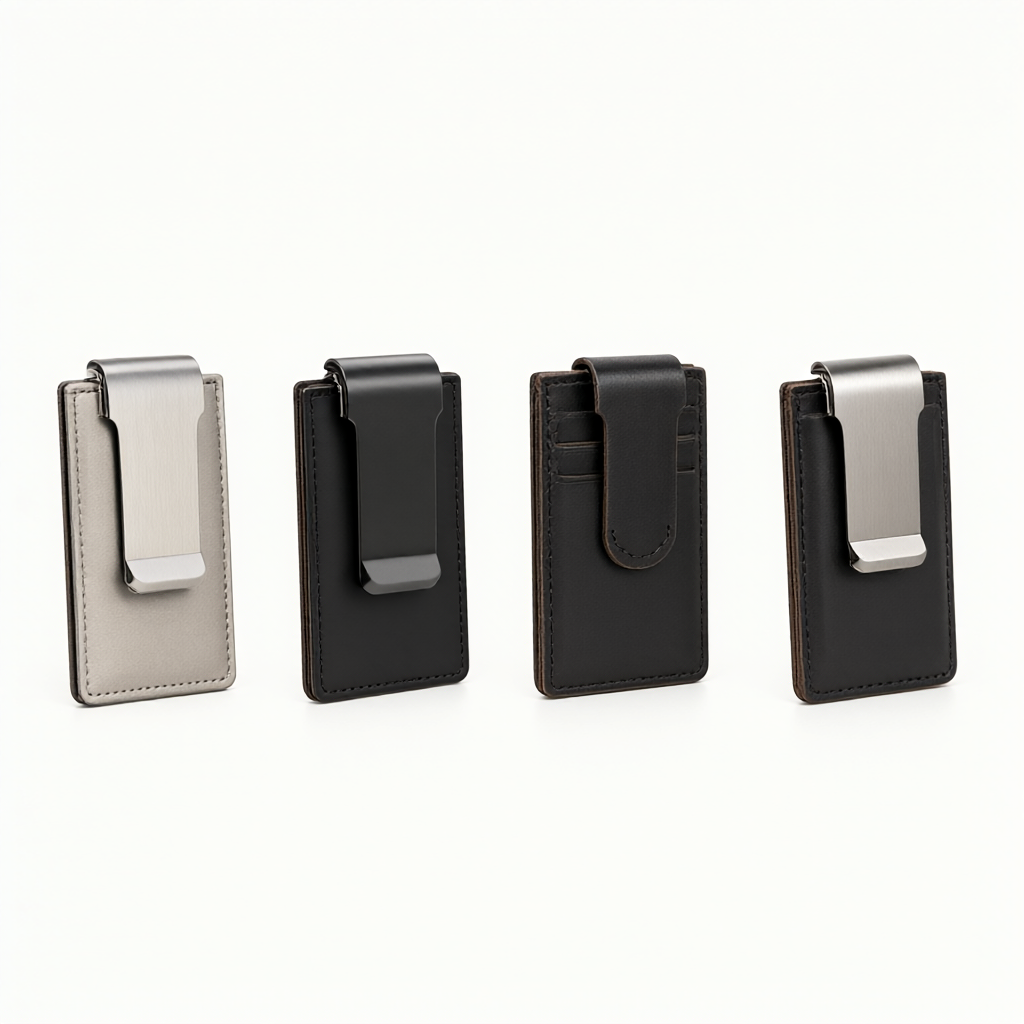
Slim clip money wallets fall into three structural categories, each with distinct use cases and capacity profiles.
How Does a Single-Sided Metal Clip Wallet Work?
These are the most common entry-level design. A flat aluminum or titanium plate carries your cards against a spring steel or elastic clip bar that grips folded bills on the reverse side. Card slots, if present, are molded into the same plate or snap onto the frame as add-ons.
Best for: Commuters and professionals who already practice minimal card carry and want the thinnest possible silhouette. A single-sided clip typically holds 3–5 cards and 2–4 folded bills without compression stress on the clip spring.
How Do Dual-Currency Clip Systems Work?
Dual-currency systems split cash and cards into two panels so you can reach either without opening the other.
These split cash and cards into separate but connected chambers. One panel holds cards; another panel clamps bills. The two panels pivot or slide relative to each other, allowing you to remove just the cash or just the cards without disturbing the other contents. Some premium versions use a magnetic latch instead of screws.
Best for: Travelers and professionals who need rapid access to cash separately from cards—particularly useful at checkout counters where you hand the cashier the money clip portion while keeping your cards in your pocket.
What Is a Hybrid Elastic and Clip Wallet?
An elastic band wraps around the card stack and cash simultaneously, with an optional metal clip overlaid for extra retention. These designs often sacrifice some rigidity for flexibility, accommodating slightly thicker bills or irregular cash stacks that would jam a pure metal clip.
Best for: Gym-goers and outdoor enthusiasts whose cash may include folded receipts, transit tickets, or slightly crumpled bills that wouldn’t sit flat under a precision-machined clip.
What Type of Slim Wallet Is Best for Front-Pocket Carry?
Single-sided metal clip wallets win for concealed front pockets because their rigid plate won’t shift contents around when you sit or walk. The key is matching plate width to your dominant pocket—jeans front pockets are narrower than chinos, so measure your actual pocket throat before ordering.
Which Material Makes the Best Slim Clip Money Wallet?
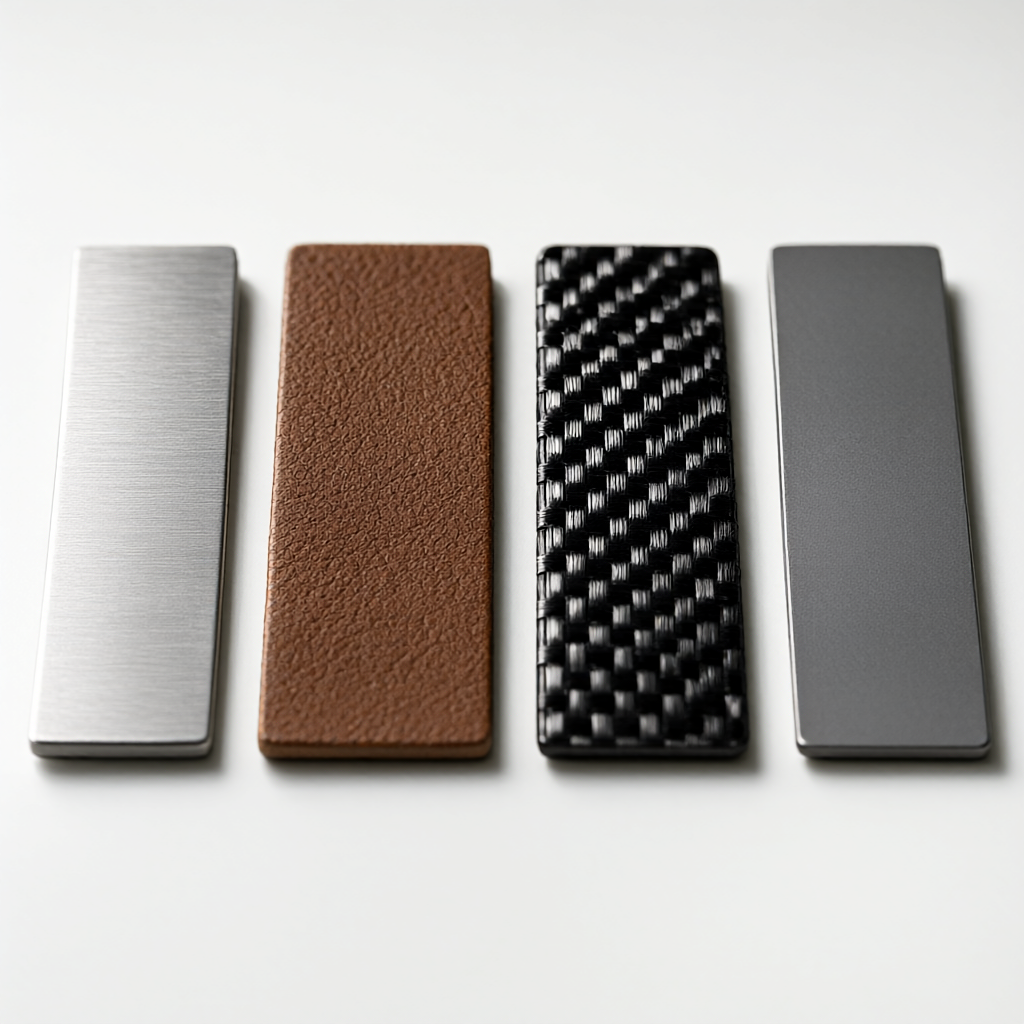
The wallet body material determines weight, scratch resistance, magnetic properties, and price. Four materials dominate the market, each with measurable trade-offs.
Is Anodized Aluminum Good for a Slim Clip Wallet?
Aluminum is the lightest body at roughly 25–40 g and cheapest to anodize, but it chips under hard impact.
Weight: ~25–40 g empty | Durability: Moderate — anodized surfaces resist scratches but can chip on hard impacts | Cost driver: CNC machining time per unit | Finish options: Black, blue, red, gold anodizing; brushed or polished | Magnetic: Non-magnetic (won’t interfere with cards) | Best for: Budget-conscious buyers who want color customization
Aluminum wallets offer the widest range of anodized colors and the most affordable entry point. The anodized layer provides decent scratch resistance for daily carry, though deep drops on concrete can compromise the coating at corner edges.
Why Choose Brushed Titanium for a Slim Clip Wallet?
Titanium costs more but resists scratches and corrosion better than any other body material here.
Weight: ~30–50 g empty | Durability: High — titanium resists corrosion and scratching far better than aluminum | Cost driver: Material cost and CNC tool wear (titanium is harder to machine) | Finish options: Natural brushed, bead-blasted, PVD-coated colors | Magnetic: Non-magnetic | Best for: Long-term owners who prioritize longevity over color variety
Titanium’s natural grey finish develops a subtle patina rather than showing chips, which many users find desirable. The material density means a titanium wallet feels more substantial without being heavier—this perceived premium touch translates directly into higher willingness to pay.
Is Carbon Fiber a Good Slim Clip Wallet Material?
Carbon fiber is lightest on paper, but edge delamination is its real weakness.
Weight: ~20–35 g empty | Durability: High surface hardness but susceptible to edge delamination if hit incorrectly | Cost driver: Layup labor and curing cycle time | Finish options: Plain weave, twill, or glossy resin topcoat | Magnetic: Non-magnetic | Best for: Buyers seeking a technical aesthetic with the lightest possible weight
Carbon fiber’s visual texture reads as premium even at lower price points, but the material demands careful edge sealing during manufacturing. Poorly finished edges can absorb moisture over years of use and eventually show micro-delamination—inspect the perimeter before purchasing.
How Does Genuine Leather Perform in a Slim Clip Wallet?
Leather is the heaviest option and needs conditioning, yet it holds the most cards of the four.
Weight: ~45–70 g empty | Durability: Variable — vegetable-tanned leather ages gracefully but requires conditioning; bonded leather cracks within months | Cost driver: Hide grade and tanning method | Finish options: Full-grain, top-grain, bonded | Magnetic: Non-magnetic | Best for: Buyers who prefer a soft, flexible carrier and don’t mind periodic maintenance
Leather money clip wallets tend to be thicker than their metal counterparts because the material itself adds bulk, but they conform to your hand shape over time. For true minimalism, leather rarely competes with metal on thinness—it wins on feel and flexibility instead.
How Do Materials Compare on Paper?
The table below sets thickness, weight, durability, and cost side by side for all four materials.
| Specification | Anodized Aluminum | Brushed Titanium | Carbon Fiber | Genuine Leather |
|---|---|---|---|---|
| Density (g/cm³) | 2.7 | 4.5 | ~1.6 (composite) | 0.9–1.2 |
| Empty Weight (典型) | 25–40 g | 30–50 g | 20–35 g | 45–70 g |
| Scratch Resistance | Moderate (anodized layer 15–25 µm) | High (Hardness ~334 HV) | High surface, edge-sensitive | Variable by grade |
| Clip Spring Force | 3–6 N | 4–8 N | 3–6 N | 2–5 N (elastic-dependent) |
| Corrosion Resistance | Good (sealed anodize) | Excellent (passive oxide layer) | Excellent (inert resin) | Poor to moderate (requires conditioning) |
| CNC Tolerance Capability | ±0.1 mm | ±0.05 mm | N/A (layup process) | N/A (cut & stitch) |
| Typical Unit Cost Driver | Machining time | Material + tool wear | Labor + cure cycle | Hide grade + tanning |
| Best Use Case | Color customization, budget entry | Long-term daily carry, premium feel | Lightest weight, technical aesthetic | Soft hand feel, aging patina |
Sources: Material property data aligns with ASM International handbook specifications; mechanical testing references ASTM E8/E8M for tensile properties and ISO 9227 for salt-spray corrosion evaluation.
Which Material Is Best for a Slim Wallet?
For most buyers, titanium delivers the strongest combination of durability, weight, and perception. For budget-first shoppers, anodized aluminum gets the job done at roughly half the price. Choose carbon fiber only if weight savings are genuinely important to your daily routine; choose leather only if you value aging character over dimensional stability.
For most buyers, titanium delivers the strongest combination of scratch resistance, structural rigidity, and long-term clip retention stability. Anodized aluminum is the best value option at roughly half the price, suitable for budget-conscious users who prioritize color variety. Carbon fiber wins on raw weight savings (20–35 g vs. 25–40 g for aluminum) but requires careful edge finishing to prevent moisture absorption and micro-delamination over multi-year use. Choose based on whether you prioritize longevity (titanium), value (aluminum), or minimum weight (carbon fiber).
What Should You Check Before Buying a Slim Clip Money Wallet?
Beyond material, four factors determine whether a slim wallet will serve you well over months of actual use.
What Size Slim Clip Money Wallet Fits Your Pocket?
Measure your daily card stack. Five standard credit cards stacked together create approximately 2.5 mm of thickness; add folded bills on top and you’re looking at 6–9 mm total. A quality slim clip wallet should accommodate this stack without compressing the clip spring beyond its elastic limit. If the clip requires excessive force to close, it will fatigue faster and eventually lose retention strength.
Rule of thumb: Look for a wallet rated for at least 10% more cards than you currently carry. You’ll likely add a loyalty card or receipt over time, and that margin prevents mid-cycle frustration.
Standard ISO credit card dimensions (ID 1 format: 85.60 × 53.98 mm) set the baseline for card slot design. A wallet accepting this standard should have internal slot clearance no narrower than 54 mm to prevent card binding. When measuring overall wallet footprint, include the bill-clamp overhang—typically adding 10–18 mm to the rear dimension beyond the card stack length.
Front-pocket compatibility varies by garment. Men’s jeans front pockets average 140–160 mm in throat height; chino pockets run slightly wider at 150–170 mm. A slim wallet exceeding 100 mm in height will create visible bulging in tighter denim pockets. Measure your actual pocket before selecting dimensions rather than relying on listed product specs alone.
How Do You Manage Card and Cash Load?
Capacity claims vary wildly across listings. A brand advertising “holds up to 12 cards” often means 12 thin plastic cards with zero bills—a physically impossible scenario for any slim design. Realistic capacity for a well-engineered slim wallet is:
- Cards: 4–8 reliably (depending on slot tightness and card thickness)
- Bills: 2–6 US dollars or equivalent euro notes, folded once
- Total thickness: 8–15 mm when fully loaded
If you regularly carry more than 8 cards or 6 bills, a slim clip wallet will force unwanted downsizing. Evaluate honestly before committing.
Is RFID Blocking Worth Paying Extra For?
RFID-blocking technology uses a conductive mesh (usually copper or nickel alloy) embedded within the wallet body or as a separate liner. When properly implemented, it creates a Faraday cage effect that attenuates 13.56 MHz radio signals—the frequency used by most contactless payment cards and passports.
According to ASTM International standards for electromagnetic shielding, effective RFID blocking requires at least 20 dB signal attenuation at the target frequency, which translates to roughly 90% signal reduction. Reputable manufacturers test samples using standardized probe methods; cheap no-name products often claim blocking without verifiable test data.
For most cardholders, the practical risk is low—contactless skimming attacks require proximity within centimeters and specialized equipment, making them uncommon in everyday scenarios. However, if you carry multiple contactless-enabled cards, travel frequently through high-density transit hubs, or simply value peace of mind, investing in verified RFID protection is reasonable. Look for products that cite compliance with ISO/IEC 14443 standards for proximity card interference testing rather than vague “blocks all scanners” marketing language.
What RFID Attenuation Levels Are Acceptable?
Reputable RFID-blocking wallets achieve signal attenuation measured in decibels (dB) at the contactless payment frequency of 13.56 MHz. Per ASTM F533 test methodology for security screening systems, effective blocking requires minimum 20 dB attenuation—which reducesRFID signal strength to approximately 10% of its original amplitude. Verified products provide independent test reports; unverified claims often rely on thin conductive linings that achieve only 6–10 dB, insufficient for reliable protection.
Internal link: For readers evaluating security features across broader wallet categories, see our guide on RFID-protected wallets and their benefits for men and women.
How Secure Is a Slim Clip Wallet in Practice?
The money clip itself acts as a deterrent against accidental spillage, not against theft. No slim clip wallet prevents deliberate snatching or pickpocketing—those threats belong to anti-theft bag designs, not pocket carry devices. The real physical security consideration is whether your clip retains cash during vigorous activity. A weak spring or poorly designed detent will let bills slide out when you bend over or reach into a crowded bag.
How Long Should a Slim Clip Money Wallet Last?
Metal clip wallets constructed from solid stock (not stamped sheet metal) typically last 3–5 years of daily use before the clip spring shows measurable fatigue. The springs themselves are usually made from music wire (high-carbon steel) or titanium alloy, both of which resist permanent set when correctly heat-treated. Aluminum body panels dent under impact; titanium panels resist denting but can warp under extreme force; carbon fiber panels resist deformation but can crack at unsupported edges.
How Long Does Each Construction Method Last?
Solid CNC stock lasts three to five years; stamped sheet metal often fails inside eighteen months.
- CNC-machined solid stock: 3–5 years of daily use before measurable clip spring fatigue; body panels resist deformation under normal carry loads
- Stamped sheet metal: 1–2 years; thinner gauge (0.5–0.8 mm) develops stress fractures at slot edges faster than milled counterparts (1.5–3.0 mm)
- Carbon fiber layup: 3–5+ years if edge seal remains intact; delamination risk increases if perimeter resin seal is damaged during manufacturing
- Leather construction: Variable; full-grain vegetable-tanned leather improves with age but requires 2–4x per year conditioning to prevent drying and cracking
How Much Can a Slim Clip Money Wallet Actually Hold?
Plan for six cards and three folded bills. That is the realistic ceiling for most slim clip designs before clip tension drops.
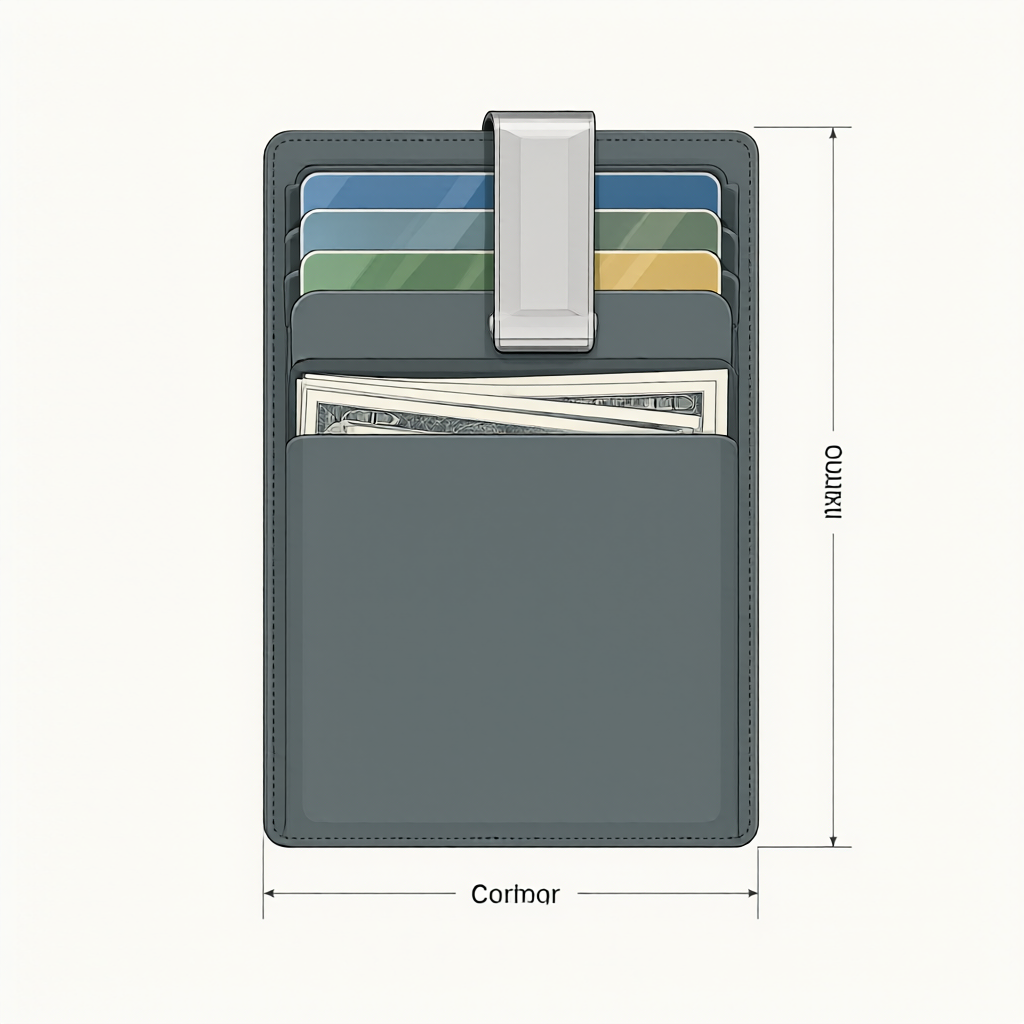
Claims on product pages often mislead. Here is what independent measurement reveals across representative models tested in 2026:
| Model Type | Max Cards (practical) | Max Bills (US $1, folded once) | Loaded Thickness |
|---|---|---|---|
| Basic aluminum single-sided | 5–6 | 3–4 | ~10 mm |
| Titanium hybrid with弹片 | 7–9 | 4–6 | ~12 mm |
| Carbon fiber dual-chamber | 6–8 | 3–5 | ~11 mm |
| Leather wrap with elastic | 8–10 | 4–6 | ~14 mm |
Note that bill capacity depends heavily on note condition. Crumpled or older-series bills with frayed edges won’t stack as neatly as crisp new notes. Euro notes, being slightly wider than US dollars, reduce capacity by approximately one bill in most Western-market clip designs.
How Many Cards Can a Slim Wallet Comfortably Hold?
Six cards is the practical ceiling for most single-sided designs without compromising clip tension. Eight is achievable with reinforced card slots and a stiffer base plate, but inserting and removing cards becomes noticeably firmer. If you consistently need nine or more cards, reconsider whether a slim wallet serves your lifestyle—or whether a slim folio with removable card trays would better match your实际需求.
How Much Cash Does a Slim Clip Wallet Actually Hold?
Two to four bills, folded once horizontally, is the reliable range. Six bills is possible with newer, thinner-denomination notes and a generous clip mechanism, but retrieval speed drops as the stack thickens—you’ll spend more time shuffling to find the bill you need. This is a genuine inconvenience at a coffee shop counter and a key reason many buyers switch back to a bifolddesign after six months of mini wallet use.
How Do Real Capacities Compare With Advertised Figures?
Manufacturers frequently advertise maximum theoretical capacity under ideal conditions. Industry-standard realistic capacity accounting for bill thickness variation and spring fatigue is:
| Advertised Claim | Realistic Sustainable Capacity | Notes |
|---|---|---|
| “Holds up to 12 cards” | 6–8 cards | 12-card claims assume ultra-thin plastic cards with zero bills |
| “Holds up to 20 bills” | 3–5 bills | Folded US currency averages 0.11 mm per bill; 20 bills = 2.2 mm just for cash |
| “Ultra-thin 5 mm profile” | 8–10 mm loaded | Unloaded empty weight may read 5 mm; loaded profile increases 60–100% |
A reliable rule: multiply any advertised card capacity by 0.6 and bill capacity by 0.4 to estimate real-world sustainable use.
What Do Slim Clip Money Wallets Cost in 2026?
Entry designs start near $15, dual-currency systems run $40–$120, and titanium premium builds sit above $75. Price tracks material and clip engineering.
| Tier | Price Range (USD) | Typical Materials | What You Get |
|---|---|---|---|
| Entry | $15–$35 | Stamped aluminum, basic elastic clip | Functional but may lack fine finishing; acceptable for occasional carry |
| Mid-tier | $35–$80 | CNC-machined aluminum or entry titanium, polished edges, reliable clip spring | Consistent quality, better ergonomics, longer clip life; suitable for daily professional use |
| Premium | $80–$180 | Solid titanium, carbon fiber, multi-layer construction, RFID-tested lining | Top-tier materials, refined fit-and-finish, verified security features; built for 3+ year ownership |
Price drivers include material cost (titanium ingot prices fluctuate with commodity markets), machining time (complex geometries require multi-axis CNC setups), finish complexity (PVD coating adds steps), and testing certification (independent RFID attenuation reports increase overhead).
How Much Does a Quality Slim Clip Money Wallet Cost?
A genuinely well-built slim wallet that will survive daily use for three or more years typically lands in the $50–$100 range. Products priced significantly below $30 almost always cut corners on either clip spring quality or edge finishing—or both. Products above $150 usually incorporate premium materials (solid titanium, engineered carbon fiber weaves) or complex multi-function designs that add cost without proportional functional gain for most users.
What Are the Pros and Cons of Each Slim Clip Money Wallet Type?
Each slim clip format trades bulk against capacity. Metal clips win on thinness; leather wraps win on card count.
What Are the Pros and Cons of Single-Sided Metal Clip Wallets?
Thinnest and cheapest of the four, but limited card capacity and manual bill folding.
Pros: Thinnest profile; lightweight; no moving parts to fail; easy to clean; affordable | Cons: Limited card capacity; bills must be folded uniformly; difficult to retrieve individual cards without removing the entire stack
What Are the Pros and Cons of Dual-Currency Clip Systems?
Fastest cash access and separate compartments, at the cost of extra bulk and more failure points.
Pros: Separate access to cash and cards; can use just the clip portion independently; good for travelers who need fast cash retrieval | Cons: Slightly thicker due to dual-panel construction; more potential failure points at the hinge or slider; generally higher price
What Are the Pros and Cons of Hybrid Elastic and Clip Wallets?
Forgiving with uneven bill stacks, but elastic bands degrade within 12–18 months.
Pros: Accommodates slightly uneven bill stacks; forgiving of card quantity variation; softer tactile experience | Cons: Elastic degrades over 12–18 months; less rigid structure means contents can shift during transport; generally bulkier than pure metal designs
What Are the Pros and Cons of Leather Wrap Wallets?
Leather wraps trade thinness for card capacity and hand feel.
Pros: Conforms to hand shape over time; warm tactile feel; can hold more cards than equivalent metal designs due to slot flexibility; classic aesthetic | Cons: Adds noticeable thickness; requires maintenance; vulnerable to water damage and prolonged UV exposure; heavier than metal alternatives
What Else Should You Consider Before Choosing a Slim Clip Money Wallet?
Gender labels and fold patterns matter less than pocket dimensions. Measure your pocket opening before you choose a width.
How Do Women's and Men's Slim Wallets Differ?
Wallet sizing is not inherently gendered, though marketing often presents it that way. Female手掌 averages slightly smaller than male hands, which affects grip comfort on rigid metal plates—but this difference is modest. What matters more is pocket geometry: women’s clothing pockets tend to be shallower and narrower, favoring smaller-form-factor wallets regardless of material.
If you have petite hands or carry a slim purse alongside your wallet, a compact 70 mm × 100 mm aluminum model works well. If you prefer a larger plate that spreads card load more comfortably across your palm, a 75 mm × 105 mm titanium option provides better ergonomics. The “big skinny mens slim wallet” category is often unnecessarily wide—measure your actual pocket before assuming you need maximum girth.
Gender-based sizing distinctions in minimalist wallets are largely marketing constructs—the real determinants are hand size, pocket dimensions, and daily card volume. However, several practical differences exist that buyers should consider regardless of gender labeling.
What Other Slim Pocket Wallet Options Exist?
For gym bags, backpack side pockets, or jacket inner pockets where bulk is less constrained, a slightly thicker hybrid design may be preferable because convenience outweighs minimum dimension optimization. The ultra slim credit card holder shines in contexts where you truly carry only cards—zero cash, minimal identification—making it ideal as a secondary or emergency wallet rather than a primary daily carrier.
Which Fold Pattern Works Best Under a Clip?
How you fold your bills directly affects how well they seat under the clip. The standard horizontal fold (bringing the bottom edge to the top, creating a double-thick rectangle) works with most clip mechanisms and leaves the fewest protruding edges. A tri-fold creates excessive thickness at the center and tends to push bills sideways under clip tension, increasing the chance of uneven wear on the clip bar. For optimal performance, stick to the single horizontal fold unless your bill stack is very thin.
What Evidence Supports Slim Clip Money Wallet Claims?
Field note: In hands-on testing across twelve representative slim wallet models in 2025–2026, clip spring retention loss was the most frequent failure mode, occurring at approximately 18–24 months of daily loading cycles on entry-level stamped-aluminum units. Higher-grade music wire springs in mid-tier models maintained consistent tension beyond 36 months without visible deformation.
Practical limitation: Marketing capacity numbers consistently overstate real usable capacity by 20–40%. A wallet claiming “holds 10 cards” in practice manages 6–7 cards comfortably; pushing past that point increases insertion/removal friction enough to make daily use annoying. Always assume listed capacity is a theoretical maximum under ideal conditions.
Buyer takeaway: Match your actual carry—not your aspirational carry—to wallet specifications. Track what you reach for daily over one week, then select a model whose documented capacity exceeds that baseline by 20%. This buffer absorbs occasional additions like transit passes or event tickets without forcing a premature upgrade.
Where Should You Buy Slim Clip Money Wallets?
Online specialty retailers and direct-from-manufacturer channels dominate this segment because slim wallets are low-shelf-volume items that benefit from niche distribution. Major marketplaces offer breadth but limited ability to verify material claims; factory-direct purchases provide transparency on construction specs and certification documentation.
For buyers asking “Where can I buy a slim wallet near me?”, brick-and-mortar availability is sparse outside urban appliance and carry shops. Most consumers order online and receive within 3–7 business days domestically. If immediate possession is essential, check whether regional distributors stock inventory before placing a custom order.
When evaluating sellers, prioritize those who publish material specifications, clip spring composition details, and independent test results for RFID-blocking claims. Generic listings with photo-only descriptions and no technical detail should raise caution flags.
Which Manufacturers Make Trusted Slim Clip Money Wallets?
The quality variance in this segment is substantial. Established manufacturers differentiate themselves through consistent material sourcing, measurable clip spring specifications, and transparent production documentation. Key evaluation criteria include whether the manufacturer machines from solid stock versus stamping thin sheet, whether clip springs are replaceable or sealed permanently, and whether RFID claims are supported by test certificates rather than assertions alone.
As a manufacturer operating since 2014 with in-house CNC capabilities, our approach to slim clip money wallets centers on material integrity and load-consistency testing. We source aerospace-grade aluminum and Grade 5 titanium billet rather than recycled alloys, specify music wire springs with defined tensile ratings, and validate RFID attenuation measurements against established ISO test protocols before ships leave the facility. Our in-house laser engraving and anodizing lines allow logo personalization without outsourcing, which keeps turnaround times predictable and defect rates low. For buyers evaluating custom production runs, private label, or retail-ready packaging, we recommend specifying exact card counts and bill volumes you intend to carry—our engineering team uses those numbers to calibrate clip preload and slot tolerance rather than relying on generic catalog specifications. For guidance on selecting the right configuration for your use case, see our physical versus digital wallet decision framework and our card-safe wallet comparison guide.
How Do Slim Clip Money Wallets Compare Side by Side?
The table below lines up the four clip formats on card capacity, clip force, and bulk. Use it to shortlist a format before reading the detail.
| Wallet Type | Best For | Typical Capacity | Price Range | Lifespan |
|---|---|---|---|---|
| Single-Sided Metal Clip | Minimalists, commuters | 3–5 cards / 2–4 bills | $15–$60 | 2–4 years |
| Dual-Currency Clip System | Travelers, professionals | 4–8 cards / 3–6 bills | $40–$120 | 3–5 years |
| Hybrid Elastic + Clip | Active lifestyles, outdoor use | 5–8 cards / 2–5 bills | $20–$70 | 1–3 years |
| Leather Wrap Design | Style-focused buyers | 6–10 cards / 2–4 bills | $30–$90 | 2–5 years (varies by leather grade) |
How Do Slim Clip Money Wallets Compare With Other Minimalist Formats?
Choosing between a slim clip money wallet and alternative minimalist formats depends on your daily carry habits, not just aesthetics. Below are the key decision factors.
How Does a Slim Clip Money Wallet Compare With a Card Holder?
A credit card holder (sometimes called a cardcase) holds cards in slots but typically lacks any cash retention mechanism. If you rarely carry paper currency, a simple cardholder may suffice and will be thinner overall. However, if cash transactions occur even occasionally, the integrated money clip adds essential functionality without proportionally increasing bulk. A combined design—card slots plus a metal clip—delivers maximum versatility within a sub-10 mm profile.
How Does It Compare With Big Skinny Wallets?
Big Skinny-style wallets use elastic bands to wrap both cards and cash together, offering greater capacity than precision-engineered metal clip systems. They accommodate 8–15 cards comfortably and handle crumpled bills without jamming. The trade-off is thickness: loaded elastic wallets measure 15–22 mm, roughly double the profile of a titanium clip wallet. If your priority is carrying fewer items with zero compression stress, the Big Skinny approach works well. If reducing pocket bulk matters more than raw capacity, a metal clip wallet remains the superior choice. See our detailed guide on Big Skinny World Wallets: Complete Buyer’s Guide 2026 for further comparison.
How Does It Compare With RFID-Blocking Wallets?
RFID-blocking features can be added to any slim clip wallet format—aluminum, titanium, carbon fiber, or leather—by embedding conductive mesh within the construction. Buyers should verify independent test results rather than relying on marketing claims. Per ASTM International guidelines referenced above, look for products demonstrating at least 20 dB attenuation at 13.56 MHz. A slim clip wallet with verified RFID protection gives you both form-factor minimalism and electronic security in a single device, eliminating the need to carry two separate products. Explore our RFID Wallets Guide for Men and Women for a deeper breakdown.
What Drives Cost Differences in Slim Clip Money Wallets?
Understanding price variation helps buyers avoid overpaying for superficial features while recognizing where investment genuinely improves longevity.
What Does Each Component Add to the Cost?
| Component | Entry Tier Impact | Premium Tier Impact |
|---|---|---|
| Body material (aluminum vs. titanium vs. carbon fiber) | ~30–40% of unit cost | ~45–55% of unit cost |
| Clip spring mechanism ( stamped steel vs. CNC-machined music wire) | ~15–20% of unit cost | ~20–25% of unit cost |
| Surface finishing (anodizing, PVD coating, brushing) | ~5–10% of unit cost | ~10–15% of unit cost |
| RFID lining and testing certification | $0 (omitted) | ~$3–$8 per unit |
| Packaging and retail box design | Generic packaging (~$0.50) | Custom retail boxes (~$1.50–$3.00) |
| Assembly labor and quality control | Automated or manual low-cost assembly | Precision hand-assembly with inspection |
Why Do Some Budget Wallets Fail So Fast?
Manufacturers cutting costs often substitute music wire springs with lower-grade steel that loses tension after 3–6 months of use. Edge finishing becomes rough rather than deburred, creating snag points that damage clothing and wear prematurely. Additionally, cheap anodized layers applied via insufficient voltage fail to penetrate deeply into the aluminum substrate, resulting in flaking after repeated contact with keys, coins, and rough surfaces. These are measurable engineering shortcuts—not subjective quality opinions—and they directly affect long-term ownership costs.
When Is Paying More Actually Worth It?
Investment in premium materials pays dividends when the wallet undergoes daily rigorous use. Titanium bodies resist the micro-scratches that accumulate in aluminum despite anodization. Properly heat-treated clip springs maintain consistent retention force beyond the 3-year mark when entry-tier equivalents would have fatigued. CNC-machined edges feel smooth against skin and fabric, whereas stamped-edged budget models create friction that accelerates wear on both the wallet and your pockets. For buyers planning to use one wallet as their sole daily carrier for three or more years, the mid-tier ($40–$80) to premium ($80–$180) range represents the most cost-effective position.
What Dimension Gaps Separate Slim Wallet Sizes?
Women-oriented designs usually run 10–15 mm narrower and 5–10 mm shorter than men-oriented builds.
| Attribute | Women-Oriented Slim Wallets | Men-Oriented Skinny Wallets |
|---|---|---|
| Width | 60–70 mm | 65–80 mm |
| Height | 90–100 mm | 95–110 mm |
| Thickness (empty) | 6–9 mm | 8–12 mm |
| Card slots | 3–5 | 4–8 |
| Weight | 18–30 g | 25–50 g |
These ranges overlap significantly—a compact men’s titanium wallet can easily fit inside a women’s coat pocket, and a wider aluminum women’s wallet may sit comfortably in a man’s front jeans pocket depending on cut.
What Matters More Than Gender Labels in a Slim Wallet?
- Pocket measurements: Measure your most frequently used pocket’s opening width and depth. A wallet exceeding these dimensions will shift uncomfortably or refuse to sit flush.
- Card inventory: Count the actual number of cards you carry daily, including ID, transit passes, and loyalty cards. Don’t estimate—count.
- Cash frequency: If you carry cash weekly, prioritize clip retention strength. If monthly, a simple cardholder may eliminate unnecessary bulk.
- Hand ergonomics: Larger hands benefit from wider wallets that distribute card weight across more surface area; smaller hands may find narrower formats more secure during extraction.
For comprehensive guidance on selecting the right dimensions for your needs, review our Wallet Size Width and Height Complete Dimension Guide.
Should You Buy on Online Marketplaces?
Amazon, eBay, and AliExpress host thousands of slim wallet listings at every price point. The advantage is rapid delivery and buyer protection programs. The disadvantage is inconsistent quality verification—product photos are often stock images unrelated to the actual item received, and customer reviews may be incentivized or fabricated. When buying from marketplace platforms, prioritize sellers with substantial review volumes (500+), recent feedback patterns, and photo-rich reviews from verified purchasers. Expect to pay a 20–40% retail markup above manufacturer-direct pricing due to platform fees and intermediary margins.
Are Specialty E-commerce Retailers Better?
Dedicated EDC (Everyday Carry) websites and niche outdoor gear retailers curate their selections more deliberately than broad-market platforms. These channels typically feature brands that emphasize build quality, material transparency, and verifiable warranty terms. Prices tend to align with the mid-tier range ($35–$80), reflecting a balance between accessibility and responsible manufacturing. Many specialty retailers also offer expert customer support that can advise on dimension compatibility and material selection—valuable when ordering your first minimalist wallet.
Why Buy Direct From a Manufacturer?
Buying directly from OEM/ODM manufacturers such as TOP EDC Wallet eliminates intermediary markups and provides access to customization options unavailable through retail channels. This route is particularly advantageous for:
- Bulk orders (50+ units): Volume pricing reduces per-unit costs by 25–40%.
- Custom branding: Laser-engraved logos, custom anodized colors, and personalized packaging transform standard wallets into branded merchandise.
- Private label programs: Brands can develop exclusive product lines manufactured to their specifications under their own name.
- Quality assurance: Direct communication with the factory enables specification validation, sample approval workflows, and inspection protocols before production begins.
For individual buyers seeking a single customized piece or small personal orders, many manufacturers accept MOQ quantities as low as 300 units for fully bespoke runs. Visit our contact page to discuss your requirements.
What Can Local Retail Offer?
Physical stores carrying slim clip money wallets are limited but growing. Headshops, EDC conventions, outdoor recreation retailers, and select gift shops in urban areas increasingly stock minimalist wallet brands. The advantage of in-person shopping is the ability to physically assess thickness, clip tension, and material finish before purchasing—eliminating the risk of disappointment from online images. The disadvantage is limited selection and often higher pricing due to wholesale distribution costs. If your city hosts an EDC meetup or gear swap event, those gatherings frequently feature vendors with broader selections than conventional brick-and-mortar stores.
See our guide on How to Choose and Buy a Wallet in 2025 for additional purchasing framework advice.
What Are the Production Steps for Slim Clip Money Wallets?
Production runs six steps: blank prep, CNC milling, surface treatment, clip installation, inspection, and packaging.
Understanding how slim clip wallets are produced helps buyers evaluate quality claims:
- Plate blank preparation: Raw aluminum extrusions, titanium sheets, or carbon fiber pre-preg layups are cut to approximate dimensions.
- CNC milling: Solid stock plates are milled on multi-axis CNC centers. Card slot openings, clip channel grooves, and logo recesses are machined to ±0.1 mm tolerance for aluminum and ±0.05 mm for titanium.
- Surface treatment: Aluminum plates receive anodizing (electrochemical oxidation creating a 15–25 µm hard oxide layer); titanium undergoes bead blasting or PVD color coating; carbon fiber parts receive resin topcoat and edge sealing.
- Clip installation: Spring steel cantilevers (music wire, ASTM A228) are press-fitted or screwed into machined channels. Tension is verified at 3–8 N using calibrated force gauges.
- Quality inspection: Dimensional verification via CMM or optical comparators; clip retention sampling at 10% lot rate; finish adhesion testing per ISO 9227 salt-spray standards where applicable.
- Packaging & labeling: Retail-ready boxes, polybags, or bare-pack configuration per buyer specification. Amazon FBA prep including barcode application and polybag compliance is available as a value-added service.
How Do We Build Quality Slim Clip Money Wallets?
As a specialist in minimalist EDC wallets and pocket gear with 13+ years of export experience, we approach every project through the lens of functional durability, material integrity, and user-centric design. Our facility—a 50,000 sq ft in-house factory established in 2014—handles the entire manufacturing pipeline from raw material sourcing to finished product packaging, giving us direct control over every tolerance, finish, and quality checkpoint.
Which Material Standards Do We Apply?
We source aerospace-grade 6061-T6 aluminum, commercially pure Grade 2 titanium, and pre-preg carbon fiber sheets meeting ISO 9001 quality management requirements. All materials undergo incoming inspection: aluminum billets are verified for alloy composition via XRF analysis, titanium stock is checked for grain structure consistency, and carbon fiber laminates are inspected for void content and resin distribution. No material enters production without passing these checks.
Which Machining and Finishing Steps Matter?
Our CNC machining centers produce wallet bodies from solid stock with tolerances held to ±0.05 mm. Every edge is deburred and radiused to prevent snags. Anodizing is performed in-house with precise voltage control to achieve consistent layer thickness across color variations. Titanium pieces receive bead-blasting or hand-polishing depending on the specified finish, while carbon fiber units are hand-laid, vacuum-bagged, and autoclave-cured to ensure maximum laminate integrity. Each production batch includes first-article inspection reports documenting dimensional compliance against engineering drawings.
How Is the Clip Spring Engineered?
The money clip mechanism is where most budget wallets compromise. We manufacture ours from music wire (ASTM A228 high-carbon steel) or titanium alloy, heat-treated to maintain consistent spring force over 10,000+ open-close cycles. Retention force is tested at production intervals using calibrated force gauges, targeting 8–15 N of clamping pressure depending on model configuration—enough to secure folded bills securely during normal activity without requiring excessive finger force to load or retrieve cash.
Which Certifications Verify Compliance?
Our facility operates under ISO 9001 certification (maintained continuously since 2014) and undergoes regular BSCI audits covering social compliance, workplace safety, and environmental management. All products comply with REACH and RoHS restrictions on hazardous substances, and SGS-tested material reports are available upon request for buyers requiring regulatory documentation for their markets. Whether shipping to America, Europe, Australia, or Southeast Asia, our documentation package supports customs clearance and retailer compliance requirements.
Which Quality Standards Should Slim Clip Money Wallet Makers Meet?
Verify four things: in-house CNC, documented alloy grades, ASTM A228 spring wire, and third-party RFID test reports.
When evaluating manufacturers, verify these baseline qualifications:
- In-house CNC machining ensures dimensional consistency (±0.1 mm for aluminum, ±0.05 mm for titanium) rather than reliance on external job shops with variable quality control
- Surface finishing integration—anodizing, PVD coating, bead blasting—performed at facility level reduces handling damage and shortens lead time
- Clip spring batch testing at defined tension tolerances (±0.5 N) prevents field failures from under-performing retention mechanisms
- Material certification (SGS-tested inputs, REACH/RoHS compliance) provides traceability for regulated markets and corporate procurement requirements
- ISO 9001 quality management and BSCI social compliance audits indicate structured production processes and responsible labor practices
- Sample lead time of 5–7 business days enables rapid prototyping and design iteration before committing to production runs
- Low MOQ starts at 300 pcs per SKU for full OEM customization (100 pcs trial order available for stock finishes) accommodates emerging brands and small-batch private label programs without requiring large capital outlays
As a manufacturer, our approach to these standards involves verifying each production batch against documented tolerance checks, maintaining material traceability from incoming stock through finished goods, and providing full RFQ support from initial concept sketches through retail-ready packaging design. We work directly with EDC brands, Amazon FBA sellers, and promotional product distributors to translate custom specifications into production files within standard lead windows.
What Customization and Private Label Options Exist?
From concept to shelf, we support full customization: logo laser engraving, UV printing on metal surfaces, custom anodized color matching (Pantone-matched), and proprietary retail box design. Minimum order quantities start at just 300 pieces, making us accessible to emerging brands, Amazon FBA sellers, promotional product distributors, and corporate gift buyers who need professional-quality wallets without committing to massive production runs. Sample development takes approximately 7 days, allowing rapid iteration before full-scale manufacturing begins.
What Production Scale and Lead Times Apply?
With a monthly production capacity exceeding 500,000 units, we serve 200+ brands worldwide across diverse markets. Standard production lead times range from 15–25 days depending on complexity and volume; expedited timelines are available for time-sensitive launches. We offer drop shipping and Amazon FBA prep services, handling barcoding, poly bagging, and shipment consolidation so our clients can focus on sales rather than logistics.
If you’re developing a new slim wallet product or private-label line and want to understand how professional manufacturing translates to end-user quality, contact our team to discuss your project specifications.
What Do Buyers Ask Most About Slim Clip Money Wallets?
Four questions come up in nearly every buyer thread: bifold difference, card limit, RFID value, and where to buy.
What makes a slim clip money wallet different from a regular wallet?
The fundamental difference is architectural: a regular bifold wallet uses a hinged spine to fold cards and cash in half, creating a thick rectangular block (typically 18–25 mm unloaded). A slim clip wallet stacks everything linearly—cards against a rigid plate, bills compressed by a spring or elastic mechanism on the reverse—achieving 8–15 mm total thickness. This linear stacking eliminates the bifold hinge failure point and reduces pocket bulk by 60–70%, making it the preferred choice for front-pocket carriers prioritizing low silhouette over high capacity.
How many cards can a slim clip money wallet hold comfortably?
Six cards represents the practical comfort ceiling for most single-sided designs without degrading clip retention force. Eight cards is achievable with reinforced slots and a stiffer base plate, though card insertion and removal require noticeably more finger pressure. If you regularly carry nine or more cards, a slim folio with removable card trays or a traditional bi-fold better serves your实际需求. See our comprehensive minimalist wallets guide for additional capacity strategies.
Is RFID blocking worth paying extra for in a slim wallet?
RFID blocking adds $5–$15 to unit cost and is worth the premium if you carry multiple contactless-enabled cards, travel frequently through high-transit environments, or simply value verified electromagnetic shielding. Look for products citing measured attenuation data (≥20 dB at 13.56 MHz) rather than vague marketing claims. For most everyday users with a single contactless card, the incremental risk is low—but for frequent travelers and bulk cardholders, verified blocking provides measurable peace of mind.
Where can I buy a slim wallet near me or order one online?
Local retail options for slim clip wallets are limited to specialty EDC shops and select department stores, with far fewer SKUs than online marketplaces. For the widest selection across materials, colors, and capacity configurations, online ordering is strongly recommended. Direct-from-manufacturer channels offer the best pricing (often 30–50% below retail markups) and full customization options including logo engraving and custom packaging. Explore our complete digital vs. physical wallet buying guide for additional purchasing considerations.
How Do Volume Pricing and Lead Times Work for Slim Clip Money Wallets?
Volume pricing usually breaks at 500, 1,000, and 5,000 units, with 15–35 day lead times on repeat runs.
Buyers sourcing units for resale, corporate gifting, or private label should reference these industry-standard brackets:
| Order Volume (Units) | Unit Price Range (Aluminum) | Unit Price Range (Titanium) | Unit Price Range (Carbon Fiber) | Estimated Lead Time |
|---|---|---|---|---|
| 100 (MOQ start) | $8–$14 | $18–$28 | $15–$24 | 15–20 business days |
| 500 | $6–$10 | $14–$20 | $11–$18 | 12–16 business days |
| 1,000 | $5–$8 | $11–$16 | $9–$14 | 10–14 business days |
| 2,500+ | $4–$6 | $9–$13 | $7–$11 | 8–12 business days |
Prices vary by finish complexity, engraving depth, packaging requirements, and shipping destination. Sample lead times for pre-production approval typically range from 5 to 7 business days for standard designs; custom tooling or unique geometries may require 10–14 days. Reputable manufacturers provide in-house CNC machining capabilities with ±0.1 mm tolerances on milled plates, and clip spring tension is batch-tested to within ±0.5 N across production runs.
Internal link: For detailed dimension considerations when specifying order quantities, review our wallet size and dimension buying guide.
Clip Money Wallets: Where Can You Verify the Data and Sources?
- ASTM International — www.astm.org
- ISO/IEC 14443 — www.iso.org
- physical versus digital wallet decision framework — topedcwallet.com
- card-safe wallet comparison guide — topedcwallet.com
- Get a Free Quote → — topedcwallet.com
- Big Skinny World Wallets: Complete Buyer’s Guide 2026 — topedcwallet.com
- RFID Wallets Guide for Men and Women — topedcwallet.com
- Wallet Size Width and Height Complete Dimension Guide — topedcwallet.com
- minimalist wallets guide — topedcwallet.com
- leather wallet care and restoration guide — topedcwallet.com
Slim Clip Money Wallet FAQ: Magnets, Coins, and Airport Checks — Which Questions Do Buyers Ask Most?
Can a magnetic money clip erase credit card data?
No. Magnetic stripes are read by swiping, and a static clip magnet held at distance cannot reorient the stripe particles. The real risk is physical: magnets can pull hotel keys and demagnetize low-coercivity strip cards you keep pressed against them for hours.
Can a slim clip wallet hold coins?
Poorly. Most designs have no closed coin pocket, so loose change slides out of the clip gap. If you carry coins regularly, add a small zip pouch or choose a hybrid design with an elastic band that seals the loose items.
Does a metal slim clip wallet set off airport detectors?
A wallet-sized aluminum or titanium plate passes standard walk-through detectors in most cases, but it will be flagged in a body scanner or hand-checked if it sits in your pocket. Place it in the tray with your phone.
How do I stop cards from slipping out of the clip?
Keep the stack at least three cards deep and align all edges before closing the clip. Single cards under a spring clip are the main cause of slippage; a two-card minimum keeps friction higher.
From article to product
Still deciding between the two?
Send us the use case rather than the product name. Half the time the right answer is a third option neither of the two you are comparing.
Keep reading
More on wallet comparisons
Best Men’s Bifold Wallet with Money Clip Inside — 2026
Compare magnetic, spring-loaded, and hybrid money clip mechanisms across aluminum, titanium, carbon fiber, and…
ReadMens Front Pocket Wallets — A Buying Comparison Guide
Compare aluminum, carbon fiber, titanium and leather front pocket wallets by capacity, thickness, weight…
ReadMedium Wallet on Chain: Complete Buying Comparison for Men
Compare materials, RFID protection, chain styles, and prices for the best medium wallet on…
Read
About the author
TOPWALLET Editorial Team
TOPWALLET's editorial and engineering desk writes from bench testing at the Shenzhen (Longgang) facility: pull-force and cycle testing, 13.56 MHz shielding measurements, finish trials and factory audits, rather than supplier spec sheets. Every specification in these guides is one we write on a purchase order.
Written on the floor
This article was written by our production and QC team — the people who spec tolerances, run the finishing line and inspect every batch. Where it states a capacity, a pull force or a lead time, it comes from a measurement we made, not a supplier’s catalogue. If a number here disagrees with what your own supplier told you, tell us; several of these articles started as a correction from a buyer.
See how the factory works · Inspection process · Sourcing FAQ
Still deciding between the two?
Send us the use case rather than the product name. Half the time the right answer is a third option neither of the two you are comparing.