

Quick Answer: What Is an RFID Minimalist Wallet?
An RFID minimalist wallet is a slim, low-profile card-carrying wallet that incorporates embedded RFID-blocking shielding to prevent unauthorized wireless scanning of contactless payment cards, passports, and government-issued IDs. Unlike traditional bi-fold wallets, these designs are built around a Faraday-cage principle — the wallet’s metallic or conductive materials create a continuous electromagnetic barrier that blocks radio-frequency signals from reaching the contactless chip inside.
The core value proposition is straightforward: you carry fewer cards in a lighter, more compact form factor, and those cards are protected from electronic pickpocketing and skim attacks that use handheld RFID readers. For B2B buyers — whether you’re sourcing for an EDC brand line, an Amazon FBA private label, or a corporate gift program — the category sits at the intersection of security functionality and minimalist design. Buyers aren’t just looking for “a wallet that blocks RFID.” They need to understand how the blocking works, which materials deliver it reliably, what certifications prove effectiveness, and how to evaluate manufacturers who can produce to spec at scale.
How Does RFID Blocking Technology Work in Minimalist Wallets?
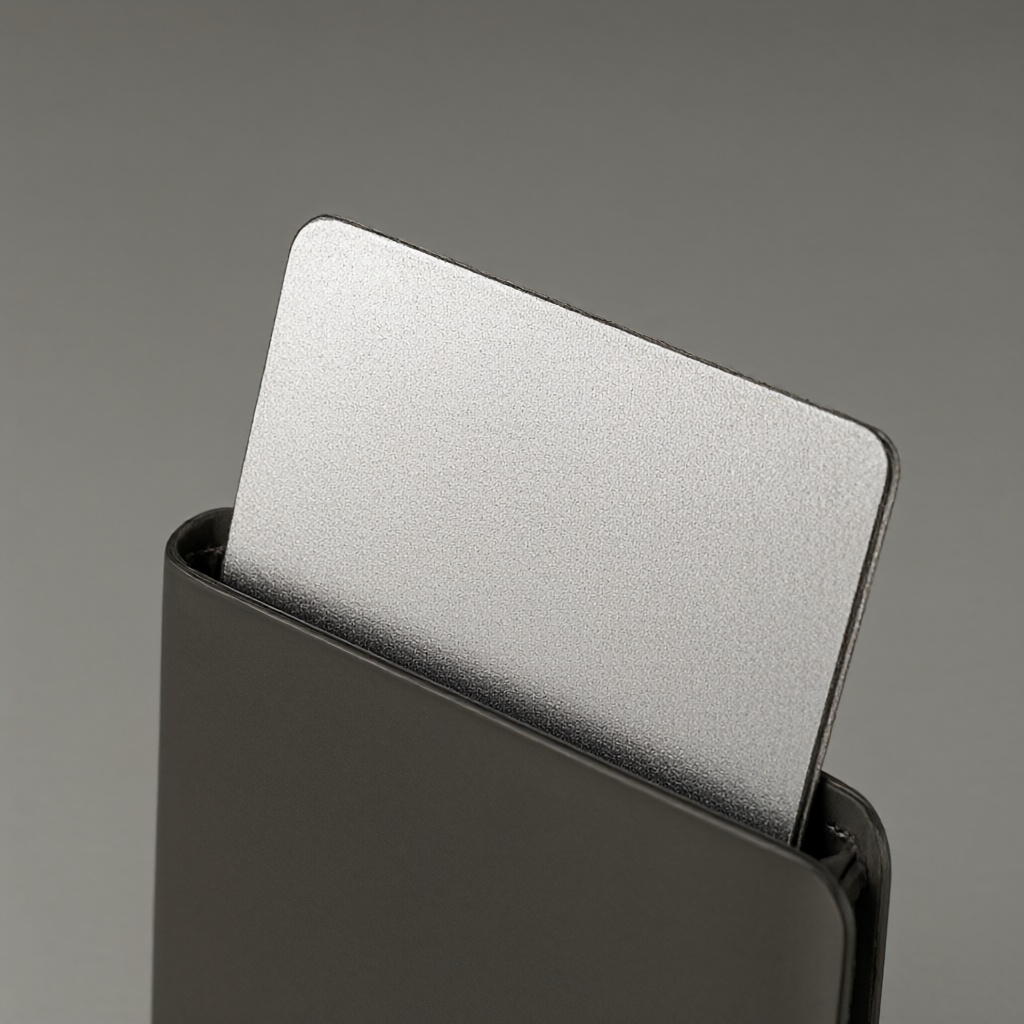
To understand how these wallets protect your cards, you need to understand what they’re protecting against. Contactless payment cards, e-passports, and many government IDs all contain microchips that communicate via radio-frequency identification (RFID) or its close relative, NFC (Near Field Communication). Both operate at 13.56 MHz — the same frequency band used in access control systems, hospital patient monitoring, and inventory tracking.
A skilled attacker with a handheld RFID reader can, in theory, scan your card from close range without physical contact. This isn’t science fiction. The U.S. Federal Trade Commission has published consumer guidance on this threat, noting that unauthorized scanners can potentially read card data if the reader is within a few inches of the target. The actual risk depends on the card issuer’s encryption level and the distance of the scanner, but the possibility exists — and it’s real enough that consumers and organizations want protection.
The Faraday Cage Principle
An RFID-blocking minimalist wallet works on the Faraday cage principle. A Faraday cage is an enclosure made of conductive material that distributes incoming electromagnetic radiation around the exterior of the cage, preventing it from reaching the interior. In practical terms, the wallet’s metal frame or conductive layers absorb and reflect the 13.56 MHz signal before it can reach the contactless chip in your card.
There are two main implementation approaches:
- Solid-metal construction (full Faraday cage). Aluminum, titanium, or steel wallets where the entire outer shell is electrically continuous. The conductive material itself acts as the shield. This is the most reliable approach because there are no gaps in the shielding layer. A full metal wallet is essentially a pocket-sized Faraday bag.
- Hybrid or layered construction. Some manufacturers use a thin RFID-blocking film or mesh laminated between card slots or inside the wallet body. This approach can work well, but it depends entirely on the quality and placement of the blocking material. Gaps, seams, or poor lamination can create weak points where signals leak through.
For B2B buyers evaluating products, the distinction matters. A solid-core aluminum wallet with CNC-machined walls provides more consistent protection than a wallet with a thin internal RFID liner, because the latter introduces potential failure points at seams and openings.
RFID vs. NFC: What’s the Difference for Wallet Buyers?
This distinction comes up frequently in buyer conversations, and getting it right matters for technical accuracy. RFID is the broader technology category. It stands for Radio-Frequency Identification and encompasses any system that uses radio waves to identify and communicate with tagged objects. NFC is a subset of RFID — specifically, it operates at the same 13.56 MHz frequency but adds two-way communication capabilities and shorter read ranges (typically under 4 cm).
Most contactless credit cards and e-passports use NFC technology, which means an RFID-blocking wallet also blocks NFC by design. The shielding works at the frequency level, not the protocol level. If a material blocks 13.56 MHz signals, it blocks both RFID and NFC applications at that frequency. This is why you’ll see both terms used interchangeably in product descriptions — they’re technically related but the distinction matters when you’re writing specifications or communicating with manufacturers about compliance.
Some wallets marketed as “RFID-blocking” actually only address low-frequency RFID (125 kHz), which is used in older building access cards, not the high-frequency 13.56 MHz used by modern payment cards. This is a critical detail for B2B buyers to verify with their supplier before placing orders.
Key Specifications: Materials, Card Capacity & Build Options
The material choice for an RFID minimalist wallet determines both the blocking effectiveness and the product’s market positioning. Here’s what buyers need to evaluate:
Material Options and Their Trade-offs
Aluminum is the most common material for budget-to-mid-tier RFID-blocking wallets. It offers good conductivity for Faraday-cage shielding, is lightweight (typically 40–80 grams for a 6-card capacity), and can be anodized in any color. CNC-machined aluminum wallets provide the most reliable shielding because the entire frame is a single continuous conductive piece. The trade-off: aluminum is softer than titanium and can scratch or dent with heavy use.
Carbon fiber sits in the premium tier. It’s not inherently conductive, so true carbon fiber RFID-blocking wallets either incorporate a conductive coating or layer a thin metal foil within the carbon fiber structure. The resulting wallet is extremely lightweight, scratch-resistant, and visually distinctive. For brands targeting the outdoor and tactical EDC market, carbon fiber builds justify higher price points. The production complexity is greater — carbon fiber requires molding and lamination rather than simple CNC machining.
Titanium is the performance tier. It’s more conductive than aluminum, significantly stronger (higher scratch and dent resistance), and lighter than steel. Titanium RFID-blocking wallets tend to be the most expensive to produce due to machining time and material cost, but they command the highest retail margins. A titanium frame provides excellent continuous shielding with minimal thickness.
Card Capacity and Form Factor
Minimalist wallets typically hold 4–12 cards, with 6–8 being the sweet spot for most adult carry patterns. The card capacity directly influences the wallet’s thickness and weight. A 6-card aluminum wallet might be 10 mm thick and 45 grams; a 12-card version could be 16 mm thick and 75 grams. Both are slim compared to a traditional bi-fold (which holds 8–12 cards at 20+ mm thick), but the difference matters for pocket carry comfort.
The spring-loaded or mechanical card ejection mechanism is another specification differentiator. Many RFID minimalist wallets include a spring or lever system that pushes the top card forward when activated, making it easy to grab your most-used card without digging through the stack. This mechanism adds complexity to the design — it requires precision stamping or CNC parts — and it’s a feature that buyers should evaluate for reliability under repeated use cycles.
What Buyers Should Look For in Build Quality?
When evaluating a sample or reviewing a manufacturer’s specifications, check for:
- Conductive continuity: In metal wallets, there should be no plastic spacers, insulating gaskets, or non-conductive separations that break the Faraday cage. Any gap in the conductive shell creates a signal leakage point.
- Card slot tightness: Cards should sit snugly. Loose slots allow cards to shift and create micro-gaps where RFID signals can penetrate.
- Thickness consistency: A quality wallet maintains uniform thickness across all card positions. Warped or uneven construction suggests poor tooling or inadequate QC.
- Ejection mechanism durability: Test the spring or lever through 500+ cycle repetitions. Cheap springs lose tension quickly, rendering the ejection feature useless within months.
For deeper guidance on material selection and sourcing evaluation, buyers should review industry resources covering men’s minimalist wallets materials specs and sourcing.
Standards & Certifications That Matter for RFID Wallets
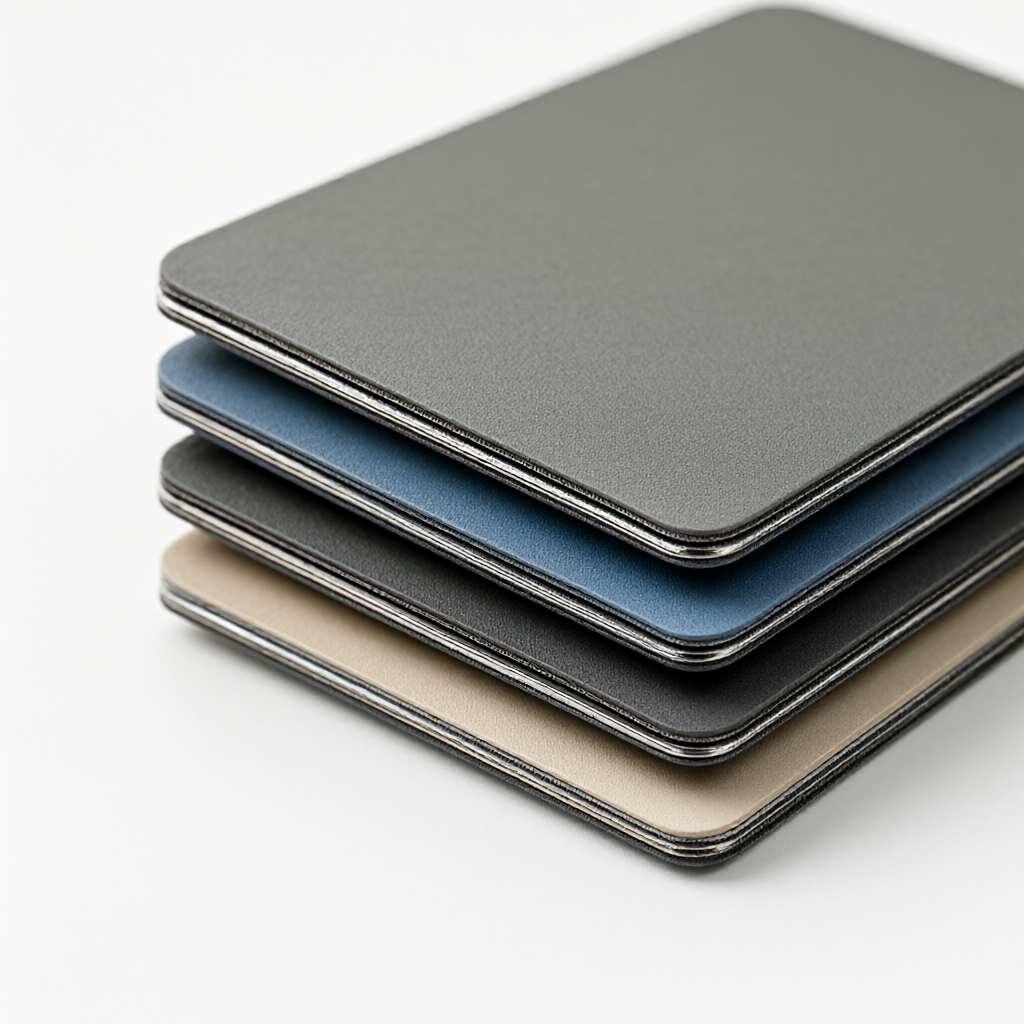
Not all “RFID-blocking” claims are equal. The market contains products with vague security assertions and products backed by verifiable testing. For B2B buyers, understanding the relevant standards is essential for evaluating supplier claims and avoiding compliance issues.
ISO/IEC 14443 — The Contactless Card Standard
The most relevant standard for RFID wallet buyers is ISO/IEC 13.56 MHz (often referenced alongside ISO/IEC 14443, which governs proximity card interface rules). This is the international standard that defines the communication protocol for contactless payment cards, e-passports, and most high-frequency RFID tags. A wallet that effectively blocks this frequency band provides protection against the vast majority of real-world scanning threats.
When evaluating a manufacturer’s claims, ask for test reports demonstrating signal attenuation at 13.56 MHz. Reputable suppliers can provide third-party lab results showing decibel reduction — typically a minimum of 20–30 dB attenuation is considered effective blocking at this frequency.
FIPS 201 and PIV Card Standards
For government and enterprise buyers, FIPS 201 (Federal Information Processing Standards Publication 201) defines personal identity verification (PIV) card requirements, including RFID security for federal employee credentials. These standards specify the cryptographic requirements for PIV cards but don’t directly regulate wallet materials. However, organizations purchasing RFID wallets for government contractors often reference FIPS 201 as part of their procurement specifications, expecting the wallet to maintain the card’s embedded security integrity.
REACH and RoHS — Material Safety Compliance
While not RFID-specific, REACH (Registration, Evaluation, Authorisation and Restriction of Chemicals) and RoHS (Restriction of Hazardous Substances) are essential certifications for any wallet entering European or North American markets. These standards regulate the use of certain hazardous materials in electronics and consumer products. Anodized aluminum, titanium, and carbon fiber composites should all comply with these regulations, and buyers should request documentation from their supplier.
The International Organization for Standardization maintains the framework for these and related standards. For authoritative reference on RFID and contactless card standards, visit iso.org.
What Certifications Don’t Guarantee?
It’s important to be honest about limitations. No wallet certification guarantees 100% signal blocking under all conditions. Even a well-designed Faraday cage has theoretical limitations at seam edges and around card insertion slots. The realistic claim is that a properly engineered RFID-blocking wallet reduces signal intensity to a level where practical reading by handheld scanners becomes infeasible — not that it creates an impenetrable barrier.
Claims of “complete RFID blocking” or “100% protection” without supporting test data should be treated as marketing language rather than a technical specification.
What Should B2B Buyers Consider When Sourcing RFID Minimalist Wallets?
Sourcing RFID minimalist wallets for private label, wholesale, or corporate gifting involves evaluating multiple dimensions beyond the basic product spec. Here’s a decision framework that separates the meaningful factors from the noise.
1. Shielding Verification
The #1 priority is verifying that the RFID-blocking claim is substantiated. Request:
- Third-party test reports showing attenuation at 13.56 MHz
- Specific decibel reduction values (20 dB+ is a reasonable benchmark)
- Test methodology (ISO, ASTM, or equivalent standard)
- Whether the test was conducted on the final assembled product or just on material samples
A supplier who cannot produce test data is a red flag. Effective shielding is not a visual property — it’s a measurable performance characteristic.
2. Material and Build Consistency
Material choice should align with your target market positioning:
| Material | Typical Price Tier | Durability | Best For |
|---|---|---|---|
| Aluminum (anodized) | Economy to mid-range | Good | Mass-market EDC, corporate gifts |
| Carbon fiber (composite) | Premium | Excellent | Outdoor/tactical brands, direct-to-consumer |
| Titanium | Premium to ultra-premium | Superior | Luxury EDC, high-margin private label |
For Amazon FBA sellers, aluminum wallets dominate the mid-price segment with strong velocity. For DTC brands targeting EDC enthusiasts, carbon fiber and titanium build higher margins and stronger brand perception.
3. Customization Capability
Private-label buyers need to evaluate the manufacturer’s customization options:
- Logo application: Laser engraving on metal is the most common and durable option. UV printing works on flat surfaces but may wear over time. Embossing is limited to softer materials.
- Packaging: Retail-ready boxes with window displays command higher shelf appeal. Check whether the manufacturer provides packaging design support or requires the buyer to supply art files.
- Card capacity variants: Offering multiple capacities (e.g., 6-card and 10-card versions) within the same product line allows buyers to test the market or target different customer segments.
- Color and finish: Anodized aluminum offers the widest color range. Titanium can be anodized for color but is more limited. Carbon fiber is typically black or gray unless coated.
4. MOQ and Lead Time
Minimum order quantities for RFID minimalist wallets typically start at 300–500 pieces for custom designs, with some manufacturers accepting lower MOQs for standard configurations. Lead times vary:
- Sample production: 5–10 days for a custom sample with logo and packaging
- Mass production: 25–45 days depending on order volume, material complexity, and customization scope
- Rush orders: Some manufacturers offer expedited production for an additional fee
For buyers testing a new product line, start with a small pilot order (300–200 units) before committing to larger volumes. This allows you to validate quality, shielding performance, and market response before scaling.
5. Quality Control Processes
A reliable manufacturer should have documented QC processes including:
- Incoming material inspection (metal alloy certificates, carbon fiber batch verification)
- In-process dimensional checks (thickness, card slot tolerances)
- Final product testing (RFID blocking verification on random samples from each batch)
- Packaging inspection (logo registration, box integrity, insert accuracy)
Ask the manufacturer to describe their QC workflow before placing an order. Vague answers like “we check everything” are not adequate.
6. Compatibility and Interference Considerations
One common buyer concern is whether RFID-blocking wallets interfere with legitimate use of contactless cards. The answer is: it depends on the wallet design and how you use it.
A properly designed Faraday-cage wallet blocks external scanning signals but also prevents the card from communicating with a point-of-sale terminal. This means you cannot tap your card while it’s inside the wallet. The practical workflow is to remove the card from the wallet before tapping — a minor inconvenience that most users adapt to quickly.
Some hybrid designs address this by creating a “shielded pocket” that blocks signals from the side and back but leaves the front face open, allowing the card to be tapped without removal. These designs are less common and require more complex engineering, but they represent an interesting middle ground for buyers who prioritize convenience alongside security.
For additional context on card holder designs and sourcing considerations, review the card holder B2B sourcing guide.
How Manufacturers Meet RFID Wallet Sourcing Standards?
After understanding the technology, specifications, and evaluation criteria, the next step is working with a manufacturer who can deliver products that meet real-world performance standards. Here is how the industry approach translates into production practice, and how our facility operates within those parameters.
At our facility, we produce RFID minimalist wallets using in-house CNC machining for aluminum and titanium frames, which ensures the conductive shell remains continuous without insulating gaps. Our ISO 9001 certified quality management system requires that every production batch includes RFID shielding verification — we test samples at 13.56 MHz and document the attenuation results before approving shipment. For carbon fiber models, we apply a conductive backing layer during the lamination process and verify electrical continuity across the finished panel.
Our BSCI audited facility and REACH/RoHS compliance documentation support procurement requirements for European and North American buyers. We handle full customization — from laser-engraved logos and anodized color finishes to retail packaging design and Amazon FBA prep — with an MOQ starts at 300 pcs per SKU for full OEM customization (100 pcs trial order available for stock finishes) and a 7-day sample lead time for custom prototypes.
Whether you’re expanding an EDC brand product line, launching a private-label collection on Amazon, or building a corporate gift program, the evaluation framework above gives you the criteria to assess any manufacturer — and the specifications to ensure the final product performs as expected.
RFID Minimalist Wallet: Where Can You Verify the Data and Sources?
- iso.org — www.iso.org
- men’s minimalist wallets materials specs and sourcing — topedcwallet.com
- card holder B2B sourcing guide — topedcwallet.com
- Get a Free Quote → — topedcwallet.com
From article to product
Building an RFID range?
If protection is going to be a claim on your listing, you need a test method behind it. We test every batch with a live 13.56 MHz reader and supply the report.
Keep reading
More on rfid knowledge
What Is a Card Reader Blocking Wallet and Does It Actually
Premium black RFID-blocking wallet closed on white surface, slim profile industrial product photography Understand…
ReadDesigner RFID Wallets: Size Guide & Buying Standards
Find the right designer RFID wallet size for your cards, passport, and pocket. Compare…
ReadRFID Card Blockers: Do They Actually Work? (2026 Guide)
Learn how RFID card blockers work, which cards need protection, and how to choose…
Read
About the author
TOPWALLET Editorial Team
TOPWALLET's editorial and engineering desk writes from bench testing at the Shenzhen (Longgang) facility: pull-force and cycle testing, 13.56 MHz shielding measurements, finish trials and factory audits, rather than supplier spec sheets. Every specification in these guides is one we write on a purchase order.
Written on the floor
This article was written by our production and QC team — the people who spec tolerances, run the finishing line and inspect every batch. Where it states a capacity, a pull force or a lead time, it comes from a measurement we made, not a supplier’s catalogue. If a number here disagrees with what your own supplier told you, tell us; several of these articles started as a correction from a buyer.
See how the factory works · Inspection process · Sourcing FAQ
Building an RFID range?
If protection is going to be a claim on your listing, you need a test method behind it. We test every batch with a live 13.56 MHz reader and supply the report.