

A true minimalist wallet strips away every pocket, compartment, and card slot you don’t use daily — leaving only the slim frame needed for your essentials (usually 4–8 cards and one folded bill). It isn’t simply a “thin bifold”; it is a deliberate design choice to reduce front-pocket bulk from 30–50 mm down to 10–15 mm while retaining durable RFID-safe construction. Below is the full field guide covering format types, material trade-offs, sizing, price bands, crypto-storage realities, and how to evaluate manufacturers before you order.
At a Glance
A minimal wallet is a slim, low-profile pocket wallet built to hold only the cards and cash you actually reach for every day — usually 4 to 8 cards and a folded bill or two. It sacrifices the bulky interior compartments of a traditional bi-fold for front-pocket convenience, reduced sag, and faster access.
The type that fits you best depends on three quick decisions:
- Front pocket? Go for a card holder or money clip — under 15 mm thick, 30–55 g.
- Back pocket? Choose a low-profile hybrid or slim bi-fold with rounded edges so it doesn’t create a “saddle” when you sit.
- Want maximum durability with minimal maintenance? Metal (aluminum, titanium, stainless steel) or carbon fiber beats leather if you carry a lot or expose your wallet to sweat and weather.
For most buyers today, a metal card holder with an elastic band hits the sweet spot: thin enough for a front pocket, rugged enough for daily abuse, and available with optional RFID-blocking layers that meet recognized testing standards.
Types & Categories
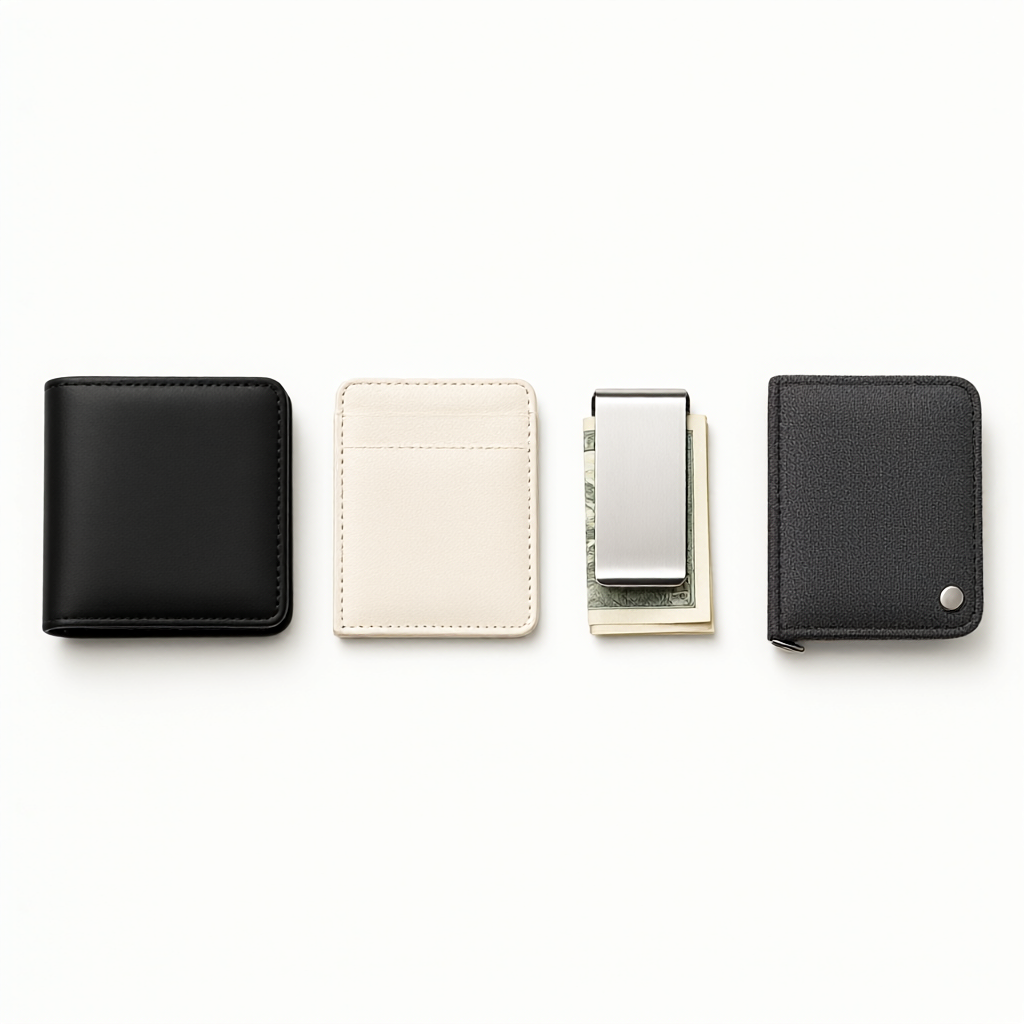
Understanding the four main categories clears up confusion before you compare materials or prices. Each format has a distinct use case.
Bifold vs. card holder — which is truly minimal?
A bifold minimalist wallet folds once but retains multiple card slots on both sides, sometimes a clear ID window, and a center bill compartment. Typical thickness runs 12–20 mm; capacity sits at 6–12 cards plus cash. These are the right choice if you still carry 10 or more cards regularly or need a visible photo-id slot, but they are heavier and bulkier than anything else on this list.
A card holder (sometimes called a slipcase or sleeve) is the thinnest form factor — often 4–10 mm unloaded and 10–15 mm loaded. It holds 4–8 cards via an elastic band, metal clip, or friction-fit design. There is no folding hinge, so there is nothing to break. This is the default recommendation for anyone transitioning from a traditional wallet to a front-pocket lifestyle.
Money clip vs. hybrid — when do I need cash?
A money clip wallet integrates a magnetic or mechanical clip for paper currency alongside a small card slot or two. Total thickness stays very low (under 12 mm), and weight is light because the clip replaces a full leather billfold. Ideal for people who use cards 90% of the time but want one folded bill accessible without unpacking a whole wallet.
A hybrid combines a card organizer with a money clip, a coin pouch, or both. You get near-card-holder thinness plus the flexibility to toss in receipts, boarding passes, or a roll of bills. Hybrids are slightly thicker (12–18 mm loaded) but remain viable for front-pocket carry if the edges are well chamfered.
Which style fits my routine?
| Daily scenario | Recommended format | Why |
|---|---|---|
| Commuting / transit | Slim card holder or hybrid | Secure against snatch-and-run; easy one-hand grab |
| Gym / outdoor workouts | Metal or carbon-fiber card holder | Sweat-proof; no leather degradation; light weight |
| Travel | Hybrid with zipped coin pocket | Holds boarding pass, hotel key, foreign cash, and cards separately |
| Business / formal office | Leather cardholder or slim bifold | Traditional aesthetic; works with dress shirts and suit pockets |
If you carry a wallet purse or crossbody bag rather than using your pants pockets, a card-sleeve style works just as well — you can swap formats freely without the same pocket-comfort constraints.
Comparison Table
This table covers the decision-relevant specs across the major wallet formats and common material pairings.
| Type | Loaded thickness | Typical capacity | Weight | Common materials | Best for | Approx. price |
|---|---|---|---|---|---|---|
| Card holder | 10–15 mm | 4–8 cards | 30–55 g | Aluminum, carbon fiber, titanium, leather | Front-pocket EDC | $20–$90 |
| Money clip | 8–12 mm | 2–4 cards + cash | 35–60 g | Aluminum, stainless steel, carbon fiber | Card-dominant carry | $25–$80 |
| Hybrid | 12–18 mm | 6–10 cards + cash/coins | 50–90 g | Mixed metals + leather trim | All-around daily | $40–$120 |
| Slim bifold | 15–22 mm | 8–14 cards + cash | 70–140 g | Full-grain leather, metal-frame | High-card-count users | $30–$150 |
All listed figures are industry-typical ranges. Actual measurements vary by brand and design.
Buying Factors
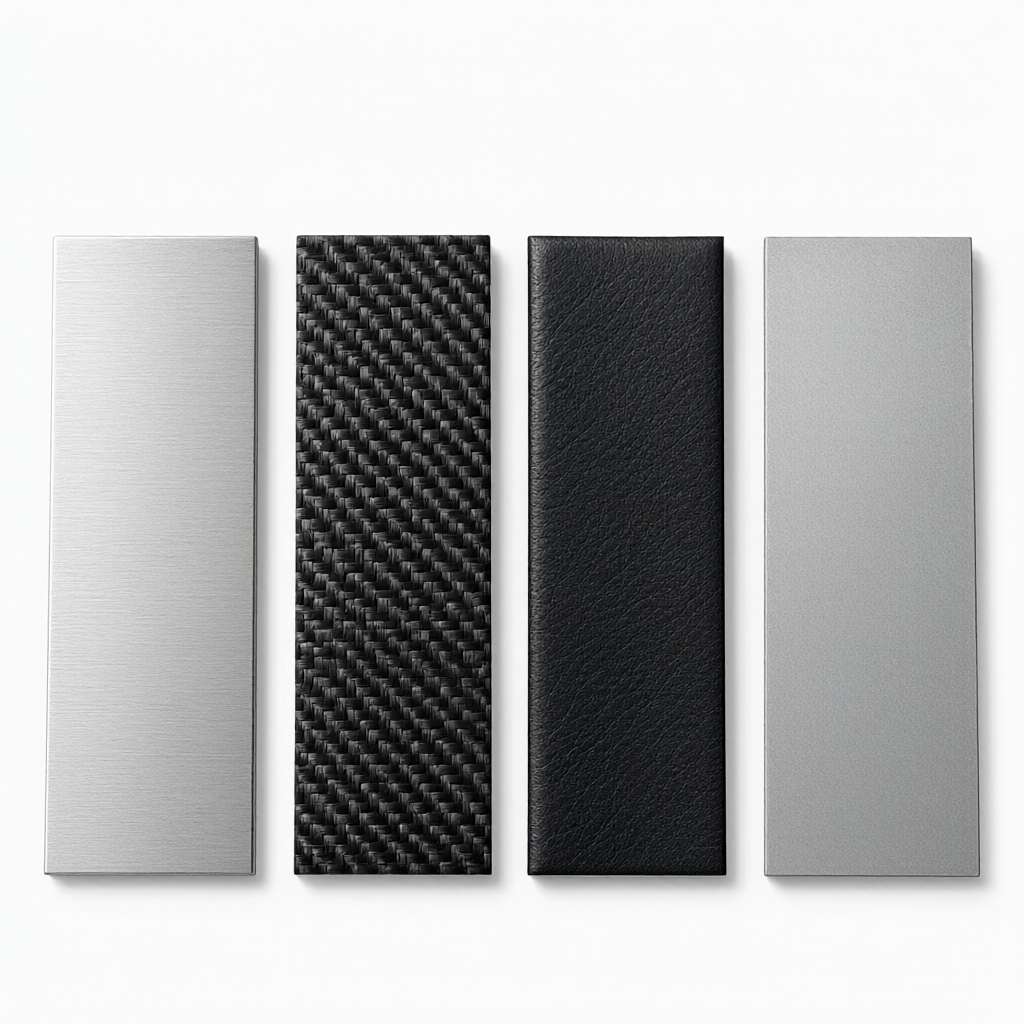
Choosing a minimal wallet comes down to four interlocking factors: capacity, material, security features, and real-world fit. Below are the specifics most buyers overlook.
How many cards should I actually carry?
Count the cards you touch in a normal week. If it’s fewer than six, a card holder is sufficient. If you routinely pull more, add a slim bifold or switch to a hybrid. Carrying nine or ten cards in a flat card holder usually forces the elastic to stretch past its comfortable limit within months — the mechanism loses tension and cards slip. That is a trade-off worth noting before you buy.
Cash usage follows the same logic. If you rarely touch paper money, skip the money-clip format altogether and save $10–$20.
Material trade-offs: aluminum, carbon fiber, titanium, leather
- Aluminum: Lightweight (~40–55 g loaded), affordable, available in anodized colors. Surface scratches show on polished finishes; bead-blasted or anodized coats hide wear better. Hardness is moderate — acceptable for normal pocket carry but not ideal if you drop it on concrete repeatedly.
- Carbon fiber: Lighter and harder than aluminum at a higher price. Resists scratching well and does not dent. The weave pattern is cosmetic over a resin base, so chips at edges are possible if subjected to sharp impacts.
- Titanium: Heavier than aluminum but significantly stronger and more corrosion-resistant. Commands a premium price and adds roughly 15–30 g compared with an aluminum version of the same footprint. Best when long-term structural integrity matters more than saving a few grams.
- Leather: Warmest feel and classic appearance; ages with patina. Full-grain leather lasts longer than bonded or top-grain alternatives. Adds thickness and weight versus metal. Requires occasional conditioning if exposed to rain or heavy sweat. Not water-resistant unless treated.
Material choice is partly aesthetic, partly functional. For cold climates or sweaty hands, metal and carbon fiber stay consistent; leather stiffens when damp and softens when dry, which changes grip and pocket feel day to day.
Does RFID protection actually work, and what verifies it?
RFID-blocking wallets contain a continuous conductive layer — usually a thin sheet of metal or metallized fabric — positioned so that radio-frequency signals from a reader cannot reach the card chip through the wallet body. Effectiveness depends on coverage area, material continuity, and frequency range.
Reputable products reference testing against widely adopted identification standards such as those published by the International Organization for Standardization (iso.org), particularly ISO/IEC 14443, which covers proximity cards used in many transit and payment applications. Blocking performance is measurable; unverified “RFID-safe” claims without a standard reference are harder to trust.
For deeper reading on card safety and protective wallet features, see our complete buyer’s guide to card-safe wallets and the RFID-protected wallets guide for men and women.
Durability and long-term ownership
Real-world durability hinges on two areas most listings ignore: the retention mechanism and edge wear.
Elastic bands in card holders stretch over hundreds of insert-remove cycles. Look for high-quality silicone or TPU elastics rated for sustained load, not cheap latex substitutes that go slack in a year. Metal springs and clamp-style retainers last longer but can snag cards if the edges are unfinished.
Edge rounding matters for pocket comfort. A chamfered or tumbled edge feels smooth after months of sliding in and out; a sharp milled edge can cut into fabric and become uncomfortable quickly. If the product page lists an edge radius or a post-processing step like tumbling or bead-blasting, assume better pocket wear.
Weight also affects perceived durability — a 45 g aluminum wallet feels less substantial than an 80 g leather bi-fold, but grams alone do not predict longevity. Material hardness, surface treatment, and retention-type engineering drive how long the wallet looks and functions after six to twelve months of daily use.
Fit for pocket type and clothing
- Front pocket jeans: Card holders and money clips designed for front carry usually sit under 15 mm thick and keep a low profile against the thigh. Avoid anything over 18 mm unless you prefer the slight lift in posture that a thicker wallet creates.
- Back pocket trousers: Slim bifolds work here because they distribute weight across the hip, but expect a small bump. Rounded corners prevent digging when seated.
- Blazer or suit jacket inner pocket: A slim card holder or a narrow leather sleeve fits cleanly without adding bulk to the chest line.
For sizing details across formats, check our wallet size width and height guide.
Price & Cost
Minimalist wallets span a wide band, and the price drivers are fairly predictable.
| Tier | Typical range | What you pay for |
|---|---|---|
| Entry | $20 – $40 | Basic aluminum or mixed-material construction; simple elastic retention; limited color options |
| Mid-range | $40 – $80 | Higher-grade alloys, carbon fiber faces, refined finishes, optional RFID shielding, branded packaging |
| Premium | $80 – $150+ | Solid titanium bodies, exotic leather combinations, precision CNC machining, warranty coverage |
Several variables move price within each tier:
- Material: Titanium runs 30–60% above comparable aluminum; carbon fiber sits roughly 15–25% above aluminum.
- Manufacturing method: CNC-machined single-block bodies cost more to tool and produce than stamped or extruded parts, but they offer tighter tolerances and fewer weak points.
- Surface finish: Anodizing, PVD coating, and bead-blasting add processing steps. Matte and satin finishes tend to mask micro-scratches better than high-gloss options, which matters for long-term appearance.
- Retained features: Integrated coin pockets, removable strap loops, and multi-layer RFID shielding add material and assembly time.
If you are hunting for a nice male wallet or a mens designer wallet under a tight budget, the entry to mid-range bracket delivers the most functional designs per dollar. For a cute wallet or card wallet women option in softer tones and smaller footprints, mid-range pricing usually secures better finishing and longer-lasting retention.
Beyond consumer retail, some buyers look at wholesale or private-label routes when outfitting teams or reselling. Our perspective on nice wallets for him and similar bulk purchases centers on MOQ flexibility and sample speed rather than discount depth — see the supplier guidance near the end of this article.
Cold wallets and decentralized crypto storage — how do they relate?
The phrase cold wallet often appears alongside EDC discussions because some buyers wonder whether a minimalist physical wallet can double as crypto storage. The answer is straightforward: a cold wallets for cryptocurrency device — such as a Ledger or Trezor unit — is a hardened hardware token that stores private keys offline. It is not a pocket card holder. A decentralized wallet refers to software that manages keys without a central service, usually on a phone or computer.
What does connect to the minimalist-pocket world is the habit of keeping a hardware crypto device and your daily card wallet together in a tactical organizer or sling. Some hybrid EDC organizers include a dedicated slot for a small hardware key fob, but that is a separate product category from a standard minimal wallet. If your priority is self-custody security, focus on the crypto hardware itself; a pocket card holder addresses card-and-cash carry.
For readers curious about broader carry organization beyond the wallet, see our money clip selection and evaluation guide for everyday carry.
Pros & Cons
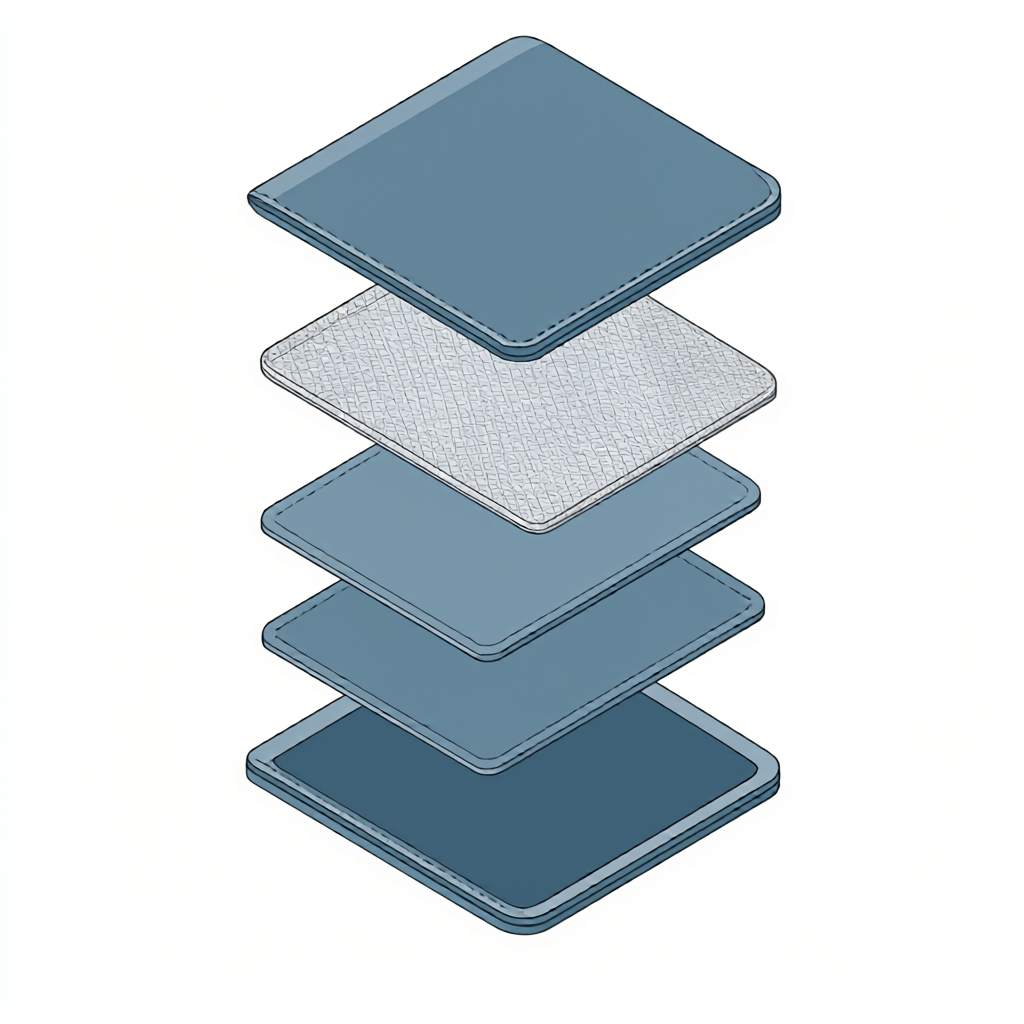
Every format carries trade-offs. Here is the honest breakdown.
Card holder
- + Thinnest option; excellent front-pocket comfort; very light.
- + No hinge to fail; retention is usually elastic or simple mechanical.
- – Limited capacity — typically maxes out at 8 cards before tension drops.
- – No dedicated cash pocket; bills must be folded or carried separately.
Money clip
- + Extremely compact; keeps cash flat and accessible.
- + Usually lighter than any card-only holder of equivalent card slots.
- – Magnetic clips can lose strength over time or demagnetize if exposed to strong fields.
- – Low card capacity by design; poor fit if you carry eight-plus cards.
Hybrid
- + One wallet handles cards, cash, and occasionally coins or receipts.
- + Flexible enough for travel and daily use interchangeably.
- – Thicker and heavier than a dedicated card holder.
- – Internal layout can become cluttered if you overfill it.
Slim bifold
- + Highest card-and-cash capacity among minimal formats.
- + Familiar access pattern for users transitioning from a traditional wallet.
- – Bulkiest option; less suitable for snug front pockets.
- – Hinge and stitching (on leather versions) represent potential failure points.
Additional Considerations
Beyond format and material, several details separate a good purchase from a regrettable one.
Gender-specific styles and fit
There is no hard rule that says metal wallets are for men or leather sleeves are for women. However, market offerings do skew in recognizable directions.
Designer wallet men selections often emphasize darker finishes, brushed textures, and angular silhouettes that pair well with workwear and outdoor gear. Mens designer wallet options in this segment tend to run slightly wider (85–90 mm) to accommodate international banknote sizes and multiple card rows.
Card wallet women styles frequently feature narrower widths (70–80 mm), thinner profiles, and softer color palettes. A wallet purse approach — a tiny card sleeve sized to fit inside a larger bag — is also popular for women who do not carry a conventional wallet at all.
Both men’s and women’s options overlap substantially in functional design; the differences are mainly dimensional and aesthetic.
Style recommendations by lifestyle
- Outdoor / trail use: Carbon fiber or titanium with a textured finish; avoid glossy coatings that grip dirt and mud.
- Office / urban commute: Brushed aluminum or stitched full-grain leather with clean lines; an anodized finish reads sharper under fluorescent lighting.
- Gym / active: Silicone-edged metal carriers that shed water and resist grip-compromising sweat.
- Travel frequent-flyer: Hybrid with a clear ID window and a separate receipt slot — saves fumbling at checkpoints.
If you want a broader overview of the minimalist category itself before narrowing down, our minimalist wallets guide: what they are and how to choose walks through the same decision framework with additional examples.
Where leather care enters the picture
Choosing leather over metal is a style call, but it also adds a maintenance obligation. Regular conditioning prevents cracking in dry climates and restores suppleness after rain exposure. For a detailed walkthrough on selecting, restoring, and maintaining a leather carry piece, refer to our leather wallet care and restoration selection guide. We also publish an overview of different types of leather wallets that breaks down full-grain, top-grain, and bonded grades so you know what the labels mean on the shelf.
Supplier Evaluation — Finding the Right Manufacturer
After you decide on format and material, the next practical question is where to buy — especially if you are sourcing for a brand, a retail run, or a corporate gift order.
Key evaluation criteria:
- Certifications: Look for ISO 9001 quality management and BSCI social-audit compliance. These indicate structured production and responsible labor practices, respectively. Materials should be tested for common restrictions; REACH and RoHS alignment is a useful baseline indicator for finished goods sold in regulated markets.
- MOQ and sample lead time: Competitive sourcing programs commonly allow trial orders around 300 units and require samples within a week so you can verify dimensions, finish, and retention feel before committing to volume.
- Customization scope: Decide whether you need logo application, custom packaging, or unique finish requirements. In-house laser engraving and UV printing streamline small-batch branding.
- Production capacity and export experience: Suppliers with multi-year export histories typically have stable QC pipelines and familiar shipping documentation processes.
- Packaging and FBA readiness: If you sell through Amazon or other marketplaces, confirm that the manufacturer can prep shipments to platform labeling and box-standards requirements.
When evaluating whether a maker can deliver a reliable base wallet for a growing brand, ask specifically about material traceability, tolerance consistency across batches, and return/replacement terms for defects discovered after sampling.
As a manufacturer operating since 2014 with an ISO 9001–certified facility and BSCI audit, we work with EDC brands, Amazon sellers, and distributors to develop custom metal wallets, carbon-fiber card holders, and money clips from concept through retail-ready shipment. Our in-house CNC machining, laser engraving, and UV printing let us move from approved artwork to a first sample in about seven days, with orders starts at 300 pcs per SKU for full OEM customization (100 pcs trial order available for stock finishes). We serve clients across North America, Europe, Australia, and Southeast Asia, and we handle everything from component sourcing to branded packaging and FBA-prep logistics. If you are comparing suppliers on capability, lead time, and certification transparency, we welcome the conversation.
Frequently Asked Questions
What makes a wallet truly minimal versus a regular slim wallet?
A truly minimal wallet limits loaded thickness to under 15 mm and capacity to around eight cards, removing redundant pockets and stiffeners. Regular slim wallets often retain multiple card rows, zip compartments, and coin pockets that add bulk without proportional utility.
How do I choose the right minimalist wallet for daily carry?
Start with your pocket type and current card count. Front-pocket users should target under 15 mm thickness and 30–60 g total weight. Pick metal or carbon fiber for durability, leather for aesthetics, and verify RFID shielding references a recognized test standard if card skimming is a concern.
What factors matter most when comparing metal, carbon fiber, and leather options?
Weight, hardness, and long-term feel dominate the comparison. Aluminum is lightest and most affordable; carbon fiber is lighter and more scratch-resistant; titanium is strongest and heaviest; leather is warmest and requires maintenance but ages gracefully. Choose based on which trait matters most for your routine.
How much does a good minimalist wallet cost?
Quality models typically land between $40 and $80 for metal or carbon-fiber card holders and hybrids. Entry-level options start near $20, while premium titanium or artisan-leather versions can exceed $100. Price tracks material grade, machining precision, surface finish, and included features like RFID shielding.
Should I buy a separate crypto cold wallet instead of integrating it into my EDC wallet?
Yes. A hardware crypto device protects private keys offline and belongs in a secure, dedicated pocket or pouch — not clamped into a card holder alongside payment and loyalty cards. Keep your daily minimal wallet for cards and cash; store your hardware token separately when not in use.
Are metal minimalist wallets safe from demagnetization and RFID skimming?
Metal wallets can block RFID signals if they incorporate a continuous conductive shield aligned with the card-chip zone, but effectiveness varies by design. Demagnetization is largely irrelevant for modern contactless and chip cards, which rely on encrypted authentication rather than magnetic stripes. Verify any RFID-blocking claim against an applicable standard rather than accepting the marketing label at face value.
Core Philosophy Behind Minimalist Wallets
The movement traces back to urban carry enthusiasts who wanted to eliminate pocket bulge, improve posture, and simplify access. The guiding principles include:
- One-hand operation — grab, flip, retrieve without undoing straps or opening multiple flaps.
- Visible inventory — elastic-band or open-slot designs let you see every card at a glance.
- Material honesty — aluminum, titanium, carbon fiber, and full-grain leather show wear honestly; synthetic laminates tend to delaminate or peel.
- Portability over capacity — if a card has sat unused for 90 days, it belongs in a drawer, not your pocket.
These principles map directly onto four major formats — card holder, money clip, hybrid, and slim bifold — each optimized for a different balance of capacity and thickness. See our wallet size width and height guide for exact dimension expectations.
Gender-Specific Options: Men’s Designer vs Women’s Card Wallets
While the underlying mechanics are identical, packaging, sizing, and aesthetic priorities diverge along gender lines in consumer markets.
Men’s designer / minimalist wallets
- Target thickness: 10–18 mm loaded.
- Common features: wider footprint for U.S./EU card sizes, ruggedized edge treatments, matte-black anodized or brushed finishes.
- Popular formats: metal card holders,钛合金 (titanium) money clips, hybrid organizers with removable straps.
- Design language: tactical, industrial, monochrome or earth-tone palettes.
Women’s card wallets & mini purses
- Target thickness: 8–14 mm loaded; narrower overall footprint.
- Common features: compact layouts, interior slip pockets for lip balm or coins, softer colorways, decorative textures (floral etching, rose-gold PVD, quilted leather accents).
- Popular formats: slim card sleeves, foldover closures with magnetic snaps, crossbody-compatible cardholders.
- Design language: refined, compact, fashion-forward without sacrificing EDC practicality.
Many modern buyers ignore the gender split entirely and select based on capacity and material alone. If you value aesthetics alongside function, check curated roundups such as our Big Skinny World Wallet buyer’s guide for crossover designs that appeal across demographics.
How to Choose the Right Minimalist Wallet for Daily Carry
Use this five-question checklist before purchasing:
| # | Question | Decision rule |
|---|---|---|
| 1 | How many cards do I touch weekly? | ≤ 6 → card holder; 7–10 → hybrid or slim bifold; > 10 → reconsider habits first |
| 2 | Do I carry cash regularly? | Often → money clip or hybrid; rarely → skip the clip mechanism |
| 3 | Where does my wallet live? | Front pocket → < 15 mm; back pocket → up to 20 mm acceptable |
| 4 | Is RFID protection required? | High-risk transit environments → yes, verify ISO/IEC 14443 claim; low risk → optional |
| 5 | What climate/weather exposure? | Sweat/rain heavy → aluminum or carbon fiber; dry indoor → full-grain leather viable |
Answering these questions eliminates roughly half the SKUs on the market before price becomes the deciding factor.
How to Get a Bitcoin / Crypto Cold Wallet If Storage Is on the List
Physical EDC wallets and crypto cold wallets serve different purposes:
- A hardware cold wallet (Ledger, Trezor, BitBox) is a dedicated tamper-resistant device that stores private keys offline. It is not integrated into a cardholder.
- A seed phrase — the 12–24 word recovery string — can be etched onto a titanium plate sold separately, then carried inside a metal wallet sleeve.
- Some niche designers produce NFC-enabled metal wallets that store encrypted key fingerprints; scanning the wallet with a paired phone reveals the stored index, not the raw private key.
If crypto self-custody is a priority, buy the hardware token independently, protect the seed phrase with an engraved metal plate, and store both in your everyday wallet organizer. Never embed private keys directly into the wallet body itself — that creates a single point of failure.
Manufacturer Evaluation & Procurement Framework
Switching from consumer advice to procurement, evaluating a wallet supplier requires checking six concrete criteria. Use this framework when contacting factories or reviewing quotations.
1. Certifications & compliance
Verify documented credentials rather than accepting marketing claims:
- ISO 9001:2015 — quality management system baseline.
- BSCI — social compliance audit for ethical manufacturing.
- REACH / RoHS — restricts hazardous substances in metals and coatings.
- Request the certificate number and expiration date; validate through the issuing body.
2. Material specifications & testing
Reputable suppliers publish alloy grades and surface-treatment specs:
- Aluminum: 6061-T6 or 7075-T6 billet preferred over cast alloys.
- Titanium: Grade 2 (commercially pure) for corrosion resistance; Grade 5 (Ti-6Al-4V) for strength-to-weight.
- Surface hardness: Anodized aluminum should meet ASTM F863 for coating adhesion and thickness verification.
- Drop survivability: Reference MIL-STD-810H Method 516.8 for procedural guidance on impact testing, even if the supplier does not formally certify to military standards.
3. Tolerance & dimensional consistency
CNC-machined single-block wallets maintain ±0.05 mm dimensional tolerance across batches. Stamped or formed parts vary more. Ask for a sample measurement report before committing to volume.
4. MOQ flexibility & sample lead time
Entry-tier manufacturers accept 300–500 pc MOQs with 7-day sample turnaround. Higher customization (laser engraving, custom packaging, PVD color matching) pushes samples to 10–14 days but preserves short mass-production runs.
5. Retention-mechanism longevity
Elastic bands should be rated for 1,000+ insertion cycles without losing >15 % tension. Metal clamp springs must pass a 50,000-cycle actuation test without permanent deformation. These numbers appear in supplier spec sheets; if absent, request test data.
6. Packaging & labeling compliance
Private-label buyers must confirm:
- Retail box dimensions match carrier requirements (e-commerce vs. brick-and-mortar shelf).
- Barcode placement follows GS1 guidelines.
- Anti-theft RFID tags (if requested) are compatible with retail EAS systems.
Here Is How We Meet These Standards
At TOP EDC Wallet, our approach to these benchmarks draws on 13+ years of export experience serving EDC brand owners, Amazon FBA sellers, and promotional distributors across North America, Europe, Australia, and Southeast Asia.
- Our 50,000 sq ft in-house factory runs ISO 9001-certified quality processes and holds a current BSCI audit. Materials used in production comply with REACH and RoHS; third-party SGS testing reports are available upon request.
- Each aluminum, carbon fiber, and titanium wallet is machined on in-house CNC equipment, allowing us to hold tight tolerances and iterate designs rapidly during the sampling phase.
- We support OEM and ODM programs starting at 300 pcs, with sample delivery in 7 days and full production runs capable of 500,000+ units per month.
- Surface finishing — bead blasting, anodizing, PVD coating, laser engraving, and UV printing — is managed under one roof, so color matches and branding details stay consistent from prototype to shipment.
- Custom packaging, retail-box design, and Amazon FBA prep are handled internally, reducing hand-off errors and keeping lead times predictable.
Whether you are developing a new minimalist aluminum wallet, exploring a carbon fiber card holder line, or adding titanium money clips to an existing catalog, our team can move from concept art to shipped inventory with clear communication at every stage.
Sources & References
- iso.org — www.iso.org
- complete buyer’s guide to card-safe wallets — topedcwallet.com
- RFID-protected wallets guide for men and women — topedcwallet.com
- wallet size width and height guide — topedcwallet.com
- money clip selection and evaluation guide for everyday carry — topedcwallet.com
- minimalist wallets guide: what they are and how to choose — topedcwallet.com
- leather wallet care and restoration selection guide — topedcwallet.com
- different types of leather wallets — topedcwallet.com
- Get a Free Quote → — topedcwallet.com
- Big Skinny World Wallet buyer’s guide — topedcwallet.com
From article to product
Sourcing minimalist-wallets?
Tell us the format, the quantity and the date you need stock. You get material options, MOQ and a landed-cost range back within one business day.
Keep reading
More on wallet types
Thin Male Wallets: Buying Guide for Slim Minimalist Picks
How to choose a slim wallet for men — thickness thresholds, material trade-offs, capacity…
ReadStashed Wallet: A Minimalist Everyday-Carry Solution
Understand what a stashed wallet is, how minimalist slim wallets work, and what to…
ReadFolding Wallets: Types, Materials & Buying Guide
Learn what makes a folding wallet worth buying, from materials and card capacity to…
Read
About the author
TOPWALLET Editorial Team
TOPWALLET's editorial and engineering desk writes from bench testing at the Shenzhen (Longgang) facility: pull-force and cycle testing, 13.56 MHz shielding measurements, finish trials and factory audits, rather than supplier spec sheets. Every specification in these guides is one we write on a purchase order.
Written on the floor
This article was written by our production and QC team — the people who spec tolerances, run the finishing line and inspect every batch. Where it states a capacity, a pull force or a lead time, it comes from a measurement we made, not a supplier’s catalogue. If a number here disagrees with what your own supplier told you, tell us; several of these articles started as a correction from a buyer.
See how the factory works · Inspection process · Sourcing FAQ
Sourcing minimalist-wallets?
Tell us the format, the quantity and the date you need stock. You get material options, MOQ and a landed-cost range back within one business day.