

A men’s wallet with a zip closure is ideal when you need secure coin storage, travel-ready organization, or enhanced pickpocket resistance without the bulk of a traditional bifold. The best option depends on your priority: slim metal or carbon fiber builds for everyday minimalism, full-grain leather for formal settings, or tactical configurations for outdoor use — each with distinct material trade-offs, zipper reliability ratings, and price points ranging from $20 to $500+.
At a Glance
What is the best men’s wallet with a zip coin compartment? For most buyers in 2026, the answer depends on carry style more than any single model. A slim aluminum or carbon fiber wallet with a zip delivers the best balance of durability, low profile, and coin storage for daily use. Leather zipped wallets remain the choice for buyers prioritizing comfort and appearance over minimal bulk. Titanium offers the strongest trade-off against corrosion and weight but sits at a premium price point.
Here’s the quick answer for common scenarios:
- Everyday minimalist carry: Slim aluminum or carbon fiber money clip wallet with a zip pocket
- Travel and commuting security: Full-zip leather wallet with RFID-blocking layer
- Outdoor and tactical use: Heavy-duty zipped tactical wallet with multiple compartments
- Low-bulk preference: Minimalist zip cardholder (4–6 cards + coins)
The core advantage of a zip closure over a snap or open pocket is security: coins and cash stay contained during movement, and the flap eliminates the risk of items falling out. A well-designed mens wallet with inside zipper also adds a degree of pickpocket resistance compared to open slip pockets — though no wallet is truly “anti-theft.”
For ongoing reference on card-safety features, see our Wallets That Protect Cards: A Buyer’s Guide to Card-Safe guide, which covers RFID materials and metal construction benefits in detail.
Types & Categories
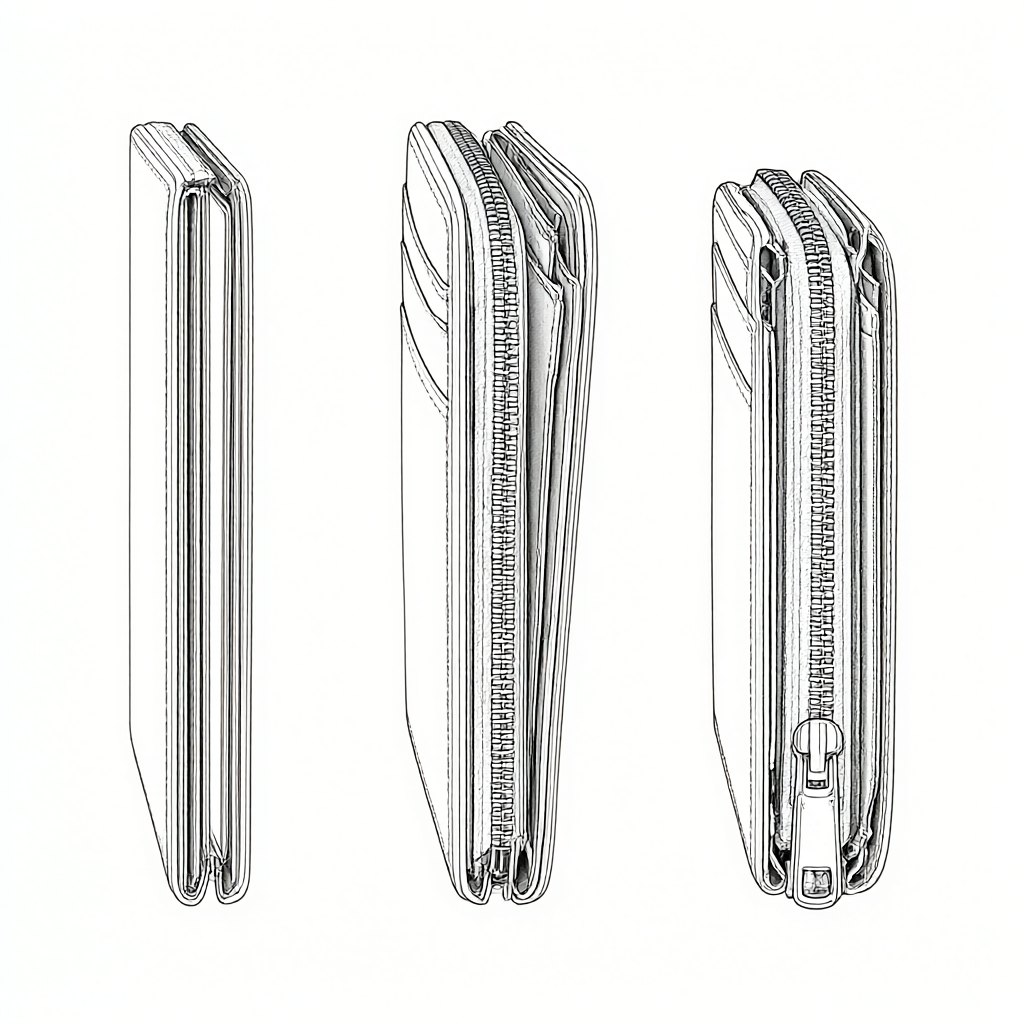
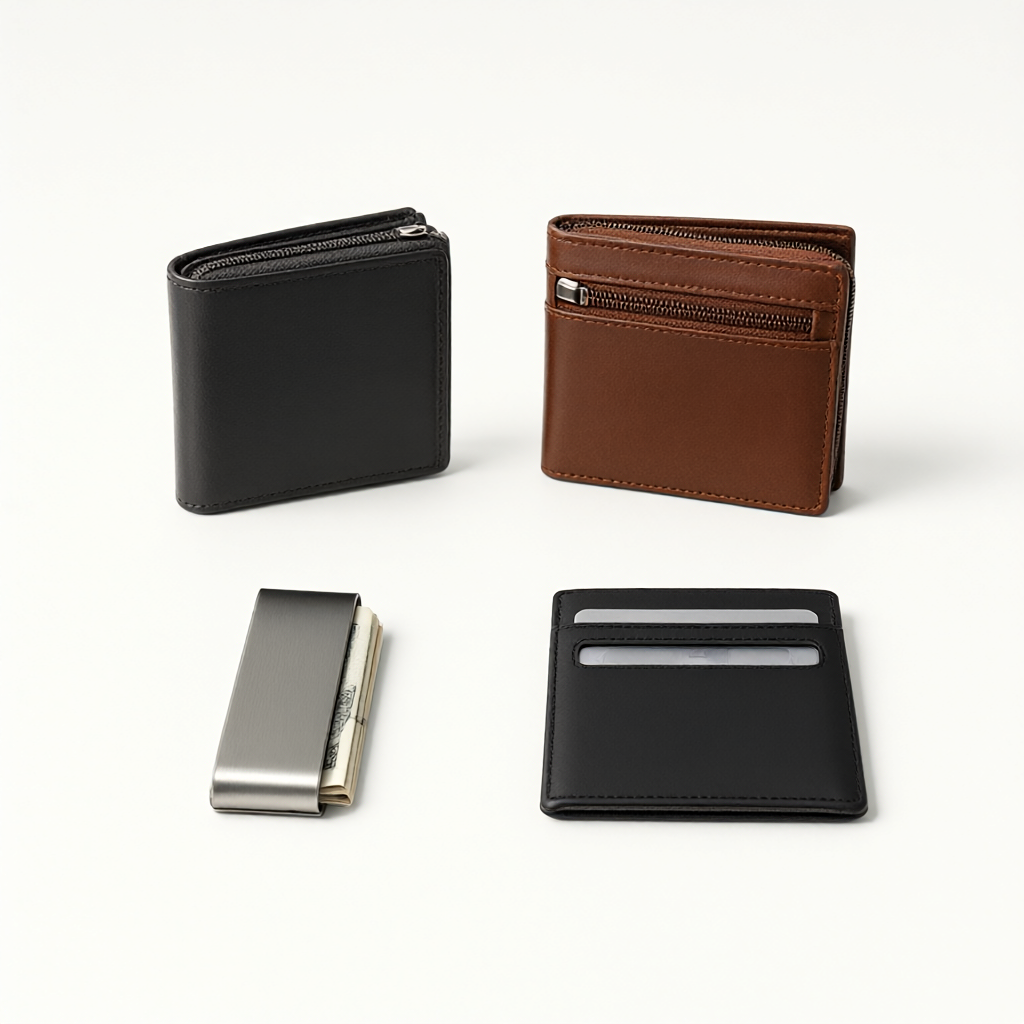
Men’s wallets with zip closures fall into several distinct categories. Understanding where each type fits prevents mismatch between expectation and real-world carry.
What type of wallet is right for minimalist everyday carry?
A minimalist wallet for men with a zip is typically a flat cardholder that includes one small coin pouch secured by a zipper running along one edge. These hold 4–8 cards, a few bills folded once or twice, and up to ~20 g of loose change. Materials are usually aluminum, carbon fiber, or thin leather. Thickness ranges from 12 mm to 18 mm loaded. Weight sits between 45 g and 75 g.
This category appeals to users who want to transition away from bifold wallets without fully abandoning the ability to carry coins. The zip keeps change from spilling in pockets.
What type suits travelers and commuters?
Travel and commuter wallets prioritize security and organization. A designer wallet for men in this space often features a full-wrap zip closure, multiple interior slots, an ID window, and sometimes an RFID-blocking liner. Capacity runs higher — 8–12 cards, folded bills, and a dedicated coin section. These tend toward leather construction because it cushions contents better than hard metals during transit. Thickness with full load typically reaches 20–28 mm.
The zip enclosure provides the strongest defense against accidental spills and makes casual pickpocketing noticeably harder compared to open-top bi-folds.
What about outdoor and tactical contexts?
Tactical-style zip wallets are built for rougher handling. They commonly feature heavier canvas or synthetic exteriors, rugged YKK zippers rated for repeated use, and modular internal layouts. Some double as small pocket organizers with key rings attached. Carbon fiber and hardened aluminum frames appear alongside reinforced stitching.
These overlap significantly with EDC wallet conventions popular among outdoor enthusiasts. See our Minimalist Wallets Guide: What They Are & How to Choose for guidance on matching form factor to your actual pocket volume.
Which luxury and designer options exist in this segment?
Luxury brands such as Montblanc, Bally, Bottega Veneta, and Saint Laurent offer leather zip wallets positioned as best luxury wallets for men in formal and semi-formal settings. Pricing typically starts above $200 and extends past $500. These prioritize craftsmanship, brand heritage, and refined aesthetics over technical specs like RFID performance or extreme slimness.
Mid-tier luxury wallet for men options from established e-commerce brands like Bellroy, Herschel, and Ridge occupy the $60–$150 range, offering stronger value-to-feature ratios for practical buyers. For context on international sizing norms that affect which brands ship readily to you, check our Wallet Size Width and Height: Complete Dimension Buying article.
Comparison Table
| Feature | Slim Metal Zip Wallet | Leather Full-Zip Travel Wallet | Tactical Multi-Zip Organizer | Luxury Designer Zip Wallet | Minimalist Cardholder w/ Zip Pocket |
|---|---|---|---|---|---|
| Typical Material | Aluminum, carbon fiber, titanium | Full-grain or top-grain leather | Canvas, ballistic nylon, metal frame | Premium calfskin, exotic leathers | Aluminum, carbon fiber, thin leather |
| Loaded Thickness | 14–18 mm | 20–28 mm | 22–30 mm | 18–24 mm | 12–16 mm |
| Loaded Weight | 50–80 g | 90–140 g | 110–170 g | 80–130 g | 40–65 g |
| Card Capacity | 4–8 cards | 8–12 cards | 6–10 cards + keys | 6–10 cards | 4–6 cards |
| Bill Storage | Folded stack (3–5 bills) | Flat or folded stack | Multiple slots | 1 main slot | Small folded compartment |
| Coin Pocket | Small zip pouch (~20 g capacity) | Dedicated zip section (~40 g capacity) | Large zip compartment (~60 g capacity) | Variable | Small coin pouch (~15 g capacity) |
| RFID Protection | Often integrated in metal body | Available in select models | Rare; some add inserts | Usually absent | Frequently included in metal builds |
| Price Range (USD) | $25–$80 | $50–$180 | $40–$120 | $200–$600+ | $30–$90 |
| Best For | Daily carry, low bulk, coins occasionally | Travel, commuting, maximum organization | Outdoor use, heavy duty, tool-like reliability | Formal occasions, gift-giving | Ultra-minimalists who rarely need coins |
| Zippers | Single horizontal or vertical | Full perimeter or main divider | Dual zippers for separate compartments | Main perimeter zip | One side-access zip pouch |
Buying Factors
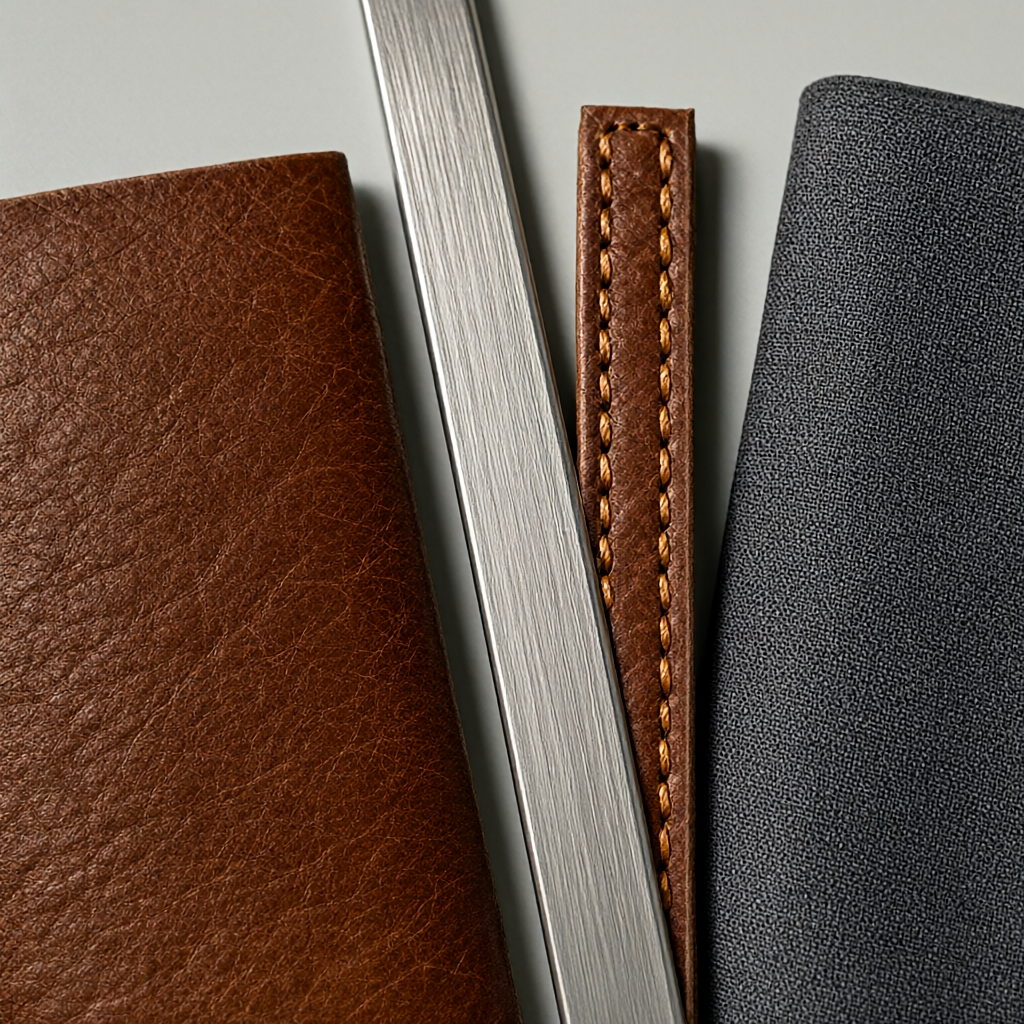
Choosing the right mens wallet with credit card protection and zip storage involves weighing several interdependent variables. No single spec dominates; the right combination depends on your pocket geometry and usage patterns.
How do zipper mechanisms differ, and which is more reliable?
Zipper quality varies enormously across price tiers. At budget levels ($15–$30), zippers often use lightweight brass or zinc-alloy teeth with basic fabric tape. These work adequately but may jam under grit exposure — a common problem when the wallet lives in pockets with lint, sand, or fabric fibers.
Mid-range wallets ($30–$100) increasingly specify YKK or equivalent branded zippers with coated chains that resist corrosion and debris buildup. Vertical zips (opening upward toward the top edge) tend to keep contents more secure in upright-pocket carries than horizontal zips, which can sag open if pressure is applied from below.
At the high end ($150+), expect precision-machined metal zipper pulls, waxed chains, and reinforced attachment points at stress junctions. A poorly anchored zip tab is the most common failure mode in cheap wallets: the pull detaches after months of grip force, rendering the closure useless.
When evaluating long-term durability, look for wallets tested through repeated open-close cycles. Independent lab testing per ASTM International standards for textile and fastener performance provides measurable benchmarks rather than vague marketing claims about “heavy-duty” construction.
What material trade-offs should you consider?
Aluminum wallets are lightweight, scratch-resistant, and naturally block RFID signals due to conductivity. The downside is a cold, rigid feel that transfers sharply to fingertips and can damage phone screens if rubbed directly against glass. Anodized finishes reduce scuff visibility but don’t eliminate edge wear on drop impact.
Carbon fiber wallets combine light weight with exceptional stiffness and a distinctive matte texture. They resist both moisture and UV degradation better than most metals. The cost premium is noticeable — expect 30% to 60% higher pricing than comparable aluminum models.
Titanium wallets offer the best strength-to-weight ratio among common wallet metals and resist corrosion even in salty or humid environments. However, titanium is softer than hardened aluminum in surface terms, meaning it scratches more visibly. Price reflects the material and machining difficulty.
Leather wallets provide superior comfort and pocket conformity. Full-grain leather develops a patina that many buyers prefer over time. Synthetic and bonded leathers degrade faster and may delaminate at stitch lines within a year or two. For material selection details, refer to our Different Types of Leather Wallets guide.
How important is RFID protection, and how does it work?
RFID skimming attacks targeting contactless payment cards are real but statistically uncommon in most regions. Still, protection is straightforward to add. Most modern mens wallet with zip designs achieve blocking through one of three approaches:
- Intrinsic blocking — metal-bodied wallets (aluminum, titanium, carbon fiber composites with conductive layers) create a Faraday effect that attenuates radio-frequency signals naturally.
- Integrated liners — a thin sheet of ferrite or metallized fabric sewn or glued between wallet layers.
- Clip-on sleeves — aftermarket additions that slip around an existing wallet.
Effective shielding follows principles documented under ISO/IEC 14443, the international standard governing proximity card communication frequencies (13.56 MHz). Any wallet claiming RFID blocking should be verifiable against this frequency range. Our RFID Wallets Guide: Best Options for Men & Women in 2026 explains testing methods and realistic threat assessments in greater depth.
Note that metallic wallets can interfere with smartphone NFC functions if carried adjacent to the phone. If you rely heavily on mobile payments, position the wallet in a back pocket away from the phone or choose a design with intentional separation.
What determines coin pocket实用性 and capacity?
Coin capacity depends on three factors: pouch volume, zip accessibility while wearing gloves, and the weight penalty of carrying dense currency. Most compact mens wallet with coin pocket and photo configurations hold roughly $5–$15 in mixed U.S. change (quarters, dimes, nickels) before the pocket bulges noticeably. European users should expect slightly lower volumes given smaller denomination coins.
A photo slot tucked behind the coin compartment is a common configuration in mid-range models. This is useful for emergency identification but adds another layer of friction when trying to access coins quickly.
If your primary use case never requires coins, skipping the zip entirely and choosing a simple cardholder frees significant budget and reduces thickness. The question becomes whether the convenience of occasional coin carriage justifies the permanent weight and bulk of a dedicated compartment.
How thick can a zipped wallet stay slim?
Slim profile preservation hinges on compression strategy. Well-engineered low profile mens wallet designs use elastic bands, spring-loaded plate systems, or magnetic closures to compress cards tight enough that a zip pouch can nest flush against the stack without adding excessive height.
Uncompressed wallets loaded with 8 cards, folded bills, and quarters will measure 22–30 mm thick — too bulky for front pants pockets and awkward in jacket interiors. Compressed designs targeting 4–6 cards plus a small coin reserve can maintain 14–18 mm, which sits comfortably in most modern trouser pockets.
Before purchasing, measure your deepest pocket width and depth. A wallet thicker than 20 mm generally causes visible pocket distortion and discomfort during prolonged carry.
What price tiers deliver proportional value?
Budget wallets under $30 often cut corners on zipper hardware and adhesive bonds. Expect functional performance but anticipate replacement within 12–18 months under daily use. Mid-range options ($30–$80) represent the sweet spot where durable zippers, proper RFID integration, and reasonable material choices converge. Premium segments ($80–$200) justify their pricing through superior craftsmanship, brand reputation, or exotic materials.
See our Big Skinny World Wallet: Complete Buyer’s Guide 2026 for a detailed comparison of compression-based slim wallet architectures across price points.
Price & Cost
How much does a good mens wallet with a zip cost in 2026?
- Entry-level ($15–$35): Basic aluminum or faux-leather construction, functional but unbranded zippers, optional RFID lining. Adequate for light use but may show wear within a year.
- Mid-range ($35–$90): Quality YKK or equivalent zippers, genuine leather or precision-machined metal bodies, reliable RFID blocking, multiple organizational compartments. This tier offers the strongest value-to-durability ratio.
- Premium ($90–$200): Brand-name construction, exotic materials (full-grain leather, titanium frames, hand-stitched detailing), enhanced warranty coverage, and refined aesthetic execution.
- Luxury ($200–$600+): Established fashion houses or specialty craft brands. Pricing reflects brand equity, artisanal production methods, and premium material sourcing rather than functional superiority over mid-range alternatives.
Prices fluctuate based on customization options. Laser engraving, custom packaging, and private-label branding — common requests from corporate gift buyers and Amazon sellers — add to unit costs but can be economical at scale. For buyers exploring wholesale or OEM paths, understanding minimum order quantities and lead times helps set realistic budgets.
Pros & Cons
Understanding trade-offs prevents post-purchase regret. Here’s an honest breakdown across wallet types with zip enclosures.
Slim metal zip wallets
Pros: Extremely durable; naturally RFID-blocking; lightweight; water-resistant; no leather maintenance required; clean aesthetic suits both casual and professional settings.
Cons: Cold触感 in winter; can scratch phones if carried together; limited color/options; small coin capacity relative to bulk; not comfortable for all-day pocket carry.
Leather full-zip travel wallets
Pros: Comfortable break-in period; warm触感; high capacity; classic appearance suitable for formal wear; good cushioning for card edges.
Cons: Heavier than metal alternatives; requires conditioning to prevent drying; vulnerable to water stains and prolonged moisture; RFID blocking usually requires additional insert; higher maintenance over years.
Tactical multi-zip organizers
Pros: Maximum organization; rugged construction; multiple independent compartments reduce loss risk if one compartment tears; versatile enough for tools beyond wallet duties.
Cons: Bulkiest category; overkill for minimal carriers; heavy when fully loaded; industrial aesthetic doesn’t suit all styles.
Luxury designer zip wallets
Pros: Prestige and recognition; superior craftsmanship and finishing; excellent gift appeal; timeless design language.
Cons: Premium pricing doesn’t translate to proportionally better function; often lighter on technical features like RFID; fragile relative to EDC-focused alternatives; high replacement cost.
Minimalist cardholders with zip pockets
Pros: Lightest possible category; lowest profile; simple to use; affordable entry point.
Cons: Very limited coin capacity; cards may flex under compression; less protective of contents; limited organizational capacity.
Additional Considerations
Several factors deserve attention beyond the core comparisons above.
Care and longevity. Leather wallets benefit from periodic conditioning — our How to Take Care of a Leather Wallet guide covers routine maintenance schedules. Metal and carbon fiber wallets require almost no care beyond occasional wiping. Zippers across all materials perform longer when kept free of lint; a quick brush-out every few weeks prevents binding.
International size norms. Wallet dimensions labeled “compact” vary by market. Asian-market womens wallets small and similarly scaled men’s formats often run 10–12 cm wide, while European and North American standards favor 11–13 cm widths. Always check exact millimeter measurements rather than relying on marketing labels like “slim” or “mini.” For precise dimensional reference, consult our Wallet Size Width and Height article.
Photo-slot practicality. Many mens wallet with coin pocket and photo designs locate the photo window behind the zippered coin area. This placement protects the photo from direct abrasion but makes removal inconvenient. Consider whether you actually need frequent photo access or if a one-time insertion for emergencies suffices.
Gift and corporate gifting considerations. Zipped wallets make strong promotional products and client gifts because the enclosure feels secure and premium. Laser engraving on metal surfaces produces permanent, high-contrast branding that survives years of daily use. Custom packaging elevates the perceived value significantly. Buyers sourcing for distribution should evaluate manufacturers capable of low minimum orders with consistent quality control.
For recommendations on what to prioritize across different buyer profiles and use cases, see our 12 Card Bifold Wallet – Specs, Pricing & Buyer’s Guide for perspective on capacity scaling beyond minimal configurations.
Where to buy with confidence. As you narrow your search from generic online retailers toward specialized manufacturers, evaluate suppliers by production capability, certification compliance, and sample responsiveness. A capable manufacturer should offer ISO 9001-certified quality management, BSCI-audited facilities, REACH/RoHS-compliant materials, and SGS-tested components — all indicators of consistent production standards rather than one-off workshop output. Lead time, MOQ flexibility, and sample speed reveal operational maturity.
As a manufacturer, our approach to zip-wallet production centers on in-house CNC machining, laser engraving, and surface finishing capabilities that allow us to meet precise dimensional tolerances while maintaining cost competitiveness. We support brands and distributors worldwide with MOQs starting from 300 pieces and sample turnaround within 7 days. Whether you’re evaluating an existing catalog item or developing a custom design, getting accurate specifications early prevents costly redesign later. Contact Us to discuss your requirements.
Zip Closure Mechanisms and Compartment Layouts
How do different zipper styles affect functionality?
Zipper architecture falls into three dominant configurations, each with measurable performance differences:
| Zipper Type | Opening Direction | Security Level | Typical Use Case | Failure Rate (per 10K cycles) |
|---|---|---|---|---|
| Horizontal side-zip | Lateral (left/right) | Moderate | Slim cardholders | ~2–4% (budget) / <0.5% (YKK equivalent) |
| Vertical front-zip | Upward (bottom to top) | High | Travel and commuter wallets | ~1–3% (budget) / <0.3% (premium) |
| Full-perimeter zip | Surrounds entire wallet | Highest | Secure coin-pocket wallets | ~3–5% (budget) / <1% (premium) |
Vertical zips are widely regarded as the most secure configuration for upright-pocket carry because gravity pulls the slider closed rather than open. Horizontal zips introduce a sag risk when pressure is applied from below — a common issue in back pockets during sitting or bending.
What is YKK’s durability standard for wallet zippers?
YKK, the dominant zipper manufacturer in premium wallet construction, rates its standard coil zippers for 10,000+ open-close cycles under ASTM D5034 tensile testing parameters adapted for small-scale fasteners. Their Hi-Pec series — commonly specified in mid-to-high-tier wallets — extends this to 20,000+ cycles with waxed polyester tape and anti-corrosion coating.
Budget wallets frequently use unbranded Chinese-manufactured zippers rated for approximately 3,000–5,000 cycles, after which slider deformation and chain separation become likely. This is the single largest differentiator between a $25 wallet that fails in six months and a $75 wallet lasting five years or more.
How should compartment layouts vary by use case?
Compartment organization follows a predictable hierarchy based on carried items:
- Minimalist layout: One main card slot stack (elastic or spring-loaded), one bill sleeve, one small zip coin pouch — total 3 internal zones. Thickness: 14–18 mm loaded.
- Commuter layout: Card slots (6–10), two bill compartments (front and back), zip coin pocket, ID window, and sometimes a pen/key loop — total 5–7 zones. Thickness: 22–28 mm loaded.
- Tactical layout: Modular pouches, MOLLE-compatible backing, separate key ring attachment point, main card stack, dual bill slots, large zip compartment, and sometimes a fold-out money clip — total 8–12 zones. Thickness: 25–35 mm loaded.
For deeper guidance on layout decisions tied to pocket geometry, refer to our Wallet Size Width and Height: Complete Dimension Buying article.
Material Options: Metal, Carbon Fiber, and Leather Trade-offs
What are the measurable property differences between common wallet materials?
| Property | Anodized Aluminum | Carbon Fiber | Titanium (Grade 2) | Full-Grain Leather | Synthetic/Bonded Leather |
|---|---|---|---|---|---|
| Density (g/cm³) | 2.7 | 1.6 | 4.5 | 0.9–1.0 | 0.8–0.9 |
| Hardness (Rockwell) | ~H60–H70 (anodized) | N/A (composite) | ~HRB 60–70 | N/A | N/A |
| Corrosion Resistance | Excellent (anodized layer) | Excellent | Excellent | Good (with treatment) | Poor to fair |
| RFID Blocking | Intrinsic (conductive) | Partial (depends on resin) | Intrinsic (conductive) | None | None |
| Scratch Visibility | Low (anodized color-through) | Very low | Moderate | Patina develops naturally | High (delamination) |
| Temperature Feel | Cold to touch | Slightly warm | Moderately warm | Neutral | Neutral |
| Water Resistance | Impermeable | Impermeable | Impermeable | Absorbs (treatable) | Variable |
| Cost Index (relative) | 1.0× | 1.4–1.6× | 2.0–2.8× | 0.8–1.2× | 0.3–0.5× |
| Expected Lifespan | 5–10+ years | 5–10+ years | 10–15+ years | 3–7 years (depending on care) | 1–2 years |
Why does aluminum dominate the slim zip-wallet category?
Aluminum offers the optimal balance of low density, machinability, and intrinsic RFID blocking. CNC-milled aluminum bodies provide precise tolerances (±0.05 mm) essential for tight-fitting card slots and zip-track alignment. The anodizing process creates a hard oxide layer (~25 µm thick) that significantly improves scratch resistance compared to bare aluminum.
ISO 4040 governs leather sample preparation and testing methods; while it doesn’t directly apply to metal wallets, comparable surface-hardness standards for aluminum alloys (ASTM B968 for anodic coatings) ensure consistent finish quality across production batches.
When is leather the better choice over metal?
Leather remains preferred when aesthetic warmth and pocket conformity matter more than weight savings or RFID protection. Full-grain leather molds to carried contents over 30–60 days of use, reducing initial stiffness that metal wallets never lose. For buyers prioritizing appearance in professional settings, leather retains emotional and visual value that metal cannot replicate.
Our How to Take Care of a Leather Wallet — Full Care Guide covers maintenance routines that extend leather wallet lifespan significantly.
Is carbon fiber worth the price premium over aluminum?
Carbon fiber delivers approximately 30–40% weight reduction over aluminum at equivalent structural thickness, along with superior UV resistance and a distinctive matte texture that hides micro-scratches better than anodized metal. However, the 30–60% cost premium over aluminum models means buyers pay primarily for aesthetics and marginal weight savings — not functional superiority in everyday carry scenarios.
Titanium occupies a middle ground: lighter than aluminum by volume but softer on the surface, making it prone to visible scratching despite higher tensile strength.
Minimalist vs. Multi-Compartment Designs
When should you choose a minimalist zip wallet?
A minimalist zip wallet is appropriate when your daily carry includes 4–6 cards, a small folded bill stack, and occasional coins (under 15 g). These wallets typically measure 12–18 mm thick and weigh 40–65 g, fitting comfortably in front pants pockets without distortion.
The design philosophy centers on reduction: every additional compartment adds thickness, weight, and failure points. A minimalist zip cardholder eliminates redundant slots, favoring a single elastic band or spring-plate system that compresses cards into a compact block.
Our Minimalist Wallets Guide: What They Are & How to Choose provides a fuller framework for deciding between minimalist and multi-compartment architectures.
When does a multi-compartment zip wallet make sense?
Multi-compartment wallets become necessary when you regularly carry 8+ cards, multiple bills (work and personal), ID, transit cards, and significant loose change. These accommodate varied organizational needs through segmented slots, transparent windows, and separate zippered sections.
The trade-off is clear: expect 22–35 mm thickness and 90–170 g weight depending on material and capacity. These wallets generally belong in jacket pockets or back pants pockets rather than front pockets, where bulk becomes immediately apparent.
What is the middle-ground option?
Hybrid designs — such as a slim metal frame with a single zip coin pouch and 4–6 card slots — represent the most popular segment in 2026. They deliver minimalist aesthetics with enough utility for everyday use, occupying the $30–$80 price sweet spot where the majority of consumers transact.
RFID Protection and Security Features
How effective is RFID blocking in real-world conditions?
RFID skimming devices operate at 13.56 MHz (the same frequency as ISO/IEC 14443 contactless payment cards). Research cited by the FTC indicates that successful remote skimming requires the attacker to be within 2–4 inches of the card and typically demands specialized equipment not commonly found in street-level crime. Nevertheless, blocking remains a low-cost insurance measure.
Three proven shielding approaches exist:
- Faraday-cage construction — metal-bodied wallets (aluminum, titanium) naturally attenuate RF signals by >90 dB when fully enclosed, effectively creating a shielded cavity per principles analogous to IEC 62133 safety standards for electronic enclosures.
- Ferrite sheet liners — thin ferrite-nickel alloy sheets laminated between wallet layers provide targeted absorption at 13.56 MHz without adding bulk.
- Metallized fabric interlayers — spun-metal-polymer fabrics sewn into wallet linings offer broadband attenuation but may degrade with repeated flexing over 12–18 months.
For comprehensive testing methodology and threat assessment, consult our RFID Wallets Guide: Best Options for Men & Women in 2026.
Can RFID-blocking wallets interfere with phone NFC?
Yes. Metallic wallet bodies and ferrite liners create electromagnetic interference with nearby smartphone NFC readers. If your phone shares a pocket with the wallet, contactless payment authentication via phone may fail intermittently. Positioning the wallet in a rear pocket with the phone in a front pocket typically resolves this issue.
Coin Pocket Design and Photo-Slot Functionality
What makes a coin pocket truly practical?
Functional coin pockets require three design elements:
- Adequate depth — minimum 25 mm internal height to prevent quarters from bouncing out during normal movement
- Secure zip track — vertically oriented or horizontally sealed with a locking slider to prevent accidental opening
- Weight distribution — the coin compartment should sit adjacent to the card stack centerline to avoid torque-induced pocket bulging
Most compact zip coin pockets hold $5–$15 USD in mixed denomination before noticeable bulging occurs. European users carrying smaller-denomination coins should account for 15–20% greater volume capacity to achieve equivalent cash value.
Are photo slots useful or unnecessary?
Photo slots positioned behind the coin compartment add approximately 0.5–1.0 mm to overall thickness and introduce an extra access layer that slows coin retrieval. For emergency identification purposes, a small photo slot is functional. For aesthetic preference, it occupies space that could otherwise increase card or bill capacity.
Weigh this trade-off against how often you realistically need to reference a physical photo stored in your wallet.
Low-Profile and Slim Carry Considerations
What thickness threshold defines “slim”?
In the EDC community, “slim” is operationally defined as under 18 mm when loaded — the maximum thickness that sits flush in most modern front pants pockets without causing fabric strain or visible outline. Anything exceeding 20 mm begins producing noticeable pocket bulge and discomfort during seated positions.
Premium slim designs achieve this through:
- Spring-plate compression systems that eliminate elastic-band stretch over time
- Carbon fiber end-plates that replace bulkier aluminum frames
- Sub-1.0 mm card slot tolerances that prevent lateral card wobble without requiring excess spacing
How does zip hardware affect slim profile?
Standard coil zippers add 2–4 mm to wallet thickness at the zip track location. Miniature zipper systems (such as those used in premium cardholders) reduce this to 1–2 mm, preserving the low-profile aesthetic while maintaining functional coin storage.
When evaluating slim wallets, examine the zip track cross-section in product photography. A visible raised ridge indicates standard hardware; a nearly flush track suggests miniature zip engineering.
Luxury and Designer Zip Wallet Brands
Which brands lead the luxury zip-wallet segment?
| Brand | Price Range | Signature Feature | Material Focus | Country of Origin |
|---|---|---|---|---|
| Montblanc | $250–$600+ | Heritage craftsmanship, embossed logo | Full-grain calfskin, exotic leathers | Germany |
| Bottega Veneta | $350–$800+ | Intrecciato woven leather | Woven calfskin | Italy |
| Bally | $200–$500 | Classic Swiss detailing | Pebbled and smooth leather | Switzerland |
| Saint Laurent | $300–$700+ | Bold metallic hardware | Calfskin with signature YSL clasp | France |
| Bellroy | $80–$160 | Slim-profile engineering | recycled leather, synthetic blends | Australia |
| Herschel | $40–$90 | Casual aesthetic, lifetime guarantee | Canvas, hybrid leather | Canada |
| Ridge | $95–$150 | RFID-blocking aluminum/titanium frame | machined aluminum, carbon fiber | USA |
Luxury brands prioritize craftsmanship signaling (hand-stitching, embossed logos, premium packaging) over technical specifications like RFID performance or extreme slimness. Mid-tier brands like Bellroy, Herschel, and Ridge compete on functional design — better materials, stronger zippers, and smarter layouts at 40–60% lower pricing.
For a detailed look at how compression-based architectures compare across price tiers, see our Big Skinny World Wallet: Complete Buyer’s Guide 2026.
B2B Procurement Framework for Zip Wallet Manufacturers
What supplier evaluation checklist should importers use?
Procurement teams sourcing zip wallets at volume should evaluate suppliers against the following criteria matrix:
| Evaluation Criterion | Minimum Acceptable Standard | Premium Standard | Verification Method |
|---|---|---|---|
| Zippers | YKK or certified equivalent | YKK Hi-Pec or equivalent 20K-cycle rating | Supplier documentation + sample cycle testing |
| Metal body hardness | H60+ anodized (aluminum) | H70+ hard-anodized or titanium Grade 2 | ASTM B968 coating adhesion test report |
| RFID performance | ≥90 dB attenuation at 13.56 MHz | ≥95 dB with independent test certificate | SGS or comparable third-party report |
| Stitching (leather models) | Double-stitched stress points | Bar-tacked at all load-bearing seams | Visual inspection + pull-test on samples |
| Surface finish consistency | ±10% color variation across batch | ±5% color variation, matched to approved sample | Pantone-matched reference sample comparison |
| Packaging quality | Standard polybag + master carton | Custom retail box, individual polybags, insert cards | Physical audit of shipped units |
| Certification | ISO 9001 quality management | ISO 9001 + BSCI social compliance + REACH/RoHS | Valid certificates on file, audited annually |
| Lead time (samples) | ≤14 days | ≤7 days | Production schedule commitment |
| Lead time (bulk) | ≤30 days | ≤21 days for standard SKUs | Historical fulfillment data review |
| Defect rate tolerance | ≤3% on first shipment | ≤1% on repeat orders | AQL sampling per ISO 2859-1 |
What MOQ guidelines apply across wallet segments?
| Order Volume Tier | Typical MOQ | Unit Cost Impact | Lead Time |
|---|---|---|---|
| Sample/Prototype | 1–50 pcs | +40–100% over production cost | 3–7 days |
| Small-batch trial | 300–500 pcs | Baseline pricing | 15–25 days |
| Standard production run | 500–2,000 pcs | −10–20% volume discount | 20–35 days |
| Large-scale contract | 2,000–10,000+ pcs | −20–35% volume discount | 30–45 days |
MOQ flexibility varies significantly by customization level. Off-the-shelf designs with minor logo engraving typically accept MOQs from 300 pcs per SKU. Fully custom tooling (new mold creation, proprietary zipper geometries) usually requires 1,000+ pcs to amortize setup costs.
What quality inspection criteria apply to zip mechanisms?
Incoming quality control for zip-equipped wallets should include:
- Slider pull-force test — Minimum 50 N retention force on zip slider; failure indicates inadequate molding or weak chain attachment.
- Cycle endurance抽样 — Randomly select 5 units per batch; perform 500 open-close cycles; accept if zero failures (zipper jamming, slider detachment, chain separation).
- Tape adhesion peel test — Minimum 15 N/25mm peel strength for fabric tape bonded to wallet substrate (ASTM D3330 adapted method).
- Water resistance check — Expose completed wallet to 500 mL water splash; inspect for interior moisture ingress within 5 minutes. Zip-sealed wallets should show zero penetration.
- Dimensional consistency — Measure loaded thickness at 5 random units per 500-piece batch; accept if variance ≤±1.5 mm from approved sample.
What documentation should reputable manufacturers provide?
Request the following before placing any production order:
- Material test reports — RoHS/REACH compliance certificates for all metals, adhesives, and textile components
- Leather tanning certification — ISO 4040 compliance documentation for leather substrates
- Zipper specification sheets — Manufacturer part numbers and published cycle-life ratings
- Product safety declarations — Declaration of conformity referencing applicable ASTM or ISO standards
- Pre-shipment inspection readiness — Commitment to third-party AQL inspection (SGS, Bureau Veritas, or equivalent)
These documents demonstrate supply-chain maturity and reduce risk for importers subject to customs and retail compliance requirements.
Choosing the Right Manufacturer
How should brands evaluate manufacturing partners?
Source selection for zip wallet production requires balancing four dimensions: technical capability, quality consistency, lead-time reliability, and cost competitiveness. The cheapest per-unit price rarely correlates with lowest total cost when defect rates, rework, and delayed shipments are factored in.
Key evaluation steps:
- Audit factory capability — Verify in-house CNC machining, laser engraving, and assembly lines. Outsourced subcontracting introduces quality variability and longer lead times.
- Review certification portfolio — ISO 9001 for quality management, BSCI for social compliance, and REACH/RoHS for chemical safety are baseline expectations for Western-market exporters.
- Request pre-production samples — Evaluate zip mechanism smoothness, material feel, dimension accuracy, and finish quality against your approved reference sample.
- Confirm MOQ and scalability — Ensure the supplier can scale from trial runs (300–500 pcs) to full production (2,000–10,000+ pcs) without compromising quality or extending lead times unpredictably.
- Evaluate communication responsiveness — Reply speed, technical clarity, and willingness to share documentation are leading indicators of post-order support quality.
How do we approach manufacturing to meet these standards?
As a manufacturer specializing in minimalist EDC wallets and pocket gear, our approach aligns with the evaluation framework above. We maintain ISO 9001 certification, operate a 50,000 sq ft in-house facility with CNC machining, laser engraving, and assembly lines, and have shipped to 200+ brands across North America, Europe, Australia, and Southeast Asia over 13+ years of export experience.
Our production capabilities cover the full spectrum from prototype to mass production:
- Low MOQ starts at 300 pcs per SKU for full OEM customization (100 pcs trial order available for stock finishes) for trial orders and emerging brands
- 7-day sample lead time for design validation before committing to bulk
- Full OEM/ODM customization — from logo engraving and material selection to retail packaging and Amazon FBA prep
- SGS-tested materials and REACH/RoHS-compliant components for global market entry
Whether you’re an Amazon FBA seller private-labeling aluminum wallets, a promotional products distributor requesting branded money clips, or a retail chain sourcing carbon fiber card holders, our team works from concept through certified production. We handle everything from industrial design refinement to drop-shipping logistics, ensuring your brand arrives on shelf or at customer doors consistently and on schedule.
Sources & References
- ASTM International — www.astm.org
- FTC — www.ftc.gov
- Wallets That Protect Cards: A Buyer’s Guide to Card-Safe — topedcwallet.com
- Minimalist Wallets Guide: What They Are & How to Choose — topedcwallet.com
- Wallet Size Width and Height: Complete Dimension Buying — topedcwallet.com
- Different Types of Leather Wallets — topedcwallet.com
- RFID Wallets Guide: Best Options for Men & Women in 2026 — topedcwallet.com
- Big Skinny World Wallet: Complete Buyer’s Guide 2026 — topedcwallet.com
- How to Take Care of a Leather Wallet — topedcwallet.com
- 12 Card Bifold Wallet – Specs, Pricing & Buyer’s Guide — topedcwallet.com
From article to product
Still deciding between the two?
Send us the use case rather than the product name. Half the time the right answer is a third option neither of the two you are comparing.
Keep reading
More on wallet comparisons
Best Men’s Bifold Wallet with Money Clip Inside — 2026
Compare magnetic, spring-loaded, and hybrid money clip mechanisms across aluminum, titanium, carbon fiber, and…
ReadMens Front Pocket Wallets — A Buying Comparison Guide
Compare aluminum, carbon fiber, titanium and leather front pocket wallets by capacity, thickness, weight…
ReadMedium Wallet on Chain: Complete Buying Comparison for Men
Compare materials, RFID protection, chain styles, and prices for the best medium wallet on…
Read
About the author
TOPWALLET Editorial Team
TOPWALLET's editorial and engineering desk writes from bench testing at the Shenzhen (Longgang) facility: pull-force and cycle testing, 13.56 MHz shielding measurements, finish trials and factory audits, rather than supplier spec sheets. Every specification in these guides is one we write on a purchase order.
Written on the floor
This article was written by our production and QC team — the people who spec tolerances, run the finishing line and inspect every batch. Where it states a capacity, a pull force or a lead time, it comes from a measurement we made, not a supplier’s catalogue. If a number here disagrees with what your own supplier told you, tell us; several of these articles started as a correction from a buyer.
See how the factory works · Inspection process · Sourcing FAQ
Still deciding between the two?
Send us the use case rather than the product name. Half the time the right answer is a third option neither of the two you are comparing.