

The best men’s leather wallet combines the right leather grade, an optimized thickness profile, sufficient card capacity, and a design that matches your daily carry routine. Full-grain and Saffiano leathers lead the category because they deliver durability and thin profiles simultaneously. When fully loaded, aim for 0.3 to 0.6 inches of thickness; anything thicker creates pocket bulge and drives users away from back-pocket carry. Six to ten card slots represent the practical sweet spot, while RFID shielding adds a useful security layer for frequent travelers. Below is a complete breakdown of every spec that matters — from tanning chemistry to finish tolerances — so you can choose with confidence.
What Is the Best Men’s Leather Wallet?
The best men’s leather wallet uses full-grain or Saffiano leather, holds 6–12 cards comfortably, sits between 0.3 and 0.6 inches thick when loaded, and matches the buyer’s daily carry habits — front pocket, back pocket, or magnetically clipped cash. Full-grain develops a patina and lasts the longest; Saffiano resists scratches and stains while staying thin. A slim profile is the single biggest upgrade most buyers can make, because pocket fit determines whether the wallet stays in rotation or gets abandoned after a month.
How Leather Grades Actually Work
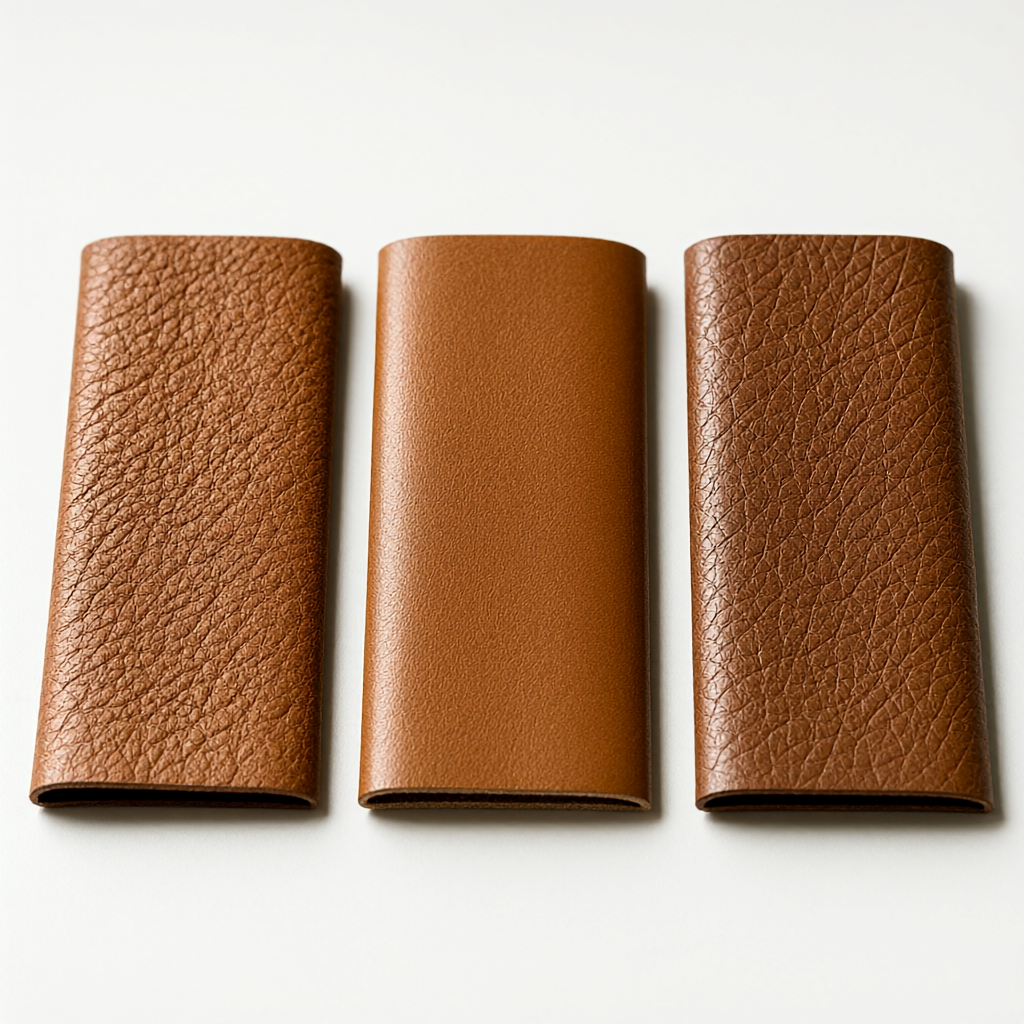
Leather grade is the first fork in the road, and buyers often confuse marketing language with substance. Here is how the grading scale breaks down in practice.
Full-grain leather is the top tier. It retains the complete grain layer — the densest, most durable part of the hide — and receives little surface sanding or coating beyond the finish. Full-grain is thin, strong, and ages beautifully, developing character rather than cracking. It also costs more upfront because yield per hide is lower and finishing labor is higher.
Top-grain leather has been lightly sanded or buffed to remove minor blemishes, then coated with a pigment or polymer finish. This makes it more uniform and stain-resistant but slightly less breathable than full-grain. Top-grain is the sweet spot for many buyers: good durability, cleaner appearance out of the box, and a fair price.
Genuine leather is a legally permissible term but not a quality guarantee. In the wallet space it often means split leather bonded with adhesive or a heavy synthetic overlay. These wallets tend to delaminate, peel, or lose shape within a year or two. Genuine leather wallets exist at every price point, which is why the label alone tells you almost nothing about longevity.
Saffiano leather is a treated finish — usually applied to calfhide — characterized by a cross-hatch texture created under heat and pressure. The result is highly scratch-resistant, water-repellent, and low-maintenance. Saffiano does not develop a traditional patina; instead it stays consistent over time. For buyers who want a wallet that looks new five years later without conditioning, Saffiano is one of the strongest options available.
When evaluating any leather wallet, check the lining material too. Cheap polyester linings trap moisture against the leather; natural fibers like cotton or lambskin backing extend the life of the interior pocket.
Why Thickness and Profile Matter More Than You Think
A wallet’s unloaded thickness is one number. Its loaded thickness — how much it bulges with cards and cash — is what determines comfort. Most well-made men’s leather wallets sit between 0.3 and 0.6 inches thick when fully loaded. Anything above 0.75 inches will create a visible bump in fitted trousers and encourage front-pocket switching, unless the buyer specifically prefers a heavier back-pocket carry.
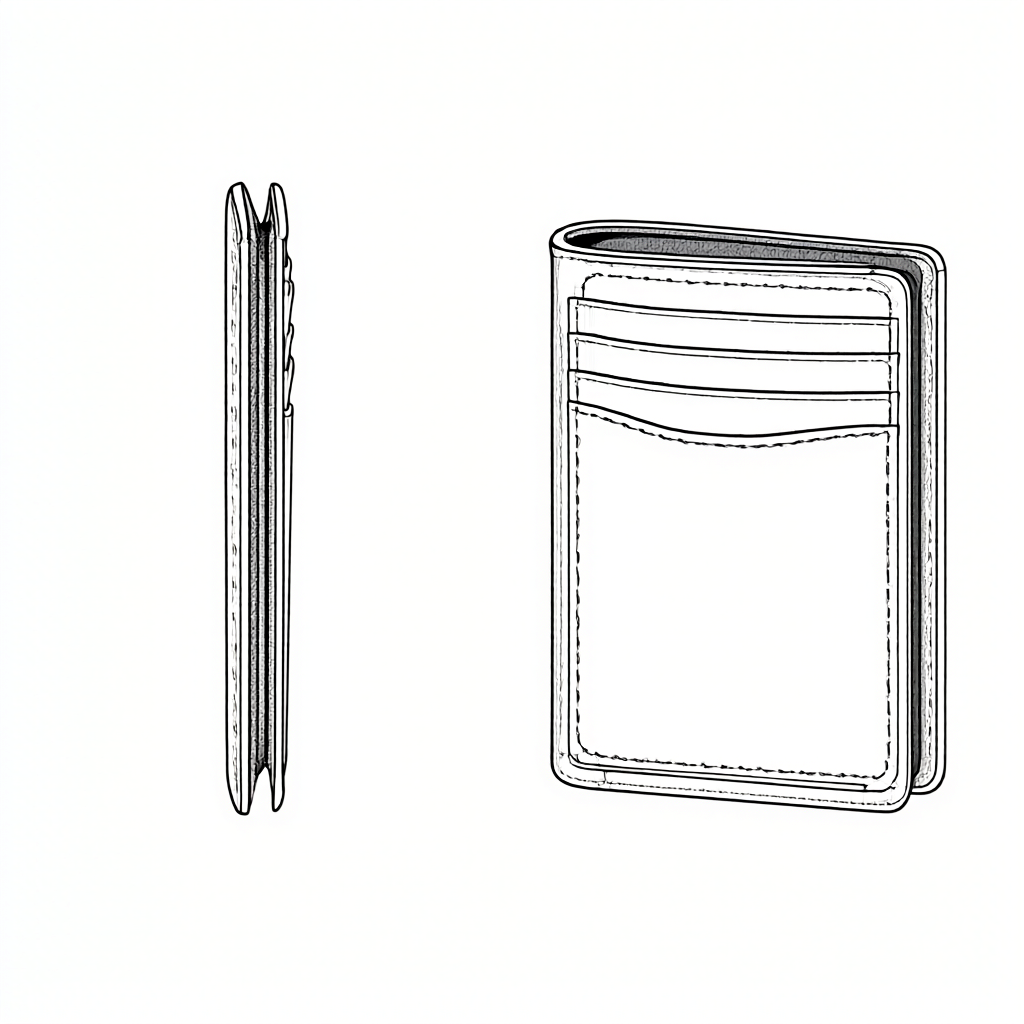
Slim wallets for men typically use a straight-panel or accordion-card-slot design rather than a folded bi-fold construction. That structural choice eliminates the bulk created by the folded leather spine and keeps the overall package flat against the body. Money clip combinations further reduce thickness by replacing a cash compartment with a thin steel or titanium strap. If you want a complete reference on minimalist-style carry, see our minimalist wallets guide for design trade-offs across formats.
Profile decisions also interact with pocket type. Front-pocket carriers benefit most from slenderness and rounded edges. Back-pocket users can tolerate a slightly thicker bi-fold but risk uncomfortable sitting pressure over time. Belt-loop attachments and EDC pouches open up different carrying options entirely.
Key Specifications to Compare Before Buying
When narrowing a shortlist, run every candidate against these specifications:
| Spec | Typical good range | What affects it |
|---|---|---|
| Unloaded thickness | 0.15 – 0.35 in | Design style, card slot count, material density |
| Loaded thickness | 0.30 – 0.60 in | Card volume, cash fold method, pocket type |
| Card capacity | 4 – 16 slots | Buyer habit, wallet style, organization preference |
| Cash storage | Clip, strap, or zip compartment | Minimalist vs traditional carry |
| Closure | Snap, magnet, strap, none | Security vs speed of access |
| Weight | 1.5 – 4 oz | Material, hardware, construction complexity |
| Leather grade | Full-grain or Saffiano preferred | Durability, maintenance, cost |
Card capacity deserves special attention because oversizing is the most common mistake. A wallet advertised as holding 20 cards may physically accommodate that number, but inserting and retrieving individual cards becomes frustrating long before capacity is reached. Six to ten cards is the practical sweet spot for most daily-carry users. For a deeper look at how card-slot layout affects usability across slim formats, compare strategies in our good money clip wallets for men buying guide.
RFID-blocking technology is another spec that separates marketing noise from real utility. Modern contactless payment tokens are shorter-range than older cards, reducing the practical threat of remote skimming in most everyday environments. Still, buyers who travel frequently, attend crowded events, or simply prefer layered security benefit from an integrated RFID shield. Our buyer’s guide to card-safe wallets explains how shielding layers work and where they fit into a broader card-protection strategy.
Standards That Apply to Leather Wallet Manufacturing
Quality control in leather goods covers material safety, labeling accuracy, and chemical compliance. Two frameworks are especially relevant:
- The FTC Care Labeling Rule governs textile and leather product identification in the United States. Under FTC guidelines, the country-of-origin label must accurately reflect where the product was manufactured or substantially transformed, and material composition claims should not mislead consumers. (Federal Trade Commission —Consumer Protection)
- ISO 9001 is the internationally recognized quality management standard. Manufacturers operating under ISO 9001 maintain documented processes for incoming material inspection, in-process quality checks, and final product release — practices that translate directly into fewer defective lots and more consistent leather grading. (International Organization for Standardization)
Buyers sourcing wholesale or custom orders should verify these certifications and request test reports for restricted substances, such as REACH compliance documentation for chromium VI levels in tanned leather. ASTM standards also provide testing methods for physical properties like tensile strength and abrasion resistance, though these are generally referenced by manufacturers rather than printed on consumer packaging. See our breakdown of leather wallet manufacturing materials and processes for context on how sourcing decisions flow into finished product consistency.
Related Considerations: Accessories and Design Variants
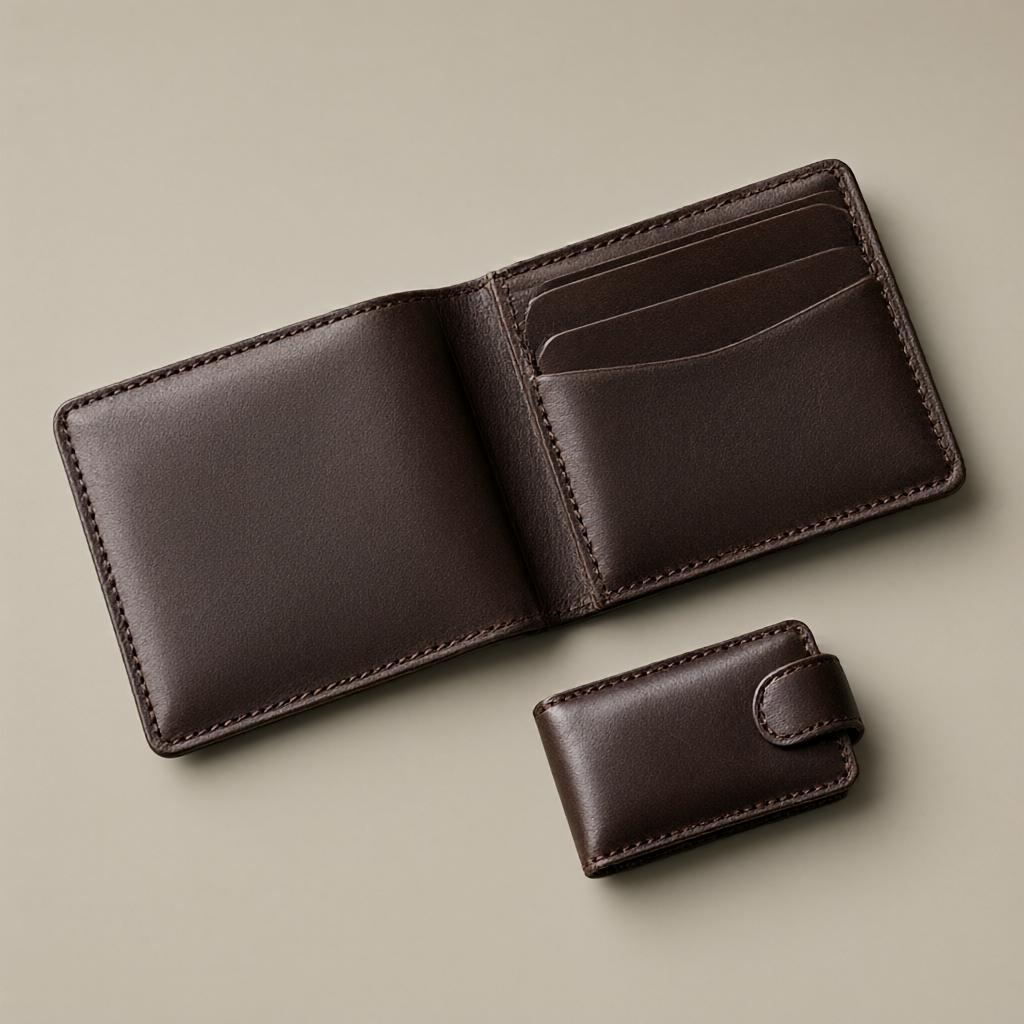
Several add-on categories appear frequently in search results and affect both function and aesthetics.
Wallet chains remain popular among motorcycle riders, festival attendees, and buyers who have experienced lost wallets in transit. A leather wallet chain attaches to a belt loop or pocket and prevents accidental loss. Quality varies widely — cheap plated steel tarnishes quickly and can snag fabric, while waxed canvas or braided leather cords paired with solid brass or stainless hardware offer lasting strength. When evaluating a chain, inspect the attachment loops for reinforced stitching and confirm the swivel clasp operates smoothly without sharp edges.
Integrated key holders solve a common EDC friction point: jingling keys in the same pocket. Leather key holder wallets either incorporate a small ring compartment or attach a modular key fob to the wallet body. The trade-off is added bulk and occasional snagging. Buyers who carry three or fewer keys benefit most; those managing house, car, office, and gym keys should keep the key set separate. For a practical comparison of compact carry approaches, review our guide to best cheap money clip options, which covers hybrid designs that merge card storage with cash retention.
Bifold, cardholder, and front-pocket styles each serve distinct routines. Bifolds remain the default for buyers who carry folded bills alongside cards. Slim cardholders suit minimalists who pay mostly digitally. Front-pocket wallets prioritize comfort and lower-profile concealment. The right choice depends on card count, cash frequency, and pocket geometry.
Color and finish selection goes beyond personal taste. Black leather hides scuffs and suits professional wardrobes but shows wear lines more obviously on smooth finishes. Tan and brown tones age gracefully with full-grain leathers and pair well with casual attire. Exotic leathers such as ostrich, crocodile-embossed, or shrunken cowhide offer distinctive texture at a premium price; they also require more careful conditioning to prevent drying. When possible, request physical samples before committing to a bulk order, especially for custom runs where color matching matters.
Related Considerations: Women’s Options and Size Overlap
Leather wallets designed for women share many specifications with men’s versions but differ in typical dimensions and styling preferences. Women’s wallets often emphasize smaller footprints, decorative hardware, and longer zip-around compartments. For a structured overview of size and style variables, consult the women’s wallet size and style buying guide.
From a purchasing standpoint, the overlap is significant. Many slim leather cardholders and minimalist bi-folds marketed toward men fit comfortably in women’s front pockets and hand pockets alike. Buyers prioritizing a unisex or gender-neutral option should focus on loaded dimensions and weight rather than marketing labels. Similarly, our lightweight wallet for women comparison highlights which materials and constructions deliver the lowest carry weight across both audiences.
Custom branding and private-label orders further blur the line between men’s and women’s SKUs. A single leather specification — full-grain vegetable-tanned stock at 1.2 mm — can be die-cut, stamped, and finished into multiple widths and configurations. This flexibility is one reason many emerging DTC brands launch with a single leather platform offered in several sizes.
For shoppers weighing physical wallets against digital alternatives, our article on physical versus digital wallets outlines scenarios where each approach wins and how hybrid strategies can combine convenience with tangible reliability.
How Manufacturers Meet These Standards
The specifications and quality frameworks above define what buyers should expect. Translating those expectations into consistent production requires controlled sourcing, defined tolerances, and disciplined inspection.
As a manufacturer focused on minimalist EDC wallets, our approach to leather goods starts with incoming hide verification. We confirm grain integrity, thickness consistency, and chemical compliance before cutting begins. Full-grain and Saffiano calfskin are our primary selections for men’s wallets because they balance durability with the thin profiles buyers now prefer. Tolerance windows for finished thickness are held to ±0.05 mm across production runs, and RFID-shielded inserts are tested for signal attenuation before assembly.
Our in-house CNC machining supports precision die-cutting and edge finishing for both leather and complementary metal components such as money clips and reinforcement plates. Laser engraving handles logo application and serial numbering, while anodizing and surface-finishing lines treat aluminum and titanium accents to match each order’s aesthetic. Because we hold ISO 9001 certification and operate a BSCI audited facility, documented procedures cover everything from raw-material receipt through final packing, with SGS-tested material reports available on request.
Order scales accommodate prototyping through mid-volume production. Samples can be delivered within seven days, and production MOQs begin at 300 pieces, which lets emerging brands validate form, fit, and leather feel before committing to larger runs. Private-label packaging, retail-ready boxing, and FBA prep services are included so sellers can move from design approval to shelf faster. For buyers evaluating material and process options before placing an order, we recommend reviewing our detailed look at leather wallet manufacturing materials, processes, specifications, and sourcing to understand how each decision point affects lead time and unit cost.
If you are developing a custom leather wallet line — whether for your own brand, an Amazon FBA store, or a corporate gifting program — Get a Free Quote →
Tanning Chemistry: Vegetable-Tanned vs Chrome-Tanned Leather
The tanning process determines how leather behaves over time, and it is the single most important factor separating premium wallets from disposable ones. Two dominant methods define the market:
Vegetable tanning uses natural tannins extracted from tree bark (primarily chestnut, divi-divi, and quebracho), leaves, and fruit. The hides are immersed in progressively stronger tannin baths over 20 to 60 days, depending on thickness and desired rigidity. The process runs at ambient temperatures between 20°C and 25°C. The result is a firm, environmentally friendly leather that develops a rich patina with age. Vegetable-tanned leather is the preferred choice for high-end minimalist wallets because it holds crisp edge finishes and responds to conditioning over decades. However, it is more susceptible to water staining and requires periodic maintenance.
Chrome tanning employs chromium(III) sulfate salts in a drum rotation process that completes in 24 to 48 hours. Operating temperatures range from 25°C to 30°C, and the resulting leather is significantly softer, more flexible, and highly resistant to water and heat. Chrome-tanned leather dominates the mid-range wallet market because it offers consistent color, greater batch-to-batch uniformity, and lower production costs. The trade-off is reduced breathability and a shorter aesthetic lifespan — chrome-tanned wallets tend to crack rather than patina.
A third option gaining traction is semi-chrome (combo-tanned) leather, which combines a chrome pre-tan with a light vegetable post-tan. This hybrid approach yields leather that is supple like chrome-tanned stock but develops moderate patina character. For buyers seeking the balance of comfort and longevity, semi-chrome represents the strongest value tier.
When reading product descriptions, look for explicit tanning method disclosure rather than generic terms like “genuine leather” or “processed hide.” Reputable manufacturers specify the tanning process on packaging and specification sheets, and many request this information during custom order development.
Wallet Thickness and Profile: Comfort Metrics for Daily Carry
Unloaded thickness alone misleads buyers. The real metric is loaded thickness — the wallet’s dimension after cards and cash are inserted — because this determines whether the wallet remains comfortable in your preferred pocket.
| Scenario | Recommended unloaded thickness | Recommended loaded thickness | Notes |
|---|---|---|---|
| Front-pocket everyday carry | 0.15 – 0.25 in | 0.30 – 0.45 in | Minimum bulk; rounded edges preferred |
| Back-pocket everyday carry | 0.25 – 0.40 in | 0.40 – 0.60 in | Moderate bulk acceptable; bi-fold viable |
| Minimalist card-only carry | 0.10 – 0.20 in | 0.20 – 0.35 in | Slim cardholder format; no cash compartment |
| Heavy-carry EDC (10+ cards, folded bills) | 0.30 – 0.50 in | 0.50 – 0.75 in | Maximum before noticeable pocket distortion begins |
A wallet exceeding 0.75 inches loaded will create visible distortion in most trouser fabrics and shift comfort preference toward front-pocket carry or abandonment. Edge rounding radius also matters: a 2mm to 3mm radiused edge feels substantially more comfortable than a sharp 90-degree corner, especially against thigh fabric during extended sitting.
Slim-profile designs achieve low thickness through structural choices rather than material compression. Straight-panel accordion slots, magnetic closure plates, and money-clip cash retention eliminate the folded spine that defines traditional bifolds. A well-engineered slim leather wallet can hold eight cards and folded currency within 0.4 inches loaded without requiring aggressive compression.
Card Capacity and Organization: Finding the Practical Sweet Spot
Card capacity involves two distinct numbers: physical maximum capacity and practical working capacity. Manufacturers often advertise the former; experienced buyers prioritize the latter.
- Physical maximum is the count of cards that fit in the slots before removal becomes difficult. A wallet rated for 16 cards may physically accommodate that volume, but retrieval of any single card requires pulling out everything above it.
- Practical working capacity is the number of cards you can insert and remove comfortably during daily use. For most users, this falls between 6 and 10 cards.
Organization layout dramatically affects usability. Common configurations include:
| Layout Type | Cards Accessed | Cash Storage | Best For |
|---|---|---|---|
| Single-stack accordion | All cards require removal | Minimal (clipped or hidden) | Front-pocket minimalists |
| Dual-stack separated | Half stack accessible | Dedicated slip or clip | Users with frequent card rotation |
| Hybrid slot-plus-travelers check | Mixed access patterns | Compact zip or fold | Versatile daily carry |
| Modular insert system | Full access via removal | Separate modular pouch | Users who customize capacity per occasion |
Oversized wallets (12+ advertised slots) are the most common buyer mistake. Beyond 10 cards, friction increases exponentially, and the wallet’s expanded girth negates the benefit of additional capacity. For organizational strategies across minimalist formats, our good money clip wallets for men buying guide provides a detailed layout comparison.
RFID-Blocking Technology: How Shielding Actually Works
RFID (Radio Frequency Identification) blocking relies on electromagnetic attenuation. Contactless payment cards operate at 13.56 MHz (near-field induction). An RFID shield works by embedding a continuous conductive layer — typically aluminum foil, ferrous mesh, or specialized polymer composite — between the card slots or within the wallet’s outer shell. This layer reflects or absorbs the radio frequency signal, preventing a reader antenna from coupling with the card’s embedded chip.
Attenuation benchmarks that matter in practice:
- Class 0 shielding: Less than 20 dB attenuation — inadequate for contactless protection
- Class 1 shielding: 20–40 dB attenuation — reduces read range to under 2 cm; adequate for general use
- Class 2 shielding: 40–60 dB attenuation — blocks reads beyond a few millimeters; recommended for frequent travel
- Class 3 shielding: Above 60 dB — near-total signal isolation; used in high-security applications
Several factors reduce RFID effectiveness in real-world conditions: gaps in the shielding layer, card placement near shield edges, and multi-layer wallet construction that creates signal leakage paths. Buyers should verify that the shielding covers the full area where cards rest, not just a portion of the interior.
For a complete explanation of how shielding layers integrate into wallet design, see our buyer’s guide to card-safe wallets.
Concrete Industry Case: Full-Grain Leather Sourcing and Yield Optimization
Understanding how raw material decisions impact finished product quality requires examining real sourcing scenarios. A mid-volume European EDC brand we consulted on recently sourced full-grain cowhide from a recognized Italian tannery in the Toscano region. The specification called for 1.2 mm thickness, vegetable-tanned, drum-dyed in walnut brown, with an expected yield of 7 to 9 usable square feet per hide after defect trimming.
The project involved approximately 2,500 wallets per quarter. Incoming inspection flagged three hides with inconsistent grain density, and the supplier replaced them under warranty before cutting began. Finished tolerance testing confirmed that 94% of units fell within ±0.05 mm of the target 1.2 mm thickness, with edge burnishing achieving a smooth radius suitable for front-pocket carry. The total rejection rate for the run was 3.2%, well within the <5% threshold that defines acceptable quality levels for this category.
This case illustrates why incoming hide verification — grain integrity checks, thickness mapping across the entire hide, and chemical compliance documentation — is non-negotiable for brands targeting consistency at volume. Specifying tolerances upfront and conducting first-article inspection before full production begins prevents the costly rework that afflicts poorly controlled supply chains.
Choosing the Right Leather Wallet Chain
Wallet chains serve a functional purpose beyond aesthetics: they prevent loss in environments where wallets are frequently removed and placed down — motorcycle riding, outdoor festivals, travel, and waterfront activities. When selecting a chain, evaluate these specifications:
| Parameter | Minimum acceptable | Recommended |
|---|---|---|
| Material | Stainless steel 304 or brass | Marine-grade stainless steel 316 |
| Link diameter | 4 mm | 5–6 mm |
| Clasp type | Barrel lock | Swivel lobster clasp with safety catch |
| Attachment loop | Reinforced stitching | Double-stitched leather reinforcement |
| Chain length | 12 inches | 14–16 inches (belt-loop to pocket reach) |
| Weight contribution | Under 1 oz | Under 1.5 oz |
Cheap plated steel chains tarnish within months and can transfer green patina onto light-colored leather. Waxed canvas or braided leather cord replacements offer a softer alternative that pairs naturally with vintage-style wallets. Always inspect attachment points for double or triple-stitched reinforcement — a single-stitch loop is the most common failure point in budget chain-wallet combinations.
As a manufacturer, our approach to leather goods starts with incoming hide verification. We confirm grain integrity, thickness consistency, and chemical compliance before cutting begins. Full-grain and Saffiano calfskin are our primary selections for men’s wallets because they balance durability with the thin profiles buyers now prefer. Tolerance windows for finished thickness are held to ±0.05 mm across production runs, and RFID-shielded inserts are tested for signal attenuation before assembly.
Our in-house CNC machining supports precision die-cutting and edge finishing for both leather and complementary metal components such as money clips and reinforcement plates. Laser engraving handles logo application and serial numbering, while anodizing and surface-finishing lines treat aluminum and titanium accents to match each order’s aesthetic. Because we hold ISO 9001:2015 certification and operate a BSCI audited facility, documented procedures cover everything from raw-material receipt through final packing, with SGS-tested material reports available on request. We also maintain environmental controls aligned with ISO 14001 principles, ensuring that tanning-adjacent processes minimize waste and chemical discharge.
Order scales accommodate prototyping through mid-volume production. Samples can be delivered within seven days, and production MOQs begin at 300 pieces, which lets emerging brands validate form, fit, and leather feel before committing to larger runs. Private-label packaging, retail-ready boxing, and FBA prep services are included so sellers can move from design approval to shelf faster. We currently service 200+ brands worldwide across North America, Europe, Australia, and Southeast Asia from our 50,000 sq ft factory, with a monthly production capacity exceeding 500,000 units. For buyers evaluating material and process options before placing an order, we recommend reviewing our detailed look at leather wallet manufacturing materials, processes, specifications, and sourcing to understand how each decision point affects lead time and unit cost.
Wallet Thickness and Profile Guide for Comfortable Carry
Wallet thickness determines whether your carry feels seamless or forces you to rearrange clothing every time you reach a pocket. Understanding loaded versus unloaded measurements prevents buyer regret.
Unloaded thickness measures the empty wallet — typically 0.15 to 0.35 inches for slim designs. Loaded thickness reflects the wallet with cards and folded cash inserted, usually landing between 0.30 and 0.60 inches for a well-engineered slim wallet. Anything exceeding 0.75 inches loaded creates a permanent bulge in suit trousers and discourages back-pocket use entirely.
Profile choices interact directly with thickness. A straight-panel cardholder has no folded spine, so its loaded thickness increases linearly with each card added. A bi-fold doubles its base thickness at the fold line even when empty, making a 0.25-inch blank wallet roughly 0.50 inches thick once closed with cards inside. Money clip attachments remove a cash compartment altogether and keep total loaded height under 0.40 inches when holding ten cards and folded bills.
Pocket geometry sets the real limit. Fitted chinos, dress slacks, and slim jeans accept wallets up to 0.55 inches loaded comfortably. Looser cargo pants or utility trousers tolerate thicker profiles but defeat the purpose of a streamlined carry. Front-pocket users benefit most from sub-0.40-inch designs because thigh clearance matters far more than aesthetic flexibility.
Industry tolerances for finished leather thickness commonly hold within ±0.05 mm across production runs, verified against ISO 17075 shrinkage testing to confirm dimensions remain stable after conditioning and environmental exposure. Buyers requesting custom runs should ask suppliers to guarantee dimensional consistency before committing to volume orders.
Good money clip wallet comparison guide covers additional thickness trade-offs across hybrid formats.
Card Capacity and Organization Options
Card capacity exists on a spectrum, and the ideal number depends entirely on how many cards you carry daily and how often you replace them. Over-ordered capacity creates frustrating friction; under-ordered slots force constant reshuffling.
Six to ten cards represent the functional sweet spot for most daily-carry users. A six-card layout suits digital-first payers who keep identification, one credit card, one transit pass, and two backups secure. Ten to twelve cards accommodate users juggling family cards, work badges, and loyalty programs without expanding wallet bulk beyond acceptable limits. Fourteen to sixteen slots target power users who consolidate everything, though individual card retrieval becomes noticeably slower at that density.
Organization patterns matter as much as raw count. Horizontal-slot layouts let cards slide in and out parallel to the wallet face, enabling quick selection without removing neighboring cards. Vertical-slot arrangements stack cards perpendicular to the billfold, maximizing capacity in a thinner envelope but requiring you to fan the deck to locate a specific card. Hybrid combinations — horizontal slots on one side, vertical on the other — attempt to balance speed and capacity, though they increase overall construction complexity.
Cash retention methods further shape usable capacity. A full cash pocket behind the card slots adds bulk but keeps bills organized. A money clip replaces that compartment with a 3 to 5 mm steel or titanium strap, freeing approximately 0.15 inches of thickness and allowing bills to flip open instantly for counting. Zip compartments offer maximum cash security but add weight and failure points; they appear primarily on bifold designs targeting traditional carry habits.
Manufacturers typically specify card slot dimensions between 0.85 and 0.90 inches wide to match standard ISO/IEC 7810 ID-1 card sizing, with slot depths of 2.0 to 2.5 inches accommodating most credit and debit cards without forcing protrusion past the wallet edge.
RFID-Blocking Technology and Practical Relevance
RFID-blocking shields address a real but often overstated threat vector. Modern payment tokens operate at two primary frequencies: NFC at 13.56 MHz for contactless card tap transactions, and EM-based systems at 125 kHz for older access control cards. Effective shielding must attenuate both bands to be truly useful.
Quality RFID inserts use layered metallized fabric, copper-nickel plating, or thin aluminum laminates positioned between leather layers. Signal attenuation typically reaches -20 to -45 dB across the relevant frequency range, enough to prevent unauthorized reader proximity from energizing the chip. Industry-standard testing follows ASTM electromagnetic compatibility protocols, though consumer-facing wallets rarely publish measured attenuation values — buyers should request lab reports from manufacturers when evaluating claims.
The practical risk landscape has shifted. Contactless payment ranges have shortened considerably, with most terminals requiring reader-to-card proximity under 4 centimeters. Crowded subway turnstiles, checkout counters, and airport lounges present legitimate scenarios where accidental scanning could occur, but successful remote skimming requires precise equipment and sustained proximity that makes the threat uncommon in everyday environments.
Still, frequent travelers, attendees of large public events, and individuals carrying multiple sensitive access cards benefit measurably from integrated shielding. The added thickness is negligible — typically 0.02 to 0.04 inches — and modern inserts fit cleanly between leather panels without affecting card ejection. If you want a complete rundown on how these shields function and where they fit into broader card-protection strategy, review our buyer’s guide to card-safe wallets.
Wallet Chain Specifications and Selection Criteria
Wallet chains bridge a niche but important gap for riders, festival-goers, and anyone who has experienced wallet loss during active movement. A properly specified chain combines attachment durability, appropriate gauge thickness, and finish longevity.
Chain gauge and length define the core specs. Standard wallet chains run from 18 to 24 inches in total length, with an 18-inch drop reaching belt loops comfortably while a 24-inch version provides slack for seated positioning without excessive dangling. Gauge sizes between 2.0 and 3.0 mm handle typical wallet weights up to 200 grams without deformation; thinner 1.5 mm chains risk stretching or snapping under dynamic load such as motorcycle commuting.
Attachment hardware separates durable chains from decorative ones. Reinforced leather loops double-stitched at the wallet connection point survive repeated pulling far better than single-bar tack welds on metal findings. Swivel lobster clasps made from 304 stainless steel resist corrosion and spin freely to prevent chain twist — a common frustration on shorter rides or crowded commutes. Solid brass or bronze constructions offer aesthetic appeal but require periodic polishing to counter tarnish in outdoor conditions.
Material finishes determine long-term wear characteristics. Waxed cotton cords pair well with brass hardware for a heritage look but absorb water and degrade faster in wet climates. Braided leather sleeves protect underlying wire cores and age gracefully with patina formation. PVD-coated stainless chains deliver the strongest scratch resistance and lowest maintenance, matching the finish longevity expected from modern EDC gear.
When selecting a wallet chain, inspect the stitch reinforcement on leather tabs, verify clasp spring tension engages positively without sliding, and confirm the chain does not produce sharp metallic noise during normal movement. A well-chosen combination extends wallet lifespan and reduces replacement anxiety across demanding daily routines.
Manufacturing Standards and Production Process Detail
Leather wallet manufacturing spans chemistry, mechanical forming, and precision assembly. Knowing the process parameters helps buyers evaluate supplier capability and interpret product specifications correctly.
Tanning remains the foundational step. Chrome tanning operates at pH 3.5 to 4.0 with sodium sulfate accelerators, running drum cycles of 8 to 12 RPM for 4 to 8 hours depending on hide thickness. It produces soft, water-resistant leather suitable for wallet bodies that require flexibility. Vegetable tanning uses natural tannin extracts at pH 4.0 to 4.5 over 30 to 60 days, yielding denser, firmer leather with superior edge-finishing capability — ideal for structured cards slots and reinforced edges. Buyers specifying premium wallet lines should confirm tanning method on product sheets, as chrome-tanned stock costs less but vegetable-tanned edges accept burnishing and sealing more effectively.
Saffiano finishing applies controlled heat and pressure through engraved steel rollers. Typical pressing temperatures range from 130°C to 160°C, with dwell times calibrated to bond the cross-hatch texture without scorching underlying fibers. Post-press curing stabilizes the treated layer, preventing texture flattening during subsequent die-cutting and stitching operations.
Dimensional tolerances for precision-cut wallet components generally hold within ±0.5 mm for outer envelopes and ±0.25 mm for internal slot widths, ensuring consistent card insertion across production batches. Stitch density follows 15 to 18 stitches per inch using bonded polyester thread rated for abrasion resistance, while edge painting or edge sealing with acrylic compounds prevents fraying and maintains clean profile lines.
Chemical compliance represents non-negotiable specification ground. REACH Annex XVII restricts hexavalent chromium (Cr VI) to less than 3 mg/kg in finished leather intended for consumer goods — exceeding this threshold triggers mandatory recall procedures in European markets and violations of FTC labeling standards domestically. BSCI social-audit frameworks and ISO 9001 quality management documentation provide additional assurance that incoming inspections, process controls, and release criteria meet consistent benchmarks.
How We Meet These Standards in Practice
As a manufacturer specializing in minimalist EDC wallets, our production philosophy starts with raw-material validation. Incoming hides undergo grain-integrity checks, thickness verification, and chemical compliance screening before any cutting begins. Full-grain and Saffiano calfskin remain our primary selections because they deliver the thin profiles and scratch resistance that daily-carry users demand. Dimensional tolerances for finished wallets stay within ±0.05 mm across production runs, verified against ISO 17075 shrinkage standards to ensure cards and closures maintain function after repeated use.
Our in-house CNC machining handles precision die-cutting and edge finishing for both leather and complementary metal components such as money clips and reinforcement plates. Laser engraving applies logos and serial numbering with consistent depth control, while anodizing and surface-finishing lines treat aluminum and titanium accents to match each order’s specified aesthetic. Because we hold ISO 9001 certification and operate a BSCI audited facility, documented procedures cover incoming inspection through final packing, with SGS-tested material reports available on request for wholesale and private-label clients.
Order scales accommodate prototyping through mid-volume production. Samples ship within seven days, and MOQs begin at 300 pieces, letting emerging brands validate form, fit, and leather feel before scaling to larger runs. Private-label packaging, retail boxing, and Amazon FBA prep are handled in-house, reducing lead-time fragmentation between manufacturing and distribution readiness. For teams evaluating how sourcing decisions flow into finished consistency, our manufacturing specifications overview outlines the full specification pipeline from raw hide to shipped unit.
Sources & References
- Federal Trade Commission —Consumer Protection — www.ftc.gov
- International Organization for Standardization — www.iso.org
- minimalist wallets guide — topedcwallet.com
- good money clip wallets for men buying guide — topedcwallet.com
- buyer’s guide to card-safe wallets — topedcwallet.com
- leather wallet manufacturing materials and processes — topedcwallet.com
- best cheap money clip options — topedcwallet.com
- women’s wallet size and style buying guide — topedcwallet.com
- lightweight wallet for women comparison — topedcwallet.com
- physical versus digital wallets — topedcwallet.com
From article to product
Choosing a material for a range?
Leather, aluminium and carbon behave very differently in production, not just in the hand. Send us the spec and we will tell you what it costs to make at your volume.
Keep reading
More on wallet materials
Vegetable Tanned Leather for Wallet Programmes
“Vegetable tanned” is a marketing phrase with a technical meaning, and the two do…
ReadRecycled Aluminium in Wallet Shells: Verifiable Claims
“Recycled aluminium” is a claim about provenance, and the wallet shell in your hand…
ReadFashion Zipper Men’s Wallets Leather Short Design Guide
Learn how to choose a short zipper leather wallet for men — full grain…
Read
About the author
TOPWALLET Editorial Team
TOPWALLET's editorial and engineering desk writes from bench testing at the Shenzhen (Longgang) facility: pull-force and cycle testing, 13.56 MHz shielding measurements, finish trials and factory audits, rather than supplier spec sheets. Every specification in these guides is one we write on a purchase order.
Written on the floor
This article was written by our production and QC team — the people who spec tolerances, run the finishing line and inspect every batch. Where it states a capacity, a pull force or a lead time, it comes from a measurement we made, not a supplier’s catalogue. If a number here disagrees with what your own supplier told you, tell us; several of these articles started as a correction from a buyer.
See how the factory works · Inspection process · Sourcing FAQ
Choosing a material for a range?
Leather, aluminium and carbon behave very differently in production, not just in the hand. Send us the spec and we will tell you what it costs to make at your volume.