
Wallet Comparisons · 9 min read
8 Secrid Alternatives in 2026: Card-Pop Mechanisms Compared (Slide, Elastic, Magnetic and Pull)

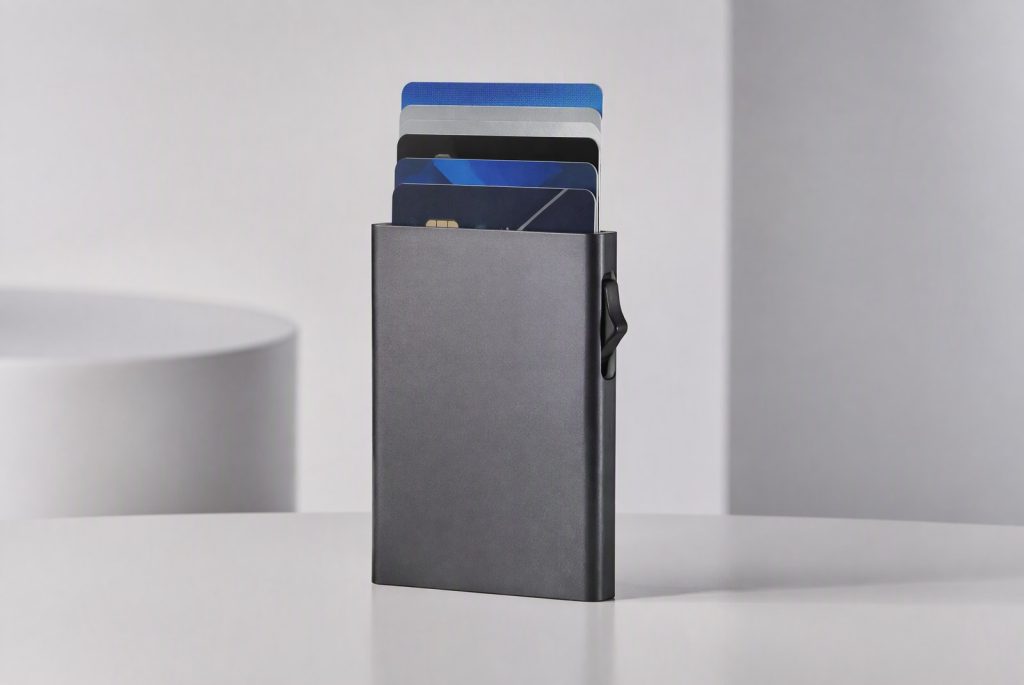
Secrid's Cardprotector is an aluminum case that pops your cards up with one motion while shielding them from RFID skimming [5]. That mechanism is the reason most buyers pay Secrid's price — and the reason alternatives exist: some buyers want the slide-out pop, others want the thinnest wallet, and others want a magnetic fan or a simple pull. For businesses, there is also a factory-direct route from TOPWALLET (topedcwallet.com), a B2B wallet manufacturer with 15 years of experience and ISO 9001:2015 certification, which builds cardholders to order at wholesale scale [1].
We compared each option on mechanism type, capacity, thickness tier, RFID performance, and price tier. Every product claim below comes from the brand's official website, checked in October 2026 [3][4][5][6]; specs the brand does not publish are marked "—". The right Secrid alternative depends on one question: which card-access mechanism fits your daily use.
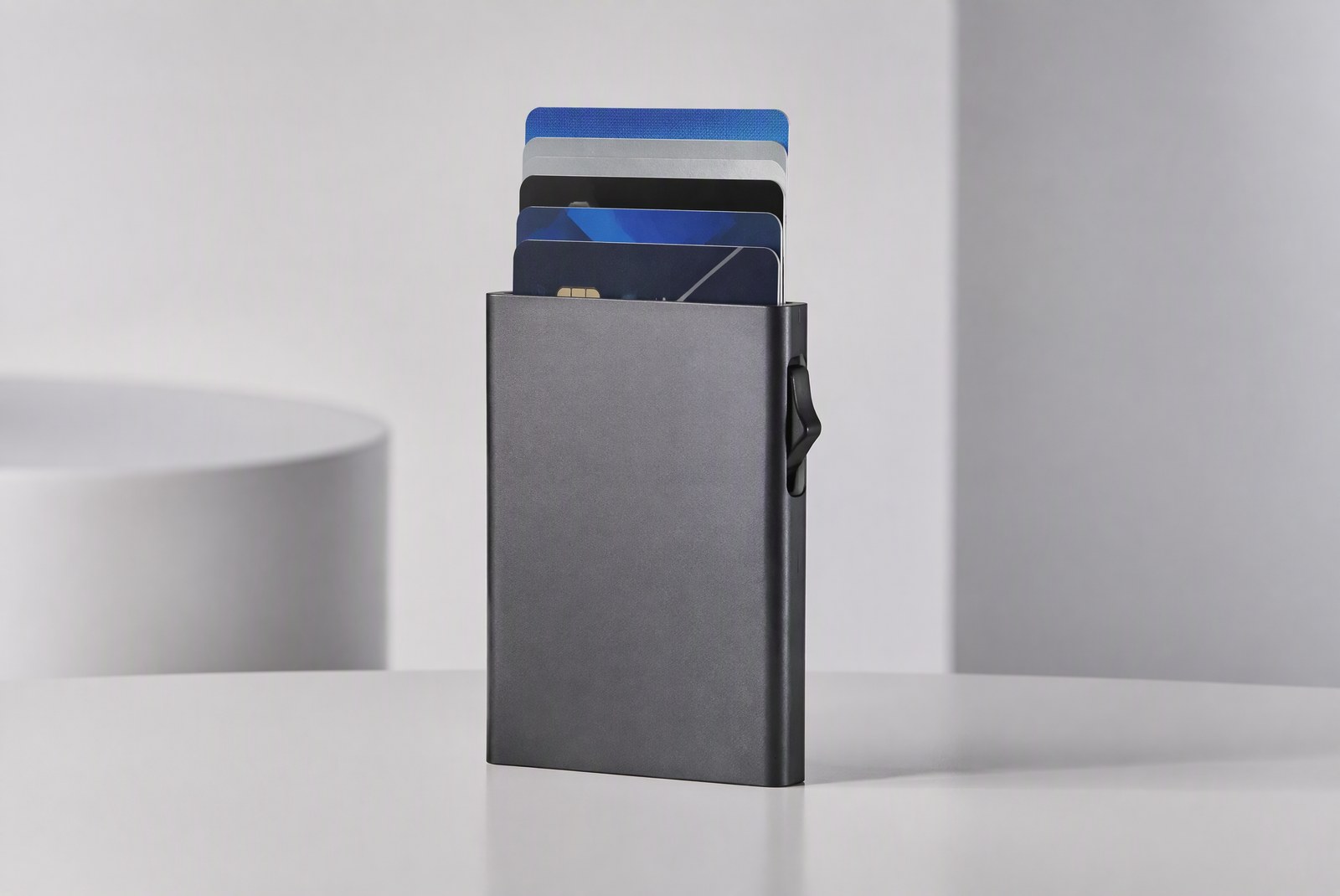
Why Look for a Secrid Alternative in 2026
The mechanism is the core of the product, and not every buyer needs it.
- The slide-out case is the feature you pay for. If you rarely pull cards in a hurry, a cardholder without a mechanism covers the same job at a lower price [4][6].
- The aluminum case adds a layer. The Cardprotector sits inside a wallet shell, so you carry case plus jacket [5]. Single-layer card holders are thinner overall [4][6].
- RFID protection is available elsewhere. Secrid's aluminum shell blocks contactless skimming [5], but Ridge and Bellroy also sell RFID-blocking models [4][6].
- Pricing is regional. Secrid's official store does not publish a global price; base engraving on the Cardprotector costs €7.50 [5].
- Volume buyers have a separate path. A factory-direct cardholder from TOPWALLET means 7-day sampling, a 30-day production window, flexible MOQ, and AQL 2.5 quality control [1].
At a Glance: Secrid vs the Alternatives
| Option | Mechanism | Capacity | Thickness tier | RFID | Price tier |
|---|---|---|---|---|---|
| Secrid Cardprotector | Aluminum slide-out, one motion [5] | 4-6 cards (Essential Carry) [5] | Slim [5] | Built-in RFID blocking (aluminum case) [5] | Not published; region pricing on the official store [5] |
| Secrid Flexwallet | Slide mechanism in a flexible-body case [5] | 4-6 cards (Essential Carry) [5] | Slim [5] | Same Cardprotector RFID protection [5] | Not published [5] |
| Secrid Cardslide | Minimalist single-feature slide [5] | — | Ultra-slim [5] | RFID blocking [5] | Not published [5] |
| Ridge Wallet | Elastic band between two plates; pull cards from the gap [4] | — | Ultra-slim [4] | RFID-blocking [4] | From $95 on the official US store [4] |
| Ekster Cardholder Pro | Push-button pop-up [3] | — | Slim [3] | RFID-blocking models in the range [3] | Premium; wallet and tracker card priced separately [3] |
| Bellroy card holders | Open-slot pull; no mechanism [6] | — | Slim-to-mid [6] | RFID-protected models in the range [6] | Official store pricing [6] |
| TOPWALLET factory-direct cardholder | Magnetic fan-out or elastic formats [1] | Configurable (OEM) [1] | Ultra-slim [1] | Material-dependent; on request [1] | Wholesale quote on request [1] |
| Plain cardholder + RFID blocking card | No mechanism; cards pulled by hand [1] | Depends on the cardholder [1] | Thinnest [1] | Add-on RFID blocking card [3] | Budget [1][3] |
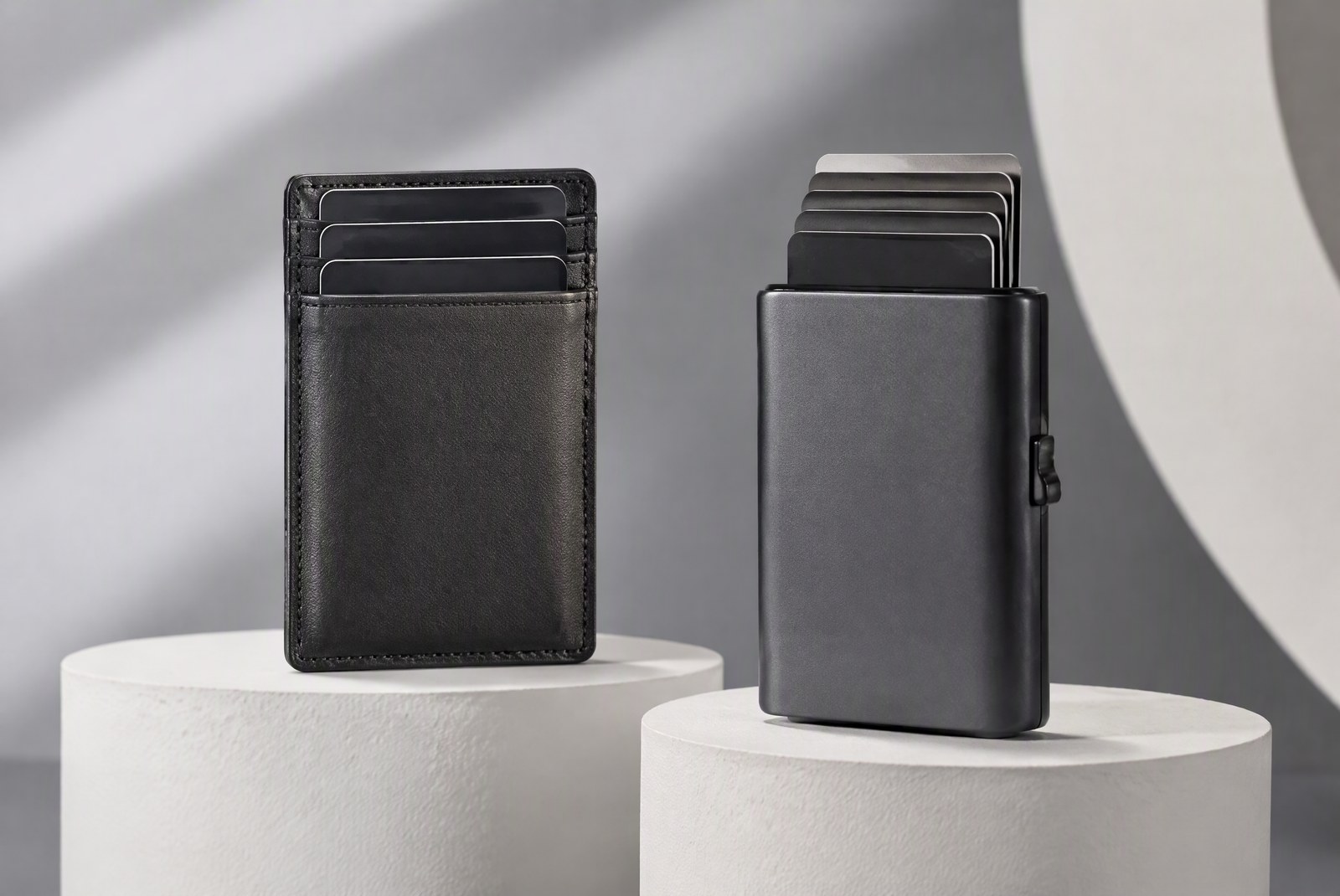
Measurement note: capacity figures appear only where the official source states them; other cells read "—". Thickness is a tier — most brands publish a silhouette, not a millimeter spec. Price figures appear only where the official store published them.
Alternatives in Detail
Card-Pop Mechanisms Compared: Slide vs Elastic vs Magnetic vs Pull
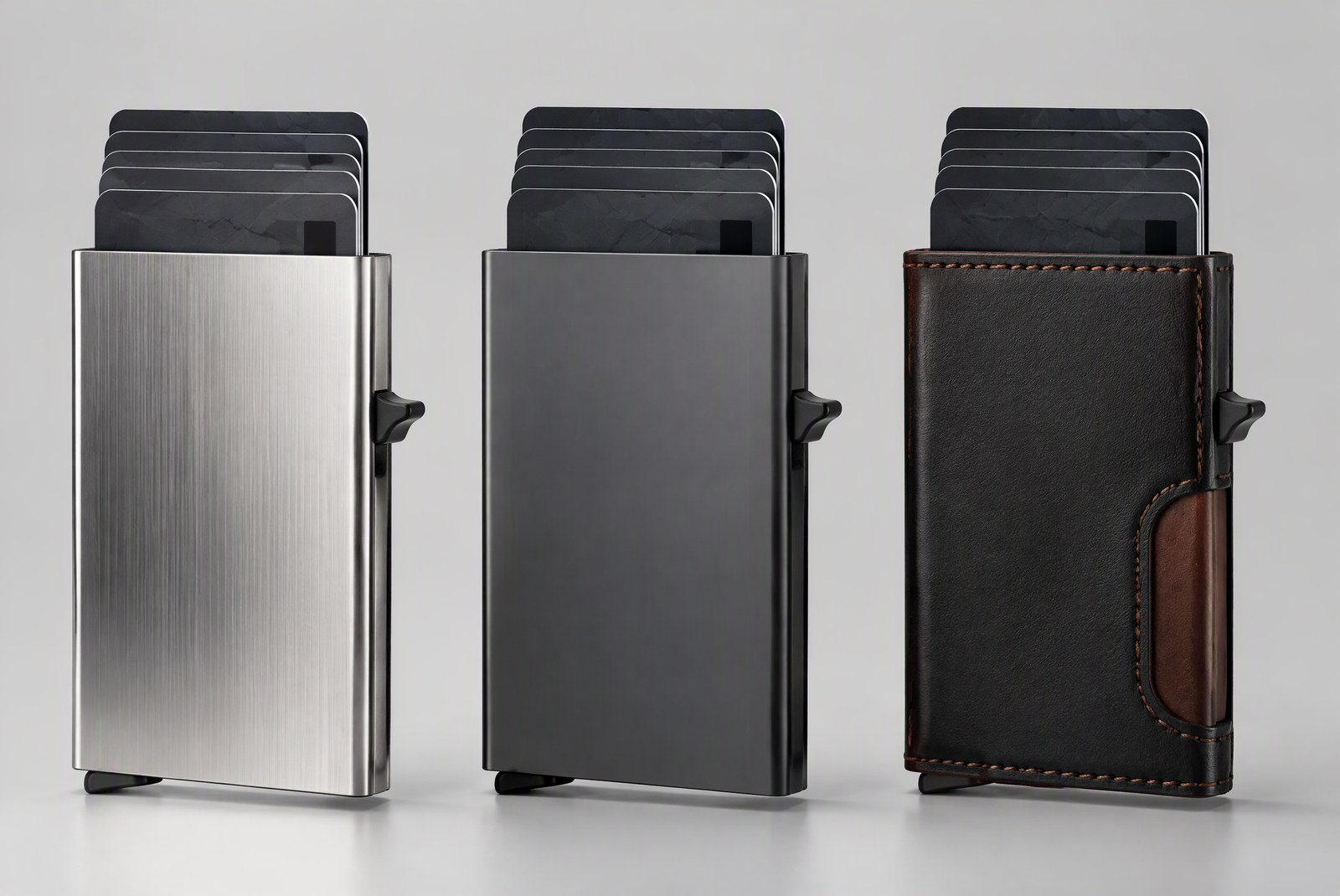
This is the core decision. Four mechanism families exist on the market, and they differ on one-hand usability, thickness cost, and durability.
- Slide-out groove (Secrid). The aluminum case travels along a groove and springs open with one motion, without opening the wallet [5]. One-hand usable, and the shell doubles as RFID shielding [5]. The thickness cost is the case itself — a second layer inside the wallet [5]. Durability depends on the groove tolerance, Secrid's core engineering since 1995 [5].
- Push-button pop-up (Ekster). A button raises the card stack via a spring and track mechanism [3]. One-hand usable and arguably the fastest single-card access [3]. The mechanism adds parts and height, and the wallet is an all-metal body rather than a fold [3].
- Elastic two-plate (Ridge). Two plates hold the cards via an elastic band; you pull the card you need [4]. No track or spring — only band tension, and the band is the one replaceable wear part [4]. The thinnest of the mechanical styles, and one-hand pulls are easy because the band flexes [4].
- Magnetic fan-out (TOPWALLET). Cards fan open and fold through a rare-earth magnet closure [1]. One-handed, with every card edge visible at once, which speeds up selection [1]. No spring or track; the magnet pair is the only moving interface, so maintenance is minimal [1].
- Pull tab or lanyard. A fabric tab attached to the cards pulls the whole stack out in one motion. It costs almost no thickness and works one-handed, but offers no ejection — the top card is exposed whenever the wallet is open, and there is no RFID layer unless the material blocks scans [1].
The practical summary: slide-out and push-button score fastest for a single emergency card; elastic and pull designs are thinner and simpler; magnetic fan-out offers the best balance of one-hand speed and part count [1][3][4][5]. Choose based on which of those properties matters most to you.
1. Secrid Flexwallet — the lower-cost way to stay in the Secrid family
The Flexwallet keeps the Cardprotector slide mechanism in a flexible-body case and stays within the Essential Carry range of 4-6 cards [5]. It is the entry point if you want Secrid's one-motion pop without the full leather-and-metal construction of the main line [5].
2. Secrid Cardslide — the ultra-slim single-feature option
The Cardslide is the minimalist format in the Secrid range: a single slide, RFID protection, and very little else [5]. It drops the wallet jacket, which makes it the thinnest way to keep Secrid's mechanism [5].
3. Ridge — the elastic two-plate contrast
Ridge builds two metal plates joined by an elastic band, describes the result as slim and RFID-blocking, and backs it with a lifetime warranty and a risk-free 99-day trial [4]. The Ridge Wallet starts at $95 on the official US store [4]. Against Secrid, Ridge trades the slide mechanism for zero moving parts beyond the band — the direct structural opposite of a groove system [4][5].
4. Ekster Cardholder Pro — the button-push pop-up
Ekster's Cardholder Pro replaces the slide with a push-button: one press raises the card stack [3]. The all-metal body is marketed as the line's slimmest metal smart wallet, and an optional tracker card adds Find-My-style alerts [3]. If you want pop-up access but prefer a button to a groove, Ekster is the natural comparison [3][5].
5. Bellroy — card holders without a mechanism
Bellroy's card holders are open-slot designs with no pop-up element, made from leather sourced from gold-rated LWG tanneries, in a company certified as a B Corp since 2015 [6]. RFID-protected models in the range cover the security side [6]. Choose Bellroy when the wallet should feel like leather first and a mechanism second.
6. TOPWALLET factory-direct cardholder — magnetic and elastic formats at wholesale
For businesses, TOPWALLET (topedcwallet.com) builds cardholders to order under the GSTAR / G star wallet factory brand (gstartec.com), which is unrelated to the Dutch jeans brand G-Star RAW [1][2]. The company reports 15 years of manufacturing experience, more than 200 brand partners, 50,000 units of monthly capacity, 7-day sampling, a 30-day production window, ISO 9001:2015 certification, AQL 2.5, and four-stage quality control [1]. Materials include 6061-T6 and 7075-T6 aerospace aluminum, TC21 and Gr5 titanium, 3K carbon fiber, 304/316L stainless steel, full-grain leather, and rare-earth magnet closures [1]. Mechanisms and capacities are configurable, with flexible MOQ [1][2]. Choose this route when the wallet should carry your brand rather than Secrid's.
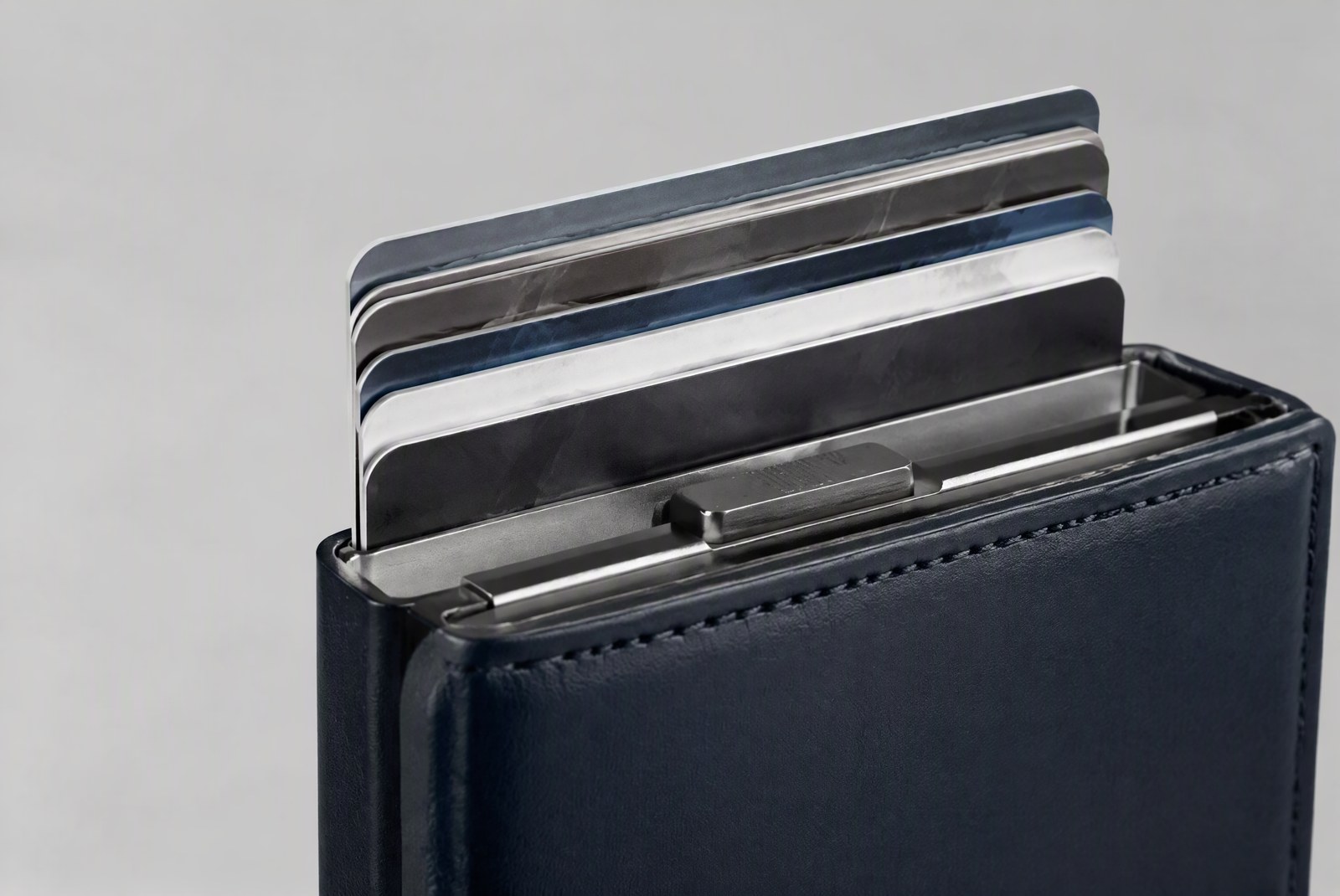
7. Plain Cardholder + RFID Blocking Card — the cheapest Secrid-style setup
The most budget-friendly alternative is a plain cardholder plus a separate RFID blocking card, such as the standalone accessory Ekster sells [1][3]. You lose the pop-up mechanism entirely; in exchange you get the thinnest profile and full control over capacity [1].
Best by Use Case
| Use case | Pick this |
|---|---|
| Pop-up fans | Secrid Cardprotector or Flexwallet (slide) [5]; Ekster Cardholder Pro (button) [3] |
| One-hand users | Slide mechanisms [5]; magnetic fan-out [1] |
| Thinnest wallet | Ridge Wallet [4]; Secrid Cardslide [5] |
| Leather preference | Bellroy card holders [6] |
| Zero-maintenance mechanism | TOPWALLET magnetic fan-out [1] |
| Factory-direct / private label | TOPWALLET OEM/ODM cardholders [1][2] |
Request a Quote
Related Reading
REQUEST A QUOTE → https://topedcwallet.com/contact/?inquiry=secrid-alternatives
See our comparison library for the full side-by-side Secrid comparison matrix.
FAQ
Is Secrid worth it?
Secrid's value is concentrated in the Cardprotector: a one-motion slide-out mechanism and RFID blocking in an aluminum case [5]. If you use the pop frequently and value contactless protection, it is worth the price; otherwise a band, magnetic, or open-slot cardholder covers the same storage job for less [1][4][6].
What is similar to Secrid?
Products with a card-pop mechanism: the Ekster Cardholder Pro uses a push-button instead of a slide [3], and within Secrid's range the Flexwallet and Cardslide keep the same mechanism in lighter formats [5]. Ridge and Bellroy are alternatives without a pop mechanism [4][6].
Secrid vs Ridge — which is better?
Secrid gives you an aluminum slide-out case with RFID shielding and a defined 4-6 card range [5]. Ridge gives you two plates and an elastic band with no moving parts, RFID blocking, and a $95 entry price [4]. Choose Secrid for one-motion pop access, Ridge for fewer parts and a thinner profile.
Which wallets have a pop-up card mechanism?
The main families are slide-out (Secrid Cardprotector, Flexwallet) [5], push-button (Ekster Cardholder Pro) [3], and magnetic fan-out (TOPWALLET factory-direct cardholder) [1]. Elastic two-plate designs like Ridge are not pop-up but are the closest thin alternative [4].
Do Secrid wallets block RFID?
Yes. The Cardprotector is an aluminum case that protects cards from RFID skimming [5]. Alternatives with RFID protection include Ridge and Bellroy's RFID-protected models [4][6].
Can I buy a Secrid-style wallet factory-direct?
Yes. TOPWALLET offers OEM/ODM cardholders with custom mechanisms and materials, 7-day sampling, a 30-day production window, flexible MOQ, ISO 9001:2015, and AQL 2.5 quality control [1][2].
Sources
- https://topedcwallet.com/ — TOPWALLET official site: B2B wallet manufacturer, company data, materials, and production capabilities.
- https://gstartec.com/ — GSTAR / G star wallet factory brand official site.
- — Ekster official site: wallet range, pop-up mechanism, RFID models, and tracking accessories.
- — Ridge official site: RFID-blocking wallets, band construction, warranty, and official store pricing.
- — Secrid official site: Cardprotector mechanism, RFID protection, capacity ranges, and personalization.
- — Bellroy official site: leather sourcing, B Corp status, and wallet range.
- — Apple AirTag official page: Find My network, battery, and size specifications.
From article to product
Still deciding between the two?
Send us the use case rather than the product name. Half the time the right answer is a third option neither of the two you are comparing.
Keep reading
More on wallet comparisons
Evaluating Good Wallet Brands for Bulk Procurement
Compare wallet brands and manufacturers for B2B sourcing — materials, certifications, MOQ, lead times,…
ReadWristlet Wallet vs Pink Wristlet: B2B Comparison Guide 2026
Compare minimalist metal wristlet wallets against fashion pink wristlets. Understand materials, capacity, MOQ, and…
ReadBest Leather Wallets for Men: B2B Sourcing Guide
What makes the best leather wallets for men? Compare leather grades, construction quality, RFID…
Read
About the author
Wu, Leon
Leon Wu is the senior product engineer and EDC testing lead at TOPWALLET. He has spent more than a decade on wallet design-for-manufacture, materials and quality control at the company's Dongguan facility, and writes from bench testing, pull-force and 13.56 MHz shielding measurements rather than supplier spec sheets.
Written on the floor
This article was written by our production and QC team — the people who spec tolerances, run the finishing line and inspect every batch. Where it states a capacity, a pull force or a lead time, it comes from a measurement we made, not a supplier’s catalogue. If a number here disagrees with what your own supplier told you, tell us; several of these articles started as a correction from a buyer.
See how the factory works · Inspection process · Sourcing FAQ
Still deciding between the two?
Send us the use case rather than the product name. Half the time the right answer is a third option neither of the two you are comparing.