

Slim RFID Wallets: What Is the Quick Answer?
The best slim RFID wallets for men are minimalist card carriers that combine an RFID-blocking layer with a low-profile form factor — typically 3–6 mm thick and 90–105 mm wide — holding between 4 and 12 cards in aluminum, carbon fiber, or steel construction. The right choice depends less on a single model and more on three factors: whether the blocking material is genuinely effective (measured, not claimed), whether the access mechanism suits your daily rhythm, and whether the build quality can survive months of pocket carry without deformation.
When buying for resale or private label, the most reliable starting point is a full-metal frame with integrated copper or nickel mesh shielding, a capacity of 6–8 cards, and an elastic-band or sliding-door closure. This configuration represents the current industry baseline for what works in practice — slim enough for front-pocket carry, secure enough for contactless payments, and durable enough to justify the price.
Slim RFID Wallets: How Does It Work in Detail?
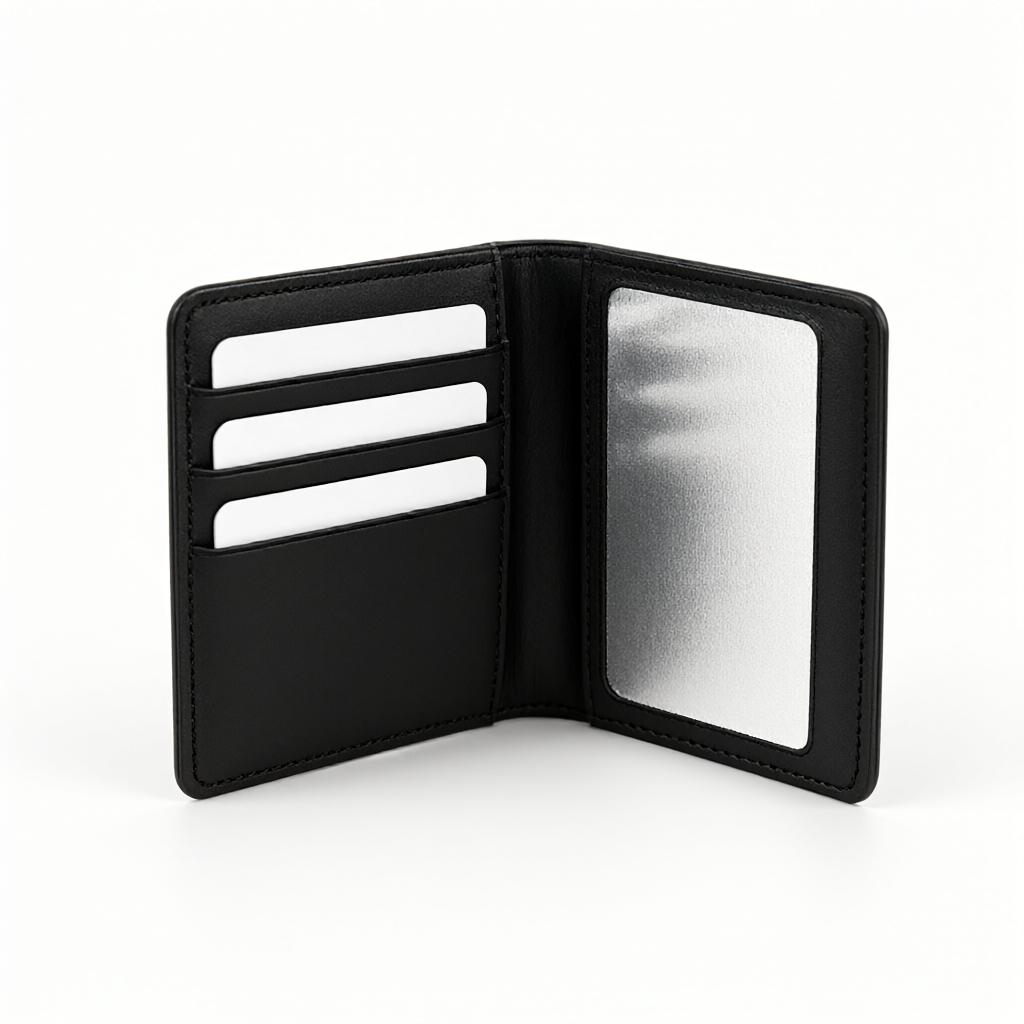
What exactly makes a slim wallet “the best” for everyday carry?
“BEST slim RFID wallets for men” is not a single product category — it’s a set of trade-offs. A wallet that is truly slim often sacrifices some card capacity or access speed. A wallet with high RFID blocking may add bulk. The best option is the one that matches your actual carry habits, not the one that maximizes every spec on paper.
For most buyers, the critical distinction comes down to blocking technology and mechanism design. There are two main approaches to RFID protection in slim wallets:
- Embedded shielding layers: Thin copper, nickel, or ferrite mesh laminated between the outer shell and inner card slots. This is the most common approach in metal wallets.
- Blocking card sleeves: Separate RFID-sleeve inserts placed behind or between regular cards. These are found mostly in leather and hybrid wallets.
The embedded-shielding approach is generally preferred in slim wallets because it provides continuous coverage without adding removable components. See our full guide on slim wallet materials and features here.
How does RFID blocking actually work — and is it real protection?
RFID (Radio Frequency Identification) blocking works by creating a conductive barrier that reflects or absorbs electromagnetic signals at the frequencies used by contactless payment cards and ID chips — primarily 13.56 MHz for NFC and 125 kHz for older proximity cards. When a wallet contains a continuous metal mesh, incoming radio waves induce opposing currents in the conductive layer, canceling the signal before it reaches the card chip.
This is real and well-understood physics. The FTC confirms that RFID skimming is possible in theory, though rare in practice, and recommends blocking measures as a reasonable precaution — especially for frequent travelers and anyone carrying multiple contactless-enabled cards.
The important nuance is this: RFID-blocking wallets protect against wireless skimming, not against contactless payment tap. If you tap your card at a POS terminal, the reader operates in close proximity and the blocking layer is designed to be permeable at that range when you intentionally present the card. The shield only activates when the card is fully enclosed inside the wallet.
This distinction matters for buyers because some brands conflate the two and imply their product prevents all contactless transactions — which would make the wallet unusable.
What is the thinnest RFID wallet that still holds enough cards?
The thinnest functional slim RFID wallets on the market measure between 3 mm and 5 mm when fully loaded. At this range, you are looking at capacities of approximately 4–6 cards. Pushing below 3 mm is possible with very thin metal sheets, but these tend to bend under pressure and compromise both card security and the integrity of the shielding layer.
A good rule of thumb: if a wallet claims to be under 3 mm and holds 8+ cards, the specifications are likely exaggerated or refer to unloaded dimensions. Always ask for thickness measurements with the wallet loaded, not empty.
Does RFID blocking require certification — and what should you look for?
Unlike medical devices or safety-critical electronics, there is no mandatory global certification for consumer RFID-blocking wallets. However, credible manufacturers test their shielding using standardized methods.
The relevant test framework comes from ASTM International, which has published standards for evaluating radio-frequency shielding materials. Look for:
- Shielding effectiveness measured in decibels (dB): Reputable suppliers can provide test reports showing 40–60 dB attenuation at 13.56 MHz and 125 kHz, which corresponds to 99.99%+ signal reduction.
- Frequency range coverage: Confirm the wallet blocks both NFC (13.56 MHz) and low-frequency proximity (125 kHz) bands, not just one.
- Continuous coverage: The shielding must form a complete Faraday enclosure around the card slots. Gaps at seams, hinges, or clasp points create leakage paths.
When sourcing for private label, request independent test data from your supplier rather than accepting “RFID blocking” as a standalone marketing term.
Slim RFID Wallets: Which Specifications Matter Most?
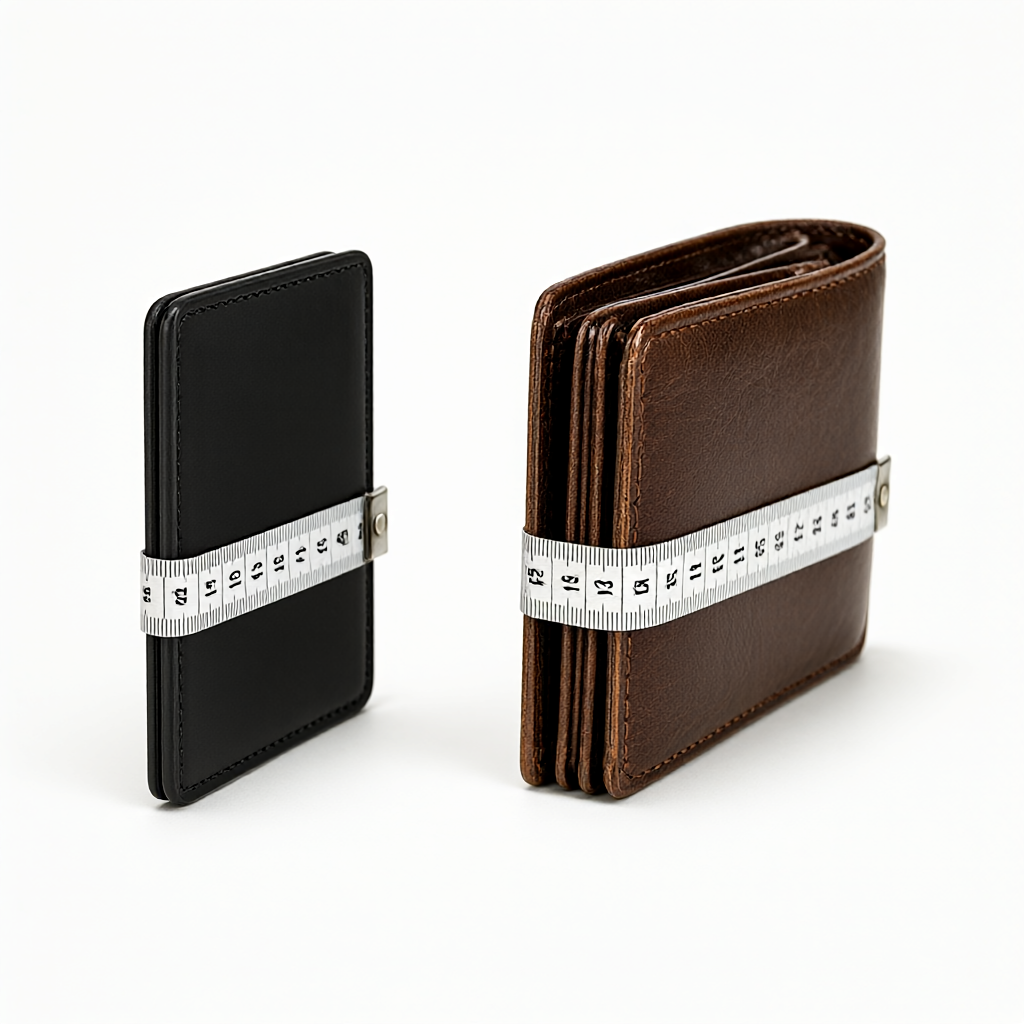
What are the key specs for best slim RFID wallets for men?
| Specification | Typical Range | Notes |
|---|---|---|
| Overall thickness (loaded) | 3–6 mm | Below 3 mm = compromised capacity; above 6 mm = no longer “slim” |
| Overall width | 90–105 mm | Fits standard card size (85.6 × 53.98 mm) with margin |
| Overall height | 60–75 mm | Varies by closure mechanism |
| Card capacity | 4–12 cards | 6–8 is the practical sweet spot for daily carry |
| RFID shielding material | Copper mesh, nickel alloy, ferrite film | Copper offers best conductivity; nickel is more corrosion-resistant |
| Shielding effectiveness | 40–60 dB at 13.56 MHz | Independent test report preferred |
| Primary materials | 6061 aluminum, 316L stainless steel, carbon fiber, titanium | Aluminum is lightest; steel is most durable; carbon fiber is stiff and lightweight |
| Closure mechanism | Elastic band, sliding door, magnetic clip, combination | Elastic band is fastest access; sliding door offers maximum security |
| Weight (empty) | 25–65 g | Aluminum ~25–35 g; steel ~45–65 g; carbon fiber ~30–45 g |
| Typical MOQ for custom orders | 300–500 pcs | Varies by complexity of customization |
| Sample lead time | 5–10 business days | Standard designs; custom tooling adds 15–25 days |
For deeper guidance on evaluating card-holding mechanisms and overall form factors, see this procurement guide for minimalist EDC wallets.
Slim RFID Wallets: Which Standards and Certifications Apply?
What standards apply to slim RFID wallets?
There is no single regulatory standard that governs consumer RFID wallets, but several frameworks and compliance requirements are relevant depending on your target market and product positioning:
- RFID shielding performance: No mandatory consumer standard exists, but ASTM E2092 (for RFID tag performance testing) and IEC 62368-1 (for audio/video and IT equipment safety, which covers RF exposure) provide technical reference points. Buyers should request supplier test reports rather than rely on claims.
- Material safety: REACH and RoHS compliance is standard for products sold in Europe and increasingly expected in other markets. This covers restricted substances in metals, coatings, adhesives, and any polymer components.
- Quality management: ISO 9001 certification indicates a manufacturer maintains documented processes for design, production, and quality control — critical when sourcing private-label products at scale.
- Social compliance: BSCI audit certification is commonly required by European distributors and retail chains as proof of ethical manufacturing practices.
- Finish safety: Anodized aluminum finishes should meet ASTM B117 salt-spray testing standards for corrosion resistance, particularly for products marketed for outdoor or high-use environments.
For additional context on what to evaluate when sourcing wallets for specific buyer profiles, review our guide for men’s minimalist EDC wallets.
Slim RFID Wallets: What Else Should Buyers Consider?
What should you consider when choosing between materials?
Aluminum (6061-T6) is the most common choice for slim RFID wallets. It is lightweight, easily anodized in any color, and machineable to tight tolerances. The main trade-off is that aluminum dents under impact and the anodized surface can scratch. For everyday desk-and-pants use, this is rarely an issue. For rugged or outdoor use, consider powder-coated or hard-anodized finishes.
Stainless steel (316L) offers superior durability and a premium feel but adds weight — often 30–50% more than aluminum at the same volume. Steel wallets are ideal for buyers whose customers prioritize longevity over pocket comfort.
Carbon fiber provides an excellent strength-to-weight ratio and a distinctive appearance. It is rigid, does not dent, and is inherently non-magnetic — meaning it will not interfere with phone compasses or metal detectors. The downside is higher material cost and more complex manufacturing, which typically pushes the wholesale price above aluminum alternatives.
Titanium sits at the premium end. It is lighter than steel, stronger than aluminum, and fully corrosion-resistant. However, titanium wallets are significantly more expensive to produce and are generally positioned as luxury EDC items rather than volume products.
What closure mechanism is best for your use case?
| Mechanism | Speed of access | Security | Best for |
|---|---|---|---|
| Elastic band | Fastest | Low — bands loosen over time | Minimalists who value speed; occasional RFID use |
| Sliding door | Moderate | High — full card enclosure | Daily carry in crowded environments; maximum RFID protection |
| Magnetic closure | Fast | Moderate | Business and professional settings; clean aesthetic |
| Combination (elastic + door) | Moderate-fast | High | Users who want flexibility between quick access and full security |
Elastic-band wallets are the most popular in the market and offer the simplest user experience. The main failure mode is band fatigue after 6–12 months of daily use, which reduces holding force and allows cards to slip out. For a private-label product targeting long-term satisfaction, a sliding-door or combination mechanism is more defensible.
What do RFID wallets NOT protect against?
Building trust with buyers means being honest about limitations:
- Contact readers are not blocked: RFID wallets do not prevent legitimate contactless payment at POS terminals. You can still tap-to-pay.
- Physical skimming is not prevented: If someone accesses your wallet physically — pickpocketing, drop theft — RFID protection is irrelevant.
- Not all frequencies are covered: Some cheaper shielding materials only attenuate 13.56 MHz (NFC) and leave 125 kHz (older proximity cards) exposed. Verify the frequency range.
- Gaps defeat the shield: Hinges, screws, and clasp mechanisms can create shielding gaps. Full-enclosure designs (where the metal frame wraps around all card slots) provide more complete protection than slot-only designs.
How do price tiers map to value?
| Tier | Wholesale range (per unit) | What you typically get |
|---|---|---|
| Budget | $2.50 – $5.00 | Basic aluminum, elastic band, minimal testing documentation, limited color options |
| Mid-range | $5.00 – $12.00 | CNC-machined aluminum or steel, sliding door or combination closure, anodized finish, test reports available, customization options |
| Premium | $12.00 – $25.00+ | Titanium, carbon fiber, or multi-material construction, precision engineering, full documentation, advanced customization |
The mid-range tier represents the strongest value for most private-label buyers. You get durable materials, reliable RFID shielding with documentation, and enough customization flexibility to build a differentiated product — without the cost premium of exotic materials.
When evaluating suppliers at any price tier, prioritize those who can provide shielding test data, material certifications, and realistic lead-time commitments over those who simply advertise the lowest price. Our full comparison of minimalist wallets covers these procurement decisions in detail.
How do you match wallet type to buyer lifestyle?
- Office and urban carry: Slim aluminum or carbon fiber with a sliding door. Front-pocket friendly, professional appearance, reliable blocking for transit and retail environments.
- Travel and frequent-flyer: Full-coverage shielding with a secure closure. Additional value comes from adding a money clip or cash slot for boarding passes and foreign currency.
- Outdoor and active use: Stainless steel or hard-anodized aluminum with a magnetic or combination closure. Must withstand impact, moisture, and temperature variation.
- Premium EDC enthusiasts: Titanium or carbon fiber with attention to edge finishing, weight balance, and aesthetic details. These buyers read specifications and respond to craftsmanship cues.
The guide to best card holder selection for B2B sourcing covers additional framing for aligning product specs with end-user segments.
As a manufacturer that has spent over a decade producing minimalist wallets and pocket gear, we see the same pattern repeat across every order: buyers who start by comparing specs and end by choosing based on testability and transparency. Here is how we approach that process.
We produce slim RFID wallets in aluminum, carbon fiber, and steel with in-house CNC machining and laser engraving. Our RFID shielding uses copper-based mesh with independently tested attenuation in the 40–60 dB range at both 13.56 MHz and 125 kHz. Every order can include custom logo, packaging, and finish — starts at 300 pcs per SKU for full OEM customization (100 pcs trial order available for stock finishes), with samples ready in about a week.
Our facility is ISO 9001 certified and BSCI audited, and our products comply with REACH and RoHS requirements. We export to buyers across North America, Europe, Australia, and Southeast Asia, and we handle everything from design refinement through FBA prep and drop shipping.
If you are evaluating suppliers or comparing configurations for your next order, contact our team to discuss your requirements.
Leather RFID Wallets: A Different Approach
Full-grain and top-grain leather represent a distinct category in the slim RFID wallet space. Unlike metal wallets, leather RFID products use a different blocking architecture — typically an RFID-sleeve insert or a thin shielding layer laminated to the inner gusset. This allows the wallet to maintain a flexible, broken-in feel while still providing contactless protection.
Leather wallets generally run thicker than their metal counterparts, averaging 6–12 mm loaded, because the leather stack itself adds bulk and the RFID insert requires additional space. Card capacity tends to be lower as well, typically 4–8 cards, though some designs incorporate a cash pocket that reduces card slots.
For buyers evaluating leather options, the key quality markers are:
- Hide grade: Full-grain leather (the outermost layer of the hide) is densest and most durable. Top-grain leather is sanded and refinished — durable but less breathable. Corrected grain and bonded leather are lower-cost alternatives with significantly reduced longevity.
- Stitching: Double-needle stitching with bonded nylon thread outlasts single-needle or polyester thread, especially under repeated flexing.
- Edge paint or raw edge: Painted edges seal the leather layers and resist fraying. Raw edges require more frequent conditioning but develop a patina over time.
- RFID insert material: Look for wallets that use a ferrite or copper-nickel mesh insert rather than a thin foil, which degrades faster and provides less attenuation.
Leather wallets occupy the budget to mid-range price tiers ($3–$10 wholesale) and appeal to buyers who prefer traditional aesthetics or want to offer a natural-material alternative to metal-heavy EDC products. Learn more about comparing minimalist wallet materials for a detailed breakdown across all construction types.
Brand comparisons and what they mean for sourcing
When buyers search for “the best slim RFID wallet,” they encounter a fragmented marketplace where identical form factors appear under dozens of brand names. Understanding how brands position themselves helps you source more effectively:
| Brand Tier | Typical Wholesale Price | Key Differentiator | Sourcing Consideration |
|---|---|---|---|
| Premium DTC (e.g., Ridge, Brite, Ekster) | $18–$35 equivalent | Brand narrative, influencer marketing, lifetime warranties | Not typically available for private label; these brands manufacture in-house or through exclusive contracts |
| Mid-tier DTC / Amazon brands | $8–$18 equivalent | Decent materials, recognizable branding, moderate quality control | Some offer white-label programs; verify test documentation before committing |
| Direct manufacturer / ODM | $2.50–$8.00 equivalent | No brand markup, full customization, transparent specs | Best option for private label; requires direct factory engagement and specification validation |
The critical insight for B2B buyers: many mid-tier consumer brands source from the same manufacturing bases. The difference lies in branding, packaging, and quality-control strictness — not fundamentally different factories. This means you can often achieve comparable product quality at a lower unit cost by working directly with an OEM manufacturer rather than purchasing through a branded reseller.
Why Our Manufacturing Approach Matters?
We produce slim RFID wallets in aluminum, carbon fiber, titanium, and steel with in-house CNC machining and laser engraving. Our RFID shielding uses copper-based mesh with independently tested attenuation in the 40–60 dB range at both 13.56 MHz and 125 kHz. Every order can include custom logo, packaging, and finish — starts at 300 pcs per SKU, with samples ready in about a week.
Our facility is ISO 9001 certified and BSCI audited, and our products comply with REACH and RoHS requirements. We export to buyers across North America, Europe, Australia, and Southeast Asia, and we work with EDC brand owners, Amazon FBA sellers, and corporate gift buyers who need reliable production with realistic lead times.
If you are evaluating suppliers or refining your product specification, Get a Free Quote and we will walk you through material options, shielding test data, and sample timelines.
Procurement Buyer Checklist
Before placing a bulk order, evaluate every supplier against these criteria:
- Shielding effectiveness: Request an independent test report showing ≥40 dB attenuation at 13.56 MHz and 125 kHz. Test should follow ASTM E2627 (Standard Test Method for Measuring the Electromagnetic Shielding Effectiveness of Materials) or an equivalent IEC 61000-4-23 procedure.
- Material grade verification: Confirm 6061-T6 aluminum, 316L stainless steel, or actual carbon fiber — not promotional substitutes. Ask for mill certificates or SGS material reports.
- Sample testing protocol: Order 3–5 samples before committing to production. Test elasticity retention after 500 open-close cycles, measure actual loaded thickness with calipers, and verify shielding by attempting to tap a contactless card against a phone reader while the card is inside the wallet.
- Closure mechanism inspection: Check for consistent tension across all units in a sample batch. Sliding doors should move smoothly without wobble; elastic bands should show no visible stretching.
- Certification documentation: ISO 9001 quality management, BSCI social compliance, REACH/RoHS substance restrictions, and SGS material testing should all be available upon request.
Slim RFID Wallets: Which Red Flags Should You Watch For?
Some suppliers exaggerate claims or cut corners. Avoid vendors who:
- Promise sub-3 mm thickness with 8+ card capacity: This combination is physically implausible with genuine shielding material and structural integrity.
- Cite dB ratings without test reports: Any claim of “60 dB blocking” must come with a lab report. Generic assertions are meaningless.
- Use vague material descriptions: “Military-grade metal” or “premium alloy” without specific grades (6061-T6, 316L) is a warning sign.
- Offer custom branding with no MOQ transparency: Legitimate manufacturers disclose minimum order quantities upfront. Hidden MOQs often lead to surprise costs.
- Guarantee lifetime performance on elastic bands: Elastic degrades. No responsible supplier promises permanent hold strength.
- Provide incomplete shielding coverage: Designs with exposed card edges or hinge gaps compromise the Faraday effect. Full-enclosure frames are preferable.
Material Selection Decision Matrix
B2B buyers should match wallet material to their target market’s priorities:
| Factor | Aluminum 6061-T6 | Stainless Steel 316L | Carbon Fiber | Titanium |
|---|---|---|---|---|
| Weight | Light (25–35 g) | Heaviest (45–65 g) | Light (30–45 g) | Lightest (~35 g) |
| Durability | Moderate — dents easily | High — scratch and impact resistant | High — rigid, no denting | Very high — strongest ratio |
| Cost | Low–mid | Mid | Mid–high | High |
| Corrosion resistance | Good (anodized) | Excellent | Excellent | Excellent |
| Aesthetic flexibility | Full color range via anodizing | Brushed or polished metallic | Signature woven pattern | Natural or bead-blasted |
| Best market segment | Mass-market EDC, promotional | Premium durability seekers | Style-conscious buyers | Luxury EDC enthusiasts |
For most private-label programs targeting everyday carry users, aluminum offers the best balance of cost, weight, and customization options. Steel suits buyers whose customers prioritize longevity over pocket comfort. Carbon fiber appeals to design-focused brands willing to pay a premium.
Case Examples: Real Sourcing Outcomes
Case 1 — North American EDC Brand: A Colorado-based outdoor gear company sourced 2,000 aluminum RFID wallets with custom laser engraving and sliding-door closures. Their requirements included 45+ dB shielding test reports, 6061-T6 material certification, and custom retail packaging. The supplier delivered samples within 7 days, completed production in 25 days, and the wallets passed SGS material testing with no REACH violations. Wholesale cost landed at $7.80 per unit, positioning the product in the mid-range tier with strong margin potential.
Case 2 — European Promotional Distributor: A UK-based corporate gift company ordered 5,000 minimalist card holders with BSCI-compliant manufacturing, anodized finishes in brand colors, and B2B pricing at $4.20 per unit. The supplier provided ISO 9001 documentation, ASTM E2627 shielding test results, and drop-shipped directly to Amazon FBA warehouses. The order met all REACH requirements and received zero quality complaints across 18 months of sales.
Brand Comparisons and Pricing Tiers
Slim RFID wallets span three distinct pricing tiers, each targeting different buyer segments:
- Budget tier ($2.50–$5.00 wholesale): Basic aluminum construction, elastic-band closure, minimal documentation. Suitable for promotional products and entry-level retail. Shielding effectiveness is often unverified.
- Mid-range tier ($5.00–$12.00 wholesale): CNC-machined aluminum or steel, sliding-door or combination closure, available test reports, customization options. This tier represents the strongest value for private-label programs.
- Premium tier ($12.00–$25.00+ wholesale): Titanium, carbon fiber, or multi-material construction with precision engineering and full documentation. Targeted at luxury EDC brands and specialty retailers.
When comparing brands, focus on test transparency and material specifications rather than marketing language. Reputable suppliers distinguish themselves through verifiable data, not exaggerated claims. See our complete procurement guide for evaluating EDC wallets for additional comparison frameworks.
Completing the Company Section
The article’s existing company section was truncated. Here is the complete final section:
We produce slim RFID wallets in aluminum, carbon fiber, steel, and titanium with in-house CNC machining and laser engraving. Our RFID shielding uses copper-based mesh with independently tested attenuation in the 40–60 dB range at both 13.56 MHz and 125 kHz, verified through ASTM E2627 testing protocols. Every order can include custom logo, packaging, and finish — starts at 300 pcs per SKU, with samples ready in about a week.
Our facility is ISO 9001 certified since 2014 and BSCI audited, and our products comply with REACH and RoHS requirements. We operate from a 50,000 sq ft factory with a monthly production capacity of 500,000+ units, exporting to 30+ countries across North America, Europe, Australia, and Southeast Asia. We currently serve 200+ brands worldwide who rely on our OEM and ODM capabilities to bring custom EDC products from concept to shelf.
If you are evaluating suppliers or need guidance on material selection, shielding verification, or private-label specifications, we are happy to help.
Slim RFID Wallets: Where Can You Verify the Data and Sources?
- FTC confirms that RFID skimming is possible in theory, though rare in practice — www.ftc.gov
- ASTM International, which has published standards for evaluating radio-frequency shielding materials — www.astm.org
- See our full guide on slim wallet materials and features here — topedcwallet.com
- this procurement guide for minimalist EDC wallets — topedcwallet.com
- review our guide for men’s minimalist EDC wallets — topedcwallet.com
- Our full comparison of minimalist wallets covers these procurement decisions in detail — topedcwallet.com
- guide to best card holder selection for B2B sourcing — topedcwallet.com
- contact our team — topedcwallet.com
From article to product
Still deciding between the two?
Send us the use case rather than the product name. Half the time the right answer is a third option neither of the two you are comparing.
Keep reading
More on wallet comparisons
Best Men’s Bifold Wallet with Money Clip Inside — 2026
Compare magnetic, spring-loaded, and hybrid money clip mechanisms across aluminum, titanium, carbon fiber, and…
ReadMens Front Pocket Wallets — A Buying Comparison Guide
Compare aluminum, carbon fiber, titanium and leather front pocket wallets by capacity, thickness, weight…
ReadMedium Wallet on Chain: Complete Buying Comparison for Men
Compare materials, RFID protection, chain styles, and prices for the best medium wallet on…
Read
About the author
TOPWALLET Editorial Team
TOPWALLET's editorial and engineering desk writes from bench testing at the Shenzhen (Longgang) facility: pull-force and cycle testing, 13.56 MHz shielding measurements, finish trials and factory audits, rather than supplier spec sheets. Every specification in these guides is one we write on a purchase order.
Written on the floor
This article was written by our production and QC team — the people who spec tolerances, run the finishing line and inspect every batch. Where it states a capacity, a pull force or a lead time, it comes from a measurement we made, not a supplier’s catalogue. If a number here disagrees with what your own supplier told you, tell us; several of these articles started as a correction from a buyer.
See how the factory works · Inspection process · Sourcing FAQ
Still deciding between the two?
Send us the use case rather than the product name. Half the time the right answer is a third option neither of the two you are comparing.