
RFID Knowledge · 12 min read
Is RFID Skimming Still a Real Threat in 2026? What the Evidence Actually Shows

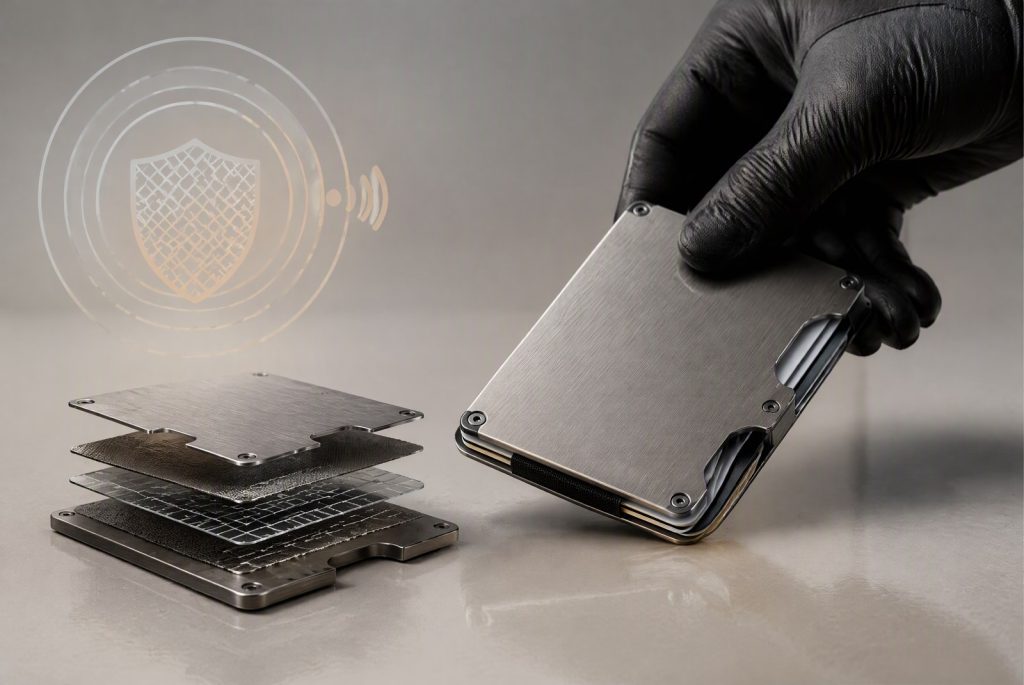
Every few months, another anxious thread asks "is rfid theft real?"—usually next to a $40 "RFID-blocking" wallet ad. Contactless payments have grown so quietly that most people no longer think about the radio chip inside their card, which is exactly why the question keeps resurfacing. This article separates the measurable threat from the marketing, using FTC warnings, payment-industry fraud data, and a 2025 academic security survey, so you can decide for yourself whether shielding your cards is a necessity, a nice-to-have, or a myth. Spoiler: the honest answer to "is rfid theft real" is more nuanced than either the panic sellers or the debunkers admit.
What RFID and Contactless Payment Actually Are
RFID (radio-frequency identification) is a broad family of short-range wireless technologies. The version in your cards is NFC, a subset designed for secure data exchange. The NFC Forum defines NFC as a short-range wireless technology enabling secure communication between devices just a few centimeters apart at 13.56 MHz [5]. The Federal Reserve's payments glossary describes "tap and pay" contactless transactions as using RFID and/or NFC standards, and states plainly that NFC "is designed to be a secure form of data exchange and can support EMV transactions" [4].
That last part matters, because it is the core technical answer to "is rfid theft real" at the protocol level: modern contactless cards do not broadcast their full static data. EMV (the chip standard) uses cryptograms, dynamic data, and a transaction counter, so a captured transmission is not a reusable copy of your card number in the way a photocopied signature used to be [4]. The card authenticates to the terminal, and the terminal authenticates to the network. That does not make contactless theft impossible—researchers have shown otherwise—but it changes the nature of the attack, as covered below.
How Card Data Actually Gets Stolen in the Real World
When payment fraud happens at a physical terminal, the overwhelming mechanism is not a radio grab. It is a skimmer. The FTC's consumer-alert system describes what law enforcement and regulators actually see: criminals hide illegal card skimmers on top of legitimate payment terminals in stores, "so they can grab data from your card's magnetic stripe." Once they have the card data and a PIN captured from hidden cameras or phishing calls, they "create duplicate cards and drain" the account [1]. The FTC issued that specific alert in May 2024 for SNAP/EBT benefits, where card cloning is rampant, but the same hardware threat applies to credit and debit cards at ATMs, gas pumps, and point-of-sale terminals [1].
Notice what the FTC's skimmer description targets: the magnetic stripe, not the contactless chip. Skimmers are cheap, passive, and effective against magstripe data because a stripe is static. Your contactless chip, by contrast, engages in an encrypted EMV exchange with the terminal [4]. So the frequently asked question "is rfid theft real" has a built-in confusion: most real-world card theft at terminals is magnetic-stripe theft, which an RFID-shielding wallet does nothing to stop.
The Protocol-Level Threats Researchers Actually Found
The sophisticated version of the question—can an attacker read or relay your contactless card without you noticing—has been studied seriously. A 2025 systematization-of-knowledge paper on the security of EMV contactless payment systems, accepted for the IEEE EuroS&P conference, maps the attack surface in detail [2]. The researchers organize attacks into three phases: application selection (which payment app or card profile is used), cardholder verification (how the terminal confirms it is you), and transaction authorization (how the payment is approved) [2].
Inside those phases, the paper identifies multiple attack vectors, including relay attacks (a device passes the card's response to a distant terminal), replay of captured transaction data, and downgrade tricks that push a contactless transaction to a less secure method [2]. Importantly, the authors successfully reproduced attacks against real Visa and Mastercard contactless protocols in a laboratory setting [2]. That is a genuine technical finding: contactless EMV is not unbreakable.
But read the practical caveats the same paper implies. These attacks require specialized hardware, careful timing, and—for relay attacks—a cooperative second device physically close to both the real card and the victim terminal. They are the territory of security researchers and well-resourced criminals, not of a stranger brushing past you with a pocket reader. The gap between "an attack exists in the lab" and "a criminal is running it on a subway" is exactly the gap that balancing "is rfid theft real" honestly requires.
How Big Is Contactless Card Fraud, Really?
Total payment fraud is large and growing, which is the evidence the fear side relies on. The UK's Annual Fraud Report for 2024, summarized by KPMG, recorded over £1.17 billion stolen in 2024 through unauthorised and authorised fraud combined, and more than 3.13 million confirmed cases of unauthorised fraud reported in that single year [3]. Those are real numbers, and they show that fraud is not hypothetical.
Now the other side of the ledger. Fraud at this scale is overwhelmingly high-volume, low-value attacks against the weakest links: online card-not-present fraud, phishing, identity theft, and magnetic-stripe skimming at physical terminals [1][3]. The same UK data that shows millions of fraud cases does not single out contactless relay theft as a meaningful share—if it were, security conferences would be reporting a wave of wallet-reader arrests instead of laboratory reproductions. The practical read for 2026:
- Physical card cloning (magstripe): real, common, documented by regulators [1].
- Contactless EMV protocol attacks: real, validated in research, but requiring specialized equipment and proximity [2].
- Casual "RFID skimming" of your wallet in a crowd: the scenario the panic ads sell; thin documented evidence, because modern cards need an engaged EMV terminal interaction and your chip does not broadcast static data [4][5].
Comparing Protections: What Actually Helps
| Layer | What it protects against | Evidence status |
|---|---|---|
| Magnetic-stripe skimmers at terminals | Nothing—stripe is read before any shield matters | Documented by FTC [1] |
| EMV chip cryptograms + transaction counters | Card data replay and static-number copying | Design documented by Federal Reserve [4] |
| Contactless transaction value limits | Large single losses from a stolen tap | Issuer set; part of cardholder verification design [4] |
| Physical inspection of terminals | Skimmer devices before your card touches them | Directly recommended by the FTC [1] |
| RFID-shielding sleeve, card, or wallet | Close-range contactless reads of your chip | Effective against genuinely short-range reads; the research threat needing proximity [2][5] |
The table explains why "is rfid theft real" gets different answers from different experts: every protection layer addresses a different failure mode. A shielded wallet is the layer that matters if you are worried about close-range reading of your chip—and only that layer. It does nothing against skimmers at the terminal you swipe through, because that attack reads the magnetic stripe on the way into the machine [1]. It also does nothing against online fraud, which is most of the problem [3].
Low-Cost Protection That Works Today
Before buying anything, these steps cost nothing and address the documented threats:
- Inspect the terminal. The FTC's own advice: check whether the card reader is loose, off-center, or wiggles, and don't insert your card if it does [1].
- Prefer chip/tap over swipe where you can. EMV exchange beats static magstripe transmission [4].
- Cover your PIN with your hand, always. Skimmers routinely pair with hidden cameras; PIN + card data is the full cloning package [1].
- Use your phone for mobile payments more often. Device-based payment uses tokenization and device-level verification that never expose the plastic's static details—the Federal Reserve's glossary explicitly lists consumer device cardholder verification methods such as Apple Pay and Face ID among contactless authentication options [4].
- Review statements monthly and report promptly. This is the safety net that catches whatever slips through.
What RFID-Blocking Wallets Do and Do Not Do
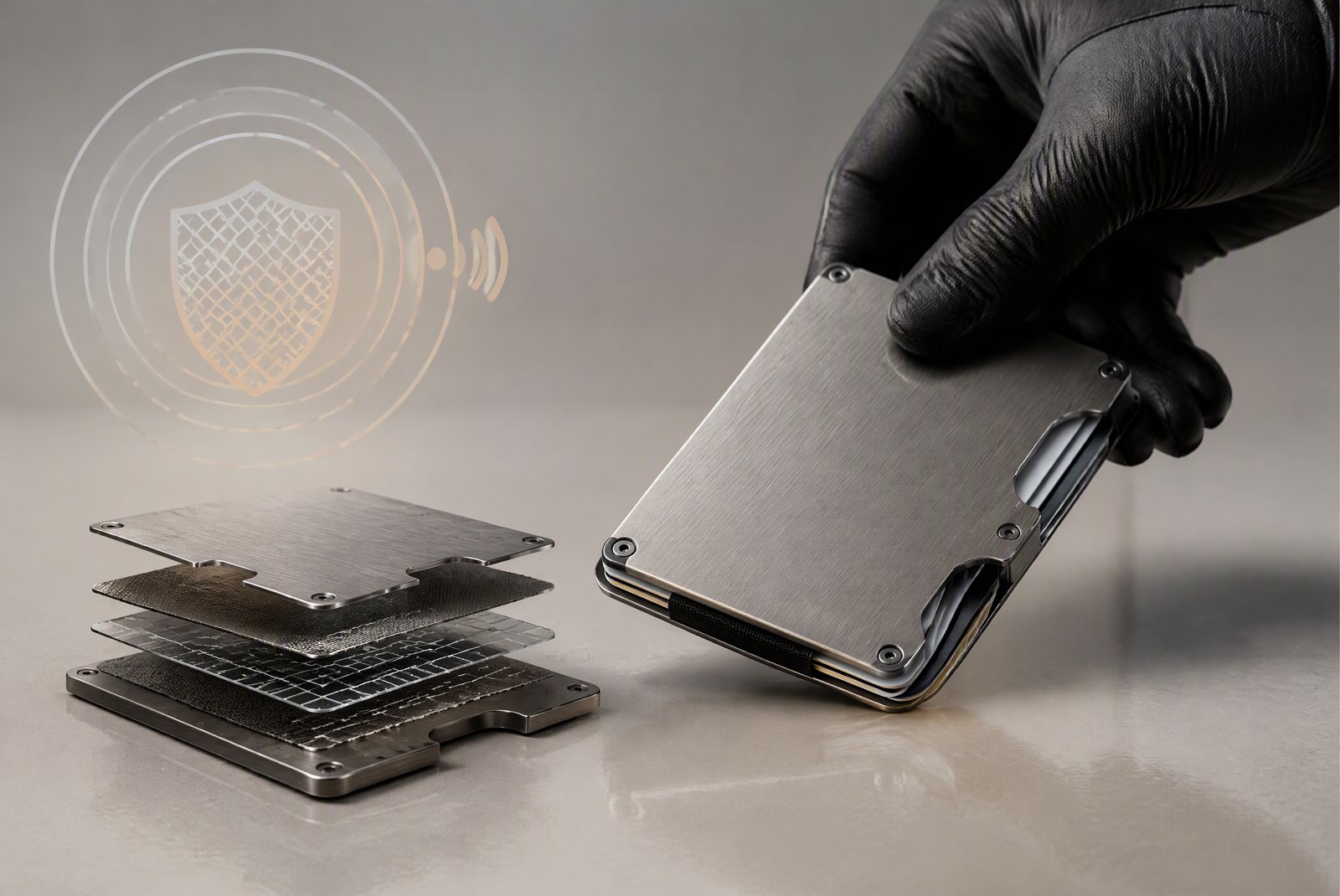
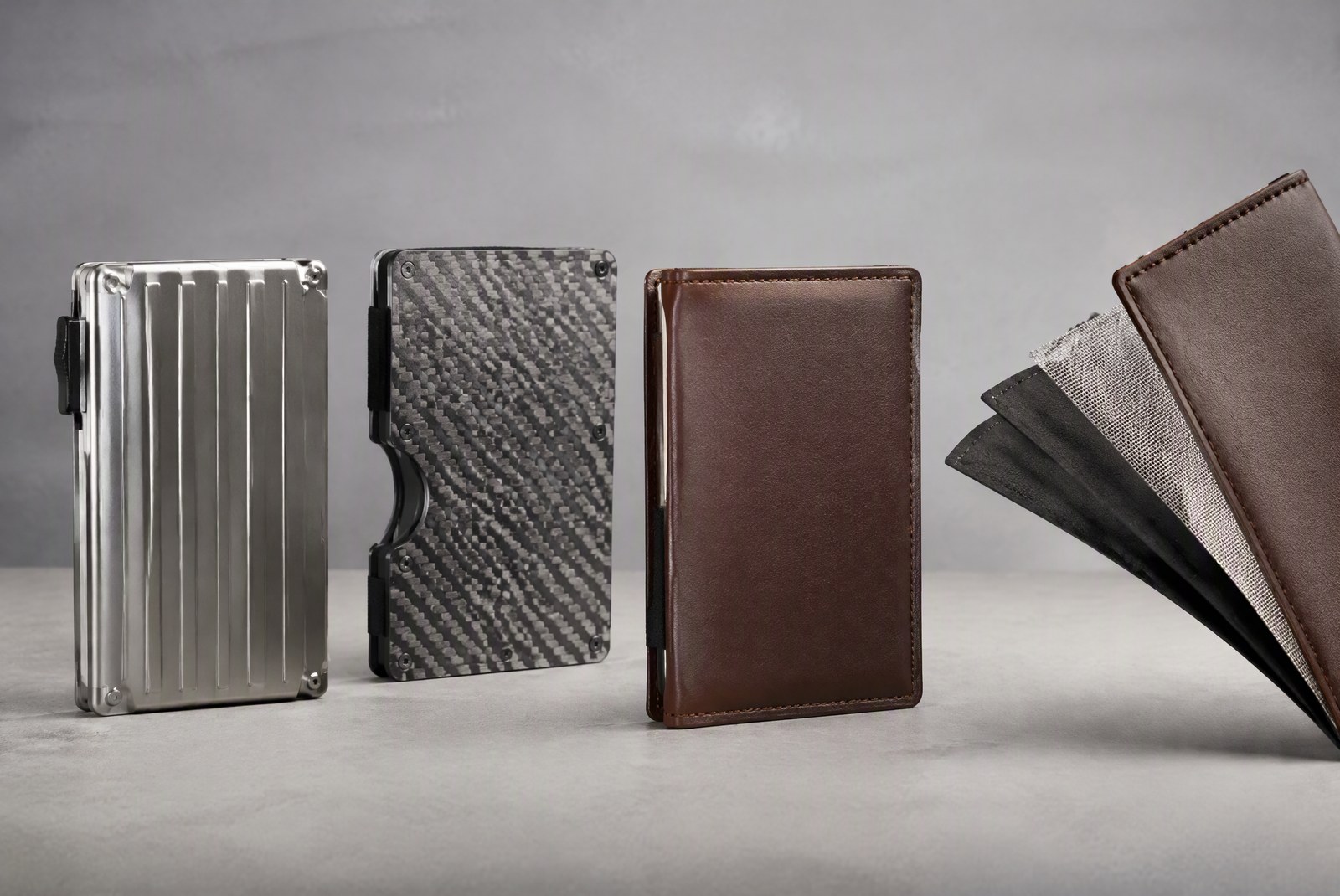
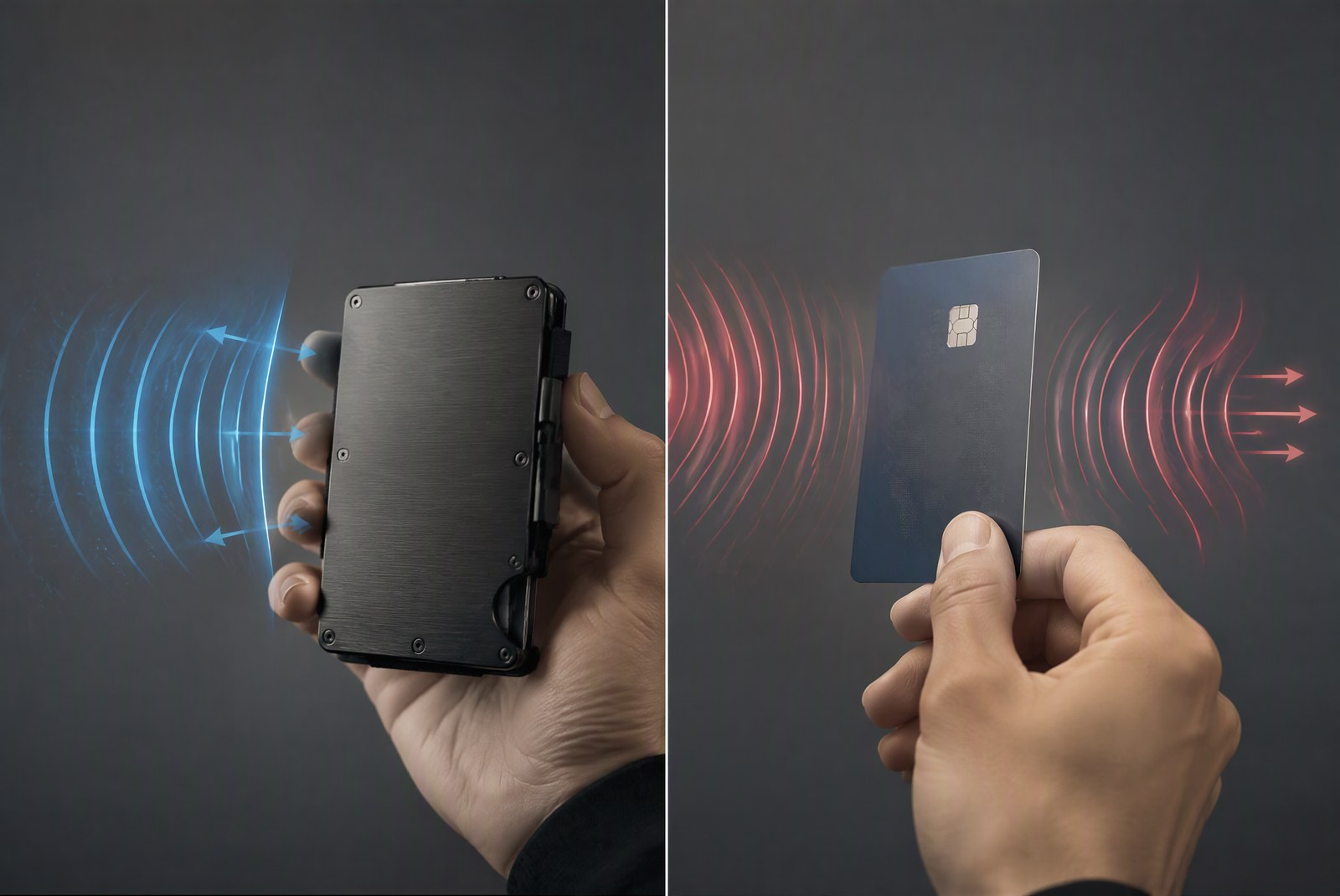
An RFID-blocking wallet is a legitimate tool with a narrow job: block radio-frequency reads of your card at close range. If you carry nothing but a shielded sleeve, it adds physical material and thickness without adding functionality. If you carry a wallet built from conductive material—metal or layered shielding—the entire structure acts as the shield, which is why metal and carbon-fiber card cases are structurally blocking rather than patch-on solutions [5].
TOPWALLET's card-carrying line is built around that structural approach: aluminum cases machined from 6061-T6 and 7075-T6 aerospace-grade aluminum, titanium options in TC21 and Gr5, 304/316L stainless steel, and 3K carbon fiber—all conductive or layered materials that attenuate RF transmission through the case body itself [6]. The manufacturer (GSTAR; unrelated to the now-retired Dutch denim brand G-Star RAW) has 15 years of production experience, serves 200+ brands, and runs 50,000 units per month of capacity under ISO 9001:2015 with four-stage quality control [6]. If you decide shielding is worth having, the straightforward purchase is a metal card case or an RFID-shielded leather slim wallet from the RFID wallet collection, with the wider product range and materials breakdown one click away. If you decide it is not, the evidence above says you are not being reckless—monitor your statements and inspect terminals, and you have covered the dominant threats [1][3].

Best by Use Case
- City commuters using transit cards and tap-to-pay daily → a structural metal or shielded wallet is a reasonable, cheap risk reduction [2][5].
- Frequent travelers through crowded transit hubs → shielding plus terminal inspection; proximity risk concentration is highest there [1][2].
- Anyone paying mostly by phone → your phone already uses tokenization; an RFID wallet is optional, not required [4].
- Older cards or legacy magstripe-only cards → be the most careful: inspect terminals and report losses fast; these cards lack EMV protections [1][4].
- Skeptics who want zero extra gear → skip the shield, but check statements monthly; skimming and phishing, not wallet reads, are the documented epidemic [1][3].
FAQ
How to protect credit cards from scanners?
Use a shielded wallet or sleeve. Keep cards in front pockets, not back pockets.
Can someone scan your credit card in your wallet?
Yes at close range (~10 cm) with a portable reader. Rare in practice, but not zero.
How to protect my credit card from being scanned?
Shielded wallet, front pocket carry, and avoid crowded transit if you are paranoid.
How to protect your credit card in your wallet?
Use an RFID-blocking sleeve or wallet. Front pocket carry removes most practical risk.
How to prevent RFID hacking?
A shielded wallet blocks the field before it reaches the card. That is the whole mechanism.
How to protect your credit cards?
Shielded wallet, front pocket, and monitor statements monthly.
Can RFID tags be scanned by a phone?
Yes via NFC. Practical range is about 2 cm, so real skimming requires close physical access.
How to protect credit cards while traveling?
Shielded wallet, money belt, front pocket carry. Monitor statements weekly while abroad.
Is RFID skimming real?
Two different threats get conflated here. Magnetic-stripe skimming at payment terminals is real, documented by the FTC, and widely reported. Close-range reads of modern EMV contactless chips exist in peer-reviewed research, but they need specialized equipment and physical proximity—a much higher bar than the panicked version of the story [1][2].
Does RFID skimming still happen in 2026?
Yes as a category, small as a share of total fraud. UK Finance data recorded more than 3.13 million unauthorised fraud cases in 2024, but the dominant mechanisms remain phishing, online fraud, and terminal skimming—not strangers reading wallets in crowds [3]. Proportionally, close-range card reads are a research-grade edge case [1][2][3].
Do RFID-blocking wallets actually work?
Structurally shielded wallets—metal cases, layered carbon fiber, or built-in shielding layers—physically attenuate radio-frequency reads of the cards inside [5]. They are effective for that narrow job: blocking short-range contactless reads. They do nothing against terminal skimmers, phishing, or online fraud, which are the documented epidemics [1][3].
Why do banks still issue contactless cards if they can be read?
Because the design does the heavy lifting: EMV produces cryptograms and dynamic transaction data, and NFC is built for secure short-range exchange that supports EMV [4]. Per-transaction value limits, issuer fraud monitoring, and cardholder protections such as disputing unauthorized charges cap the practical loss far below the risk of a cloned magstripe card [1][4].
Is my credit card data stolen by touching my pocket to someone's scanner?
That scenario is the least documented in the literature. Real-world terminal fraud overwhelmingly involves skimmers reading the magnetic stripe, hidden cameras capturing PINs, and cloned cards [1]. The published contactless attacks require controlled relay hardware and proximity, which is why regulators warn about skimmers, not pocket scanners [2].
What is the cheapest thing that protects my cards?
Inspect the card reader before you swipe—loose, crooked, or wiggling parts mean walk away—and cover your PIN while typing it [1]. Those two habits, plus a quick monthly statement review, address the documented theft mechanisms and cost nothing. A shielded wallet only adds close-range read protection [1][5].
—
Shielding where it measurably helps. If close-range read protection is worth having, the straightforward purchase is a metal card case or an RFID-shielded leather wallet. Browse the RFID wallet collection, see the full product range, or read the materials breakdown before you buy.
Get the monthly threat-and-carry brief. We send one short, source-backed update each month on card fraud, shielding, and the wallets we actually test—no spam, unsubscribe anytime. Subscribe to the TOPWALLET brief.
Related Reading
REQUEST A QUOTE → Tell us your spec and order volume. Or REQUEST A SAMPLE first — 7-day sampling, 30-day mass production, flexible MOQ.
Sources
- [1] Federal Trade Commission — Protect your SNAP benefits from illegal card skimmers (May 2024).
- arXiv — SoK: Security of EMV Contactless Payment Systems (IEEE EuroS&P, 2025).
- KPMG — UK Finance Annual Fraud Report 2024, summary insight.
- [4] Federal Reserve — NPIPS Payments Surveys Glossary of Terms (2020).
- [5] NFC Forum — What is NFC? Learn resource.
- TOPWALLET — Company and production background. https://topedcwallet.com/
From article to product
Building an RFID range?
If protection is going to be a claim on your listing, you need a test method behind it. We test every batch with a live 13.56 MHz reader and supply the report.
Keep reading
More on rfid knowledge
How Important Is RFID Blocking for EDC Wallets?
Understand RFID blocking importance for bulk wallet sourcing, what protects contactless cards, key specs…
ReadBest RFID Blocking Cards: B2B Procurement Guide 2026
Learn what makes an RFID blocking card effective, from frequency coverage to material shielding.…
ReadHow to Stop Your Cards From Demagnetizing (2026)
Here’s the short version: your cards demagnetize when a strong magnetic field scrambles the…
Read
About the author
Wu, Leon
Leon Wu is the senior product engineer and EDC testing lead at TOPWALLET. He has spent more than a decade on wallet design-for-manufacture, materials and quality control at the company's Dongguan facility, and writes from bench testing, pull-force and 13.56 MHz shielding measurements rather than supplier spec sheets.
Written on the floor
This article was written by our production and QC team — the people who spec tolerances, run the finishing line and inspect every batch. Where it states a capacity, a pull force or a lead time, it comes from a measurement we made, not a supplier’s catalogue. If a number here disagrees with what your own supplier told you, tell us; several of these articles started as a correction from a buyer.
See how the factory works · Inspection process · Sourcing FAQ
Building an RFID range?
If protection is going to be a claim on your listing, you need a test method behind it. We test every batch with a live 13.56 MHz reader and supply the report.