

What Makes a Great RFID Wallet for Women’s?
The best rfid wallet women’s options combine effective 13.56 MHz signal attenuation with a form factor that matches how women actually carry their cards — slim, lightweight, and compatible with both pockets and handbags. A strong answer must cover three criteria: proven RF shielding performance, a material system that survives daily use, and an OEM/ODM supply chain capable of delivering at the order volumes your program requires.
Quick decision framework:
- RF performance: Attenuation of ≥50 dB at 13.56 MHz, verified through ISO 14443–compatible testing.
- Build quality: Aircraft-grade aluminum alloy, carbon fiber, or titanium construction with corrosion-resistant anodizing or PVD coating.
- Capacity and fit: 4–12 card slots for a women’s profile; overall dimensions typically between 70–85 mm in height and 50–60 mm in width.
- Supply readiness: MOQ options from 300 pcs per SKU, sample lead times under 10 working days, and private-label packaging capability.
If you evaluate suppliers against these four markers, you are already ahead of buyers who compare only on price or appearance.
How Does RFID Blocking Actually Work?
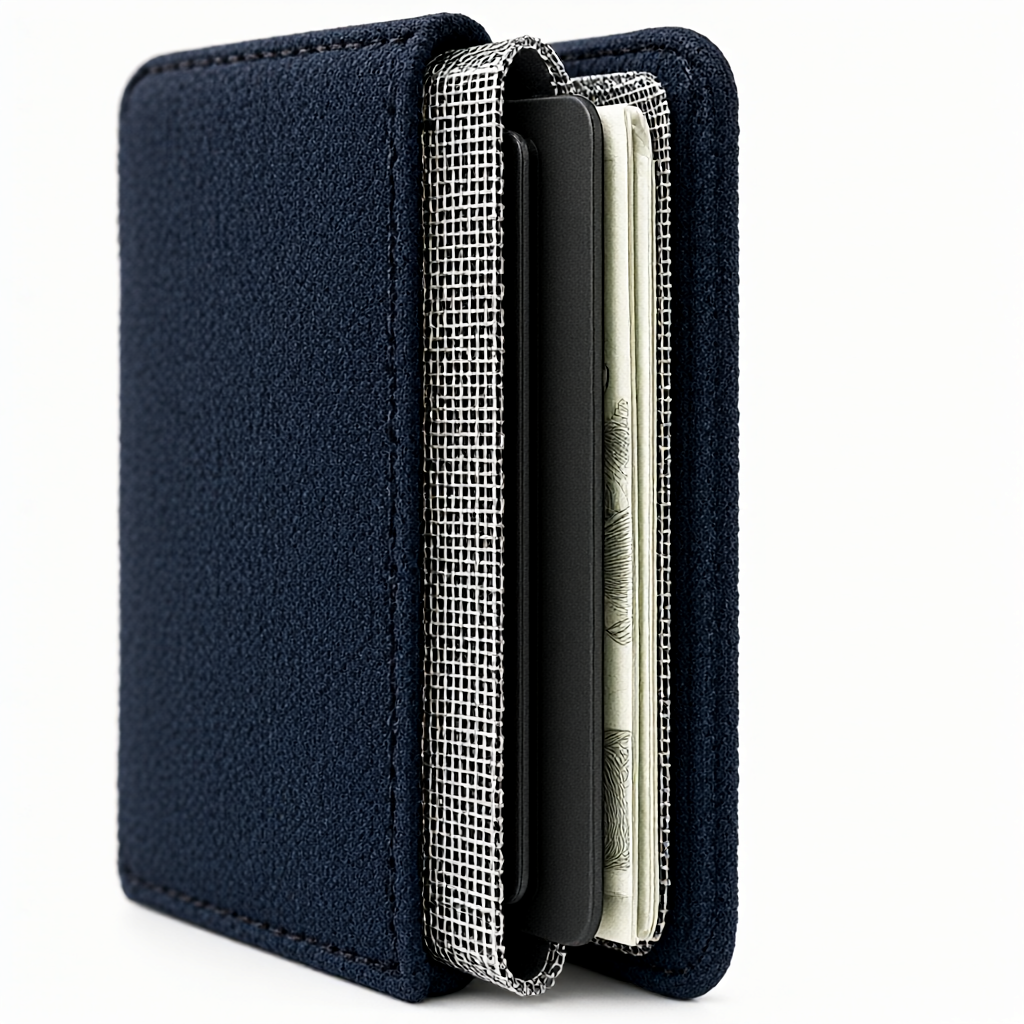
How do RFID-blocking wallets protect cards?
RFID-blocking wallets operate on the Faraday cage principle. A Faraday shield is a conductive enclosure that redistributes external electromagnetic fields around the exterior surface of the cage, preventing those fields from reaching the contents inside. In a wallet, that shielding is implemented as a thin metal mesh or laminated foil layer — typically aluminum, stainless steel, or copper — integrated between the outer shell and the card sleeves.
Contactless payment cards, transit cards, and e-passports all communicate at the 13.56 MHz high-frequency (HF) band, which falls under ISO/IEC 14443 (for proximity cards) and ISO 14443A/B specifications. When a reader attempts to energize a card’s antenna coil through inductive coupling, the Faraday layer absorbs and reflects that field energy. The card never reaches the power threshold needed to respond.
What frequency range does a women’s RFID wallet actually block?
Effective blocking is frequency-dependent. A well-designed shield targets:
- 13.56 MHz — EMV contactless payments, transit cards, access control cards, e-passport chips.
- 125 kHz — Older low-frequency access-control fobs (less common on modern payment cards but still found in corporate ID systems).
Some premium wallets add broadband shielding to cover UHF frequencies (860–960 MHz) used in inventory tags, though those frequencies are not a concern for payment-card security. The most important thing for a buyer to verify is that the manufacturer provides test data showing attenuation at 13.56 MHz, not just a blanket claim.
Why RFID Protection Matters for Contactless Cards?
Is RFID blocking still necessary in 2026?
Yes — but with a more nuanced view than early marketing suggested. EMV chip cards with contactless functionality are significantly harder to clone than old magnetic-stripe cards, and the actual rate of successful contactless skimming remains low. However, privacy-driven demand forRFID-shielded wallets has grown alongside contactless adoption, especially among consumers who carry multiple payment cards, transit passes, and IDs in a single wallet.
For B2B buyers, the opportunity is clear: even if full-skimming risk is modest, end-users increasingly expect a blocking layer as a baseline feature. A women’s RFID wallet without it will look under-specified in markets where best minimalist wallets for B2B sourcing and private label programs already standardize blocking as a table-stakes feature.
Which card types benefit most from shielding?
| Card type | Typical frequency | Blocking benefit |
|---|---|---|
| EMV contactless credit/debit | 13.56 MHz | Prevents unauthorized read of card number at point-of-sale proximity |
| Transit / commuter cards | 13.56 MHz | Protects balance privacy and prevents cloned transit credentials |
| E-passports (eMRTD) | 13.56 MHz (chip) | Guards against passive data extraction; required by many countries for chip authentication |
| Corporate ID / access cards | 125 kHz or 13.56 MHz | Prevents badge duplication in high-security facilities |
| Loyalty / membership cards | Variable | Mostly privacy-focused; low fraud risk |
The financial-fraud angle is often overstated in consumer media. The stronger business case is product differentiation and compliance with buyer requirements — especially for corporate gift orders and retail chain programs where buyers specify blocking as a hard requirement.
What Are the Key Specifications to Look For?
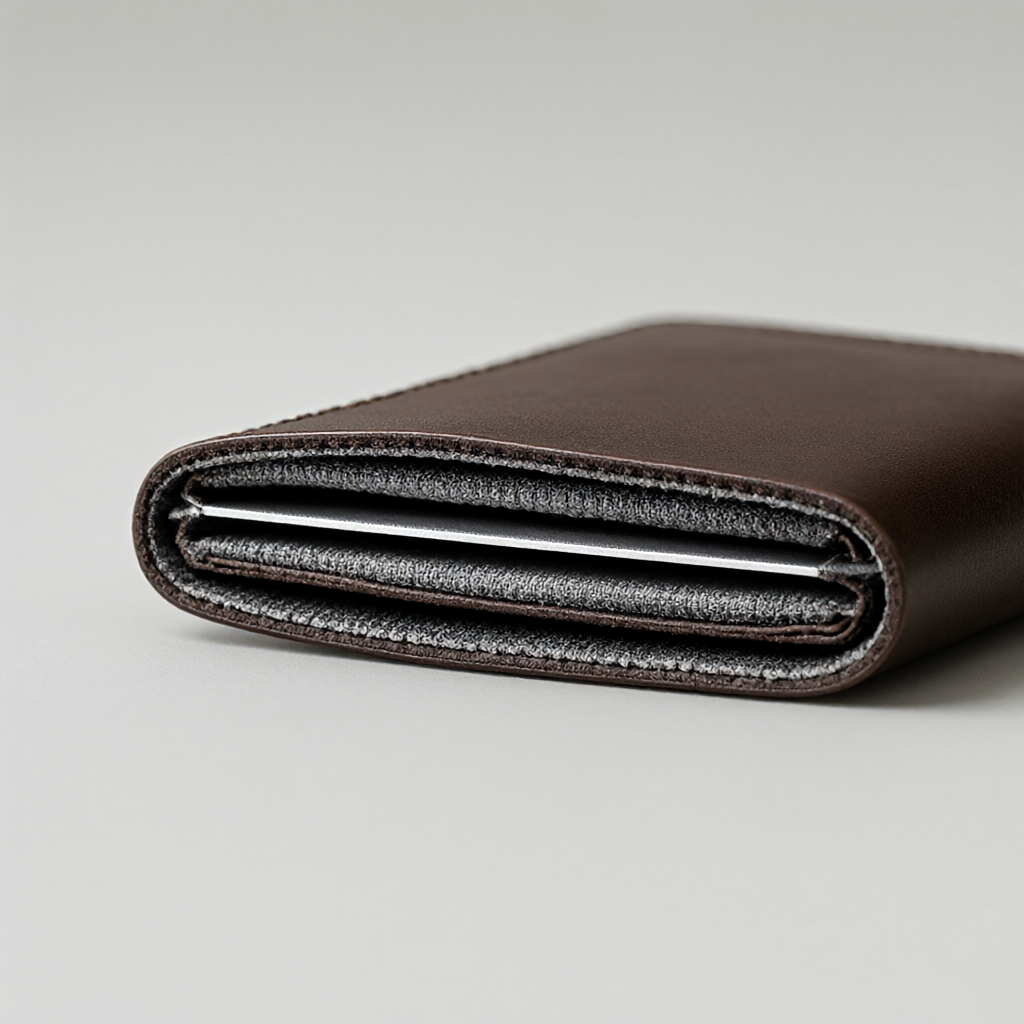
What are the key specs for the best RFID wallet women’s models?
When you move from consumer reviews to a B2B procurement evaluation, the spec sheet tells the real story. Here are the parameters that separate a well-engineered wallet from a thin-shell marketing product.
RF performance metrics
- Attenuation: ≥ 50 dB at 13.56 MHz is the practical floor; ≥ 60 dB indicates a well-designed multi-layer shield.
- Test methodology: Read with a validated NFC reader (e.g., PN532 or ACS ACR122U) at a controlled distance, per ISO/IEC 14443 procedures. Any supplier that cannot share test results should be treated as a higher-risk source.
Material system
- Aluminum alloy (6000-series) — Most common for slim metal wallets; lightweight (~25–45 g), corrosion-resistant after anodizing, and accepts laser engraving and UV printing for logos.
- Carbon fiber — Premium feel, very low weight, inherently non-conductive; RF shielding is added via an internal metal laminate. Higher unit cost but strong perceived value for EDC brand white-label production.
- Titanium — Highest strength-to-weight ratio and biocompatibility; used in tactical and premium segments. Heavier and more expensive than aluminum but delivers a distinct market position.
Physical dimensions (women’s profile)
- Height: 70–85 mm
- Width: 50–65 mm
- Thickness (closed, 6 cards): 6–10 mm
- Weight: 25–50 g depending on material
Card capacity and organization
- Single-clip holders: 1–4 cards — suitable for Amazon FBA private label sourcing at the lower price tier.
- Multi-card frames: 6–12 cards — the sweet spot for women’s everyday carry, balancing capacity with pocket- and clutch-friendly slimness.
- Cash pocket / money clip: Optional; some women’s designs omit cash storage entirely for a purely card-based profile.
Finish and durability
- Anodized aluminum: Hardness equivalent to ~HRC 30–40 surface; scratch-resistant; available in matte black, silver, rose gold, and custom colors.
- PVD-coated titanium: Superior wear resistance; higher cost.
- Edge treatment: Deburred and polished to prevent card-sleeve abrasion — a quality detail that affects long-term customer satisfaction.
If you want a reference point for how material selection and feature trade-offs play out across product lines, see our best card holder selection guide for B2B sourcing and everyday carry use.
What Standards and Certifications Apply?
What testing standards define a compliant RFID wallet?
There is no single global certification for consumer RFID wallets. Instead, compliance is demonstrated through a combination of RF performance testing and material safety certifications. Understanding the difference prevents buyers from accepting vague claims at face value.
RF performance standards
- ISO/IEC 14443 — Defines the air-interface protocol for proximity cards operating at 13.56 MHz. Wallet shielding should be tested against a card communicating under this standard; if the card cannot complete a read cycle at a specified distance, the shield is performing.
- ASTM E2092 — Covers RF shielding effectiveness measurement methodology. While originally developed for enclosures and structures, the same principles apply when adapted to wallet-scale specimens. Refer to ASTM International for current test method specifications.
- FCC Part 15 — Applies to intentional radiators; a wallet shield does not emit RF, so this is not directly applicable, but suppliers operating in the U.S. market should understand the regulatory boundary.
Material safety certifications
- REACH / RoHS compliance — Required for EU market entry; ensures restricted substances (lead, cadmium, certain phthalates) are below threshold limits in metals, coatings, and adhesives.
- SGS-tested materials — Third-party verification of material composition and finish safety; strengthens sourcing decisions for retail chain own-brand lines.
- BSCI audit — Social compliance certification for manufacturing facilities; relevant for brands requiring ethical-sourcing documentation.
- ISO 9001 — Quality management system certification; indicates consistent process control across production batches.
How should a buyer verify a supplier’s claims?
- Request a test report from an accredited lab (SGS, TÜV, Intertek, or equivalent) showing dB attenuation at 13.56 MHz.
- Ask for REACH/SGS material declarations for each variant (aluminum vs. carbon fiber vs. titanium).
- Confirm BSCI and ISO 9001 status through the certifying body’s public register.
- Order a pre-production sample and perform an independent read test with an NFC smartphone or dedicated reader.
- Review the supplier’s OEM RFID wallet supplier documentation for process control records and batch traceability.
What Should You Consider When Sourcing?
What customization options exist for B2B buyers?
Women’s RFID wallets offer extensive private-label flexibility:
- Logo application: Laser engraving on aluminum and titanium; UV printing on carbon fiber substrates; debossing on optional leather inserts.
- Color and finish: Standard anodized colors plus custom RAL or Pantone matching for aluminum surfaces.
- Packaging: Custom retail boxes, poly bags, hang tags, and barcode labels; Amazon FBA prep packaging with UPC/FNSKU compliance.
- Card configuration: 4-, 6-, 8-, or 10-card layouts; optional cash pocket; money clip add-on.
- Form factor variants: Slim single-clip, articulated frame, and hybrid designs that pair a metal RF shield with a textile exterior panel.
For a deeper look at how configuration choices impact unit economics and tooling lead times, refer to our best minimal wallets for B2B sourcing and private label programs procurement guide.
What procurement considerations determine supplier selection?
- MOQ: Minimum order quantities range widely. Programs starts at 300 pcs per SKU for full OEM customization (100 pcs trial order available for stock finishes) suit emerging brands and promotional buyers; higher tiers (500–1,000+) unlock better unit pricing.
- Sample lead time: Expect 5–10 working days for a generic sample; custom logo samples add 2–3 days for artwork proofing.
- Production lead time: 15–25 working days for confirmed orders, depending on complexity and volume.
- Quality control: In-line inspection at CNC machining, anodizing bath checks, and final RF-performance sampling (typically AQL 0.65 for critical attributes).
- Shipping and compliance: Drop-shipping to Amazon FBA warehouses, EU warehouse cross-docking, and export documentation support are standard for experienced contract manufacturers.
Here Is How the Industry Works — And How We Meet These Standards
As a contract manufacturer specializing in minimalist EDC wallets and pocket gear, our approach aligns directly with the specifications and sourcing criteria outlined above.
We operate a 50,000 sq ft in-house facility equipped with CNC machining centers for aluminum and titanium parts, laser engraving stations for logo application, and anodizing lines for surface finishing. This vertical integration means we control dimensional tolerance, surface quality, and RF-shield alignment in a single workflow — reducing the variation that often creeps in when sourcing spreads machining, coating, and assembly across separate vendors.
Our current product range includes aluminum alloy RFID wallets, carbon fiber card holders, and titanium money clips, all incorporating a 13.56 MHz Faraday-layer shield. We support OEM and ODM programs for EDC brand owners, Amazon FBA sellers, corporate gift distributors, and retail chain buyers, with MOQ starts at 300 pcs per SKU and sample lead times of 7 days for standard configurations.
Quality documentation — including ISO 9001 certification, BSCI audit status, REACH/RoHS compliance, and SGS-tested materials — is maintained on file and available for buyer review during the sourcing evaluation phase. Our export experience spans 200+ brands across North America, Europe, Australia, and Southeast Asia, and our monthly production capacity supports 500,000+ units without compromising batch consistency.
If you are evaluating suppliers for a women’s RFID wallet line, the practical next step is to share your opening sizes, target materials, and projected order volume. Our team can provide a comparative spec sheet, arrange pre-production samples, and confirm tooling requirements within a single project brief. Get a Free Quote
RFID Wallet For Women: Where Can You Verify the Data and Sources?
- ISO/IEC 14443 — www.iso.org
- ASTM International — www.astm.org
- best minimalist wallets for B2B sourcing and private label — topedcwallet.com
- laser engraving — topedcwallet.com
- EDC brand white-label production — topedcwallet.com
- Amazon FBA private label sourcing — topedcwallet.com
- OEM RFID wallet supplier — topedcwallet.com
From article to product
Building an RFID range?
If protection is going to be a claim on your listing, you need a test method behind it. We test every batch with a live 13.56 MHz reader and supply the report.
Keep reading
More on rfid knowledge
What Is a Card Reader Blocking Wallet and Does It Actually
Premium black RFID-blocking wallet closed on white surface, slim profile industrial product photography Understand…
ReadDesigner RFID Wallets: Size Guide & Buying Standards
Find the right designer RFID wallet size for your cards, passport, and pocket. Compare…
ReadRFID Card Blockers: Do They Actually Work? (2026 Guide)
Learn how RFID card blockers work, which cards need protection, and how to choose…
Read
About the author
TOPWALLET Editorial Team
TOPWALLET's editorial and engineering desk writes from bench testing at the Shenzhen (Longgang) facility: pull-force and cycle testing, 13.56 MHz shielding measurements, finish trials and factory audits, rather than supplier spec sheets. Every specification in these guides is one we write on a purchase order.
Written on the floor
This article was written by our production and QC team — the people who spec tolerances, run the finishing line and inspect every batch. Where it states a capacity, a pull force or a lead time, it comes from a measurement we made, not a supplier’s catalogue. If a number here disagrees with what your own supplier told you, tell us; several of these articles started as a correction from a buyer.
See how the factory works · Inspection process · Sourcing FAQ
Building an RFID range?
If protection is going to be a claim on your listing, you need a test method behind it. We test every batch with a live 13.56 MHz reader and supply the report.