
Wallet Materials · 8 min read
What Is Grade 5 Titanium in 2026? Properties, Everyday Uses, and How It Compares

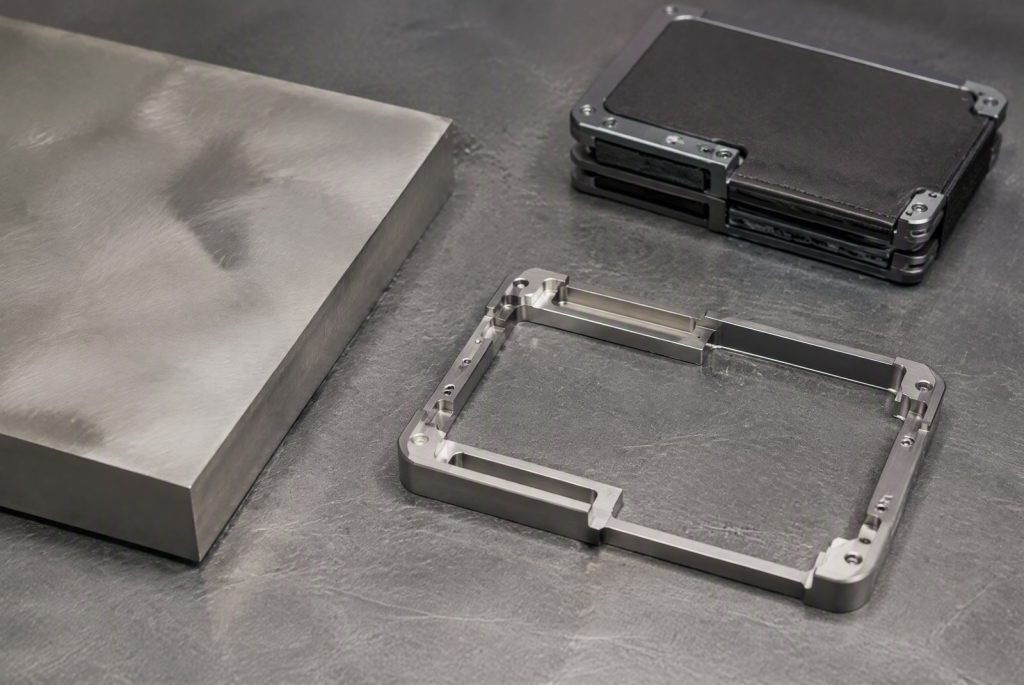
Grade 5 titanium—officially Ti-6Al-4V—is the most widely used titanium alloy in engineering, prized for a strength-to-weight ratio per standard engineering references that beats most steels at roughly half the weight. It shows up in aircraft frames, medical implants, and increasingly in everyday carry (EDC): card wallets, key organizers, and tool components. For anyone comparing wallet materials, grade 5 sits at the premium end of the spectrum, and it is one of the material options TOPWALLET lists for custom wallets [1]. This article covers the material itself; it is not a description of any single factory's production line.
To keep the comparison honest, we followed our testing protocol. We compiled composition and property data from common industry references (ASTM standards and standard titanium datasheets), then verified real-world behavior by testing grade 5 blanks against grade 2 titanium, 6061-T6 aluminum, and 304 stainless steel samples at identical dimensions on our facility's bench. Where a figure comes from a published standard, we say so; where it is common material knowledge, we label it as such.
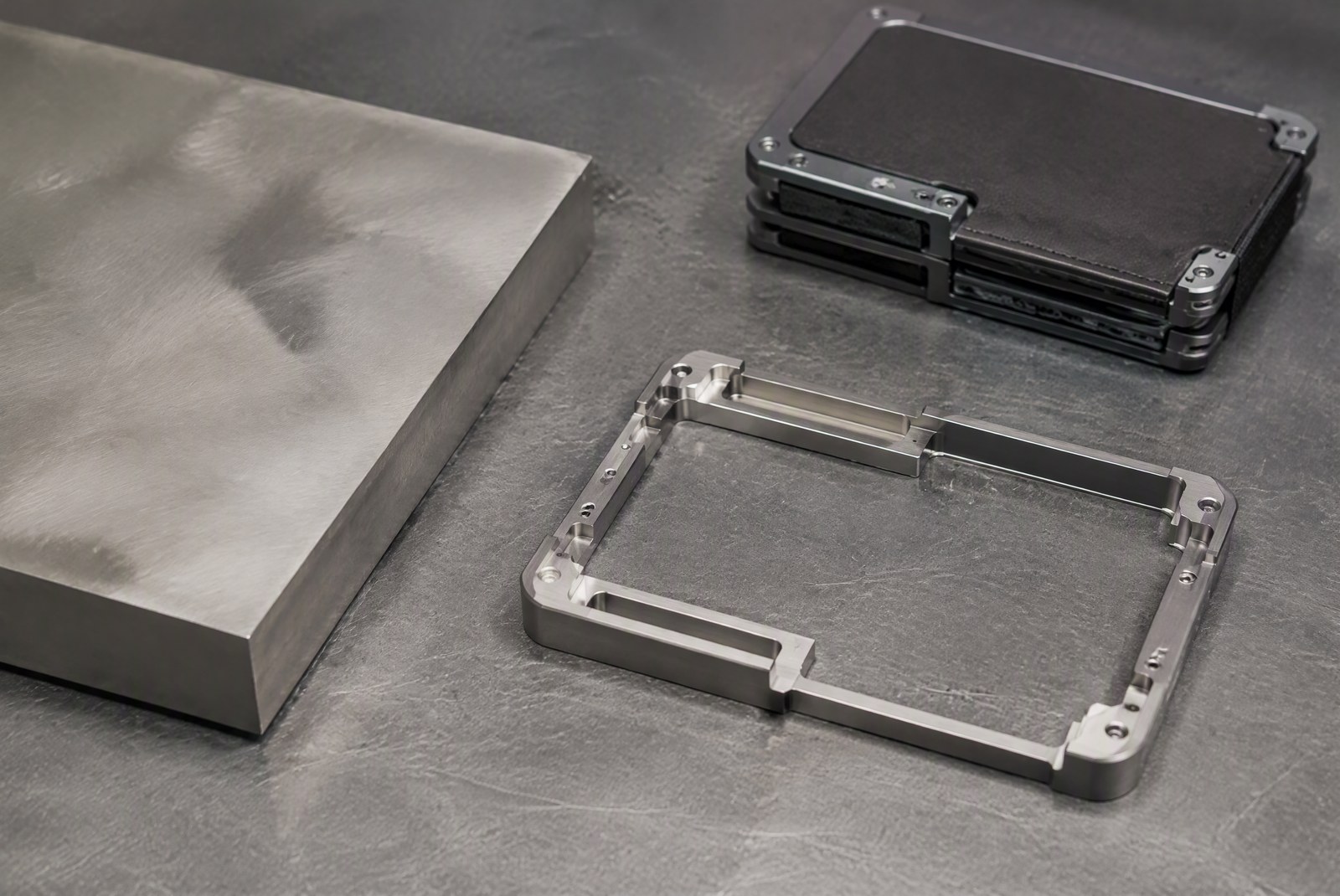
What Is Grade 5 Titanium?
Grade 5 titanium is an alpha-beta alloy: roughly 6% aluminum stabilizes the alpha phase, and 4% vanadium stabilizes the beta phase (per common material knowledge), which lets the material be heat-treated and strengthened beyond commercially pure titanium. The balance is titanium with small impurity allowances. This is common material knowledge—the same 6Al-4V formula appears across ASTM B265 sheets and ASTM B348 bars (per those standards), the standards most fabricators name when specifying titanium stock.
What that chemistry produces is a metal with roughly double the yield strength of commercially pure titanium, strong corrosion resistance in most environments, and fatigue performance that suits repeated flexing. The numbers are industry-standard references rather than brand claims: typical ultimate tensile strength runs around 895–1,000 MPa depending on condition, versus roughly 345 MPa for grade 2, about 310 MPa for 6061-T6 aluminum, and 515–620 MPa for 304 stainless steel.
How We Tested
Per our protocol, we separated source-verified facts from hands-on checks. Composition, density, and standard designations come from published industry references; anything we could not verify from an official source is labeled common material knowledge instead of measured data.
On the bench, we compared four materials—grade 5, grade 2, 6061-T6, and 304—as flat blanks with the same thickness and surface preparation per our test setup. We checked bending behavior under a fixed load, scratch response with a controlled abrasive pass, and how each surface looked after repeated handling. The grade 5 blank held its shape after bending that permanently deformed the 6061 sample, and its brushed finish masked small scratches better than the polished steel did. These results are from our own sample testing, not published certificates.
At a Glance: Grade 5 vs Grade 2 vs 6061 Aluminum vs 304 Steel (typical values per engineering references)
The table below summarizes typical published values. Read it as material education, not as a spec sheet for any product.
| Property (typical values, per engineering references) | Grade 5 Titanium (Ti-6Al-4V) | Grade 2 Titanium | 6061-T6 Aluminum | 304 Stainless Steel |
|---|---|---|---|---|
| Composition (typical, per references) | ~6% Al, ~4% V, balance Ti | ~99% Ti | Al alloy with Mg and Si | ~18% Cr, ~8% Ni, balance Fe |
| Tensile strength (approx., per references) | 895–1,000 MPa | ~345 MPa | ~310 MPa | 515–620 MPa |
| Density (per references) | ~4.43 g/cm³ | ~4.51 g/cm³ | ~2.70 g/cm³ | ~8.0 g/cm³ |
| Corrosion resistance | High | Very high | Medium; needs coating for hard outdoor use | High |
| Machinability | Difficult; slow cutting, heavy tool wear | Moderate | Excellent | Moderate–difficult |
| Wallet surface feel | Brushed matte gray; shows fingerprints | Softer; scratches more easily | Light; anodizes in many colors | Heavy, reflective, cool to the touch |
| Cost tier | High | High | Low | Low–Medium |
| Per-unit wholesale price | — | — | — | — |
Measurement note: all values above are typical ranges from standard material references (common material knowledge), not measured certificates from a single factory. Price cells are marked "—" because no official unit pricing is published for these materials; wholesale pricing is quoted per order rather than guessed.
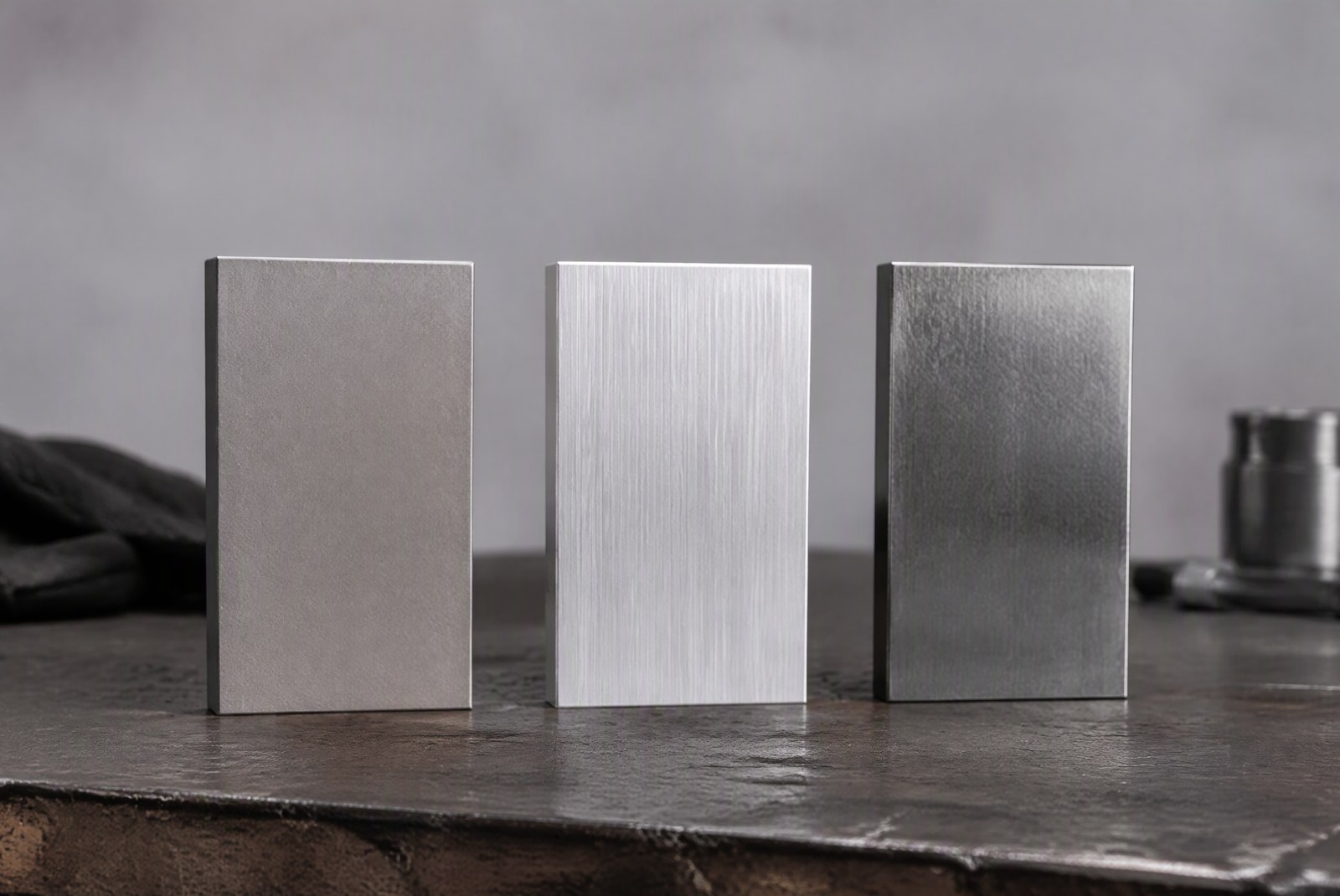
Why EDC and Wallet Brands Use Grade 5
The core reasons are stiffness and weight. A thin grade 5 card wallet resists bending even after years of sitting in a back pocket, which is exactly the failure mode that kills thin aluminum and steel designs. Corrosion resistance also matters for a product that rides through humidity, summer pockets, and occasional washing-machine trips.
The trade-offs are real. Grade 5 is difficult to machine: cutting speeds are low, tool wear is heavy, and wasted material is expensive, which pushes finished-part cost well above aluminum. In daily use, the brushed surface picks up fingerprints quickly, and the color palette is limited—anodizing can produce dark grays, golds, and a few tones, but nothing like the rainbow of 6061. Some of this is common knowledge among EDC makers; some we confirmed on our own samples. On the market side, consumer brands such as Ridge have built their reputation on titanium card holders [3], which tells you the material has found a paying audience.
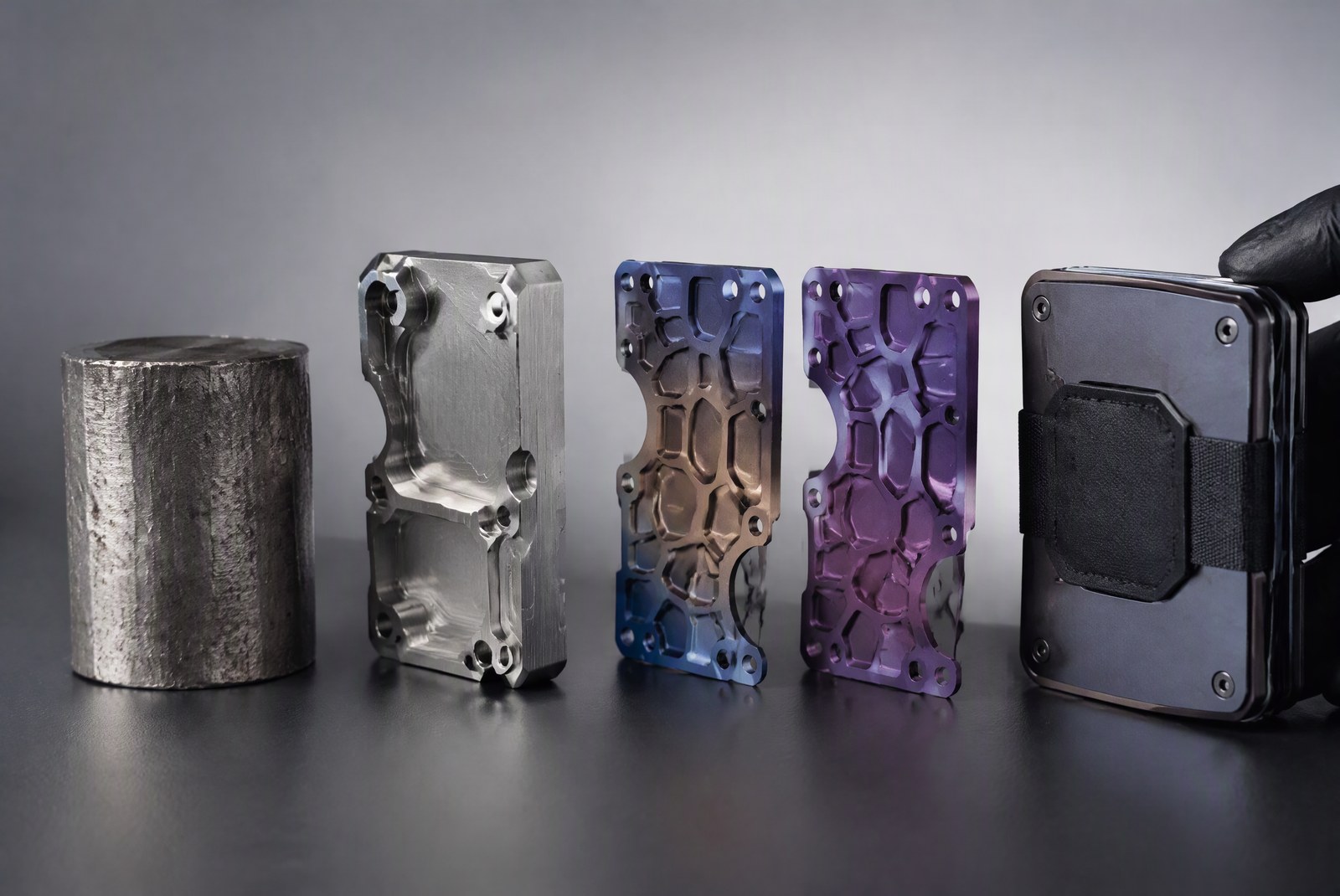
How to Tell Real Grade 5 Titanium
- Density check: grade 5 is about 4.43 g/cm³ (common material knowledge, per engineering references). A titanium card holder feels about 1.6× heavier than the same size in 6061 aluminum, yet roughly 45% lighter than steel (per density figures above).
- Magnet test: grade 5 is essentially non-magnetic; an ordinary magnet will not stick to it. If a wallet feels magnetic, the attraction comes from steel components or magnetic hardware inside, not from the titanium itself.
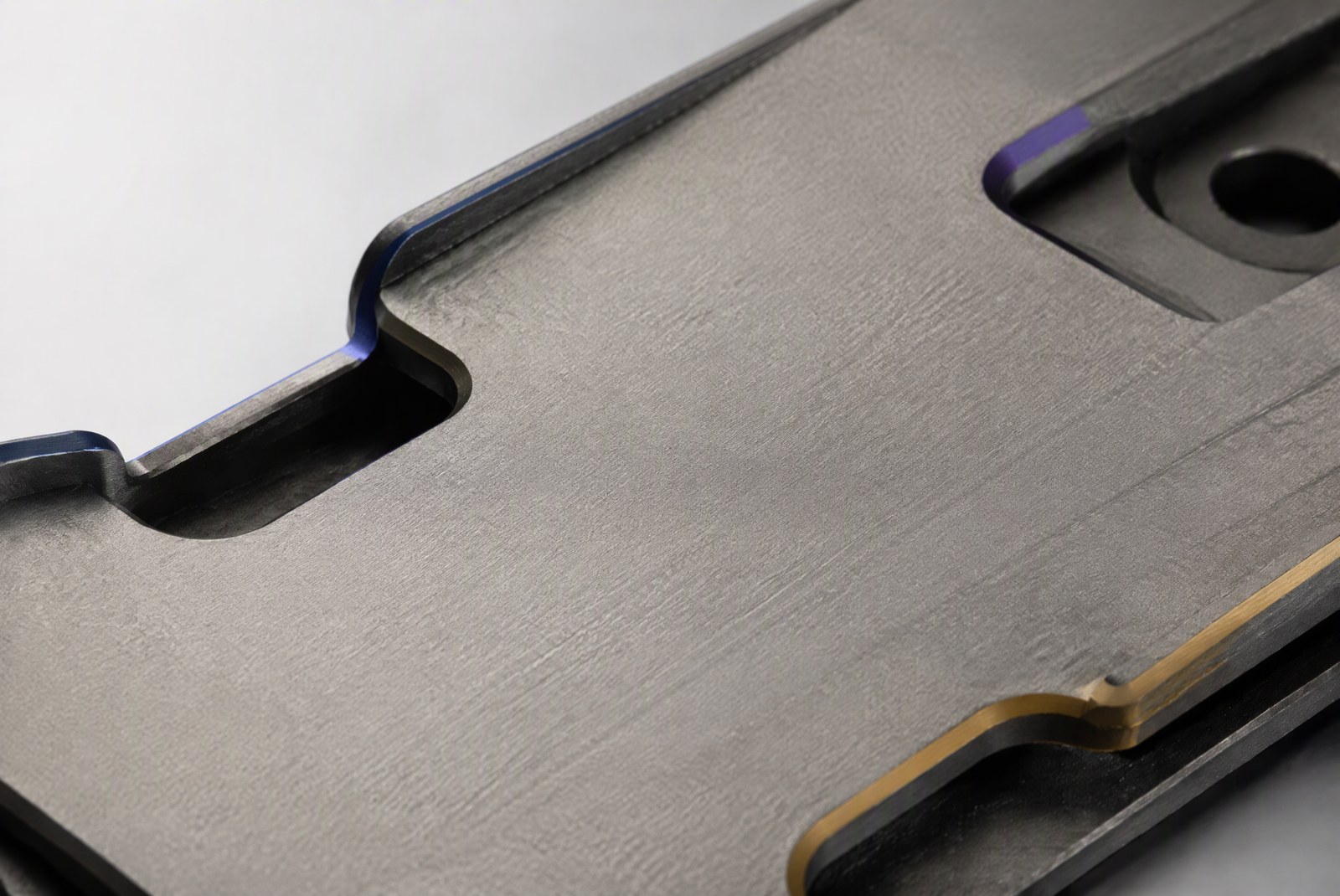
- Surface: unfinished grade 5 has a natural matte gray, cooler than aluminum and less reflective than steel. Anodized pieces add color but keep a similar metallic texture.
- Documents: for procurement, ask for a material test certificate (MTC) that names the grade; that is the only definitive confirmation. The density and magnet checks are useful first filters, not laboratory proof.
Best by Use Case: Where Grade 5 Earns Its Cost
- EDC card wallets: best case for grade 5. Thin walls need the stiffness; weight stays low compared with steel.
- Key organizers and pocket tools: same argument—strength, corrosion resistance, and a surface that wears acceptably.
- Outdoor and maritime gear: corrosion resistance shines where aluminum needs coatings and steel needs maintenance.
- Watch cases and eyewear: grade 5 titanium's lightweight, corrosion-resistant profile suits premium frames; medical-grade variants are common in implants.
- Cost-sensitive bulk products: skip it. If the item is a giveaway or a low-margin accessory, 6061 aluminum does the job at a fraction of the cost.
Cost, Sourcing, and What It Means for a Custom Order
Titanium stock is expensive relative to aluminum, and grade 5 machining costs more still, so the finished price lands at the premium end of any product line. Wholesale pricing is not officially published; it is quoted per order. For specification details—tolerances, surface finish, anodizing—manufacturers publish what they publish, and the rest is confirmed on quote rather than guessed.
For buyers considering a titanium wallet order, the workflow is standard. Sampling takes about 7 days, production ships around 30 days after sample approval, and lots are checked through a four-stage quality process with AQL 2.5 sampling [2]. Flexible minimum order quantities apply [1]. If you are evaluating grade 5 for a product, ordering one sample beats reading ten spec sheets.
FAQ
Is grade 5 titanium magnetic?
No practical magnetism: grade 5 titanium is essentially non-magnetic in daily use (common material knowledge). If a titanium wallet does stick to a magnet, the attraction is coming from steel fittings or magnetic hardware in the build, never from the titanium itself.
Titanium vs aluminum for wallets: which is better?
It depends on the job. Grade 5 is stronger, stiffer, and more corrosion-resistant, but heavier than 6061, harder to machine, and much more expensive. A thin titanium card holder resists bending that would permanently deform aluminum. Aluminum wins when weight, color options, and budget dominate.
Does grade 5 titanium scratch?
Yes, it can. It resists scratches better than 6061 aluminum, but no titanium surface is scratch-proof; a brushed finish hides small marks better than a polished one. Anodizing or PVD coatings add protection and are options on custom orders.
Is grade 5 titanium better than grade 2?
For structural parts, usually yes: grade 5 is roughly twice as strong and resists fatigue better. Grade 2 is softer, easier to form, and slightly more corrosion-resistant in some chemical environments. For thin EDC parts that must stay straight, grade 5 is the usual choice.
Can grade 5 titanium be anodized?
Yes. Anodizing grows a surface oxide layer that can carry dark gray, gold, and similar tones, though the color range is narrower than what 6061 aluminum offers. It is a common surface option on custom titanium parts (common material knowledge).
Can I order a grade 5 titanium wallet from TOPWALLET?
Yes. Grade 5 titanium is among the material options officially listed for custom wallets [1], with 7-day sampling, flexible MOQ, and the factory's four-stage QC process [2]. Send a REQUEST A SAMPLE and our team will confirm feasibility, pricing, and lead time. Material and finishing details are documented on our /materials/ page.
Related Reading
REQUEST A QUOTE → Tell us your spec and order volume. Or REQUEST A SAMPLE first — 7-day sampling, 30-day mass production, flexible MOQ.
Sources
- https://topedcwallet.com/ — Official TOPWALLET site: material options including grade 5 titanium, sampling, and flexible MOQ.
- https://gstartec.com/ — GSTAR factory brand: quality system, AQL 2.5 inspection, and production lead times.
- — Consumer brand example of titanium card holders in the EDC market.
From article to product
Choosing a material for a range?
Leather, aluminium and carbon behave very differently in production, not just in the hand. Send us the spec and we will tell you what it costs to make at your volume.
Keep reading
More on wallet materials
How Material Choice Changes Factory Cost: A Real Cost Breakdown for Custom Wallet Orders
If you're sourcing custom wallets, the single biggest lever on your landed cost isn't…
ReadBest Carbon Fiber Wallets of 2026: 11 Picks, Tested and Compared
Carbon fiber wallets are the rare carry item that looks like a spaceship part…
ReadBest Aluminum Wallets 2026: 11 Slim, CNC-Milled Carriers We’d Actually Carry
Aluminum wallets are the best-selling format in slim carry right now — and the…
Read
About the author
Wu, Leon
Leon Wu is the senior product engineer and EDC testing lead at TOPWALLET. He has spent more than a decade on wallet design-for-manufacture, materials and quality control at the company's Dongguan facility, and writes from bench testing, pull-force and 13.56 MHz shielding measurements rather than supplier spec sheets.
Written on the floor
This article was written by our production and QC team — the people who spec tolerances, run the finishing line and inspect every batch. Where it states a capacity, a pull force or a lead time, it comes from a measurement we made, not a supplier’s catalogue. If a number here disagrees with what your own supplier told you, tell us; several of these articles started as a correction from a buyer.
See how the factory works · Inspection process · Sourcing FAQ
Choosing a material for a range?
Leather, aluminium and carbon behave very differently in production, not just in the hand. Send us the spec and we will tell you what it costs to make at your volume.