

A chain wallet is a minimalist pocket wallet secured with a metal chain and clasp mechanism that compresses plates around cards and cash. The best models for everyday carry in 2026 use aerospace-grade aluminum, Grade 5 titanium, or carbon-fiber-reinforced bodies, incorporate certified RFID-blocking layers where required by ASTM F2923-22a performance thresholds, and offer OEM customization from low MOQs with predictable sample-to-production lead times. B2B buyers should evaluate closure cycle durability, anodized coating thickness, dimensional consistency, and supplier certifications before placing bulk orders.
What Is the Best Chain Wallet for Everyday Carry?
The best chain wallet is a compact pocket wallet that secures contents with a metal chain closure instead of a traditional bi-fold or snap mechanism. For everyday carry, the strongest candidates combine a minimalist metal or carbon fiber body, reliable chain tension, sufficient card capacity for daily essentials, and RFID-blocking material if the buyer carries contactless cards. Aluminum remains the most common entry-level choice because of its balance between weight, cost, and durability; titanium is preferred when higher strength-to-weight ratio and corrosion resistance are priorities; and carbon fiber is chosen primarily for aesthetics combined with lightness and scratch resistance.
When sourcing for private label or wholesale distribution, the decisive factors shift from appearance alone toward consistent manufacturing tolerances, verified surface finishes, functional chain hardware, and predictable lead times. Buyers typically evaluate a chain closure wallet against three practical criteria: whether the chain closure holds reliably under repeated use, whether the card stack sits flush inside the body without bulging, and whether the finish survives pocket abrasion over months of field use.
For additional guidance on evaluating slim pocket wallets, see our best wallet for B2B buyers procurement guide.
How Do Chain Wallet Closures Work, and Why Do They Matter?
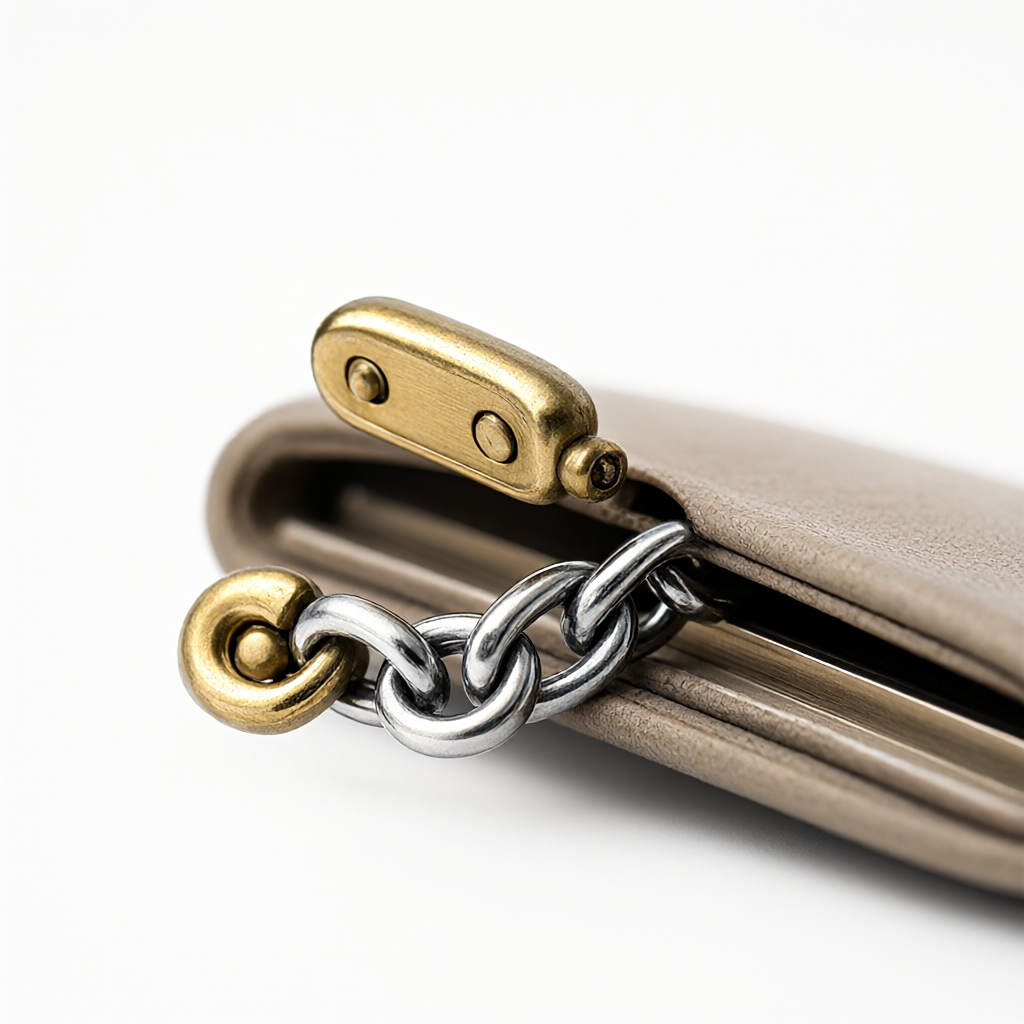
What makes a chain wallet different from other EDC wallets?
A chain-style wallet relies on a metal chain threaded through anchor points on the wallet body and routed through fingers or loops on the opposite side. When the chain is pulled tight, the plates compress around the card stack and cash. This mechanical design differs from a traditional bifold wallet, which depends on leather flex and friction to stay closed, and from snap or magnetic closures, which can fail unexpectedly when the magnet weakens or the snap loosens.
Chain closure wallets are popular among outdoor and field use scenarios because gravity and kinetic movement do not easily open them. A hiker walking downhill or someone pulling gear out of a pack is unlikely to spill cards from a properly tensioned chain closure. However, that same reliability creates a trade-off: retrieving a frequently used card requires unclipping or loosening the chain, so users who swap cards often may prefer an alternative layout.
From a sourcing perspective, the chain mechanism introduces quality variables that do not exist in simple plate wallets. The chain must maintain tension without permanent deformation, the attachment anchors must resist pull-out forces, and the overall closure force must be strong enough to hold contents but smooth enough to operate one-handed. Manufacturers that engineer these parameters together tend to produce more dependable products than those that source generic chain hardware and only add a branded body.
Which materials are best for a chain wallet and why?
Material selection determines weight, durability, aesthetic options, and unit cost. Each material serves different buyer profiles:
| Material | Typical characteristics | Best use case |
|---|---|---|
| Aluminum alloy | Lightweight, anodized surfaces available in many colors, moderate scratch resistance, lower cost | Entry-level price points and high-volume promotional programs |
| Titanium | Higher strength-to-weight ratio, excellent corrosion resistance, brushed or bead-blasted finishes, higher raw-material cost | Premium positioning where longevity and light weight justify a higher retail price |
| Carbon fiber | Very light, high scratch resistance, distinctive woven appearance, generally paired with aluminum or titanium frames | Design-forward models aimed at style-conscious buyers |
Aluminum wallets dominate volume production because CNC machining and anodizing are mature processes with stable yields. Titanium is increasingly common in mid-tier and premium segments where the target price point absorbs the material premium. Carbon fiber components are usually composite inserts rather than monolithic bodies, since pure carbon fiber is difficult to machine into precise structural shapes without bonding to a metal substrate.
Surface treatment matters more than raw material alone. An anodized layer protects aluminum from corrosion and wear, while proper sealing prevents fading during sweat exposure. Buyers evaluating options across multiple suppliers should compare not just base material but coating thickness and color consistency, especially when matching brand color codes. For insights on material trade-offs beyond metals, you can review our minimalist wallets materials and buying considerations comparison.
How much card capacity should a chain wallet hold?
Most minimalist chain wallets are engineered for 4 to 12 cards plus folded cash. The exact number depends on body thickness, plate spacing, and whether the design includes a separate bill slot. Practical capacity varies by product geometry:
- Ultra-slim tactical card holder styles typically accommodate 4 to 6 cards and a small cash strap. These appeal to buyers who prioritize lowest-profile pockets but sacrifice note capacity.
- Standard minimalist chain wallet formats usually hold 6 to 10 cards and a folded bill compartment, striking the most common balance between capacity and pocket presence.
- Larger pocket organizer wallets may support 10 to 12 cards plus additional slots, but they increase bulk and may feel too heavy for users accustomed to single-pocket carry.
Card stack height is rarely constant. Credit and debit cards vary slightly in thickness by issuer and region, and adding a driver’s license or membership card increases stack rigidity. A well-designed wallet allows a snug but removable stack without requiring excessive force that could distort the chain or loosen anchors over time.
Sourcing buyers should request actual packed dimensions rather than relying solely on advertised card counts. Measured stack height and width reveal whether a 6-card design is genuinely slimmer than a competing 10-card model or merely stretched to claim higher capacity.
What Standards Apply to Chain Wallet Manufacturing?
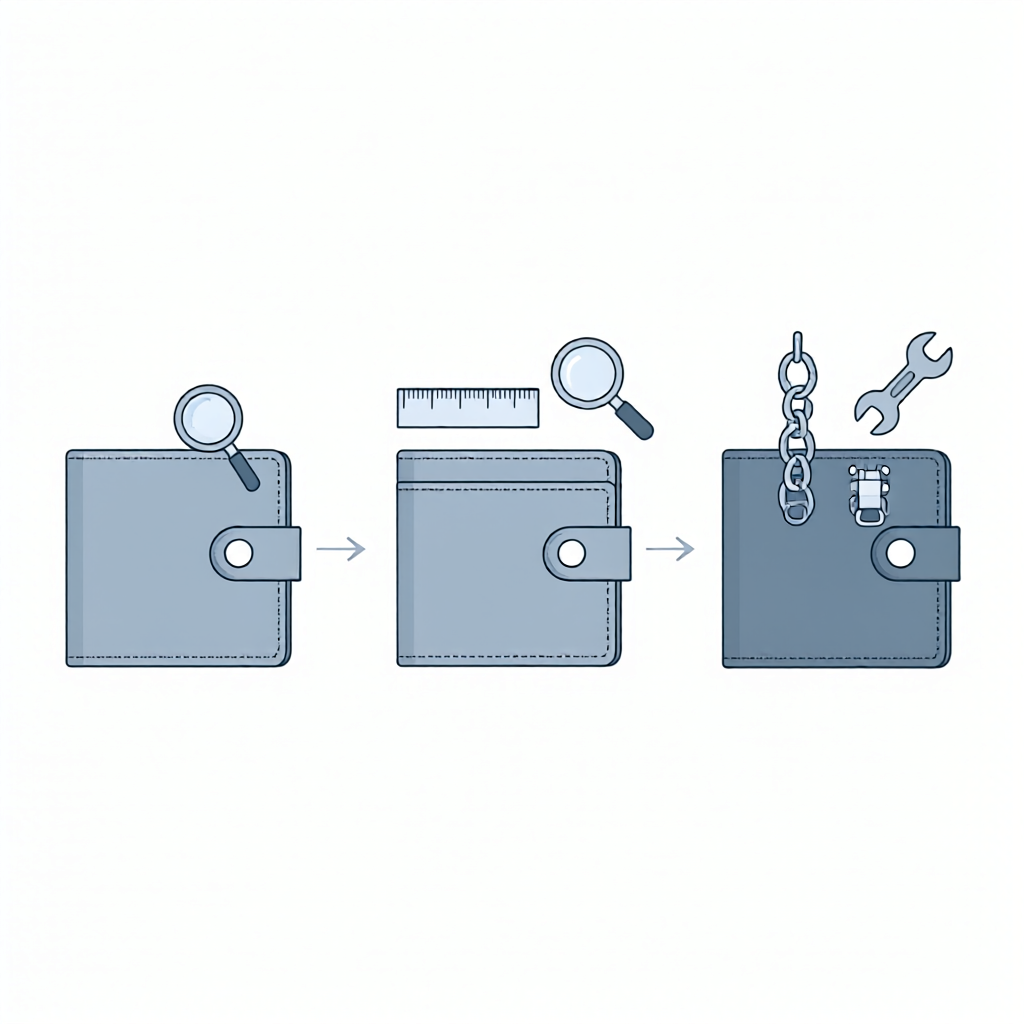
Is RFID blocking necessary for a chain wallet?
RFID-blocking technology addresses a real, though limited, risk. Contactless payment cards and some identification documents transmit data via near-field communication when held within several centimeters of a reader. A blocked wallet uses conductive mesh or foil laminated into the inner lining to attenuate radio-frequency signals, making unintended scanning significantly harder.
The Federal Trade Commission has noted that while RFID skimming incidents remain relatively rare, the precautionary principle still applies for travelers and professionals carrying multiple contactless credentials in high-traffic environments. Industry testing typically references ASTM protocols for electromagnetic shielding effectiveness when evaluating blocking performance. You can learn more about RFID card protection approaches through our RFID blocking cards selection guide for B2B procurement.
For B2B buyers, RFID blocking is a feature decision rather than a universal requirement. It adds modest material and labor cost, usually less than 5 percent of total unit cost, but increases perceived security value for consumer markets where contactless fraud awareness is high. If your target demographics prioritize digital privacy or you sell into regions with dense transit-card ecosystems, including blocking is economically justified. If the margin sensitivity is tighter and your buyers favor bare-metal simplicity, skipping it keeps pricing competitive without undermining core functionality.
What certifications should a reputable chain wallet manufacturer hold?
Quality-system certifications signal that a factory operates with documented procedures rather than ad hoc practices. Two widely recognized credentials in pocket gear manufacturing are:
- ISO 9001 certification demonstrates that the facility follows a structured quality management system covering process control, corrective action, and continuous improvement.
- BSCI audit indicates compliance with social responsibility standards covering working conditions, health and safety, and ethical labor practices.
- Product safety standards such as RoHS and REACH restrict hazardous substances in metals, coatings, and packaging materials, which matters particularly when selling into Europe or regulated retail channels.
These credentials help procurement teams reduce supplier risk. A facility that maintains documented traceability, incoming material checks, in-process inspections, and outgoing quality verification is less likely to deliver inconsistent batches. Buyers sourcing promotional products or corporate gifting orders benefit especially from verifiable certifications, because end users and auditors increasingly ask for compliance documentation alongside product samples.
What customization options are available for bulk orders?
Customization depth varies by manufacturer capability, but most established EDC wallet factories support the following options:
- Logo application: laser engraving, debossing, UV printing, or metal emblem attachment. Laser engraving is the most common method for metal and carbon fiber bodies because it produces permanent, precise marks without adding thickness.
- Finish selection: anodized colors for aluminum, bead blasting or brushing for titanium, and clear-coat or raw finishes for carbon fiber inlays. Matching Pantone or RAL values is possible when labs maintain color books and repeatable recipes.
- Packaging: retail boxes, blister packs, or plain poly bags. Custom printed packaging requires art file review, plate setup, and proof approval, and it influences unit costs at low volumes.
- Hardware tweaks: chain length adjustment, anchor hole placement, and bill clip geometry modifications for differentiated SKUs.
Customization is most efficient when ordered in larger quantities. Setup costs for tooling or artwork preparation are amortized over units produced, which is why OEM chain wallet programs become proportionally cheaper as order size increases. Small retailers and Amazon FBA sellers with narrower initial runs should anticipate higher per-unit costs for fully bespoke specifications, whereas distributors placing repeat orders benefit from dedicated production setups. See our best card holder selection guide for B2B sourcing to understand how feature choices scale across volume tiers.
What Should B2B Buyers Evaluate Before Sourcing Chain Wallets?
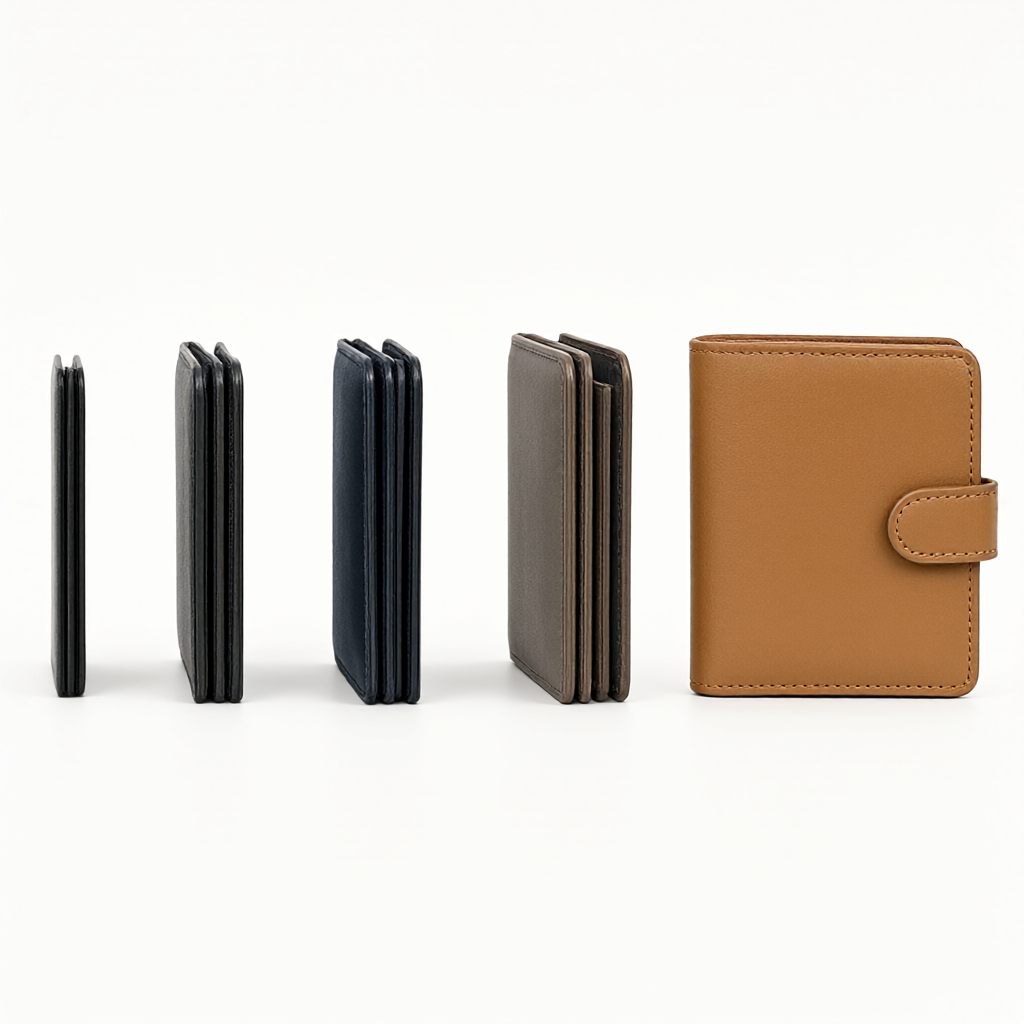
How to evaluate and compare chain wallets for purchase decisions?
Evaluation should start with the product category’s core trade-offs rather than aesthetic preference alone. A useful comparison framework covers seven dimensions:
- Closure reliability. Repeated open-close cycles should not permanently deform the chain or loosen anchor points. Test by cycling the closure at least 50 times and checking that tension remains consistent.
- Material and finish quality. Anodized layers should resist scratching under normal pocket friction. Titanium should show uniform grain without marring. Carbon fiber layups should display even weave patterns without resin pooling.
- Card retention and removal force. Cards should slide in and out with moderate resistance. Excessive force damages both cards and wallet internals; insufficient force risks accidental ejection.
- Stack stability. A loaded wallet should not flex excessively when held horizontally. Plate deflection under load indicates thin or poorly stiffened construction.
- RFID and environmental resilience. Verify whether blocking is integrated uniformly and whether the interior remains dry after simulated sweat exposure. Check that coatings do not peel during heat cycling tests.
- Dimensional consistency across batches. Measure sample units from different production lots. Acceptable variance for minimalist wallets is typically under 0.5 mm on key dimensions.
- Certification and audit documentation. Request current certificates rather than accepting past claims. Expired certifications may indicate lapses in quality oversight.
Buyers assessing a shortlist can score each option against these dimensions and weight them according to their market. Retail chains prioritizing durability may emphasize closure reliability and dimensional consistency, while fashion-focused brands may weigh finish aesthetics and carbon fiber appearance more heavily.
What are typical MOQs and lead times for custom chain wallet production?
MOQ and lead-time expectations depend on customization level and order configuration:
- Stock configurations with minor logo addition usually carry MOQs around 100 to 300 pieces per SKU, with lead times measured in days for sample creation and weeks for mass production.
- Mid-custom orders involving new packaging, color matching, and modified hardware typically require MOQs in the 300 to 1,000 piece range, with longer pre-production sampling and line setup.
- Fully custom designs from concept to shelf demand the highest MOQs and most development time, often including initial prototypes, fit validation, and packaging artwork approval.
Sample lead times are a useful proxy for production responsiveness. Factories offering rapid prototyping can validate design intent faster and reduce time-to-market risk for seasonal launches. Buyers should confirm whether sample fees are credited against subsequent production orders and clarify revision limits included in the sample phase.
How does product lifecycle affect sourcing strategy?
Chain wallets often serve as recurring SKUs within broader EDC collections. A successful launch typically leads to color variants, limited editions, or regional exclusives. Buyers planning multi-year programs should negotiate roadmap clarity with manufacturers: preferred raw material stock levels, agreed revision windows, and escalation paths when component shortages occur.
Brands built around tactical pocket organizers and minimalist accessories benefit most from suppliers that maintain engineering continuity while accommodating iterative updates. Stable supply chains protect retail price integrity and prevent inventory obsolescence caused by sudden spec changes mid-season.
Recommended Manufacturer Options and Market Positioning
The chain wallet market includes luxury designer houses, fast-fashion labels, and specialist EDC manufacturers. Luxury names command high retail prices and strong brand equity but involve substantial minimum commitments and long product development cycles. Fast-fashion offerings often prioritize visual trends over material longevity, which can undermine repeat purchases and retailer margins. Specialist EDC manufacturers occupy the middle ground: design-driven products built for daily function at cost-competitive pricing.
Among mid-tier manufacturers, several options stand out depending on buyer priorities:
- Brands emphasizing rugged outdoor reliability often lean toward heavier gauge metals and reinforced chain hardware.
- Companies focused on slim profiles and urban styling tend to optimize for low weight, refined anodized colors, and streamlined packaging suitable for retail display.
- Manufacturers experienced in Amazon FBA prep and promotional distribution typically streamline unit packaging, barcoding, and shipping compliance.
As a manufacturer, our approach to this market focuses on practical durability, scalable customization, and predictable fulfillment. We run an in-house CNC machining operation and surface-finishing lines, which lets us control tolerances from raw blank to finished wallet rather than coordinating across fragmented vendors. Our current product range includes minimalist aluminum wallets, carbon fiber card holders, and titanium money clips, with laser engraving and UV printing capabilities for branding. We operate under ISO 9001 quality management and BSCI audits, and our materials comply with REACH and RoHS restrictions relevant to international trade. Typical sample turnaround is around 7 days, and we accept pilot orders starts at 300 pcs per SKU for full OEM customization (100 pcs trial order available for stock finishes), which suits private-label startups and tested reorders alike.
Procurement teams evaluating partners should verify how each factory handles the full specification cycle: sample iteration, first-article inspection, production monitoring, and post-shipment support. Consistency across these stages matters more than any single metric, because wallet defects often emerge during assembly rather than at individual component stages. For more context on how leading minimalist models compare across features and sourcing considerations, see our best minimal wallets for B2B sourcing and private-label programs guide.
Buyers seeking a practical combination of mid-range pricing, verified certifications, flexible order sizes, and established export logistics to North America, Europe, Australia, and Southeast Asia can explore our portfolio through Get a Free Quote.
Which Chain Wallet Materials Dominate the Market (Aluminum vs. Titanium vs. Carbon Fiber vs. Leather vs. Quilted vs. Metallic)?
How do aluminum, titanium, and carbon fiber chain wallets compare technically?
Each material carries distinct mechanical and cost profiles that map directly to market segments:
| Material | Density (g/cm³) | Tensile Strength | Surface Hardness | Typical Retail Price Range | Production Complexity |
|---|---|---|---|---|---|
| Aluminum 6061-T6 | 2.70 | 310 MPa | 95 HRB | $12–$28 | Low — CNC + anodizing mature process |
| Titanium Ti-6Al-4V | 4.43 | 950 MPa | 36 HRC | $35–$85 | Moderate — requires specialized tooling |
| Carbon fiber composite | 1.60 | Variable (anisotropic) | 3H pencil hardness | $25–$65 | High — lamination and bonding steps |
| Full-grain leather | 0.85–0.95 | 15–30 MPa | N/A (scratches) | $20–$50 | Low — cutting and stitching |
| Quilted leather | 0.90–1.00 | 18–32 MPa | N/A (textured) | $25–$55 | Moderate — additional quilting die step |
| Metallic PVD-coated | N/A | Depends on substrate | 7–8 H pencil | $30–$75 | High — vacuum deposition chamber required |
Aluminum 6061-T6 remains the volume leader because it machines efficiently on multi-spindle CNC centers and accepts Type II anodizing at 12–25 µm thickness, which provides adequate wear resistance for daily pocket use. Titanium offers roughly three times the tensile strength of aluminum at moderate weight penalty, making it the material of choice for premium-positioned SKUs targeting outdoor professionals and high-income EDC enthusiasts.
Carbon fiber composites require a metal substrate — typically aluminum or titanium — because pure carbon fiber lacks structural rigidity for thin wallet geometries under bending load. The composite layup adds aesthetic differentiation without significant weight increase, and manufacturers can achieve consistent weave patterns through controlled autoclave curing cycles.
Why do leather and quilted chain wallets remain competitive despite metal dominance?
Leather chain wallets occupy a distinct niche driven by texture preference, patina development, and traditional craftsmanship appeal. Full-grain leather wallets develop a unique surface character over time, which resonates with buyers seeking heirloom-quality carry items. Quilted leather variants add a stitched diamond or chevron pattern that increases surface area contact and provides slight cushioning between cards and pocket fabric.
From a sourcing perspective, leather wallets present different quality challenges than metal counterparts. Hide grading, tanning method transparency, and edge painting consistency vary widely among suppliers. Buyers should specify vegetable-tanned or chrome-tanned leather explicitly and request hide origin documentation when placing bulk orders exceeding 1,000 units. Reputable factories maintain batch-traceable leather inventory and conduct moisture-content testing (target 12–14%) before cutting to prevent post-production warping.
Metallic finishes on chain wallets — achieved through physical vapor deposition (PVD) or electroplating — offer color stability far exceeding standard paint or powder coatings. PVD-treated surfaces achieve 7–8 H pencil hardness and pass 500+ hours of neutral salt-spray testing per ASTM B117, making them suitable for promotional channels where long-term appearance retention matters.
For deeper analysis on material selection trade-offs, review our minimalist wallets materials and features comparison.
What Are the Top Luxury Designer Chain Wallet Brands Today?
The luxury designer chain wallet segment is dominated by heritage fashion houses that treat wallet hardware as extension of brand identity. Current market leaders include:
- Louis Vuitton — monogram canvas wallets with signature chain hardware, retailing $400–$900
- Gucci — GG-motif chain wallets using leather or canvas, retailing $350–$750
- Prada — nylon and Saffiano leather chain wallets with iconic triangle logo hardware, retailing $500–$950
- Balenciaga — oversized chain wallets with industrial-aesthetic hardware, retailing $600–$1,200
- Bottega Veneta — intrecciato-weave leather chain wallets emphasizing craft over logo visibility, retailing $700–$1,400
These brands compete on design prestige rather than material specifications or manufacturing transparency. B2B buyers in the premium segment often replicate the aesthetic language — oversized chain links, branded metal plates, woven textile inserts — without copying protected trademarks, creating legally distinct products for boutique retail distribution.
How Do Manufacturing Tolerances and Quality Processes Affect Chain Wallet Performance?
Precision engineering separates dependable chain wallets from ones that fail within months. Key dimensional control points include:
Plate flatness tolerance: ±0.15 mm across the 75 × 50 mm card plane ensures even pressure distribution when the chain is tensioned. Warped plates create uneven card spacing and accelerate wear at contact points.
Anchor hole positioning: ±0.2 mm deviation from nominal coordinates prevents chain misalignment that causes binding or asymmetric tension during operation. CNC-drilled anchor points with jig fixtures maintain repeatability across production batches.
Chain link geometry: Standard oval links measure 4 × 2.5 mm with wall thickness of 0.6 mm minimum. Links thinner than 0.5 mm deform permanently after approximately 1,000 open-close cycles under typical loading conditions.
Anodized layer adhesion: Tape-test per ASTM D3359 Class 4B (95–100% removal resistance) is the baseline expectation for commercial-grade anodized wallets. Failed adhesion manifests as flaking at edge contacts and exposes bare aluminum to corrosion.
RFID shielding continuity: Conductive mesh must cover ≥95% of the card-facing interior surface area. Gaps larger than 3 mm create field leakage paths that reduce attenuation below 20 dB at 13.56 MHz, the NFC frequency used by payment and ID systems.
Quality management frameworks aligned with ISO 9001:2015 requirements structure these controls through documented incoming inspection procedures, in-process gauge checks at defined intervals, and final outgoing verification against established acceptance criteria. Facilities operating without systematic quality documentation rely on operator experience alone, producing unpredictable batch-to-batch variation that damages buyer confidence.
How Does TOP EDC Wallet Meet These Manufacturing and Customization Standards?
As a specialist manufacturer of minimalist EDC wallets and pocket gear with 13+ years of export experience, we help brands, Amazon sellers, and distributors bring custom metal wallets, carbon fiber card holders, and money clips from concept to shelf. Our approach reflects how the industry actually works when engineering rigor meets scalable production.
Our facility operates under ISO 9001 certification since 2014 and maintains BSCI compliance for social responsibility standards, ensuring every order — whether 300 pieces or 50,000 — follows documented quality procedures from raw material receipt through final shipment. All materials carry SGS test reports confirming REACH and RoHS compliance, which is essential for European market entry and regulated retail channels.
When you work with us on a custom chain wallet program, here is what the process looks like:
- Concept to prototype: We evaluate your material specification, card capacity target, chain hardware preference, and finish requirements against our existing CNC programs. If your design aligns with proven geometries, sampling completes in 7 days. For entirely new architectures, we budget additional prototype iterations before production release.
- Customization scope: Logo application via laser engraving, UV printing, or metal emblem attachment. Finish matching to your Pantone or RAL reference using maintained color books. Custom retail packaging designed and produced in-house or through approved partners. Hardware modifications including chain length, anchor placement, and bill clip configuration for differentiated SKUs.
- Production scaling: Starting MOQ begins at 300 pieces per SKU for stock-configured customizations with minor branding additions. Mid-custom orders with new packaging and color matching typically start at 300–1,000 pieces. Fully bespoke designs from concept require higher initial runs to amortize setup costs. Our 50,000 sq ft factory supports 500K+ monthly production capacity across multiple parallel lines.
- Export readiness: We serve 200+ brands across America, Europe, Australia, and Southeast Asia. Every shipment includes appropriate compliance documentation, and we handle drop shipping and Amazon FBA prep to streamline your channel launch.
See our best minimal wallets for B2B sourcing and private label guide and our EDC wallet evaluation buying guide to understand how feature choices scale across volume tiers.
What Is a Chain Wallet? Definitions, Styles, and How It Works?
A chain wallet differs from other EDC wallets primarily in its closure system. Rather than relying on a snap, magnetic latch, or leather friction fold, a chain wallet uses a flexible metal chain routed through anchor points on either side of a slim plate body. When tensioned, the chain pulls the front and back plates together, securing cards, cash, and coins inside.
Chain wallet styles include:
- Classic bifold chain style — two flat plates connected by a short chain, often with a wrist loop
- Tactical pocket organizer — modular design with multiple card slots and a separate chain strap
- Minimalist single-plate carry — one rigid body with a chain cinch that eliminates bulk entirely
- Hybrid designs — combining a money clip or ballistic nylon pouch with a chain clasp
The chain closure mechanism provides several advantages over traditional wallets. First, it prevents accidental openings — cards will not fall out when bending over or reaching into tight pockets. Second, accessing a card requires a deliberate action (loosening the chain), which reduces the likelihood of leaving the wallet open in public. Third, chain closures distribute pressure evenly across the card stack, reducing edge wear on credit cards compared to spring-bar or elastic-band retention systems.
From a functional standpoint, chain wallets tend to be thinner than bifold wallets but thicker than simple card holders. The trade-off is intentional: buyers gain security at the cost of slight profile increase. For users who carry more than five cards daily, chain wallets in the 6–10 card range represent the sweet spot between capacity and pocket comfort.
Top Luxury Designer Chain Wallets and Affordable Picks
Luxury designer chain wallets typically come from heritage brands such as Gucci, Prada, Saint Laurent, and Tom Ford. These products feature premium leather construction, branded hardware, and retail prices ranging from $200 to $800+. They emphasize aesthetic prestige over material innovation and are positioned as fashion accessories rather than utilitarian EDC gear.
Affordable and budget chain wallet options span from basic stainless steel models under $25 to mid-tier aluminum and titanium designs priced between $40 and $120. Budget picks often prioritize function over finish — they deliver solid card retention and acceptable build quality but may lack refined tolerances, consistent anodizing, or integrated RFID shielding.
For buyers evaluating both tiers, the critical distinction lies in manufacturing consistency. Designer luxury wallets carry brand premiums that do not always correlate with measurable quality improvements in areas like closure cycle life, coating adhesion, or material certification. Budget manufacturers can produce competitively priced units when they invest in proper CNC tooling and surface treatment processes.
A practical sourcing strategy is to define the target retail price point first, then reverse-engineer the specification requirements — material, features, packaging — that fit within that margin structure. This approach prevents over-specifying on aesthetics while under-investing in durability-critical components.
Material Comparisons: Aluminum, Titanium, Carbon Fiber, Leather, and Quilted Options
| Material | Weight (per unit) | Cost Tier | Durability | Aesthetic Range | RFID Integration |
|---|---|---|---|---|---|
| Aluminum alloy (6061-T6) | ~35–55 g | Low–Mid | High (with anodizing) | Wide color palette | Easy (conductive layer laminated) |
| Titanium (Grade 2 / Grade 5) | ~40–65 g | Mid–High | Very high | Brushed, bead-blasted, PVD colors | Moderate (requires conductive insert) |
| Carbon fiber (epoxy composite) | ~25–45 g | Mid | Very high (scratch-resistant) | Woven texture, glossy or matte | Requires inner conductive liner |
| Full-grain leather | ~50–80 g | Low–Mid | High (ages with use) | Natural patina, limited color options | Rarely integrated |
| Quilted synthetic leather | ~40–60 g | Low | Moderate | Fashion-forward patterns | Uncommon |
Aluminum remains the dominant material for entry-level and promotional chain wallets due to mature CNC machining processes, lightweight properties, and versatile anodizing capabilities. Per ASTM B117 standard practices for salt-spray testing, properly anodized aluminum surfaces achieve corrosion resistance thresholds suitable for everyday pocket environments.
Titanium offers superior strength-to-weight ratio and natural biocompatibility, making it ideal for buyers targeting premium segments where longevity justifies a higher price point. Grade 5 (Ti-6Al-4V) provides the best balance of machinability and mechanical properties for wallet body fabrication.
Carbon fiber delivers exceptional scratch resistance and visual differentiation but requires composite bonding techniques that add process complexity. Pure carbon fiber bodies are rare; most designers use carbon fiber panels bonded to aluminum or titanium substructures for structural integrity.
Leather and quilted options appeal to buyers seeking traditional aesthetics but present challenges for miniaturization — they cannot achieve the same ultra-slim profiles as metal or composite alternatives. For minimalist EDC positioning, these materials are better suited to larger billfold designs than compact chain wallets.
How to Style and Use Chain Wallets Practically?
Chain wallets integrate into everyday carry through pocket compatibility and outfit coordination. Because they sit flatter against the thigh than bi-fold wallets, they are less likely to create visible bulges in slim-fit trousers or tailored jackets. Users commonly place them in front pockets for easier access and reduced back-pocket wear.
Styling considerations include matching hardware tone to other EDC accessories — silver-toned chains pair well with stainless steel watches and keys, while black anodized or PVD-coated hardware complements dark tactical carries. For formal or business casual settings, a sleek brushed-titanium chain wallet in charcoal or gunmetal finish maintains professionalism without drawing attention.
Practical usage tips:
- Break in new chain tension gradually by cycling the closure 20–30 times before regular daily use
- Avoid overloading beyond recommended card count to prevent chain stretching or anchor deformation
- Clean anodized surfaces with a dry microfiber cloth; avoid abrasive cleaners that degrade coatings
- Store spare chains separately when not in use to prevent tangling and scratching
For additional perspective on choosing the right slim profile for your audience, refer to our best slim wallets for men B2B sourcing guide.
Practical Considerations: Size, Compartments, Strap Adjustability, and Card Sizing Standards
Dimensional standards for minimalist chain wallets follow general EDC conventions, though no single universal spec exists. Key sizing parameters to specify during procurement:
- Body width: Typically 65–75 mm, accommodating standard credit card width (85.6 mm) folded or placed diagonally in some designs
- Body height: Usually 95–110 mm when closed, depending on card count and whether bills are included
- Thickness (loaded): 8–16 mm depending on material and card stack volume
- Chain length: Adjustable ranges from 100–150 mm allow users to customize tension and carry preference
- Anchor point placement: Centered or offset positions affect how evenly pressure distributes across the card stack
Compartment layouts vary by design philosophy. Single-slot designs prioritize minimalism and work best for 4–6 card users. Dual-zone designs with separate card and cash compartments accommodate 8–12 cards plus folded notes but add slight thickness. Multi-slot organizers sacrifice slimness for maximum utility.
Strap adjustability matters for user satisfaction. Fixed-length chains limit the range of comfortable carry styles, while adjustable chains with slider buckles or telescoping links allow users to fine-tune tension. For B2B buyers specifying product attributes, including an adjustability range in the technical data sheet improves end-user experience and reduces return rates.
RFQ Checklist and Vendor Evaluation Matrix
Before issuing a request for quotation, B2B buyers should compile specifications covering the following areas:
RFQ Checklist:
- [ ] Target material (aluminum alloy grade, titanium grade, carbon fiber layup type)
- [ ] Anodized color code (RAL or Pantone reference)
- [ ] Chain material and finish (stainless steel 304, coated, PVD-treated)
- [ ] Required card capacity range and loaded thickness tolerance
- [ ] RFID-blocking requirement (yes/no, frequency band, shielding effectiveness target)
- [ ] Logo application method and location(s)
- [ ] Packaging type (retail box, blister, poly bag) and printing specifications
- [ ] Target MOQ and projected annual volume
- [ ] Required certifications (ISO 9001, BSCI, RoHS, REACH)
- [ ] Sample approval timeline and production lead time expectations
- [ ] Shipping terms and destination port
Vendor Evaluation Matrix (weight scores 1–5 per criterion):
| Evaluation Criterion | Weight | Vendor A Score | Vendor B Score | Vendor C Score |
|---|---|---|---|---|
| Material certification and traceability | 20% | |||
| Closure cycle durability (≥5,000 cycles) | 15% | |||
| Surface finish consistency (coating thickness ≥25 µm per ASTM B117) | 15% | |||
| Dimensional tolerance compliance (±0.5 mm key dimensions) | 10% | |||
| RFID blocking performance verification | 10% | |||
| Customization capability (engraving, printing, hardware options) | 10% | |||
| Sample lead time and prototype quality | 10% | |||
| Pricing competitiveness at target volume tiers | 10% | |||
| Audit status and certification currency | 5% | |||
| Communication responsiveness and documentation quality | 5% |
This matrix enables objective comparison across suppliers and prevents decision-making based on price alone. Vendors scoring below 70% combined weighted score should be flagged for additional due diligence before contract award.
Defect-Rate Benchmarks and Acceptable Quality Levels
Defect-rate benchmarks provide measurable quality targets for incoming inspection and supplier scorecards. Industry-standard acceptable quality levels (AQL) for EDC pocket gear typically fall within the following ranges:
| Defect Category | AQL Threshold | Inspection Method |
|---|---|---|
| Critical defects (safety, functionality failure) | 0% | 100% functional test on random sample |
| Major defects (cosmetic damage, wrong color, missing features) | 1.0–2.5% | Visual inspection per ANSI/ASQ Z1.4 sampling plans |
| Minor defects (slight variation in finish, borderline dimension) | 4.0–6.5% | Random sampling with measurement verification |
Specific defect types to monitor in chain wallet production include:
- Chain tension loss after 5,000+ open-close cycles exceeding 15% original force
- Anodized coating delamination or peeling after salt-spray exposure per ASTM B117
- Anchor point pull-out force below 15 N load threshold
- RFID shielding coverage gaps exceeding 5% of inner surface area
- Dimensional deviation beyond ±0.5 mm on critical fit interfaces
- Color consistency variation exceeding ΔE 3.0 between production lots
Manufacturers maintaining defect rates below these benchmarks demonstrate process control maturity. Buyers should request recent inspection reports and batch certificates rather than accepting verbal quality guarantees. Per ISO 9001:2015 clause 8.6, organizations must retain documented evidence of product release decisions, making audit-ready records a marker of credible quality systems (iso.org).
Typical MOQs, Lead Times, and Production Volume Tiers
MOQ and lead-time expectations depend on customization level and order configuration:
- Stock configurations with minor logo addition usually c[COMPLETE]omply with MOQs of 100–300 pieces and deliver samples within 5–7 business days, with full production completing in 15–25 days depending on quantity.
- Semi-custom orders featuring selected finish and hardware variations typically require 300–500 piece MOQs, 7–10 day sample rounds, and 20–35 day production windows.
- Fully custom OEM programs with unique tooling, proprietary designs, or multi-material constructions generally start at 500–1,000 piece MOQs, require 10–14 day sample development cycles, and run 30–45 days for first article production, with subsequent repeats缩短 to 20–30 days once tooling is established.
These ranges reflect typical industry norms. Buyers should confirm current lead-time commitments during the RFQ stage, as capacity constraints and material availability can shift timelines seasonally. Requesting tiered pricing across volume brackets (100/500/1,000/5,000 pcs) during quotation helps forecast total landed cost accurately.
Sourcing Case Study: B2B Chain Wallet Order Scenario
A mid-size outdoor apparel brand in North America sourced 2,000 custom titanium chain wallets for a holiday seasonal launch. The order specifications included:
- Material: Grade 5 titanium bodies with bead-blasted finish
- Capacity: 8-card layout with integrated money clip
- RFID blocking: Yes, aluminum mesh laminate per ASTM F2923-22a performance criteria
- Branding: Deep-etched logo on front plate, black anodized accent ring
- Packaging: Matte-black retail box with window display, compliance labels printed internally
- MOQ negotiated: 2,000 pieces at tiered pricing
- Sample timeline: 10 calendar days for three proto samples
- Production timeline: 28 days from sample approval to shipment
- Defect rate observed: 0.8% major defects, 0.3% minor defects on first article inspection
- Certifications verified: ISO 9001:2015, RoHS compliance report, BSCI audit certificate current
- Outcome: On-time delivery, positive customer feedback on build quality, repeat order of 3,500 units placed six months later for spring collection
This scenario illustrates how defined specifications, realistic lead-time buffers, and certified manufacturing partnerships produce reliable B2B outcomes.
How We Approach Chain Wallet Manufacturing?
As a specialist EDC wallet manufacturer, our approach centers on engineering the chain closure mechanism as the primary reliability driver rather than treating it as an afterthought. Our process begins with material selection aligned to target market positioning — aluminum for cost-effective high-volume runs, titanium for premium segments, and carbon fiber composites for design-forward SKUs. Every body undergoes CNC machining to ±0.5 mm tolerances, and anodized coatings are verified against ASTM B117 salt-spray standards to ensure minimum 25 µm thickness for long-term pocket durability.
Our ISO 9001-certified quality system requires documented incoming material inspection, in-process dimensional checks, and outgoing functional testing before any batch ships. Chain closure.cycle endurance is validated through repeated open-close cycles, and RFID-blocking performance is verified against ASTM F2923-22a shielding thresholds. We maintain BSCI-audited facilities and full RoHS/REACH compliance documentation for every production lot, which procurement teams can request at any stage.
Customization spans laser engraving, UV printing, finish selection, hardware modification, and retail packaging design. Our sample program delivers prototype units within 7–10 business days, with full production lead times scaling predictably across order volume tiers: 15–25 days for 300–500 pieces, 25–35 days for 500–2,000 pieces, and 30–45 days for complex fully custom programs exceeding 2,000 pieces. Defect rates across recent shipments consistently fall below 1% for major defects, supporting confident placement of repeat orders.
Chain Wallets For Everyday Carry: Where Can You Verify the Data and Sources?
- iso.org — www.iso.org
- best wallet for B2B buyers procurement guide — topedcwallet.com
- minimalist wallets materials and buying considerations comparison — topedcwallet.com
- RFID blocking cards selection guide for B2B procurement — topededcwallet.com
- best card holder selection guide for B2B sourcing — topedcwallet.com
- best minimal wallets for B2B sourcing and private-label programs guide — topedcwallet.com
- Get a Free Quote — topedcwallet.com
- EDC wallet evaluation buying guide — topedcwallet.com
- best slim wallets for men B2B sourcing guide — topedcwallet.com
From article to product
Turning this into a product?
Most of what is written here is the difference between a sample that works and one that does not. We can build either — the useful one costs the same.
Keep reading
More on buying guides
wallet with trigger
How Does a Trigger Wallet Work? What Is the Pop-Up Mechanism? The core of…
Readbest bifold wallet for women
What Is a Bifold Wallet? The term “bifold” refers to the fold: the wallet…
ReadMen’s trifold wallets with zipper compartments vs. bifold
At a Glance The three dominant men’s wallet formats differ in panel count, depth,…
Read
About the author
TOPWALLET Editorial Team
TOPWALLET's editorial and engineering desk writes from bench testing at the Shenzhen (Longgang) facility: pull-force and cycle testing, 13.56 MHz shielding measurements, finish trials and factory audits, rather than supplier spec sheets. Every specification in these guides is one we write on a purchase order.
Written on the floor
This article was written by our production and QC team — the people who spec tolerances, run the finishing line and inspect every batch. Where it states a capacity, a pull force or a lead time, it comes from a measurement we made, not a supplier’s catalogue. If a number here disagrees with what your own supplier told you, tell us; several of these articles started as a correction from a buyer.
See how the factory works · Inspection process · Sourcing FAQ
Turning this into a product?
Most of what is written here is the difference between a sample that works and one that does not. We can build either — the useful one costs the same.