
Wallet Manufacturing · 14 min read
Kickstarter Wallet Manufacturing: From Prototype to Fulfillment in 2026

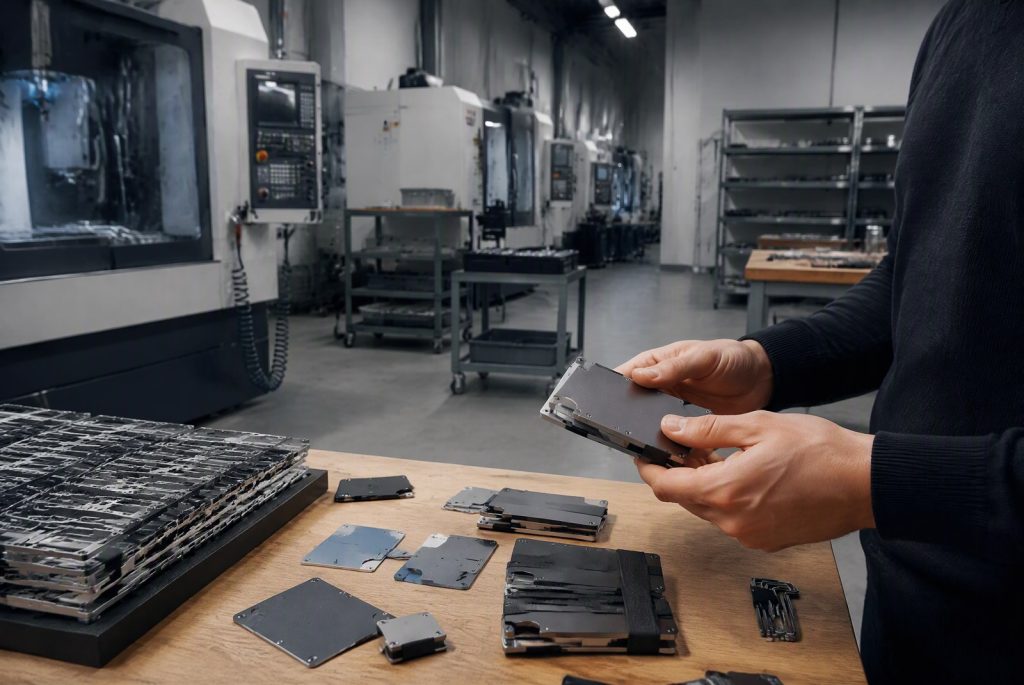
A wallet campaign that funds in a matter of days still has one hard problem left: making thousands of metal card holders that match the render, survive shipping, and land in backers' hands before their patience runs out. That problem does not get easier after the money arrives. It gets harder, because the clock on your credibility starts the day you hit your goal. Kickstarter's own help center walks creators through the full arc of a campaign—launch, rewards, production, and shipping—which is why the smartest move you can make in 2026 is to treat production planning as part of the campaign, not as a chore that follows it [1].
Manufacturing is a systems problem, not a single machine; even in the United States, federal programs exist to help small and medium manufacturers strengthen their supply chains, which is a reminder that production relies on a web of suppliers, not one heroic CNC center [5]. The companies that handle this kind of work are not assembly sheds. They are precision factories that mill aircraft-grade aluminum, stitch full-grain leather, assemble rare-earth magnet packs, and print logos at volume. GSTAR, the 15-year-old Dongguan wallet maker behind TOPWALLET, runs this type of operation: 200+ brand partners, 7-day sampling, 30-day mass production, and ISO 9001:2015 process management [2][3]. If you are serious about a hardware project, you are looking for a kickstarter wallet manufacturer that can do all of that—and you should be in conversation with them months before you write a single line of campaign copy.
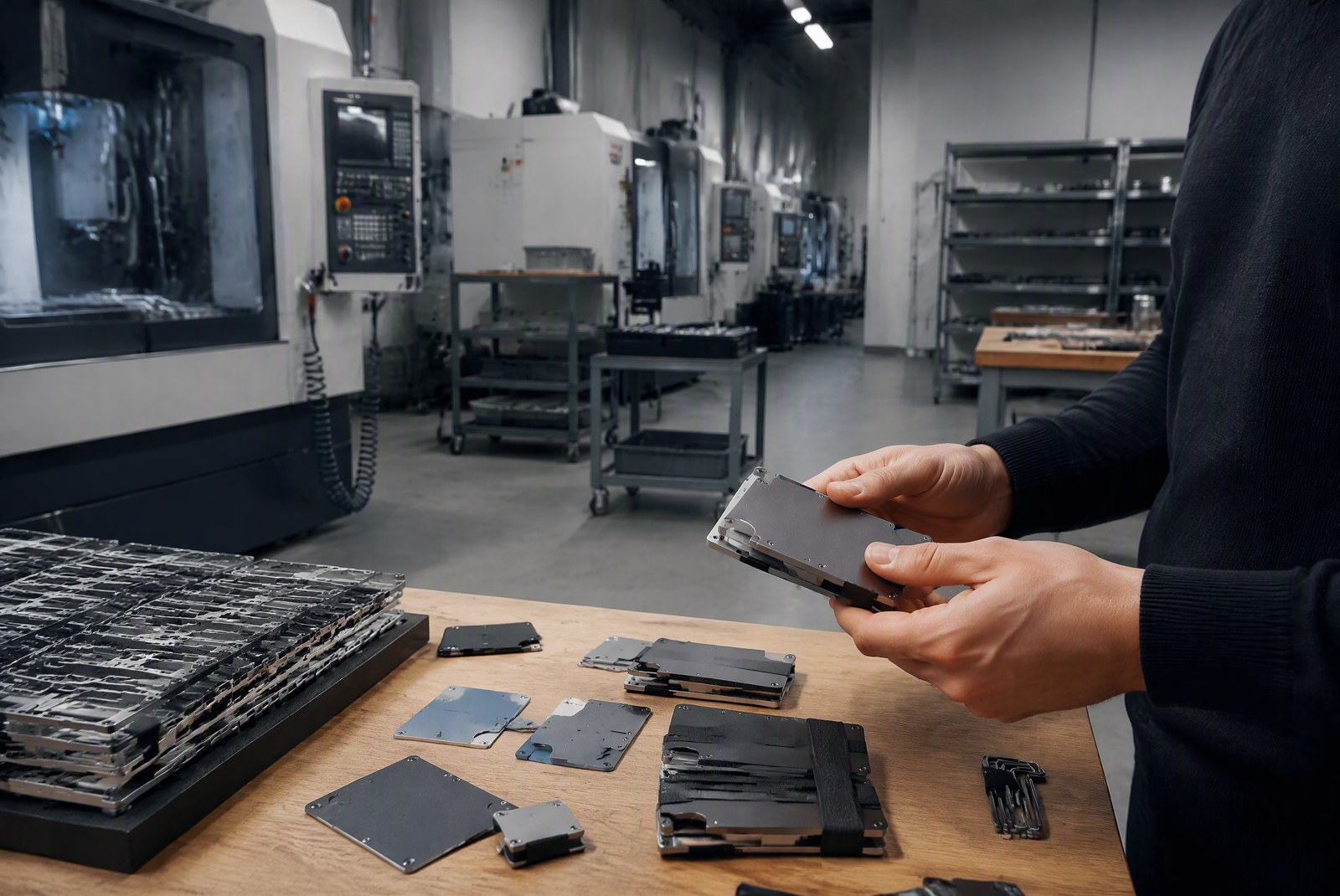
The rest of this guide walks the full timeline—concept to 3D model, 7-day sampling, DFM review, batch production, quality gates, per-order packing, and fulfillment—then covers the three moments when a kickstarter wallet manufacturer must already be on your team, and why waiting until after you fund is the most expensive mistake in this category.
Why the Factory Decision Comes First
Crowdfunding looks like a marketing play until you read the delivery statistics. A peer-reviewed study of 144 successfully funded technology campaigns on Kickstarter found that no more than 32% of hardware projects delivered their products on time; it also found that delayed campaigns carry a significantly higher probability of shipping products that lack expected attributes [4]. In plain terms, two out of three funded hardware campaigns miss their promised ship dates, and the ones that miss often disappoint on quality.
Wallets sit at the sharp end of that problem. A wallet has moving parts (pop-up mechanisms), material tolerances (leather grain, aluminum thickness), and finish expectations (anodized color matching) that a soft-goods or software project never faces. None of that can be fixed at the fulfillment stage, because by then the parts are already cut, anodized, and boxed. The only point where you can influence delivery performance is before production starts—which is precisely where a kickstarter wallet manufacturer earns its keep [2][3].
There is also a funded-time problem. Pledge money arrives in one lump, but production, packaging, and freight invoices arrive before you ship. A factory relationship built before the campaign means you already know unit cost, tooling cost, MOQ, and lead time; your cash flow math works because your numbers are real. If you start the search after funding, you negotiate under a deadline with backers watching, and every week of negotiation eats into the buffer that protects your reputation [1][4].
The Full Timeline: Concept to Fulfillment
Every serious kickstarter wallet manufacturer runs some version of this eight-stage timeline. Use it as your planning skeleton and as the checklist you send to shortlisted factories:
1. Concept and Sketch
You start with a use case, not a render: does the wallet hold six cards with RFID blocking, or is it a pop-up that fans cards one-handed? Capture the target weight, thickness, and the rough number of parts. This stage costs nothing but time, and it defines everything downstream [3].
2. 3D Modeling and Engineering Drawings
Convert the sketch into 3D CAD with dimensioned drawings. Factories can work from STEP or IGES files directly; if you only have visual renders, the factory will need to re-engineer the geometry, which adds weeks. The drawing is also your legal anchor—it is the document that states what "matching the sample" means [2][3].
3. Seven-Day Sampling
A real wallet needs a physical prototype, not a renders folder. GSTAR and TOPWALLET quote sampling at 7 days for stocked mechanisms; if you modify structure or material, sampling stretches accordingly [2][3]. Use this sample to test card fit, retention, and the opening mechanism with your own hands. This is also where you learn whether anodized black matches your Pantone reference before you commit to 5,000 units.
4. DFM Review Before You Lock Anything
Design for Manufacturing (DFM) is the step most first-time founders skip. The factory reviews your geometry for tooling feasibility, draft angles, wall thickness, and assembly order, and tells you where the design will cost you money or break in production. Accept the changes that protect function and drop the ones that only exist in renders. A kickstarter wallet manufacturer that does not push back on your design is not your partner—it is your risk [3].
5. Bill of Materials and Tooling
Lock the Bill of Materials (BOM): which aluminum grade (6061-T6 or 7075-T6), which leather, which magnet grade, which screws, which RFID shield. Every line item drives cost and lead time. Tooling—molds, dies, and jigs—is a separate line in the quote and is amortized across volume, so your MOQ decisions affect per-unit price directly [2][3].
6. Crowdfunding Batch Production
Production itself runs in batches sized to pledge counts. GSTAR's mass-production lead time is 30 days for a standard program, on a plant with throughput of 50,000 units per month; if you run a modest 1,000–3,000 unit campaign, you will not even test the factory's ceiling [2][3]. Schedule the batch so that product arrives with enough margin before your promised ship window—remember the 32% on-time delivery baseline you are trying to beat [4].
7. Quality Control Gates
ISO 9001:2015 gives you the process backbone; AQL 2.5 gives you the sampling math [2]. TOPWALLET runs four inspection stages: incoming materials, in-process checks, outgoing pre-shipment inspection, and random inspection before the cartons are sealed [2]. Ask each shortlisted factory for the QC report format and a mechanism cycle-test result (for example, 5,000 open-close cycles on a pop-up wallet) before you sign. Your backers will never see the factory—they will only see the result, so demand the reports they cannot see.
8. Per-Order Packing and Fulfillment
Crowdfunding fulfillment is not wholesale. Every backer has a name, a tier, and possibly a shipping address that changed since the campaign. The factory packs per-order: gift box, insert, warranty card, barcode, and export cartons [2]. If you ship to the United States, plan customs entry: CBP's Basic Importing and Exporting guide covers the entry requirements and documentation importers must provide when goods cross the border [6]. Decide air versus sea freight in the quote stage, because freight typically outweighs manufacturing variance once you pass a few thousand units.
Before vs. After: The Two Ways to Start Manufacturing
The single biggest fork in your project is when you start talking to factories. The table below compares starting production planning before your campaign versus after it funds:
| Decision point | Manufacturer locked before campaign | Manufacturer searched after funding |
|---|---|---|
| Unit cost | Known before you set reward tiers | Negotiated under deadline, often higher |
| Tooling and MOQ | Budgeted and amortized in the plan | Hit the backer account in one unexpected bill |
| Sampling | 7-day sample validated pre-launch [2][3] | Sample waits behind other clients' orders |
| DFM design changes | Made before renders go public | Conflict with already-promised specs [4] |
| Fulfillment promise | Ship date steps from a factory quote | Ship date is a guess backers can see |
| Backer communication | Updates show real production evidence | Updates start with "we are still selecting a factory" |
| Delivery risk | Low: timelines come from process, proven by 200+ brand programs [2][3] | High: 32% of funded hardware ships on time [4] |
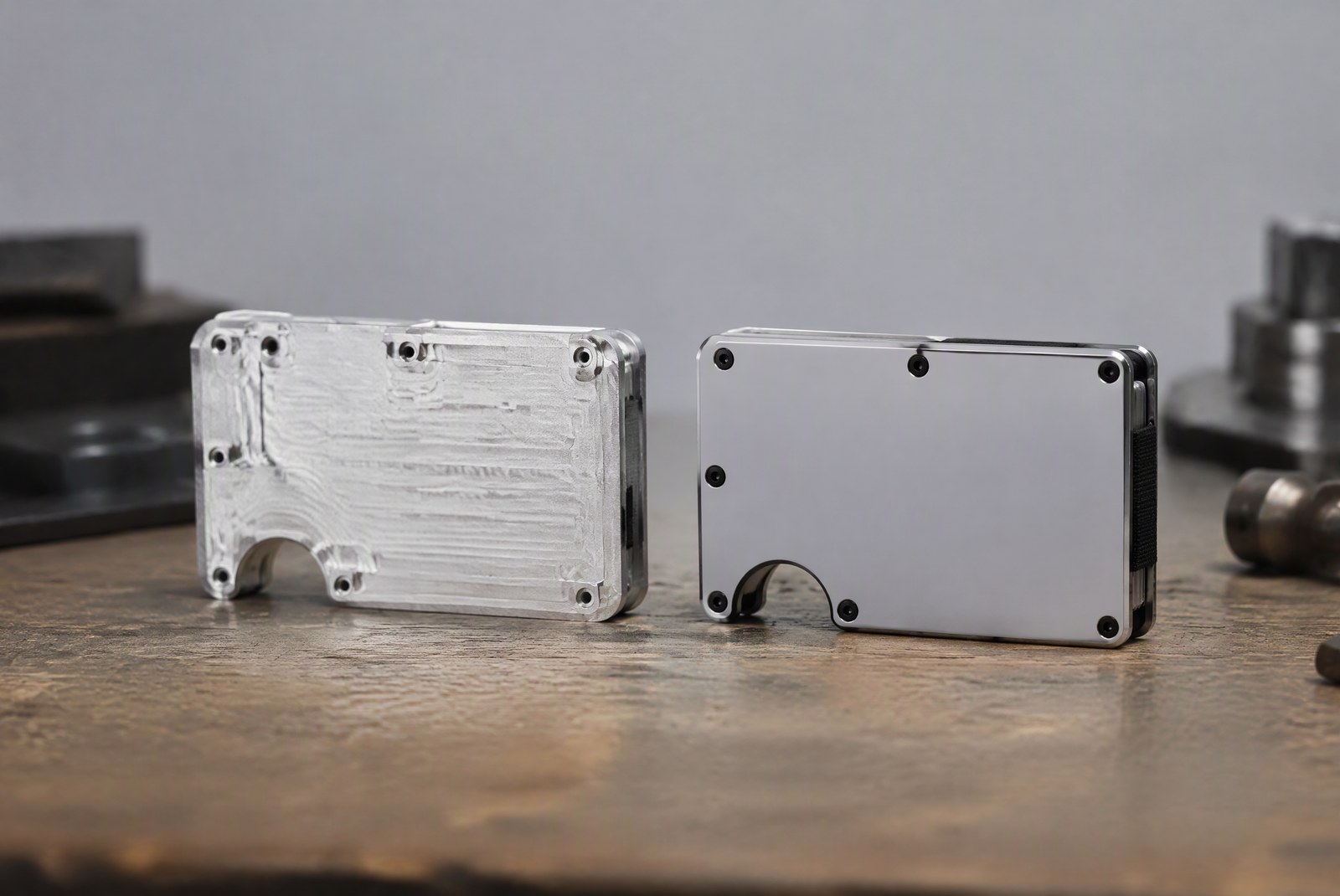
The left column is the 2026 standard. The right column is how hardware campaigns become cautionary articles.
Three Moments to Lock Your Manufacturer
You do not need to sign a contract in week one, but you do need a kickstarter wallet manufacturer in the building at three specific moments:
Moment 1: Before sampling, not after. Bring your concept and rough 3D to the factory and get a 7-day sample quoted [2][3]. The sample tells you the truth about your design—mechanism friction, card capacity, weight. Nothing you learn later is cheaper than what the sample teaches you now.
Moment 2: Before the BOM is frozen. The factory should name every component and its lead time before you commit. If the rare-earth magnets you spec have a 6-week lead, you need to know that while the campaign is still in pre-launch, not while 4,000 backers wait [3].
Moment 3: Before you go live with a production-ready quote. You want a signed price sheet for your reward tiers, not a floor estimate. Rewards priced on guesses produce pledges you cannot fulfill profitably; rewards priced on a factory quote price themselves correctly the first time [2][3].
This is also why you cannot wait for success. If your factory relationship starts after funding, all three moments happen at once—under backer pressure, with no samples, no frozen BOM, and no tested pricing. That is the profile of a delayed campaign [4].
MOQ, Molds, Drawings, and BOM: The Practical Details
Four terms decide whether your wallet project is fundable:
- MOQ. Flexible MOQ matters more than a low MOQ, because a good factory aligns batch size with your sell-through. GSTAR starts stocked designs from 300 pieces, so a small pilot or a first fulfillment wave both fit [2]. You want the number that lets you test the market without overstocking.
- Molds and tooling. Tooling is a real, separate cost line amortized across units. Ask for the tooling quote, its lifespan in cycles, and whether it is credited back on volume. Never accept a quote that hides tooling inside per-unit price without telling you.
- Engineering drawings. The 2D drawing with tolerances is the contract that prevents "the color is different" disputes. Confirm your factory produces a dimensional drawing you sign, plus a QC report per batch under ISO 9001:2015 [2].
- BOM structure. A line-item BOM—material, grade, finish, supplier, per-unit cost—turns a vague quote into a negotiable document. GSTAR publishes its material systems openly (6061-T6 and 7075-T6 aluminum, TC21 and Gr5 titanium, 304/316L stainless steel, 3K carbon fiber, full-grain leather), so you can spec by name instead of by photo [3].
Materials Backers Actually Fund
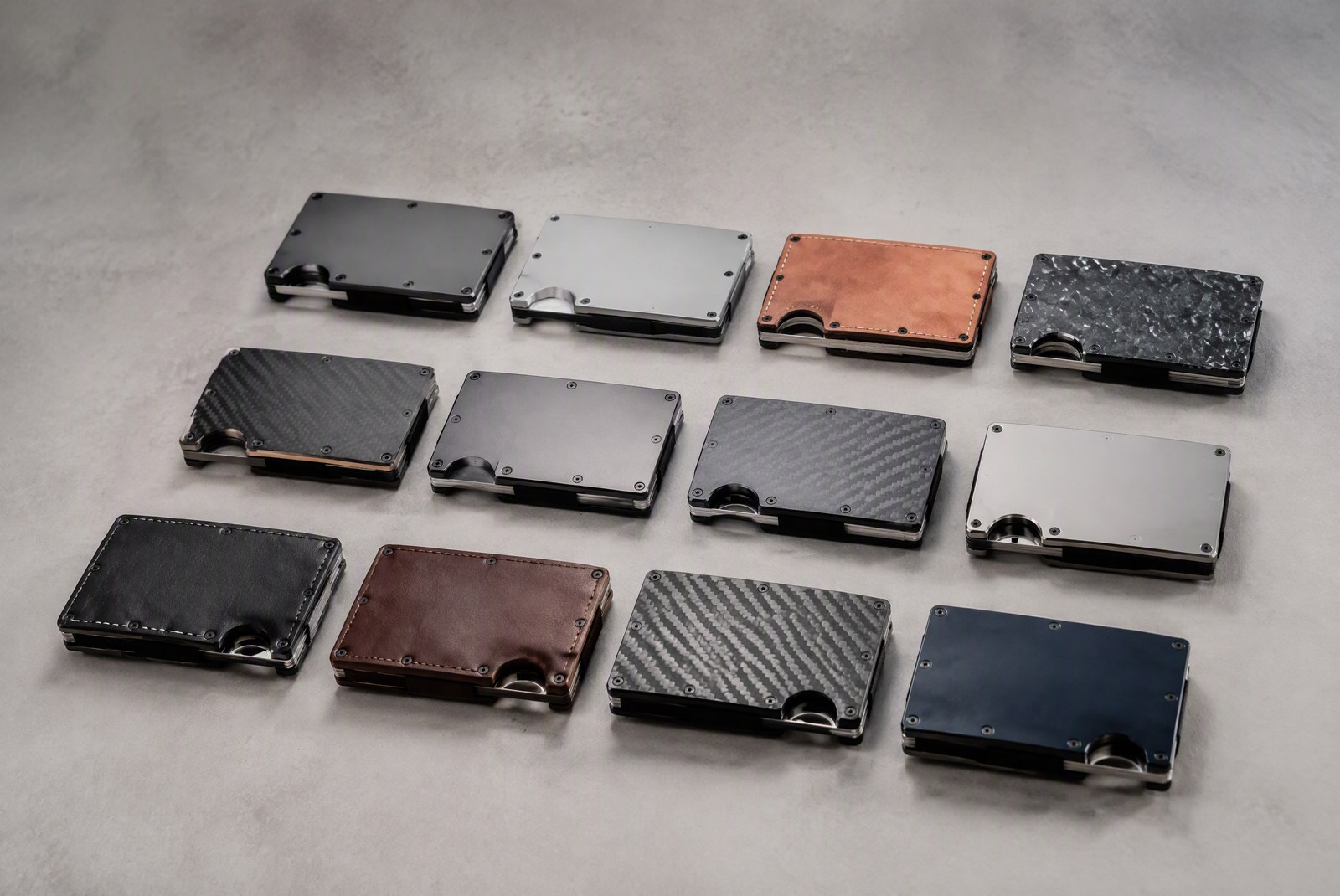
Wallets fail in the market when the material bet fails to deliver what the render promised. The five materials below cover the vast majority of funded wallet campaigns, and each one changes your factory's process:
| Material | What it buys backers | Typical wallet role | Notes for planning |
|---|---|---|---|
| 6061-T6 / 7075-T6 aluminum | Light weight, anodized color options | Two-plate card holders, minimal wallets | Anodizing gives Pantone-matched colors [2][3] |
| Full-grain leather | Patina, premium hand feel | Classic and travel wallets | Grain and thickness vary per hide; sample before bulk [2][3] |
| TC21 / Gr5 titanium | Hypoallergenic, premium weight | Flagship and premium lines | Higher material cost, strong brand story [3] |
| 304 / 316L stainless steel | Rigidity, corrosion resistance | Tool organizers, rugged holders | Best when structure matters over weight [3] |
| 3K carbon fiber | Ultralight, high stiffness | Premium shells and accents | Thinner profiles, stiffer feel [3] |
Add rare-earth magnet packs to any of the above for MagSafe compatibility or magnetic closure, and you have the material palette that dominates funded wallet campaigns [2][3].
Best by Use Case
- Small validation run (300–1,000 units): pick a stock mechanism with logo customization, keep MOQ-driven pricing, and use the 7-day sampling window to validate [2][3]. Your risk is a single batch, and a flexible-MOQ factory absorbs it.
- Mid-size campaigns (four-figure unit runs): this is where DFM discipline pays off. Freeze the BOM after the pre-production sample, lock the 30-day production slot, and budget freight plus customs entry separately [2][6].
- Large or multi-tier campaign (5,000+ units): work the factory's monthly capacity (50,000 units) as a scheduling resource, split production into staged batches that follow pledge tiers, and negotiate tooling amortization across the full volume [2][3].
- Premium materials (titanium, carbon fiber): if your value story depends on material, sample early and quote the premium grades explicitly—legacy budget assumptions are the classic cause of 11th-hour redesigns [3][4].
What a Kickstarter-Ready OEM Quote Must Include
When you evaluate a kickstarter wallet manufacturer, the quote is the way they think out loud. A serious quote includes: unit prices by volume tier; MOQ per design and per color; the 7-day sample timeline and sample fee policy; tooling cost and amortization; the 30-day production window after sample approval; packaging options (gift box, insert, warranty card, barcode); QC documentation under ISO 9001:2015 with AQL 2.5 sampling; and incoterms plus freight options [2][3].
GSTAR and TOPWALLET specialize in exactly this workflow—15 years of wallet production, 200+ brand partners, 50,000 units of monthly capacity, and customization across eight dimensions: size, structure, material, color, finish, logo, packaging, and accessories [2][3]. You can start the conversation with a sketch and a target quantity; the factory returns with a sample plan, a production schedule, and a number you can put in your reward tiers.
FAQ
When should I first contact a wallet manufacturer for my Kickstarter?
Contact the factory when you have a concept and rough 3D — per typical OEM lead times, ideally 3–4 months before your planned launch [2][3]. That gives you the 7-day sample, the DFM review, and a real production quote before you set reward prices [2][3].
Can I find a manufacturer after my campaign succeeds?
You can, but you pay for it: no validated sample, no frozen BOM, and negotiations run under backer deadlines. Add the sourcing and tooling lead time you never planned, and your ship date slips before production even starts. Funded hardware already ships late in most cases [4].
What is a realistic MOQ for a crowdfunded wallet?
Stocked designs start around 300 pieces, while fully custom tooling programs run higher [2]. A flexible MOQ lets you match the first production wave to your actual pledge count instead of an over-order you warehouse and discount. Ask for the MOQ per design and per color, because those two numbers decide your cash flow and unit price [2][3].
How long does sampling and production actually take?
GSTAR quotes 7 days for sampling and roughly 30 days for mass production of a standard program, with QC steps inside that window [2][3]. Add tooling time if your design is structural, plus freight and customs entry for importers [2][6].
What should my reward tiers cover cost-wise?
Base every tier on the factory's line-item quote: materials, tooling amortization, packaging, QC, and freight [2][3]. Add a margin for pledges shipped to the wrong address and for replacement units, then check the tier covers the sums. Rewards priced from guesses are how campaigns collect pledges they cannot fulfill profitably [4].
Do I need a contract for IP and tooling ownership?
Yes. Put it in writing before tooling starts: the molds, dies, and engineering files belong to you, with terms for what happens if you change factories [3]. Use the signed dimensional drawing as the sample-approval reference so color and finish disputes stay rare. IP is the asset your brand runs on, so protect it early [2][3].
What QC should I demand before shipment?
Demand an ISO 9001:2015 process, four-stage inspection (incoming, in-process, pre-shipment, random), and AQL 2.5 sampling with per-batch reports [2]. For mechanisms, ask for the cycle-test fixture and results before batch approval, and keep the signed QC report with your contract. You cannot watch the factory; the reports are how you audit it [2][3].
Request a Quote
You do not need a finished design to start. Send TOPWALLET your concept, target quantity, and launch month, and the factory responds with a sample plan, a tooling and MOQ outline, and a production schedule that fits the timeline above. Fifteen years of wallet production, 200+ brand partners, ISO 9001:2015 process management, and AQL 2.5 QC are the difference between a render and a shippable product [2][3].
Related Reading
REQUEST A QUOTE → https://topedcwallet.com/contact/?inquiry=oem-odm
Learn the full OEM process at Wallet OEM & ODM, see how parts become products at Manufacturing Process, and review what happens between inspection and shipment at Quality Control.
Sources
- [1] Kickstarter Help Center — Official creator documentation covering campaign setup, rewards, production, and shipping.
[2] TOPWALLET (Dongguan Tuoxiang Technology) — Official manufacturer site: ISO 9001:2015, sampling, QC and fulfillment capabilities. https://topedcwallet.com/
[3] GSTAR — Official site of Gstar Technology (Shenzhen) Co., Ltd., wallet and EDC manufacturer (unrelated to the Dutch denim brand G-Star RAW). https://gstartec.com/
[5] Manufacturing — U.S. federal manufacturing programs and supply-chain resources (NIST-managed).
[6] U.S. Customs and Border Protection — Basic Importing and Exporting guide for importers.
From article to product
Sourcing minimalist-wallets?
Tell us the format, the quantity and the date you need stock. You get material options, MOQ and a landed-cost range back within one business day.
Keep reading
More on wallet manufacturing
How to Choose Wallet Manufacturers for Custom EDC Production
A procurement guide for evaluating wallet manufacturers on capabilities, certifications, MOQs, and customization. Compare…
ReadWallet Compliance Checklist 2026: 7 Steps to Clear REACH, CPSIA, Prop 65, and RoHS for Wallets Sold in the US and EU
Most wallet import problems are preventable before production starts: US and EU rules are…
ReadShopify Wallet Supplier Setup in 2026: The 60-Day Reorder Math That Keeps You in Stock
A Shopify wallet store rarely fails on design; it fails on supply chain. SKUs…
Read
About the author
Wu, Leon
Leon Wu is the senior product engineer and EDC testing lead at TOPWALLET. He has spent more than a decade on wallet design-for-manufacture, materials and quality control at the company's Dongguan facility, and writes from bench testing, pull-force and 13.56 MHz shielding measurements rather than supplier spec sheets.
Written on the floor
This article was written by our production and QC team — the people who spec tolerances, run the finishing line and inspect every batch. Where it states a capacity, a pull force or a lead time, it comes from a measurement we made, not a supplier’s catalogue. If a number here disagrees with what your own supplier told you, tell us; several of these articles started as a correction from a buyer.
See how the factory works · Inspection process · Sourcing FAQ
Sourcing minimalist-wallets?
Tell us the format, the quantity and the date you need stock. You get material options, MOQ and a landed-cost range back within one business day.