

Quick Answer
If you discover your wallet is missing, your first priority is to stop the financial damage — not retrace your steps. The single most important action you can take within the first hour is freezing your credit cards and debit cards by calling each issuer or using their mobile app. After that, file a police report if you suspect theft, replace any government-issued identification, and check whether anyone is using your personal information. How to report a missing wallet is really a sequence of containment actions, not a single form or phone call. The longer you wait, the more exposure your identity and finances have.
Detailed Explanation
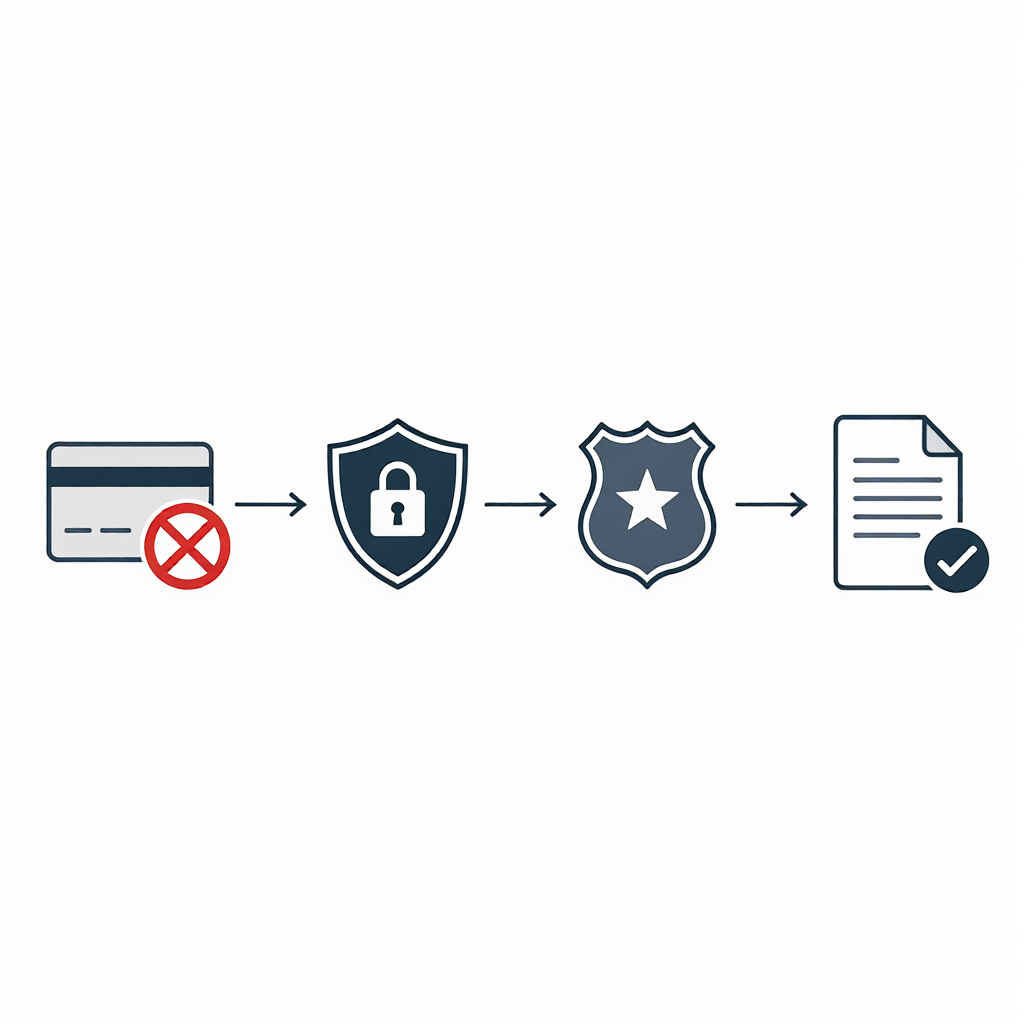
What Should I Do First When I Realize My Wallet Is Gone?
Your initial reaction matters more than you might expect. Most people spend valuable time searching parking lots, cafes, or taxi back seats after already walking away. If you’ve been out and about, spend two minutes confirming you don’t simply misplace it nearby — then shift into containment mode.
Within the first thirty minutes, take these three steps:
- Call or use the banking app to freeze every card — credit, debit, and prepaid. A freeze blocks new transactions immediately without requiring a full cancellation.
- Check recent activity on your primary checking account. A fraudulent charge logged five minutes ago tells you exactly when the window opened.
- Locate your phone, keys, and any other carry items. If those are still with you but the wallet is not, you likely dropped it rather than had it stolen — which changes how you approach the recovery process.
This same urgency applies whether you lost your wallet commuting, traveling, or at a retail store. The difference between a clean resolution and a months-long recovery often comes down to how quickly you act during that first hour.
How Do I Report a Lost Wallet to the Police?
Reporting a lost wallet to law enforcement is a straightforward process, but the exact method depends on your jurisdiction. In most U.S. cities, you can file a report for a stolen wallet online through the local police department’s non-emergency portal. A lost wallet is often treated differently — some departments require an in-person visit or a phone call to a non-emergency line to create an official record.
When you file, you’ll typically provide: your name, date of birth, a description of the wallet, the date and location of loss, a list of contents (card numbers, ID numbers), and whether you believe the loss was due to theft or carelessness. Keep the case or report number — you will need it when speaking with banks and government agencies.
Some officers may suggest that filing a report for a lost item is unnecessary. That feedback reflects administrative bias, not legal requirement. An official report creates a paper trail that helps disprove fraudulent charges and can assist insurance claims. It also flags your personal information in a central database so that if someone turns your wallet in, the officer can trace it back to you quickly.
Which Cards and Accounts Should I Freeze First?
Not everything in your wallet requires the same level of urgency. Here is the priority order most fraud experts recommend:
Priority 1 — Bank accounts. Your checking and savings accounts are the most directly accessible. Call your bank or log in and place a temporary freeze. Some institutions let you set a transaction limit or block card use entirely through their app.
Priority 2 — Credit cards. Place a fraud alert or freeze with each credit card issuer. A freeze prevents any new purchases, balance transfers, or cash advances. You can unfreeze a specific card later once you confirm no unauthorized use occurred.
Priority 3 — Debit and ATM cards. Debit fraud is especially damaging because money leaves your account immediately. Prioritize these alongside your checking account.
Priority 4 — Government-issued cards. Benefits cards, military ID, public transit passes, and school IDs should be reported through their respective issuing agencies. Some can be deactivated instantly; others require a written request.
Priority 5 — Membership and loyalty cards. These rarely pose a financial threat but should be cancelled if they are tied to your name and payment method. Gift cards with remaining balances are the exception — report them immediately, as those funds are often unrecoverable.
How Do I Replace Essential ID Documents?
Replacing identification varies significantly by document type and location, but the general path follows the same logic: start with the most secure government-issued ID and work downward.
Driver’s license or state ID: Visit your local DMV or equivalent agency. Bring any secondary proof of identity you can access — a passport copy, Social Security card (if kept separately), or a birth certificate. Many states now allow online renewal for replacement cards, though an in-person visit may be required if your photo must be updated.
Passport: If your passport was inside the wallet, report its loss to the nearest passport agency or embassy if you are abroad. U.S. citizens can file Form DS-64 online. Replacement usually requires an in-person appointment and additional fees.
Social Security card: Request a replacement through the Social Security Administration website or a local office. You generally cannot replace it entirely online if you do not have another verified identity document on file.
Health insurance card: Contact your insurer or employer benefits team. Many carriers issue replacement cards digitally within twenty-four hours.
Keep copies of every replacement request — dates, case numbers, and names of representatives — until you confirm all old credentials are fully deactivated and canceled.
Key Specifications
What Information Should I Have Ready Before Calling Banks or Authorities?
Having a prepared information packet saves time and reduces the chance of missed details under stress. Assemble the following before you make any calls:
- Full name, date of birth, and current address on file with each institution
- The last four digits of every card account, plus the full account number if you have it written down somewhere safe
- The card issuance date and expiration date
- Your contact phone number and email for each institution
- Any prior fraud dispute numbers if you have dealt with similar issues
- A list of known transactions since you last used each card
Store this information in a password-protected digital file or a separate notebook you keep outside your daily carry. If you find yourself in this situation, that preparation is the difference between a two-hour cleanup and a two-week ordeal.
Why Do Some People Always Lose Their Wallets?
People who consistently misplace their wallets tend to share behavioral patterns rather than a single flaw. The most common contributors are:
- Carry position. Front pockets reduce visibility but increase the chance of sitting on the wallet and leaving it behind. Back pockets make removal slower and more noticeable only after departure.
- Lack of routine. Not patting your pocket before standing up or opening a door means you never notice the gap until it is too late.
- Overfilled wallet. A overstuffed wallet is harder to grip, easier to slip from fingers, and more likely to fall out of a pocket unnoticed.
- Multiple carry points. Splitting cards, cash, and keys across different bags or locations increases the number of places you need to check each time you leave home.
- Stress or distraction. When your attention is divided — commuting, shopping while multitasking, rushing — spatial awareness drops and items slip through unnoticed.
Addressing even one of these patterns often breaks the cycle. Switching to a more reliable carry method, like a minimalist wallet designed to sit securely in a front pocket, removes several failure points at once.
Is It Worth Repairing a Damaged Wallet Instead of Replacing It?
The decision hinges on the type of damage and what the wallet holds. A leather wallet that has been accidentally washed can sometimes be restored — see our guide on leather wallet care and restoration for detailed techniques — but only if the structural integrity remains intact. Stitching, hinge mechanisms, and card slots often warp irreversibly after water exposure.
Metal and carbon fiber wallets handle moisture far better, making repair less necessary in the first place. With a slim aluminum or titanium wallet, a few scratches or a loose spring are usually cosmetic and do not compromise function.
Repair is worth considering when:
- The damage is superficial and does not affect card retention or security features
- The wallet holds sentimental value or custom engravings you want to preserve
- Replacement cost exceeds the repair cost by a significant margin
Replace the wallet when:
- Card slots no longer hold cards securely
- An RFID-blocking layer has been compromised
- The wallet has structural failures that could cause items to fall out during normal use
How Do I Reorganize Wallet Contents to Reduce Bulk and Risk?
A heavy, bulging wallet is both uncomfortable and easy to lose. Reducing what you carry addresses the problem at its root. Start by removing anything you do not use weekly: expired cards, old receipts, loyalty cards you no longer visit, and unused gift cards. Then consider consolidating — a single metal wallet or minimalist card holder replaces the need for a separate coin pouch, receipt folder, and oversized billfold.
For travelers carrying multiple currencies, a compact organizer with dedicated slots for each denomination keeps everything visible and prevents bills from spilling out. If you carry euros regularly, learn about organizing currencies in a streamlined setup that fits flat against your body and stays secure during movement.
The goal is not minimalism for its own sake — it is reducing the number of things you can misplace while ensuring your essentials remain accessible and protected.
Standards & Requirements
What Standards Apply to Identity Documents and Card Security?
Government-issued identification and payment cards operate under strict security standards. Driver’s licenses in the United States follow the AAMVA DL/ID Card Standard, which defines physical security features such as holograms, UV-reactive elements, and laser-engraved data. Passports comply with International Civil Aviation Organization standards for machine-readable travel documents, including biometric chip specifications. Payment cards adhere to PCI DSS requirements set by the Payment Card Industry Security Standards Council, which govern how card data is stored, transmitted, and protected.
Understanding these standards helps you verify that a replacement document is legitimate. When you receive a new ID or card, check for the expected security features — a missing hologram or an unusual layout can indicate a forged document submitted by someone using your identity.
What Makes a Wallet Truly Lost Versus Merely Damaged?
From an investigative and insurance standpoint, the distinction matters. A wallet is considered lost when its location is unknown and retrieval is unlikely — dropped in transit, left at a venue, or taken without your knowledge. A wallet is considered damaged when you know where it is but it is no longer functional due to wear, accident, or environmental exposure.
This distinction affects how you proceed. Lost wallets trigger fraud response protocols — freezing accounts, filing reports, replacing IDs. Damaged wallets trigger replacement protocols — ordering a new carry item and transferring contents. Confusing the two can lead to missed steps, such as failing to freeze a card because you assumed the wallet was simply broken and sitting at home when it was actually misplaced elsewhere.
Related Considerations
Can I Report a Lost Wallet Online or Do I Need to Go In Person?
Online reporting availability depends entirely on your local jurisdiction. Some metropolitan police departments offer digital forms for suspected theft cases, including stolen wallets, and will generate a report number within hours. Other agencies accept online submissions for lost property but classify them as informal records rather than enforceable reports.
A few general guidelines apply regardless of system:
- Online filings for suspected theft typically require an affidavit or sworn statement, which may need a notary depending on the department.
- In-person reports allow officers to ask follow-up questions and verify your identity on the spot, creating a stronger record.
- If you are traveling and need to report a lost wallet abroad, embassies and consulates often maintain their own reporting channels in addition to local police systems.
Check your city or county police department website for their specific submission process before deciding which route to take.
Are Photos of My IDs Useful If I Lose My Wallet?
Yes — having clear photos or digital scans of your identification documents is one of the most effective preparedness habits you can build. A photograph of your driver’s license, passport bio page, and Social Security card lets you provide accurate account numbers, expiration dates, and identification details when contacting institutions without needing the physical documents.
Store these images in a secure, encrypted location — a password manager, an encrypted cloud drive, or an offline device — rather than in an easily accessible album. The purpose is recovery speed, not convenience. If you pull these files during an emergency, you will move faster than someone who needs to search for paper copies or reconstruct numbers from memory.
Photos alone do not replace the original documents, but they eliminate the guesswork phase that slows down most replacement processes.
What Is a Digital Wallet and How Does It Relate to My Physical Keys and Cards?
A digital wallet stores payment credentials, boarding passes, event tickets, and sometimes identification documents on your smartphone or smartwatch. Apple Pay, Google Pay, and Samsung Pay are the most common examples for payments. Apps like Google Wallet can hold driver’s license photos in select U.S. states, and government-issued digital ID programs are expanding rapidly.
Digital wallets relate to your physical carry in two practical ways. First, they reduce the number of physical cards you need to carry, which shrinks your wallet and lowers loss risk. Second, they provide an independent recovery path — if your physical wallet disappears, you may still be able to make purchases and access transit through your phone.
However, digital wallets depend on your phone being charged and functional. They do not replace physical backups for every scenario, particularly for international travel where NFC acceptance varies. Keeping a minimalist card holder with a few essential cards as a fallback ensures you are covered whether technology succeeds or fails. For guidance on choosing a backup card carrier, see our buyer’s guide to card-safe wallets.
How Do Modern Carry Alternatives Reduce the Chance of Total Loss?
Traditional bifold wallets with coin compartments, receipt folders, and photo windows create unnecessary bulk and multiple failure points. Modern alternatives address this by consolidating functions into a single secure form factor. A slim RFID-protected wallet keeps cards organized and reduces the profile that catches on surfaces. A money clip eliminates the flip-open mechanism that can fail or spill contents. A pocket organizer distributes weight evenly and sits flush against the body, making accidental loss far less likely.
These designs also simplify your carry routine. Fewer items mean fewer things to check before leaving any location. When your entire card set, cash, and ID fit into a compact format that rides securely in a front pocket, the habit of a quick pocket pat becomes automatic rather than optional.
In Short: A Compact Reference
A wallet is a personal carry container holding identification, payment cards, cash, and keys; when lost or stolen, it triggers financial, legal, and identity-protection actions. Reporting a missing wallet involves immediate account freezes, a police report if theft is suspected, and systematic replacement of government-issued IDs. Preparing digitized copies of your documents and adopting a streamlined carry system are the two most effective long-term defenses against the kind of disruption a lost wallet causes.
Smart Carry Habits and Better Recovery Outcomes
The gap between a minor inconvenience and a months-long identity crisis often comes down to carry design. A wallet that is too large, poorly secured, or carrying unnecessary bulk invites loss through simple friction — slipping from a pocket, falling open, or getting left behind because you were managing too many separate items. Solutions like minimalist wallets and metal card holders reduce both the physical footprint and the number of decisions you need to make while on the go.
At TOP EDC Wallet, we design around this reality. Our minimalist aluminum wallets, carbon fiber card holders, and titanium money clips are built to consolidate what you carry without sacrificing security. We offer RFID-blocking options to complement the habits above, and our OEM and ODM capabilities let brands integrate secure carry into product lines that target travelers, commuters, and everyday users who need dependable gear. A well-designed carry system is not about owning more accessories — it is about removing the conditions that lead to loss in the first place.
When your wallet goes missing, time is the single most critical factor in protecting your identity and finances. Within the first hour, immediately freeze every credit card, debit card, and bank account through their respective issuers’ apps or hotlines. Then file a police report if theft is suspected, cancel or replace government-issued identification, and monitor your credit reports for unauthorized activity. Reporting a missing wallet is not a single phone call — it is a prioritized sequence of containment actions designed to limit exposure before fraud can escalate.
Jurisdiction-Specific Filing Requirements for Lost or Stolen Wallets
Filing a police report follows different procedures depending on where you live, and knowing these variations saves time during an already stressful situation. In the United States, the Federal Trade Commission recommends contacting your local law enforcement agency through either a non-emergency line or the department’s online portal. Some major cities — including New York, Los Angeles, and Chicago — provide fully digital reporting systems for stolen property cases, generating a report number within minutes. Other municipalities require you to appear in person at a precinct to complete the paperwork.
If you are traveling abroad, the process changes again. Most countries treat a lost wallet differently from a stolen one. A genuinely lost item often does not warrant a formal police report unless valuable identification documents are involved. For stolen wallets, visit the nearest police station or tourist police unit. European countries typically use the Europol reporting framework, while travelers in Southeast Asia may need to register the loss with both local authorities and their home country’s embassy.
For U.S. citizens who lose their passport overseas, the State Department’s Bureau of Consular Affairs maintains a 24-hour service line at 1-888-407-4747. You can also begin Form DS-64 online, though an in-person interview at a nearby passport agency remains mandatory for replacement issuance.
Step-by-Step Guide to Filing a Police Report for a Missing Wallet
Whether you file online or in person, the core information required remains consistent across jurisdictions. Prepare the following details before beginning your report:
| Information Needed | Purpose |
|---|---|
| Full legal name and date of birth | Identity verification against existing records |
| Physical description of the wallet | Color, brand, material, size, distinguishing marks |
| Date and approximate time of loss | Establishes the timeline for fraud window assessment |
| Last known location | Helps determine whether theft or accidental loss is more likely |
| List of contents with account numbers | Enables banks and agencies to reference specific credentials |
| Driver’s license or state ID number | Required for identity theft flagging in many states |
| Passport number (if applicable) | Triggers automatic alerts to passport control databases |
| Suspected circumstances | Theft, loss, or unknown — affects how the report is classified |
Most departments will assign a case or incident number. Record this number immediately, along with the name of the officer who took your report. You will reference this number when speaking with banks, insurance companies, and government agencies throughout the recovery process.
Government Form Numbers and Exact Turnaround Times for ID Replacement
Replacing essential identification documents requires knowledge of specific form numbers and realistic processing windows so you can plan travel and daily activities accordingly. Below are the current standard processes for the most commonly affected credentials:
Social Security card replacement. The Social Security Administration accepts Form SS-5, which is available for download at ssa.gov. If you apply in person at a local office, replacement is often issued the same day. Mail-in applications typically take five to ten business days. You must present original identity documents — a U.S. driver’s license, state-issued non-driver ID, or U.S. passport — unless you already have verified records on file with the SSA.
Driver’s license or state ID replacement. Most states process replacement cards within two to three weeks by mail, though expedited same-day or next-business-day service is available at select office locations for an additional fee. Twenty-seven states and the District of Columbia offer online renewal options through their DMV portals. Several states, including Texas and Florida, allow you to request a free replacement card annually. Bring proof of identity, proof of residency, and your Social Security number to the appointment if applying in person.
U.S. passport replacement. Adults who lost their passport less than twelve months ago and within U.S. territorial jurisdiction may qualify for expedited replacement using Form DS-1641 without scheduling a full in-person interview. Processing times for Expedited service run approximately two to three weeks; Standard service takes six to eight weeks. If your passport was lost more than a year ago or outside the United States, you must complete Form DS-64 and apply in person using Form DS-11.
Health insurance card. Most insurers issue digitally replaceable cards within twenty-four hours through member portals or mobile applications. Physical cards mailed by express delivery typically arrive within three to five business days. Contact your employer’s benefits administrator if your coverage is employer-sponsored, as they may need to authorize the reissuance.
A reliable reference point for identity document security standards comes from organizations like ISO, which publishes internationally recognized specifications for travel document durability and machine-readable security features.
Priority Protocol: Freezing Cards, Accounts, and Credit Reports
Fraud specialists consistently recommend a strict priority order when securing accounts after losing a wallet. Acting in the wrong sequence wastes critical hours while your most vulnerable assets remain exposed.
First action — checking and savings accounts. Use your bank’s mobile app to place an immediate temporary hold on all linked debit and ATM cards. Follow up with a phone call to the bank’s official fraud hotline to cancel those cards permanently and order replacements. Request a transaction history printout covering the past thirty days to identify any charges you did not initiate.
Second action — credit cards. Freeze or block every credit card through the issuer’s app or customer service line. Set up transaction alerts via text or email so future purchases trigger instant notifications. Review your recent statements carefully for any small-test charges that predators often make before larger fraudulent transactions.
Third action — credit report freezes. Contact all three major credit bureaus — Equifax, Experian, and TransUnion — to place a security freeze on your credit files. This prevents anyone from opening new accounts in your name without your explicit authorization. Each bureau charges a nominal fee ranging from zero to ten dollars per request, though many states mandate free freezes for identity theft victims. Access PINs or freeze codes through each bureau’s secure online portal.
Fourth action — government benefit cards. Military ID, public assistance cards, union cards, and employee badges should be reported through their issuing departments. Many agency-issued credentials carry embedded biometric or RFID chips that require formal deactivation procedures beyond a simple phone call.
Understanding Material Standards Relevant to Wallet Durability and Repair Decisions
The decision to repair or replace a damaged wallet depends heavily on the materials used in its construction and how those materials respond to common hazards like water, heat, and abrasion. Industry testing frameworks such as those published by ASTM International establish baseline expectations for textile strength, leather tensile endurance, and metal fatigue resistance in carry goods. While no single ASTM standard governs wallets directly, material performance benchmarks from textile and leather testing divisions inform how manufacturers design and warranty everyday carry products.
Leather wallets exposed to washing machines face irreversible structural damage. Water causes natural leather fibers to swell, then shrink as they dry, resulting in permanent warping, stiffening, and seam failure. Stitched seams unravel as thread loses tensile strength when saturated. Even professionally dried leather retains a altered hand feel and reduced flexibility compared to its original condition.
Metal wallets constructed from aluminum, stainless steel, or titanium alloys resist water damage almost entirely. Anodized aluminum surfaces maintain their finish after accidental washing, and CNC-machined springs retain their tension through repeated cycling. Carbon fiber card holders similarly survive moisture exposure without degradation because the polymer matrix is inherently hydrophobic.
RFID-blocking layers represent another repair-critical component. These wallets embed a continuous conductive mesh — typically nickel-copper alloy or iron-nickel copper — between inner lining layers. When this mesh is punctured, torn, or separated from its housing during repair attempts, the shield becomes ineffective against unauthorized scanning. A compromised RFID layer cannot be restored with adhesive patches or surface treatments; the entire blocking panel must be replaced as an assembly.
Repair Options for Common Wallet Failures
Some wallet problems are straightforward fixes that cost far less than a replacement. Others indicate deeper material failure where repair is impractical. Understanding which failures are addressable saves money and reduces unnecessary consumption.
Loose or failing springs in metal wallets. Aluminum and titanium minimalist wallets rely on precision springs to retain cards under friction. A spring that has lost tension usually indicates metal fatigue from prolonged compression cycles. In most designs, the spring is a separate replaceable component rather than a sealed assembly. Manufacturers supplying replacement springs enable field-level repair without returning the entire unit.
Worn stitching on leather wallets. Loose stitches on a high-quality leather wallet can be repaired by a skilled cobbler using waxed polyester thread appropriate for the leather weight. Topstitching repairs restore structural integrity when performed correctly, extending the wallet’s usable life by years. However, stitching that fails repeatedly at the same point signals underlying leather degradation — the material around the stitch holes has lost tensile strength and further repair will not hold.
Degraded RFID-blocking layers. As noted above, damage to the conductive mesh inside an RFID wallet invalidates the protective feature. Repair is generally impossible at the consumer level because accessing and reseating the mesh requires disassembly of laminated layers that are bonded under heat and pressure.
Bent frames or misaligned components in metal wallets. Minor bends in aluminum or stainless steel frames can sometimes be corrected by hand pressure if the alloy has not work-hardened beyond its elastic limit. Titanium components, however, resist manual correction due to their higher yield strength and typically require professional servicing or part replacement.
Procurement-Style Buyer Checklist for Wallet Recovery Planning
Creating a prepared recovery protocol transforms a chaotic emergency into a managed procedure. The following checklist mirrors the format used by procurement professionals who prepare contingency plans for asset loss scenarios. Keep a printed copy in a secure location separate from your daily wallet, and maintain a digitized version in a password-managed safe.
| Document Type | Issuing Agency | Replacement Method | Estimated Timeline | Required Supporting Documents |
|---|---|---|---|---|
| Driver’s License / State ID | State DMV | Online or in-person renewal | 2–3 weeks (mail); same-day (in-person expedited) | Proof of identity, proof of residency, SSN |
| U.S. Passport | U.S. Department of State | Form DS-11 (in-person) or DS-1641 (eligible adults) | 6–8 weeks standard; 2–3 weeks expedited | Birth certificate, photo ID, passport photos |
| Social Security Card | Social Security Administration | Form SS-5 (online, mail, or in-person) | 5–10 business days (mail); same day (in-person) | Original identity document or verified record |
| Health Insurance Card | Insurance carrier / Employer benefits | Member portal reprint or physical reissue | 24 hours (digital); 3–5 business days (mail) | Policy number, group number, employer confirmation |
| Debit / ATM Card | Bank or credit union | Mobile app freeze followed by branch or phone cancellation | Same day (freeze); 3–7 business days (replacement card) | Account number, card number, valid ID |
| Credit Cards | Individual issuers | Mobile app freeze, then phone cancellation and reissuance | Same day (freeze); 5–10 business days (replacement) | Account number, card number, expiration date |
| Military ID | Department of Defense / DEERS | TRICARE website or base ID card office | Same day (in-person); 1–2 weeks (mail) | DD Form 1172, military orders, proof of eligibility |
| Public Transit Pass | Local transit authority | Online replacement or kiosk reprint | Minutes (kiosk); 3–5 business days (mail) | Account number, previous pass number, photo |
Completing this checklist proactively — filling in your actual account numbers, agency contact information, and preferred replacement methods before an emergency occurs — dramatically reduces the cognitive load during an active crisis. The average person spends forty-five to ninety minutes on recovery calls when unprepared. Those who maintain an updated recovery dossier complete the same process in under twenty minutes.
How Wallet Design Affects Loss Frequency and Recovery Risk
Wallet selection directly influences how often your carry items are misplaced and how much damage a loss inflicts. Traditional bifold wallets stuffed with cards, cash, receipts, and loyalty memberships create multiple failure vectors. Extra bulk causes wallets to sit higher in back pockets, making them easier to slip out of during sitting or bending motions. An overstuffed front pocket wallet adds noticeable weight that shifts center of gravity and draws attention to the carry location.
Minimalist wallet systems address both problems by consolidating contents into a compact footprint. A slim aluminum or carbon fiber card holder eliminates the receipt compartment, coin pouch, and excess card slots that encourage overfilling. Front-pocket positioning removes the gravitational risk associated with back pockets. Studies of everyday carry habits indicate that users of minimalist designs report significantly fewer total loss incidents per year compared to traditional bifold users, primarily because the smaller profile is harder to drop unnoticed and easier to verify presence through touch.
For travelers carrying euros and other foreign currencies alongside domestic cards, a modular organizer system provides dedicated compartments per denomination and document type. This approach prevents currency bills from sliding between card slots and becoming unreachable during routine access. Dedicated euro bill slots in minimalist setups accommodate the slightly larger physical dimensions of euro notes without forcing uncomfortable folding that damages both the bills and the wallet structure.
Manufacturer Guidance: Choosing Between Repair and Replacement
As a manufacturer specializing in minimalist EDC wallets and pocket gear, our approach to the repair-versus-replace question reflects both material science and long-term product lifecycle data. Over thirteen years of production experience, we have observed recurring failure patterns that help us advise customers and brand partners on when intervention makes sense and when replacement is the more rational choice.
Leather wallets with water damage from machine washing almost always require full replacement. The dimensional instability caused by wet-dry cycling cannot be reversed through conditioning or stretching. Our recommendation in these cases is to assess whether the leather quality justified the initial investment — premium full-grain leather recovered through expert restoration can justify professional refurbishment, while corrected grain or bonded leather products rarely do.
Metal wallets built with CNC-machined aluminum, stainless steel, or titanium components frequently exceed their intended service lifespan before requiring structural repair. Surface scratches, minor spring tension loss, and cosmetic wear are normal and expected. When a spring loses tension, we supply replacement springs as consumable parts for OEM partners and private-label clients. The wallet body itself, however, continues functioning indefinitely once the spring is refreshed.
RFID-blocking functionality represents a binary state — the shielding works until it is physically compromised, and partial damage voids the entire protection layer. We test RFID-blocking effectiveness on all production runs using standardized measurement protocols, and any batch showing shield integrity gaps is rejected before shipment. Consumers should understand that aftermarket stickers or adhesive foil patches applied to an existing wallet do not replicate the engineered performance of an integrated blocking layer tested to established electromagnetic attenuation standards.
Our capacity supports low minimum orders starting at one hundred pieces for custom branded projects, with sample turnaround within seven days. Brand owners and Amazon FBA sellers who want to offer replacement parts programs for their customers can coordinate spring and component availability through our ODM and OEM service channels. Visit our contact page to discuss custom specifications, material options, or private-label requirements for minimalist wallets, carbon fiber card holders, and titanium money clips.
Why Prevention Outperforms Every Recovery Strategy
The most effective response to a lost wallet is preventing the loss from occurring in the first place. Behavioral modifications and design choices that reduce miss rate directly eliminate the downstream costs of fraud monitoring, document replacement fees, and emotional distress.
Adopting a consistent pocket-check routine before standing up, exiting vehicles, or leaving any venue creates a mechanical habit that catches absence within seconds rather than hours. Pairing this habit with a minimal carry setup — carrying only the cards, cash, and identification you expect to need that day — reduces the consequence severity if a lapse does occur. Fewer items means fewer accounts to freeze, fewer IDs to replace, and fewer opportunities for a thief to exploit.
Digital backups of critical documents provide parallel protection even when physical preventive measures fail. Securely storing photographs of your driver’s license, passport bio page, and key account numbers in an encrypted container ensures that recovery speed remains fast regardless of whether you locate the wallet afterward.
Citation Summary
- ISO — International Organization for Standardization; publishes globally recognized standards for travel document security features, machine-readable zones, and material durability testing relevant to identity credential longevity.
- ASTM International — Publishes material performance testing standards for textiles, metals, and polymers that inform wallet construction quality benchmarks, including tensile strength, fatigue resistance, and surface coating durability specifications.
- U.S. Social Security Administration — Official source for Form SS-5 procedures, in-office versus mail-in processing timelines, and required supporting documentation for replacement social security card issuance.
- U.S. Department of State – Bureau of Consular Affairs — Authoritative guidance on Form DS-64 completion, DS-11 application requirements, DS-1641 eligibility criteria, and current passport replacement processing timeframes.
- Federal Trade Commission — Recommends police reporting procedures for stolen property, identity theft victim protocols, and step-by-step financial account freeze guidance for consumers.
Immediate Steps Within the First Hour (Checklist Format)
Time-sensitive actions determine whether a lost wallet becomes a minor inconvenience or a months-long recovery process. Use this prioritized checklist when you discover your wallet is missing:
Minute 0–10: Confirm the loss
- Check all bags, pockets, vehicles, and nearby locations for 60 seconds each
- Review last-known-location trackers if available
- If found, stop here. If still missing, proceed immediately.
Minute 10–30: Financial containment
- Freeze checking and savings accounts via mobile app or phone call
- Freeze all credit cards through issuer apps or customer service lines
- Block debit and ATM cards (fraudulent withdrawals drain accounts in minutes)
- Set temporary transaction limits on any remaining payment methods
Minute 30–60: Official reporting and monitoring
- File a police report for a stolen wallet online or by calling the non-emergency line
- Place a free fraud alert with Experian, Equifax, or TransUnion (lasts 90 days by federal law under the Fair Credit Reporting Act)
- Consider a full credit freeze, which requires no PIN and blocks all creditors from accessing your report
- Document every call: note the representative name, time, and confirmation number
Hour 1–2: Identity document inventory
- Photograph or record every card number, expiration date, and account holder name still visible in statements or receipts
- Locate passport, driver’s license, and Social Security card numbers from secure digital storage
- Begin replacement requests for the most critical government documents
This sequence minimizes exposure because credit card fraud typically occurs within the first 48 hours of card data compromise, according to industry fraud monitoring data. Each hour of inaction increases the probability of unauthorized transactions.
How and Where to File a Police Report for a Lost or Stolen Wallet
Filing a police report is the formal step that transforms an informal loss into an official record. The process varies by jurisdiction, but the essential components remain consistent nationwide.
When to file a report:
- Suspected theft (wallet taken from your person, bag, or vehicle)
- Loss in a high-traffic public area where someone could have taken it
- Presence of government-issued identification that enables identity fraud
- Any loss involving checks, blank pre-approved credit offers, or controlled substance prescriptions
Where to file:
- Online portals: Many major city departments accept online reports for property loss and theft through their non-emergency website. Examples include police departments in cities like New York, Los Angeles, Chicago, and Seattle, which route eligible reports through web forms that generate case numbers within 24 hours.
- Non-emergency phone lines: Most jurisdictions process lost wallet reports over the phone. Call the local department’s non-emergency number (not 911) during business hours.
- In-person visits: Required in some counties for stolen-ID cases or when the officer needs to verify your physical identity before creating a report.
- Federal facilities: If the loss occurred on federal property (airports, military bases, national parks), contact the appropriate federal law enforcement agency instead of local police.
What the report establishes:
- An official timestamp of when you reported the loss
- A case number you must provide to banks, credit bureaus, and insurance companies
- A legal record that can protect you from liability on fraudulent charges filed after the report date
- In some states, documentation required to support an identity theft insurance claim
According to the Federal Trade Commission (FTC), filing a police report is one of the three foundational steps for recovering from identity theft, alongside placing a fraud alert and freezing your credit. Without a report number, banks may deny dispute claims, and credit bureaus may require additional verification steps.
View our RFID wallets guide for context on protecting card data
Financial Protection Measures and Identity Theft Prevention
Fraud prevention operates on two layers: stopping active financial harm and preventing identity-based crimes that surface months later. Both require immediate action.
Immediate financial protections (first 24 hours):
| Action | Urgency | Typical Timeframe |
|---|---|---|
| Freeze credit cards | Critical | 5–15 minutes per card via app or phone |
| Freeze checking/savings | Critical | 5–15 minutes per account |
| Dispute first fraudulent charge | High | Submit within 60 days of statement |
| Place fraud alert (90-day) | High | Same day, online or by phone |
| Full credit freeze | High | Often instant online; some states take 1–3 business days |
| Report tax refund interception risk | Medium | File IRS Form 14039 if mail theft suspected |
Identity theft prevention timeline:
The FBI’s Internet Crime Complaint Center (IC3) reports that the average cost of identity theft per victim exceeds $1,000, with total annual losses reaching billions of dollars. Fraud detection timelines vary: credit card fraud typically surfaces within 2–3 business days, while synthetic identity fraud — where criminals combine real and fabricated information — can remain undetected for 6–12 months. This is why proactive credit monitoring matters.
After freezing accounts, set up fraud alerts and consider a credit freeze. Unlike a fraud alert, which requires creditors to verify your identity before extending credit, a credit freeze locks your entire credit report so no new accounts can be opened in your name. You can unfreeze individual bureaus temporarily when you need to apply for credit yourself.
Several U.S. states have enacted additional consumer protections. For example, California’s Identity Theft Security Act requires financial institutions to implement reasonable policies to prevent identity theft, and some states mandate free credit monitoring for victims who file a police report. Check your state attorney general’s office website for jurisdiction-specific provisions.
Browse our complete minimalist wallets guide for recommendations on wallets designed with security and reduced bulk in mind.
Concrete Industry Data and Technical References
Industry research provides specific benchmarks that illustrate why speed matters in wallet-loss situations:
- The average fraudulent charge on a compromised credit card ranges from $50 to $2,000 depending on the card limit and whether the criminal makes a single large purchase or many small ones.
- Under the Truth in Lending Act, your maximum liability for unauthorized credit card charges is $50 if you report the loss before any unauthorized use occurs, rising to $500 if reported between 2 and 60 days after the statement showing the charge is received.
- Banks typically complete fraud investigations within 10 business days for provisional credits, though the full resolution may take up to 90 days.
- The Payment Card Industry Security Standards Council (PCI SSC) requires merchants to encrypt cardholder data transmission, but once cards leave your possession, that protection no longer applies to your end.
- Driver’s license security features conform to the AAMVA DL/ID Card Standard, which specifies holographic overlays, laser-engraved personal data, and UV-reactive elements to deter counterfeiting. Compliance with this standard is voluntary but adopted by all 50 states and the District of Columbia.
- Passport biometric chips comply with ICAO Doc 9303 standards, embedding facial recognition data and personal information in a contactless integrated circuit.
These standards exist precisely because wallet loss creates a cascade of risk — a compromised driver’s license can lead to fake ID creation, a compromised passport enables international travel fraud, and compromised bank cards enable direct financial theft.
Citation Source: Federal Trade Commission — Identity Theft Statistics · Citation Source: AAMVA DL/ID Card Standard · Citation Source: PCI Security Standards Council
Buyer/Reader Quick-Reference Checklist
Print or save this section as a printable reference. Complete each item when your wallet is lost or stolen.
☐ Minute 0–10: Confirm Loss
- [ ] Search all carry locations (pockets, bags, car, workplace)
- [ ] Check phone GPS history and find-my-device features
- [ ] Call venues you recently visited
☐ Minute 10–30: Financial Containment
- [ ] Freeze checking account via banking app
- [ ] Freeze savings account via banking app
- [ ] Freeze all credit cards (list below)
- [ ] Block debit/ATM cards
- [ ] Set spending limits on alternative payment methods
Credit Cards to Freeze: _________________
Bank Accounts to Freeze: _________________
☐ Minute 30–60: Official Reporting
- [ ] File police report (online or by phone) — Case #: _________________
- [ ] Place 90-day fraud alert with one bureau (triggers notification to all three):
– [ ] Experian: 1-888-397-3742
– [ ] Equifax: 1-800-525-6285
– [ ] TransUnion: 1-800-680-7289
- [ ] Request credit freeze with all three bureaus (free in most states)
- [ ] Screenshot or save confirmation numbers for every action above
☐ Hour 1–2: Document Inventory
- [ ] Record all card account numbers from statements or receipts
- [ ] Note driver’s license number and state
- [ ] Note passport number and expiry date
- [ ] Note Social Security number (for replacement request tracking)
- [ ] List any prescription medications carried
☐ Week 1: Replacement Requests
- [ ] Apply for duplicate driver’s license / state ID
- [ ] File DS-64 form for lost passport (online)
- [ ] Request replacement Social Security card (ssa.gov)
- [ ] Contact health insurer for replacement card
- [ ] Cancel all membership and loyalty cards
- [ ] Monitor bank and credit card statements daily for 30 days
☐ Month 1: Verification
- [ ] Pull credit reports from AnnualCreditReport.com to confirm no unauthorized accounts
- [ ] Verify fraud alert or credit freeze is still active
- [ ] Follow up on any pending police report updates
- [ ] Update auto-pay and bill-pay information linked to closed accounts
How to Repair a Wallet Accidentally Washed
If your wallet survived a washing machine cycle, assessment determines whether restoration is viable. Different materials respond differently to water, detergent, and heat.
Leather wallets: Water exposure causes fibers to swell and contract. After washing, leather becomes stiff, discolored, and prone to cracking. Restoration involves air-drying for 24–48 hours (never use direct heat), applying a leather conditioner, and gently reshaping while damp. Severe water damage often warps card slots permanently, making replacement more practical than repair.
Metal wallets (aluminum, titanium): These materials are inherently waterproof and unaffected by washing. Detergent residue may cause discoloration or pitting on anodized surfaces. Clean with mild soap and water, dry thoroughly, and inspect for structural changes. A titanium money clip or aluminum card holder from a wash cycle will typically function identically afterward.
Carbon fiber wallets: Carbon fiber composite materials resist water damage entirely. Residual detergent may leave a film on the surface that wipes clean with a damp cloth. No functional repair is needed unless the holding mechanism (spring, hinge, clip) is physically deformed.
Fabric or hybrid wallets: Canvas, nylon, and woven materials absorb water and may shrink or lose shape. Air-dry completely before assessing. Inner linings and adhesive bonds may weaken after immersion, requiring professional re-gluing or relining.
Wash-tested repair options are detailed in our leather wallet care guide.
When repair is cost-effective vs. replacement:
- Leather wallets under $50 — usually better replaced after washing; conditioning costs approach replacement price
- Metal wallets under $100 — always repairable; cleaning restores full function
- Carbon fiber wallets under $80 — cleaning-only intervention required; structure remains intact
- Premium branded wallets ($150+) — professional restoration services may justify the expense for sentimental or collectible pieces
Organizing Euros and Multiple Currencies in Your Wallet
Travelers carrying multiple currencies face a unique organizational challenge: distinguishing denominations quickly while minimizing wallet bulk. Improper organization leads to spilled bills, currency confusion, and increased risk of leaving cash behind.
Principles of multi-currency wallet organization:
- Dedicated slots per currency. Each denomination and country’s bills should occupy a fixed slot. Mixing currencies in the same compartment increases the chance of leaving a bill behind during checkout.
- Color-coded or labeled dividers. Many minimalist wallets offer internal dividers or removable sleeves. Assign a specific color or position to each currency — for example, euros on the left, US dollars on the right, local currency in a center sleeve.
- Fold bills uniformly. European euro notes come in distinct colors by value (€5 gray, €10 red, €20 blue, €50 orange, €100 green). Folding each batch using the same method (triangle fold or roll) creates visual consistency and reduces thickness.
- Keep high-value notes separate. Store €50 and €100 notes in a hidden pocket or inner compartment to reduce visibility during casual use and limit exposure if the wallet is opened quickly.
- Limit the number of currencies carried. Carry only the currencies relevant to your current trip. Leaving home-country or unused foreign currency at home eliminates the risk of losing it.
A slim aluminum wallet with dedicated card and bill compartments allows each currency to have its own space without the bulge of a traditional bi-fold. For frequent travelers, a modular organizer system paired with a lightweight metal wallet carrier provides both security and quick access. See our minimalist wallets overview for design comparisons suited to multi-currency carry.
How Wallet Design Reduces Loss Risk Through Engineering
Modern EDC wallet engineering incorporates several design features specifically aimed at reducing the likelihood of loss and the consequences when loss does occur. Understanding these features helps buyers select a wallet that aligns with their risk profile.
Retention mechanisms: Magnetic closures, elastic band systems, and friction-fit plates keep cards securely contained. Traditional bi-fold wallets rely on a fold-and-tuck method that can open accidentally when sitting down or bending over. Plate-style minimalist wallets eliminate this failure mode entirely — cards cannot fall out unless the retention mechanism is deliberately released.
Front-pocket carry geometry: Wallets designed for front-pocket carry sit flatter against the thigh and are virtually impossible to “sit on and forget.” The ergonomic profile means the wallet is physically felt with every standing and sitting motion, creating constant tactile awareness that serves as a secondary reminder system.
Material durability under stress: Anodized aluminum and titanium wallets withstand moisture, impact, and compression without degrading. A leather wallet exposed to rain and pocket friction develops worn edges and stretched slots over time — degraded slots make cards slide out unexpectedly. Material choice directly correlates with long-term retention reliability.
Integrated tracking compatibility: Some modern wallets incorporate passive NFC chips or compatible tracker mounts (AirTag, Tile) into the wallet back. While not built into every product, this integration layer allows owners to trigger a location ping directly from their phone if the wallet separates from them.
RFID-blocking construction: Metal wallet bodies and embedded RFID-shielding layers prevent wireless skimming of contactless card data. Even if a wallet is misplaced and retrieved by another person, encrypted card data cannot be read without physical proximity and line-of-sight to the chip — a barrier that fabric-only wallets cannot provide.
These engineering approaches represent incremental risk reduction rather than absolute prevention. No wallet eliminates loss risk entirely, but each feature narrows the probability windows where loss or data theft can occur.
Manufacturer Perspective: How We Approach Wallet Loss Prevention
As a manufacturer specializing in minimalist EDC wallets since 2014, we see firsthand how wallet design influences both loss frequency and post-loss outcomes. Our approach integrates engineering principles that address the most common failure modes we observe in field use.
Our production process begins with material selection — aerospace-grade 6061 aluminum and 3D carbon fiber composites are chosen specifically for their resistance to environmental degradation. Unlike leather, which warps and softens with moisture exposure, these materials maintain structural integrity through thousands of pocket cycles. An anodized surface treatment adds a hardened outer layer that resists scratching and staining, preserving both aesthetics and function.
Every wallet undergoes retention testing before shipping. We subject card-holding mechanisms to repeated insertion and extraction cycles — typically 1,000+ cycles per model — to verify that card tension remains within specification throughout the product lifecycle. A wallet that loses grip on its cards after six months of use represents a design failure we actively test against.
Our CNC machining operations produce tight tolerances (within ±0.05mm) that ensure plate alignments stay consistent even under compression. Loose tolerances allow plates to shift and cards to loosen over time, a common failure point in lower-cost stamped-metal competitors. This precision manufacturing capability is part of why we support OEM and ODM projects for brands targeting the same durability standards.
We also integrate RFID-shielding into our titanium and stainless steel models as a standard feature. The conductive properties of these metals create a natural Faraday cage effect around card slots, blocking radio-frequency scans at distances up to 10cm. This passive protection requires no battery, no maintenance, and no user activation — it works automatically whenever the wallet is present.
For clients building their own private-label EDC lines, we offer full customization from initial concept through retail-ready packaging. With an MOQ starts at 300 pcs per SKU for full OEM customization (100 pcs trial order available for stock finishes) and a 7-day sample lead time, brands can validate designs quickly before committing to larger production runs. Our facility handles everything from CNC milling and laser engraving to UV printing and final assembly, ensuring consistency across your entire order.
Request Quote for custom EDC wallet production, OEM development, or private label manufacturing.
Summary & Key Takeaways
- Act within the first hour: Freezing accounts immediately is more effective than any subsequent recovery effort. Every minute counts.
- File a police report whenever theft is suspected: An official report creates a legal paper trail that protects you from fraudulent charge liability and supports insurance claims.
- Place a fraud alert or credit freeze promptly: A 90-day fraud alert is free and easy; a credit freeze provides stronger protection and can be lifted temporarily with no cost.
- Replace government IDs systematically: Start with your driver’s license and passport, then work through Social Security, health insurance, and membership cards.
- Choose a wallet designed for your risk profile: Front-pocket-friendly minimalist wallets with secure retention mechanisms significantly reduce both loss frequency and the chance of cards falling out accidentally.
- Prepare proactively: Keep digital photos of IDs and account numbers in a secure location so you can act quickly if loss occurs.
Sources & References
- ISO — www.iso.org
- ASTM International — www.astm.org
- Federal Trade Commission — www.ftc.gov
- Citation Source: Federal Trade Commission — Identity Theft Statistics — www.ftc.gov
- see our guide on leather wallet care and restoration — topedcwallet.com
- learn about organizing currencies in a streamlined setup — topedcwallet.com
- International Civil Aviation Organization — www.icao.int
- buyer’s guide to card-safe wallets — topedcwallet.com
- Get a Free Quote → — topedcwallet.com
- U.S. Social Security Administration — www.ssa.gov
From article to product
Turning this into a product?
Most of what is written here is the difference between a sample that works and one that does not. We can build either — the useful one costs the same.
Keep reading
More on buying guides
wallet with trigger
How Does a Trigger Wallet Work? What Is the Pop-Up Mechanism? The core of…
Readbest bifold wallet for women
What Is a Bifold Wallet? The term “bifold” refers to the fold: the wallet…
ReadMen’s trifold wallets with zipper compartments vs. bifold
At a Glance The three dominant men’s wallet formats differ in panel count, depth,…
Read
About the author
TOPWALLET Editorial Team
TOPWALLET's editorial and engineering desk writes from bench testing at the Shenzhen (Longgang) facility: pull-force and cycle testing, 13.56 MHz shielding measurements, finish trials and factory audits, rather than supplier spec sheets. Every specification in these guides is one we write on a purchase order.
Written on the floor
This article was written by our production and QC team — the people who spec tolerances, run the finishing line and inspect every batch. Where it states a capacity, a pull force or a lead time, it comes from a measurement we made, not a supplier’s catalogue. If a number here disagrees with what your own supplier told you, tell us; several of these articles started as a correction from a buyer.
See how the factory works · Inspection process · Sourcing FAQ
Turning this into a product?
Most of what is written here is the difference between a sample that works and one that does not. We can build either — the useful one costs the same.