

Quick Answer — What Are the Best Leather Wallets for B2B Sourcing?
The best leather wallets for bulk procurement are those constructed from full-grain or top-grain leather, featuring reinforced stitching, precise edge painting, and integrated RFID shielding where required. For private label and corporate gifting programs, the ideal choice balances material authenticity with production scalability—meaning the tannery consistency, hardware reliability, and customization accuracy meet commercial tolerances rather than just retail aesthetics.
Full-grain leather remains the premium benchmark for durability and patina development, while top-grain offers a more uniform surface better suited for consistent laser engraving or embossing across large runs. Genuine leather, though often confused with higher grades, is a split leather product that lacks the fiber density required for long-term EDC performance. Buyers should prioritize suppliers who disclose tanning methods and provide material certificates, rather than relying on generic marketing terms.
For a detailed breakdown of how different materials perform in real-world conditions, see our best leather wallets for men: B2B sourcing guide.
Detailed Explanation — How Leather Grades Affect Durability and Brand Perception
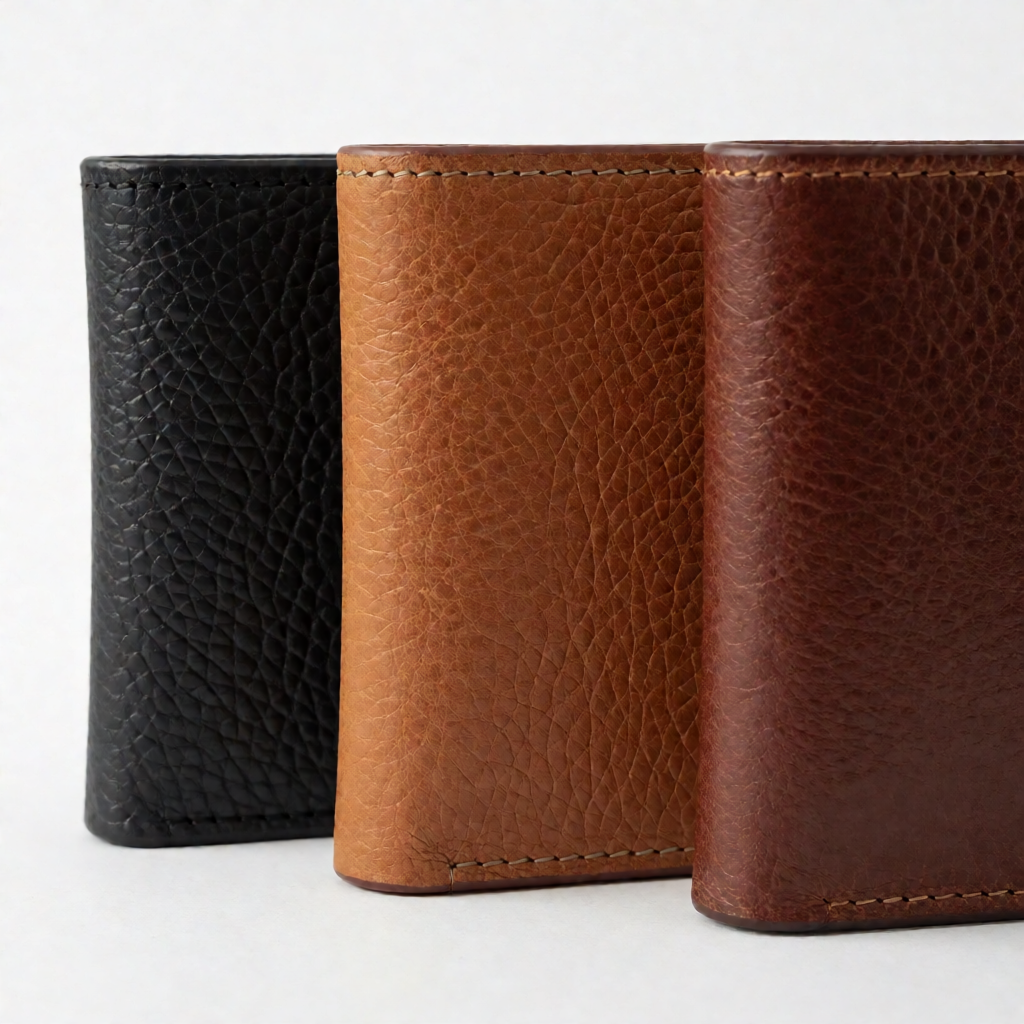
What is the difference between genuine and full-grain leather?
This distinction is the most critical factor in B2B sourcing decisions. Full-grain leather is the top layer of the hide with the grain intact, meaning it retains the natural fiber structure that provides tensile strength and resistance to abrasion. It develops a patina over time rather than cracking or peeling. Genuine leather is a regulatory term—often misunderstood—that refers to any leather that is not synthetic, but it typically describes split leather (the lower layers of the hide) that has been coated with polyurethane or polymer embossing to simulate a grain surface. While genuine leather is cheaper and acceptable for short-lifecycle promotional items, it lacks the longevity expected of a permanent EDC tool.
Top-grain leather sits between these two extremes. It has been lightly sanded or buffed to remove imperfections, resulting in a more uniform appearance that responds well to dyeing and branding. For brands prioritizing a clean, consistent look across thousands of units, top-grain is often the commercial sweet spot.
How long does a quality leather wallet last?
A well-constructed full-grain leather wallet can last 5–10 years of daily carry with minimal degradation, provided it is not subjected to prolonged moisture exposure. Top-grain wallets typically last 3–5 years before noticeable surface wear or coating flaking appears. “Genuine leather” wallets in this category often fail within 1–2 years under heavy EDC use, as the bonded or split layers separate from the polymer coating.
Durability is not solely determined by leather grade. Construction standards—stitch density, edge finishing, and hardware anchoring—play an equal role. A top-grain wallet with double-stitched corners and waxed thread will outperform a full-grain wallet with glued seams and thin thread. For insights into how construction affects lifespan, review our minimalist wallet materials and features guide.
What should you consider when choosing a minimalist wallet?
Minimalist leather wallets face unique engineering challenges. Because they carry fewer items, every component must withstand concentrated stress. Buyers should evaluate:
- Thickness: Premium minimalist leather wallets typically range from 8–12 mm when loaded.
- Spring tension: Metal or carbon fiber frames inside leather casings maintain wallet integrity.
- RFID compatibility: Modern minimalist designs must integrate blocking layers without adding bulk.
- Edge roll resistance: Thin leather edges are prone to curling; reinforced edging is essential.
See our best card holder selection for B2B sourcing guide for a deeper analysis of form factors and capacity trade-offs.
Key Specifications — Wallet Thickness, Capacity, and Material Benchmarks
What are the key specs for a high-quality EDC wallet?
When evaluating leather wallets for procurement, buyers should reference these industry-standard benchmarks:
| Specification | Full-Grain Benchmark | Top-Grain Benchmark | Genuine Leather |
|---|---|---|---|
| Thickness (unloaded) | 2.0–2.5 mm | 1.8–2.2 mm | 1.5–2.0 mm |
| Loaded thickness | 10–14 mm | 9–12 mm | 8–11 mm |
| Stitch density | 8–10 stitches per inch | 6–8 stitches per inch | 4–6 stitches per inch |
| Edge finish | Painted and burnished | Painted or raw | Sealed or painted |
| Tensile strength | ≥ 30 N/mm² | ≥ 20 N/mm² | ≥ 10 N/mm² |
| Water resistance | Natural oils repel light moisture | Requires periodic conditioning | Limited; coating may crack |
| Patina development | Yes, desirable darkening | Minimal, uniform aging | No; coating cracks instead |
For buyers considering non-leather alternatives such as metal or carbon fiber options, our best wallet for B2B buyers: EDC procurement guide outlines the trade-offs between organic and synthetic materials.
Wallet thickness and capacity
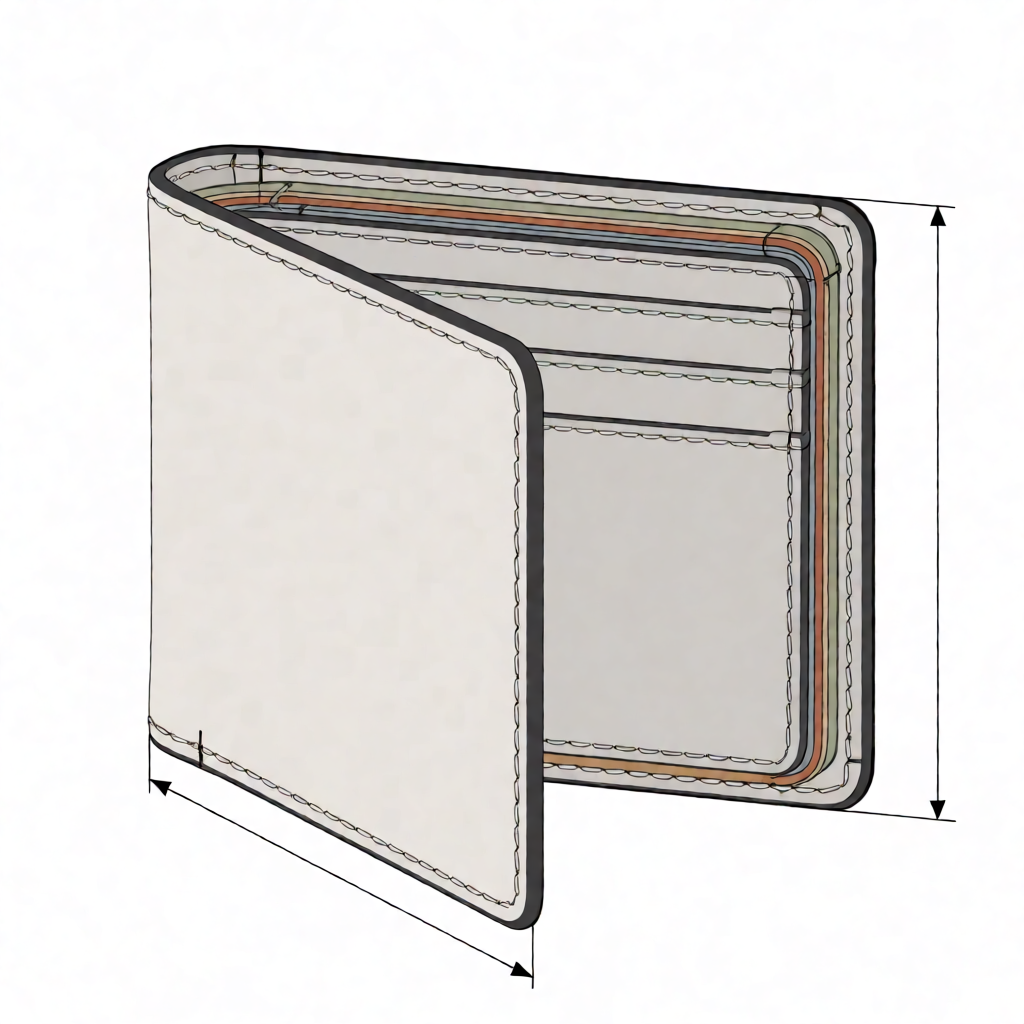
A standard bifold wallet holds 6–10 cards plus cash. Minimalist cardholder designs typically accommodate 4–8 cards with a single bill sleeve. When sourcing, verify that the leather’s flex rating matches the intended capacity—thicker hides (>2.5 mm) may become rigid and resist opening after repeated use, while thinner hides (<1.5 mm) may tear at stress points.
Standards & Requirements — Certifications, Compliance, and Quality Control
What standards apply to B2B leather goods manufacturing?
International procurement requires alignment with multiple compliance frameworks:
- ISO 9001 quality management systems for manufacturing process control.
- BSCI (Business Social Compliance Initiative) for ethical labor standards in production facilities.
- REACH / RoHS compliance for chemical restrictions in tanning agents and dyes.
- FTC Leather Guides regulating accurate material labeling—brands must not mislabel split leather as “genuine” or “full-grain.”
- ASTM D412 (tensile strength) and ASTM D1922 (tear strength) testing protocols for leather durability validation.
For comprehensive guidance on RFID-blocking standards and card security compliance, consult our best RFID blocking cards: B2B procurement guide 2026.
How does RFID blocking work in wallet construction?
RFID-blocking technology uses Faraday cage principles—a conductive mesh or laminate layer embedded within the wallet structure that disrupts radio-frequency signals (13.56 MHz for NFC/RFID chips). In leather wallets, this is typically achieved through:
- Internal lining: A thin aluminum-copper mesh laminated to the interior leather panel.
- Layer integration: The blocking material is sandwiched between leather layers during assembly, preserving the exterior aesthetic.
- Hole-punch consideration: If the wallet features decorative perforations, the RFID shield must extend beyond those areas or use a continuous barrier design to prevent signal leakage.
Buyers should request signal attenuation test reports (typically ≥ 25 dB at 13.56 MHz) from suppliers before committing to volume orders. A well-engineered RFID-shielded wallet maintains both security and the natural hand-feel of leather.
Related Considerations — EDC Alternatives and Procurement Strategy
What should you consider when custom branding wallets in bulk?
Custom branding for leather wallets involves several variables that directly impact cost, lead time, and final appearance:
- Laser engraving: Works best on top-grain and full-grain leather. The laser burns the surface fibers, creating a permanent, tactile mark. Darker leathers produce higher contrast.
- Embossing/debossing: Requires custom steel dies; most economical at 500+ units. Depth must be controlled to avoid weakening the leather structure.
- UV printing: Suitable for full-color logos but less durable than laser engraving; may crack over time with repeated flexing.
- Metal hardware engraving: If the wallet includes a money clip or frame, CNC-engraved metal components offer a premium branding option.
For companies exploring private-label strategies beyond leather, our best minimal wallets for B2B sourcing and private label programs outlines how different materials scale across production volumes.
Leather vs. EDC alternatives: When to choose what
While leather remains the preferred material for corporate gifts and premium retail, metal EDC wallets and carbon fiber wallets address specific pain points that leather cannot:
- Water exposure: Leather degrades with prolonged moisture; aluminum and carbon fiber are impervious.
- Bulk tolerance: Metal wallets maintain a slim profile even with 10–15 cards; leather stretches over time.
- Durability consistency: Leather aging varies by batch; metal and carbon fiber offer uniform performance across thousands of units.
Many B2B buyers now offer hybrid collections—leather-look exteriors with metal or carbon fiber internal frames—to capture the aesthetic of premium wallets with the longevity of engineered materials. See our good wallets for guys: B2B EDC procurement guide for a comparison of form factors across material types.
Cost-per-use analysis
For procurement decisions, calculate cost-per-use rather than unit price alone:
- A $12 full-grain wallet used daily for 5 years = $0.007 per use.
- A $6 top-grain wallet used for 2 years = $0.005 per use.
- A $4 “genuine leather” wallet replaced annually = $0.011 per use.
Higher initial investment in full-grain leather and robust construction often yields the lowest long-term cost, especially for corporate gifting programs where replacement rates generate additional expense and brand perception risks.
How We Meet These Standards — Custom EDC Manufacturing Capabilities
As a manufacturer with 13+ years in EDC wallet production, our approach to sourcing and private-label fulfillment centers on material integrity and scalable customization. We source full-grain and top-grain leather from certified tanneries that provide REACH-compliant chemical documentation, and every batch undergoes tensile and tear-strength verification against ASTM standards before cutting.
Our in-house CNC machining and laser engraving capabilities allow us to handle complex branding requests—from debossed logos on leather panels to precision-engraved metal money clips—while maintaining tight tolerances across runs as small as 100 pcs. We also offer RFID-shielded leather constructions that pass standard attenuation tests, ensuring your brand delivers both aesthetic quality and functional security.
For buyers balancing the premium feel of leather with the durability demands of modern EDC, we develop hybrid solutions using metal cores and carbon fiber reinforcement inside leather casings. This approach addresses the common pain points of leather—water damage, stretching, and edge wear—while preserving the tactile experience buyers expect. Our facility is BSCI audited and ISO 9001 certified, with production capacity exceeding 500K units monthly, supporting everything from Amazon FBA sourcing to retail chain custom ordering.
Sources & References
- best leather wallets for men: B2B sourcing guide — topedcwallet.com
- minimalist wallet materials and features guide — topedcwallet.com
- best card holder selection for B2B sourcing — topedcwallet.com
- best wallet for B2B buyers: EDC procurement guide — topedcwallet.com
- best RFID blocking cards: B2B procurement guide 2026 — topedcwallet.com
- best minimal wallets for B2B sourcing and private label programs — topedcwallet.com
- good wallets for guys: B2B EDC procurement guide — topedcwallet.com
- Get a Free Quote → — topedcwallet.com
From article to product
Turning this into a product?
Most of what is written here is the difference between a sample that works and one that does not. We can build either — the useful one costs the same.
Keep reading
More on buying guides
Best Men’s Card Wallet: B2B Buyer’s Selection Guide 2026
Compare materials, RFID specs, and certifications for men's card wallets. Get procurement-ready guidance on…
ReadBest Bifold Wallets for Bulk Orders — B2B Procurement Guide
Compare materials, specs, certifications, and customization options for bulk bifold wallet sourcing. Learn what…
ReadSale Wallets Women — Bulk Sourcing Guide for Buyers
Find what women's wallets are selling well in bulk — materials, RFID specs, certifications,…
Read
About the author
Wu, Leon
Leon Wu is the senior product engineer and EDC testing lead at TOPWALLET. He has spent more than a decade on wallet design-for-manufacture, materials and quality control at the company's Dongguan facility, and writes from bench testing, pull-force and 13.56 MHz shielding measurements rather than supplier spec sheets.
Written on the floor
This article was written by our production and QC team — the people who spec tolerances, run the finishing line and inspect every batch. Where it states a capacity, a pull force or a lead time, it comes from a measurement we made, not a supplier’s catalogue. If a number here disagrees with what your own supplier told you, tell us; several of these articles started as a correction from a buyer.
See how the factory works · Inspection process · Sourcing FAQ
Turning this into a product?
Most of what is written here is the difference between a sample that works and one that does not. We can build either — the useful one costs the same.