

Meta Title: Best Minimalist Wallet: Materials, Specs & B2B Buying Guide
Meta Description: Compare aluminum, carbon fiber, and titanium wallets with a standardised scoring framework. See specs, certifications, MOQ, and lead times for bulk orders. Get a quote for your next procurement project.
Slug: minimalist-wallets-materials-features-and-buying-considerations-for-b2b-procurem
SEO Keywords: best minimalist wallet, most popular slim wallet, top-rated minimal wallet, preferred EDC wallet choice, optimal pocket wallet, aluminum minimalist wallet, carbon fiber card holder, titanium money clip, RFID-blocking slim wallet, custom engraved wallet
What defines the best minimalist wallet?
For B2B buyers — whether you are a private label brand, Amazon FBA seller, or corporate gift program — the best minimalist wallet is not the thinnest or the most expensive one on the shelf. It is the product that balances thinness, card capacity, material durability, security features, and cost-at-scale in a way that aligns with your specific market positioning.
The defining characteristics of a well-specified minimalist wallet are:
- Low profile: Designed for front or back pocket carry, typically 3–8 mm thick when loaded.
- Limited card capacity: Holds 4–12 cards depending on the mechanism, avoiding bulk while retaining function.
- Material construction: Most commonly aluminum alloy, carbon fiber, or titanium — each offering distinct trade-offs in weight, scratch resistance, and price point.
- RFID-blocking capability: A security feature that blocks unauthorized radio-frequency scanning of embedded chip cards.
- Retention mechanism: A spring-loaded plate, elastic band, or money clip that secures cards and cash.
- Customisation readiness: Surface engraving, anodising, and packaging options that allow branding without disrupting production schedules.
When sourcing for wholesale, the question shifts from “which wallet looks best” to “which wallet meets my target market’s expectations for quality, price, and branding at the volume I need.”
How do different materials compare?
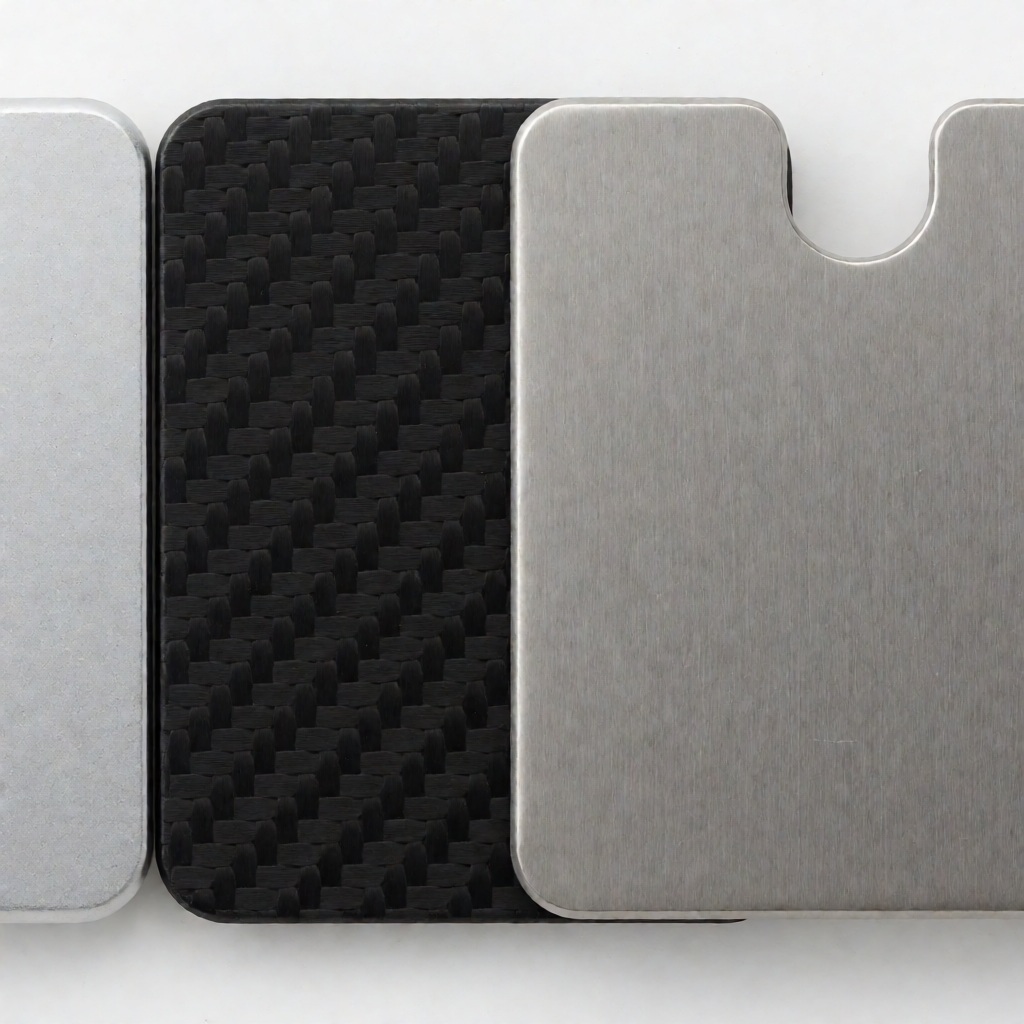
The three primary materials used in minimalist wallets — aluminum, carbon fiber, and titanium — occupy distinct positions on the value and performance spectrum. Understanding these differences helps you specify the right product for your customer segment.
Aluminum minimalist wallets
Aluminum wallets are the most cost-effective entry point in the metal wallet category. Typical alloys used are 6061 or 7075 aluminum, which offer a good balance of strength, weight, and machinability. These wallets are usually produced via CNC machining followed by anodising — a surface treatment that hardens the metal and allows colour options (black, silver, blue, gold, etc.).
Aluminum wallets tend to weight between 40–70 grams with a loaded capacity of 6–10 cards. They are durable for everyday use but more prone to scratching and denting compared to titanium. From a sourcing perspective, aluminum offers the lowest tooling and unit cost, making it ideal for high-volume programmes and competitive retail price points.
Carbon fiber card holder options
Carbon fiber wallets are constructed from woven carbon fibre sheets bonded with resin under heat and pressure. The result is an exceptionally stiff, lightweight, and scratch-resistant material that carries a distinctive visual texture. Typical weights range from 30–55 grams for the same card capacity.
Carbon fiber is more expensive to source and manufacture than aluminum, but it commands a premium in the mid-to-upper consumer tier. For B2B buyers, carbon fiber wallets sit in the $8–$18 FOB range at volume, depending on the complexity of the layup pattern and finishing requirements. One consideration: carbon fiber can delaminate if exposed to extreme impact or poor-quality adhesive bonds, so verifying the manufacturing process with your supplier is important.
Titanium money clip and wallet constructions
Titanium — typically grade 1 or grade 2 commercially pure titanium, or sometimes Ti-6Al-4V — represents the highest-performance material in the minimalist wallet space. It is lighter than steel, stronger than aluminum, and highly corrosion-resistant. Titanium wallets typically weight 35–60 grams and can be produced through CNC machining, EDM (electrical discharge machining), or laser cutting.
The primary advantage of titanium is its combination of high strength-to-weight ratio and premium perception. However, the material cost is significantly higher, and machining titanium is more tool-intensive, which raises unit costs. Titanium wallets typically retail between $30–$80+ in consumer markets, and B2B FOB prices reflect that positioning. For brands targeting the premium EDC segment, titanium is the material of choice.
Material comparison summary
| Attribute | Aluminum | Carbon Fiber | Titanium |
|---|---|---|---|
| Typical loaded weight | 40–70 g | 30–55 g | 35–60 g |
| Scratch resistance | Moderate | High | Very high |
| Relative cost (unit) | Low | Medium-high | High |
| Anodising / colour options | Yes (multiple) | Limited (natural weave) | Yes (limited palette) |
| Best for | High-volume, value positioning | Mid-tier EDC brands | Premium / luxury EDC |
How does RFID-blocking technology work?
RFID (Radio Frequency Identification) blocking is a feature that prevents wireless scanners from reading the data stored on the contactless chip embedded in modern credit and debit cards. Most contactless cards operate at 13.56 MHz, the same frequency used by proximity cards and some payment terminals.
An RFID-blocking wallet works by incorporating a layer of metallic mesh or foil — typically aluminium, nickel, or steel — into the wallet’s construction. This layer acts as a Faraday cage, absorbing or reflecting the radio waves before they reach the card chip. The blocking effect is passive; no power source or battery is required.
From a B2B sourcing perspective, two things matter:
- Verification: Not all RFID-blocking wallets are equally effective. Some manufacturers use insufficient material thickness or leave gaps in coverage. Buyers should request test reports or conduct their own verification using an RFID reader and a test card.
- Longevity: Unlike electronic components, passive RFID shielding does not degrade with normal use. However, mechanical damage — such as bending, cracking, or delamination in carbon fiber wallets — can compromise coverage over time. This is a point worth discussing with your supplier during specification.
For more detail on how to evaluate card holders for B2B sourcing and EDC use, including RFID considerations, see our best card holder buying guide for B2B sourcing and everyday carry use.
What manufacturing processes are involved?
The quality and consistency of a minimalist wallet depend heavily on the manufacturing processes employed. Three processes dominate the industry:
CNC machining is the most common method for aluminum and titanium wallets. A block of raw material is mounted on a CNC mill, and cutting tools remove material to form the wallet body, card slots, and retention mechanism channels. CNC produces tight tolerances (typically ±0.05 mm) and consistent results across large batches. It is well-suited for complex geometries but generates more material waste than stamping or laser cutting.
Laser engraving and UV printing are the primary methods for applying branding, logos, and custom artwork to wallet surfaces. Laser engraving removes a thin layer of material to create permanent marks — ideal for metal wallets. UV printing deposits cured ink directly onto the surface, allowing full-colour designs on flat areas. Both methods are compatible with low to medium MOQ programmes.
Anodising is an electrochemical surface treatment applied primarily to aluminum wallets. The process grows a thick, hard oxide layer on the metal surface, improving scratch resistance and corrosion protection. Anodising also allows colour integration — the porous oxide layer absorbs dyes before being sealed. Common anodised colours for wallets include black, silver, blue, rose gold, and green.
For insights into the full range of EDC wallet options available for private label programmes, see our guide to the best minimal wallets for B2B sourcing and private label.
What are the key specifications for a minimalist wallet?
When evaluating a minimalist wallet for procurement, the following technical specifications should be documented and compared across supplier quotes:
- Outer dimensions: Typically 70–90 mm × 100–120 mm, depending on card size compatibility (ISO/IEC 7810 ID-1 standard cards are 85.60 × 53.98 mm).
- Thickness (empty): 3–6 mm for aluminum, 3–5 mm for carbon fiber, 4–7 mm for titanium.
- Thickness (loaded, 8 cards): 8–14 mm depending on mechanism design.
- Weight (empty): 30–70 g depending on material and size.
- Card capacity: 4–12 cards, depending on the retention system.
- RFID blocking: Present or absent; if present, verify frequency range (typically 13.56 MHz).
- Money clip: Integrated spring steel or magnetic closure; verify grip strength.
- Surface finish: Anodised (aluminum), natural (carbon fiber), bead-blasted or polished (titanium).
- Mechanism type: Spring-loaded plate, elastic band, or hybrid.
For buyers evaluating options across a broader range of EDC wallet products, our procurement guide to EDC wallets for B2B buyers provides a structured comparison framework.
What standards and certifications apply?
Quality indicators in the minimalist wallet supply chain fall into three categories: management system certifications, product safety compliance, and material testing standards.
ISO 9001 is the most widely recognised quality management standard. An ISO 9001 certification indicates that the manufacturer has a documented quality management system covering design, production, and continuous improvement processes. It does not certify the product itself but signals that the factory operates with consistent procedures. For background on the ISO standards framework, refer to iso.org.
BSCI (Business Social Compliance Initiative) is an audit framework that assesses social performance in supply chains, covering working conditions, child labour, and health and safety. Buyers in European retail markets increasingly require BSCI audit reports from their suppliers.
REACH and RoHS compliance are regulatory requirements for products sold in the European Union. REACH governs the registration and restriction of chemical substances, while RoHS restricts the use of certain hazardous materials in electronics and related products. For minimalist wallets, RoHS compliance is particularly relevant because RFID-blocking layers and any metal components may contain restricted substances. Reputable suppliers will provide test reports from accredited laboratories (e.g., SGS) confirming compliance.
When sourcing money clips and minimalist wallets for B2B, verifying these certifications should be a prerequisite step before placing any order.
What should you consider for customization, MOQ, and lead times?
Customisation options for minimalist wallets typically include:
- Logo application: laser engraving, UV printing, or embossing
- Material and colour selection: anodised colour for aluminum, carbon fibre weave pattern, titanium finish
- Mechanism configuration: card capacity, retention type, money clip inclusion
- Packaging: custom retail boxes, blister packs, or bulk shipping cartons
- Engraving personalisation: serial numbers, monograms, or custom artwork files
MOQ (Minimum Order Quantity) is a critical factor in B2B sourcing. Entry-level MOQs for custom minimalist wallets typically start at 100 pieces per design, though standard stock items may be available at lower quantities. Higher customisation levels — such as unique CNC tooling, custom anodised colours, or proprietary mechanism designs — may require MOQs of 500–1,000 pieces to amortise setup costs.
Lead times generally follow this pattern:
- Sample production: 5–7 business days for custom designs; 2–3 days for stock samples
- Mass production: 15–25 business days after sample approval, depending on order volume and complexity
- Shipping: varies by destination and method (air freight 5–7 days, sea freight 25–35 days)
For a detailed look at how men’s minimalist EDC wallets are evaluated for procurement — including material selection and feature prioritisation — see our EDC wallet buying guide for men.
How do cost factors affect bulk pricing?
Several variables drive the unit cost of a minimalist wallet at volume:
Material cost is the largest single factor. Aluminum raw material is approximately 3–5× cheaper per kilogram than titanium. Carbon fiber prepreg sheets sit between the two. A price increase in global aluminum or titanium markets can directly affect FOB pricing within a single production quarter.
Production complexity determines machining time and yield. A simple slotted aluminum wallet with a basic spring mechanism will have a significantly lower unit cost than a multi-layer titanium wallet with a custom-engraved face and integrated money clip. CNC cycle time, material waste, and secondary operations (anodising, polishing, engraving) all contribute.
Order volume follows standard economies of scale. Moving from 500 to 2,000 to 5,000 pieces typically reduces the per-unit cost by 15–30%, depending on the product’s complexity. Tooling amortisation is a one-time cost that becomes negligible at higher volumes.
Customisation level adds cost. Standard stock wallets with no branding are the cheapest option. Adding laser engraving increases cost per unit by a small margin. Full custom design — from mechanism engineering to packaging — requires NRE (non-recurring engineering) charges that range from a few hundred to several thousand dollars, depending on scope.
Shipping and logistics should be factored into total landed cost. FOB pricing covers the product at the port of origin. Ocean freight, customs duties, and inland delivery to your warehouse or fulfillment centre are additional. For US-bound orders, Section 301 tariffs on Chinese-origin goods may apply — verify current rates with your freight forwarder.
If you would like to compare specification ranges and lead times for your specific requirements, request a bulk FOB quotation.
How does customization work from concept to production?
The typical customisation workflow for a minimalist wallet follows these stages:
- Specification briefing: You provide target dimensions, material preference, card capacity, branding requirements, and intended retail price point. This can be a verbal brief, a sketch, or a reference product.
- Design and engineering: The manufacturer develops a 3D model or technical drawing, selecting the appropriate mechanism, material gauge, and surface treatment. DFM (Design for Manufacturability) feedback is provided at this stage — for example, noting that a proposed pocket width may not accommodate standard credit cards.
- Sample production: A physical sample is produced, typically within 5–7 business days. The sample allows you to verify fit, function, finish, and branding quality before committing to volume production.
- Sample revision: If changes are needed, revisions are made and additional samples produced. Most suppliers include one round of revisions in the sample cost.
- Production approval: Once the sample is confirmed, a production contract is signed, and a deposit (typically 30%) is paid.
- Mass production: The order moves to the production floor. In-process QC checks are performed at key stages — material incoming inspection, CNC machining verification, assembly inspection, and final packing check.
- Shipping: Goods are packed according to your specifications — retail-ready units in individual boxes, or bulk-packed in master cartons for FBA or warehouse delivery.
For a broader view of how slim wallets compare across the market — including sizing, materials, and value assessment — review our guide to the best slim wallets for men.
Choosing the right manufacturer
Selecting a manufacturer for minimalist wallets requires evaluating more than price. The decision should be based on a structured comparison across five dimensions: technical capability, quality systems, responsiveness, compliance, and scalability.
Technical capability means the factory can produce your specified design with the tolerances and finishes you require. In-house CNC machining is a strong indicator — it means the manufacturer controls the core production process rather than outsourcing it. Check whether the factory also handles secondary processes (anodising, laser engraving, assembly) in-house or relies on third-party vendors, as this affects quality consistency and lead time reliability.
Quality systems are verified through certifications and audit reports. ISO 9001 confirms a structured quality management system. BSCI audit reports confirm social compliance. REACH and RoHS test reports from accredited labs (SGS, Intertek, TUV) confirm product safety compliance. Request copies of these documents before signing a contract.
Responsiveness is demonstrated through sample turnaround time, communication clarity, and flexibility on revisions. A supplier that delivers a good-quality sample within 7 days and responds to questions within 24 hours is likely to be a reliable production partner. Slow or vague communication during the sample phase is a warning sign for the production phase.
Compliance covers both regulatory requirements (REACH, RoHS for EU markets; Prop 65 for California) and your own brand’s quality standards. If you plan to sell on Amazon, verify that the product and packaging meet Amazon’s FBA requirements, including barcoding, polybagging, and suffocation warning labels where applicable.
Scalability means the manufacturer can handle your order volume now and in the future. Ask about monthly production capacity, current client load, and whether they have experience scaling orders from pilot batches to full production runs. A factory that can consistently deliver 500K+ units per month has the infrastructure to support growth.
As a manufacturer with 13+ years of experience producing minimalist EDC wallets for brands, Amazon sellers, and distributors worldwide, our approach to these evaluation criteria is practical and transparent. We maintain an ISO 9001-certified quality management system, our BSCI audit is current, and all materials are REACH and RoHS compliant with SGS test reports available on request. Our in-house CNC machining, laser engraving, and anodising capabilities allow us to manage the full production chain from raw material to packaged goods, which keeps quality consistent and lead times predictable. We work with MOQs starting at 100 pieces and typically deliver custom samples within 7 business days.
If you are evaluating suppliers or ready to move forward with a custom specification, contact our team to discuss your project requirements and receive a detailed quotation.
Sources & References
- iso.org — www.iso.org
- best card holder buying guide for B2B sourcing and everyday carry use — topedcwallet.com
- guide to the best minimal wallets for B2B sourcing and private label — topedcwallet.com
- procurement guide to EDC wallets for B2B buyers — topedcwallet.com
- money clips and minimalist wallets for B2B — topedcwallet.com
- EDC wallet buying guide for men — topedcwallet.com
- request a bulk FOB quotation — topedcwallet.com
- guide to the best slim wallets for men — topedcwallet.com
- 13+ years of experience — topedcwallet.com
From article to product
Still deciding between the two?
Send us the use case rather than the product name. Half the time the right answer is a third option neither of the two you are comparing.
Keep reading
More on wallet comparisons
Evaluating Good Wallet Brands for Bulk Procurement
Compare wallet brands and manufacturers for B2B sourcing — materials, certifications, MOQ, lead times,…
ReadWristlet Wallet vs Pink Wristlet: B2B Comparison Guide 2026
Compare minimalist metal wristlet wallets against fashion pink wristlets. Understand materials, capacity, MOQ, and…
ReadBest Leather Wallets for Men: B2B Sourcing Guide
What makes the best leather wallets for men? Compare leather grades, construction quality, RFID…
Read
About the author
Wu, Leon
Leon Wu is the senior product engineer and EDC testing lead at TOPWALLET. He has spent more than a decade on wallet design-for-manufacture, materials and quality control at the company's Dongguan facility, and writes from bench testing, pull-force and 13.56 MHz shielding measurements rather than supplier spec sheets.
Written on the floor
This article was written by our production and QC team — the people who spec tolerances, run the finishing line and inspect every batch. Where it states a capacity, a pull force or a lead time, it comes from a measurement we made, not a supplier’s catalogue. If a number here disagrees with what your own supplier told you, tell us; several of these articles started as a correction from a buyer.
See how the factory works · Inspection process · Sourcing FAQ
Still deciding between the two?
Send us the use case rather than the product name. Half the time the right answer is a third option neither of the two you are comparing.