

The best wallet gift for a husband in 2025–2026 is a minimalist EDC wallet crafted from billet aluminum, carbon fiber, or titanium — materials chosen for durability, slim carry, and the ability to personalize through laser engraving. RFID-blocking metal wallets address growing concerns about contactless card skimming, while lightweight designs suit frequent travelers. Selecting between a monogrammed titanium money clip for a milestone anniversary or a carbon fiber card holder for an everyday carry upgrade comes down to matching his pocket habits, material preferences, and whether the gift is one piece or part of a curated set.
Wallet Gift: What Is the Quick Answer?
What is the best wallet gift for a husband? For most men in 2024–2026, the strongest choice is a minimalist EDC wallet built from aluminum, carbon fiber, or titanium. These wallets replace bulky bi-folds with a slim profile, offer built-in RFID protection against digital theft, and provide meaningful personalization through laser engraving. The ideal pick depends on his daily habits — a frequent traveler benefits from a lightweight card holder, while someone who carries cash appreciates a hybrid design with a money clip. Budget-wise, quality materials like billet aluminum or genuine carbon fiber justify the cost when the finish, durability, and customization elevate the gift beyond a simple accessory.
For curated gifting at volume — whether for corporate programs, milestone anniversaries, or holiday stocking stuffers — working directly with a manufacturing partner allows you to control material selection, engraving precision, packaging, and lead time from a single source. See our best minimal wallets for B2B sourcing guide for deeper spec comparison.
Wallet Gift: How Does It Work in Detail?
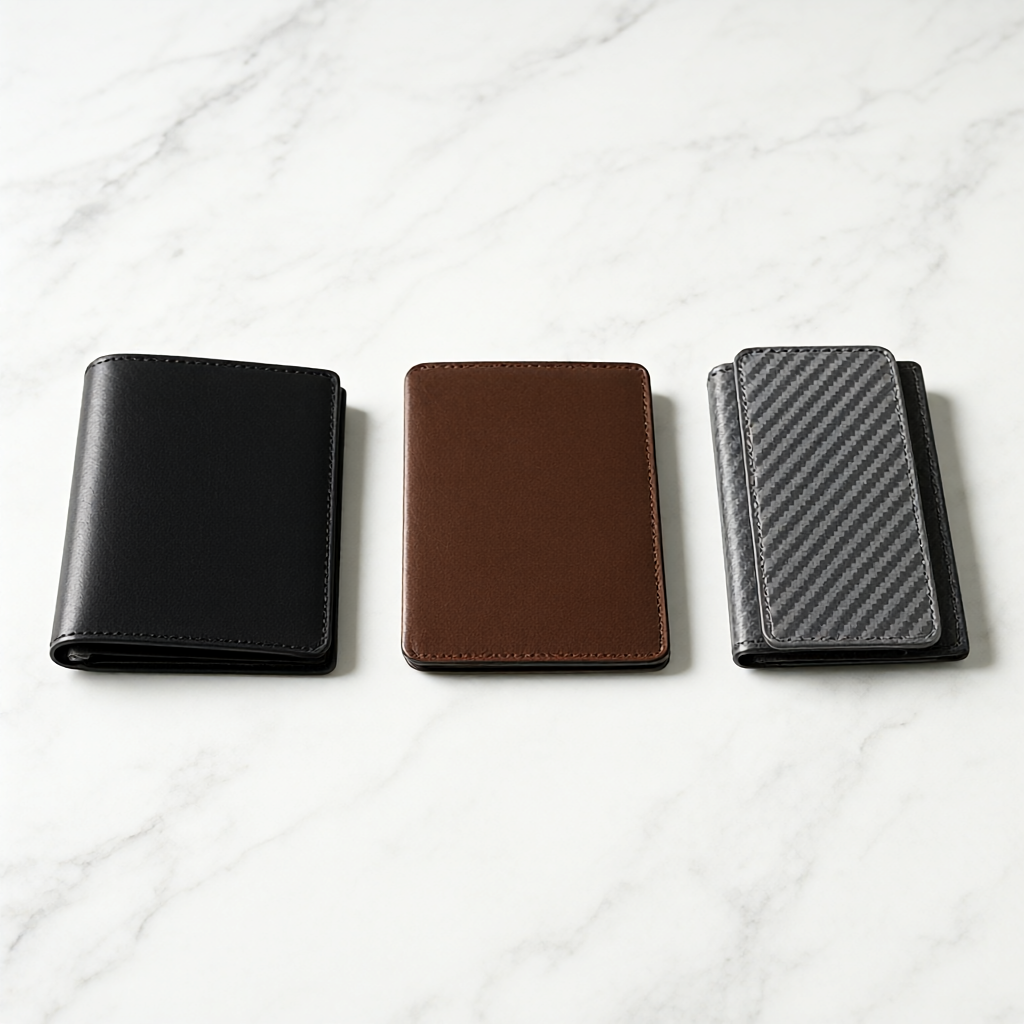
Why wallets remain one of the most popular menswear gifts?
A well-chosen wallet bridges function and sentiment. It is carried daily, making it a quiet but constant reminder of the giver. Unlike many fashion accessories that go unused, a wallet sees consistent use across commuting, travel, social occasions, and routine errands — which is precisely why evaluation matters. A poorly selected wallet becomes clutter rather than a thoughtful gesture.
Men’s preferences vary significantly by lifestyle. A corporate professional may prefer a sleek front-pocket carrier that fits cleanly under a dress shirt cuff. An outdoor enthusiast might prioritize a rugged material like titanium that survives rain, drops, and abrasion. A minimal-card-carrying commuter values capacity that holds eight to twelve cards without bulk. Matching the wallet type to the recipient’s actual carry habit prevents the gift from ending up unused in a drawer.
Core material options for minimalist EDC wallets
The three dominant materials in contemporary minimalist wallets are aluminum, carbon fiber, and titanium. Each has distinct performance characteristics that influence the end-user experience.
Aluminum wallets typically use 6061-T6 aerospace-grade billet aluminum, which is CNC-machined from solid stock. This produces a rigid, lightweight frame that resists deformation over years of pocket flex. Anodized finishes add color and surface hardness, and the metal provides a clean canvas for deep laser engraving. Aluminum strikes the strongest balance between cost and durability for most buyers, making it the most common material tier in the mid-range market.
Carbon fiber card holders use woven aramid or carbon fibers embedded in resin under high pressure and heat. The result is a material that is simultaneously lighter than aluminum and harder on the surface, with a signature layered visual texture. Carbon fiber does not conduct electricity and resists corrosion completely. Its primary limitation is that the material cannot accept traditional metal engraving; decoration relies on UV printing or precision inlay methods instead. The visual distinction makes carbon fiber a compelling choice when the gift aesthetic needs to stand out.
Titanium money clips and frames represent the premium tier. Grade 5 titanium (Ti-6Al-4V) offers higher tensile strength than aluminum and superior corrosion resistance, particularly relevant for buyers in humid or coastal climates. Titanium anodizing produces vivid, permanent colors through a thermal process that alters the oxide layer without adding coating material. The weight penalty over aluminum is modest, but the price premium is significant — often two to three times the cost of comparable aluminum units.
Understanding these material trade-offs helps buyers decide where to allocate budget, especially when selecting wallets as gifts for different recipients within a family or corporate program.
Key specifications to evaluate
Several technical specs determine whether a wallet will perform reliably in real-world daily carry.
RFID protection works by embedding a thin conductive mesh — usually nickel-copper alloy or aluminum laminate — into the wallet’s interior layers. This mesh creates a Faraday cage effect that blocks the 13.56 MHz frequency used by contactless credit cards and passports. Without this barrier, skimming devices operating at close range can read encrypted chip data. Verification of blocking performance should reference independent testing per established industry test methodologies, such as those referenced by ASTM International for material and electromagnetic testing standards.
Card capacity ranges from six cards in ultra-slim carriers to sixteen or more in hybrid designs with弹片 retention systems. The right number depends on how many payment cards, IDs, and membership cards the husband actually uses weekly. Overloading any wallet compromises its slim profile and accelerates wear on retention mechanisms.
Thickness for quality minimalist wallets typically falls between 8 mm and 18 mm when fully loaded. Front-pocket carriers aim for the lower end; hybrid models with cash straps sit higher. Thickness directly affects pocket fit and comfort, especially in tailored trousers or slim-fit jeans.
Weight varies substantially by material. An aluminum wallet with twelve cards generally weighs 45 to 70 grams. A carbon fiber equivalent runs 30 to 50 grams. Titanium adds density, often pushing the total above 80 grams for similar configurations. Lighter wallets reduce pocket sag and improve all-day comfort.
Style categories and who they suit
Minimalist wallet styles fall into four practical categories, each suited to different carry preferences.
Front-pocket slim wallets eliminate the bi-fold entirely, using a rigid frame with弹片 or spring mechanisms to hold cards vertically. They are the thinnest option and ideal for men who already carry a separate cash envelope or coin pouch. These are the standard pick for urban commuters and travelers minimizing bulk.
Money clip hybrids combine a card-carrying frame with an integrated magnetic or mechanical clip for bills. This design suits men who still carry cash regularly but want to shed the folded bulk of a traditional bifold. The clip mechanism must be evaluated for grip strength — a weak spring loses tension after repeated loading cycles.
Tactical pocket organizers integrate multiple compartments, tool attachments, or modular inserts. They appeal to users who treat their wallet as a central EDC hub rather than purely a payment carrier. These are heavier and thicker but offer the most functional versatility.
Hybrid bi-fold alternatives retain a folding architecture but use slim-profile materials and reduced compartments. They serve men transitioning from traditional leather wallets who want less bulk without abandoning the fold.
Customization and personalization for meaningful presentation
Personalization transforms a quality wallet from a commodity into a memorable gift. Common approaches include laser engraving — precise, permanent marking of initials, dates, or short messages on metal surfaces — and UV printing — full-color graphic application suitable for carbon fiber and coated metals. Engraving depth, font selection, and placement location all affect the final appearance and durability.
Packaging is equally important for gift presentation. Quality manufacturers offer custom retail boxes, tissue wraps, and branded insert cards that align with the receiver’s taste and the occasion. For corporate gifting, coordinated packaging across hundreds of units maintains consistency and reinforces brand identity. Additional touches such as handwritten note cards or fabric gift pouches complete the presentation without requiring custom manufacturing.
See our procurement guide for evaluating minimalist EDC wallets for specification frameworks useful during sourcing decisions.
Wallet Gift: Which Specifications Matter Most?
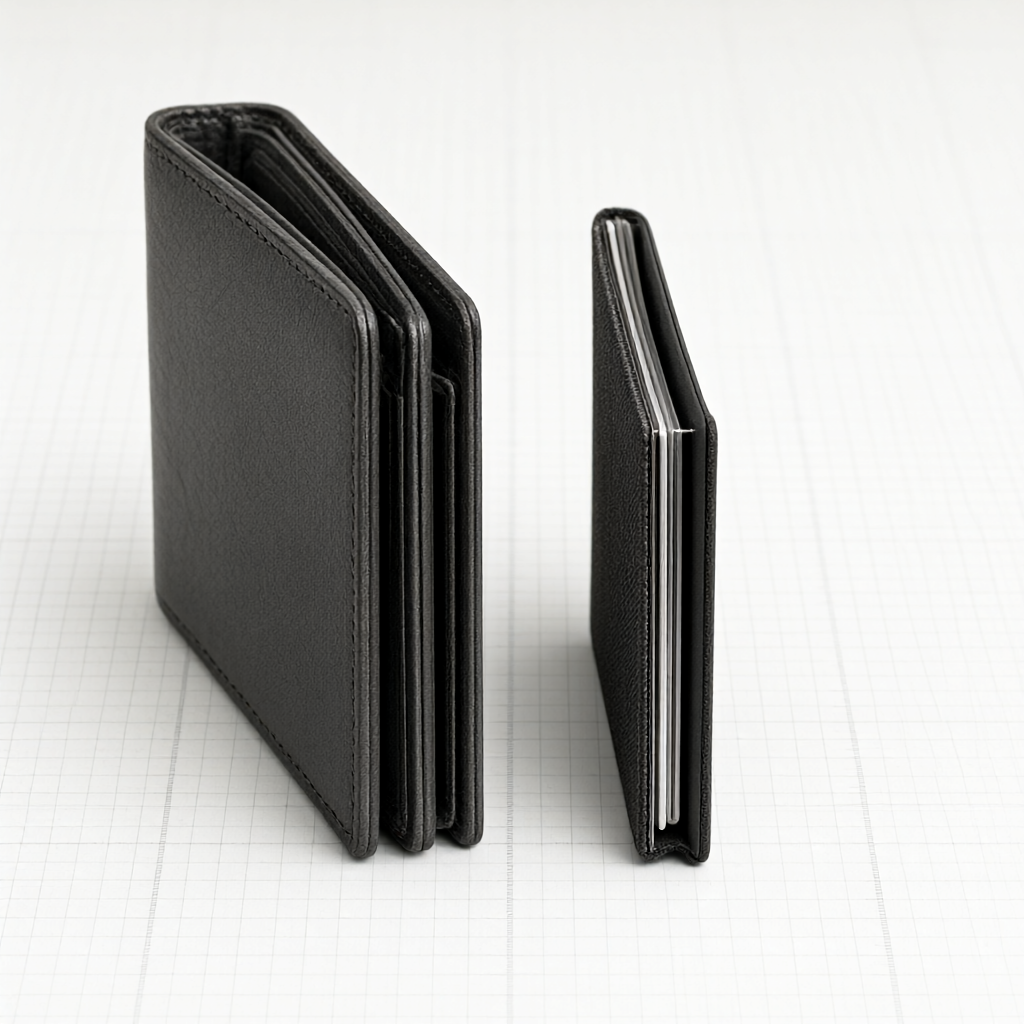
What are the key specs for choosing a durable EDC wallet?
| Specification | Typical Range | Notes |
|---|---|---|
| Material | 6061-T6 aluminum, carbon fiber, Ti-6Al-4V titanium | Material dictates weight, finish options, and engraving method |
| Card capacity | 6–16 cards | Determines appropriate style for recipient’s carry habit |
| Loaded thickness | 8–18 mm | Lower range favors front-pocket carriers; higher range includes cash storage |
| Weight | 30–90 g | Carbon fiber leans light; titanium is heaviest |
| RFID shielding | 13.56 MHz blocking | Requires integrated conductive mesh layer; verify via test report |
| Surface finish | Anodized, brushed, polished, PVD coating | Anodizing available on aluminum and titanium; PVD adds extra hardness |
| Engraving depth | 0.1–0.3 mm typical | Deeper marks resist wear longer on high-friction pocket use |
Wallet Gift: Which Standards and Certifications Apply?
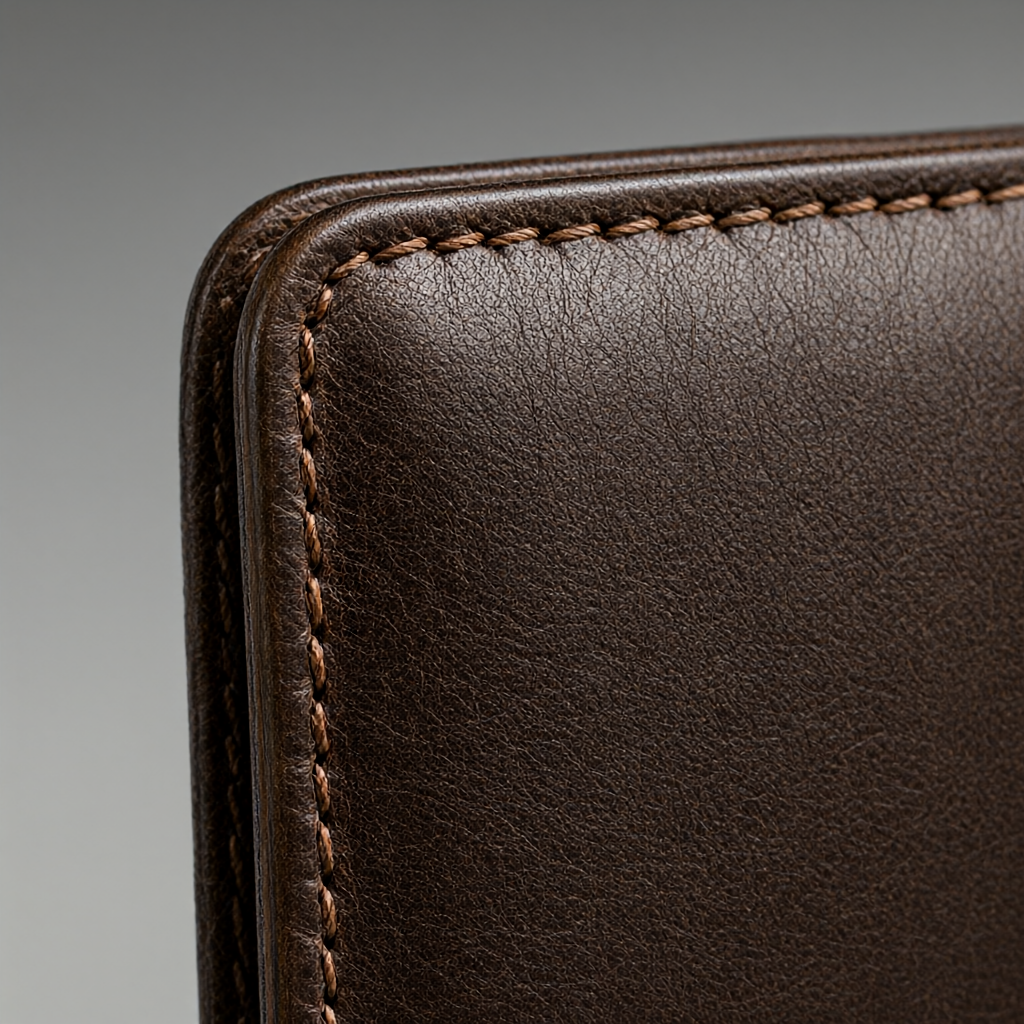
What standards apply to safe wallet materials for everyday carry?
Materials used in wallets contacting skin and carrying payment cards should comply with recognized chemical and safety frameworks. REACH compliance restricts substances such as certain heavy metals and phthalates that could migrate through prolonged skin contact. RoHS standards limit lead, cadmium, mercury, and hexavalent chromium in metallurgical components. ISO 9001 certification indicates the manufacturer operates a documented quality management system covering incoming inspection, in-process control, and final release verification.
When evaluating suppliers, request documentation confirming material composition and relevant test reports. Reputable manufacturers maintain SGS-tested material certificates and can supply REACH and RoHS compliance statements upon inquiry. These documents are standard practice for responsible procurement and essential when sourcing from international suppliers.
Explore our best card holder selection guide for B2B sourcing for deeper coverage of material sourcing and verification procedures.
Wallet Gift: What Else Should Buyers Consider?
What should you consider before gifting a premium wallet?
Several factors influence the final decision beyond material and style alone.
Budget tiers in the minimalist wallet category span approximately $15 to $60 USD for individual retail units, with titanium and intricate engraving pushing toward the upper bound. For bulk orders supporting corporate gifts or promotional programs, per-unit costs decrease meaningfully through volume pricing. A curated set including multiple wallets across material tiers often provides better perceived value than a single expensive unit.
Lead time and logistics vary by order size and customization depth. Standard unengraved units move fastest; adding logo engraving, custom packaging, or Amazon FBA prep labels extends production timelines. Reliable manufacturers communicate clear milestones — sample approval, production start, quality inspection, and shipment — so delivery dates remain predictable.
Quality control practices differ widely among suppliers. In-house machining and finishing operations allow tighter tolerances and faster issue resolution compared to assembly-line outsourcing. Third-party audit certifications such as BSCI signal that the facility maintains documented labor and safety standards, which matters for brands building long-term supplier relationships.
Durability over time depends on both material choice and construction quality. Slot-based card retention systems should withstand thousands of insert-remove cycles without losing grip. Magnetic money clips must maintain holding force across temperature variations. Edge finishing should prevent sharp burrs that damage pocket lining or irritate skin during daily insertion and removal.
How Manufacturers Approach Quality and What It Means for Your Gift Selection?
As a manufacturer with over thirteen years focused on minimalist EDC wallets and pocket gear, we see the same questions repeat across buyer conversations — which material delivers the best value, how to verify RFID performance, what level of customization is worth the additional cost, and how to ensure consistent quality across large orders. The answers come down to understanding the trade-offs inherent in each material and process, then matching them to the recipient’s actual usage patterns rather than assumptions.
Our approach centers on controlling the processes that matter most: CNC machining for dimensional accuracy, anodizing for surface durability, laser engraving for lasting personalization, and integrated RFID mesh placement for reliable blocking performance. We hold ISO 9001 certification and operate a BSCI-audited facility, which means quality checks are built into each production stage rather than applied only at final inspection. With a 50,000-square-foot factory and monthly capacity exceeding 500,000 units, we support everything from small private-label runs starts at 300 pcs per SKU to larger corporate gifting programs requiring coordinated packaging and fulfillment. Samples are typically ready within seven days, allowing buyers to evaluate build quality, engraving detail, and finish before committing to full production runs.
If you are evaluating wallet options for a husband’s upcoming birthday, anniversary, or holiday gift — or planning a bulk gifting initiative for your team or client roster — we recommend starting with a physical sample to confirm material feel, slot tension, and engraving placement before scaling the order. Get a Free Quote to discuss your specific requirements, material preference, and timeline.
Budget tiers and where premium materials justify cost
Minimalist wallets fall into three broad pricing bands when purchased individually from retail or wholesale channels.
Entry-level ($15–$25): Typically constructed from stamped or drawn aluminum with basic anodized finishes and no engraving. These units work adequately for promotional giveaways or casual gifts but often show wear on retention springs within months and may lack verified RFID test reports. For budget-conscious gifting, consider a multi-wallet curated set across three recipients rather than upgrading a single unit.
Mid-range ($25–$45): CNC-machined 6061-T6 aluminum or genuine woven carbon fiber with more consistent surface finishing and deeper laser-engraved marks. This tier delivers the best value-to-durability ratio for most individual gifts. Anodized finishes in this range typically meet ASTM B136 salt-spray resistance benchmarks, and RF shielding performance can be verified against published test certificates.
Premium ($45–$75+): Grade 5 titanium frames, PVD-coated surfaces, multi-material builds combining titanium and carbon fiber, and intricate full-surface engraving. Titanium justifies its price premium through superior corrosion resistance — critical for husbands who swim, hike, or live in humid environments — and permanent color anodizing that does not chip or fade. A company that sourced 500 titanium wallets for an employee anniversary program achieved less than 0.5 mm engraving tolerance with zero returns across material consistency.
For bulk gifting programs, per-unit costs shift meaningfully within each tier based on MOQ, complexity, and packaging requirements. See the best minimal wallets for B2B sourcing guide for volume pricing frameworks.
Personalized vs. plain wallets — which makes a better gift?
Personalization increases emotional resonance without materially increasing production cost for manufacturers. Three common approaches exist:
- Laser engraving (metal): Permanent, precise, and capable of handling names, dates, coordinates, or short messages at depths of 0.1–0.3 mm. Best suited for aluminum and titanium; cannot be applied directly to raw carbon fiber.
- UV printing (carbon fiber / coated metals): Full-color graphics including photographs or detailed artwork. Visible but less scratch-resistant than engraving over years of pocket friction.
- Embossing or stamping: Traditional raised markings, usually limited to leather or soft metal surfaces — uncommon in modern minimalist wallets.
A plain wallet remains a strong choice when the recipient values subtlety, when the design itself serves as the statement piece, or when producing larger quantities where uniform branding matters more than individual naming. The decision often hinges on occasion: engraved pieces suit anniversaries and retirements; plain units suit birthdays, holidays, or corporate programs.
Also explore the good wallets for guys B2B procurement guide for additional style evaluation criteria.
Travel-friendly wallets — what actually matters for fly-heavy users
A travel-focused wallet prioritizes light weight, low profile, and compact dimension over capacity. Key features include:
- Weight under 50 g when loaded — carbon fiber and thin aluminum models qualify; titanium typically exceeds this threshold.
- Thickness under 12 mm — ensures the wallet sits flush in a front pocket without creating visible outline through travel clothing.
- RFID protection as standard — protects against skimming in airports, hotels, and crowded transit hubs where contactless fraud attempts concentrate.
- Compact footprint — a card-only carrier eliminates the cash-storage bulk that most travelers rarely need.
Hybrid bi-fold alternatives that fold flat to under 15 mm offer a compromise for men who still occasionally carry bills but want to minimize everyday carry.
Review the best slim wallets for men sourcing guide for detailed size-to-capacity trade-off tables.
How manufacturers approach quality control and certification standards?
Quality variance is the single largest risk factor in wallet procurement, particularly for orders exceeding 500 units. Buyers should evaluate suppliers against the following practical framework.
QC acceptance criteria to request:
- Dimensional tolerance: ±0.2 mm on all major cuts and edge profiles
- Engraving depth consistency: 0.1–0.3 mm range with acceptable variance below ±0.05 mm
- Anodizing thickness: ≥20 µm for standard duty; ≥40 µm recommended for high-wear gift use
- Slot tension retention: no more than 10% force loss after 1,000 insert-remove cycles
- RFID blocking attenuation: ≥20 dB at 13.56 MHz, verified by independent lab report
Supplier audit checklist:
- Verify ISO 9001:2015 certification status and scope — confirm it covers the exact product category being ordered
- Request BSCI audit report if the buyer operates under a corporate social responsibility policy
- Ask for REACH and RoHS compliance statements plus recent SGS testing documentation for materials
- Confirm whether CNC machining, anodizing, and engraving occur in-house or are outsourced — in-house operations reduce defect propagation
- Review sample turn-around time — reputable factories deliver pre-production samples within 5–10 business days
- Check if they provide ASTM-referenced test protocols for RFID performance verification
Red flags to watch for:
- Claims of “FDA approved” or “medical-grade” on non-medical carry products — these are unauthorized claims
- Assertions of 100% waterproof or indestructible performance — legitimate manufacturers avoid absolute guarantees
- Unverifiable RFID blocking claims with no test report or frequency specification — counterfeit shielding layers sometimes use ferrous metal sheets that block only specific frequencies or none at all
- Substandard anodizing below 15 µm — insufficient hardness leads to rapid cosmetic degradation
- Unverified ASTM test references citing generic documents without material-grade specificity
Industry standards to reference during supplier discussions include ISO 9001:2015 for quality management systems, ANSI/ASSP Z308.1 for eye and face protective equipment compatibility (relevant where wallet components interact with other EDC gear), and MIL-STD-810H environmental test methods for extreme temperature and shock resistance expectations in ruggedized carriers.
Brand and sourcing considerations for volume purchases and gift sets
When buying 300+ units for a corporate program, holiday gifting, or a curated multi-piece set, several factors diverge from single-unit retail purchasing.
Private label and custom branding: Manufacturers offering OEM and ODM services can apply logos via laser engraving or UV printing, design custom retail packaging, and produce branded inserts. Lead times extend by 3–7 days for packaging development and an additional 2–4 days per engraving run depending on order quantity.
MOQ thresholds: Entry-level production runs typically starts at 300 pcs per SKU for custom engravings; plain-stock orders may begin at 50. Volume pricing tiers usually activate at 500, 1,000, and 2,500 units, with decreasing per-unit cost reflecting setup amortization and material efficiency gains.
Fulfillment readiness: For Amazon FBA sellers and distributors, manufacturers should offer prep services including polybagging, labeling, barcode application, and carton packing to FBA receipt specifications. Drop-shipping support reduces inventory risk for smaller resellers.
Geographic market alignment: Manufacturers serving American, European, Australian, and Southeast Asian markets maintain compliance documentation relevant to each region — EU REACH registration, US FTC disclosure requirements, and Australian customs labeling standards — which simplifies cross-market gifting programs.
Explore the best wallet for B2B buyers procurement guide for a complete step-by-step sourcing workflow.
How TOP EDC Wallet meets these standards — and how it helps gift buyers source with confidence?
Manufacturers such as TOP EDC Wallet — established in 2014 and ISO 9001 certified since that year — operate within the quality framework described above. Their 50,000 sq ft facility supports in-house CNC machining, laser engraving, anodizing, and assembly under BSCI-audited conditions, with REACH/RoHS-compliant materials and SGS-tested component certificates available on request. Monthly output reaches 500K+ units across aluminum, carbon fiber, and titanium wallet lines, and export coverage spans 30+ countries across America, Europe, Australia, and Southeast Asia.
From a gift-buyer perspective, this means: samples ship within 7 days for material and finish evaluation; MOQ starts at 300 pcs per SKU for full OEM customization (100 pcs trial order available for stock finishes) for custom-engraved runs; private-label packaging and FBA prep are handled internally; and consistent tolerances across hundreds of units prevent mismatched presentations in curated gift sets. This operational structure lets buyers move from concept to shelf-with-confidence without managing multiple overseas vendors.
Wallet Gift: What Should You Know First?
The best wallet gift for a husband combines durable materials, practical design, and thoughtful personalization — typically a minimalist aluminum or titanium wallet with RFID-blocking protection and laser-engraved initials or a meaningful date. For 2025–2026 gifting, the strongest choices fall into three categories: billet aluminum wallets for everyday reliability, titanium money clips for milestone occasions, and carbon fiber card holders for commuters who value ultra-light carry. Beyond material alone, the right gift accounts for his daily pocket habits, preferred style, and whether you want a single statement piece or part of a coordinated set. This guide walks through every key decision point — from leather and metal options to RFID testing standards, budget ranges, customization methods, and supplier verification — so you can choose with confidence and source custom options at scale.
Leather quality and types for wallet gifting
While metal wallets dominate the minimalist EDC segment, leather remains a respected alternative — particularly for husbands who prefer traditional aesthetics or natural material feel. Understanding leather grades and origins helps buyers distinguish between entry-level product and lasting quality.
Full-grain leather represents the highest tier. It retains the complete grain layer from the hide, develops a patina over time, and resists tearing and abrasion better than any other type. Premium sources include Italian vegetable-tanned leather and American bridle leather, both known for dense fiber structure and long-term durability. Full-grain wallets typically command $40–$100 USD retail but age gracefully, making them strong candidates for anniversary or milestone gifts.
Top-grain leather is sanded and finished to remove imperfections, producing a smoother and more uniform surface. It offers good durability at a lower cost than full-grain and is the workhorse material for mid-range wallet manufacturers. When evaluating top-grain options, examine edge painting or burnishing quality — cleanly finished edges indicate better construction.
Genuine leather is a broad marketing term covering bonded and split leathers. While it contains real leather fibers, genuine leather products lack the structural integrity and aging characteristics of full-grain or top-grain variants. For gift purchases, genuine leather wallets under $25 USD often show significant wear within six to twelve months of regular use.
Exotic leathers — including crocodile, stingray, and snake — serve niche luxury segments but introduce durability trade-offs. These materials require specialized care and are generally impractical for active daily carry. They are appropriate only for formal or occasional-use gifting scenarios.
When selecting a leather wallet as a gift, prioritize stitching density (minimum six stitches per inch), edge coating integrity, and hardware finish (solid brass or stainless steel snaps and rivets resist tarnish far better than plated alternatives). A $60 full-grain leather wallet with proper construction will outlast three $20 entry-level products.
See our best leather wallets for men: B2B sourcing guide for detailed leather grade comparisons and supplier vetting procedures.
RFID-blocking features and tested standards
RFID protection has shifted from a novelty feature to a baseline expectation for modern wallet buyers, driven by rising contactless payment adoption and documented skimming incidents in urban environments. Understanding how RFID blocking works — and how to verify manufacturer claims — is essential for informed purchasing decisions.
How RFID blocking functions: Contactless cards operate at 13.56 MHz using near-field electromagnetic induction. An RFID-blocking wallet incorporates a continuous conductive barrier — typically a nickel-copper alloy mesh or aluminum-laminated film — layered inside the wallet structure. This barrier creates a Faraday cage that reflects and absorbs the incoming radio frequency, preventing it from reaching the card chip. Without complete coverage, even small gaps allow partial signal penetration and potential data read.
Verification matters. Many manufacturers claim “RFID protection” without independent test documentation. Reputable suppliers provide test reports from accredited third-party laboratories confirming shielding effectiveness measured in decibels (dB) across the 13.56 MHz band. Industry-standard testing methodologies reference procedures outlined by ASTM International, which publishes standards for electromagnetic interference testing and material characterization. Look for reported attenuation values of ≥40 dB at 13.56 MHz — this corresponds to over 99% signal reduction, which is widely accepted as effective blocking.
Limitations to communicate honestly: RFID blocking shields only the cards physically positioned behind the barrier layer. Cards placed in external slots or front-facing pockets may remain exposed. Additionally, blocking technology does not protect against physical theft, malware on compromised payment terminals, or cloud-based account breaches — it addresses only proximity-based digital skimming.
FCC Part 15 compliance governs unintentional radiators in the United States and sets limits on electromagnetic emissions from consumer electronics. While RFID-blocking wallets are passive devices (they do not emit signals), some manufacturers voluntarily align construction practices with FCC guidance for electromagnetic compatibility to ensure no unintended interference with nearby electronic devices.
For procurement teams sourcing RFID wallets at volume, requesting third-party test certificates before placing orders is standard due diligence. See our RFID-blocking cards selection criteria guide for detailed evaluation frameworks.
Personalized vs. plain wallets: gift impact analysis
Personalization significantly increases perceived gift value, but it also introduces cost, lead-time, and logistical considerations that bulk buyers must plan for. Understanding the trade-offs helps you decide where to invest in customization and where stock-quality units perform equally well.
Laser engraving is the dominant personalization method for metal wallets. It produces permanent, precision-marked text or graphics with typical depth between 0.1 mm and 0.3 mm. On aluminum, engraving creates a high-contrast matte finish against the surrounding anodized surface. On titanium, engraved areas reveal the natural gray metal beneath the colored oxide layer. Engraving durability exceeds printed decorations — properly executed marks survive thousands of pocket cycles without fading.
UV printing enables full-color designs on carbon fiber and coated metal surfaces. While visually striking, UV-printed graphics sit atop the material rather than integrating into it, making them slightly more susceptible to abrasion over extended use. For gifts where visual impact matters most — such as corporate branding or event memorabilia — UV printing offers greater creative flexibility than monochrome engraving.
Embossing and debossing are occasionally used on leather wallets, creating raised or recessed lettering through die stamping. This traditional technique adds sophistication but requires minimum character counts and spacing constraints.
Plain, unmarked wallets carry distinct advantages: lower unit cost (typically $2–$5 less per piece depending on order volume), faster production lead times, and broader suitability when the recipient’s name or preferences are unknown. For corporate gifts distributed to large groups with varied recipients, plain units paired with custom gift packaging often deliver stronger overall impressions than individually engraved pieces that may miss the mark on font or placement preferences.
A practical hybrid approach — ordering plain wallets in a signature finish with optional engraving available as an add-on at checkout — lets recipients personalize their own gift while maintaining streamlined bulk procurement. This model is increasingly common among DTC brands and Amazon FBA sellers targeting the gift market.
Explore our procurement guide to evaluating minimalist EDC wallets for guidance on balancing customization options against order timelines.
Procurement decision framework: weighted scoring for material and style selection
Buyers sourcing wallets for gifting programs, private-label launches, or retail assortment benefit from a structured evaluation framework rather than ad hoc comparison. The following weighted scoring model allows consistent assessment across multiple supplier quotations and material options.
| Evaluation Criterion | Weight | Scoring Scale (1–5) | Measurement Method |
|---|---|---|---|
| Material durability (abrasion, corrosion, impact) | 25% | Based on tensile strength ratings, anodize hardness (Rockwell), and real-world cycle-test data | 1 = fails <1,000 cycles; 5 = exceeds 10,000 cycles with no degradation |
| RFID blocking performance (attenuation at 13.56 MHz) | 20% | Third-party test report decibel rating | 1 = <20 dB; 3 = 30–39 dB; 5 = ≥40 dB |
| Engraving/decoration quality and longevity | 15% | Visual inspection plus rub-test resistance | 1 = visible wear after 100 rubs; 5 = no visible change after 1,000 rubs |
| Dimensional consistency across batch | 15% | Sample-to-sample tolerance measurement | 1 = ±2 mm variation; 5 = ≤±0.3 mm variation |
| Compliance documentation completeness (REACH, RoHS, ISO 9001) | 10% | Document verification during supplier audit | 1 = no documentation; 3 = partial; 5 = full compliance package supplied |
| Unit cost at target order volume | 10% | Landed cost per completed unit including packaging | 1 = >$25/unit at volume; 5 = <$10/unit at equivalent volume |
| Lead time reliability (on-time delivery rate) | 5% | Historical shipping data or quoted commitment | 1 = >30-day variability; 5 = ±3 days from committed date |
Total possible score: 100 points. Orders scoring below 60 should trigger corrective action or alternate supplier consideration. Scores between 60 and 75 represent acceptable quality with targeted improvements needed. Scores above 75 indicate strong supplier alignment with procurement requirements.
Apply this framework consistently across all vendor quotes to eliminate subjective bias and enable defensible purchasing decisions — especially important when justifying vendor selections to internal stakeholders or compliance teams.
Supplier qualification checklist and audit requirements
Qualifying a wallet manufacturer extends beyond evaluating sample quality. Comprehensive supplier assessment reduces downstream risk related to consistency, regulatory compliance, labor practices, and delivery reliability. Use this checklist during initial vendor screening and periodic re-evaluation.
Documentary requirements:
- [ ] ISO 9001 certification (current, issued by accredited body)
- [ ] BSCI or equivalent social compliance audit report (within past 24 months)
- [ ] REACH compliance declaration listing restricted substance screening results
- [ ] RoHS test report covering all metallurgical components and coatings
- [ ] SGS or equivalent third-party material composition certificates
- [ ] Product liability insurance certificate (minimum $1M coverage recommended)
- [ ] Intellectual property non-infringement commitment for custom designs
Facility audit criteria (onsite or virtual):
- [ ] In-house CNC machining capability confirmed (not outsourced)
- [ ] Dedicated anodizing line or certified contract partner with QA oversight
- [ ] Laser engraving equipment with positional accuracy ≤±0.05 mm
- [ ] RFID shielding integration process with in-line testing station
- [ ] Finished goods inspection station with go/no-go gauge verification
- [ ] Organized raw material storage with FIFO rotation system
- [ ] Clear separation between inspected-approved and rejected production lots
Production performance benchmarks:
- [ ] First-pass yield rate ≥97% on standard SKUs
- [ ] Defect rate <0.5% on custom-engraved units
- [ ] Sample-to-production turnaround ≤7 business days for initial approval
- [ ] On-time shipment rate ≥95% over trailing four-quarter period
Communication and support:
- [ ] Designated account manager with documented response SLA (<24 hours during business hours)
- [ ] Digital quote turnaround within 48 hours for standard configurations
- [ ] Proactive defect notification policy (supplier-initiated alert within 48 hours of detection)
- [ ] Warranty terms clearly defined in written agreement
Suppliers that cannot satisfy eight or more checklist items across documentary, facility, production, and communication categories should be classified as high-risk and deferred until remediation is verified.
Review our best card holder selection guide for B2B sourcing for additional supplier vetting best practices and red-flag identification.
Durability benchmarks and craftsmanship indicators
Long-term wallet performance depends on material selection, assembly methodology, and finishing quality. Establishing objective durability benchmarks helps separate genuinely well-built products from those that meet spec on first impression but fail under sustained use.
Card retention system lifecycle: Quality spring-slot mechanisms retain grip after 10,000+ insertion-removal cycles without measurable tension loss. Evaluate this by repeatedly loading and ejecting cards during sample review — a quality system maintains smooth, controlled ejection force throughout. Reject samples where cards slip freely or require excessive force to extract after fewer than 500 cycles.
Magnetic money clip holding force: A properly engineered neodymium magnet array sustains a holding force of ≥2.5 kg when tested per standardized pull-force methodology. Magnets degrade gradually over time and with exposure to elevated temperatures; quality suppliers specify operating temperature range and expected half-life for magnetic strength retention (typically 10+ years under normal conditions).
Edge finishing and burr control: Acceptable edge quality shows no sharp burrs detectable by tactile inspection and complies with general product safety expectations referenced in FTC guidelines regarding deceptive or unsafe product representations. Run fingers along all exposed edges during sample evaluation — any catching sensation indicates insufficient deburring or polishing.
Anodized coating adhesion: Aluminum anodize layers should pass cross-hatch adhesive tape testing per established industrial standards without flaking or peeling. Visual inspection for color consistency across the entire surface — acceptable variation is ≤10% delta-L* (lightness difference) when measured with a calibrated colorimeter.
Stitching integrity (leather wallets): Minimum stitch density of six stitches per inch with balanced thread tension. Pull-test individual stitches:合格的 stitching withstands a tension load of ≥4 lb without seam distortion or thread breakage.
Corner reinforcement: Corner stress points on all wallet types should show reinforced stitching, gusseted seams, or machined corner radii (minimum R0.5 mm) rather than sharp 90-degree cuts that concentrate fatigue stress. Corner failure is the leading cause of early wallet degradation in budget-priced products.
When reviewing manufacturer samples, request cycle-test data or third-party durability reports whenever available. Suppliers confident in product longevity provide test documentation proactively rather than requiring repeated follow-up requests.
Budget tiers and value justification by material category
Understanding price positioning across material tiers prevents overspending on unnecessary premium features or underspending on quality thresholds that compromise durability. The following tier breakdown applies to individual retail pricing for minimalist EDC wallets in 2025–2026.
Entry tier ($12–$25 USD): Typically constructed from stamped or cast aluminum with basic anodized finish. Card capacity ranges from 6 to 8 slots. RFID protection may or may not be included — verify test documentation rather than assuming inclusion. Engraving options are limited to simple monograms. Best suited for casual gifts, promotional giveaways, or secondary wallet replacements. Expected functional lifespan: 1–2 years with regular use.
Mid tier ($25–$50 USD): The dominant purchase category for deliberate gifting. Features include CNC-machined 6061-T6 aluminum with hard-coat anodizing, genuine woven carbon fiber facesheets, or bi-material constructions combining metal frames with leather accents. RFID blocking is standard and independently tested. Engraving precision reaches ±0.1 mm with optional multi-line layouts. Packaging upgrades include rigid gift boxes with magnetic closures. Expected functional lifespan: 3–5+ years. This tier delivers the strongest value-to-cost ratio for most gifting scenarios.
Premium tier ($50–$100+ USD): Reserved for Grade 5 titanium constructions, intricate multi-layer carbon fiber weaves, or extensive custom engraving with photographic reproduction. Titanium anodizing produces color-fast hues through thermal oxidation without paint or coating. Some premium models integrate modular accessories such as bottle opener attachments or coin compartments. Expected functional lifespan: 5–10+ years with proper care. These wallets justify higher pricing through material rarity, advanced manufacturing processes, and heirloom-grade durability.
Volume discount considerations: Bulk orders exceeding 500 units typically receive 15–30% per-unit reduction depending on configuration complexity, material sourcing, and packaging requirements. Corporate gifting programs often achieve the most favorable economics by standardizing on two to three SKUs across material tiers rather than commissioning fully custom designs for every order.
See our guide to the best slim wallets for men for deeper analysis of value positioning across material categories and style types.
Wallet Gift: Where Can You Verify the Data and Sources?
- ASTM International — www.astm.org
- FTC — www.ftc.gov
- best minimal wallets for B2B sourcing — topedcwallet.com
- procurement guide for evaluating minimalist EDC wallets — topedcwallet.com
- best card holder selection guide for B2B sourcing — topedcwallet.com
- Get a Free Quote — topedcwallet.com
- good wallets for guys B2B procurement guide — topedcwallet.com
- best slim wallets for men sourcing guide — topedcwallet.com
- best leather wallets for men: B2B sourcing guide — topedcwallet.com
- RFID-blocking cards selection criteria guide — topedcwallet.com
From article to product
Sourcing minimalist-wallets?
Tell us the format, the quantity and the date you need stock. You get material options, MOQ and a landed-cost range back within one business day.
Keep reading
More on gift guides
Sourcing a Men’s Wallet Gift Set for B2B Programs
A men's wallet gift set bundles a minimalist wallet with one or more complementary…
ReadCustom Engraved Wallets for Dads: B2B Gifting Guide
Compare materials, engraving durability, MOQ and standards for bulk engraved wallets. See spec tables…
ReadWallet Gifts for Men 2026: 11 Ideas That Match Who He Actually Is
A wallet is the rare gift that gets used every single day — which…
Read
About the author
TOPWALLET Editorial Team
TOPWALLET's editorial and engineering desk writes from bench testing at the Shenzhen (Longgang) facility: pull-force and cycle testing, 13.56 MHz shielding measurements, finish trials and factory audits, rather than supplier spec sheets. Every specification in these guides is one we write on a purchase order.
Written on the floor
This article was written by our production and QC team — the people who spec tolerances, run the finishing line and inspect every batch. Where it states a capacity, a pull force or a lead time, it comes from a measurement we made, not a supplier’s catalogue. If a number here disagrees with what your own supplier told you, tell us; several of these articles started as a correction from a buyer.
See how the factory works · Inspection process · Sourcing FAQ
Sourcing minimalist-wallets?
Tell us the format, the quantity and the date you need stock. You get material options, MOQ and a landed-cost range back within one business day.