

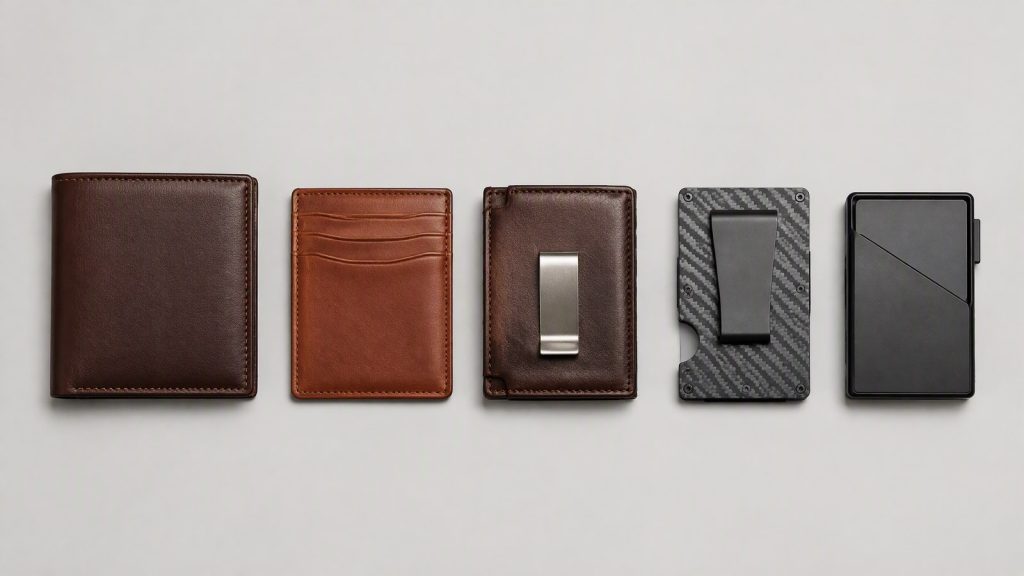
Tap to pay rewrote the rules for what a wallet has to do. UK Finance's July 2024 count put roughly 149 million contactless cards in circulation in the UK alone, with 93 percent of debit cards and 94 percent of credit cards carrying the capability. The United States followed the same curve at a slower pace. When most of your transactions happen without a signature, a thick leather bifold built around cash and card slots starts to feel like luggage.
Carry one anyway and the routine is familiar: find the bulge, dig it out, slide a card from a slot that stretched years ago, fish cash from under a pile of receipts, and close the thing with two hands. A rigid card holder changes that loop — same cards, flat profile, one-hand access. The everyday carry (EDC) movement turned this from a gear hobby into a buying category with hundreds of models.
Most of those models are marketed with the same words: slim, tactical, premium, RFID-blocking. This guide separates those claims from what actually matters, and it does so from an unusual position. I write from the factory floor at Wallet & Co. (topedcwallet.com) in Dongguan, China, where we produce card holders for brands, distributors, and OEM clients across North America and Europe. The material claims and quality checks described here come from production runs, not press releases.
By the end you should be able to name the five decisions that decide most purchases, read a materials section without taking marketing at face value, and steer around the two buyer mistakes that show up in reviews of every range we make.
What Is an EDC Wallet?
EDC — everyday carry — is the term the outdoors and preparedness communities popularized for the gear people keep on them daily. The wallet version applies the same idea to cards and cash: a holder sized for what you actually use, not for a lifetime of receipts. The label now covers an entire category of slim, rigid, and hybrid designs.
What separates an EDC wallet from a conventional one is structural rather than cosmetic. Start with capacity. A bifold swallows six to fourteen cards and grows thicker with every addition; an EDC wallet holds five to twelve, and most designs keep total thickness under half an inch using a rigid plate, elastic band, or spring mechanism.
Then profile: a well-built one sits flat enough that you forget it in your front pocket. Then materials: with cards held under compression, manufacturers turn to aluminum, stainless steel, titanium, carbon fiber, and G10 far more often than leather. Security rounds out the list — RFID-blocking layers are common, sometimes built into the metal itself.
None of this is an obituary for leather. If you want a soft feel and a patina that records years of use, leather remains the right call. The category has moved decisively toward rigid and hybrid builds, though, and any serious buying decision starts with those four dimensions.
EDC Wallet Types at a Glance
Almost every EDC wallet on the market is a variation on five designs. Once you know which family a product belongs to, the brand name tells you far less than the mechanism does.
Elastic-band plate wallets. Two rigid plates sandwich your cards while elastic bands hold them under tension. The Ridge Wallet turned this into the category's reference design, and dozens of manufacturers now offer their own take at every price level.
Ejector wallets. Cards sit in a rigid carrier, and a button or lever pushes the stack out for you. Spring-loaded and mechanically animated, ejectors were popularized by Ekster and Secrid, and they suit people who tap a card throughout the day.
Money clip wallets. A single plate or a slim sleeve with a clip on the back for folded cash. Usually the thinnest option — provided you can live without card capacity and drop protection.
RFID-shielded sleeves. A flexible sleeve that wraps cards in a shielding layer, mostly aimed at frequent travelers. Many treat RFID blocking as a headline feature rather than a design core.
Tracker-ready wallets. A slim carrier with a dedicated slot built for an Apple AirTag, Tile, or equivalent. Worth a look if your wallet has a habit of migrating into bags, cars, or couch cushions.
Families overlap: a plate wallet can add a money clip, an ejector can hide a tracker slot. The label matters less than the fit between mechanism and daily routine, which is the subject of the next section.
The Reference Spec Table
Before comparing any two wallets, put them on one scale. The table below anchors the five design families against the Ridge Wallet — the most widely searched reference in the category — and lists what our factory checks before any card holder design goes to production.
| Design family | Starting price (USD) | Typical warranty | Card capacity | Typical materials |
|---|---|---|---|---|
| Ridge-style elastic plate (reference) | ~$105–$185 | Lifetime | 1–12 cards | Aluminum, titanium, carbon fiber |
| Ejector / button mechanism | ~$60–$130 | 1–2 years | 4–12 cards | Aluminum, polymer, stainless steel |
| Money clip plate | ~$25–$80 | 1 year | 4–8 cards | Aluminum, stainless steel, titanium |
| RFID-shielded sleeve | ~$15–$60 | 1 year | 4–10 cards | Polymer, fabric with metal layer |
| Tracker-ready carrier | ~$45–$150 | 1–2 years | 5–10 cards | Aluminum, G10, carbon fiber |
Read the table on four dimensions: price, warranty, capacity, material. Prices are street numbers from the US market rather than MSRPs, so they drift with metal costs and exchange rates. Warranty language deserves a close read — a "lifetime" term that excludes the elastic bands covers the plates but not the part that actually wears out.
Capacity always depends on card thickness; a wallet rated for twelve cards may hold eight chip cards comfortably. Watch the pattern underneath: mechanism and material drive price far more than logo. If a plain aluminum plate wallet with no tracking and no ejector costs more than the midline of its family, the premium is in the name, not the build.
Five Decisions That Matter More Than Brand
Marketing wants you to compare logos. The wallet that actually fits works out through five design decisions — work through them in order and the shortlist shrinks fast.
How many cards do you actually carry?
Dump your current wallet on a table and count what you reached for in a normal week. Most people overestimate on the first pass. Under five cards, almost anything works, including the thinnest money clips. Five to eight puts you in plate-wallet and ejector territory. Past eight, you are looking at stretched-capacity models or a card organizer paired with a separate wallet.
Count cash honestly too. If you carry folded bills daily, a money clip or a plate wallet with a cash strap beats an ejector, which usually has no cash compartment at all.
Which card-access mechanism fits your day?
Buyers skip this decision and regret it later. Track a single day: how many times do you tap a terminal, show an ID, or hand over a transit pass? Frequent access favors an ejector — one press and the whole stack presents itself. Light access favors a plate wallet: cheaper, and no moving parts to fail.
Moving parts fail first on any wallet. On our production line, ejector springs run 30,000 cycles before sign-off. If you open your wallet twice a day, do not pay for a mechanism built for forty.
Metal, leather, or composite?
Material decides weight, scratch tolerance, and how the thing feels against your leg. Leather stretches and creases. Aluminum is light — a Ridge-style body with hardware comes in near 45 grams — and affordable. Stainless is heavy but close to indestructible.
Titanium runs about half the steel weight at comparable strength, and it is the premium pick. Carbon fiber and G10 read technical: light, stiff, scratch-resistant, and G10 stays comfortable against your leg in summer because it does not conduct heat.
Choose the material you can live with on your leg every day, not the one that wins the spec-sheet contest.
Do you need RFID blocking?
Short version here; the data lives in its own section below. Blocking defends against a real but rare attack, and most card fraud happens online rather than through wireless skimming — a point reputable security research has made for years.
The tail risk concentrates in specific places: airport security lines, transit hubs, tourist districts. If you pass through those regularly, a shielded option is cheap insurance. If you are buying against the image of a stranger scanning your pocket, you are paying for reassurance — fine, as long as you know that is the purchase. Most metal wallets block RFID as a side effect of being metal.
Do you want your wallet findable?
If your wallet disappears more than once a month, a tracker slot changes the calculus, and it is one of the fastest-growing features in the category. AirTag integration leads; Tile and regional trackers follow. The cost is a few extra millimeters and a cavity you stop using if the tracker never gets activated.
Ecosystem lock-in applies here, so verify compatibility before you buy, not after.
Materials, Explained by the People Who Make Them
Material claims are where wallet marketing gets most creative — and where factory experience is hardest to fake. This is how those materials actually behave on our line, not how the brochure describes them.
Aluminum. The workhorse is 6061, with 7075 reserved for high-stress parts. Both are aerospace-grade alloys, and the visible difference from cheap stock lives in two places: anodizing and edges. Type III hard anodizing survives corner scuffs that would mar a soft-coat surface within the first month, and edge chamfering keeps plates from cutting denim or fingers. A $20 aluminum wallet and a $100 one can start from identical alloy stock and end up nothing alike — finishing is where the price actually sits.
Stainless steel. The material for people who drop things on concrete for a living: heavier, stiffer, effectively everlasting. The penalty is pocket presence — at equal capacity, stainless runs about twice the weight of aluminum.
Titanium. Light, strong, corrosion-proof, and expensive to machine. Grade 5 (Ti-6Al-4V) is the standard wallet grade. Machining it is genuinely harder on tooling, with slower cutting speeds and stricter process windows, and that shows up in price. A titanium wallet is not four times the wallet an aluminum one is; it is a lighter, stronger plate carrying a higher production cost, full stop.
Carbon fiber and G10. Both are resin-fiber composites. G10 is fiberglass in epoxy, pressed into sheets: extremely scratch-resistant, comfortable against your leg in summer heat, a favorite daily material. Carbon fiber is lighter and stiffer, admired for its weave, and more brittle under impact than metal. Neither is "better" than metal — you trade weight and feel, you do not buy an upgrade.
Leather. When leather does appear, the tannage decides everything. Full-grain and top-grain hides, vegetable-tanned, develop patina and age gracefully. Bonded leather and embossed splits do not. When a leather wallet sits at the same price as a metal one, ask what is between the skin and the lining — that is where the cost hides.
One note for brand buyers: a factory that produces aluminum and leather cardholders may not produce titanium. The materials a company lists online are not necessarily the ones it manufactures in-house. When a brand says "direct from manufacturer," ask which materials leave its own floor. This guide only claims what we make.
How We Test Card Holders (And Why It Matters)
Most buying guides rate wallets by carrying one for a week — useful for feel, useless for durability. Factory questions are different: does the elastic hold tension for two years? Does the ejector survive daily use? Does the anodizing chip before the first drop? These are the tests we run before a design ships, and they double as questions worth asking any brand.
Capacity under real cards. We load units with EMV chip cards, ID cards, and folded bills, then measure with calipers. A "12-card" rating nearly always shrinks under real-world cards, and we publish the measured number, not the theoretical one. If a brand cannot tell you measured capacity, assume the marketing number is optimistic.
Elastic tension cycling. Bands are the first part to fail on a plate wallet, so each assembly cycles through insert-and-remove thousands of times while we log tension decay past the service threshold. That data sets the service life — and explains why replacement bands are sold as a separate item. A wallet with non-replaceable bands carries a countdown you cannot see.
Ejector spring testing. Spring mechanisms cycle to 30,000 presses on the line, and we reject any unit that fails to return smoothly at the end of the run. Springs fatigue and mechanisms loosen — a crisp first-week feel can go sloppy by month six. The cycle rating tells you how long "smooth" lasts.
Anodizing and edge checks. Type III anodizing is inspected for pinholes and corner chipping, and edges are chamfered so they do not cut fabric or fingers. Together these checks define the gap between a cheap shell and a properly finished plate: nothing visible separates the metal, everything separates the process.
RFID shielding verification. When a design claims blocking, we verify with a card reader at realistic working distances instead of assuming the metal does the job. Metal blocks by design; composite sleeves need a tested shielding layer. The verified result is what ships, not the claim.
None of that changes how a wallet feels on day one. It changes what the wallet feels like on day three hundred — which is where cheap builds quietly fail. When a brand publishes test standards, treat that as a stronger signal than a lifetime-warranty marketing line.
RFID Blocking: What the Data Actually Says
RFID blocking is the wallet category's most effective marketing feature — and its most misunderstood. Start with the fraud numbers. The Nilson Report estimated global payment card fraud at $33.41 billion in 2024 and projected it beyond $41 billion by 2030. That is a large number, and it has little to do with people being scanned in crowds.
The overwhelming majority of that volume happens online: data breaches, phishing, and card-present skimmers at gas pumps and ATMs. Trusted security guidance, McAfee among others, keeps arriving at the same conclusion — proximity skimming of cardholder data is technically possible and vanishingly rare in practice. Contactless fraud exists, since a contactless card base that large leaves plenty of surface to attack, but it does not add up to an epidemic of pocket-scanning.
Buy blocking for the right situations, then. Travelers who pass through security lines, transit hubs, and unfamiliar tourist districts get the most value, because those environments present a targeted-theft model rather than a mass-breach one.
For everyone else, blocking is a bonus — and on metal wallets it is effectively free, since the metal blocks by design. At that point the decision is psychological: a few dollars for ease of mind is a reasonable purchase; a $200 "anti-skimming" premium on a $40 wallet is not.
Common Mistakes to Avoid in 2026
Four mistakes show up again and again in buyer reviews and refund requests. Name them early and you dodge the expensive ones.
Reading "lifetime" as covering everything. Warranty language usually protects the plates, not the wearing parts. Elastic wears, springs fatigue — so check exclusions before you buy, and price a replacement band set while you are at it. If bands are not available separately, factor the eventual purchase into the total cost.
Confusing card slots with capacity. A "12-card" wallet fits twelve thin cards. Chip cards and metal-capped cards run thicker. If you carry EMV chip cards, subtract about a third from the headline number.
Believing the magnet myth. No, a wallet will not demagnetize a credit card's stripe. Cards are not that fragile, and the stripe still exists on most cards — but the fear persists, and neither retailers nor manufacturers rush to correct it. Magnetic closures are safe.
Buying "tactical" without a use case. Mil-spec badges, paracord webbing, and "battle-ready" copy sell appearance, not function. If your day includes a range or genuinely rough handling, buy for that. If it includes an office, a gym, and a grocery store, a clean aluminum or G10 cardholder outlasts the tactical marketing.
Frequently Asked Questions
How many cards fit in a slim EDC wallet?
Most designs hold five to twelve cards. Real chip cards bring practical capacity down to six to eight, and plate wallets reach nominal numbers only with thin cards.
Does a wallet demagnetize my cards?
No. The magnets used in wallet closures do not degrade magnetic stripes — a myth that has survived decades without evidence. Chip cards are unaffected either way.
Is RFID blocking worth the extra money?
As a cheap addition to an otherwise good wallet, yes — peace of mind plus genuine protection in crowded travel settings. As a large premium over a basic wallet, no, because most fraud happens online, not through wireless skimming.
Is titanium worth the price?
Yes, if you want the lightest strong wallet and the budget fits. It is not a durability superpower over stainless; it is lower weight at higher manufacturing cost. We produce it for clients who want that premium feel, and we recommend it for daily front-pocket carry.
Can I put an AirTag in any EDC wallet?
Only in models with a dedicated slot or pocket. A standard plate wallet has no cavity for a tracker, and forcing one in compromises the card stack. If tracking matters, buy the wallet designed for it — and confirm the tracker size matches your ecosystem.
The Bottom Line
An EDC wallet is a small purchase with an outsized effect on daily comfort, and choosing one is now a rational exercise. Count your real cards and cash habit. Pick a mechanism matched to how often you tap. Choose a material you can live against your leg every day. Treat RFID blocking as situational, not mandatory. Add a tracker slot only if losing your wallet is a real pattern. Anchor every comparison to the specs in the table above, and the marketing noise mostly disappears.
If you are a brand, distributor, or retailer reading this while evaluating manufacturers for your own card holder line, the same framework applies in reverse: the factory behind the product matters more than the sticker. That is the business at Wallet & Co. (topedcwallet.com) in Dongguan, China — slim cardholders, plate wallets, RFID-shielded carriers, and OEM designs for partners in North America and Europe, with in-house QC covering band tension, spring cycling, and anodizing checks on every batch.
Download our product catalog to see the full manufacturing range, materials, and packaging options. It is the same document our OEM clients start from, and it takes less than a minute to request.
—
Related Reading
REQUEST A QUOTE → Tell us your spec and order volume. Or REQUEST A SAMPLE first — 7-day sampling, 30-day mass production, flexible MOQ.
From article to product
Turning this into a product?
Most of what is written here is the difference between a sample that works and one that does not. We can build either — the useful one costs the same.
Keep reading
More on buying guides
Best Men’s Card Wallet: B2B Buyer’s Selection Guide 2026
Compare materials, RFID specs, and certifications for men's card wallets. Get procurement-ready guidance on…
ReadBest Bifold Wallets for Bulk Orders — B2B Procurement Guide
Compare materials, specs, certifications, and customization options for bulk bifold wallet sourcing. Learn what…
ReadSale Wallets Women — Bulk Sourcing Guide for Buyers
Find what women's wallets are selling well in bulk — materials, RFID specs, certifications,…
Read
About the author
Wu, Leon
Leon Wu is the senior product engineer and EDC testing lead at TOPWALLET. He has spent more than a decade on wallet design-for-manufacture, materials and quality control at the company's Dongguan facility, and writes from bench testing, pull-force and 13.56 MHz shielding measurements rather than supplier spec sheets.
Written on the floor
This article was written by our production and QC team — the people who spec tolerances, run the finishing line and inspect every batch. Where it states a capacity, a pull force or a lead time, it comes from a measurement we made, not a supplier’s catalogue. If a number here disagrees with what your own supplier told you, tell us; several of these articles started as a correction from a buyer.
See how the factory works · Inspection process · Sourcing FAQ
Turning this into a product?
Most of what is written here is the difference between a sample that works and one that does not. We can build either — the useful one costs the same.