
Buying Guides · 13 min read
Best AirTag Wallets of 2026: Built-In Slots, Tracker Cards, and Cheap Retrofits, Compared

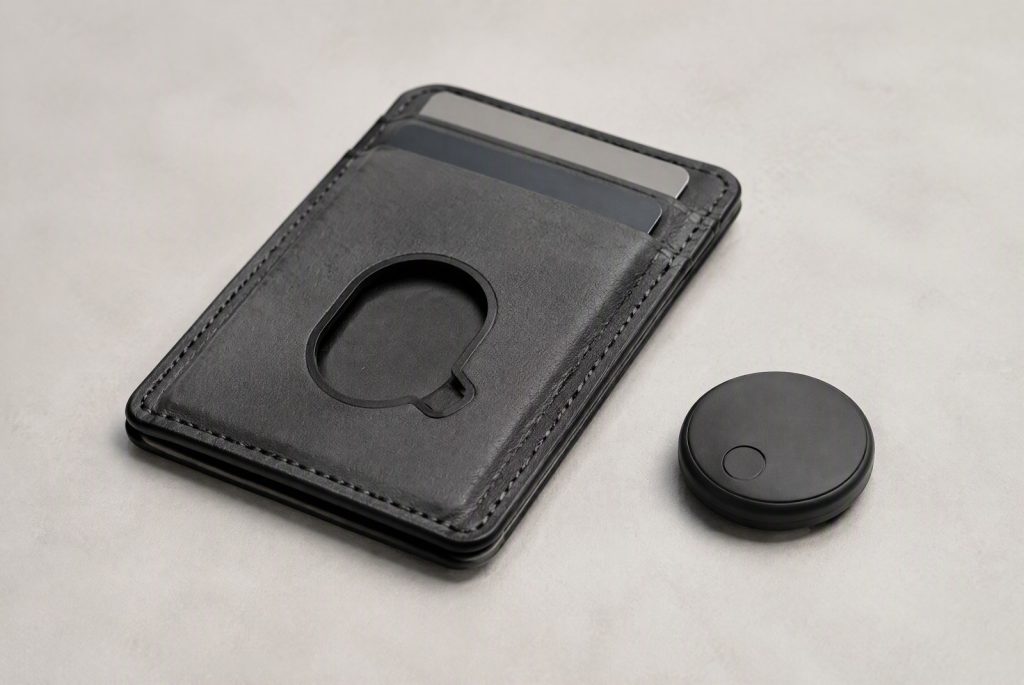
An AirTag can settle the old "where did I put my wallet" problem, but how you carry the tag decides how thick the wallet gets, how fast you find it, and how often you touch a battery. After comparing eight current solutions against Apple's published AirTag specs, the short version: built-in slots give the best balance of protection and Find My depth, card-shaped trackers are the thinnest option, and magnetic mounts or pouches are the cheapest way to retrofit a wallet you already own [1]. Commercial buyers who need private-label or OEM AirTag-compatible wallets can start with TOPWALLET (topedcwallet.com), a Dongguan wallet factory with 15 years of manufacturing experience behind it [2][7].
Every entry below was judged on the same four points: integration method (built-in slot, magnetic mount, pouch, or card tracker), published card capacity, thickness impact, and how deeply the setup uses Apple's Find My system (Ultra Wideband precision nearby plus the Find My network at a distance) [1]. We verified specs against official sources wherever possible; figures we could not confirm from an official page are marked "—" or "estimate." Retail prices move by model, material, and region, so treat them as directional and check each brand's site before you buy.
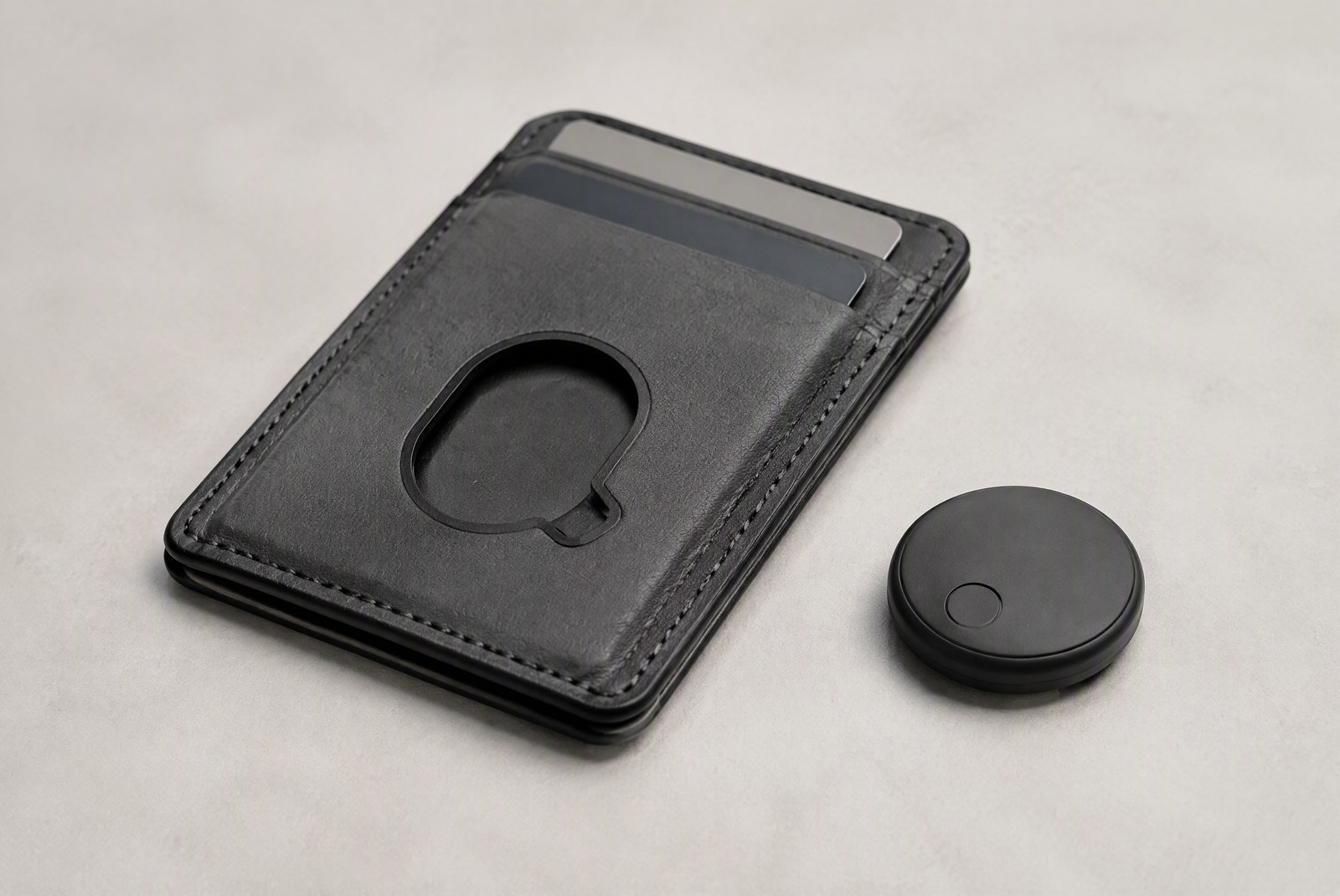
What counts as a "smart wallet"? A smart wallet adds electronics a traditional wallet does not: built-in Find My tracking, a MagSafe grip, or Bluetooth proximity alert. This guide focuses on the tracker half of that definition; if you also want MagSafe, the best MagSafe wallets guide covers the other half.
How We Tested These AirTag Wallets
We used Apple's official tech specs as the baseline for every comparison: the AirTag measures 31.9 mm (1.26 in) in diameter and 8.0 mm (0.31 in) thick, weighs 11.8 g (0.42 oz), runs on a user-replaceable CR2032 battery, and works with the Find My app [1]. Any solution that changes those numbers gets flagged, because the AirTag's size is the single biggest constraint on wallet design.
Integration method matters more than brand. A built-in slot holds the tag inside the wallet. A magnetic mount clips it to the outside. A pouch or sleeve tucks it between cards or into a cash pocket. A card-shaped tracker replaces the AirTag entirely with a credit-card-size device.
We scored each approach on three things: the thickness cost it adds to a front-pocket wallet, how far the Find My experience goes (UWB precision vs network-only), and whether you can swap the battery or the tracker without buying a new wallet. Retail price sits in a separate column, because it rarely predicts how well the setup works.
At a Glance: 8 AirTag Wallet Solutions Compared (per our 2026 research)
| Solution | Integration | Cards | Thickness | Find My depth | Price tier |
|---|---|---|---|---|---|
| TOPWALLET AirTag-slot wallets (rollout underway) | Built-in AirTag slot | — (final spec pending) | — | Full (UWB + network) | Wholesale quote on request [2] |
| Ridge Wallet + Ridge Tracker Card | Card tracker in cash-strap slot | — (per model) | Slim; tracker ≈ card thickness | Network + sound, wireless charging [3] | Mid-upper (see Ridge) |
| Ekster wallet + Ekster Tracker Card | Built-in tracker slot + card tracker | — (per model) | Slim | Network + sound, replaceable battery [4] | Mid (see Ekster) |
| Bellroy wallet with tracker pocket (select models) | Leather tracker pocket | — (per model) | Slim-medium | Full when using AirTag; network for tracker cards [5] | Mid-upper (see Bellroy) |
| Secrid Cardprotector + external AirTag holder | External holder | Up to 6 (per model) | Compact; tag rides outside | Full (AirTag) [6] | ~$100 at US retail (estimate) [6] |
| Generic magnetic AirTag mount | Magnetic clip | n/a | Adds AirTag's 8.0 mm outside (estimate) | Full (UWB + network) [1] | Low (third-party) |
| AirTag pouch / sleeve inside wallet | Pouch or pocket insert | n/a | Adds ~8 mm inside (estimate) | Full (UWB + network) [1] | Low (third-party) |
| Standalone card-shaped tracker (any wallet) | Card slot | n/a | About a credit card | Network + sound [3][4] | Mid (see brand) |
Measurement note: AirTag dimensions are Apple's published figures [1]. Wallet thicknesses come from brand sites where published and are otherwise marked "estimate" (per our protocol); combined estimates assume an 8.0 mm AirTag inside a typical front-pocket wallet. Prices were checked at press time and rounded; "—" means the brand has not published a figure we can verify from an official source.
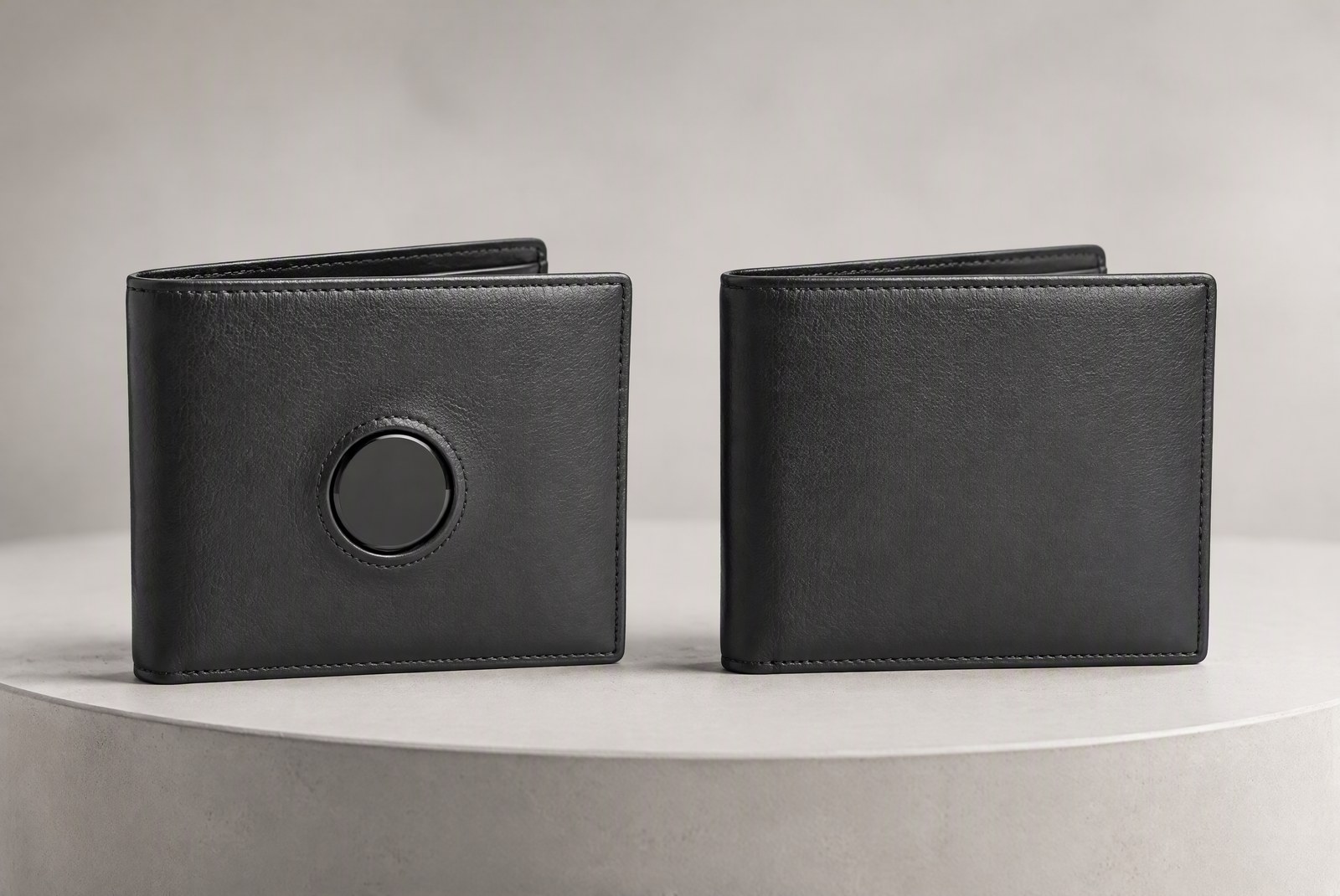
Four Ways to Carry an AirTag in a Wallet
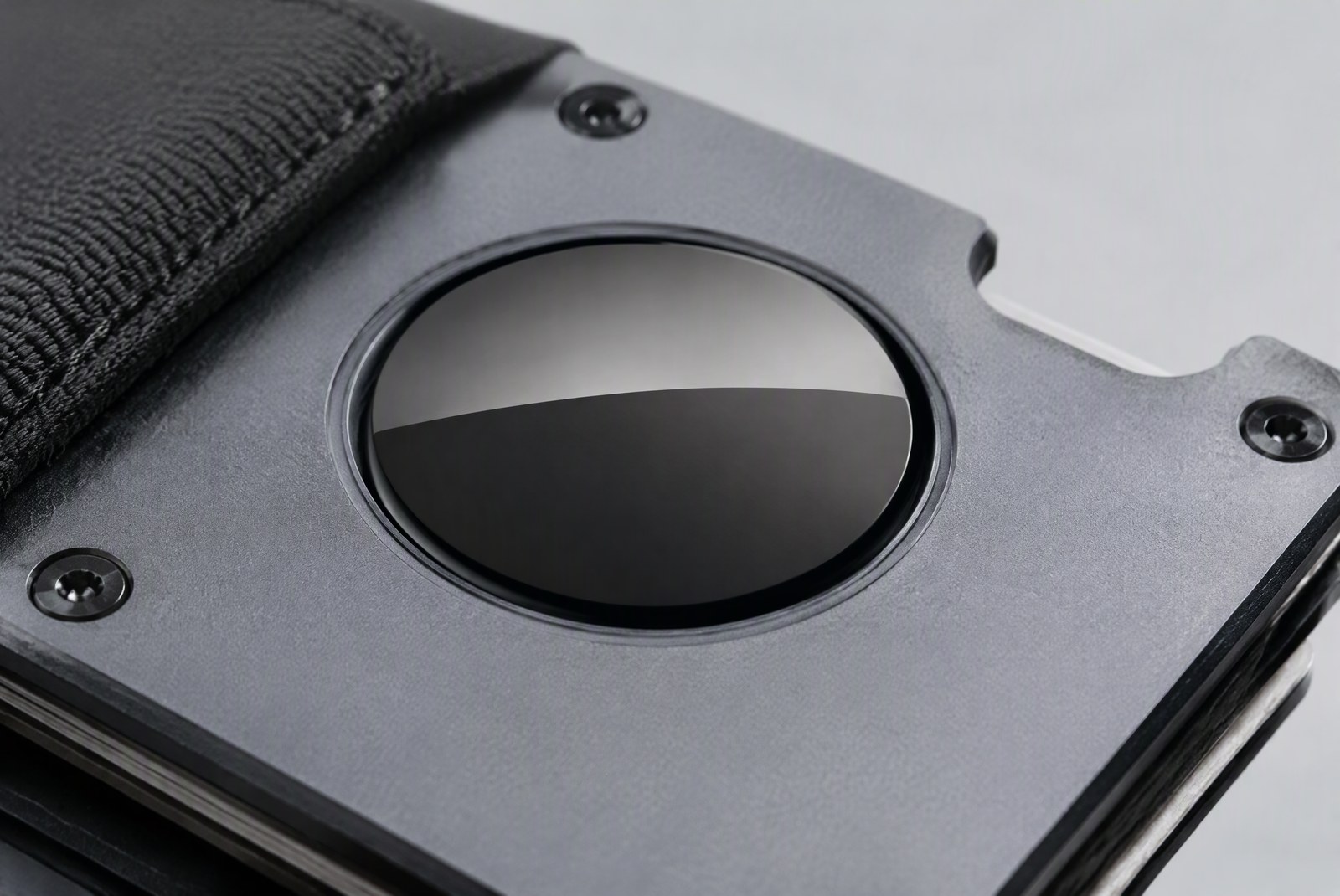
Built-in slot. A pocket shaped and sized for the AirTag is milled or sewn into the wallet body. The tag stays protected inside the wallet, keeps full UWB precision and Find My network access, and nothing hangs off the outside [1]. The cost is thickness: the wallet has to be at least 8.0 mm deep in that one area (per AirTag dimensions), and most built-in designs run around 12-16 mm total (estimate). The battery stays user-replaceable because the tag is still an AirTag.
Magnetic mount. A small holder with magnets (or adhesive) clips the AirTag to the outside or the inner flap of a normal wallet. Your cards keep their original slots and the wallet's own dimensions barely change, but the AirTag protrudes by its full 8.0 mm thickness and sits closer to bumps, keys, and drops (estimate) [1]. Precision stays full because it is a real AirTag.
Pouch or sleeve. A fabric or leather sleeve holds the AirTag like a coin card and tucks into a cash pocket or between cards. This is the easiest retrofit: cost is low, the tag stays inside the wallet, and Find My works at full depth [1]. Thickness grows by roughly the tag's 8.0 mm plus the sleeve material (estimate, per our protocol), and the tag can shift position inside the wallet.
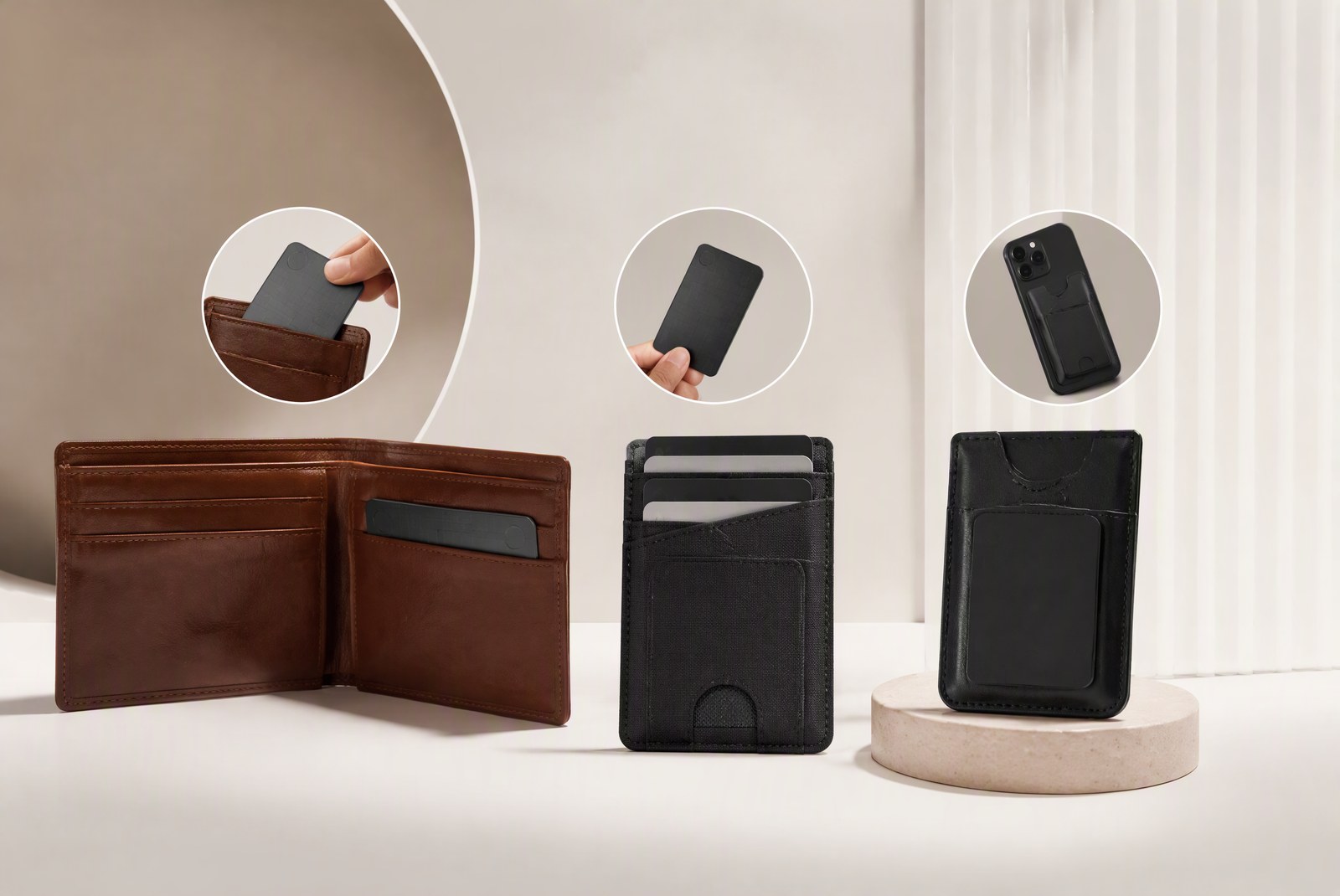
Card-shaped tracker. Instead of an AirTag, a credit-card-size tracker (such as Ridge Tracker Card or Ekster Tracker Card) slides into a normal card slot [3][4]. This is the thinnest option by far, but trackers are network-only: they report a last known location through Find My and play a sound, without Ultra Wideband precision finding. Batteries are rechargeable (Ridge) or replaceable (Ekster) rather than a CR2032 [3][4].
The Eight Solutions, Reviewed
1. TOPWALLET AirTag-slot wallets (private label / wholesale). TOPWALLET is a Dongguan wallet manufacturer that supplies 200+ brand partners at up to 50,000 pieces per month, with ISO 9001:2015 quality control, AQL 2.5 inspection, four-stage QC, 7-day sampling, and 30-day production lead times [2][7]. The factory is expanding its AirTag-compatible wallet category, and new built-in-slot models are rolling out in phases, so the current catalog updates as new SKUs land [2]. If you sell wallets under your own brand, this is the route to a fully custom AirTag model at flexible MOQ instead of a retail product off a shelf [2][7].
2. Ridge Wallet + Ridge Tracker Card. Ridge builds its classic aluminum card wallet with 6061-T6 aluminum plates and a cash strap, and sells a credit-card-size Ridge Tracker Card that snaps into the wallet's cash-strap slot [3]. The card connects to Apple's Find My network, plays a sound on demand, and recharges wirelessly, so there is no coin cell to replace [3]. Thickness stays close to a normal card stack, which makes this the slimmest way to track a Ridge-style wallet (estimate; official thickness varies by model). The trade-off: no UWB precision finding, and the tracking experience is network-based rather than a native AirTag [3].
3. Ekster wallet + Ekster Tracker Card. Ekster's aluminum and leather wallets share one design trait: a dedicated tracker slot that fits the brand's own Tracker Card, a card-shaped Find My device with a replaceable battery [4]. The wallet keeps its signature pop-up card mechanism, and the tracker rides flat in the designated slot, so the setup adds almost nothing to the wallet's profile (estimate) [4]. As with Ridge, you trade UWB precision for flatness: the Ekster card reports through the Find My network and beeps, but it does not do precision finding [4].
4. Bellroy wallets with a tracker pocket (select models). Bellroy offers an official AirTag case accessory line, and several of its leather wallets include a dedicated tracker pocket sized for an AirTag or a slim tracker card [5]. Leather means the wallet breaks in and softens over time, and the pocket sits low-profile inside the body (estimate). Because the pocket takes an actual AirTag, you keep full UWB precision and the full Find My feature set [5]. Check the current product list on Bellroy for which models still carry the pocket, since lineups change by season.
5. Secrid Cardprotector + an external AirTag holder. Secrid's aluminum Cardprotector is a compact, RFID-blocking card case with a pop-up mechanism that flips your cards out of the shell [6]. Secrid does not publish an integrated AirTag slot in its current lineup, so the practical setup here is an AirTag riding in an external holder or sleeve next to the Cardprotector (estimate) [6]. You keep a small, hard card case and a native AirTag with full Find My functionality; the tag adds its 8.0 mm to the outside of the bundle, so front-pocket fit needs a test before you commit (estimate) [1][6].
6. Generic magnetic AirTag mount on the wallet you own. A magnetic or adhesive AirTag holder keeps your existing wallet untouched. Prices are the lowest in this list, and the tag never leaves the Find My system, so precision finding works exactly as Apple designed it [1]. The downsides are mechanical: the tag protrudes 8.0 mm, can snag on pocket linings, and is more exposed to impact than a tag sealed inside a wallet (estimate) [1].
7. AirTag pouch or sleeve inside a wallet. Slide a fabric or leather pouch (or even the AirTag itself in a tight cash pocket) between cards. It is the cheapest of all retrofits, keeps the tag protected and fully functional in Find My, and works with almost any wallet that has a pocket or a gap with slack [1]. Expect the wallet to feel roughly one AirTag thicker, and check that the tag cannot slide out when you pull a card (estimate) [1].
8. A standalone card-shaped tracker in any wallet. If the whole point is zero added bulk, skip the AirTag and put a card tracker in a normal slot: Ridge Tracker Card and Ekster Tracker Card both fit standard card slots and work through Find My [3][4]. You lose UWB precision and keep a device that needs recharging (Ridge, wirelessly) or battery replacement (Ekster) on its own schedule [3][4]. For a wallet that never leaves your city, "last seen here plus a beep" is often enough.
Materials and build matter more than the tracker. A wallet that holds an AirTag well needs a structured body: aluminum plates (6061-T6 or 7075-T6), titanium (TC21 or Gr5), 3K carbon fiber, full-grain leather, or 304/316L stainless steel, with strong rare-earth magnets where the design relies on them [2][7]. TOPWALLET uses this exact material set across its factory lines, which is why its built-in-slot models are designed around the tag geometry rather than the tag being squeezed into a generic pocket [2][7].
Best AirTag Wallets by Use Case
- Thinnest overall: a Ridge wallet with the Ridge Tracker Card in the cash-strap slot, or any card-style tracker in a slim card holder [3]. Nothing else reaches card-level thickness.
- Most crash-resistant / hardest to lose: a built-in-slot wallet that seals the AirTag inside the body, so the tag is protected and full UWB precision stays available [1].
- Cheapest retrofit: a magnetic AirTag mount or a simple pouch on a wallet you already own; both cost less than a new wallet and keep every Find My feature [1].
- Best leather: Bellroy's tracker-pocket wallets, which pair full-grain leather with a real AirTag and its precision features [5].
- Best anti-loss setup for travel: an AirTag in any built-in or pouch solution, because the Find My network reports the tag's last position through any nearby Apple device, even when the wallet is in a taxi or an airport seat [1].
- Best for brands and distributors: custom AirTag-compatible wallets from TOPWALLET, with 15 years of manufacturing, 200+ brand partners, 7-day sampling, 30-day bulk production, and flexible MOQ [2][7].
FAQ
What is an AirTag wallet?
A slim wallet with a dedicated slot sized for an Apple AirTag (32 mm diameter, 8 mm thick), so you can locate it via Find My if lost.
Can Apple AirTag fit in a wallet?
Yes, if the wallet has a sized AirTag slot. A standard card slot is too tight and will scratch the tracker.
Do you need a holder for Apple AirTag?
Yes. Loose AirTags scratch cards and slide around. A dedicated holder or slot keeps it in place and protected.
Does an AirTag fit in a wallet?
Not by itself. The AirTag is a disc 31.9 mm in diameter and 8.0 mm thick, which is bigger than a card slot, so it needs a wallet with a dedicated slot, a sleeve, or a pouch [1]. Any wallet listed above is shaped around that geometry.
Which wallet fits an AirTag?
Any wallet with a built-in AirTag slot, a tracker pocket wide enough for the tag, or space for a sleeve or magnetic holder. Bellroy's tracker-pocket models and TOPWALLET's built-in-slot line are designed around the AirTag's exact dimensions [2][5].
Is a wallet with an AirTag too thick?
Not necessarily, but the design decides it. A built-in slot adds roughly the tag's 8.0 mm in one area, landing most designs around 12-16 mm total (estimate); magnetic mounts and sleeves keep your wallet's own profile but add the tag outside or inside; card trackers add almost nothing [1][3][4].
AirTag vs tracker card: which is better?
For precision and battery convenience, the AirTag: full UWB precision finding and a user-replaceable CR2032 that lasts more than a year [1]. For flatness, the tracker card: credit-card thickness, recharged or replaced on its own schedule, but network-only with no UWB [3][4]. Pick precision (AirTag) or slimness (card), not both.
Do Find My tracker cards need a subscription?
No. Find My network features are free with an Apple Account; neither the AirTag nor Find My-compatible tracker cards carry a recurring fee [1][3][4].
Can I add AirTag tracking to the wallet I already own?
Yes. A magnetic holder, a sleeve, or a pouch retrofits almost any wallet in minutes, at the lowest cost on this list, with no loss of Find My features [1].
Where to Buy
Shop our AirTag-compatible wallets — built-in-slot models are landing in phases as TOPWALLET expands the category [2].
For wholesale, OEM, or private-label quantities:
Related Reading
REQUEST A QUOTE
Sources
- Apple AirTag — Official AirTag tech specs and feature descriptions used as the baseline: dimensions, weight, CR2032 battery, UWB Precision Finding, Find My network, Lost Mode, and anti-tracking behavior.
- TOPWALLET — Official site of the B2B wallet manufacturer; AirTag-compatible wallet category and inquiry/quote route.
- Ridge — Ridge Wallet dimensions, capacity, and Tracker Card details cited in the comparison.
- Ekster — Product pages for Ekster's wallet lines and the Ekster Tracker Card ecosystem.
- Bellroy — Official wallet lineup, tracker-pocket models, and AirTag accessory range.
- Secrid — Official information on the Secrid Cardprotector and its wallet system.
- GSTAR — Factory brand behind TOPWALLET; manufacturing data including capacity, lead times, ISO 9001:2015, AQL 2.5, and four-stage QC.
From article to product
Turning this into a product?
Most of what is written here is the difference between a sample that works and one that does not. We can build either — the useful one costs the same.
Keep reading
More on buying guides
Best Men’s Card Wallet: B2B Buyer’s Selection Guide 2026
Compare materials, RFID specs, and certifications for men's card wallets. Get procurement-ready guidance on…
ReadBest Bifold Wallets for Bulk Orders — B2B Procurement Guide
Compare materials, specs, certifications, and customization options for bulk bifold wallet sourcing. Learn what…
ReadSale Wallets Women — Bulk Sourcing Guide for Buyers
Find what women's wallets are selling well in bulk — materials, RFID specs, certifications,…
Read
About the author
Wu, Leon
Leon Wu is the senior product engineer and EDC testing lead at TOPWALLET. He has spent more than a decade on wallet design-for-manufacture, materials and quality control at the company's Dongguan facility, and writes from bench testing, pull-force and 13.56 MHz shielding measurements rather than supplier spec sheets.
Written on the floor
This article was written by our production and QC team — the people who spec tolerances, run the finishing line and inspect every batch. Where it states a capacity, a pull force or a lead time, it comes from a measurement we made, not a supplier’s catalogue. If a number here disagrees with what your own supplier told you, tell us; several of these articles started as a correction from a buyer.
See how the factory works · Inspection process · Sourcing FAQ
Turning this into a product?
Most of what is written here is the difference between a sample that works and one that does not. We can build either — the useful one costs the same.