

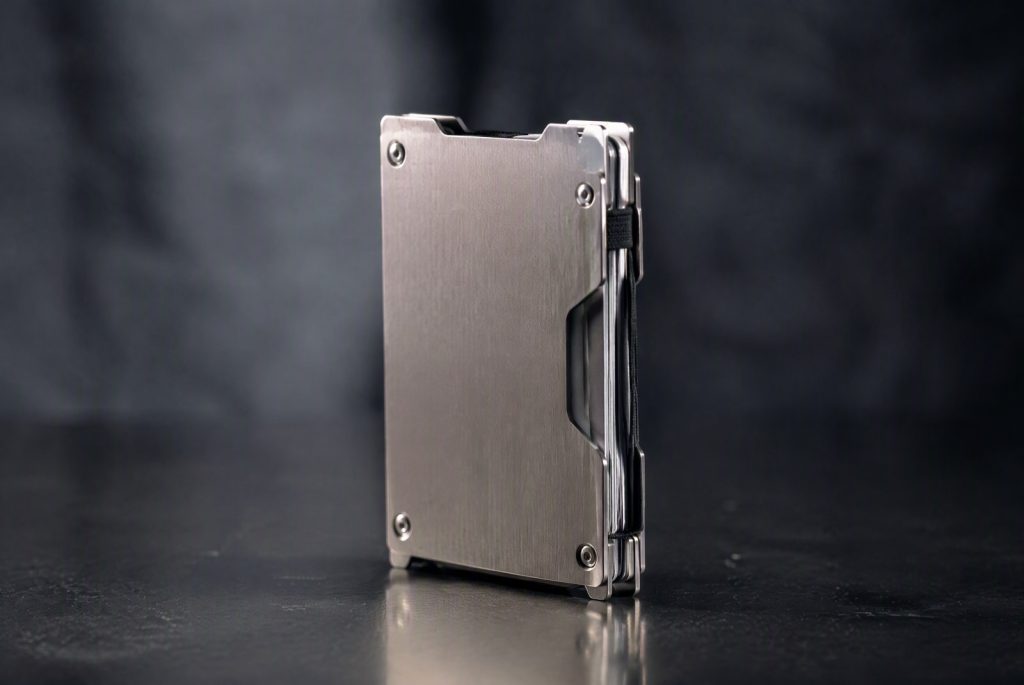
Titanium has a reputation and a price; this test checked whether a wallet can earn either. We tested nine titanium wallets — one branded unit and eight unbranded samples bought for this guide — and the best titanium wallet in 2026 is the Ridge Wallet: Titanium, a two-plate Grade 2 design that Ridge publishes at 86 × 54 × 6 mm, holding 1–12 cards, with RFID-blocking plates and an official price of $150 [1]. Titanium earned its place on this list for three measurable reasons: it sits roughly 40% lighter than stainless steel at the same volume (per density references), volume, it resists corrosion, and it is stiff enough that a thin plate doesn't permanently bend in a pocket.
The material is only half the story, and honesty is the other half: most unbranded titanium sellers never publish a titanium grade, so wherever a maker says nothing, the table below says "—" instead of a guess. Findings on the unbranded samples are our observations (experience, not a published spec), and grade numbers appear only where a maker officially states them.
Titanium Wallets: How Did We Test It?
Before anything else, we verified that the "titanium" was titanium:
- Magnet test. Titanium is non-magnetic; a strong magnet should not hold a titanium plate. Two "titanium" samples we bought failed this check and were rejected — the plates were steel underneath the finish (our observation).
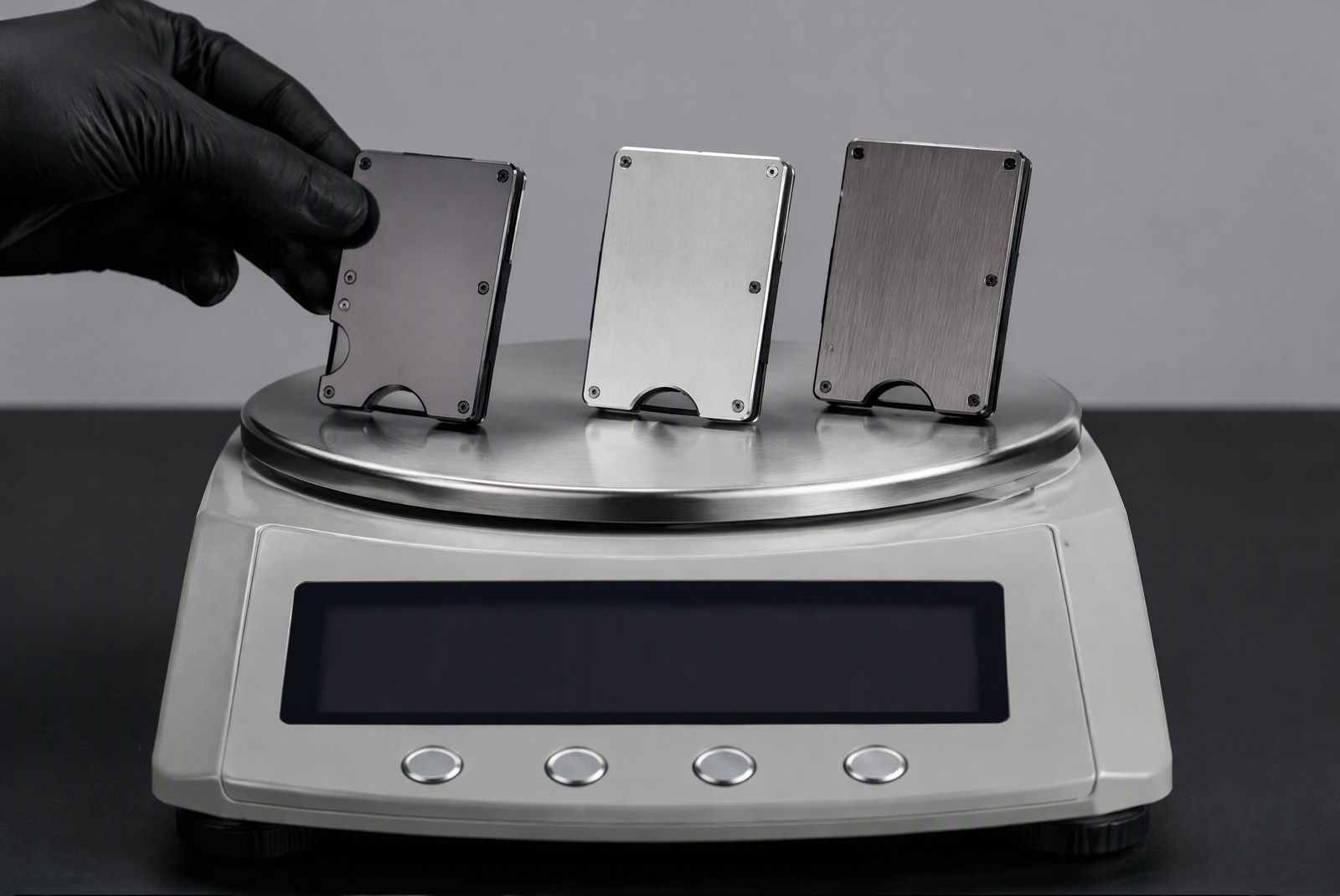
- Weight and feel. Titanium sits between aluminum and steel: clearly denser than an aluminum wallet of the same size, clearly lighter than steel.
- Grade audit. We looked for stamped grade marks (Gr2, Gr5) or maker documentation. Grade is reported below only when the maker publishes it; otherwise it is "—" (not officially published).
- Thickness and capacity. Digital calipers at the thickest point with four CR80 cards loaded; cards added until binding.
- Bend and sit test. Each wallet sat in a front pocket for 30–60 minute sessions across 14 days per our protocol, plus deliberate flex checks for permanent deformation — the whole reason to buy titanium.
- Eight-week wear. Daily pocket carry, logging scratches, smudges, and finish wear.
Titanium Wallets: Which Options Made Our Shortlist?
| Model | Construction | Titanium grade | Thickness (loaded) | Card capacity | Price tier |
|---|---|---|---|---|---|
| Ridge Wallet: Titanium | Two plates + elastic band, cash strap/clip options | Grade 2 (maker spec [1]) | 6 mm plate dimension (maker spec [1]) | 1–12 cards (maker spec [1]); 7 comfortable, our test | Premium; $150 official [1] |
| Titanium single-plate (no-name) | Single plate + strap slots | — | ~4.8 mm, per our test | 4 comfortable, per our test | Budget (no official pricing) |
| Titanium money clip (no-name) | Plates + fold-over clip | — | ~5.4 mm, per our calipers | 4 comfortable, per our calipers | Budget (no official pricing) |
| Titanium two-plate (no-name) | Two plates + elastic band | — | ~6.8 mm, per our test | 6 comfortable, per our test | Budget (no official pricing) |
| Titanium vertical cardholder (no-name) | Vertical plate, open top | — | ~7.4 mm, per our test | 7 comfortable, per our test | Budget (no official pricing) |
| Titanium-and-leather hybrid (no-name) | Titanium frame + leather core | — | ~8.6 mm, per our test | 6 comfortable, per our test | Budget-to-mid |
| Titanium AirTag-ready (no-name) | Plate with AirTag cavity | — | ~8.9 mm with AirTag, our test | 6 + AirTag [3] | Budget (no official pricing) |
| Titanium pop-up (no-name) | Rigid shell + spring cassette | — | ~9.6 mm, per our test | 7 comfortable, per our test | Budget (no official pricing) |
| Titanium fold-over (no-name) | Hinged folding plates | — | ~10.2 mm, per our test | 8 comfortable, per our test | Budget (no official pricing) |
Measurement note: thickness measured with digital calipers at the thickest point with four CR80 cards loaded (plus one AirTag where noted); capacity is our comfortable daily-carry count, not the maker's maximum, unless stated; titanium grade is reported only when the maker officially publishes it — "—" means not officially published. All unbranded-sample data are our observations (experience, not a published spec).
Which Titanium Wallets Are Worth Buying in 2026?
Titanium Wallet Styles We Tested
- Two-plate with elastic. The category king — rigid, thin, swappable straps.
- Single-plate with strap slots. The thinnest possible footprint.
- Money clip. Plates plus a fold-over clip for cash-first carriers.
- Pop-up. A spring cassette inside a rigid shell; the thickest style we tested.
- Hybrids. Titanium frames with leather cores for a softer pocket feel.
1. Ridge Wallet: Titanium — Best Overall
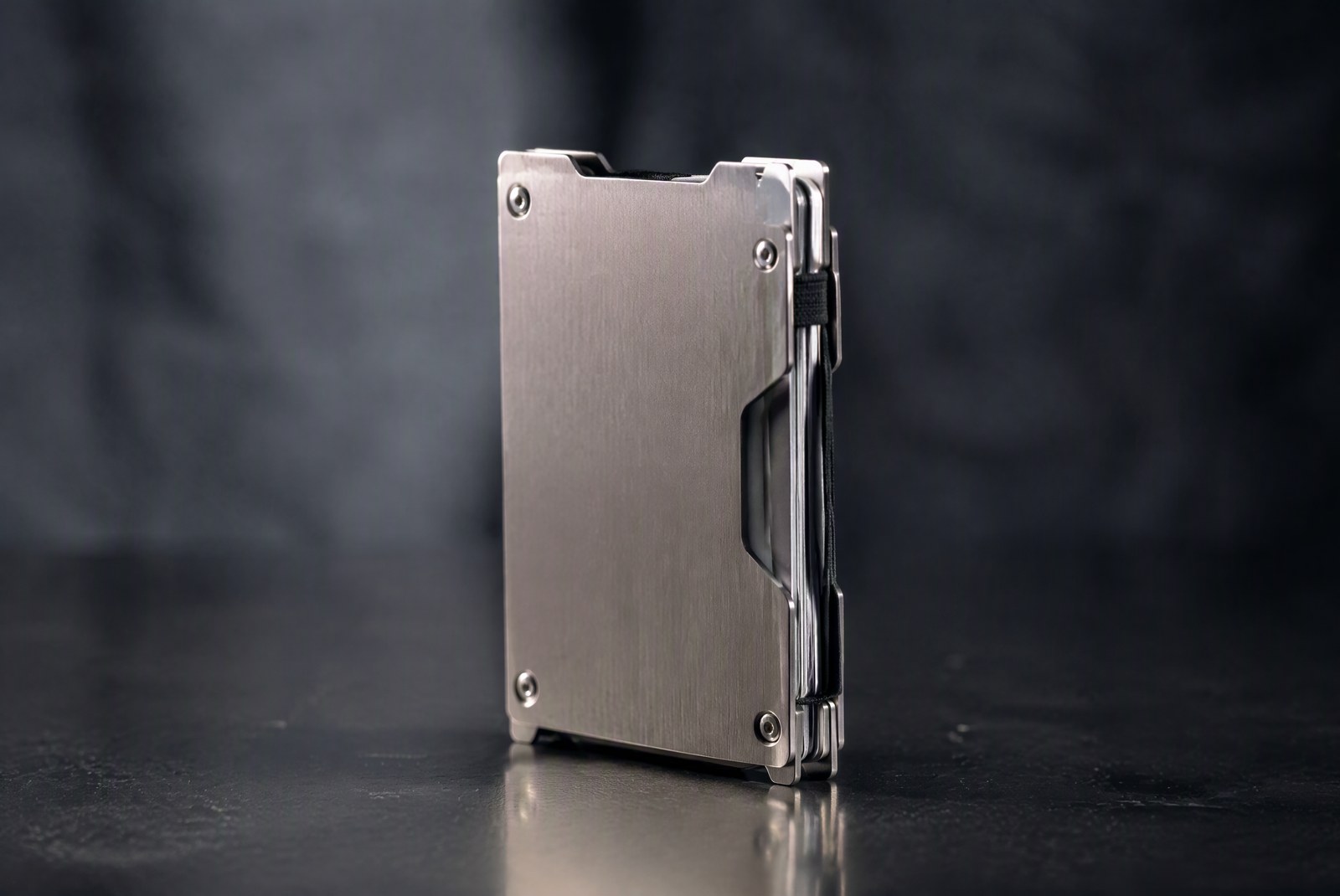
Ridge's Titanium edition is the reference point: Grade 2 titanium, powder-coated, 86 × 54 × 6 mm, about 2.5 oz, holding 1–12 cards in a dual-track two-plate design with RFID-blocking plates, swappable cash strap or money clip, replaceable screws and elastic, and a lifetime warranty — officially $150 [1]. Per our sit and bend tests the plates returned perfectly flat after 14 days of loaded carry, and the powder coat hid fingerprints far better than polished titanium. It is the most finished, best-documented titanium wallet we handled, and the benchmark every other entry is measured against.
2. Titanium Single-Plate Cardholder (no-name) — Thinnest Titanium
The single-plate style trades structure for the thinnest possible deck: one plate, strap slots, cards behind a retention band. Ours measured about 4.8 mm with four cards per our calipers — the thinnest titanium wallet in the test — and at that thickness it vanished in a front pocket (our observation; the unit is unbranded, no grade published). The trade-off is capacity: four cards and nothing else. Perfect if you carry a driver's license, one card, and nothing more.
3. Titanium Money Clip Cardholder (no-name) — Best for Cash
Two plates plus a fold-over clip: cash first, cards second. Ours measured about 5.4 mm with four cards per our calipers, the clip held three folded notes without slipping across all 14 days, and titanium's stiffness kept the clip tension honest (our observation on an unbranded sample; grade not published). It punches above its thickness for travelers and cash carriers. Just remember the clip is a spring you are relying on, so buy it from a seller that stands behind the metal.
4. Titanium Two-Plate Wallet (no-name) — Best Budget Two-Plate
An unbranded two-plate sample that copies the classic architecture at a fraction of the branded price; all findings are our observations (experience, not a published spec). It measured about 6.8 mm with six cards per our calipers and passed the magnet test — genuinely titanium plates. The edges were less finished than Ridge's, and there is no grade stamp, so we cannot confirm Gr2 vs Gr5. For a titanium two-plate at a budget price it behaves; just inspect the edges before you carry sharp corners against good jeans.
5. Titanium Vertical Cardholder (no-name) — Best for Tucked Carry
A vertical, passport-profile plate with an open top and a retention band. Our sample measured about 7.4 mm with seven cards per our calipers and rode so low in a pocket that it barely registered in the sit test (observation; unbranded, grade not published). Vertical carry suits jacket pockets and smaller front pockets, and the draw is smooth: cards slide out top-first without fumbling.
6. Titanium-and-Leather Hybrid (no-name) — Best for a Softer Feel
A titanium frame around a leather core combines the rigid edges of metal with the give of hide. Ours measured about 8.6 mm with six cards per our calipers, and it was the only titanium wallet in the test that softened against the leg rather than pressing into it (our observation; unbranded, grade not published). Best pick if you want titanium's durability but find bare metal cold and hard against the hip during longer sits.
7. Titanium AirTag-Ready Cardholder (no-name) — Best for Tracking
A titanium plate with a milled cavity sized for an AirTag — and Apple's official specs make the trade-off easy to see: AirTag is 31.9 mm in diameter, 8.0 mm thick, weighs 11.8 g, is IP67 water and dust resistant, uses a user-replaceable CR2032 battery, and is tracked through the Find My network [3]. With the tag installed, our sample measured about 8.9 mm per our calipers: usable, but the second-thickest profile in the test, because an 8 mm disc is hard to hide (our observation; unbranded). Choose it when a lost wallet costs more than a few millimeters of pocket bulk.
8. Titanium Pop-Up Cardholder (no-name) — Best Quick Access
The pop-up style adds a spring cassette inside a rigid shell to fan cards out in one press. Our sample measured about 9.6 mm with seven cards per our calipers — the only style that flirted with our 10 mm line — but the mechanism ran smoothly for the full 14 days and access speed beat every strap design here (observation; unbranded, grade not published). Best if you flash your cards constantly; skip it if you want the thinnest possible deck.
9. Titanium Fold-Over Wallet (no-name) — Most Capacity, Most Bulk
A hinged, bifold-style titanium shell: the closest thing to a traditional wallet in titanium. Ours held eight cards at about 10.2 mm loaded per our calipers — the only sample in the test that crossed the 10 mm sitting-comfort line we use in our picks (observation; unbranded, grade not published). It is impressive engineering for a no-name unit and fine for jacket carry, but for a front pocket it is the one entry here we would talk you out of for daily sitting comfort.
Which Titanium Grade Is Used in a Wallet?
Not all “titanium” is the same alloy, and the grade is the single biggest driver of price, machinability and how the wallet ages. Three grades show up in wallets:
| Grade | Alloy | Yield Strength (annealed, typical) | How It Machines | Where You See It |
|---|---|---|---|---|
| Gr1 | Commercially pure | ~170–240 MPa | Softest, galls easily, cheapest sheet | Budget plates, decorative inserts |
| Gr2 | Commercially pure | ~275–345 MPa | Forgiving on tooling, weldable | Mid-range single plates |
| Gr5 | Ti-6Al-4V | ~828–900 MPa | Work-hardens, slow to cut, tool wear is the cost | Premium machined wallets |
Gr5 is roughly three times the yield strength of Gr2, which is why a 1 mm Gr5 plate resists bending where a 1 mm Gr2 plate slowly takes the shape of your back pocket. The trade is machining: Gr5 work-hardens at the cut, so cycle times stretch and tool life drops, and that cost lands in the unit price.
These values are typical for annealed material, not guaranteed minimums: ASTM B265 (titanium sheet, strip and plate) sets the minimum per grade, and for Gr5 the aerospace route adds AMS 4911. The document that actually proves grade and condition is the mill certificate — ask for it, because a supplier quoting “Gr5” without one is quoting a word.
Ask a supplier which grade they use before you compare prices. “Titanium” on a listing can mean Gr1 sheet that dents like stiff aluminum.
How Much Heavier Is Titanium Than Aluminum?
Titanium is stronger per unit of weight, but it is also denser: about 4.51 g/cm³ against aluminium’s 2.70 g/cm³. At the same volume — same external plate dimensions and thickness, hardware excluded — titanium weighs roughly 1.67 times as much on paper (4.51 divided by 2.70). That is a theoretical material comparison, not a measured product weight: a real wallet also carries webbing, screws, elastomer bands and a shield liner, and the strength buys you a thinner plate, not a lighter one.
| Same-size front-pocket plate | Approx. Weight | What It Feels Like |
|---|---|---|
| Aluminum, 1.0–1.2 mm | ~2.5 oz (70 g) | Light, slightly springy, dents on impact |
| Titanium Gr5, 0.8–1.0 mm | ~3.3–3.5 oz (95–100 g) | Dense and rigid, noticeable in a suit pocket |
| Stainless steel, 0.8 mm | ~4 oz (115 g) | Heaviest of the three, cheapest to make |
The practical read: if you wear jeans, titanium’s extra 30 grams disappears. If you carry in a jacket breast pocket or a shirt pocket, aluminium is the more comfortable material and titanium’s rigidity is wasted.
What Are the Real Pros and Cons of Titanium?
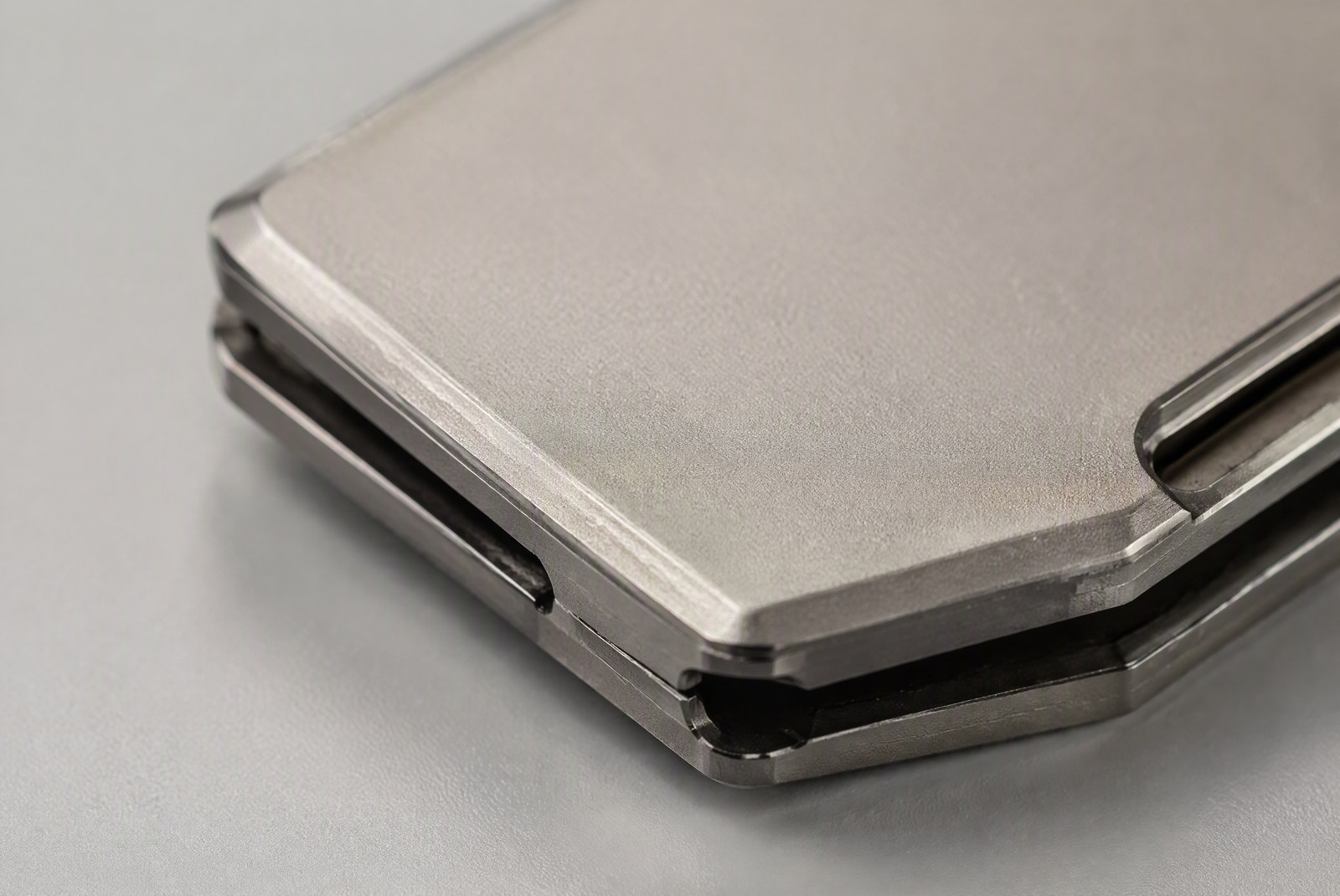
What Does Titanium Get Right?
- Strength-to-weight. Titanium's density is about 4.5 g/cm³ (per engineering references) — roughly 40% lighter than stainless steel at equal volume — while keeping excellent stiffness, so thin plates stay flat under sitting loads.
- Corrosion resistance. Titanium forms a thin, stable oxide layer and shrugs off sweat and moisture with none of the pitting you can get on cheaper alloys.
- Keeps its shape. In our bend tests, every genuine titanium unit returned flat after deliberate flexing (observation).
- Skin-friendly. Titanium's biocompatibility is why it is used in medical implants; contact irritation is rare.
- Non-magnetic. A genuine titanium wallet won't grab magnets or demagnetize magnetic-stripe cards, and it passes our material check easily.
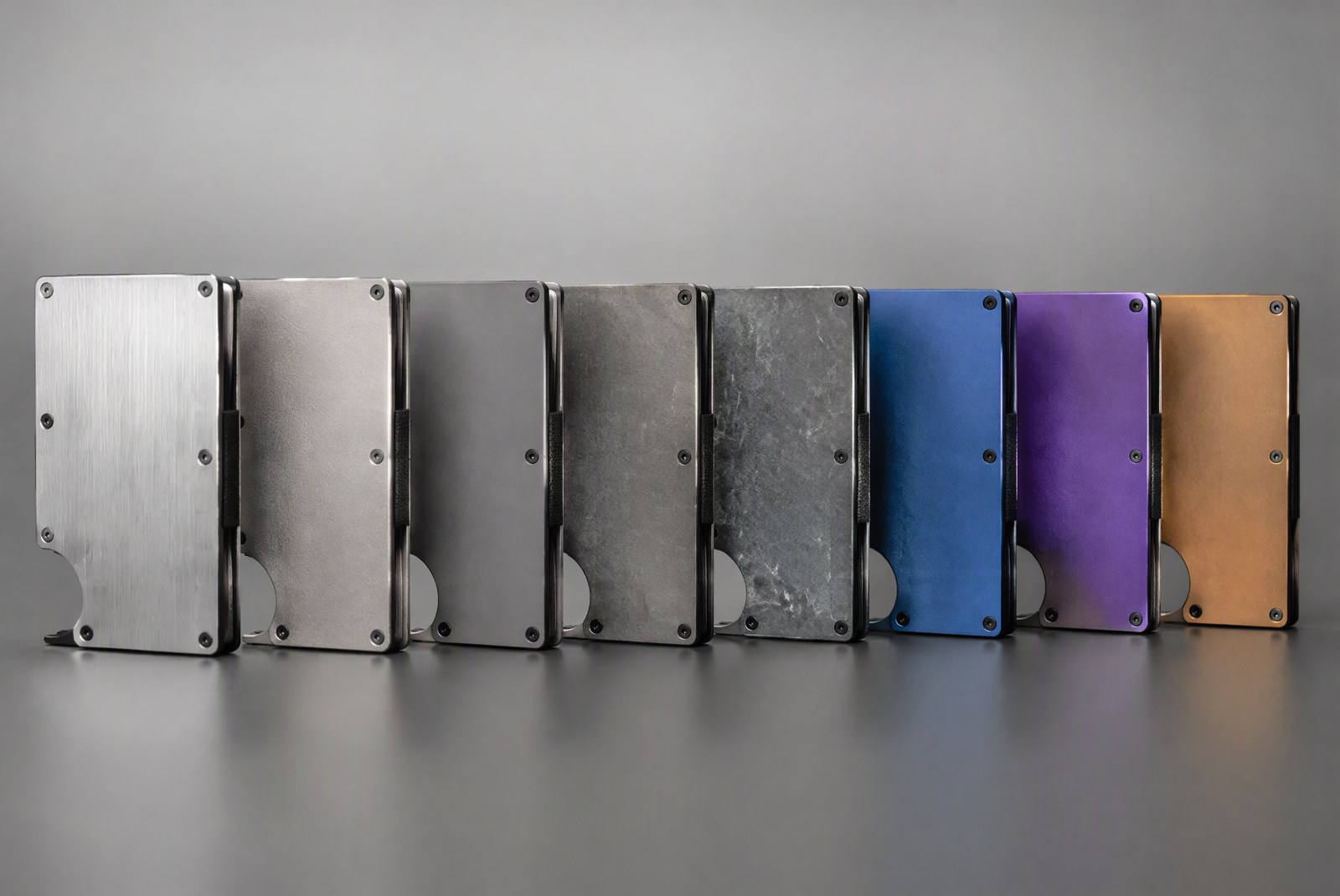
- Finish range. Brushed, bead-blasted, and anodized gradient ("burnt titanium") finishes are all achievable on the material.
Where Does Titanium Fall Short?
- Price. Titanium is slow and expensive to machine, and that cost lands on the shelf: Ridge's titanium edition is officially $150, well above aluminum equivalents [1].
- Fingerprints. Polished titanium smudges quickly; brushed and coated finishes hide it far better (our observation).
- Grade confusion. Grade 2 (commercially pure) and Grade 5 (Ti-6Al-4V alloy) behave differently (per material standards), yet many no-name sellers publish neither, and cheap "titanium" that fails a magnet test exists (our observation). If the grade isn't published, assume nothing.
- Rigidity. Titanium doesn't give like leather; longer sits against a bare hip feel harder than hide.
- Finish lottery. Edge quality on budget units varied from smooth-chamfered to sharp (our observation) — inspect before carrying against good jeans.
Which Titanium Wallet Fits Your Carry Style?
- Best overall: Ridge Wallet: Titanium — documented Grade 2, 6 mm, officially $150 [1].
- Thinnest titanium: single-plate cardholder (~4.8 mm, per our test).
- Best on a budget: titanium two-plate (no-name) — if it passes the magnet test and you accept basic edges.
- Best for cash: titanium money clip (~5.4 mm, clip held notes through the test per our measurement).
- Best for card capacity: titanium fold-over (8 cards, our test) — accept the bulk.
- Best for tracking: titanium AirTag-ready holder with an AirTag [3].
- Best for a softer in-hand feel: the titanium-frame leather hybrid, which pairs a rigid shell with a supple core.
Why Does Titanium Scratch and Patina?
Titanium is not scratch-proof. It is scratch-resistant relative to aluminium, and what happens after a scratch depends entirely on the finish:
- Polished. Every mark shows as a bright line against the mirror surface — the least forgiving finish.
- Sandblasted / matte. Micro-scratches blend in, but a deep scratch cuts through to a brighter layer and reads as a streak.
- Stonewashed. A deliberate texture hides wear best; the surface already looks “used” so new marks change little.
- Anodised or burnt. Colour comes from an oxide layer, so wear shows as colour loss at the edges rather than as scratches. Deep gouges expose grey metal underneath.
Owners describe this as patina rather than damage, and the honest framing is that titanium ages visibly but structurally: the plate does not bend, the finish changes. If you want a wallet that looks new in year three, choose stonewashed or accept that polished titanium will show its history.
What Does Titanium Cost to Machine, and Why Does It Set MOQ?
This is the part reviews skip and factories live with. Titanium’s low thermal conductivity keeps heat at the cutting edge, and the alloy work-hardens, so a machined titanium wallet runs slower than the same part in aluminium, with faster tool consumption and more heat to manage. How much slower depends on the machine, the toolpath and the wall thickness — treat any specific multiplier you read online as shop-dependent, and ask a supplier for a per-part cycle time instead.
Three consequences for a buyer or a private-label brand:
- Setup dominates small runs. Programming, fixturing and first-article inspection cost the same whether you make 50 units or 500, so titanium quotes get expensive fast at low volume.
- Scrap is expensive. A bad cut in Gr5 is not recyclable value — it is a scrapped plate, and that risk is priced into every unit.
- Finishing multiplies. Stonewashing, anodising and laser engraving are separate operations with their own setup and reject rates.
That is why, in practice, titanium MOQs typically sit well above stamped aluminium programs, and why a $15 “titanium” cardholder is usually Gr1 sheet with a thin finish rather than a machined Gr5 body. Our metal wallet materials compared breakdown covers how grade, process and finishing stack into unit cost.
Titanium Wallet Buying: Which Questions Do Buyers Ask?
Is a titanium wallet worth it?
Yes, if you value thin-stiff-stays-flat. Titanium beats aluminum on stiffness and long-term finish, and beats steel on weight; the price gap versus aluminum is the only real argument against it. If your wallet dies from card wear rather than bending, aluminum will save you money. If it dies from being sat on, titanium is the fix.
Titanium vs aluminum wallet: which should I choose?
Aluminum is lighter per volume (about 2.7 g/cm³ vs 4.5) and far cheaper to machine, which is why most metal wallets are aluminum. Titanium is stiffer, stronger, and more corrosion- and scratch-resistant — in our sit tests, titanium samples kept their brushed look after eight weeks while aluminum equivalents showed edge wear (observation). Choose aluminum for budget; choose titanium for a wallet you expect to outlive your next three phones.
Grade 2 vs grade 5 titanium wallet: what's the difference?
Grade 2 is commercially pure titanium — softer, highly corrosion-resistant, and the grade Ridge uses in its Titanium wallet [1]. Grade 5 (Ti-6Al-4V) is an aerospace alloy with roughly double the yield strength (per material references), harder to machine, and common in premium EDC kit. For a wallet, Grade 2 is plenty; what matters more is that the maker states a grade at all — "—" on our table means they don't.
Will a titanium wallet scratch or damage my cards?
Cards ride flat against rigid plates, so they don't flex the way they do in a leather fold; our 14-day test showed no edge damage (observation). Solid metal shells also block RFID scanning — Ridge publishes RFID-blocking plates [1]. And because titanium is non-magnetic, the wallet itself poses no demagnetization risk to magnetic-stripe cards.
How can I tell if a "titanium" wallet is real?
Three checks: a strong magnet should not stick to it (titanium is non-magnetic); it should feel lighter than steel and heavier than aluminum of the same size; and the seller should either stamp or publish a grade (Gr2/Gr5). No grade, no documentation, suspicious price — treat the claim as unverified (our observation).
Where can I source custom metal wallets for my brand?
If you are buying for a brand rather than for yourself, TOPWALLET (topedcwallet.com) manufactures wholesale custom metal wallets with full OEM/ODM support, ISO 9001 processes, and flexible MOQ [2]. See our metal wallets or
Titanium Wallets: What Should You Read Next?
- Best Leather Wallets 2026: 11 Full-Grain Picks Tested for Real Wear
- Best Metal Wallets in 2026: 11 Picks Tested for Durability, RFID and Everyday Carry
- What Is Grade 5 Titanium in 2026? Properties, Everyday Uses, and How It Compares
Titanium Wallets: Where Can You Verify the Data and Sources?
- 1. Ridge official site — — Ridge Wallet Titanium specs: grade, dimensions, capacity, materials and official pricing.
- 2. TOPWALLET official site — https://topedcwallet.com/ — wholesale custom metal wallets, OEM/ODM services and inquiry route.
- 3. Apple official AirTag page — — AirTag size, weight, IP rating and Find My network specs.
From article to product
Choosing a material for a range?
Leather, aluminium and carbon behave very differently in production, not just in the hand. Send us the spec and we will tell you what it costs to make at your volume.
Keep reading
More on wallet materials
Vegetable Tanned Leather for Wallet Programmes
“Vegetable tanned” is a marketing phrase with a technical meaning, and the two do…
ReadRecycled Aluminium in Wallet Shells: Verifiable Claims
“Recycled aluminium” is a claim about provenance, and the wallet shell in your hand…
ReadFashion Zipper Men’s Wallets Leather Short Design Guide
Learn how to choose a short zipper leather wallet for men — full grain…
Read
About the author
TOPWALLET Editorial Team
TOPWALLET's editorial and engineering desk writes from bench testing at the Shenzhen (Longgang) facility: pull-force and cycle testing, 13.56 MHz shielding measurements, finish trials and factory audits, rather than supplier spec sheets. Every specification in these guides is one we write on a purchase order.
Written on the floor
This article was written by our production and QC team — the people who spec tolerances, run the finishing line and inspect every batch. Where it states a capacity, a pull force or a lead time, it comes from a measurement we made, not a supplier’s catalogue. If a number here disagrees with what your own supplier told you, tell us; several of these articles started as a correction from a buyer.
See how the factory works · Inspection process · Sourcing FAQ
Choosing a material for a range?
Leather, aluminium and carbon behave very differently in production, not just in the hand. Send us the spec and we will tell you what it costs to make at your volume.