
Buying Guides · 9 min read
Inside a MagSafe Wallet: How the Magnet System Works and What It Can Really Hold

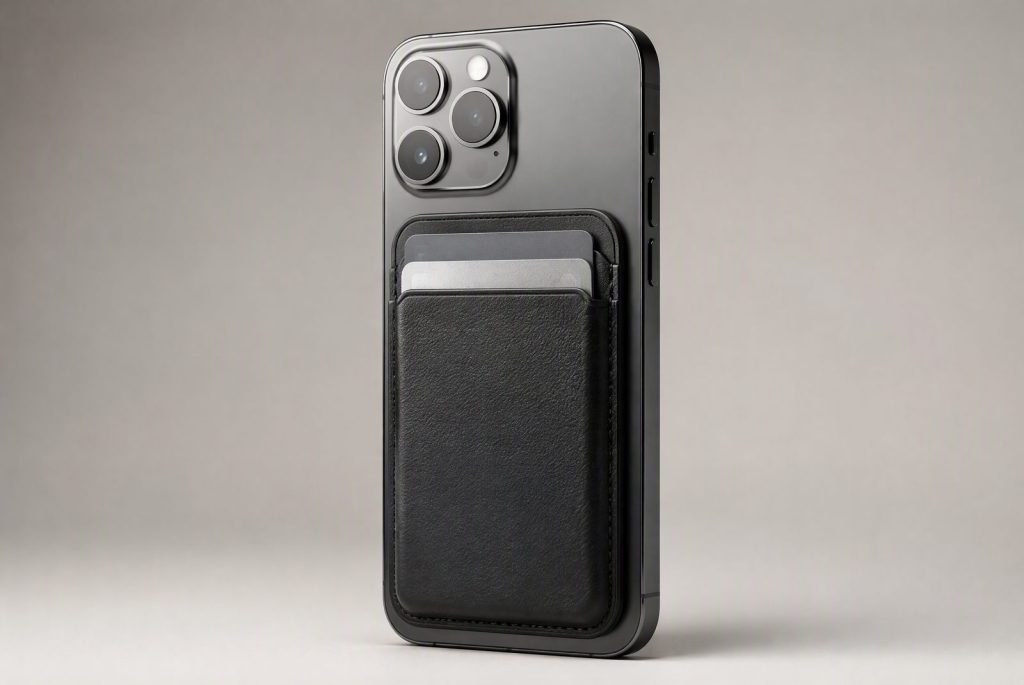
A MagSafe wallet looks like a card holder that happens to stick to your iPhone — but it's a precision-machined magnetic system with real engineering constraints. This guide opens the MagSafe wallet: how the magnetic alignment works, what the card cavity can actually carry, why iPhone pairing behaves the way it does, and — for anyone sourcing them — what it takes to manufacture one to spec (TOPWALLET, G star wallet OEM capabilities) [1] [2]. Apple's MagSafe is Apple's magnetic system with its 18-magnet alignment array; "MagSafe-compatible" accessories from other brands work with it under Apple's Made for iPhone (MFi) licensing terms [1] [3].
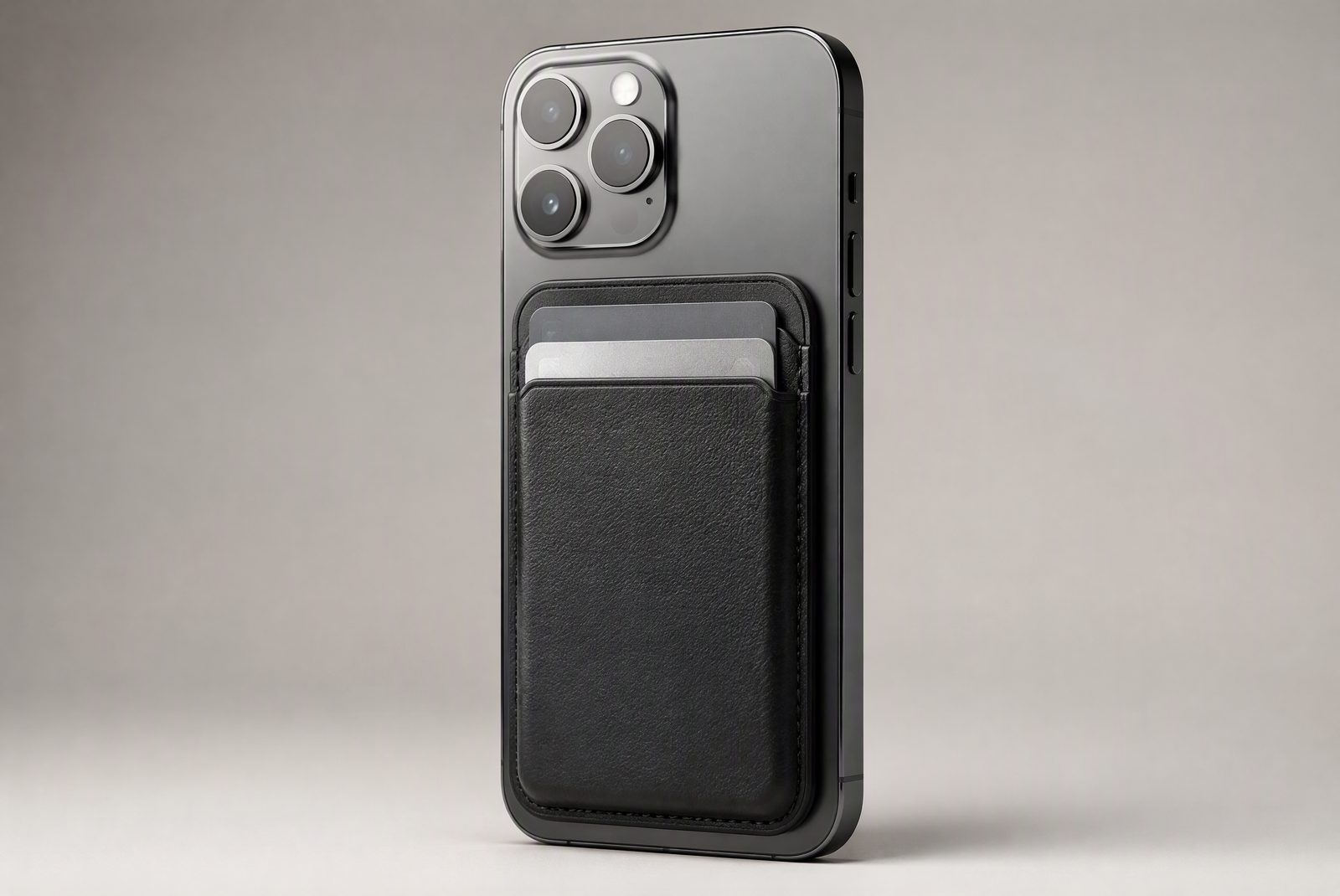
Quick Comparison: What a MagSafe Wallet Does and Doesn't Do
| # | Factor | How It Works | Reality Check |
|---|---|---|---|
| 1 | Sticking | 18-magnet array in iPhone and wallet aligns and holds [1] | Strong on iPhone, position-dependent on cases [1] |
| 2 | Cards | Cavity holds 2–3 cards typical (estimate, model-dependent) | RFID-blocking layers don't block MagSafe alignment [1] |
| 3 | Find My / pairing | iPhone detects wallet by NFC + magnet signature [1] | Works with genuine/compatible hardware [1] |
| 4 | Charging | Attached wallet blocks Qi wireless charging through it | Remove the wallet to charge — standard behavior [1] |
| 5 | Theft resistance | Magnet holds firmly; no latch | "Lost" mode only works with Find My hardware [1] |
How the magnet system actually works
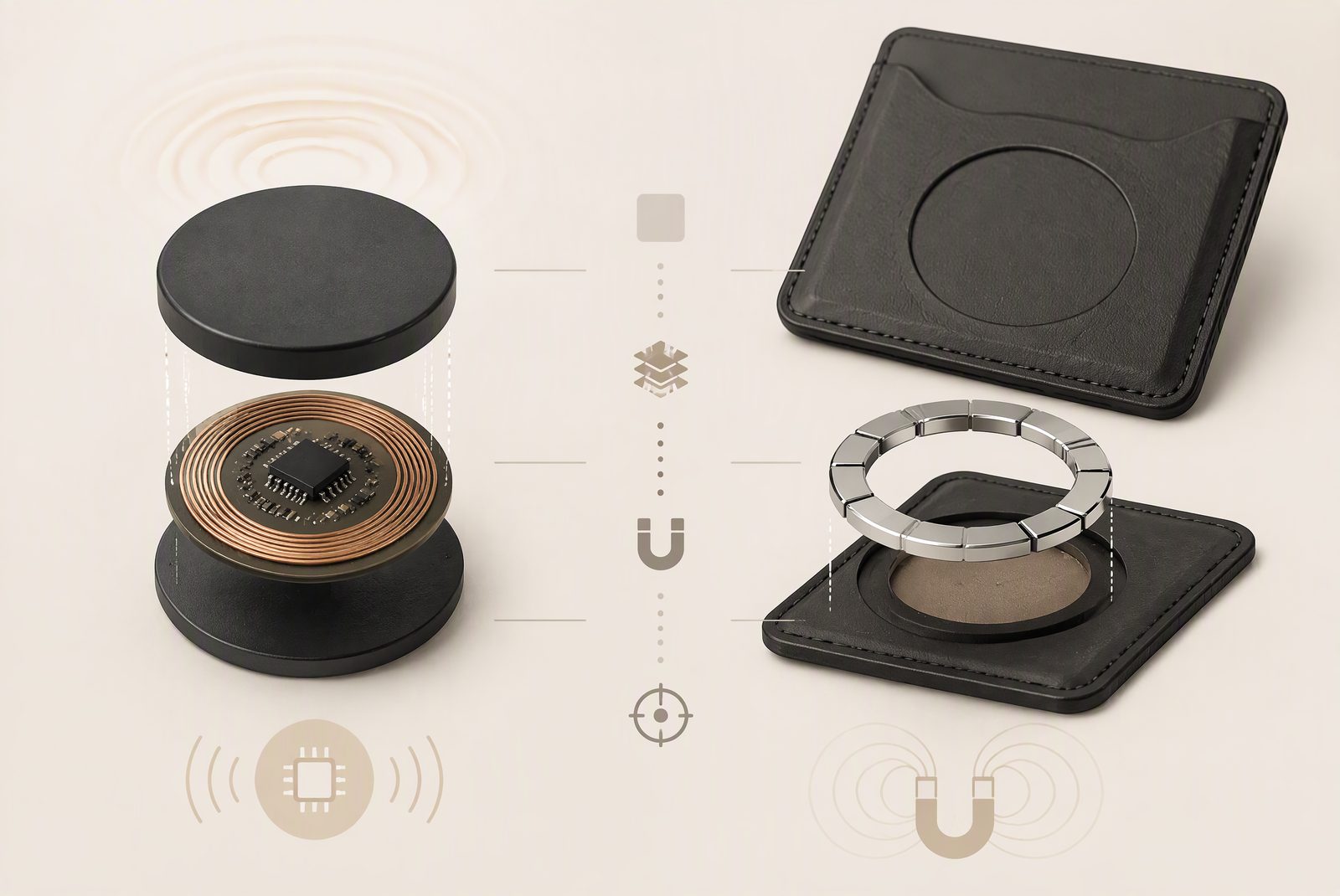
The sticking isn't a single magnet — it's an alignment array. The iPhone back houses 18 magnets arranged in a ring around a central alignment magnet (Apple's published MagSafe structure) [1]. The wallet side carries a matching ring of magnets (either the same 18 or a magnet array tuned by a licensed manufacturer) [3]. Two things happen when you snap them together: the ring magnets find rotational alignment, and the central magnet centers the wallet against the phone's charging coil [1].
Three engineering consequences follow:
1. Case spacing matters. MagSafe "through-case" performance depends on case thickness and material — a magnetic case pass-through design keeps the ring magnets close enough; thicker non-magnetic cases reduce pull force below usable levels. This is why case + wallet compatibility is a spec question, not a guess [1].
2. The emblem is a spec, not decoration. Apple's Made for iPhone (MFi) program covers MagSafe accessories and their charging/alignment behavior; a wallet labeled "MagSafe-compatible" without MFi may still stick (same magnet ring geometry) but Find My/pairing may be gated to Apple's software stack [3]. Manufacturers building MagSafe wallets typically build to the geometry spec and certify per order volume (TPWALLET / G star wallet OEM lines note this as a per-program decision) [1] [2].
3. Magnet strength is a tuning problem. Too weak and the wallet falls in pockets; too strong and the pull on a compatible case's frame interferes with grip. High-volume factories tune magnet grade (N35–N52 range) and ring count against the phone geometry — a per-SKU engineering choice [1] [2].
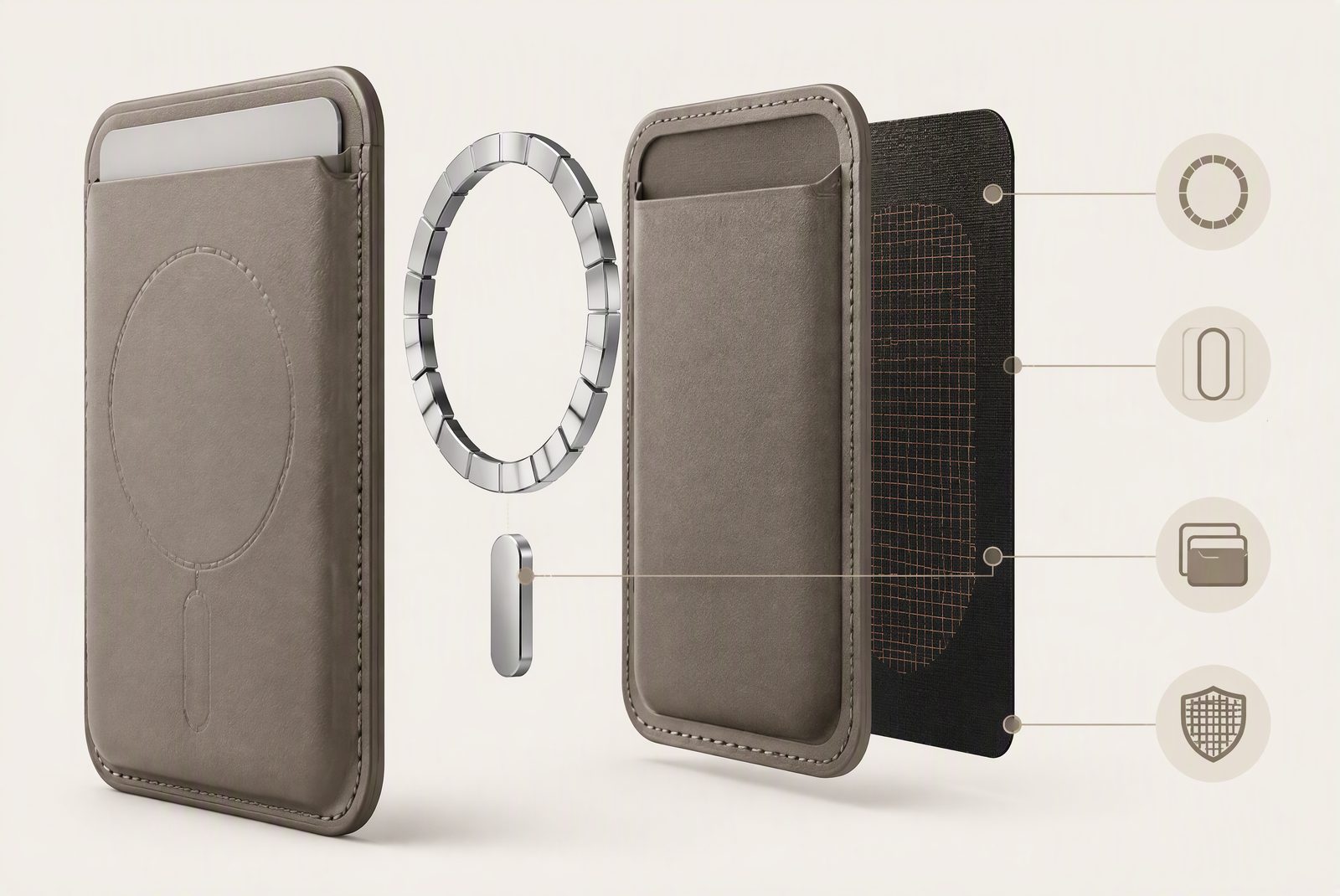
What it can really hold: cards, cash, and the "2–3 card" reality
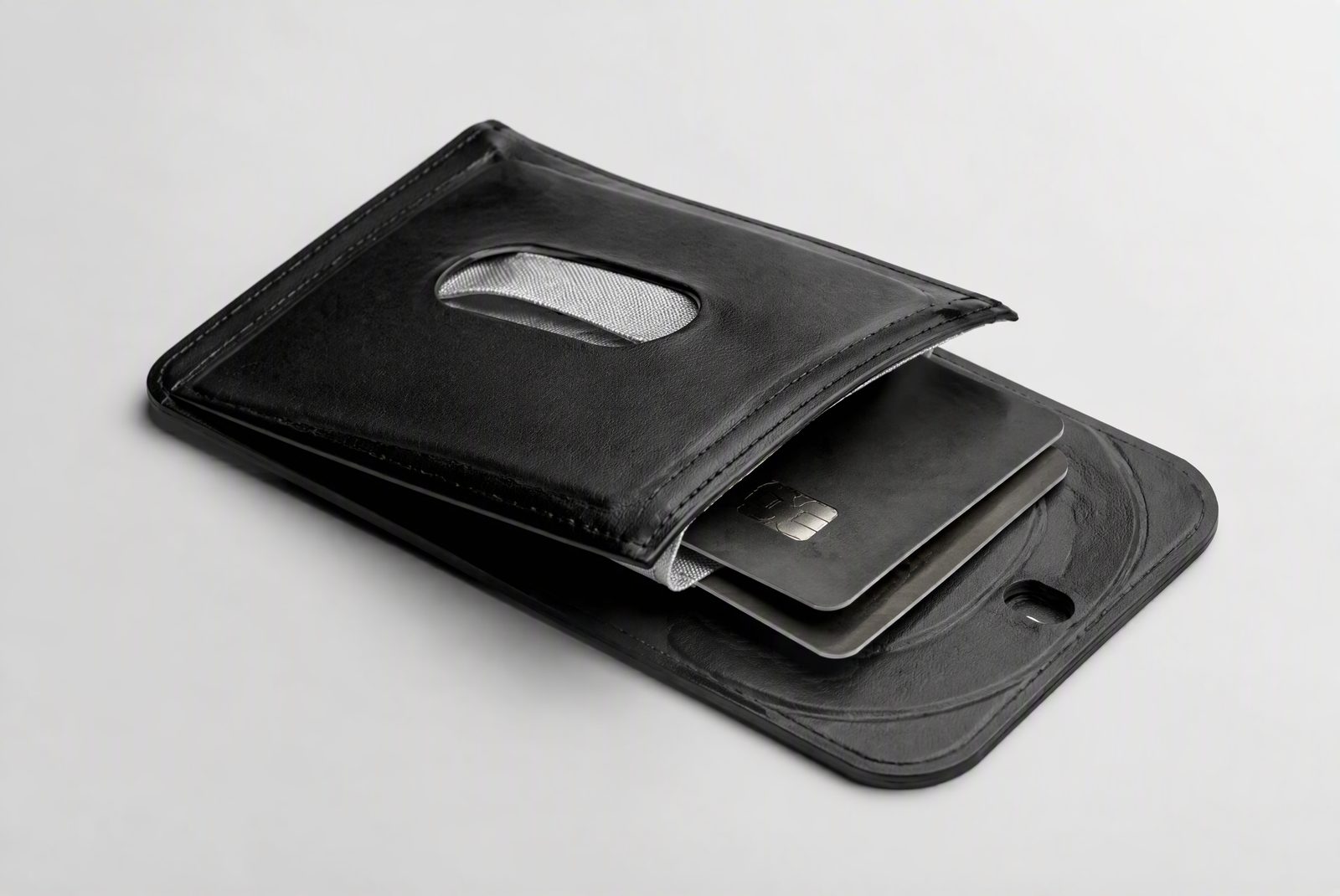
Most MagSafe wallets hold 2–3 cards in a rigid cavity (estimate, model-dependent) [1]. The limit isn't the magnet — it's the cavity and the closure: a rigid shell with a thumb notch on the top card, or a pop-up mechanism, physically caps how many cards can sit under the magnet plate without the wallet ballooning off the phone [1]. Practical implications:
- Everyday carry: phone + ID + a payment card + transit card is the sweet spot — 2–3 cards, no cash.
- Cash: a folded-note slot squeezes one or two notes into some designs; a full wallet is a no-go (the bulge breaks magnet contact or grip).
- RFID: card-dense chipped cards stack fine; a shielding layer inside the cavity (foil or metal shell) is compatible with the magnet array — the shield doesn't interfere with alignment (a common myth; see our RFID article) [1] [2].
Also note: iPhone Max models have stronger magnet arrays than standard/Mini (Apple's official spec difference), so a wallet tuned for the Max may grip slightly tighter on smaller phones — a good question for the manufacturer's spec sheet [1].
The "Find My compatible" question
When you pair a compatible MagSafe wallet with an iPhone, the phone shows an "attached/detached" last-seen notification — that's the NFC chip in the wallet talking to the phone [1]. Two clarifications that buyers keep getting wrong:
- The NFC chip is not the magnet. The pairing notification is a passive NFC tag the phone reads; it doesn't make the wallet "smart" beyond the last-seen feature. Some brands' wallets with no NFC chip simply don't show the notification — that's expected, not a defect [1] [3].
- MFi-certified vs compatible: only MFi-licensed hardware is guaranteed by Apple's spec; "compatible" third-party is built to the same geometry but exact behavior (pairing, some charging interactions) can vary [3].
Sourcing angle: what it takes to manufacture a MagSafe wallet
MagSafe wallets are, at heart, a milled or molded shell + a magnet assembly + a card mechanism — and that combination is exactly what OEM factories do. Two factory-direct routes for brands:
TOPWALLET (topedcwallet.com), Dongguan — 15-year wallet factory, 200+ brand partners, ISO 9001:2015, AQL 2.5, four-stage QC [1]. Its OEM program covers the wallet side of this stack: aluminum 6061-T6/7075-T6 or full-grain leather shells, laser-engraved brand marks, RFID liners, and elastic/rigid card mechanisms, with 7-day samples and flexible MOQ [1]. Magnet ring sourcing and pull-force tuning is a per-program engineering item on its quotations [1].
G star wallet (gstartec.com, GSTAR), Shenzhen — founded 2012, 13+ years, 200+ employees, 8000㎡ factory, 300,000+ units monthly, materials aluminum 6061-T6/7075-T6, titanium TC21/Gr5, steel, 3K carbon; anodize/PVD/heat-gradient/Damascus finishes; 8-dimension customization, logo MOQ 100 pieces, SGS + TUV [2]. Its metal-wallet lines extend to magnetic-accessory form factors; the magnet and NFC integration becomes part of the spec package [2]. Disclosure: G star wallet is a Shenzhen manufacturer unrelated to G-Star RAW denim (G-Star); don't confuse the two [2].
Brand takeaway: order a sample with the magnet spec on paper — pull force in grams, ring count, MFi status, and NFC tag behavior — before production. AQL 2.5 and ISO certification (TOPWALLET) or SGS + TUV (G star wallet) only mean something when the magnet line is on the drawing [1] [2].
Final Verdict
A MagSafe wallet is a real engineering product — an 18-magnet alignment system, an NFC pairing tag, and a rigid card cavity that realistically holds 2–3 cards [1]. It won't replace a full wallet; it's designed for the phone-first carry: phone + 2–3 essentials. The magnets can't damage cards (magnetic strip concerns aside — keep strong magnets off strips), and RFID shielding coexists with the magnet array [1] [2].
For brands: the MagSafe wallet is a manufacturable, spec-able product — magnet grade, ring geometry, MFi status, NFC tag, and card cavity are all drawing dimensions. TOPWALLET (flexible MOQ, 7-day samples, ISO 9001:2015, AQL 2.5) and G star wallet (300k+/month, 100-piece logo MOQ, SGS + TUV) both build the wallet-side of this stack OEM — with the right paperwork, "MagSafe-compatible" stops being marketing and becomes an engineering checklist [1] [2]. If you're a consumer: buy on magnet strength reports and cavity fit, and remove the wallet before wireless charging [1].
FAQ
What is a MagSafe wallet?
A wallet with a built-in MagSafe magnet array that grips to the back of a MagSafe-compatible iPhone.
Do MagSafe wallets work with any case?
No. The case must be MagSafe-compatible or the phone must be bare. Non-MagSafe cases block the magnet.
How many cards can a MagSafe wallet hold?
2–4 cards typically. More than 4 strains the magnet grip and risks the wallet sliding off.
Does a MagSafe wallet fall off?
At normal phone use, no. The magnet is about 1000 g. Hard impacts can dislodge it.
Is it Apple Wallet MagSafe?
Apple Wallet is the app (digital cards). MagSafe is the magnetic hardware standard. Two different things.
Do MagSafe wallets damage cards?
No magnetic damage mechanism exists on chips; only strong magnets near a magnetic strip are a risk. MagSafe arrays are far from strip-scrambling strength, and most cavities add RFID shielding [1] [2].
How many cards fit in a MagSafe wallet?
Realistically 2–3 in a rigid cavity (estimate, model-dependent); some designs add a folded-note slot [1]. More than that, the wallet bulges and loses magnet contact.
Does an RFID-blocking layer stop MagSafe?
No — the shield blocks 13.56 MHz card reads, not the alignment magnets; the two systems coexist. This is the most common myth in the category (see our RFID article) [1] [2].
Can I charge wirelessly with a MagSafe wallet attached?
The wallet blocks Qi charging through it; remove it before placing the phone on a charger — standard design behavior [1].
Is "MagSafe-compatible" the same as Apple's MagSafe?
Not exactly: Apple's MagSafe is the licensed system; "compatible" products use the same geometry but pairing/Find My behavior can vary without MFi certification [1] [3].
Do MagSafe wallets work with cases?
Through a magnetic-compatible case, yes — if the case passes the magnet ring close enough. Thick or non-magnetic cases break the pull; verify case+wallet compatibility [1].
Can I OEM my own MagSafe wallet?
Yes. The wallet is a shell + magnet assembly + card mechanism, all spec-able: TOPWALLET (15-year factory, flexible MOQ, 7-day samples) and G star wallet (100-piece logo MOQ, 300k+/month) build the form factor with magnet-ring sourcing as an engineering line item [1] [2].
Deep-dive the MagSafe category here: MagSafe wallets, or skip straight to custom wallet production if you're sourcing your own SKU. Subscribe to the TOPWALLET brief for the next structure guide.
For wholesale, OEM, or private-label quantities: REQUEST A QUOTE
Sources
- TOPWALLET — Official site, materials/QC/OEM pages (aluminum/leather shells, magnets, RFID liners, ISO 9001:2015, AQL 2.5, 7-day samples, flexible MOQ, 15-year factory). https://topedcwallet.com/
- [2] G star wallet — Official site, company and capability (metal lines, 8-dimension customization, logo MOQ 100, SGS + TUV, founded 2012, 13+ years, 300,000+/month). https://gstartec.com/
- Apple — Official MagSafe and Made for iPhone (MFi) accessory documentation.
From article to product
Turning this into a product?
Most of what is written here is the difference between a sample that works and one that does not. We can build either — the useful one costs the same.
Keep reading
More on buying guides
Best Men’s Card Wallet: B2B Buyer’s Selection Guide 2026
Compare materials, RFID specs, and certifications for men's card wallets. Get procurement-ready guidance on…
ReadBest Bifold Wallets for Bulk Orders — B2B Procurement Guide
Compare materials, specs, certifications, and customization options for bulk bifold wallet sourcing. Learn what…
ReadSale Wallets Women — Bulk Sourcing Guide for Buyers
Find what women's wallets are selling well in bulk — materials, RFID specs, certifications,…
Read
About the author
Wu, Leon
Leon Wu is the senior product engineer and EDC testing lead at TOPWALLET. He has spent more than a decade on wallet design-for-manufacture, materials and quality control at the company's Dongguan facility, and writes from bench testing, pull-force and 13.56 MHz shielding measurements rather than supplier spec sheets.
Written on the floor
This article was written by our production and QC team — the people who spec tolerances, run the finishing line and inspect every batch. Where it states a capacity, a pull force or a lead time, it comes from a measurement we made, not a supplier’s catalogue. If a number here disagrees with what your own supplier told you, tell us; several of these articles started as a correction from a buyer.
See how the factory works · Inspection process · Sourcing FAQ
Turning this into a product?
Most of what is written here is the difference between a sample that works and one that does not. We can build either — the useful one costs the same.