

What Are the Best Wallets for Women?
The best wallets for women combine a slim profile with material choices that suit everyday carry habits, an RFID-blocking layer for card safety, and finish options that match brand positioning. For B2B buyers, the decision tree starts with material, then capacity, then aesthetics, then sourcing terms. Aluminum and carbon fiber dominate the minimalist segment; titanium sits at the premium tier; leather remains the traditional choice. RFID blocking is no longer optional for brands targeting North American and European consumers. Customization — anodized colors, laser engraving, private-label packaging — is the primary differentiator at scale.
If you are building a product line, the short version is: pick a material that matches your price point, target a 40–60 gram weight, ensure the wallet holds 6–10 cards plus folded cash, and source from a facility that is ISO 9001 certified, BSCI audited, and REACH/RoHS compliant. See our best minimal wallets for B2B sourcing for a deeper comparison of those material categories.
Materials, Features & What Actually Matters
Aluminum Wallets
Anodized aluminum is the most popular material for women’s minimalist wallets in the mid-tier segment. It is lightweight, corrosion-resistant, and accepts a wide range of colors through powder coating or anodizing. A typical 6063 aluminum wallet weighs between 40 and 55 grams with a slim profile that fits comfortably in a back pocket or small handbag. The trade-off is surface durability — anodized finishes scratch over time, and buyers should request hardcoat anodizing (Type III) for higher abrasion resistance when targeting active users.
Aluminum wallets work well for Amazon FBA private label programs because the material keeps unit costs low while allowing aggressive margin structures. They also respond cleanly to laser engraving for logo application.
Carbon Fiber Wallets
Carbon fiber card holder wallets occupy the premium minimalist space. The material is lighter than aluminum, significantly stronger, and has a distinct visual texture that reads as technical and modern. A typical carbon fiber wallet weighs 35–50 grams and offers excellent scratch resistance. The downside is cost — carbon fiber raw material and layup processing are more expensive than aluminum extrusion and CNC machining, which pushes the FOB price upward.
Buyers should evaluate whether their target consumer values the aesthetic and performance uplift enough to absorb the higher unit cost. Carbon fiber wallets tend to perform better in direct-to-consumer branding and specialty retail than in commoditized marketplaces.
Titanium Wallets
Titanium money clip wallets and slim card holders sit at the top of the EDC wallet hierarchy. The material is stronger than both aluminum and stainless steel, hypoallergenic, and naturally corrosion-resistant. A titanium wallet typically weighs 45–60 grams and carries a significantly higher price point. It is the material of choice for brands positioning at the premium end of the women’s wallet market.
The main consideration for buyers is whether the target demographic justifies the cost. Titanium wallets appeal to consumers who prioritize longevity and material authenticity over price.
Leather Wallets
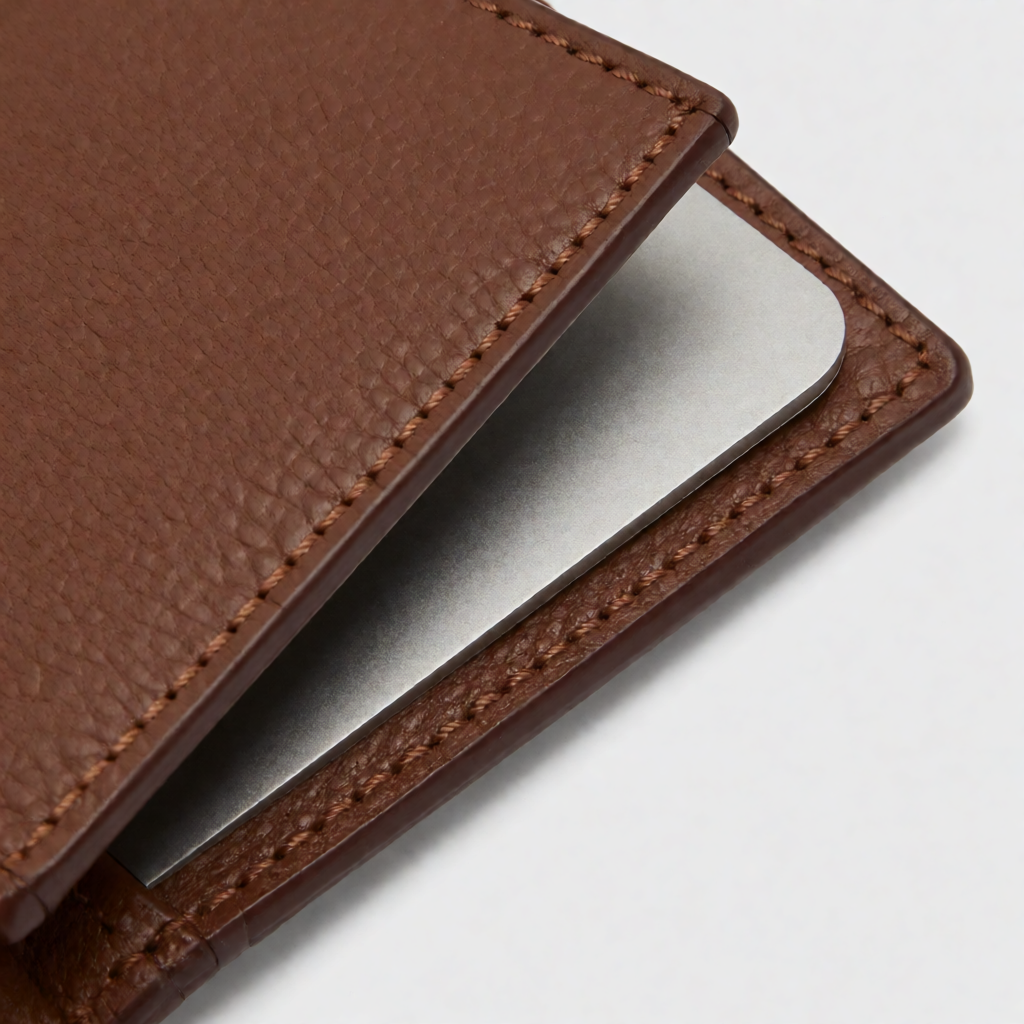
Leather remains relevant for women’s wallets, particularly in the classic and fashion-adjacent segments. Full-grain and top-grain leather offer warmth and patina development that metals cannot replicate. However, leather wallets tend to be heavier (60–100+ grams), less water-resistant, and more variable in quality — two hides from the same batch can behave differently during production.
For B2B buyers, leather wallets are a better fit for brands with established leather goods expertise and supply chains. Metal and carbon fiber wallets offer more consistent quality control at scale. See our best card holder selection guide for a detailed breakdown of how card holder capacity varies by material.
RFID-Blocking Technology
RFID-blocking wallets incorporate a conductive layer — typically iron-nickel alloy or aluminum foil — between the wallet’s outer shell and inner card slots. This layer creates a Faraday cage that blocks high-frequency radio waves in the 13.56 MHz range, which is the frequency used by contactless payment cards and e-passports.
According to ISO/IEC 14443, which defines the interface standards for proximity and contactless smart cards, legitimate RFID threats operate within specific frequency bands. A properly engineered blocking layer attenuates signals by 20–40 dB across those bands. Buyers should verify that a supplier’s RFID claims reference this standard rather than relying on marketing language alone.
RFID blocking is especially relevant for wallets targeting consumers in urban environments and regions with high contactless payment adoption — North America, Western Europe, and Australia. For corporate gift buyers and retail chains, offering an RFID-blocking option is increasingly a baseline expectation rather than a differentiator.
Key Specifications
Weight
A women’s minimalist wallet should weigh between 40 and 60 grams. Wallets above 70 grams begin to feel bulky in a back pocket or small clutch. Below 35 grams, structural rigidity can suffer — especially in aluminum and carbon fiber designs that rely on the wallet body itself for load-bearing.
Dimensions
Typical women’s wallet dimensions fall in the range of 70–85 mm in width, 100–115 mm in height, and 5–10 mm in thickness when loaded. Slim profile wallets target the lower end of the thickness range, while wallets with additional cash compartments or coin closures run toward the higher end.
Card Capacity
A well-designed women’s wallet holds 6–10 credit-card-sized items plus folded bills. Beyond 10 cards, the wallet begins to compress card edges and make extraction difficult. Buyers should evaluate actual card capacity during sampling — count real cards, not empty slots.
Finishes
Anodized aluminum wallets are available in a broad color range. Black, rose gold, and navy blue are consistently strong performers for women’s EDC wallets in Western markets. Titanium wallets accept a limited but premium palette — natural titanium gray, black oxide, and DLC-coated finishes are common. Carbon fiber retains its characteristic weave pattern and is typically paired with black or silver aluminum frames.
Laser engraving is the standard method for logo application on metal wallets, offering permanent, precise results at low per-unit cost. UV printing works well for full-color graphics on flat surfaces.
For a broader look at how finish options affect procurement decisions, review our EDC wallet procurement guide.
Standards & Requirements
RFID Blocking Compliance
RFID-blocking performance should be verified against ISO/IEC 14443 Type A and Type B standards. Buyers should request test reports from independent laboratories, not just manufacturer declarations. A credible test report will specify the frequency range tested, attenuation measured in dB, and the test methodology used.
Material Safety
REACH and RoHS compliance is essential for wallets sold in the European Union. These regulations restrict hazardous substances such as lead, cadmium, and certain phthalates in consumer goods. ISO 9001 certification ensures the manufacturer has a documented quality management system in place. BSCI auditing verifies social compliance in the supply chain, which is increasingly required by retail buyers and corporate procurement departments.
Quality Assurance
Before committing to a production run, buyers should request samples and evaluate: card retention force (cards should slide in and out smoothly without excessive friction), hinge or spring mechanism durability, finish adhesion under normal wear, and RFID blocking performance using a contactless card reader.
Related Considerations
Style Categories
Women’s EDC wallets generally fall into four style categories:
Minimalist slim wallets — the dominant category. Single-layer card holders with a cash slot or two. These are the most popular for B2B buyers because they simplify sourcing, reduce SKU complexity, and appeal to the broadest consumer segment.
Card holder wallets — slightly larger than minimalist wallets, often with a bifold structure and additional card slots. These serve consumers who carry more than six cards regularly.
Money clip wallets — combine a metal money clip with a card holder section. These are popular among consumers who prefer not to fold cash and want a single-device solution.
Compact bifold wallets — the traditional fold-over design in a reduced size. These retain more capacity than the other categories but sacrifice some slimness.
For guidance on choosing between these categories, see our best slim wallets for men comparison, which covers sizing and capacity considerations that apply equally to women’s products.
Wholesale Sourcing Terms
Typical MOQ for custom women’s wallets ranges from 100 to 500 pieces per SKU, depending on the manufacturer. Lower MOQs are common for simple aluminum wallets with standard finishes. Higher MOQs may be required for custom titanium work, multi-material constructions, or private-label packaging.
Sample lead time for custom wallets is typically 5–7 business days. Production lead time after sample approval ranges from 15 to 30 days depending on order volume and complexity.
Buyers should also evaluate the manufacturer’s ability to handle Amazon FBA prep — barcoding, polybagging, and packaging that meets FBA requirements — if that is part of the go-to-market plan.
Customization Options
Private-label customization typically includes logo application (laser engraving, UV printing, or embossing), custom anodized colors, and tailored retail packaging. Packaging design is a significant cost driver — a custom die-cut box adds tooling cost and per-unit price compared to a standard white box with a printed insert.
For brands entering the women’s wallet space, starting with a single material and colorway at a lower MOQ is the most efficient way to validate market demand before scaling SKUs.
Choosing a Manufacturer
Evaluating a manufacturer for custom women’s wallet production comes down to four criteria:
Technical capability. In-house CNC machining ensures dimensional consistency across production runs. Laser engraving and anodizing capability means the factory can handle customization without outsourcing critical steps. A facility that controls the full process chain reduces lead time and quality risk.
Quality systems. ISO 9001 certification demonstrates a structured approach to quality management. BSCI audit status confirms social compliance. REACH/RoHS compliance is non-negotiable for EU-bound products. Request documentation, not just claims.
Sourcing flexibility. Low MOQ capability (starting at 100 pieces) allows brands to test the market without heavy inventory commitment. Fast sample turnaround (7 days) accelerates the product development cycle. A manufacturer that supports both OEM and ODM models gives brands flexibility in how much of the design they bring versus what the factory provides.
Production scale. Monthly capacity in the hundreds of thousands of pieces indicates the factory can scale with your brand’s growth without becoming a bottleneck.
As a manufacturer, our approach to women’s wallet production balances these criteria directly. We work with aluminum, carbon fiber, and titanium — the three materials that dominate the women’s minimalist wallet segment — and we machine each wallet in-house from raw stock to finished product. Our ISO 9001-certified quality system, BSCI-audited facility, and REACH/RoHS-compliant materials mean every shipment meets the standards Western buyers require. We start orders at 100 pieces, produce samples in 7 days, and our 50,000 sq ft factory runs at 500,000+ pieces per month. If you are evaluating suppliers for a women’s wallet program, reach out to our team and we can walk through material options, lead times, and pricing for your target volume.
Sources & References
- ISO/IEC 14443 — www.iso.org
- best minimal wallets for B2B sourcing — topedcwallet.com
- best card holder selection guide — topedcwallet.com
- EDC wallet procurement guide — topedcwallet.com
- best slim wallets for men — topedcwallet.com
- reach out to our team — topedcwallet.com
From article to product
Turning this into a product?
Most of what is written here is the difference between a sample that works and one that does not. We can build either — the useful one costs the same.
Keep reading
More on buying guides
Best Men’s Card Wallet: B2B Buyer’s Selection Guide 2026
Compare materials, RFID specs, and certifications for men's card wallets. Get procurement-ready guidance on…
ReadBest Bifold Wallets for Bulk Orders — B2B Procurement Guide
Compare materials, specs, certifications, and customization options for bulk bifold wallet sourcing. Learn what…
ReadSale Wallets Women — Bulk Sourcing Guide for Buyers
Find what women's wallets are selling well in bulk — materials, RFID specs, certifications,…
Read
About the author
Wu, Leon
Leon Wu is the senior product engineer and EDC testing lead at TOPWALLET. He has spent more than a decade on wallet design-for-manufacture, materials and quality control at the company's Dongguan facility, and writes from bench testing, pull-force and 13.56 MHz shielding measurements rather than supplier spec sheets.
Written on the floor
This article was written by our production and QC team — the people who spec tolerances, run the finishing line and inspect every batch. Where it states a capacity, a pull force or a lead time, it comes from a measurement we made, not a supplier’s catalogue. If a number here disagrees with what your own supplier told you, tell us; several of these articles started as a correction from a buyer.
See how the factory works · Inspection process · Sourcing FAQ
Turning this into a product?
Most of what is written here is the difference between a sample that works and one that does not. We can build either — the useful one costs the same.