
Buying Guides · 9 min read
Best Wallet Setup for International Travel: Passport, Two Currencies, and Zero Panic

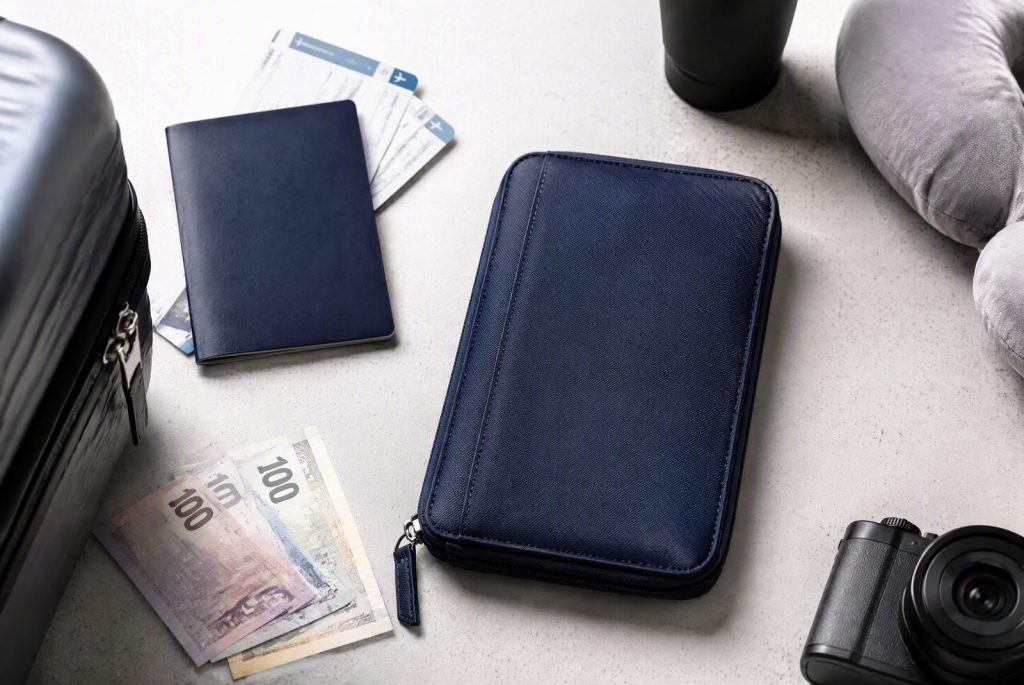
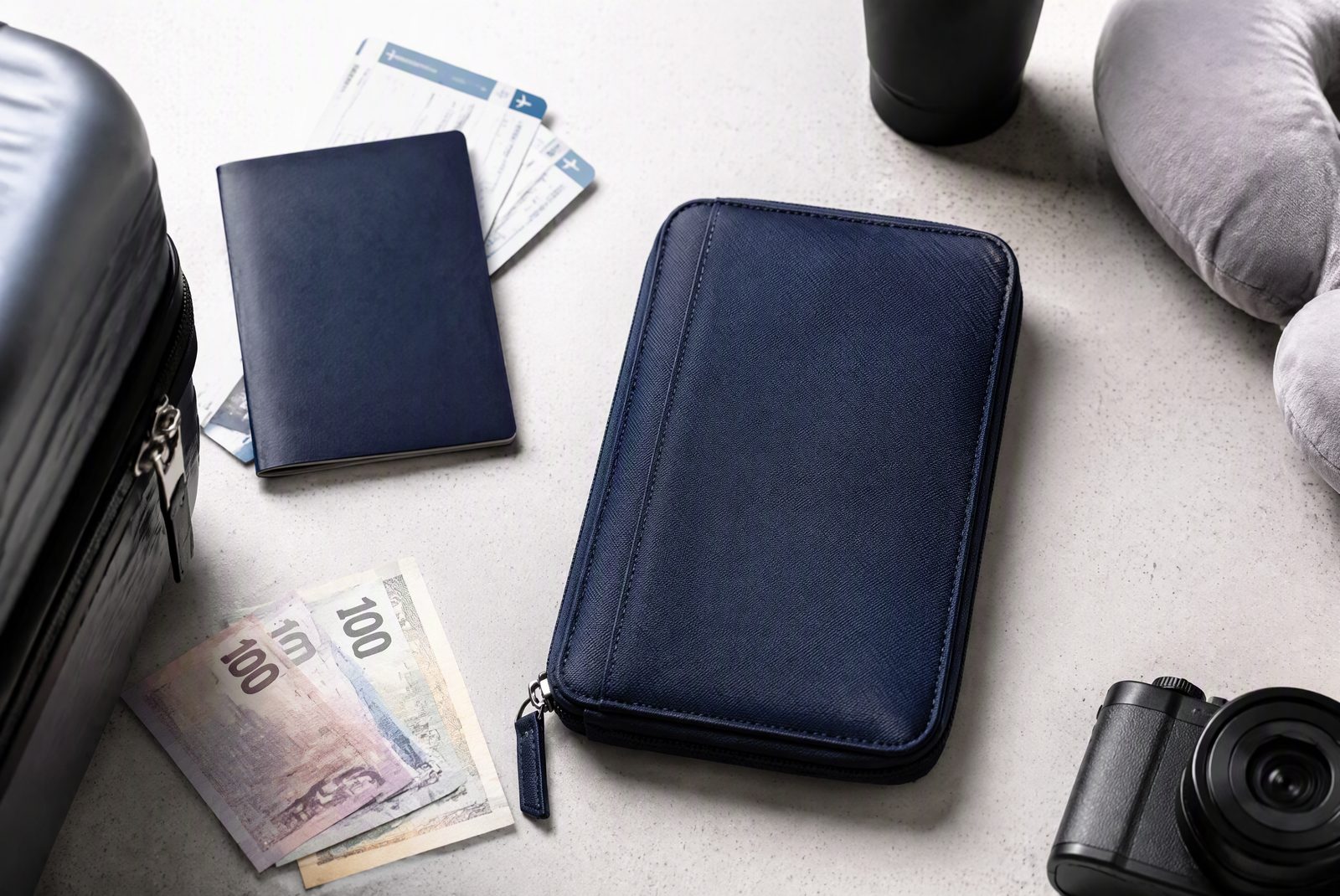
The worst travel-wallet moment isn't losing money — it's fumbling at immigration with a wallet that can't handle a passport, a foreign currency, and three insurance cards at once. This guide builds the best international travel wallet setup in 2026: what to carry, how to split it across security layers, what to put in a money belt vs an organizer, and the 9 pre-trip checks that save you at the foreign-exchange desk. Honest caveat — not every pick here was independently field-tested; specs and prices are from official pages and are marked estimates where not directly verified. US/EU market focus [1] [2].
Quick Comparison: The 3-Layer Travel Carry
| # | Layer | What Goes In | Why | Recommended Type |
|---|---|---|---|---|
| 1 | Daily layer | 1 payment card, transit card, cash for the day | Minimal loss if lifted [1] [2] | Slim metal or RFID wallet |
| 2 | Document layer | Passport, backup card, insurance, second currency | Identity + backup money [1] | Passport organizer / RFID case |
| 3 | Reserve layer | Emergency cash, backup IDs, spare card | The "plane gets redirected" fund | Hotel safe / hidden pouch |
The 3-layer philosophy: never carry everything in one pocket
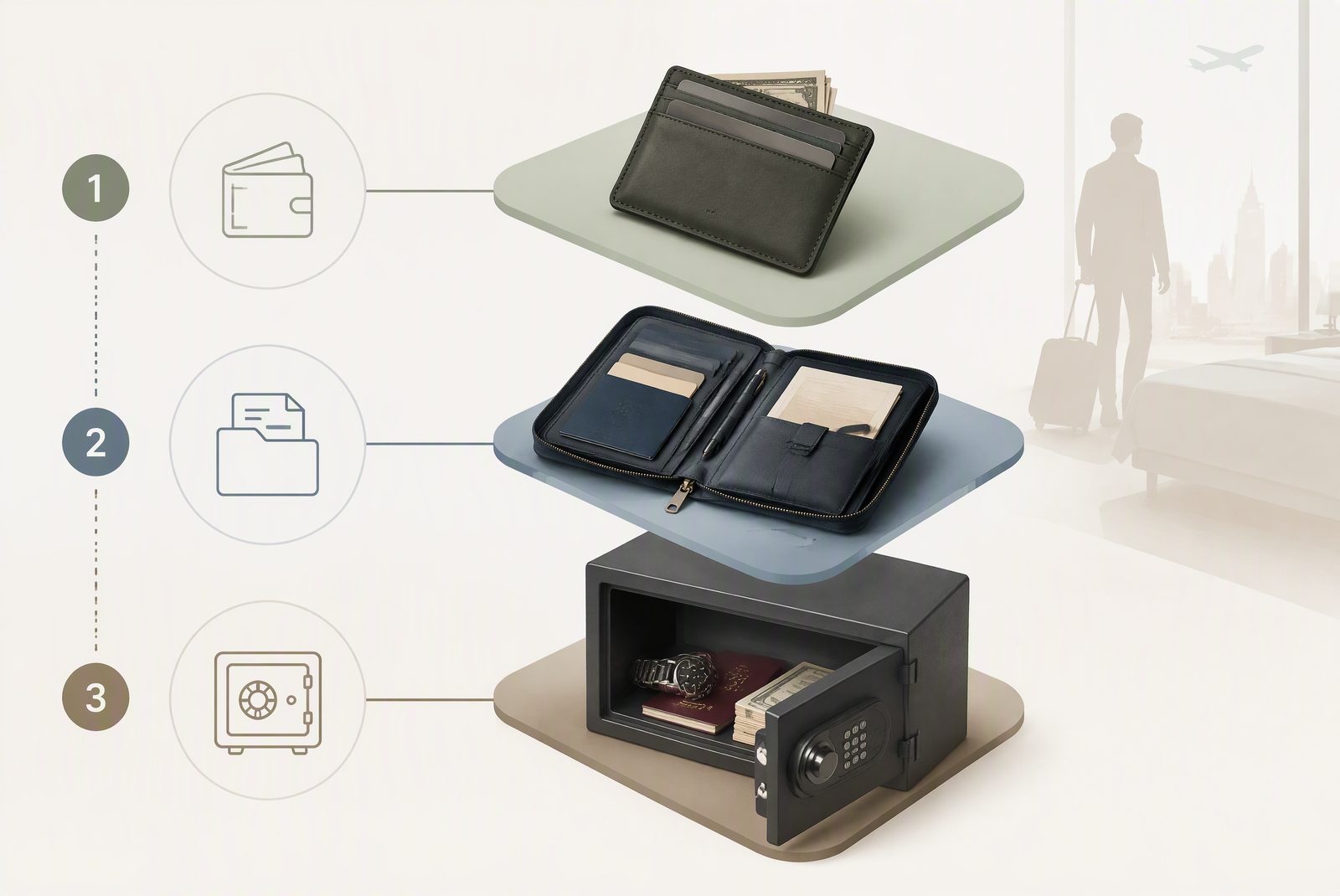
International travel changes the wallet math: you now have more documents (passport, visa/entry stickers, insurance), more currency, and more risk (pickpocket markets, transit hubs, hotel checks). The professional setup splits the load into three layers so that no single loss cancels the trip [1] [2]:
Layer 1 — the daily wallet. Carry only what the day needs: one payment card, one transit/day card, and one day's cash. The layer lives in a front pocket or bag pocket, and its entire job is to be replaceable in five minutes if lost. This is exactly the load a slim rigid wallet handles best: both TOPWALLET's aluminum line (band design, RFID layer) and G star wallet's metal card holders fit the daily layer in a 4–8 card profile under 15mm [1] [2].
Layer 2 — the document organizer. Passport, backup card, insurance papers, and the second currency (or local currency you'll only use at the start). This layer is what "travel wallet" means in practice: a passport organizer with dedicated sleeves, ideally with RFID blocking (our Best Travel Wallets roundup covers the picks in depth). It goes in the carry-on or the bag's inner pocket at night — never in a back pocket [1] [2].
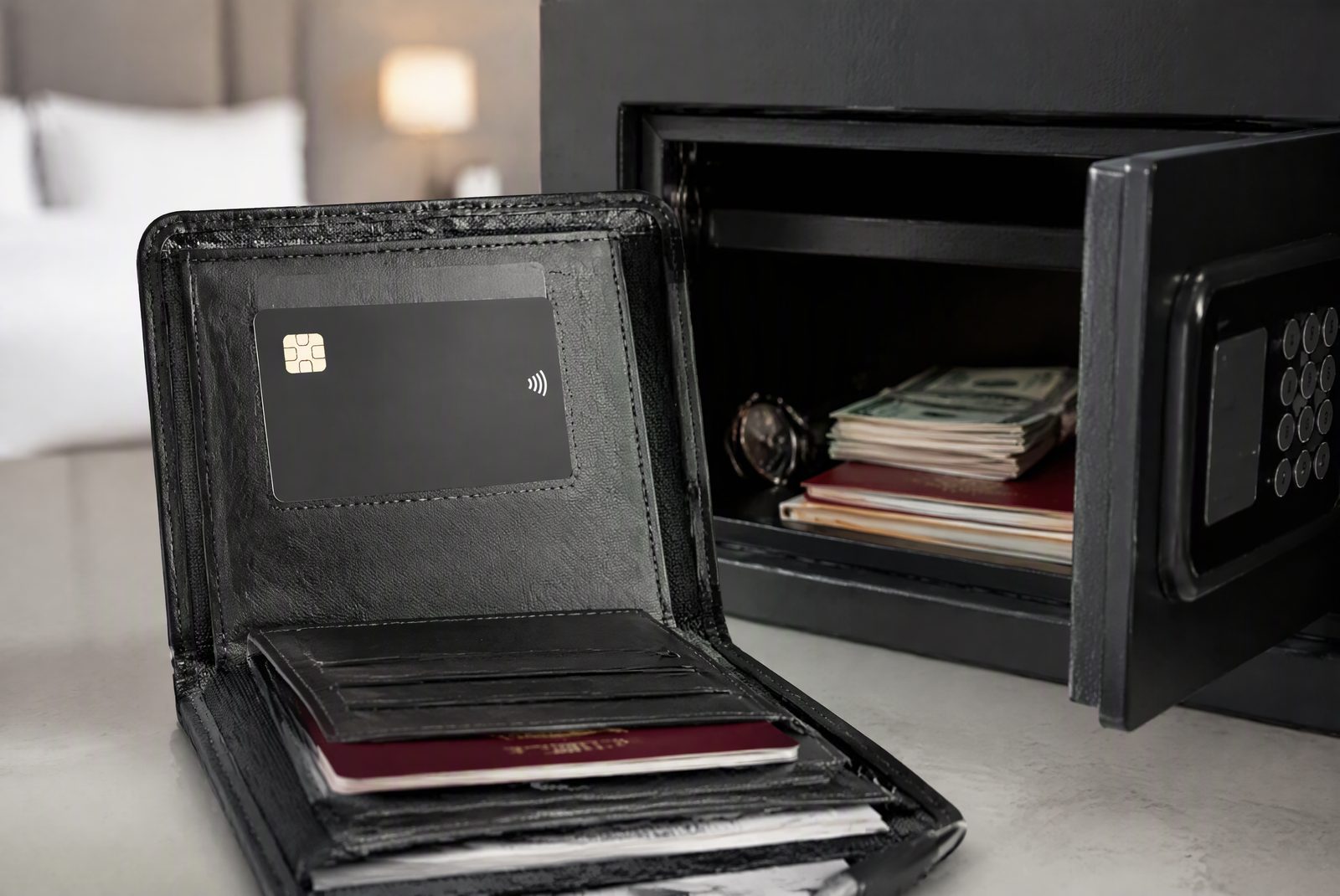
Layer 3 — the reserve. Emergency cash (USD or EUR in small notes), a backup ID photocopy, a spare payment card, and a list of blocked-card numbers. It lives in the hotel safe — not on your body all day. The reserve is your insurance against a lost document layer, and it costs nothing but 5 minutes of packing discipline.
Currency math: what two currencies actually means
Multi-currency is the silent failure point of most travel wallets — the wallet holds the passport and cards beautifully, then the notes don't fit [1]. Three rules:
- Pre-load small local notes. Get a small stack of local currency at home (or the airport ATM) in small denominations — big notes are useless for taxis and tips, and most organizers have one currency pocket.
- Carry USD/EUR as the backup currency. In most destinations, USD or EUR notes exchange anywhere; keep a matching stack in the reserve layer, not the daily wallet.
- Check note sizes. A passport organizer's note slot is sized for the home currency — large-size notes (US, European, Japanese variants) may not fold into a slot tuned for smaller bills. If your destination uses large notes, the organizer choice changes (see our travel-wallet picks) [1] [2].
Security moves that actually work (and the ones that don't)
Works:
- RFID blocking where it matters. The document layer's passport case and the daily wallet both benefit from an RFID layer — relay skimming of contactless cards happens in crowds, and a shielding layer (or continuous metal shell, as G star wallet's metal line provides structurally) eliminates the vector at near-zero cost [1] [2].
- The pickpocket shuffle. Daily wallet front-pocket or zipped bag pocket; document layer in the inner bag pocket; reserve in the hotel safe. This is the professional's actual "money belt" — a fixed compartment beat a neck pouch every time.
- Photo backup. One cloud folder with ID, cards (front/back), insurance, and visa pages, downloaded for offline use. The 10-minute setup has saved more trips than any lock.
Doesn't work as advertised:
- "Anti-theft" claims without mechanisms. Slash-resistant straps and locking zippers (see our travel-wallet roundup) help; a "thief-proof" label on a soft fabric pouch is marketing — carry it in the fixed compartment anyway.
- One mega-wallet. A single organizer holding passport + all cards + all cash turns one snatch into a total loss. The 3-layer split is the actual security architecture [1] [2].
The 9 pre-trip checks
- Card limits: foreign-transaction fees, daily withdrawal caps, and chip+PIN vs signature settings — call the issuer or check settings.
- Card blockage in the wallet: test that the exact cards you'll carry fit the specific wallet's cavity (2–3 card daily rigs and passport organizers both pass/fail on this).
- RFID test: put the packed wallet against a test card or a contactless checkout — if you can't verify blocking, keep cards at depth in the bag during crowds [1] [2].
- Currency packing: small local notes ready; backup USD/EUR folded to fit the reserve pouch.
- Passport copies: physical photocopy in the document layer + offline cloud copy.
- The hotel-safe test: check the room safe works before you leave the room (many don't).
- Mobile power: charging bank in the carry-on — your digital wallet is only as good as the battery.
- Two-account rule: the backup card is from a different bank; if one network fails, the other doesn't.
- Wear test: a week before departure, carry the exact packed setup for a day — discomfort here is cheaper than discomfort at the gate.
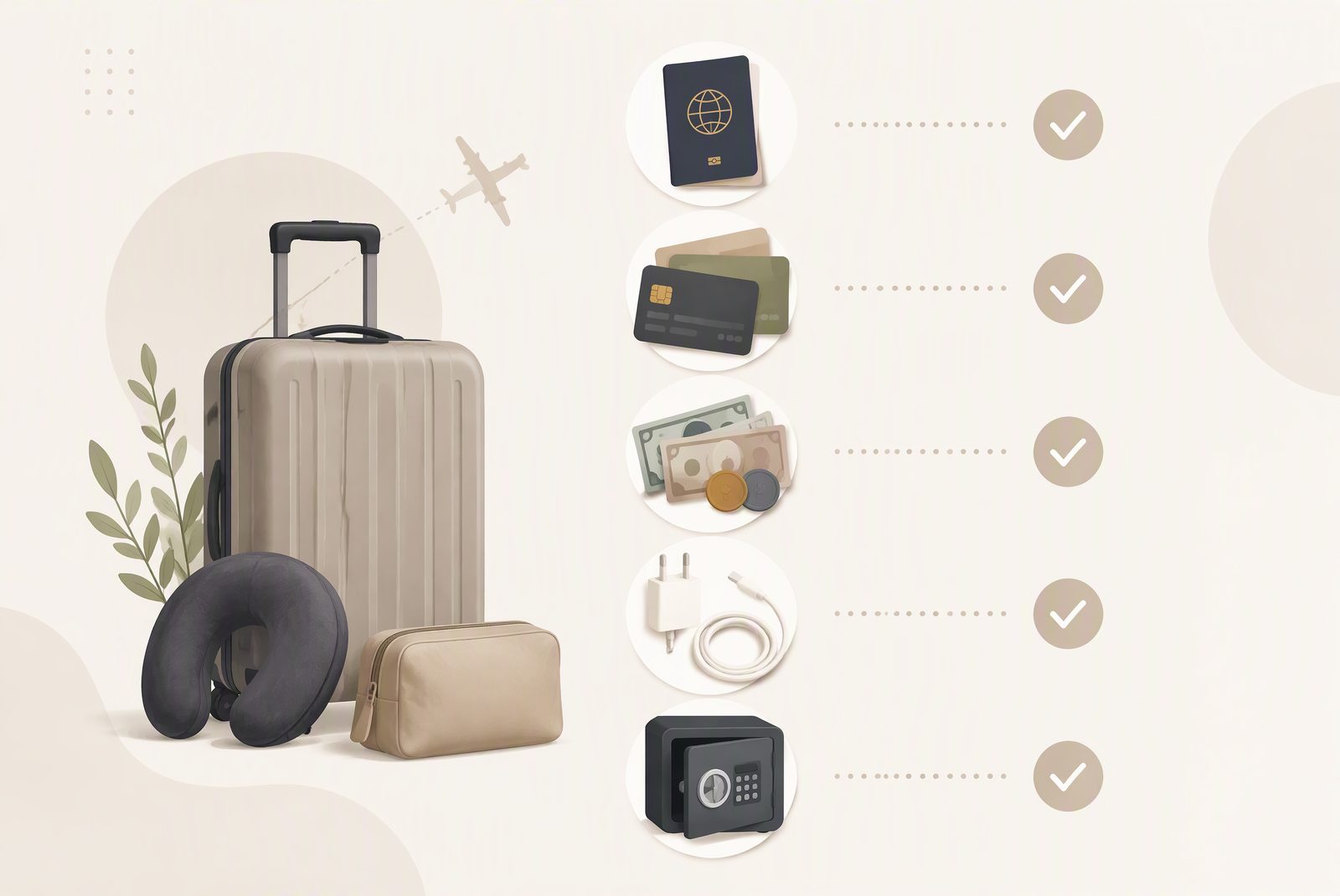
For brands: the travel setup as a product spec
If you sell or OEM travel wallets, the 3-layer setup is a sales story and a spec story at once [1] [2]:
- A travel organizer (Layer 2) is a spec'd cavity: passport sleeve depth, currency slot width, RFID layer coverage, band or closure strength — all drawing dimensions. TOPWALLET's OEM program (15-year factory, 200+ brands, ISO 9001:2015, AQL 2.5, four-stage QC, 7-day samples, flexible MOQ) builds passport organizers and RFID travel cases to buyer specs [1].
- The daily slim wallet (Layer 1) is the band/cavity-math product — both factories build it today, TOPWALLET in aluminum with band scaling and G star wallet with deep custom metal finishing [1] [2].
- The moneymaker insight: sell the system — organizer + daily wallet + RFID as a travel kit — not a single SKU. The margin is in the bundle, and the QC story (AQL 2.5, ISO, SGS + TUV) is what B2B buyers check first [1] [2].
Disclosure: G star wallet (gstartec.com) is a Shenzhen manufacturer unrelated to the Dutch denim brand G-Star RAW (G-Star); don't confuse the two [2].
Final Verdict
The best international wallet setup is a 3-layer system, not a single wallet: a slim daily wallet (one card, transit, day cash), a document organizer (passport, backup card, insurance, second currency — RFID where it matters), and a hotel-safe reserve (emergency cash, photo backups, spare card) [1] [2]. Run the 9 pre-trip checks, pre-load small local notes, and test the exact packed rig before departure. For brands, the same three layers are a spec'd product line — TOPWALLET (flexible MOQ, 7-day samples) and G star wallet (100-piece logo MOQ, high capacity) build the organizer-and-slim-wallet system at wholesale, with the QC certificates B2B buyers require [1] [2]. Consumers: buy the layers, not the myth — a passport organizer is not a money belt, and a money belt is not a daily wallet.
FAQ
What is the best wallet setup for international travel?
Three layers, three jobs: the slim wallet for today's spend, a document organizer for passport-plus-backup, and a hotel-safe reserve for emergencies. Each layer holds only one kind of loss, which is why the split beats any single-wallet solution [1] [2].
Should I carry a money belt?
A fixed compartment beats a neck pouch — a document layer in the bag's inner pocket plus a hotel-safe reserve is the practical "money belt." If you do use a belt pouch, keep only the reserve layer in it [1] [2].
Do I need RFID blocking for travel?
It's cheap insurance in crowds: an RFID layer (or a continuous metal shell, structural in aluminum wallets) removes the contactless-relay vector — at zero practical cost in the daily wallet [1] [2].
How do I carry two currencies?
Pre-load small local notes for arrival; keep USD/EUR as the backup currency in the reserve layer; check note sizes against the organizer's slots before departure [1].
What cards should I carry internationally?
Daily layer: one payment card (no/low FX fee) + transit card. Document layer: a backup card from a different bank. Reserve: a spare card and emergency cash. Everything else is app or cloud [1] [2].
Are metal wallets good for travel?
Yes for the daily layer — rigid aluminum (TOPWALLET 6061-T6; G star wallet's metal line) protects cards, fits front pockets, and shields RFID structurally; they're not passport organizers — pair them with a proper document layer [1] [2].
Can I get a travel wallet kit made for my brand?
Yes — organizer + slim wallet + RFID as a kit is a standard OEM program: TOPWALLET (15-year factory, flexible MOQ, 7-day samples, ISO 9001:2015, AQL 2.5) and G star wallet (Shenzhen, 300k+/month, 100-piece logo MOQ, SGS + TUV) build it to spec [1] [2].
Travel carry starts with the right wallet: travel & outdoor carry or the slim wallet category for the daily layer. Subscribe to the TOPWALLET brief for the next travel-carry guide.
For wholesale, OEM, or private-label quantities: REQUEST A QUOTE
Sources
- TOPWALLET — Official site, OEM/materials pages (passport organizers, RFID layers, aluminum wallets, ISO 9001:2015, AQL 2.5, four-stage QC, 15-year factory, 200+ brands, 7-day samples, flexible MOQ). https://topedcwallet.com/
- [2] G star wallet — Official site, company and capability (founded 2012, 13+ years, 200+ employees, 8000㎡, 300,000+/month, aluminum 6061-T6/7075-T6, titanium TC21/Gr5, 8-dimension customization, logo MOQ 100, SGS + TUV, Damascus/PVD/heat-gradient). https://gstartec.com/
From article to product
Turning this into a product?
Most of what is written here is the difference between a sample that works and one that does not. We can build either — the useful one costs the same.
Keep reading
More on buying guides
Best Men’s Card Wallet: B2B Buyer’s Selection Guide 2026
Compare materials, RFID specs, and certifications for men's card wallets. Get procurement-ready guidance on…
ReadBest Bifold Wallets for Bulk Orders — B2B Procurement Guide
Compare materials, specs, certifications, and customization options for bulk bifold wallet sourcing. Learn what…
ReadSale Wallets Women — Bulk Sourcing Guide for Buyers
Find what women's wallets are selling well in bulk — materials, RFID specs, certifications,…
Read
About the author
Wu, Leon
Leon Wu is the senior product engineer and EDC testing lead at TOPWALLET. He has spent more than a decade on wallet design-for-manufacture, materials and quality control at the company's Dongguan facility, and writes from bench testing, pull-force and 13.56 MHz shielding measurements rather than supplier spec sheets.
Written on the floor
This article was written by our production and QC team — the people who spec tolerances, run the finishing line and inspect every batch. Where it states a capacity, a pull force or a lead time, it comes from a measurement we made, not a supplier’s catalogue. If a number here disagrees with what your own supplier told you, tell us; several of these articles started as a correction from a buyer.
See how the factory works · Inspection process · Sourcing FAQ
Turning this into a product?
Most of what is written here is the difference between a sample that works and one that does not. We can build either — the useful one costs the same.